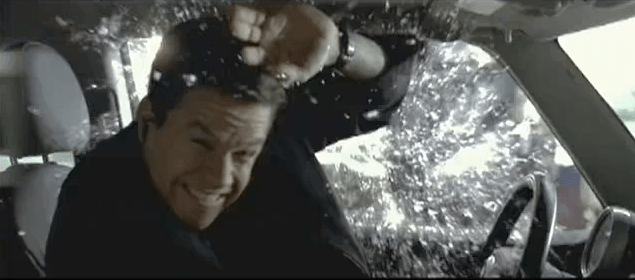
VIDEO ESSAY: MONEYBALL and Ways of Seeing, Presented by The Seventh Art

VIDEO ESSAY: MONEYBALL and Ways of Seeing, Presented by The Seventh Art

EDITOR'S NOTE: Press Play is proud to co-present a new series of video essays produced by The Seventh Art, an independently produced video magazine on cinema. Our initial co-presentation is a lengthy critical video essay on Moneyball, coinciding with the opening week of Major League Baseball. The video is written and edited by Christopher Heron, and narrated by John Boylan. It originally appeared in Issue Two of The Seventh Art published last month.

This excerpt from the video's narration summarizes its main thesis:

"It’s tempting to think of the film as potentially operating in the same way as the tenets of player valuation championed by this new perspective on reading baseball – that it, too, champions looking at things differently. I believe the formal level of the film does gesture towards this and there is one unmistakable moment that illustrates how the film pushes the baseball film in a new direction through the film’s form and story. However… the film misses in its summary of the new philosophy and this misunderstanding of the importance of logic results in moments where the film is operating in a way antithetical to the subject matter. The result is a transitory film, which at once makes interesting strides in how it differentiates itself formally and narratively from the traditional baseball film, while still beholden to some of the unfortunate formal conventions associated with conveying information in an overly didactic way that includes rote documentary bells and whistles."

The Seventh Art describes its work in the online video magazine format on its website:

"The Seventh Art is an independently produced video magazine about cinema with profiles on interesting aspects of the film industry, video essays and in-depth interviews with filmmakers set in casual environments.

The magazine is based equally on the rich history of writing on cinema and French television shows about cinema, such as Cinéastes de notre temps. The video format allows us to seek ways to differentiate The Seventh Art from the former, while building on the latter through the lack of time or content limitations afforded by the internet. Conventional wisdom tells that internet users are looking for extremely short content, but we believe the value of this medium exists in the abolishment of assumptions of how users engage with content. Our sections err on the longer side because they are like a magazine, which you can pick up and put down at your leisure – never requiring that you consume all sections, or even each section in its entirety in one sitting.

With this video magazine format we strive to explore cinema in a manner that is at once accessible and in-depth as we pursue questions of film form/aesthetic that link back with the initial theorization of cinema as the seventh art – regardless of how unfortunately self-justifying this initial discourse had to be. We ask not only what is cinema, but when is cinema, where is cinema, how is cinema and why cinema, especially as media converges on new distribution models that are hopefully reflected in the cross-platform nature of our 'magazine'."

SIMON SAYS: Nanni Moretti’s Cinema of Opposition

SIMON SAYS: Nanni Moretti’s Cinema of Opposition

null

The films of Italian writer/director Nanni Moretti primarily revolve around his own ego and then secondarily around questions of moral responsibility, specifically the extent to which we function in society. Moretti himself plays a recurring role in almost all his films: the empathetic and, as he puts it in Dear Diary (1993), "whimsical" skeptic. In I Am Self Sufficient (1978), a single father struggles to come to terms with the fact that his goofy, sub-Brechtian theater troupe isn't really reaching its minuscule audience. And in The Mass is Over (1985), a priest (also Moretti) leaves his sheltered island home to pursue his vocation but finds himself easily distracted and frequently uninterested in his congregants' problems.

I talked with Moretti with the help of an Italian interpreter last week, and my discussion only confirmed what I already knew after watching his films: Moretti is his own best character. Through his characters' various permutations, Moretti, whose new film We Have a Pope (2011) opens at Manhattan's IFC Center this Friday, often wavers between introspective self-seriousness and manic self-parody. In that way, he's a worthy acolyte of poet and filmmaker Pier Paolo Pasolini, whose death Moretti commemorates in Dear Diary when his character takes a long Vespa ride around and beyond Rome's city limits. In films like The Gospel According to St. Matthew (1964) and Hawks and Sparrows (1973), Pasolini questioned whether it was possible to achieve the kind of utopian ideals that intellectual discourse often strives for. The same is true of Moretti's movies, though he often begins by poking fun at himself.

In his movies, Moretti defines himself in opposition to the institutions he is a part of. Even in The Son's Room (2001), a deceptively tranquil family drama that also won the Palme D'Or, Moretti voices frustration with being part of a unit, in this case a nuclear family. Even before Moretti's character’s son abruptly dies, Moretti's character wonders just how involved he can be in his family's collective life. In The Mass is Over, Moretti's stand-in is just as easily uncomfortable with his calling as a priest. He plays soccer with some local children when he doesn't want to listen to a plaintive parishioner and turns up the radio when another congregant tries to confess to him. Moretti often laments that he can't be there for his film's supporting characters. But that semi-comic resistance is a big part of his cinematic persona's charm.

According to Moretti, there's a problematically narcissistic tendency towards self-pity amongst Italians and Italian movies that he parodically embraced when he made Dear Diary. Moretti described Dear Diary to me as his way of spoofing an ongoing trend in contemporary Italian films, where 40 year-old men act like blameless "victims" and lament about being unable to leave behind their difficult jobs, their needy families or their backwards countries. "This feeling of being a victim and not assuming one’s responsibility is a constant in Italians," Moretti told me. "Dear Diary makes fun of that attitude of feeling like a victim for 40 year-olds, for 20 year-olds, for 60 year-olds—it’s still present. It’s a model [of thinking] that still exists and it’s still a problem with the Italian personality. The fault is always someone else’s. If a match is lost, it’s the fault of the referee."

null

Then again, through his films, Moretti expresses his own personal frustrations with being an atheist (in The Mass is Over and We Have a Pope), a Communist (in I Am Self Sufficient and Moretti's 1989 masterpiece, Red Lob), a lover of theater and films (in I am Self Sufficient and Dear Diary), and someone that often finds himself at odds with everyone around him (all of the above). This is funniest whenever Moretti's character despairs over popular contemporary cinema. In I Am Self Sufficient, Moretti works himself up into a frenzy at the thought that Seven Beauties was, upon its original 1975 theatrical release in Italy, hailed as the start of a new kind of Italian cinema. He goes further in Dear Diary, in which he tracks down one of the Italian critics that gushed over the 1986 American serial killer pic Henry: Portrait of a Serial Killer and brings the poor reviewer to tears by reading his laudatory review back to him. Funnily enough, Moretti is reluctant to talk about Henry. When I tried to make an admittedly long-winded parallel between the "psychological simplicity" of characters in both his films and in Henry, Moretti became comically antsy. Even now, there are some films that you simply can't talk to Moretti about, it seems. 

Still, it's not especially surprising to see Moretti act in real-life as one of his characters might in his movies. When asked about how he was preparing for this year's Cannes Film Festival, where he will lead the jury of the festival's main competition, he instinctively responded with a self-deprecating joke. "I’d like to go to Cannes and buy some suits, lose a kilo or two, learn a little English," Moretti said. "I won't be able do do any of these things. The suits, yes, but the English and the weight, no." Moretti went on to tell me at some length what participating in film festivals as a juror has been like for him. But, just like when he jokingly corrected his interpreter, who initially mistranslated "referee" as "coach," Moretti behaved exactly, well, like himself. He's a self-possessed boy philosopher who carries the weight of his world on his shoulders with unabashed gaiety. A victim, he ain't.

null

Simon Abrams is a New York-based freelance arts critic. His film reviews and features have been featured in The Village Voice, Time Out New York, Slant Magazine, The L Magazine, The New York Press and Time Out Chicago. He currently writes TV criticism for The Onion AV Club and is a contributing writer at the Comics Journal. His writings on film are collected at the blog, Extended Cut.

Motion Studies #12: Everything Is a Remix

Motion Studies #12: Everything Is a Remix

From now through April, the Oberhausen International Short Film Festival will present "Film Studies in Motion", a Web Series curated by Volker Pantenburg and Kevin B. Lee. This series, available on the festival's website and Facebook page, presents weekly selections of analytical video essays on the web, in preparation for Pantenberg and Lee's presentation  "Whatever happened to Bildungsauftrag? – Teaching cinema on TV and the Web", scheduled for April 28 at the festival.

Week Three: Remixes: Parody, Supercut and Mashup

Appropriating and recombining existing footage has been a prime strategy of art and analysis for a long time. With the immense circulation of movies on the web and the accessibility of editing software, this method is no longer restricted to experimental cinema or contemporary art, but has become part of a wider remix culture. This episode gathers recent examples from a wide range of practices. Some of them are driven by critical intentions, some by sheer enthusiasm for iconography and rhythm.

Today's selection:

Everything is a Remix. Part 2: Remix Inc.

Kirby Ferguson (2011)

An exploration of the remix techniques involved in producing films.

View all Motion Studies video selections.

Volker Pantenburg is assistant professor for moving images at the media faculty of the Bauhaus-Universität Weimar. 

Kevin B. Lee is Editor in Chief of IndieWire’s PressPlay Video Blog and contributor to Roger Ebert.com. Follow him on Twitter.

A New Press Play Column: 10/40/70: Melancholia

A New Press Play Column: 10/40/70

This experimental film column began its life at The Rumpus, and we are very excited to see it continue here.  The column freezes the frames of a film at the 10, 40, and 70 minute marks, using these points as the foundations for an essay.null

10 minutes:

The remarkable thing about Melancholia’s early, just married, journey-to-the-castle scenes featuring newlyweds Justine (Kirsten Dunst) and Michael (Alexander Skarsgård) is that, in retrospect, you come to understand that Justine was just play acting. In probably the freshest use and subversion of the Dogme 95 style since The Celebration, these early scenes convey a spontaneity and naturalness (as opposed to the elaborately staged, slow motion prelude) that is highly expressionistic and self-consciously artful. Although the prelude has received the lion’s share of critical attention, it is the scene in and around the limousine, as it maneuvers a sharp turn in the dirt road that leads (presumably from “the Village,” which remains off screen and implied) to the place where Justine’s depression will first express itself. Manuel Alberto Claro, Melancholia’s cinematographer (the film was shot digitally on an Arri Alexa), has said that his “aim is to make images that are in love with the story and not with themselves.”

And so this moment, at the 10 minute mark, we have the tenderness of Justine’s hand on Michael’s cheek, a gesture which seems so genuine but which, in a fine example of delayed decoding, suggests a different meaning, one in which Justine (who will end up having sex, in just a few hours, not with her new husband, but with a young man she is introduced to by her boss at the wedding party). The great English literary historian Ian Watt,, in a study of the works of Joseph Conrad (whose romantic determinism has something in common with von Trier’s), defined delayed decoding as “the forward temporal progression of the mind, as it receives messages from the outside world, with the much slower reflexive process of making out their meaning.” It is, perhaps, only at the end of Melancholia that we remember the early lightness of spirit around the 10-minute mark and wonder: was this all a heroic feat of acting by Justine?null

40 minutes:

Having disappeared from her own wedding reception, Justine is tracked down by her brother-in-law John (Kiefer Sutherland). At the 40-minute mark (which comes during his line “On whether or not we have a deal” from the exchange below), we see him in near silhouette profile, his face filling nearly half the screen:

JOHN: Do you have any idea how much this party cost me? A ballpark figure?

JUSTINE: No, I don’t. Should I?

JOHN: Yes, I think you should. A great deal of money. A huge amount of money. In fact, for most people, an arm and a leg.

JUSTINE: I hope you feel it’s well spent.

JOHN: Well that depends. On whether or not we have a deal.

JUSTINE: A deal?

JOHN: Yes, a deal. That you be happy.

JUSTINE: Yes, of course. Of course we have a deal.

John seems to be speaking not only to Justine here, but to us as well, as the film’s (or any film’s) audience, demanding that we acknowledge “the deal” (the relationship between the film and ourselves) and that we uphold our end of the deal by being “happy.”  In other words, did we get a good “product” for our ticket? (John, as a totalitarian in the realm of feeling, does not instruct Justine merely to act happy, but to be happy.) On one level, John’s instruction is a weird reversal of Jonathan Franzen’s distinction between, in fiction, the Status model and the Contract model. In the Status model, Franzen’s argument goes, the feelings of the average reader simply don’t matter: if readers don’t “get” the book, they are philistines unable to appreciate the complex work of genius. The Contract model, on the other hand, presupposes that “every writer is first a member of a community of readers, and the deepest purpose of reading and writing fiction is to sustain a sense of connectedness, to resist existential loneliness; and so a novel deserves a reader's attention only as long as the author sustains the reader's trust. This is the Contract model. The discourse here is one of pleasure and connection.”

John, from this angle, is von Trier’s sly stand-in for a tyrannical director (“do you have any idea how much this [movie] cost me? A huge amount of money”) who orders his actress [audience?] to “be happy.” And Justine has pretended so well up until now. She flees the set in costume, the ridiculous costume that is her wedding dress, and is cornered in the dark by her dark director.null

70 minutes:

Justine’s sister Claire (Charlotte Gainsbourg) near the beginning of Part 2, on the phone with Claire, who has re-entered the orbit of full-blown depression, a depression which brings her fatally close to Claire. “Hello, darling, how are you?” Claire asks Justine, John hovering and speaking in exasperated whispers (perhaps giving voice to our own “common sense” as viewers, the part of us that resists seeing Justine as the noble, tormented sister who dares to face the truth of extinction, unlike Claire), “Just do as I’ve told you. There’s a taxi down the street, waiting for you. Just open the door and get in. Just get in the cab, darling.” Claire is caught in motion. She passes through frames more swiftly than her sister, as if movement can help her elude the inevitability of the internal catastrophe that is her sister’s fate and her own.

The in-between moment of this frame is un-reckonable, the looming of a vast Disorder.

The Village cannot be reached.

The horses will not cross over.

Nicholas Rombes can be found here. For more entries from the 10/40/70 series, check here.

Motion Studies #11: Razzle Dazzle Part 6: The Takeaway

Motion Studies #11: Razzle Dazzle Part 6: The Takeaway

http://www.movingimagesource.us/flash/mediaplayer.swf?id=129/891

From now through April, the Oberhausen International Short Film Festival will present "Film Studies in Motion", a Web Series curated by Volker Pantenburg and Kevin B. Lee. This series, available on the festival's website and Facebook page, presents weekly selections of analytical video essays on the web, in preparation for Pantenberg and Lee's presentation  "Whatever happened to Bildungsauftrag? – Teaching cinema on TV and the Web", scheduled for April 28 at the festival.

Week Three: Remixes: Parody, Supercut and Mashup

Appropriating and recombining existing footage has been a prime strategy of art and analysis for a long time. With the immense circulation of movies on the web and the accessibility of editing software, this method is no longer restricted to experimental cinema or contemporary art, but has become part of a wider remix culture. This episode gathers recent examples from a wide range of practices. Some of them are driven by critical intentions, some by sheer enthusiasm for iconography and rhythm.

Today's selection:

Razzle Dazzle Part 6: The Takeaway

Aaron Aradillas, Steven Santos, Matt Zoller Seitz (2010)

A stunning montage that tunnels through the media distortion field as depicted in dozens of movie and video clips.

View all Motion Studies video selections.

Volker Pantenburg is assistant professor for moving images at the media faculty of the Bauhaus-Universität Weimar. 

Kevin B. Lee is Editor in Chief of IndieWire’s PressPlay Video Blog and contributor to Roger Ebert.com. Follow him on Twitter.

Breaking the Silence, Sort Of: Whit Stillman’s DAMSELS IN DISTRESS

Breaking the Silence, Sort Of: Whit Stillman’s DAMSELS IN DISTRESS

 null

Wherefore art thou, O Whit Stillman? Though never exactly a blur in motion, the minor auteur managed to generate three hyper-stylized, hyper-talky meditations on manners, morality and money throughout the ‘90s—the last of which, Last Days of Disco, proved his best known and arguably finest. After that, rumors about him licking his wounds in Europe swirled for years, though little was definitively known about his goings-on. Now, after a nearly decade-and-a-half gap in his curriculum vitae, Damsels in Distress marks his first venture back into cinema. And lo! what an odd re-entry it is.

It’s not that this series of vignettes about a year at Seven Oaks University, a fictional liberal arts college, is terrible. Nor does it mark much of a departure in form or function for Stillman, who’s always liked to focus on old-fogeyish young people. It’s just that, despite its many clever bits and terrific cast, including mumblecore siren Greta Gerwig, this film sounds a wan echo of Stillman’s earlier work. Intentionally or not, he has fashioned here an auto-valentine to his already-established tropes (a murky mentor and her ingénue; the watered-down Kool-Aid of an elite subculture; the questionable merits of nostalgia; the healing power of dance), and it comes with less certitude and many more protestations than does his previous work.

Take the film’s opening minutes, in which 50s-style elevator music swells while big-co-ed-on-campus Violet (Gerwig), flanked by her lackeys Heather and Rose (all three clad in floral prints, lest we not get the flowergirl motif), approaches transfer student Lily (Crazy Stupid Love’s rubbery faced Analeigh Tipton).  “You were unhappy at your old school,” Violet says. “Would you prefer our guidance or to sink or swim on your own?” Predictably, Lily opts for the former, and she preens and then bristles under their tutelage as she stumbles through the university’s rarified ecosystem of body-odor-afflicted education majors, aggressively moronic fraternity brothers, tap-dancing depressives, anal-sex-fixated foreign grad students, and, yes, damsels in distress.

Like all of Stillman’s characters, the girls and boys of this world speak in a halting schoolmarm-ese (no contractions, no cussing, no colloquialisms) that betrays the vehemence of their fastidiously parsed paragraphs. On topics ranging from the acceptable plural of doofus (doofi? doofuses?) to the human tendency to seek those cooler than ourselves, Violet and her peers deliver speeches and aphorisms with strangely ineffective hand gestures and a minimum of flair. Says eighth-year ed student Fred (Adam Brody, whose apparent nose job reinforces his blank, tabula rasa demeanor): “I do romanticize the past. It’s gone, so we may as well romanticize it.” Says Lily: “We value idiosyncrasies and uniqueness but really such people are pains in the asses.”

As you watch, you get the sense that Stillman has been chomping at the bit for years to serve up these unique, idiosyncratic, pain-in-the-ass gems, and so he wishes them as unadulterated as possible.  To that end, these kids are oddly indistinguishable, although each bears one branding characteristic. Rose is haughty (and black! With this film, Stillman has finally broken his racial barrier); Heather is cheerily dimwitted; Lily is a reluctant ingénue; and Violet, who, as Stillman’s most overt stand-in, is also most fully fleshed out, prevails as an earnestly flawed Jane Austen-style heroine. Say what you will about Stillman, he does know his Austen.

The girls’ stances and passions, if they have them, seem to spring from nowhere and just as quickly evaporate, while their many beaus prove interchangeable—liars or dolts, all of them. Even such marginal characters as campus policemen and waitresses utter Whitticisms in the writer-director’s patented cadences. Obviously cats like David Mamet feature a similar homogeneity in tone, but Mamet Stillman is not. And I don’t even like Mamet.

The problem is that since all these kids are so blank, only Stillman, as the narrative voice, is in on his many jokes (“I fled to a Hotel 4, even more economical than a Hotel 6,” states Violet flatly in an account of post-breakup despair.) It’s a pat-himself-on-the-back device that quickly rings hollow: Characters as cogs.  The fact that, as a technician, he doesn’t produce much to write home about here doesn’t help. Pastel and bracingly bright, the film often resembles a Lifetime TV movie—sun-splashed is the name of the game—and its pacing is as ungainly and stiff-legged as these young people’s gaits. (Sharp editing proved a saving grace in his earlier trifecta.)

Near the end, Damsels abruptly transforms into a paean to Fred Astaire, complete with a few inexpert ensemble musical dance numbers. At that point, not uncharmed, I threw up my hands. Just like the paper-thin storylines of Astaire’s movies always functioned as mere filler between his dance numbers, plot and character are apparently mere conduits for Stillman’s signature shouts and murmurs. Lest this connection not be fully drawn, one morose Seven Oaks student even insists upon being referred to as Freak Astaire. Fuck subtext, Stillman seems to be saying. Whit Disney world is my oyster, and herein lie my pearls.

As I left the screening, I described myself to a colleague as feeling “vexed.” “Now you’re talking like the movie,” he replied drily and, indeed (even in the paragraphs above), I’ve fallen prey to its sticky vernacular. Despite myself, I have to admit that I’ll probably be happily charmed by this world for years to come—albeit most likely, and most preferably, in 15-minute snatches on 2 AM cable. Just the gems, ma’am.

Lisa Rosman writes the indieWire film blog New Deal Sally and has reviewed film for Marie Claire, Time Out New York, Salon.com, LA Weekly, Us Weekly, Premiere and Flavorpill.com, where she was film editor for five years. She has also commentated for the Oxygen Channel, TNT, the IFC and NY1. You can follow Lisa on twitter here.

VIDEO ESSAY: 2001/The Dawn of Blood

VIDEO ESSAY: 2001/The Dawn of Blood

Paul Thomas Anderson is a director who wears his cinematic influences on his sleeve. From sprawling dramas that echo Robert Altman’s work (Short Cuts, Nashville) to the signature camera movements found in Martin Scorsese movies (most notably Scorsese’s Copacabana Nightclub tracking shot in Goodfellas, which Anderson employs during a television studio walkthrough in Magnolia), the filmography of Paul Thomas Anderson is the direct result of passionate cinephilia merged with mastery in filmmaking. And Anderson’s last film There Will Be Bloodis the kind of staggering, challenging and singular piece of cinema that launches a director into the stratosphere, to be hailed as an “auteur.”

In Blood, it’s the influential work of Stanley Kubrick’s 2001: A Space Odyssey that permeates the body of the film. To say that There Will Be Bloodis only about the dawn of twentieth century capitalism is about as valid as describing 2001: A Space Odyssey as merely an astronaut’s adventure tale. Consider: Anderson’s masterpiece opens with a wordless, quietly haunting sequence, which in many ways mirrors “The Dawn of Man” section in 2001. Next, both films heavily rely on unnerving, sweeping pieces of music to drive key scenes; in 2001, György Ligeti’s “Requiem” brings malice to the mysterious black monolith, while Jonny Greenwood’s disconcerting Blood score suggests a volatile turn of the century American frontier. Finally, if one considers the framing of certain shots—apes around a black monolith, workers around an oil derrick—and the implications they carry, it’s obvious that Anderson is channeling Kubrick’s powerful visualization on the primordial nature of humanity, amidst the frail, dangerous act of discovery.

Nelson Carvajal is an independent digital filmmaker, writer and content creator based out of Chicago, Illinois. His digital short films usually contain appropriated content and have screened at such venues as the London Underground Film Festival. Carvajal runs a blog called FREE CINEMA NOW which boasts the tagline: "Liberating Independent Film And Video From A Prehistoric Value System."

“Critical Film Studies”: The Hazards of Reference

“Critical Film Studies”: The Hazards of Reference

null

“Critical Film Studies,” the 19th episode of the 2nd season of Community, was probably pretty confusing to most fans of the series when it aired in the Spring of 2011. Heavily promoted by NBC as the show’s full-scale Pulp Fiction parody, the episode turned out instead to be a lengthy and rather muted (by the show’s standards) homage to Louis Malle’s My Dinner With Andre, with only a few Tarantino sight gags tucked neatly away in the periphery. People were understandably disappointed: Community appeared to have traded a spoof of one of the most enduringly popular and widely acclaimed films of the last several decades in a for a more affectionate and high-minded take on a film few in the show’s key demo knew anything at all about. It was, in a sense, an intellectual bait and switch: they promised something familiar but delivered a reference that would prove more substantive, both intellectually and emotionally. 

Though My Dinner With Andre was the toast of the upper-crust New York literati when it was released in 1981, it is now widely regarded by people who haven’t seen it as a movie they’d rather not, ever, lest they become the sort of snobbish intellectuals who regard a film about two guys talking as “interesting” rather than “unendurable”, which they assume it must be. Its reputation has trickled down through pop culture for almost three decades now, and its high-concept setup, of course, has been prime parody real estate for years. One of the advantages of the format is that your audience doesn’t need to be familiar with the film as a whole for the reference click: the novelty lies in recognizing the basic structure–two men meet for dinner and, over the course of an extended discussion or argument, learn more about each other and about themselves–and an un-clever title riff along the lines of “My x With y”. Everything else is context-specific and just sort of writes itself.

A My Dinner With Andre parody is not in and of itself particularly special. Part of the problem is that the format has become a bit of a cliché, but a bigger issue is that lifting the premise of My Dinner With Andre wholesale somehow devalues its content and execution, or at least contributes to the pervading misconception that the film is boring and stuffy and worth remembering only for its setup. My Dinner With Andre is by no means a perfect film, but I’m still immensely fond of it, and it means a lot to me personally for reasons that “Critical Film Studies,” in its own modest way, articulates surprisingly well. It might sound trite (or too typical of a former film student), but I honestly believe that watching My Dinner With Andre for the first time several years ago was something of a life-changing experience, and that it made me, to some extent, a better person.

Before Andre, I felt depleted and vaguely adrift, remote from my friends and from myself. I was living in a run-down student bungalow with four disparate twentysomethings, struggling to care enough about the fifth year of my undergraduate degree to prevent the need for a sixth, and I was one Bukowski book away from drinking myself into utterly cliched oblivion. It was all admittedly pretty juvenile. One night, one of my roommates lent me a copy of My Dinner With Andre, a movie he thought I might enjoy, and, in a bid to avoid schoolwork for a few hours more, I decided to give it a shot. It was a revelation. I mean that: it was though a new world of emotional and intellectual depth had been revealed to me, a world of real conversations and connections and living. My life seemed childish and empty by comparison. Why wasn’t I dining with old friends, sharing a worldview and learning to see things from another person’s perspective? Why was I so reliant on simplistic humor, and on the pop culture that had saturated my life? I suddenly didn’t want to drink too much and quote “Pulp Fiction” and act like a jerk–that wasn’t living, it was acting, and it wasn’t the life of the person I wanted to be.

The next night I brought My Dinner With Andre over to the apartment of some close friends to watch it a second time with them, and then I watched it a third time a week later with another friend. I felt I had to share this feeling with other people. Naturally, I gave into the impulse to call friends from whom I believed I’d drifted apart, and I began dining and talking constantly. It was a strange experience: I was rejecting pop culture in favor of what I perceived to be unmediated experience, but it was a work from pop culture that had inspired me to do it. I didn’t want to rely on movie tropes and references, and yet by imitating Andre I was living an elaborate reference out. I knew this personal sea change had been good for me, but I couldn’t help but worry that my route to being what I felt was a better person was just as steeped in pop culture and cliche as the life I was trying to leave behind.

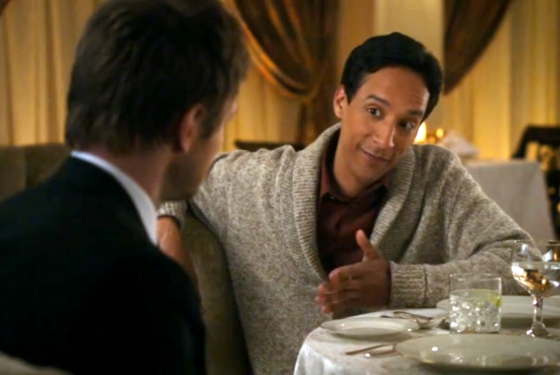
"Critical Film Studies," it turns out, is about exactly this sort of double-bind, about the implications of attempting to reject the influence of pop culture and about the effect of My Dinner With Andre specifically. The episode begins precisely as it needs to: Abed, in the Andre Gregory role, has invited Jeff, his better-looking Wallace Shawn, to meet him for dinner at an uncharacteristically lavish restaurant, which Jeff describes as in an Andre-style voiceover as something he’s not been looking forward to. Abed arrives in a chunky grey sweater, channeling Gregory’s jovial grin, but because Community imitates the forms and conventions of pop culture touchstones as often as its characters explicitly refer to them, it isn’t quite clear if the show is sending up My Dinner With Andre or if Abed is setting it up to look that way deliberately. This ambiguity serves a narrative purpose as well as a thematic one: when a waiter inadvertently brings up My Dinner With Andre and Abed quickly silences him, Jeff begins to realize that he’s been acting out a movie reference without even being aware of it, and a lack of familiarity with the plot and dialogue of My Dinner With Andre is what allows Jeff, as well as the audience, to be fooled by the gag. The writers know the reference will be as much a surprise to most of the show’s viewers as it is to Jeff, and they’re more than okay with that fact–if the episode is in part about a desire to return a state of pop culture innocence, ignorant of references and ready for real conversation, it makes sense that most people watching wouldn’t catch the principal one.

The audience’s assumed lack of awareness is important because it corresponds directly with what Abed’s claims to be afflicted by, which is that his obsession with pop culture has been preventing him from truly living his life and connecting with other people. The point of the dinner, he tells Jeff, is for the two of them to have a meaningful conversation without resorting to shallow pop culture references, which is, of course, what watching My Dinner With Andre has inspired so many of us to go out and do. The problem with following through yourself is that attempting to bond with a friend without pop culture references under the influence of Andre is itself a reference to pop culture, even if it’s a piece of pop culture that’s considered stuffy and obscure. Can a movie inspire you to reject the pervasive influence of other movies? Can a fictional connection drive you to seek out a real one?

Over the course of the dinner, Abed explains a revelation he had while appearing as an extra on the set of ABC’s Cougar Town. As the director calls “action,” Abed realizes that it would be impossible for any character in the fictional world of Cougar Town, even an extra with no lines, to be familiar with Cougar Town the series, because obviously the fiction doesn’t exist in the world of that fiction itself. In order to satisfy his need for authenticity, Abed imagines a fictional persona for himself to pretend to be during his walk-on appearance, but he becomes severely distressed when it occurs to him that this character might have been living a richer and deeper life than his own. It’s the central conceit of almost all fiction: the characters live, actively and with purpose, rather than watching, passively and with disinterest. Like the character in David Foster Wallace’s The Pale King who has an awakening when he hears “you are watching As The World Turns” on TV, Abed is made suddenly and intensely aware of his own relationship to the pop culture he’s been consuming, and being on the passive side is too much to handle. It’s a problem we can all relate to, with one key difference: Abed himself is a character on TV, and we’re watching him discuss his Cougar Town crisis on a show called Community. Fans should be used to the meta impulse on Community, but “Critical Film Studies” takes it a step further–here it’s self-critical.

I sometimes worry about consuming too much pop culture, as I imagine many of us do. Nobody wants to feel shallow, and there’s a constant feeling of obligation to read or watch things that are more serious, or that have more depth. We worry about being the passive spectator, and about coming to be defined by that passivity. For me, “Critical Film Studies” deals with exactly that kind of anxiety, and with how the need to live and connect sometimes seems impossible to take on. There’s no such thing as a totally unmediated dinner, and there can never be a culture-free conversation; even talking openly and honestly with a close friend over dinner becomes a reference to something. Abed tries to reject his dependence on tropes and quotes, hoping instead to have depth, but doing so ultimately proves shallow. Jeff gets indignant when he finds out that’s his been tricked into opening up, but he ultimately learns something. The point isn’t that connection is impossible or that pop culture is toxic, but that we can still have the former while totally subsumed by the latter: sometimes connections cut through all the movie references and surprise us. What “Critical Film Studies” made me realize is that it’s okay to feel weighed down by pop culture, and that’s it natural to struggle fruitlessly against it. It made me realize that the change afforded me by watching My Dinner With Andre could be both shallow and deep, that being inspired by it could be both an elaborate reference and the route to true connections. “It has something to do with living,” Andre says to Wally–and that’s a reference I don’t mind knowingly making.

Calum Marsh is a frequent contributor to Slant Magazine.

TRAILER MIX: House at the End of the Street

TRAILER MIX: House at the End of the Street

null

The trailer for House at the End of the Street goes all Memento on its viewers from the start, beginning at what appears to be the film's climactic chase scene, then winding back, in snippets, to a nasty origin story. Thanks to intermittent rewinds, we can gather that the clip unfolds in eight separate sections, each one stepping a tad further into the past. Though presumably saying little about the film that's represented, this is a rather novel approach to trailer construction, and it's safe to assume that the one-take conceit of similar spookfest Silent House had a certain influence. The trailer demands that you pay attention to its imagery, which is more than can be said of most previews.

When we first see Jennifer Lawrence (whose other film is bound to make this one an instant hit), she's fretting up a storm and climbing into a parked car, where a bottle of chloroform foreshadows her heroine's retaliation. Then we venture back, with the aid of a reversing clock, to see her witness the emergence of a creepy girl, and back again to see her mother (Elisabeth Shue) checking in on her whereabouts. So, that's three sections down, at which point it's clear that her boyfriend (Max Thieriot) is linked to the movie's hauntings. “I want you to leave her alone,” he says of Lawrence's screamer, speaking, we gather, to the ghastly little girl.

It's a bad sign that House at the End of the Street opted to dub its antagonist “Carrie Ann,” a blatant echoing of Carol Anne from Poltergeist. Modern horror ought to do all it can to seem unique, and this doesn't seem the sort of project that will thrive on winking nostalgia. Yet another step backwards in time takes us to a pool party, where Shue and Lawrence's neighborhood newbies are exposed to the local lore, about how Carrie Ann murdered her family in the house we've seen earlier. “That house is the reason we can afford to rent this house,” Shue's concerned mom explains, exposing the family as both relatably un-rich and punishably opportunistic.

It's not every day you get a trailer that delivers its content in reverse, and given the dearth of ingenuity that plagues this micro-medium, any deviation is generally quite welcome. But no one should be fooled by a couple of nifty tricks: beneath the surface, House at the End of the Street still looks as generic as the next girl-on-the-run ghost story.

Finally, the trailer retraces the initial dastardly deed, wherein young Carrie Ann clearly massacred her parents, only to be trapped in her house to haunt it ever more. The always-ominous dripping faucet ushers in the fateful scene, and the (sadly) obligatory parting line has Shue's character assuring her daughter that the home “is going to be really good.” The title then appears, only to disperse into an acronym that makes a handy hashtag (#HATES), revealing a glaring sales priority that trumps strength of form.

R. Kurt Osenlund is the Managing Editor of Slant Magazine's The House Next Door, as well as a film critic & contributor for Slant, South Philly Review, Film Experience, Cineaste, Fandor, ICON, and many other publications.

Motion Studies #10: Pure

Motion Studies #10: Pure

From now through April, the Oberhausen International Short Film Festival will present "Film Studies in Motion", a Web Series curated by Volker Pantenburg and Kevin B. Lee. This series, available on the festival's website and Facebook page, presents weekly selections of analytical video essays on the web, in preparation for Pantenberg and Lee's presentation  "Whatever happened to Bildungsauftrag? – Teaching cinema on TV and the Web", scheduled for April 28 at the festival.

Week Three: Remixes: Parody, Supercut and Mashup

Appropriating and recombining existing footage has been a prime strategy of art and analysis for a long time. With the immense circulation of movies on the web and the accessibility of editing software, this method is no longer restricted to experimental cinema or contemporary art, but has become part of a wider remix culture. This episode gathers recent examples from a wide range of practices. Some of them are driven by critical intentions, some by sheer enthusiasm for iconography and rhythm.

Today's selection:

Pure

Jacob Bricca (2009)

"Jacob Bricca's Pure (2008)—which played at a number of film festivals, including the Berlinale—groups together a slew of visual cues from action movies, creating a kind of auto-critical futurist paean to maximum velocity. The shots he finds are so similar that the effect is often like watching the same exact thing from multiple angles." – Tom McCormack, Moving Image Source

View all Motion Studies video selections.

Volker Pantenburg is assistant professor for moving images at the media faculty of the Bauhaus-Universität Weimar. 

Kevin B. Lee is Editor in Chief of IndieWire’s PressPlay Video Blog and contributor to Roger Ebert.com. Follow him on Twitter.