VIDEO ESSAY: It’s a MAD World – a MAD MEN Video Tribute

VIDEO ESSAY: It’s a MAD World – a MAD MEN Video Tribute

Part of the Mad Men Moments Video Essay Series

Serena Bramble, who has already created several dazzling montage tributes to film noir, Powell and Pressburger, and Steven Spielberg, among others, unveils her latest work, weaving dozens upon dozens of clips into a jazz-like succession of motifs, mapping out the resplendent world of Mad Men

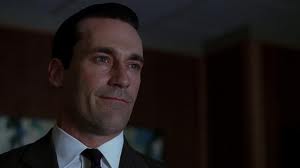
Bramble's video includes an excerpt of Don Draper reading Frank O'Hara's poem "Mayakovsky" from the premiere episode of Season Two. Writer David Ehrenstein takes that scene as the starting point for the following meditation on the poem, its author the poet Frank O'Hara, and their significance to the series:

Don Draper reading Frank O’Hara’s poem "Mayakovsky" was one of the most startling yet oddly right cultural cross-references in all of Mad Men. Don is of course extremely intelligent and very much aware of the arts — but hardly what anyone would call an intellectual. His romantic exploits have brought him in passing contact with late 50’s /early 60’s New York bohemia (jazz clubs, loft parties) but he’s never evidenced a desire to be part of them. His chance encounter with an O’Hara poem is part and parcel of his magpie-like instinct to gather up information for possible future use. Had Don actually run into Frank O’Hara it’s doubtful he’d have anything to say to him. O’Hara, of course, would have been sure to put the make on a Total Babe like John Hamm.

Frank O’Hara (1926-1966) lived a life that in some ways mirrors that of the Mad Men characters. He went to Harvard (Edward Gorey was his roommate) studied music, but became profoundly interested in poetry — especially avant-garde French and Russian poets Stephane Mallarme, Arthur Rimbaud, Pierre Reverdy, Boris Pasternak and Vladimir Mayakovsky. He got a job working in the card shop at the Museum of Modern Art and in a very short space of time worked his way up to being one of the Museum’s most important curators. This Peggy-like rise was aided by the fact that he became personal friends with the Abstract Expressionists the Museum was collecting. His essays reveal him to be one of their most vocal and direct champions. It wasn’t lofty and “theoretical” with O’Hara at all. A prodigious imbiber, the fact that he could drink any abstract expressionist in the house under the table was why this very openly gay man with — in his words — “the voice of as sissy truck driver” doubtless impressed this decidedly straight and very macho crew. Here’s the greatest love poem ever written (IMO).

O’Hara wrote constantly. His powers of inspiration never waned. The poem he reads above is about Vincent Warren — a dancer in the chorus of the New York City Ballet. O’Hara had been invited by John Ashbery to accompany him on a State Department sponsored Cultural Tour of Europe (hence the cities listed in the poem). The minute he said “Yes” to the trip was the same minute he discovered that he was in love with Vincent Warren. O’Hara’s open celebration of joy in his sexual and romantic self is something Mad Men’s Sal couldn’t possibly bring himself to so much as dream of. 

Frank O’Hara died in 1966 as a result of injursies sustained when he was hit by a slow-moving dune buggy on Fire Island coming back in the wee smalls from a party. He was in mid-conversation with Babe du Jour J.J. Mitchell, when J.J. suddenly realized Frank had stopped talking. He looked back and there Frank was on the sand. He was flown back by helicopter to New York where he died in hospital while trying to comfort his distraught friends. His last words were to Willem de Kooning. “Oh Bill, you’ve come by. How nice.”

It would be nice if Mad Men makes mention of it when the time comes in the story arc.

Serena Bramble is a film editor currently pursuing a Bachelor's degree in Teledramatic Arts and Technology from Cal State Monterey Bay. In addition to editing, she also writes on her blog Brief Encounters of the Cinematic Kind.

David Ehrenstein is a film critic and writer whose books include Open Secret: Gay Hollywood 1928-2000 and The Scorsese Picture: The Art and Life of Martin Scorsese. He lives in Los Angeles.

VIDEO ESSAY – MAD MEN Moments: The Carousel

VIDEO ESSAY – MAD MEN Moments: The Carousel

Part of the Mad Men Moments Video Essay Series

Click here to watch this video on your mobile device.

This video is inspired by the famous "Carousel" presentation in the finale of season one of Mad Men. In this scene, Don Draper uses idyllic images of his family to sell Kodak's new slide projector as a "time machine" taking us from one perfect moment of our life to the next.  This video re-imagines the scene as a time machine journey through the life of Don Draper, with moments that are anything but picture-perfect. It asks the question that has run through the entire series: "Who Is Don Draper?" and explores the gaping chasm between the man he has been and the man he wishes to be.

The original sequence is embedded below, and is further explored by Tommaso Tocci in the following essay.

The 'carousel scene' was one of the moments that helped define the first season of Mad Men. The series had made a strong first impression on its 2007 debut and had consistently built on that over the course of the twelve episodes before 'The Wheel'. Many of the seasonal arcs had already reached their conclusion in the penultimate episode, 'Nixon vs. Kennedy', leaving this one as a sort of offbeat climax covering emotional grounds.

nullThe season finale finds creative director Don Draper in charge of a pitch to Kodak executives for the marketing of their new projector. The client request is to work the technology angle, emphasizing the automated capabilities of the device.

Except that Don Draper doesn't really trust technology, or even the future. Earlier in the season (ep. 1.2), he dismissed a space-themed campaign because 'some people think of the future and it upsets them'. As much as he doesn’t like thinking of himself – and his agency – as 'traditional' (ep. 1.6), he always goes searching for his ideas in the past, because that’s where the emotions he’s drawn to really are.

'Technology is a glittering lure, but there’s the rare occasion when the public can be engaged on a level beyond flash, if they have a sentimental bond with the product'.

When we met him in the pilot, we took his boyish smile at face value. We could believe his free-spirited nature, his philosophy that what we call love was invented by guys like him – to sell nylons. He lives like there’s no tomorrow because there isn’t one. It’s only at the end of the episode that we learn how heavily Don had invested on an idealized, prefabricated version of tomorrow (and love). We discover that there's very little we can take at face value in this show. After thirteen episodes spent trying to stabilize this fracture, it's clear that something has gone wrong in the process. By the time he gets to work on the Kodak pitch, Mr. Draper is no longer a happy customer.

The carefully crafted ‘love-doesn’t-exist’ fiction is consistent with the way he approached his first challenge of the series: the creation of a new slogan for Lucky Strike. Claiming that advertising is only based on 'happiness' ('a billboard screaming with reassurance that whatever you’re doing, it’s okay. You are okay' – it’s worth noting that Jon Hamm was instructed to say the line as if he was telling that to himself), in a fit of genius he abandons any thoughts of complexity and just focuses on immediate pleasure: 'It’s toasted'. Don’s discomfort throughout the episode is mirrored by the setting of the scene when he walks into the meeting. He sits alongside Roger in a fully lit, unforgiving room, desperately scrambling for inspiration. He’s just scratching the surface of himself, like a patient on the first session with his therapist.

null

Thirteen episodes later, with an extremely messier but more acute self-awareness, he owns the Kodak pitch. He's the man behind the curtain, now. He's getting closer to the darkness that's being eating at him while simultaneously distancing himself from it by literally projecting it on the wall. Look how he disappears in the dark background of the room, firmly in charge of the narrative. Confident, composed, assured while he exposes himself. He is a man with a plan, and his plan is so effective because it feeds off everything that’s happened to him in 13 episodes.

Over the course of the season, we’ve seen flashbacks of a forgotten childhood emerge through the cracks of a crumbling conscience. As in a twisted psychoanalytical process, Don refuses to acknowledge his past on a conscious level, but he allows it to re-surface in his work. Indeed, it’s the only place he ever goes to – his secret emotional goldmine.

'A deeper bond with the product. Nostalgia. It's delicate, but potent'.

The story he tells about his first job, 'in-house at a fur company' with 'this old pro copywriter' Teddy, is a convenient half-truth (we’ll find out only in episode 4.6), just like the Greek etymology of 'nostalgia' that he uses as a gateway for his carousel allegory: 'nostalgia' is not 'the pain from an old wound'; it’s actually the pain caused by the desire to return home. But for Don Draper, the thought of returning home IS an old wound, and a very painful one.

As the plastic of the projector rotates, echoing each of Don’s increasingly assertive statements, we go back and forth between full-frame family pictures and Don’s face. It’s almost shot-reverse-shot. Note how the pictures are kept in motion and in contact with the scene by the cigarette smoke blowing in front of the projector ('Smoke gets in your eyes') and how Don’s dark, austere frame is dynamically countered by the abstract painting in the background.

nullThe first slide with Don and Betty – playfully biting the same hot dog – is a recreation of an actual photo of series-creator Matthew Weiner’s parents on their first date. Beyond the autobiographical detail, this also reinforces the notion of Mad Men as a ‘time machine’ for the people who are now 40-to-50 years old. A way for that generation to come to terms with their parents’ time. This is interesting because every major character can be examined through the lens of its child issues (Don, Betty, who’s always been a child, Peggy, who must fight to no longer be considered one). Mad Men is full of irresolvable controversies and contradictions – simultaneously stigmatizing and fetishizing the customs of the 60s, hating and loving its anti-hero protagonist, believing in his emotions or regarding his whole identity as a ploy, and ultimately being in itself a meta-meta play on the ambivalence of advertising. It's epic turned parody turned irony turned postmodern epic. A rational centrifuge of polar opposites spinning faster and faster until you need a different set of eyes to make sense of it. Reconciling such opposites is the way in which we make peace with our parents, with their world. It’s how we put them to rest. It’s probably the only point of view from which Mad Men can be experienced as a whole – rather than as an eternal duality.

That’s why the carousel scene has made such an impression – it encapsulates not only the themes and storylines of every character in the first season, but also the different layers that the series has taught us to look out for. People ‘buy’ the scene for its straightforward, raw emotional power, or they choose to see it as the ultimate manipulation. It can be a psychoanalytic struggle or an historical rollercoaster. It can be earnest or cynical, cathartic or parodic.

The 'place where we ache to go again' also complements another etymological quirk that appears earlier in the season (1.6), when Rachel explains to Don that ‘Utopia’ means both ‘the good place’ and ‘the place that cannot be’. Another double definition perfectly fitting Don’s search for his past AND the time of Mad Men in its entirety. A magical Babylon. Has it ever really existed? Or did we collectively imagine it? Is it just some good memories of a child mixed with the rational judgment of a man? 'It was good, but it cannot be' would make a great caption for the show’s attitude towards the values and customs it depicts.

Tommaso Tocci is a freelance writer and translator currently based in Italy. Follow him on Twitter.

Kevin B. Lee is Editor in Chief of IndieWire’s PressPlay Video Blog and contributor to Roger Ebert.com. Follow him on Twitter.

VIDEO ESSAY – MAD MEN Moments: The Sad Clown Dress

VIDEO ESSAY – MAD MEN Moments: The Sad Clown Dress

Part of the Mad Men Moments Video Essay Series

Click here to watch this on your mobile device.

In selecting an iconic moment for Season Two of Mad Men, we wanted to shift the focus away from the storied office shenanigans of Sterling Cooper and spend time unpacking the domestic storyline that, while less sexy, imbues the world of Mad Men with added dimension and depth. By focusing on the idyllic domestic world of Betty Draper and how it all falls apart within a 24-hour span, this video serves as a complement to the Season One video portrait of Don Draper in "The Carousel." 

The script for this video essay is written by Deborah Lipp, narrated by Roberta Lipp, and edited by Kevin B. Lee.

TRANSCRIPT

Mad Men's Betty Draper is a master of surfaces.

A former model who is happiest when praised for her beauty.

She lives the life expected of her, but the suburbs bore her and she has no real interest in motherhood.

Her husband is a mystery…and a philanderer.

In episode 2.08, A Night to Remember, it all comes apart.

Betty intends to prove herself the perfect hostess and wife, throwing the perfect party.

She then discovers she's a pawn.

She spirals into a rage. Don has broken the pact to maintain a perfect surface. Now there is nothing for Betty to hide, and so much to expose. 

Betty spends the night with her daughter instead of Don, as if to seek solace in a childlike state.

Over the course of the next day , her flawless party look–which costume designer Janie Bryant calls her “Sad Clown Dress”– falls to ruin.

She no longer bothers putting on a show of perfection. It no longer exists.

And she won’t move beyond this moment, until she finds the proof she seeks: that this man, and the idyllic life they’ve created are built on a lie.

But she’s unable to expose Don. She can only hurt herself.

And yet, she knows what she knows. She can no longer trust appearances, since that’s all her husband has to offer. Don stays in the shadows, denying everything.

Betty’s hair is held back in a band so that we see the full effect of emotion on her face.

The surface of perfection is gone. She’s exposed and looks broken. But underneath is a new found conviction about herself.

Finally, she faces Don without makeup, without a hairdo, without even a color. The white robe accentuates the starkness of this moment.

Now it is Don who’s afraid of losing everything. And it’s his expression of fear that brings her back.

The next day, the house is filled with warm, renewing light. Betty is back to being an immaculate housewife, as if nothing happened.

But a TV commercial brings it all back.

It has all crumbled. Her perfect home, her handsome husband, they are empty surfaces that have all been sold to her.

Betty is no longer buying.

Deborah Lipp is the co-owner of Basket of Kisses, whose motto is "smart discussion about smart television." She is the author of six books, including "The Ultimate James Bond Fan Book."

Roberta Lipp is the co-owner of Basket of Kisses and is or has been a voiceover artist, improvisor, actor, singer/songwriter, blogger and Mad Men aficionado. She plans to produce a one-woman show.

Kevin B. Lee is Editor in Chief of IndieWire’s PressPlay Video Blog and contributor to Roger Ebert.com. Follow him on Twitter.

VIDEO ESSAY – MAD MEN Moments: The Lawnmower

VIDEO ESSAY – MAD MEN Moments: The Lawnmower

Part of the Mad Men Moments Video Essay Series

Click here to watch this on your mobile device.

Our iconic moment of Mad Men season three easily ranks as one of the most shocking of the entire series to date. To explore it in depth, we adapted one of the best pieces we could find about the episode, written by Amanda Marcotte of Pandagon. This video is narrated by Roberta Lipp of Basket of Kisses and edited by Kevin B. Lee.
 

Amanda Marcotte is a Brooklyn writer who likes indie rock, quality television, and political blogging. She blogs at Pandagon. Follow her to Twitter

Kevin B. Lee is Editor in Chief of IndieWire’s PressPlay Video Blog and contributor to Roger Ebert.com. Follow him on Twitter.

VIDEO ESSAY – MAD MEN Moments: The Fight

VIDEO ESSAY – MAD MEN Moments: The Fight

Part of the Mad Men Moments Video Essay Series

Click here to watch this video on your mobile device.

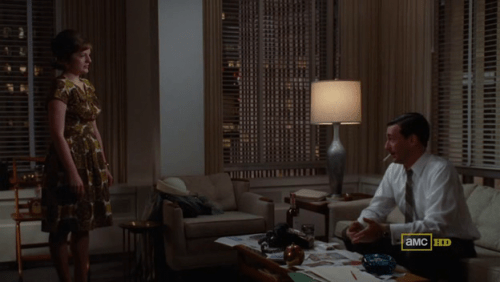
There is near unanimous consensus that 4.07: "The Suitcase" is the standout episode of Season Four of Mad Men, so we knew that our video essay on a singular moment from that season had to come from that episode. But there are so many great moments in "The Suitcase:" Peggy's telephone breakup with her boyfriend (and her family), the scenes between Don and Peggy in the diner and the bar (where they express their mutual attraction as far as they allow themselves to); the confrontation with Duck Phillips back in the office; the early morning phone call; and of course the hand-holding. But for this video, we decided on the fight that erupts between Don and Peggy after she decides to devote her evening in the office with him on the Samsonite ad campaign. There is just so much to unpack in this swift, three minute scene, four seasons' worth of narrative and character subtext that has built up and finally explodes between them. What's also remarkable is how much of this is conveyed through subtle but effective choices in staging and direction, as we hope this video illustrates.

The script for this video essay is written by Serena Bramble, Deborah Lipp and Kevin B. Lee, based on "a kernel" of an idea by Serena Bramble. The video is edited by Kevin B. Lee and narrated by Roberta Lipp and Kevin B. Lee.

TRANSCRIPT

Don has received an ominous phone message about his dying friend Anna.

Telephone at his side, he is trying to bring himself to call.

Don is staged front and center, conveying a sense of isolation and confrontation with himself.

The framing of this wide shot emphasizes the distance between Don and Peggy.

The rest of scene goes back and forth between these two shots of Don seated on the couch and Peggy standing as if above him.

The staging highlights Peggy's newfound aggressiveness towards Don in this scene. She is emboldened by her breakup. He is weakened by Anna's imminent death.

The following dialogue plays like an exchange of blows that resonates with the episode's boxing subplot. It even lasts about the 3 minute length of a boxing round.

Don's response doesn't invite further conversation or empathy. It is action-based, in line with his past advice to Peggy.

Don’s smile betrays relief that he won’t be alone. He can put aside the call. But he conceals this by acting as if Peggy could easily have left.

The framing of Don on the couch has shifted left. A space has opened.

Peggy wants to finish the fight she started with Mark by taking on the man at the opposite end of what’s expected of her. Her insult of Don's personal life is as much towards herself as to him. The remark doesn't faze Don in the least.

Peggy's body now occupies the space to Don's left, further establishing her imposing presence.

Now it is Don who insults Peggy's personal life, patronizing her for being girlish. But Peggy, too, is unfazed. She jabs directly at what really bothers her.

Unlike with Peggy's insult of his personal life, Don takes this insult of his professional life as "personal" Don is ready to fight, if only to drown out the more painful feelings of grief. He can do it best where he feels most at home: the office.

The scene moves into tighter closeups of Don and Peggy as they exchange jabs with increased intensity

Like Cassius Clay in the prize fight going on that night, Peggy fights with sharp, rapid flurries. Like Clay’s opponent, Sonny Liston, Don is slower, methodical, and forceful.

Don's face is intensely red. He needs the emotional release of this fight as much as Peggy.

Peggy again seeks recognition, but now it’s not professional. It’s emotional. But showing emotions is unprofessional. She’s been caught with her gloves down. Don finally unleashes.

The knockout blow: one last insult encapsulating the conflicts running through the scene.

Serena Bramble is a film editor currently pursuing a Bachelor's degree in Teledramatic Arts and Technology from Cal State Monterey Bay. In addition to editing, she also writes on her blog Brief Encounters of the Cinematic Kind.

Deborah Lipp is the co-owner of Basket of Kisses, whose motto is "smart discussion about smart television." She is the author of six books, including "The Ultimate James Bond Fan Book."

Roberta Lipp is the co-owner of Basket of Kisses and is or has been a voiceover artist, improvisor, actor, singer/songwriter, blogger and Mad Men aficionado. She plans to produce a one-woman show.

Kevin B. Lee is Editor in Chief of IndieWire’s PressPlay Video Blog and contributor to Roger Ebert.com. Follow him on Twitter.

VIDEO – The Top Five Mad Men Moments

VIDEO – The Top Five Mad Men Moments

Part of the Mad Men Moments Video Essay Series

Click here to watch this video on your mobile device.

The Mad Men Moments video essay series is co-produced by Deborah Lipp, co-owner with Roberta Lipp of the popular Mad Men website Basket of Kisses. The site features a robust community of Mad Men fans, so we thought to poll them on their expert opinion on what the best moments of the series have been after four seasons.  Here are the results, with the selected scenes featured in the video above. Below are brief accounts of each scene written by several members of the Basket of Kisses community.
 

5. Peggy and Joan, (4.13: Tomorrowland)
This scene, full of small pleasures, takes off when Joan becomes Peggy's safe place on a bad day. “Whatever could be on your mind,” she purrs. – Anne B

4. Don and Peggy hold hands (4.07: The Suitcase)
If actions speak louder than words…if three years of previous build-up lead to one glorious culmination…that is the pinnacle of this episode's (and for that matter, this season's) denouement: never was a simple gesture so fraught with dimensionality of meaning as when Dick Whitman places his hand on top of Peggy Olson's. – Peg4Prez

3. "Open the drawer" (3.11: The Gypsy and the Hobo)
The Don/Betty game changer. Just when you think Don's about to run away with Suzanne, the woman of his dreams, Betty makes it crystal clear that he'll never outrun his past. It's shocking — in a good way — to see Don suddenly so helpless and small. – Andee Joyce, aka Meowser

2. "I Wanted Other Things" (2.13: Meditations in an Emergency) 
The writers’ words often carry several shades of meaning on Mad Men, and this is one instance. "Well, one day you're there, and then all of a sudden, there's less of you, and you wonder where that part went, if it's living somewhere outside of you, and you keep thinking maybe you'll get it back, and then you realize it's just gone." At first, we wonder if Peggy is talking about the baby, coming as it does on the heels of her confession. Then we understand she’s referring to her own feelings for Pete—she “wanted something different”. And then, a deeper echo of truth—there is a cost to moving forward, and it’s not just giving up a piece of the past. The weight of her words is crushing, almost cruelly made lighter by the tenderness of her touch across Pete’s shoulder as she leaves. – Mitch Virchick

1. Carousel (1.13: The Wheel)
Everybody loves this scene. Don’s pitch leaves the men from Kodak speechless. The scene serves the show, tapping into the right plot points, but what really makes it work isn’t on the screen. It’s our own set of life-shots, inserted into the projector’s circular slide tray, in our mind’s-eye. Brilliant! – SmilerG

Deborah Lipp is the co-owner of Basket of Kisses (hyperlink), whose motto is "smart discussion about smart television." She is the author of six books, including "The Ultimate James Bond Fan Book."

VIDEO – Motion Studies #3: Falling: The Architecture of Gravity

VIDEO – Motion Studies #3: Falling: The Architecture of Gravity

For the next seven weeks, the Oberhausen International Short Film Festival will present "Film Studies in Motion", a Web Series curated by Volker Pantenburg and Kevin B. Lee. This series, available on the festival's website and Facebook page, presents weekly selections of analytical video essays on the web, in preparation for Pantenberg and Lee's presentation  "Whatever happened to Bildungsauftrag? – Teaching cinema on TV and the Web", scheduled for April 28 at the festival.

Press Play will track the series, posting four or five of the selected videos each week as they also become available on the Oberhausen Film Festival website.

This week is an initial sampling of exemplary works from the emerging genre of online video essays on cinema. Combined they cover a wide range of subject matter (a genre, a sequence in a film, a cinematic motif, a director’s body of work). They demonstrate a variety of stylistic approaches to the video essay form, using an array of techniques: montage and rhythm, split screens, narration, creative use of on-screen text, etc. These works, some of them conceived as multi-part series, are made typically on computers with consumer-grade editing software, but they display an ingenuity that is comparable to that of the films they explore.

Today's selection:

Falling. The Architecture of Gravity

Jim Emerson (2009)

The video essay at its most direct, eloquent and illuminating, by virtue of simple comparison and astute observation.

Volker Pantenburg is assistant professor for moving images at the media faculty of the Bauhaus-Universität Weimar. 

Kevin B. Lee is Editor in Chief of IndieWire’s PressPlay Video Blog and contributor to Roger Ebert.com. Follow him on Twitter.

VIDEO – THREE REASONS: BATTLE ROYALE, a HUNGER GAMES for Grownups

VIDEO – THREE REASONS: BATTLE ROYALE, a HUNGER GAMES for Grownups

[EDITOR'S NOTE: Contributor Robert Nishimura's video series Three Reasons continues with Kinji Fukasaku's Battle Royale. He feels this film – a Hunger Games for Grownups – deserves release on the Criterion label.]

With Hollywood poised and ready to drop the next big book-to-screen adaptation on March 23, The Hunger Games will be the latest tween sci-fi/fantasy franchise to wipe moviegoer's minds of wand-waving witches and vapid vampires.  Frankly, if my editor hadn't informed me of this fact I would've been blissfully unaware of the whole thing.  I had no idea that Suzanne Collins had written a series of insanely successful young adult novels, thus dubbing her one of the most influential people of 2010.  I didn't know that Gary Ross had directed the film adaptation featuring a star-studded cast of younglings (plus Woody Harrelson, Stanley Tucci, and Donald Sutherland to make the film tolerable for parents). Fans of the novels had camped out hours before an early screening at LA Live, anxious to have the book retold to them. It has already broken records in advance ticket sales, beating out Twilight: Blah Blah Blah.  

I have no doubt that the movie franchise of The Hunger Games will be as insanely popular as the books. Whether we like it or not, the next three films are already in pre-production.  Lionsgate has tailor-made "youthful, edgy, exciting high quality entertainment," so it will be guaranteed to thrill and tantalize preteens across the globe.  Perhaps bows and arrows will come back into fashion.  Maybe the film will inspire some kids to kill each other, or in the very least grow wacky facial hair.  Now that I've been inundated with all the hype for The Hunger Games, I feel like I've already seen it, and not because the trailer spelled it out for me. 

The blogosphere was quick to point out the similarities between Collins' Hunger Games Trilogy with Koushun Takami's 1999 novel, Battle Royale, going so far as to call it a bold-faced ripoff.  Suzanne Collins admitted to never having heard of the book, nor has she read it since continuing the series.  So it goes without saying that Collins has never seen Kinji Fukusaku's film adaptation of Battle Royale, which will undoubtedly bare a striking resemblance to Gary Ross' The Hunger Games.  Both sources portray various degrees of a dystopian future, where teenagers are forced to fight to the death for the amusement of the government/home-viewing audience.  

Beyond that, it would be a waste of time to defend Battle Royale from plagiarism, since The Hunger Games has an entirely different set of cultural baggage, as well as being a disservice to countless other source material that deal with the exact same subject matter.  Collins just happened to tap in to the creative collective consciousness, drawing on ideas that have played out many times before, in addition to her intentional reference to Greek mythology.  There are elements of Orwell and Huxley at work here, but just enough to pander to its target audience.  The trailer for The Hunger Games focuses on defining the characters of Jennifer Lawrence, Josh Hutcherson, Liam Hemsworth, and the rest of the primped up cast, but showed me very little of what I'd really like to see: these pretty people killing each other.

Takami's Battle Royale is set in an alternative universe in which Japan was victorious in the Second World War, making it an authoritative world power.  It's the turn of the century, and society is falling apart with an economy on the brink of collapse, a rise in unemployment and in teen delinquency.  The government reacts by installing the Millennial Reform School Act (BR Act) as a means to thin out the numbers of juvenile delinquents.  Every year one 9th grade class is randomly chosen to compete in Battle Royale, forced into a game of survival in which there can only be one winner.  The unknowing selected class is then kidnapped, whisked away to a de-populated island, and each student is given a unique weapon, a map, and enough provisions to last three days.  Each participant is fitted with a metal necklace that monitors their whereabouts, exploding if they attempt an escape.  

As the game progresses, sections of the island become "forbidden zones," to keep the students moving closer to each other.  If you are caught in a forbidden zones your necklace explodes.  If there is more than a single survivor at the end of the three days, all the necklaces will explode and the game is forfeited.  If one person does survive he/she is allowed to return home, or in some cases, be allowed to play again.  To make things more interesting the BR Committee will plant "transfer students" in certain schools months before the class is selected.  Having these seasoned killers among the 40 student class helps speed the game along and forces the other students to play.  Takami's original novels reveals much more about this universe and the relationships of the students, whereas the film adaptation of Battle Royale very quickly establishes the setting and introduces this year's lucky participants, Shiroiwa Junior High School, Class B.

nullThe man responsible for selecting this year's class is Kitano (brilliantly cast with "Beat" Takeshi Kitano), who used to work at Shiroiwa Junior High School years before becoming the mouthpiece for the BR Committee.  His calm demeanor is especially off putting as he describes the rules to the game, pausing occasionally to kill a student to set an example for the rest of the class.  It's especially poignant to see Takeshi Kitano in this role since it would ultimately be Fukusaku's swan song.  Fukusaku had a long established career as a genre filmmaker, responsible for some of the most energetic and innovative yakuza exploitation films.  His crowning achievement could be the Battles Without Honor and Humanity series, known in the West as The Yakuza Papers.  

Takeshi Kitano's directorial debut, Violent Cop was originally intended for Fukusaku, who passed the film along to Kitano because he was too ill at the time.  A few years later, Kitano would (re)pay homage to Fukusaku's Sympathy for the Underdog (1971) with his film Sonatine (1993).  Kitano's films are largely indebted to Fukusaku and his generation of filmmakers.  Reaching the end of his career, Battle Royale brought Fukusaku back into the limelight, garnering several Japanese Academy Award nominations in addition to some well deserved controversy.  After 40 years in the business, Fukusaku still had the moxy of a young exploiter.  He managed to shoot only one scene for Battle Royale 2: Requiem (coincidentally, with Kitano) before passing away, leaving his son Kenta to complete the film in his father's memory.

In The Hunger Games contestants are chosen in pairs from various districts, some of whom seemingly have been training their whole lives to enter the game.  They are complete strangers to each other, the only attachment (as for the viewer) is purely physical.  The students in Battle Royale have known each other for years, and in some cases quite intimately.  This has a profound effect on the game and how it is played.  Some students try to form alliances to avoid any violence, while other students immediately start playing as soon as they leave the gate, desperate to to be the winner or seeking revenge for past grievances.  Most of the students are frightened beyond belief, questioning themselves and suspicious of even their closest friends.  The couple that we are meant to identify with are Shuya (Tatsuya Fujiwara) and Noriko (Aki Maeda), who now must confront their feelings for each other as well as frequent attacks from their fellow classmates.  

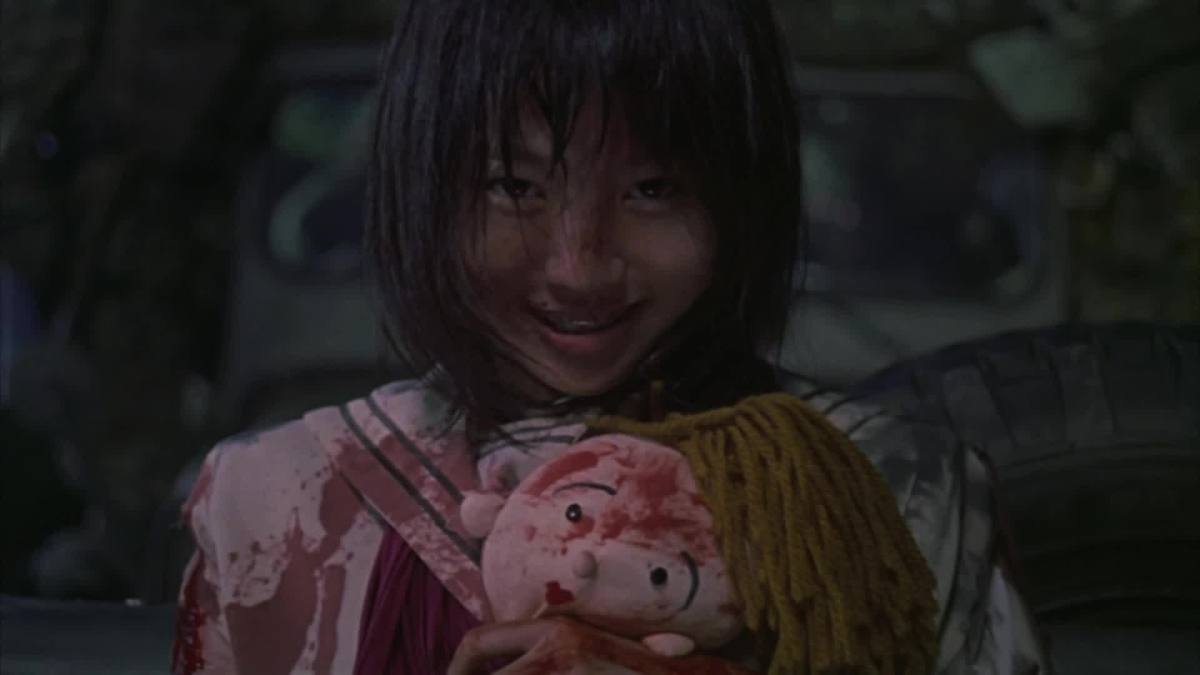
nullOne notable assailant is played by Chiaki Kuriyama, who basically reprises the the same role in Quentin Tarantino's love letter to J-sploitation, Kill Bill.  Fans of QT will recognize the tone that Fukusaku maintains throughout the film.  Realistic violence pushed to the point of absurdity, sometimes even cartoonish.  Shuya and Noriko witness all their friends (and enemies) unravel from fear and paranoia, either killing each other out of spite or suspicion.  As the student body dwindles away, they form an alliance with Shogo, one of the "transfer students" who had played the game before.  Together they devise a way to end the game and seek revenge on Kitano, who is surveilling them from the center of the island.

Contrary to popular belief, Battle Royale was never banned from US distribution.  The file was released soon after the Columbine incident, which wasn't the best time to be promoting a film that glorified killing your classmates.  Why the film hadn't be picked up since is the real mystery.  For years the film had garnered a cult following in the US, and still no distributor would touch it.  Even after Tarantino had given it his hipster seal-of-approval, he could have at least put it out under his Rolling Thunder label.  Criterion had already released David Lean's Lord of the Flies and Ernest B. Schoedsack's The Most Dangerous Game, so Battle Royale would have fit snugly betwixt those classics.  If only Criterion had picked up Battle Royale years ago it could've quite possibly saved us all from The Hunger Games.  

nullCriterion missed their chance to nab this title, and now that The Hunger Games have begun, another company has stepped up to finally bring Battle Royale to the US.  It would appear that my Three Reasons video is already an empty gesture since Anchor Bay is set to release the long-awaited special edition of Battle Royale 1 & 2 on DVD and Bluray, three days before The Hunger Games hits theaters.  It's loaded with features on Fukusaku's career and the impact Battle Royale had on cinema in Japan.  We can certainly trace the line from Battle Royale to The Hunger Games without too much difficulty, even though the film was never released in the US until now.  Its influence on Western cinema over the past decade has justified having our own kiddy-porn death-match. The level of violence in cinema has caught up to speed that we can now have our The Hunger Games, so it seems the US is finally ready for Battle Royale. For anyone who has not seen Battle Royale, it will not disappoint, but it may steal the "edge" that The Hunger Games is so desperately trying to project.

Robert Nishimura is a Japan-based filmmaker, artist, and freelance designer. His designs can be found at Primolandia Productions. His non-commercial video work is at For Criterion Consideration. You can follow him on Twitter here. To watch other videos in his "Three Reasons" series, click here.

VIDEO: Motion Studies #2: A Diary on David Holzman

VIDEO: Motion Studies #2: A Diary on David Holzman

For the next seven weeks, the Oberhausen International Short Film Festival will present "Film Studies in Motion", a Web Series curated by Volker Pantenburg and Kevin B. Lee. This series, available on the festival's website and Facebook page, presents weekly selections of analytical video essays on the web, in preparation for Pantenberg and Lee's presentation  "Whatever happened to Bildungsauftrag? – Teaching cinema on TV and the Web", scheduled for April 28 at the festival.

Press Play will track the series, posting four or five of the selected videos each week as they also become available on the Oberhausen website.

This week is an initial sampling of exemplary works from the emerging genre of online video essays on cinema. Combined they cover a wide range of subject matter (a genre, a sequence in a film, a cinematic motif, a director’s body of work). They demonstrate a variety of stylistic approaches to the video essay form, using an array of techniques: montage and rhythm, split screens, narration, creative use of on-screen text, etc. These works, some of them conceived as multi-part series, are made typically on computers with consumer-grade editing software, but they display an ingenuity that is comparable to that of the films they explore.

Today's selection:

Diary on David Holzman Part 1: The Sons and Daughters of David
Kevin B. Lee (2011)

This video essay links an under-seen 1967 American independent film with the current wave of reality TV and video blogs that pervade contemporary culture.

Volker Pantenburg is assistant professor for Visual Media with the main focus “Research of the Moving Image” at the media faculty of the Bauhaus-Universität Weimar. 

Kevin B. Lee is Editor in Chief of IndieWire’s PressPlay Video Blog and contributor to Roger Ebert.com. Follow him on Twitter.

VIDEO – Motion Studies #1: The Substance of Style

VIDEO – Motion Studies #1: The Substance of Style

http://www.movingimagesource.us/flash/mediaplayer.swf?id=11/767

For the next seven weeks, the Oberhausen International Short Film Festival will present "Film Studies in Motion", a Web Series curated by Volker Pantenburg and Kevin B. Lee. This series, available on the festival's website and Facebook page, presents weekly selections of analytical video essays on the web, in preparation for Pantenberg and Lee's presentation  "Whatever happened to Bildungsauftrag? – Teaching cinema on TV and the Web", scheduled for April 28 at the festival.

Press Play will track the series, posting four or five of the selected videos each week as they also become available on the Oberhausen website.

The following introduction to the series is taken from the Oberhausen International Short Film Festival website:

Anyone who has an internet connection and wants to expand their understanding of cinema can behold the remarkable abundance of analytical video essays on the web. Proliferated in just the last five years, these meticulous readings of title sequences, thorough investigations of film style and montage decisions, dialogic inquiries of acting or mise en scene have created a genre in its own right. They can be found on websites like IndieWire's Press Play, Fandor, Moving Image Source and Audiovisualcy, on the last of which curator Catherine Grant has categorized these works under the term "videographic film studies." The essays are expressions of a cinephilia 2.0, fueled by weblogs, internet-journals and streaming platforms, produced from DVDs and digital media, laptops, and DIY editing software.

This week is an initial sampling of exemplary works from the emerging genre of online video essays on cinema. Combined they cover a wide range of subject matter (a genre, a sequence in a film, a cinematic motif, a director’s body of work). They demonstrate a variety of stylistic approaches to the video essay form, using an array of techniques: montage and rhythm, split screens, narration, creative use of on-screen text, etc. These works, some of them conceived as multi-part series, are made typically on computers with consumer-grade editing software, but they display an ingenuity that is comparable to that of the films they explore.

Today's selection:

The Substance of Style, Pt 5: The prologue to The Royal Tenenbaums, annotated
Matt Zoller Seitz (2009)

What better way to kick off the series than with an opening credit sequence, unpacked in such a way that can only be done via video essay?

Volker Pantenburg is assistant professor for Visual Media with the main focus “Research of the Moving Image” at the media faculty of the Bauhaus-Universität Weimar. 

Kevin B. Lee is Editor in Chief of IndieWire’s PressPlay Video Blog and contributor to Roger Ebert.com. Follow him on Twitter.