VIDEO ESSAY: 2001/The Dawn of Blood

VIDEO ESSAY: 2001/The Dawn of Blood

Paul Thomas Anderson is a director who wears his cinematic influences on his sleeve. From sprawling dramas that echo Robert Altman’s work (Short Cuts, Nashville) to the signature camera movements found in Martin Scorsese movies (most notably Scorsese’s Copacabana Nightclub tracking shot in Goodfellas, which Anderson employs during a television studio walkthrough in Magnolia), the filmography of Paul Thomas Anderson is the direct result of passionate cinephilia merged with mastery in filmmaking. And Anderson’s last film There Will Be Bloodis the kind of staggering, challenging and singular piece of cinema that launches a director into the stratosphere, to be hailed as an “auteur.”

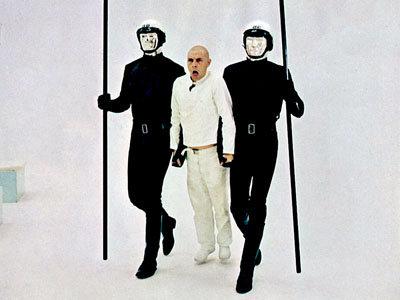
In Blood, it’s the influential work of Stanley Kubrick’s 2001: A Space Odyssey that permeates the body of the film. To say that There Will Be Bloodis only about the dawn of twentieth century capitalism is about as valid as describing 2001: A Space Odyssey as merely an astronaut’s adventure tale. Consider: Anderson’s masterpiece opens with a wordless, quietly haunting sequence, which in many ways mirrors “The Dawn of Man” section in 2001. Next, both films heavily rely on unnerving, sweeping pieces of music to drive key scenes; in 2001, György Ligeti’s “Requiem” brings malice to the mysterious black monolith, while Jonny Greenwood’s disconcerting Blood score suggests a volatile turn of the century American frontier. Finally, if one considers the framing of certain shots—apes around a black monolith, workers around an oil derrick—and the implications they carry, it’s obvious that Anderson is channeling Kubrick’s powerful visualization on the primordial nature of humanity, amidst the frail, dangerous act of discovery.

Nelson Carvajal is an independent digital filmmaker, writer and content creator based out of Chicago, Illinois. His digital short films usually contain appropriated content and have screened at such venues as the London Underground Film Festival. Carvajal runs a blog called FREE CINEMA NOW which boasts the tagline: "Liberating Independent Film And Video From A Prehistoric Value System."

Motion Studies #10: Pure

Motion Studies #10: Pure

From now through April, the Oberhausen International Short Film Festival will present "Film Studies in Motion", a Web Series curated by Volker Pantenburg and Kevin B. Lee. This series, available on the festival's website and Facebook page, presents weekly selections of analytical video essays on the web, in preparation for Pantenberg and Lee's presentation  "Whatever happened to Bildungsauftrag? – Teaching cinema on TV and the Web", scheduled for April 28 at the festival.

Week Three: Remixes: Parody, Supercut and Mashup

Appropriating and recombining existing footage has been a prime strategy of art and analysis for a long time. With the immense circulation of movies on the web and the accessibility of editing software, this method is no longer restricted to experimental cinema or contemporary art, but has become part of a wider remix culture. This episode gathers recent examples from a wide range of practices. Some of them are driven by critical intentions, some by sheer enthusiasm for iconography and rhythm.

Today's selection:

Pure

Jacob Bricca (2009)

"Jacob Bricca's Pure (2008)—which played at a number of film festivals, including the Berlinale—groups together a slew of visual cues from action movies, creating a kind of auto-critical futurist paean to maximum velocity. The shots he finds are so similar that the effect is often like watching the same exact thing from multiple angles." – Tom McCormack, Moving Image Source

View all Motion Studies video selections.

Volker Pantenburg is assistant professor for moving images at the media faculty of the Bauhaus-Universität Weimar. 

Kevin B. Lee is Editor in Chief of IndieWire’s PressPlay Video Blog and contributor to Roger Ebert.com. Follow him on Twitter.

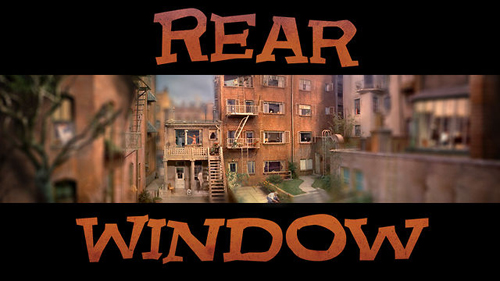
Alfred Hitchcock’s REAR WINDOW reimagined by artist Jeff Desom

Alfred Hitchcock’s REAR WINDOW reimagined by artist Jeff Desom

Rear Window Timelapse from Jeff Desom on Vimeo.

[Editor's Note: We at Press Play can't imagine the hours, the imagination and the creativity it took to create the above tableau. It is a reworking of Alfred Hitchcock's film Rear Window, presenting this classic in a way that has never been seen before. It extracts all of the film footage as seen from Jimmy Stewart's point of view, stitches and reconstructs the pieces, and places them on a single plane. This has to be seen to be believed. It is the remarkable work of installation artist Jeff Desom, who employed any number of digital effects programs and lots of caffeinated coffee to create this effect. Way to go, Mr. Desom. Let us know what you're doing next. Here is Mr. Desom's site.]

Motion Studies #9: Rose Hobart

Motion Studies #9: Rose Hobart

From now through April, the Oberhausen International Short Film Festival will present "Film Studies in Motion", a Web Series curated by Volker Pantenburg and Kevin B. Lee. This series, available on the festival's website and Facebook page, presents weekly selections of analytical video essays on the web, in preparation for Pantenberg and Lee's presentation  "Whatever happened to Bildungsauftrag? – Teaching cinema on TV and the Web", scheduled for April 28 at the festival.

Week Three: Remixes: Parody, Supercut and Mashup

Appropriating and recombining existing footage has been a prime strategy of art and analysis for a long time. With the immense circulation of movies on the web and the accessibility of editing software, this method is no longer restricted to experimental cinema or contemporary art, but has become part of a wider remix culture. This episode gathers recent examples from a wide range of practices. Some of them are driven by critical intentions, some by sheer enthusiasm for iconography and rhythm.

Today's selection:

Rose Hobart

Joseph Cornell (1936)

The original movie remix.

View all Motion Studies video selections.

Volker Pantenburg is assistant professor for moving images at the media faculty of the Bauhaus-Universität Weimar. 

Kevin B. Lee is Editor in Chief of IndieWire’s PressPlay Video Blog and contributor to Roger Ebert.com. Follow him on Twitter.

VIDEO – Motion Studies #8: Following

VIDEO – Motion Studies #8: Following

From now through April, the Oberhausen International Short Film Festival will present "Film Studies in Motion", a Web Series curated by Volker Pantenburg and Kevin B. Lee. This series, available on the festival's website and Facebook page, presents weekly selections of analytical video essays on the web, in preparation for Pantenberg and Lee's presentation  "Whatever happened to Bildungsauftrag? – Teaching cinema on TV and the Web", scheduled for April 28 at the festival.

Week Two: Cinematic Techniques on Display

The video essay format has quickly shown its abilities to illuminate and critique the techniques of filmmakers in ways that surpass the reach of traditional text-based analysis. This selection of videos creatively engages with various films to reveal surprising insights into the many dimensions of cinema: cinematography, editing, sound, etc.

Today's selection:

Following

Matt Zoller Seitz (2009)

More than 50 following shots from different films form a seemingly continuous forward movement, displaying dozens of variations on a single camera technique.

View all Motion Studies video selections.

Volker Pantenburg is assistant professor for moving images at the media faculty of the Bauhaus-Universität Weimar. 

Kevin B. Lee is Editor in Chief of IndieWire’s PressPlay Video Blog and contributor to Roger Ebert.com. Follow him on Twitter.

VIDEO – Motion Studies #7: Low Budget Eye Candy

VIDEO – Motion Studies #7: Low Budget Eye Candy

From now through April, the Oberhausen International Short Film Festival will present "Film Studies in Motion", a Web Series curated by Volker Pantenburg and Kevin B. Lee. This series, available on the festival's website and Facebook page, presents weekly selections of analytical video essays on the web, in preparation for Pantenberg and Lee's presentation  "Whatever happened to Bildungsauftrag? – Teaching cinema on TV and the Web", scheduled for April 28 at the festival.

Week Two: Cinematic Techniques on Display

The video essay format has quickly shown its abilities to illuminate and critique the techniques of filmmakers in ways that surpass the reach of traditional text-based analysis. This selection of videos creatively engages with various films to reveal surprising insights into the many dimensions of cinema: cinematography, editing, sound, etc.

Today's selection:

Low Budget Eye Candy

Steven Boone (2009)

Even George Lucas started out as a resourceful low-budget filmmaker, as detailed in this video essay manifesto on DIY film production.

View all Motion Studies video selections.

Volker Pantenburg is assistant professor for moving images at the media faculty of the Bauhaus-Universität Weimar. 

Kevin B. Lee is Editor in Chief of IndieWire’s PressPlay Video Blog and contributor to Roger Ebert.com. Follow him on Twitter.

VIDEO ESSAY: GALLO(W)S OF PUNISHMENT

VIDEO ESSAY: Gallo(w)s of Punishment

There is hardly a more polarizing figure in the independent film scene than Vincent Gallo. He once called Roger Ebert a “fat pig with the physique of a slave trader” after Ebert blasted the Cannes debut of his sophomore directorial effort, The Brown Bunny. On his official website, Gallo sells himself as a weekend escort and even offers women his sperm for an “in-vitro fertilization.” Most recently, Gallo declared that his third directorial project, an abstract romantic film, Promises Written In Water, would not be released. Ever. Still, if one can overlook—or even just ignore—the jaw-dropping, off-screen antics that Gallo throws at the public, it is actually pretty rewarding to take in the quiet power of Gallo’s first two (and still available) directorial works: Buffalo ’66 and The Brown Bunny. Not only does Gallo write, direct and star in each of these feature films, he basically offers himself as a post-postmodern martyr for a new generation of moviegoers. In fact, a lot of actors, writers, and directors could never pull off what Gallo does in these works. Gallo’s screen martyrdom ends up being an effective technique for revealing dark truths within his film’s heroes.

For starters, consider his directorial debut Buffalo ’66. Gallo plays Billy Brown, an ex-convict coming off a five-year prison stint for a crime he didn’t commit. Billy was the fall guy for a bookie played by Mickey Rourke—again phoning in his 90s tough guy persona (Thursday, Fall Time, Bullet). So Billy, still emotionally scarred from his childhood upbringing, kidnaps the angelic Layla (Christina Ricci) in order to present her to his spacy parents (Anjelica Huston and Ben Gazzara) as his wife. Billy’s parents, nestled in their Buffalo, New York home, are trapped in a time capsule of naïve nostalgia: They seem to care more about a recorded VHS tape of a Buffalo Bills football game than they do with their son’s supposed new bride. On paper, all of this sounds like a black comedy in the vein of The Whole Nine Yards. Yet, Buffalo ’66 plays out with a quiet surrealism. There is an instrumental dance sequence in a bowling alley, showcasing Layla’s impromptu tap dancing skills. There is also a fantasized murder of a Buffalo Bills kicker at a strip club. The color scheme of every shot is muddled,  like a fading Polaroid. And most of the film is actually quiet, with Billy basking in his own sorrow. Yes, kidnapping Layla is the last thing he should probably be doing upon being released from prison. But Billy is so distraught with his broken existence that he becomes blind to his downward path of behavioral absurdity. Gallo’s performance here is key to the power of Buffalo ’66. He is able to sell Billy’s self-punishment not as an act of self-righteousness but as a self-remedy. Screwing up and avoiding any sort of real relationship not only feigns a reinvention of self-identity–it also helps Billy hold on to the last bit of sanity he thinks he has. In the off-kilter universe that Gallo creates in Buffalo ’66, people can rewrite their existences by deceiving themselves about the past and the projected future. There is something to be said about a filmmaker exploring these notions behind and in front of the camera.

In his next directorial project, The Brown Bunny, Gallo takes even more abrasive narrative risks and they take the movie to heights of pathos that most American independent films don’t even get a peek at. In this film, Bud Clay (Gallo) drives and drives listlessly across an indifferent highway, a drive through Americana itself. Sometimes he stops at a pet store. Other times he stops for gas. His few encounters with women prove fruitless. And then, in the last third, we meet Bud’s elusive beau, Daisy (Chloe Sevigny), in a soft-lit hotel room. The two embrace and begin to get intimate. In fact, Daisy—in front of the camera—performs oral sex on Bud. The scene is shocking. Are we really seeing this in an American indie flick? And then, ingeniously, Gallo the filmmaker pulls the rug from under us. While Daisy and Bud spoon on the hotel bed, a flashback sequence occurs: It’s revealed that Daisy was a drug addict and died of asphyxiation during a house party some time ago. She was also pregnant with Bud’s child when this happened. And during all of this we hear a broken Bud sob helplessly on the soundtrack, asking aloud why Daisy made the choices she did. A concluding shot shows Bud lying on the bed—alone. Thus, The Brown Bunny reveals itself not so much as a vain Vincent Gallo road trip movie but as a crippling dissection of male insecurity and ailing guilt. It’s the kind of film that would have thrived in the 1970s, when artists were unabashedly emoting their anxieties and fears on the screen.

In the end, with only two directorial efforts, Mr. Gallo has given us more profundity than any of his shock-driven publicity stunts or sound bites could ever articulate.

Nelson Carvajal is an independent digital filmmaker, writer and content creator based out of Chicago, Illinois. His digital short films usually contain appropriated content and have screened at such venues as the London Underground Film Festival. Carvajal runs a blog called FREE CINEMA NOW which boasts the tagline: "Liberating Independent Film And Video From A Prehistoric Value System."
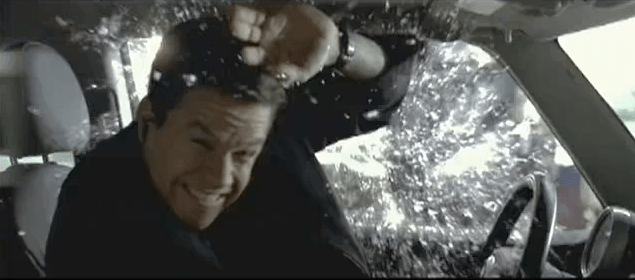
VIDEO – Motion Studies #6: Chaos Cinema Part 1

VIDEO – Motion Studies #6: Chaos Cinema Part 1

From now through April, the Oberhausen International Short Film Festival will present "Film Studies in Motion", a Web Series curated by Volker Pantenburg and Kevin B. Lee. This series, available on the festival's website and Facebook page, presents weekly selections of analytical video essays on the web, in preparation for Pantenberg and Lee's presentation  "Whatever happened to Bildungsauftrag? – Teaching cinema on TV and the Web", scheduled for April 28 at the festival.

Week Two: Cinematic Techniques on Display

The video essay format has quickly shown its abilities to illuminate and critique the techniques of filmmakers in ways that surpass the reach of traditional text-based analysis. This selection of videos creatively engages with various films to reveal surprising insights into the many dimensions of cinema: cinematography, editing, sound, etc.

Today's selection:

Chaos Cinema Part 1

Matthias Stork (2011)

This popular video, first featured on Press Play, explores how chaos reigns in the techniques used to make contemporary action films.

View all Motion Studies video selections.

Volker Pantenburg is assistant professor for moving images at the media faculty of the Bauhaus-Universität Weimar. 

Kevin B. Lee is Editor in Chief of IndieWire’s PressPlay Video Blog and contributor to Roger Ebert.com. Follow him on Twitter.

VIDEO – Motion Studies #5: Variation on a Sunbeam

VIDEO – Motion Studies #5: Variation on a Sunbeam

From now through April, the Oberhausen International Short Film Festival will present "Film Studies in Motion", a Web Series curated by Volker Pantenburg and Kevin B. Lee. This series, available on the festival's website and Facebook page, presents weekly selections of analytical video essays on the web, in preparation for Pantenberg and Lee's presentation  "Whatever happened to Bildungsauftrag? – Teaching cinema on TV and the Web", scheduled for April 28 at the festival.

Week Two: Cinematic Techniques on Display

The video essay format has quickly shown its abilities to illuminate and critique the techniques of filmmakers in ways that surpass the reach of traditional text-based analysis. This selection of videos creatively engages with various films to reveal surprising insights into the many dimensions of cinema: cinematography, editing, sound, etc.

Today's selection:

Variation on the Sunbeam

Aitor Gametxo (2011)

A 12 minute D.W. Griffith short is dissected and rearranged into multiple spaces playing out in real time, providing a revelatory view of Griffith's approach to storytelling and space.

View all Motion Studies video selections.

Volker Pantenburg is assistant professor for moving images at the media faculty of the Bauhaus-Universität Weimar. 

Kevin B. Lee is Editor in Chief of IndieWire’s PressPlay Video Blog and contributor to Roger Ebert.com. Follow him on Twitter.

VIDEO – Motion Studies #4: Godardloop

VIDEO – Motion Studies #4: Godardloop

For the next seven weeks, the Oberhausen International Short Film Festival will present "Film Studies in Motion", a Web Series curated by Volker Pantenburg and Kevin B. Lee. This series, available on the festival's website and Facebook page, presents weekly selections of analytical video essays on the web, in preparation for Pantenberg and Lee's presentation  "Whatever happened to Bildungsauftrag? – Teaching cinema on TV and the Web", scheduled for April 28 at the festival.

Press Play will track the series, posting four or five of the selected videos each week as they also become available on the Oberhausen Film Festival website.

This week is an initial sampling of exemplary works from the emerging genre of online video essays on cinema. Combined they cover a wide range of subject matter (a genre, a sequence in a film, a cinematic motif, a director’s body of work). They demonstrate a variety of stylistic approaches to the video essay form, using an array of techniques: montage and rhythm, split screens, narration, creative use of on-screen text, etc. These works, some of them conceived as multi-part series, are made typically on computers with consumer-grade editing software, but they display an ingenuity that is comparable to that of the films they explore.

Today's selection:

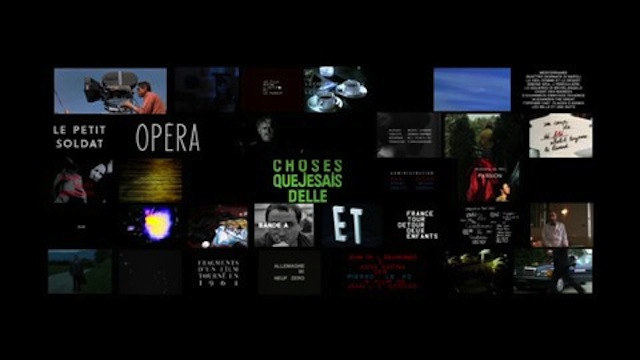
Godardloop


Michael Baute (2010)

47 films spanning 50 years of filmmaking are channeled into a stream of images that attest to an inimitable talent: an artist who transforms the world simply by how he looks at it through a camera.

Volker Pantenburg is assistant professor for moving images at the media faculty of the Bauhaus-Universität Weimar. 

Kevin B. Lee is Editor in Chief of IndieWire’s PressPlay Video Blog and contributor to Roger Ebert.com. Follow him on Twitter.