VIDEO ESSAY – Matt Porterfield and the Art of the Question

VIDEO ESSAY – Matt Porterfield and the Art of the Question

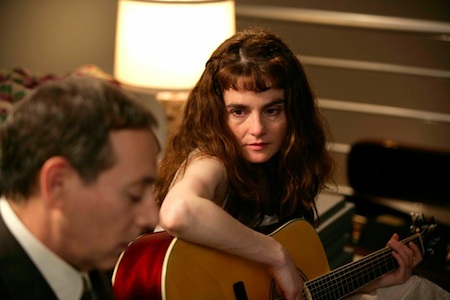
What is it that makes Putty Hill one of the more striking American independent films of recent years? Is it the genuine working class Baltimore setting, where director Matt Porterfield grew up and still lives today? Is it the cinematography by Jeremy Saulnier? Is it the ensemble of nonprofessional actors who give the film a genuine, unaffected sense of character? Or is it the questions?

Putty Hill does so much with the first three elements to immerse you in the documentary-like authenticity of its world. But the film tears its own fabric of verisimilitude in scenes where Porterfield spontaneously interviews the characters, asking them questions from offscreen. Matt Porterfield is as much a member of this community, and a character in the film, as those on screen in 'Putty Hill.' These interviews are a paradox: They break the film’s documentary realism by making its format a subject in itself.

One might worry that such a strategy would reek of arty self-consciousness, but there’s something genuine about it, because it puts Porterfield’s relationship with his characters front and center. Porterfield spent a long time working with each of these nonprofessionals, asking them questions to help them develop their characters, mixing their real life experiences and fictional inventions. These scenes are both the outcome and an acknowledgment of that process. What it reveals about Porterfield is that he is not just a director of these subjects, but a confidante. In other words, he is as much a member of this community, and a character in his film, as those on screen.

You can already see this questioning approach in Porterfield’s first film Hamilton. The majority of the dialogue consists of questions and responses. By my count there are 65 questions asked in this 65-minute film. Even the rap song featured in a key scene is full of questions. Hamilton seemingly has the objective surface of an observational documentary, but when you listen to these dialogue scenes, you can practically hear Porterfield’s voice from Putty Hill in each conversation in Hamilton. Porterfield’s world shows everyday life as an investigative documentary, with people constantly interrogating each other, seeking answers.

Is there an underlying significance to all these questions? Both films deal with the ripple effect on a community caused by a private trauma. In Hamilton, it’s a teen pregnancy; in Putty Hill it’s a suicide. In most films, asking questions would serve to explore these incidents and lead towards a dramatic resolution. Here, the questions themselves are the drama: a constant effort to reach out and stay connected. The more questions are asked, the more they suggest how vulnerable these relationship are, and how strong the desire is to hold them together. In Porterfield’s films, the story is less important than exploring the community in which it takes place, and what’s at stake in preserving it.

Originally published on Fandor

Kevin B. Lee is Editor in Chief of IndieWire’s PressPlay Video Blog, Video Essayist for Fandor Keyframe, and contributor to Roger Ebert.com. Follow him on Twitter..

VIDEO ESSAY: ON THE QT # 1: RESERVOIR DOGS

ON THE QT # 1: RESERVOIR DOGS

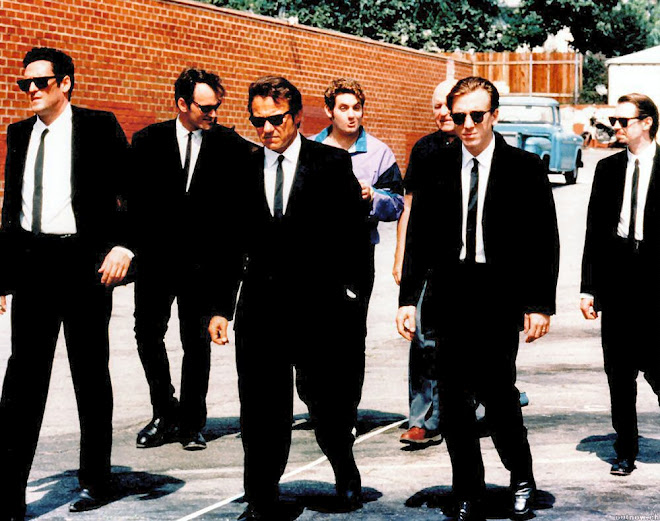
Press Play launches its new director series On the Q.T., about Quentin Tarantino, with a look at his debut Reservoir Dogs (1992). Although it earned plenty of acclaim, the film also sparked two kinds of controversy. One had to do with the movie's content: its profanity, racial epithets, blood, and torture merged art house and grindhouse traditions in a fresh and unsettling way. The other controversy was aesthetic: Tarantino, a former video store clerk, quoted movie history so ostentatiously—even working pop culture rants into his dialogue!—that detractors accused him of being more of a gifted mimic than a real artist, a charge that has followed him throughout his career.

Funny thing, though: when you look back on the late '90s and early '00s, you see plenty of films that desperately wanted to be Reservoir Dogs or Pulp Fiction. Truth or Consequences, N.M., Things to Do in Denver When You're Dead, The Usual Suspects, Two Days in the Valley, Mad Dog Time, and many others channeled what was presumed to be the Tarantino formula. Yet none of them has had the staying power of Reservoir Dogs. Why? The answer is contained in Reservoir Dogs' opening monologue about Madonna's "Like a Virgin"—delivered by none other than Tarantino himself—and in the scenes of the undercover cop, Mr. Orange (Tim Roth), getting into character as one of the crooks. Put these images together—a lover so good that he makes a sexually experienced woman feel like a virgin, and an actor so good that he fools hardbitten crooks into thinking he's one of them—and you have Tarantino's early career: a performance so extraordinary that it stops being performance and becomes an emotional event.

How does Tarantino do it? Press play to find out.

San Antonio-based film critic Aaron Aradillas is a contributor to The House Next Door, a contributor to Moving Image Source, and the host of “Back at Midnight,” an Internet radio program about film and television.

Matt Zoller Seitz is one of the founders of Press Play. A finalist for the Pulitzer Prize in Criticism, he is currently the TV Critic for New York Magazine.

Ken Cancelosi is a writer and photographer living in Dallas, Texas. He is the co-founder of Press Play.

VIDEO – Sight & Sound Film Poll: Nicole Brenez on THE HOUR OF THE FURNACES PART I: NOTES AND TESTIMONY ON NEOCOLONIALISM, VIOLENCE AND LIBERATION

VIDEO – Sight & Sound Film Poll: Nicole Brenez on THE HOUR OF THE FURNACES PART I: NOTES AND TESTIMONY ON NEOCOLONIALISM, VIOLENCE AND LIBERATION

For optimal viewing, click on the fullscreen button on the bottom right of the player.

Press Play presents Sight and Sound Film Poll: Critics' Picks, a series of video essays featuring prominent film critics on films they selected for Sight and Sound magazine's poll of the greatest films of all time. New videos will premiere each week until the poll results are announced later this summer.

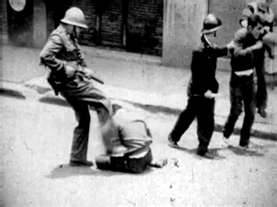
The seventh video in this series is adapted (with the author's permission) from an essay by Nicole Brenez that appeared earlier this year in Sight & Sound, which was part of a series of articles proposing films for top ten consideration. Her selection of The Hour of the Furnaces by Argentina's Fernando Solanas and Octavio Getino is one that, in my view, challenges a number of conventions that typify movie top ten lists. For starters, it may very well be the most important film to have ever been made in Latin America, a region that's long been neglected by the Sight & Sound Poll (unless you count Luis Buñuel as a Latin director).*

Brenez' endorsement also has a bit of intrigue in that it focuses exclusively on the 208 minute documentary's first part, Notes and Testimony on Neocolonialism, Violence and Liberation, ignoring the second part, which in Brenez' words "mainly consists of advocacy for the Argentinian politician Juan Péron and therefore does not concern us here." This year Sight & Sound instructed poll participants not to count multiple titles as a single work (i.e. The Godfather I and II, Dekalog); Brenez' essay provokes the question of whether half of a film can rank among the greatest (though unlike most films, in this instance there is a clear demarcation of parts forming a whole).  

But perhaps most importantly, Brenez's argument makes a compelling case for the poll's consideration of the political film – as well as the politics of filmmaking. It's fair to say that, particularly with regard to greatest films lists, overtly political filmmaking has long endured a stigma as being inferior to films that focus more exclusively on cinema as art. But it's a false dichotomy, as this video hopes to illustrate; The Hour of the Furnaces is a dense work that weaves several modes of cinema into a multifaceted polemical discourse. It plays like the apotheosis of a rich film lineage traced through the likes of Sergei Eisenstein, Dziga Vertov, Joris Ivens, Humphrey Jennings, Alain Resnais and many others.

Moreover, the film is driven by a revolutionary philosophy of filmmaking that, from today's perspective, seems ever more pertinent, if only because what it opposes seems ever more dominant. To my discredit, the video does not incorporate the passage in Brenez' essay specifically pertaining to the film's relationship to its filmmakers' seminal manifesto, "Towards a Third Cinema: Notes and Experiences for the Development of a Cinema of Liberation in the Third World." This landmark text lays a blueprint for cinema in the developing world, proposing an entirely new system for filmmaking and distribution that can truly serve the needs of a society seeking independence from external colonizing forces. It argues for a politically conscious, self-determining "Third Cinema" that can oppose the two prevailing cinemas that, Solanas and Getino argue, serve the forces of cultural and societal oppression: first, the Hollywood model of industrial filmmaking; and second, the auteur / arthouse cinema, which purports to provide an alternative to the first cinema, but amounts to a "safety valve," in Brenez' words.**

These days, it seems nearly impossible to conceive of movies beyond "mainstream" and "arthouse / alternative / independent", or to think of great cinema without summoning a rollcall of auteurs. Watching a film like Hour of the Furnaces – produced as a collective effort outside of a commercial or auteurist model, screened illegally within its home country, and made with a comprehensive, groundbreaking understanding of filmmaking's role in affecting the status quo – one starts to realize how so much of today's film culture has settled into a comfortable, marginalized space in relation to the rest of society. And yet, so much of the world described by Hour of the Furnaces still resembles ours. The film is a bracing reminder of how cinema can confront such a world head-on.

This is the second video I've produced with Nicole Brenez. Our first was on Boris Barnet's By the Bluest of Seas; as with that video, Nicole's words are voiced by another person. Here it is Nova Smith, doctoral candidate in cinema and media studies at the University of Chicago.

– Kevin B. Lee

*In the 2002 Sight & Sound Poll, only five Latin American films received more than one vote: Los Olvidados, The Exterminating Angel, and El by Buñuel (all from his Mexican period); and two films from Brazil, Black God White Devil by Glauber Rocha and Barren Lives by Nelson Pereira Dos Santos.

**Reading Solanas and Getino's essay, it occurred to me that auteurism and Facebook have something in common. Auteurism allows us to cozy up to a virtual, personalized experience of movies [movies as "personal visions"], as Facebook allows us to do so with the internet ["personal" interactions online]; in both instances, fantasies of personalization come at the risk of ignoring a more comprehensive, systemic view of the apparatus: its methods, aims, and outcomes in shaping our perceptions of reality and social order.

Nicole Brenez is professor of cinema studies at University of Paris 3/Sorbonne Nouvelle and a senior member of the Institut Universitaire de France. She is a film historian, curator, and leading specialist of avant-garde cinema. Her books include “Cinéma d’avant-garde” (2007), “Abel Ferrara” (2007), and “Chantal Akerman” (2011). Brenez has also been curating the Cinémathèque Française’s avant-garde film sessions since 1996.

Kevin B. Lee is Editor in Chief of IndieWire’s PressPlay Video Blog, Video Essayist for Fandor Keyframe, and contributor to Roger Ebert.com. Follow him on Twitter.

VIDEO ESSAY: Cocaine du Cinema

VIDEO ESSAY: Cocaine du Cinema

For roughly the last one hundred and thirty years cocaine has been the drug of choice for the working class—in fact, for even longer than that, common workers often used it as an energizer. South American indigenous populations in the Andean Region survived centuries of arduous living conditions (rough terrain, high elevations) by chewing on the cocaine leaf; in North America, during the 1890s, African American workers were actually given cocaine by their employers in an effort to help them pummel through the harsh working conditions of railroad construction and mining. The modern world, however, has seen the cocaine drug go down two polar, simultaneous routes: the “crack” cocaine circuit in poverty-stricken inner-cities, and the elite, expensive distribution rings among the rich and powerful urban elite. And in today’s pop culture, cocaine has retained its rebellious status of being an exciting and attractive goad, especially on the silver screen. It’s no surprise that Scarface’s Tony Montana remains a better-known figure than say, To Kill A Mockingbird’s Atticus Finch.

But cocaine’s presence in movies is a tricky object to dissect. It’s never really a MacGuffin. Audiences are very familiar with cocaine’s societal significance. It is, after all, a destructive catalyst in the never-ending, off-camera narrative called The War on Drugs. Still, even with an awful, bloody contemporary history under its belt, cocaine seems to be the “cool” drug for modern cinematic heroes and heroines. Unlike marijuana, which often inspires bum-lazy comedies (Half Baked, Up In Smoke) or heroin, which provokes stark warning-label movies (Requiem For A Dream, Trainspotting), cocaine is usually presented as the “Fonzie” of narcotics: in style and very much the life of the party. Sure, there are the occasional movies offering instructive principles on the perils of cocaine addiction (Less Than Zero comes to mind) but for the most part, movies treat cocaine with zeal and elation. Johnny Depp defined his crime kingpin character with a badass stroll through the airport—with suitcases of cocaine in hand—to the tune of Ram Jam’s “Black Betty” in Blow. Uma Thurman snorted some lines of coke in the Jack Rabbit Slims women’s restroom before partaking in a show-stopping dance with John Travolta in Pulp Fiction. Even when it’s the punch line of comedies (Walk Hard, Corky Romano), cocaine miraculously dodges any serious negative connotation. Cocaine is the naughty drug that no one in the movie auditorium will dare admit to being drawn to—a narcotic pastiche that’s continually expanding its cinematic iconography.

Ultimately, in the movies—as in life—the cocaine-laden screen heroes get their comeuppance. Who could forget Uma’s near-fatal mistaking of a bag of heroin for cocaine in Pulp Fiction? Or Mark Wahlberg almost getting his head shot off during a botched coke deal at the end of Boogie Nights? Strangely, such climactic, nightmarish instances aren’t what moviegoers tend to recall or replay in their heads.  Moviegoers like to remember Tony Montana as a king perched behind his cocaine-piled desk, and not as a dead body floating in a mansion lobby fountain. As on the wretched morning after a wild party, it’s always easier to cling on to the previous night’s happier moment. And for audiences, this may be the safest of vicarious pleasures; a gateway drug to cinematic escapism, without having to face the reality of cocaine addiction and violence.

Nelson Carvajal is an independent digital filmmaker, writer and content creator based out of Chicago, Illinois. His digital short films usually contain appropriated content and have screened at such venues as the London Underground Film Festival. Carvajal runs a blog called FREE CINEMA NOW which boasts the tagline: "Liberating Independent Film And Video From A Prehistoric Value System."

VIDEO ESSAY: Sight and Sound Film Poll – Adrian Martin on Philippe Garrel’s L’ENFANT SECRET

VIDEO ESSAY: Sight and Sound Film Poll – Adrian Martin on Philippe Garrel’s L’ENFANT SECRET

Press Play presents Sight and Sound Film Poll: Critics' Picks, a series of video essays featuring prominent film critics on films they selected for Sight and Sound magazine's poll of the greatest films of all time. New videos will premiere each week until the poll results are announced later this summer.

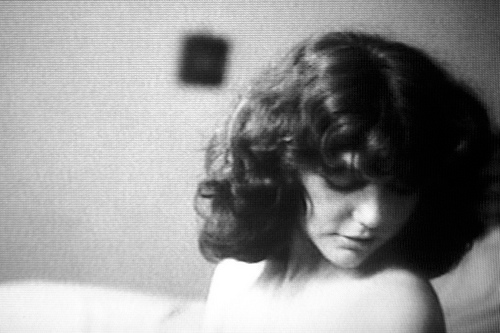
When Adrian Martin visited Chicago last May, I made certain not to miss the opportunity to record him for this video series. Martin was one of the earliest enthusiasts of video essays when they started popping up online a few years ago, and I've wanted to collaborate with him since. At the tail end of a busy trip (a film criticism conference at Northwestern Univeristy and a master class on dance in cinema at the Univeristy of Chicago), we met to discuss his all-time favorite film, Philippe Garrel's L'Enfant Secret / Secret Child. The ease with which Martin delivers his testimony is remarkable (and made for a pleasant editing session); perhaps it's no surprise given that Martin has recorded 33 DVD commentaries and has regularly appeared on Australian TV and radio. I've long admired the range of his work: from mainstream broadcast media to teaching at Australia's Monash University; his writing appears in everything from books to international film journals to his own online journals, such as Lola (co-edited with Girish Shambu).

What distinguishes Martin's scholarship for me is his passion for all that is improbable or even impossible about the cinema; how cinema breathes life into things that can't exist or last in reality. This spirit of vital, celebratory defiance in cinema came through in his presentation on dance in film that I attended: instead of doting on the familiar instances of Fred Astaire and Gene Kelly, he showed breathtaking clips from Leos Carax's Mauvais sang, David Lynch's Twin Peaks: Firewalk with Me and John Waters' A Dirty Shame that reconceive the meaning of cinematic dance as a gesture that somewhat defies meaning. That spirit of dancing at the fringe of our understanding can also be sensed in Martin's love of Philippe Garrel and especially L'Enfant Secret, a chronicle of a tortured, fragile existence that embodies those qualities in its material properties: a film that at times "threatens to disintegrate."

To some extent the delicate filmic qualities of L'Enfant Secret that are crucial to Martin's testimony can't be conveyed in an online video essay, due to the limitations of transposing the film between mediums.  One can only hope that this video will induce further efforts to present the film in its intended format, so that audiences might have the same visceral reaction that Martin relates in this video. In addition to this video, one should also read Martin's article on the film published in Transit magazine (in Spanish and English).

Adrian Martin is a film critic, scholar and co-editor of the online film journal Lola. He is winner of the Australian Film Institute's Byron Kennedy Award and the Pascall Prize for Critical Writing. 

Kevin B. Lee is Editor in Chief of IndieWire’s PressPlay Video Blog, Video Essayist for Fandor Keyframe, and contributor to Roger Ebert.com. Follow him on Twitter.

VIDEO ESSAY: A Drop of BLOOD Through the Heart – A TRUE BLOOD Tribute

VIDEO ESSAY: A Drop of BLOOD Through the Heart

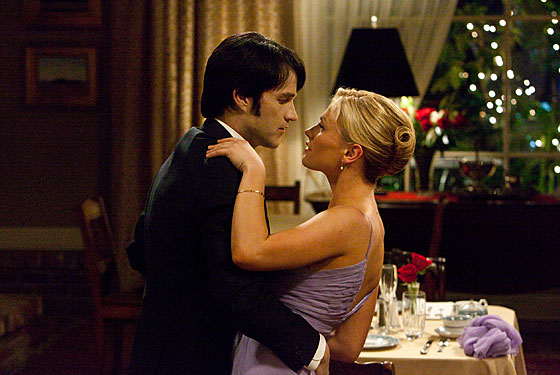
It's perhaps either a fitting coincidence or a realization of my own 20-something existential crisis that the making of this True Blood montage came shortly after I completed my video contemplation of the world of Mad Men's Don Draper. The similarities might not be obvious, but they are there: While Don Draper struggles to conceal his true identity as Dick Whitman as others around him try in vain to scratch beneath the surface, Sookie Stackhouse is still on a journey to reconcile her supernatural fairy blood with her human existence.

The essays contrast the question "Who is Don Draper?" with "What are you?" At its heart, True Blood is exactly about how we cope when we realize our constant, our humanity, is taken from us—new vampire Jessica's relationship with human Hoyt, shapeshifter Sam's investigation into the lives of his birth parents, and Bill's flashbacks to his first few decades as a vampire with Lorena are all examples. As the dearly departed Queen Sophie-Anne reminds Bill, "we started out [as humans] too." And when we left off in the Season 4 finale, mortality had never been more pressing than when Debbie and Tara had seemingly died—and perhaps even more shocking was Sookie's pulling of the trigger on Debbie in cold blood. I have a feeling that humanity, in addition to Tara's mortal life and Sookie's redemption, will be a huge theme in Season 5. And wild werewolves couldn't drag me away from seeing what happens next.

Serena Bramble is a rookie film editor whose montage skills are an end result of accumulated years of movie-watching and loving. Serena is currently pursuing a Bachelor's degree in Teledramatic Arts and Technology from Cal State Monterey Bay. In addition to editing, she also writes on her blog Brief Encounters of the Cinematic Kind.

VIDEO: A Todd Solondz Tribute Concert

VIDEO: A Todd Solondz Tribute Concert

Hailing “America’s crown prince of comic discomfort,” this week Film Society of Lincoln Center celebrated Todd Solondz with an advance screening of his new film, Dark Horse)—and this video attempts to do the same. It is, I hope, the ultimate tribute to the inimitable films of Todd Solondz. No director in the past three decades of American cinema has been as good at taking audiences where they don’t want to go as Solondz, who pokes at the ugliest of human behaviors and taps into an oozing vein of unexpected humor and pathos.

Watching all six of Solondz’s features prior to Dark Horse (including his debut, Fear, Anxiety and Depression), I was newly struck by how critical a role music plays in the work. From Welcome to the Dollhouse, with its suburban garage band’s off-kilter cover of the Stones’ “Satisfaction” and Dawn Weiner’s harrowing rendition of her school’s fight song at the end, to Jared Harris’s surprisingly touching serenade of “You Light Up My Life” in Happiness down to Life During Wartime‘s haunting interlude where Joy sleepwalks through suburban Florida to the tune of Devendra Banhart’s “Heard Somebody Say,” some of Solondz’s funniest and most lyrical moments have come through music. And while Solondz has dismissed Fear, Anxiety and Depression as a failed work due to reported lack of creative control, arguably its finest assets are the abundant musical numbers that run throughout, mostly written by Solondz, that charge the film with a giddy (if deranged) Broadway energy. His penchant for music is most explicit in his NYU student short “Feelings” where his own nasal crooning gleefully tears a new one in the old lounge chestnut.

This video takes three musical instances from Solondz’s filmography to form a kind of mini-tribute concert for the man’s work. Each song has its own distinct mood reflecting one side of Solondz’s flms and sensibilities, from tentative, hopeful yearnings of happiness, to painfully awkward romantic expressions, to surreal visions of suburban devastation. Once these songs lined up, the best moments of Solondz’s body of work fell into their natural place among them. Still, many great moments and lines didn’t make the cut, but this final musical trilogy still offers a potent six minutes of happiness, Solondz style.

Kevin B. Lee is Editor in Chief of IndieWire’s PressPlay Video Blog, Video Essayist for Fandor Keyframe, and contributor to Roger Ebert.com. Follow him on Twitter.

VIDEO ESSAY: Ridley Scott’s PROMETHEUS Timeline

VIDEO ESSAY: Ridley Scott’s PROMETHEUS Timeline

It’s perplexing to survey the recent surge of excitement from sci-fi movie fans about Ridley Scott. Sure, Scott’s two directorial sci-fi films—Alien and Blade Runner—set the benchmarks for the sci-fi horror and the sci-fi futuristic thriller, respectively, but Scott hasn’t directed a sci-fi film in thirty years. In fact, Scott hasn’t garnered much critical or financial success for a large chunk of his recent work (Body of Lies, Robin Hood, Kingdom of Heaven and A Good Year). So this excitement must be the result of two forces: 1) the studio’s clever marketing strategy of highlighting the fact that Scott only directed the original Alien, thus forgiving those late, lackluster spin-offs in the franchise; and 2) moviegoers’ desperate yearning for a credible companion piece to that same landmark 1979 film (e.g. Roger Ebert on the fourth Alien film: “There is not a single shot in the movie to fill one with wonder”). Considering these notions, Scott’s newest film, Prometheus, is destined to come under harsh scrutiny.

For starters, Prometheus was long thought to be a prequel to Alien—until Ridley Scott vehemently insisted that Prometheus was not a “prequel” per se, but a film that occupied the same fictional universe—a dark, capitalism-gone-awry space frontier full of privately funded space vessels and government-manned cargo ships—Scott created with Alien. This notion clashes with the studio’s marketing strategy of anchoring both Scott and Prometheus with Alien trademarks (the similar font for its title in the trailer, a strong female lead battling monstrous beings, etc.). As a result, much Internet speculation has surfaced regarding the possible linkage between Alien and the new Prometheus; where would Scott’s new film take place and would it feature the franchise’s aliens? The irony here is that Prometheus—once shrouded in secrecy—has become one of the year’s more transparent blockbusters. After releasing three (yes, three!) teaser videos announcing the arrival of its first theatrical trailer back in December 2011, Prometheus began a viral marketing campaign illustrating the visual history of its own place in Scott’s fictional universe. And if one were to do some homework and logical placement of events, the Prometheus-universe timeline would look something like this:

2023 – Weyland Industries Founder Peter Weyland gives a bold speech at a TEDTalks event, declaring humans’ new roles as Gods because of their ability to create human-like “cybernetic” individuals (a reality embodied in the Alien franchise, with Androids like Bishop and Call).

2089 – Archaeologist Elizabeth Shaw discovers an ancient map in a cave and then sets off a series of events leading to a space expedition to discover the origins of human life.

2093 – The Weyland Industries expedition crew, aboard the spaceship named Prometheus, lands on the distant moon LV-223. Instead of the origins of human life, they discover destructive beings (but not the titular monsters from Alien). The crew is killed. In the end, one of these destructive beings evacuates LV-223 in an ancient space pod of some sort.

The next date is not a Prometheus viral video; it is a known event from the original Alien film.

2122 –The crew of USCSS Nostromo (the cargo vessel carrying Alien heroine Ellen Ripley) investigates the planetoid LV-426 (which wouldn’t be too far from LV-223) and discovers a wrecked alien ship. Lo and behold, they find the fossilized remains of the destructive being from Prometheus.

In conclusion, Scott seems to have created a “peripheral prequel” to his historic sci-fi horror film Alien. There are no direct character lineages (outside of Weyland Industries) or same alien threats (presumably). The important difference between Alien and Prometheus seems to come down to Scott’s polarizing themes. With Alien, Scott set out to rewrite the space opera (e.g. Star Wars, Star Trek) into a terrifying gore fest. Judging from the ideas and content in the Prometheus viral videos (the origins of life, man’s ambition to play God), Scott now looks to expound on the hazards of ambition and hubris. If that’s the case, then maybe Scott’s thirty-year absence from sci-fi is worth the wait.

But this is all speculation. Maybe Scott just wants another monster to pop out of someone’s chest. We’ll find out on June 8th.

Nelson Carvajal is an independent digital filmmaker, writer and content creator based out of Chicago, Illinois. His digital short films usually contain appropriated content and have screened at such venues as the London Underground Film Festival. Carvajal runs a blog called FREE CINEMA NOW which boasts the tagline: "Liberating Independent Film And Video From A Prehistoric Value System."

VIDEO ESSAYS: The Seventh Art on GIRL WITH THE DRAGON TATTOO and SON FRERE

VIDEO ESSAYS: The Seventh Art on GIRL WITH THE DRAGON TATTOO and SON FRERE

This month the online video film magazine The Seventh Art has published two video essays on films: one on David Fincher's remake of The Girl with the Dragon Tattoo, and one on Son Frere and depictions of death and dying in cinema. The videos are part of The Seventh Art Issue 4.

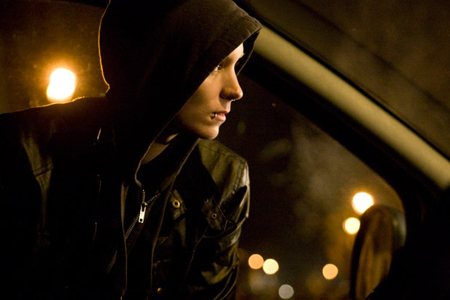
"The Girl with the Dragon Tattoo as a Meta-Remake". Written by Christopher Heron, edited by Simone Smith, sound recording by Brian Robertson, narrated by John Cohen. Excerpt:

The two most common types of film remakes at the moment are remakes of older films and remakes of recent foreign language films. The remakes of these foreign films aim to port the domestic success of a film to a North American market that has not seen the original. David Fincher’s remake of The Girl with the Dragon Tattoo is somewhat of an aberration because the original film had grossed a very healthy $10 million in the United States based, in part, on the success of the source novel. Compare that with the recent remake of Let the Right One In, another Swedish domestic success, which only accumulated $2.1 million in the U.S. ahead of its own American remake. It’s fair to say that The Girl with the Dragon Tattoo is a unique remake where a fair amount of the prospective audience is aware that it’s a remake.  

"'The Color & the Texture of Blood': Visible Mortification of the Body in Son frere." Written by Elysse Leonard, edited by Christopher Heron, sound recording by Brian Robertson, narrated by John Cohen. Excerpt:

Classical cinema’s approach to non-­‐violent, or “natural,” death can be differentiated from that of post-­‐classical cinema in several ways. Death in classical cinema is meaningful, narratively functional, and, perhaps most significantly, invisible. Post-­‐classical death, however, is irrational, contemplated, and highly visible as a material process. This is represented in Son frère through a nonlinear story, close-­‐up shots of the body and the use of camera to identify with the dying character.

VIDEO: Sight & Sound Film Poll: Ekkehard Knörer and Michael Baute on UNDER THE BRIDGES

VIDEO: Sight & Sound Film Poll: Ekkehard Knörer and Michael Baute on UNDER THE BRIDGES

The fifth video in our ongoing series is the first to involve a film on my own top ten list for the Sight & Sound Film Poll. But I'm not one of the commentators on the video. Nor is the film on the top ten list of either of the commentators. But somehow the three of us form "an inclusive whole" (to use a phrase in the video) to make the case for why Helmut Käutner's Under the Bridges is one of the greatest films ever made.

I first watched the film three years ago as part of Shooting Down Pictures, where I started producing video essays. My viewing of the film came weeks before a trip to Berlin, where I discussed my video essays in public for the first time, as part of the series Kunst der Vermittlung (translated as "Cultural Education" according to Google) organized by Stefan Pethke, Michael Baute, Volker Pantenburg, Stefanie Schluter and Erik Stein. This was an extensive series of screenings and talks dedicated to showcasing film criticism and scholarship performed within the medium of film and video.

I was really taken by the project organizers' enthusiasm for this sub-genre of filmmaking and film criticism, and proposed to collaborate on a video essay on Under the Bridges. Michael Baute accepted the invitation and also enlisted the help of Ekkehard Knörer, editor of the film journal Cargo and one of Germany's leading film critics. We met at Michael's apartment in Kreuzberg, I with my recording equipment and Michael and Ekkehard with a voiceover script they prepared. We recorded the narration; later that day Michael accompanied me on a boat tour of Berlin's Spree River, where we filmed several bridges, thinking it might be a good visual element for the video. I concluded my visit happily and went back to the States with freshly recorded footage ready to edit.

Three years later, the video is finished. I'll refrain from listing extenuating circumstances for why it took three years to make this video essay. I've already apologized to my collaborators, and I am happy to report that they are satisfied with the results. This comes as a relief to me, because the quality of their commentary is such that it may have caused some trepidation on my part, contributing to the delay. Until that time, I had never been handed such an eloquent and extensively prepared narration with which to produce a video. In fact, this narration played no small part in opening my eyes to the splendor of this film.

Knörer and Baute talk about the film's attempt to create beauty in the most unlikely and unyielding circumstances: the end of the Nazi regime, with bombs falling all over Berlin and hardly any resources for filmmaking. They talk about a film whose style embodies a richness borne of poverty: finding the sublime in the most quotidian images and slightest of gestures. They talk about the alchemy of filmmaking, creating miraculous effects out of an improbable scenario bordering on a whimsical absurdity out of touch with the reality of its times – and yet strangely appropriate, even necessary. Necessary because of the small, delicate, and redemptive human touches that float across the screen from start to finish, and that culminate in a feeling of unassuming yet profound grace.

As modest in its brilliance as it is brilliant in its modesty, Under the Bridges is precisely the kind of film that deserves to benefit from an exercise like the Sight & Sound Critics Poll. While many come to the list curious about the new consensus over what the greatest films are, many others are craving to discover lesser-known titles that others passionately cherish. This is such a film. Please watch this video, and learn about one of the greatest films ever made. – Kevin B. Lee

Ekkehard Knörer is a film critic and editor and co-founder of Cargo Film/Medien/Kultur as well as the editor of Merkur Deutsche Zeitschrift für europäisches Denken.

Michael Baute works as an author, critic and curator and in various media-related projects. Since 2001 he is a contributor to the weblog newfilmkritik. In 2006 he (together with Volker Pantenburg) published a book on Charles Laughton’s Night of the Hunter. Recently he’s been the artistic director of Kunst der vermittlung, a website and screening series exploring the art of video-form criticism.

Kevin B. Lee is Editor in Chief of IndieWire’s PressPlay Video Blog, Video Essayist for Fandor Keyframe, and contributor to Roger Ebert.com. Follow him on Twitter.

TRANSCRIPT

EK: "Under the bridges" is a film about Willy and Hendrik, two skippers on a cargo barge who, as a song sung by one of them makes explicitly clear, have led a skipper's promiscuous life. This, however, they have now decided, has to come to an end. They are, very literally, on the lookout for a woman to love. They both are, which brings up the issue of their friendship, their life together on this barge named Lotte. "Under the bridges" on the surface is not much more than a romantic comedy about these two men and their attempt to find a way of integrating a woman in their unsteady lives. But "Under the bridges" is far stranger than it seems. It was shot in wartime, from May to October 1944. You wouldn't know from the film. The Berlin you see is a city in peace. Its buildings are unscathed. Indeed, everything here, these industrial buildings, the landscapes and even these people and their relationships, seem made up from the scraps of better times. But they had no means at all, no money, when they did it, bombs were falling at the time, it really is an arte povera film.

MB: The question then becomes: Is this escapism? The devastations of real life in Germany at the time seem purposefully suppressed in every single image and montage. But at the same time something else makes itself felt underneath the peaceful floating of the barge and the joking and the erotic innuendo. "Under the bridges" is in every respect a film about having to make do, about never expecting too much, about confining yourself to what is near. This is true of Hendrik and Willy who are never es free and independent as they seem. There is even an explicit symbol for that in the film: their barge lacks an engine so they have to rely on other boats taking their barge upriver.

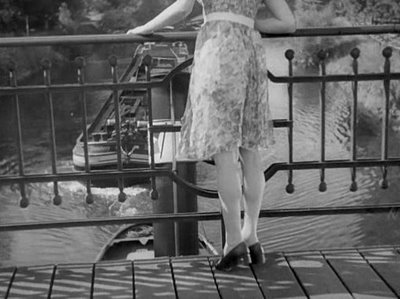
EK: Anna, the woman, with whose fate theirs will be connected, is in quite similar a position. She has very recently arrived in Berlin from an Eastern province and her first attempt to find a partner has disastrously failed. When Hendrik and Willy "meet" her she is standing on a bridge, at night, throwing money in the water. Hendrik and Willy suspect that she may jump and follow the money, with suicidal intent. They take her on board and they begin, in their unassuming ways, wooing her. It seems an impossible task this story has set for itself: Making one out out of these three on an allegorically floating thing like this barge.

MB: There is a kind of suspense in the film that has little to do with the question of how to succeed with that. (And it is obvious that success can only lie in all of them finally taking something like a back seat.) No, the real suspense of the film has much to do with a back and forth of little charges and discharges. This is one of the film's most intimate scenes. It is Anna's first night on the boat, she can't sleep, alone on a boat with two strangers, but also because of all the little noises. Hendrik, however, explains it to her. These natural sounds, made by the rope and the reed, are not noises, but in fact they are music. Natural life, the everyday, is in this way charged with the notion that in fact it is something more poetic. In this case: music. Listen to that.

EK: "Under the bridges" is a film about efforts, but in an almost paradoxical way: efforts are being made to make things seem effortless. It is a film where every feast is frugal, but frugality is made into a feast. And love, the feast of feasts, is effortlessly made into something on which not too many efforts, nor too many words or too many gestures or feelings should be spent. Modesty is what this film strives for, in the middle of a war it makes every effort to ignore. Efforts are visibly made, however, also on the aesthetic plane. "Under the bridges" is not simply a film in the vein of what very soon will be called neo-realism. The expressionist heritage makes itself felt in quite a few scenes playing with darkness and light. The camera moves in rather sophisticated ways, and also the actors are moving naturally and at the same time seem quite choreografed. The effortless flow Käutner achieves comes from his blending of these two seemingly contradictory movements.

MB: Let's concentrate on two emblematic scenes. In the first one Hendrik comes to surprisingly visit Anna at her place. She lives in one of those Berlin courtyards. All she can see of the city is a cigarette ad on the wall of a building and a rather small aperture between the walls of this yard. And now they are intimately together. It is, in its very own way, the film's major love scene. Nothing much happens but in this "nothing much" lies the core of this film's ideology. You have to make do. Käutner manages to charge the most frugal rapprochment with a lot. This is the film's most moving scene because it sums up what "Under the bridges" is all about: You have to be able to find the jubilatory in even the most everyday gesture. One later scene even plays out like a montage reminding of Walter Ruttmann's "Berlin, Symphony of a Big City". We see Anna and Willy on a small lake in a much smaller boat. They stop, under a bridge, in the dark. What we experience here is more than one denouement. This is the moment when Willy learns that all his hopes are dashed, that Anna will never love him, but has always only loved Hendrik. All Käutner needs and wants at the moment is another very small gesture: Willy is lowering his head. He takes this blow in the most modest and gentle way possible.

EK: This most definitely is not a typical scene for the film. But it is decisive and absolutely necessary because it delivers all the plot details whose postponement has kept this potentially melodramatic story so low key before. All the melodramatic potential that Käutner so purposefully never unfolds is compressed into this fast and technically rather elaborate montage. It's a film in the film, so to speak, that by absorbing most of the narrative as well as the emotional pressures makes possible the seeming effortlessness of the low key semi-comedic rest of the film. And, one could argue, the solution that will be found is only possible after this intricate denouement. This scene, I would say, is the film's hidden engine. It makes the rest of it flow so effortlessly. The happy ending is no longer a miracle after that.