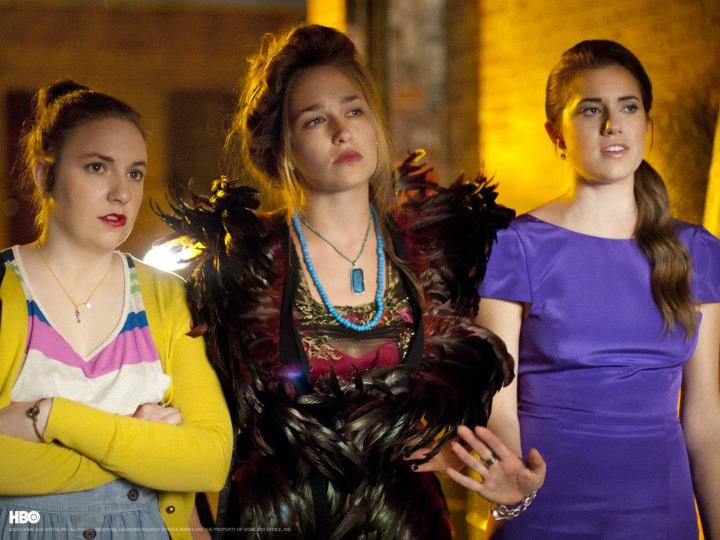
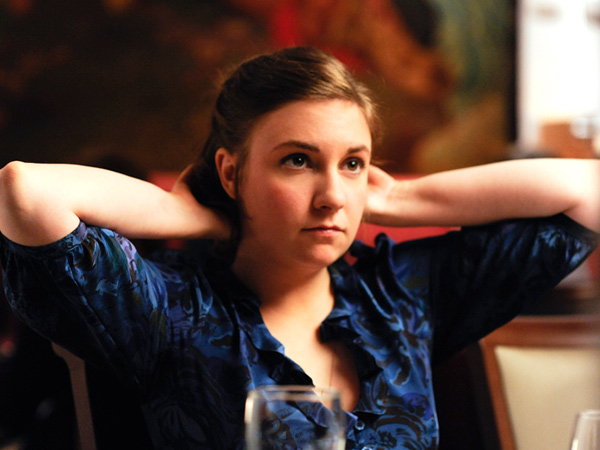
GIRLS RECAP 6: THE RETURN

GIRLS RECAP 6: THE RETURN

null

One of the things I liked most about The Return—and I liked a bunch of things—was its title. Nearly every series has an episode like The Return, in which the hero returns to his/her place of origin to find things much changed for the smaller; after years of recapping serial television, on seeing that title, I'd originally expected the customary uncreative variation on one of the plots sure to follow—"Going Home," for instance, or "Homecoming," or a pun on the idea that you can't go home again or it's where the heart is.

null"The Return" was written by Lena Dunham and Judd Apatow, who pick up the clichés that surround "home" and see what icky bugs run out from underneath by sending Hannah to her parents' house in Michigan for the weekend, for their thirtieth anniversary. The episode defines and redefines "home" as it applies to Hannah: as an oblivious twentysomething, as a New Yorker, and as an adult only child. And it starts with the "oblivious" part when Hannah's heading to the airport. Marnie—Hannah's mother hen by proxy—leans out the window to remind Hannah that rent is due next week, and admonishes her to "be nice to your parents. Okay?" "I'm the nicest!" Hannah chirps.


She tries to be, but not very hard. Hannah slogs off the plane, lugging the garbage bag full of laundry that's serving as her suitcase. (In what post-2001 fantasy-land would the Hefty luggage get past TSA? Marnie would have made her borrow a duffel bag, I think.) Mom and Dad are waiting over-eagerly at the curb (next to their Volvo, natch); Dad is holding a sign with a picture of bananas on it, and mentions on the ride back to the house that they couldn't think of a better way to spend their anniversary than with "our best friend, who we just happened to create." That idea, simultaneously sweet and inappropriate, comes up repeatedly in the ep; her parents seem to have always treated Hannah as a sort of peer, but now that she's a real voting adult, nobody quite knows how to deal with that reality.

Mom responds to Dad by mentioning local job listings; she's doing it because she misses Hannah, but Hannah is immediately defensive. Mom also mentions the "fun Netflix" they've got at the house, a spot-on parental detail that Hannah is too busy texting, then stomping out of the room when Mom suggests she's hungry, to appreciate. (The movie they're watching: Million Dollar Baby. Rimshot!) Hannah flops on her bed, stares at her Party Girl poster, ignores a text from Marnie asking if she got the rent money from her parents, and calls Adam's phone but hangs up after one ring—she's put herself in his mind, but can plausibly claim that she just butt-dialed him.

And Dad assumes that Hannah is going on their anniversary "date," but Hannah declines—not because it's kind of weird, although she does mention that, but because she has a date of her own. Eric , whom Hannah meets when her frantic mother sends her on a mission to pick up hot-flash meds, is a sideburned cutie who co-owns a local pharmacy with his father, and a stark contrast to Adam in every possible way: traditionally good-looking; makes good money in a non-creative field; reacts with disbelief when Hannah tries to put a finger in his poop chute during sex, then murmurs to him, "I'm tight like a baby, right?" The look on Hannah's face when he initiates no-kink missionary intercourse is almost pitying.

He's a pleasant, solicitous young man with a business-like, adult relationship with his father, and he's definitively Not Adam. He's also definitively Not New York, and the automatic, unearned superiority Hannah feels to her high-school classmates—one perpetrated by New Yorkers of all ages—is another theme of the episode. It's made explicit in the pep talk Hannah gives herself in the mirror as she's getting ready to go out: "You are from New York, therefore you are just naturally interesting, okay? It is not up to you to fill up all of the pauses. You are not in danger of mortifying yourself." The latest in a line of unbecoming vintage frocks would beg to differ on that last point, as would the moment where she mentions offhandedly to Eric that she gave up on vegetarianism because Adam had nothing to eat at his place except meat—and because she thought that, if she went out for food, Adam wouldn't let her back in.

Hannah's New York bias in favor of, well, herself is even stronger in her interactions with Heather, an old high-school friend. We've seen framed pictures of Hannah and Heather in Hannah's old room, but they haven't kept in touch; Hannah hasn't heard anything about "the benefit"—the fundraiser Heather has put together for her friend Carrie, who got Natalee Hollowayed on a spring-break trip. Hannah also hasn't heard that Heather's about to move to Los Angeles to pursue a dance career, and when she asks whether Heather has any contacts out there to help her get started, Heather shrugs airily, "I know enough to know that you don't really have to know anybody."

In a way, she's right, because based on the moves we see, no contact short of Alvin Ailey could get Heather a job that wouldn't involve a pole—but it's Hannah's attitude we're meant to look at, and she believes that she knows better than Heather simply by virtue of living in "the big city" herself. Heather's belief that she merely has to move to L.A. and go on auditions to "make it" sounds innocent, even silly, but we've seen that Hannah cherished the publishing-world version of that belief. (And may yet cherish it.) Yes, the "benefit" is low-rent (to underscore the point, Edwin McCain's obnoxiously ubiquitous "I'll Be" is playing when Hannah and Eric walk in), and when Hannah buries her face in her pint to keep from laughing, it's sad for Heather and her inappropriate booty-dance of tribute to Carrie. It's also sad for Hannah, who thinks she knows something Heather doesn't about how to make it in a creative field.

Hannah's rant to Eric afterwards is revealing; Eric concedes that Heather's show "was a little cheesy," and Hannah wails, "It was very cheesy, and nobody's telling her! She's gonna go to L.A. and live in some shitty apartment and feel, like, sad and scared and lonely and weird, all the time, but she's got a good life here. I would like her life." Noooo kidding—that speech isn't a prediction for Heather's life, it's a description of Hannah's. When Eric jokes that he knows the florist has a job opening, Hannah retreats to the safety of Gotham-centric condescension, saying she'd get "a real job, like a teacher or something." Eric, bless his heart, doesn’t point out that she'd need a master's or certification to do that, just asks what her real job in New York is. She snaps that she's a writer, like she told him. Eric is surprised: "That's how you make money?" Hannah non-answers, "I don't have any money." I had that "no no no, it's not what I do, it's what I am" conversation about my career several times. In those conversations, it’s impossible not to sound like a stubborn jackass who should suck it up and sit for the LSATs before she winds up in bankruptcy court, and that's exactly what Hannah sounds like. But I can relate.

So can her father, as it turns out, but his "relating" to Hannah is more like "projecting." He's filling the space she's left at the dinner table by worrying aloud about her. "What does a person like that turn into?" he wonders, adding that she's funny and likable, "but that and ten cents . . ." Such a dad-ly expression, that. Mom thinks his assessment is harsh, but it’s really about Dad's own disappointments: "At what point will she realize, she's not gonna get to be what she wants to be when she grows up?" Like Hannah's comments about Heather moving to L.A., this isn't so much about the subject of the remarks as it is about the utterer; apparently Dad's life didn't turn out like he'd dreamed. Mom is taken aback by his lack of faith, and asks how he knows. "You know that, you're the one who forced us to cut her off to help her realize that!" Interesting take on what we saw; Mom did force the issue, but according to her, she wanted to have a lake house. Now she's singing a different tune: "I cut her off so she'd have something to write about!" Dad grumbles that "we don't even know if her writing is any good." It's hard to tell if this is a comment on how Hannah doesn't produce much in the first place, or if her parents just don't read it (remember how they left the pages she'd brought them behind in their hotel room?), but Mom thinks that Hannah knows how to have fun, "and she thinks about that fun, and she learns from that fun." The pronouncement is completely irrelevant to what makes a good, or successful, writer—but it also shows exactly how parents misunderstand what a writer does.

Certainly her parents try to supply Hannah with material later that night. Dad, vigorously pumping Mom from behind in the shower, slips and hits his head on the bathroom floor. Hannah comes home to find them dishabille, Mom trying to revive Dad, Dad naked and worried about a back strain, and has to help Mom haul Dad off the floor and into bed, suggesting repeatedly that he put a towel or a robe on.

After Dad's safely tucked in, Mom makes a gentle "not Mr. Right, but Mr. Right Now" observation about Eric that Hannah's surprised to hear the truth in, then asks if Hannah's doing okay financially, admitting that they cut her off rather abruptly. But they're proud that she's "making it work"—and Hannah, after taking a moment to consider asking for rent money anyway, chooses to pretend that she is making it work. Or vows to actually make it work.

Later, Adam calls. When Hannah says she's at home, he duhs that he is too, but she clarifies "home home," at her parents' house. She tells Adam about Dad's "sex injury," and about her own Eric-scapade, asking if it's "weird" that she told Adam that she slept with someone else. She's hoping it is, and the fruitlessness of this attempt to arouse his jealousy is as familiar to her now as her old high-school life no longer is. But Adam—wearing black undies and a lacy green satin sleep mask—doesn't react, so she changes the subject to Eric's gigantic, cheap apartment, wondering why they kill themselves to stay in a city that doesn't want them. Adam misses her. She's pleased, because she misses him—but what she really misses is home, the city, her life. She asks Adam to tell her what's going on out his window, and as he narrates a neighborhood crackhead's perambulations, Hannah stands on her parents' silent, dark front lawn, listening.

The Return is well crafted, subtle and smart about that day in every adult child's life when she refers to "home" as college, or her current city, and her mom goes quiet. It portrays Hannah's New York tunnel vision accurately without expecting us to sign off on it, and it asks what the definition of "home" is without answering its own question. Nice work by the supporting cast, especially Becky Ann Baker and Peter Scolari as her parents (and Little Scolari, heh), as the show itself "returns" to the exact observations that make it work best.

Sarah D. Bunting co-founded TelevisionWithoutPity.com, and has written for Seventeen, New York Magazine, MSNBC.com, Salon, Yahoo!, and others. She's the chief cook and bottle-washer at TomatoNation.com.

GAME OF THRONES RECAP 7: A MAN WITHOUT HONOR

GAME OF THRONES RECAP 7: A MAN WITHOUT HONOR

What makes for a great Game Of Thrones episode? What stories can it tell that could put it on the rarefied level of, say, HBO’s holy trinity of The Sopranos, Deadwood, and The Wire? I’m not sure how I would have answered this question before seeing “A Man Without Honor.” I would not have expected to say that arguably the show’s best episode would have only one major event combined with a series of dialogues. This isn’t a surprise, given that the dialogue and characters are some of the strongest components of the show, but it is somewhat odd, given how many different storylines are going on at once, that so few move directly forward.

Instead, in scene after scene, we’re shown reasons why these characters are important, and why the stakes are so high. Not many of the metaphorical poker hands are fully played out, but watching them progress gives us insight into most every major character as well as a few minor ones.

Take, for example, the centerpiece of the episode, Jaime Lannister, in his cage, talking to a cousin he barely remembers. The cousin squired for Jaime once, and clearly worships Jaime as a hero. They reminisce. They bond. Jaime supplies us with a bit of exposition, a reminder of the currently missing Barristan Selmy. They discuss their current situation. “I’m not well-suited for imprisonment.” Jaime has a plan of escape. The cousin wants to know what he can do. Jaime says “die” and then kills the man he just charmed.

There are two good reasons this scene shouldn’t work. First, it’s been done before. In the middle of the first season, Jaime talked with Ned Stark’s guard, Jory Cassel. After initially dismissing Jory, the two men ended up bonding over past war stories. Shortly afterwards, Jaime killed Jory with no regrets. For this reason, and because of the slow buildup of danger via the blocking, lighting, and music cues, Jaime’s violent turn isn’t a surprise. It's still a great scene, though.

Nikolaj Coster-Waldau’s performance as Jaime Lannister deserves the credit here. From the beginning, he has imbued Jaime with the charisma and power that the novels tell but don’t show until much later. He’s been largely off-screen this season—there's only so much you can do when chained in a cage—but Coster-Waldau’s cheerful cynicism dominates anytime Jaime is on-screen.

Only writing this now do I realize that Jaime didn’t say much to the poor boy he promptly murdered, beyond generic platitudes. Perhaps he did remember the boy, and spoke to him as a friend because he wanted some pleasant human interaction even as Jaime planned his cousin’s murder. Perhaps he didn’t remember the lad, and simply told him what he wanted to hear in order to get him within arm’s reach. Jaime was built up as the primary villain in the first season, but here, imprisoned for months and covered in his own shit, plotting a desperate, doomed escape, he seems even more dangerous.

This may have been the standout scene of the episode, but “A Man Without Honor” is filled with one-on-one interactions, most of them good, some of them brilliant. Arya Stark’s dangerous sparring with Tywin Lannister is dramatically improved this week, after the too-farcical physical comedy last week. Instead, tonight it’s a game of wits. Seeing both Charles Dance and Maisie Williams take each other on is a joy, and further confirmation that Williams is a potential star. This is one of the show’s funniest-ever scenes, with Dance’s slight facial expressions showing how impressed he is with the girl’s audacity, and Arya just barely staying ahead of Tywin’s probing questions.

Almost every major character gets a scene where the tension of their surroundings is built and detailed. Sansa Stark continues her awkward, tense relationship with The Hound, who seems to have adopted her as a pet of his own, saying “You’ll be glad of the hateful things I do when you’re queen, and I’m all that stands between you and your beloved king.” This may be Sophie Turner’s best episode as Sansa, and it’s also the one where she’s had the most to do, as Sansa’s first period shows up, making her betrothal to Joffrey much more likely to be completed. With this known, she meets with Queen Cersei, whose odd mentoring of Sansa is even more explicit than The Hound's, thanks to Tywin’s parallel relationship with Arya Stark.

Cersei then meets with Tyrion Lannister, and finally shows vulnerability, admitting that her children were born of incest and how troubled she is by Joffrey. During the first season, I thought Lena Headey was the weakest actor in the ensemble, constantly relying on her “scrunchyface” to convey any emotion, genuine or manipulative. With a bit of vulnerability on display, Headey manages to make a scene where Tyrion and Cersei bond a bit seem honest and even sympathetic. It also serves as a reminder that Stannis, with his huge fleet and new army, is less than a week away from the capital, and close to the climax of the season.

Some of the most fun comes from the romantic comedy Beyond the Wall, where Jon Snow continues to hold the wildling Ygritte prisoner. Much like Jaime Lannister’s scene, there are lots of reasons to dislike this storyline: Ygritte’s sexual manipulations are so transparent as to be downright wacky, and the part where she argues about who owns the land struck me as overly-modern, with its anti-colonial discourse (“You lot just came along and put up a big wall and said it was yours!”). The acting, once again, helps—Rose Leslie sells both the sexuality and the wildlings’ different norms—but I think the real work is done by the location. The scenes north of the Wall were shot in Iceland, and the craggy hills, tundra, and cold, cold snow and rain imbue the apparently comic scenes with seriousness and even danger.

Also, impressively enough, several episodes in, Jon’s half-brother Robb Stark and his infatuation with the nurse Talisa has finally gotten to the point where it doesn’t stand out as the worst part of the episode. That, surprisingly, goes to Dany’s adventures in Qarth, where her pursuit of her dragons’ kidnappers leads her deeper and deeper into a storyline where she lacks agency, which she attempts to make up for by screaming, in increasingly petulant and shrill fashion. (She sounds like Mel Gibson in the commercials for Ransom, yelling “GIVE ME BACK MY DRAGONS.”) It’s disappointing given the depth Emilia Clarke brought to Danaerys in the first season.

And then Game Of Thrones tosses in a sucker punch. After an hour of scenes consisting almost exclusively of two people talking to one another, the action returns to Winterfell and Theon Greyjoy’s pursuit of the younger Stark boys. After a day of fruitless searching, Theon returns to Winterfell, claiming to have found the boys, and offers proof: two charred, dismembered children’s corpses. The grim music rises as we see that a character who began the season as a sidekick to one of the heroes is now a child-murderer. That doesn’t relieve the tension built up over the course of the episode—it hammers it in. That’s what will make Game Of Thrones worthy of inclusion in the tevevision pantheon.

Adaptation:

As far as I can tell, every single scene in this episode was significantly altered, or simply invented, compared with the novel. Robb’s, Arya’s, Dany’s, Jorah’s, and Jaime’s scenes with the cousin are totally new. Jon and Cat have had their scenes altered chronologically, and their motivations have also been changed due to alterations in previous episodes: Qhorin didn’t leave Jon with Ygritte for days in the novel, instead disappearing for a while, then returning.

Missing characters change the structure and meaning of Bran’s main scene in the episode—a friend with a premonition of the dead bodies has been deleted and has had his character merged with Osha, who doesn’t have that gift. Meanwhile, Theon’s worst impulses are being exacerbated by one of his crew, instead of by another major character (who will apparently be introduced later). Sansa’s scene with Cersei may be the only one to be relatively unchanged from the novel.

I would quibble with some of these decisions—in fact, I almost certainly will next week when we see the fallout from Cat’s confrontation of Jaime—but overall, I think this marks a turning point for Game Of Thrones as an adaptation. It has fully detached itself from the source material. It still uses the books' themes, characters, and overall story, but it now has the confidence to be tell that story in its own fashion.

Rowan Kaiser is a freelance pop culture critic currently living in the Bay Area. He is a staff writer at The A.V. Club, covering television and literature. He also writes about video games for several different publications, including Joystiq and Paste Magazine. Follow him on Twitter @rowankaiser for unimportant musings on media and extremely important kitten photographs.

MAD MEN RECAP 8: DARK SHADOWS

MAD MEN RECAP 8: DARK SHADOWS

"I’m thankful that I have everything I want, and that no one else has anything better."

nullBetty can't just be happy. She can't just have what she wants. Having what she wants doesn't feel good. Instead, what feels good is having what she wants at the expense of others. It's a mean-spirited way to live, and no amount of window-dressing can make it sound nicer. "Selfish" would be an improvement. She lacks self-awareness to such an extent that she can say the above as a sincere expression of gratitude at Thanksgiving. The Internet is full of Betty haters, and I don't consider myself one of their number, but this aspect of her character cannot be explained away, softened, or justified. It's just nasty.

I know what you're thinking. You thought I'd open with the "Every man for himself" quote. Clearly, that's the, or a, theme of Mad Men Episode 5.09: Dark Shadows, and it's also something that Matt Weiner has been talking about in the media. Because Weiner is so secretive about what's to come on the show, when he releases a quote or a theme, it spreads like wildfire in the blogosphere.

Yet "Every man for himself" only takes us halfway on our journey. Don could have pushed hard for himself without ditching Ginsberg's work in the cab. Betty could work to lose weight and be a supportive wife without trying to destroy Don's new marriage. Pete could pursue Beth Dawes without taking a shot at her husband. (Check out Pete's delightful Beth fantasy in the video below, and don't fail to notice that Pete can't fantasize about sex without fantasizing about power and recognition as well.)

So, it's every man for himself, sure, but it's also about crushing the other guy in the process, and the notion that success just isn't as much fun unless someone is under your bootheel. I don't think many fans love Jane Sterling, but her plaintive realization that she's been defeated by Roger touched me: "You get everything you want, and you still had to do this." That, as much as Betty's Thanksgiving gratitude, is the real point: Winning in this show's world is hollow unless someone else loses.

What are the major plot lines this episode? First is Betty: Her weight struggle, and her competitiveness with Megan. Then comes Don and his competitiveness with Ginsberg. Then there's Roger, who is competing with Pete for business and with Jane for a sense of ownership. Others are swept up into various competitions: Peggy versus Ginsberg, Pete versus Howard, Julia versus Megan. These people compete not only for themselves, but because they specifically and pointedly resent what others have.

I doubt fans will love this episode. There is, first of all, the Betty backlash to contend with. I think her character was absolutely compelling this week, but she usually sets off an Internet Comment Shitstorm. You heard it here first. It was also kind of a difficult episode. It didn't have a lot of BANG WOW moments: I mean, sure, Megan in a bra, Beth in nothing at all, but no hand jobs or blow jobs or fisticuffs in sight, so maybe people will feel shortchanged. I also think seeing this kind of nastiness can be wearing; it feels petty and so you come away from it like Sally at the end of last episode; "Dirty." The "killer smog" at the end of the episode really happened, and it also serves as a symbol for the creeping toxicity of these cutthroat shenanigans. It makes it hard to breathe for all of us, and I suspect some portion of the audience might react negatively. [Click through to the next page for more…]

A second, connected theme is secrecy, and people being outed. This is threaded throughout Dark Shadows: Secrets and the ability to expose secrets represent power, and power is what our characters compete for. Nothing is more insidious than Betty's "sweetly" mentioning Anna Draper to Sally (watch it below):

In Betty's version of self-revelation at her Weight Watchers' meeting, she's so vague as to border on meaningless: She says merely that she experienced something that upset her. What upset her was another person's happiness. Don and Megan have a magnificent apartment, and Megan has a young, beautiful body. Betty can barely contain how awful this makes her feel. Inadvertently finding a love note from Don to Megan puts her over the edge: It's simply not okay for them to be in love, for Don to be sweet to Megan, for the Draper apartment to be more beautiful than the Francis house. (By the way, Megan is wrong about the distance; it's 25 miles from Rye to 73rd and Park.)

Betty setting up Sally to ask just the right question to create havoc reminds me so much of Betty setting up Sara Beth in the Season 2 episode Six Month Leave (Betty has an Episode 9 pattern, I guess). She manages her feelings by making others suffer, this time in an episode where the Weight Watchers leader talks about stuffing the feelings you can't express using food. Betty wants to feel differently; swallowing the mouthful of canned whipped cream and then spitting it out is a perfect encapsulation of that YES NO YES NO feeling; wanting and not wanting, stuffing and letting it out. She offers just the right kind of support and wisdom to Henry even while spreading her poison.

So, Betty tries to use outing someone's secret as a weapon, and we get a sense of that with Jane and Ginsberg, too: Jewishness is a secret you have to keep in Roger's social circles, a secret Roger required Jane to keep. Now he expresses power over her by pushing that secret out of the shadows. Roger wants Ginsberg to keep a secret and he says no; Peggy kept a secret for Roger, and each was paid for it (although Peggy was paid a lot more). Whoever holds the reins to a secret is ahead in this "doggy dog world."

Some additional thoughts:

  • Henry wonders if he "bet on the wrong horse" for nothing. It seems like Betty is wondering the same, and Henry is that horse.
  • It looks like a senility plot might be in Bert Cooper's future. Correcting "hip" for "hep" makes him seem amusingly out of touch, but not knowing that Roger and Jane are divorcing could be a bad sign.
  • Betty really enjoys food this episode: Whether it's her meager breakfast, or a bit of steak, or a tiny bit of Thanksgiving dinner, she chews with gusto. In past seasons, when thin, she barely ate at all. Allowing herself or not allowing herself to experience pleasure is a whole motif with this character. At least chewing is some kind of start.
  • On the other hand, I feel like the chin appliance gets in the way of January Jones's ability to use her face expressively.
  • Okay, fine, I said I wouldn't, but I'll give quote of the week to this: Peggy: "You are not loyal. You only think about yourself." Roger: "Were we married? Because you’re thinking about yourself too. That’s the way it is, it’s every man for himself."

Deborah Lipp is the co-owner of Basket of Kisses, whose motto is "smart discussion about smart television." She is the author of six books, including "The Ultimate James Bond Fan Book."

Watch Mad Men Moments, a series of videos on Mad Men, produced by Indiewire Press Play.

GIRLS RECAP 5: HARD BEING EASY

GIRLS RECAP 5: HARD BEING EASY

More like "Hard Writing Consistently." What was that?
 

nullFor four episodes, Girls has stayed on the right side of believable. Not likeable or admirable, necessarily, when it came to the three leads and their behavior (I'll excuse Shoshanna from the discussion for the time being), but we don't have to like characters, or find them attractive physically or emotionally, to see something familiar in them and in the situations they move through. Our interest in a narrative isn't always about comfort, or escape. Sometimes, it's about recognition. I wouldn't characterize Girls as holding a pitiless mirror up to a generation or anything, but I think it gets at certain truths that lie underneath (and/or in) the pretension and self-absorption and unprofessional bumbling, or at least it tries to.

I don't know what "Hard Being Easy" was trying to do, besides annoy/baffle the audience. (Mission accomplished.) The episode has a handful of neatly observed moments, and the usual complement of too-awkward-to-watch bits . . . but the awkwardness didn't come from the characters this week. It came from Lena Dunham losing control of the material.

The Marnie/Charlie storyline picks up shortly after the end of the last episode, and it's well done—but it has to climb uphill from a ridonkulous beginning in which Charlie forces Hannah to read aloud from the journal in front of him and Marnie. Hannah goes along with this, despite the fact that 1) Charlie (well, mostly Ray, but whatever) violated her privacy, 2) Marnie threw a drink on her and called her a bitch, 3) neither of them apologized, and 4) whatever Hannah's involvement, the only credible action for any character would be to hole up elsewhere until the couple's storm blew over. And Hannah not only goes along with it, she corrects them, saying it's "notes for a book," not a journal, and asks for feedback on the writing. Yes, Hannah lives in her own bellybutton, but this isn't believable behavior from anyone.

The rest of Marnie's subplot resonates, though, from Ray overplaying the loyal-best-bud card, to the revelation that Marnie has never gone to Charlie's apartment (once there, she admiringly notes that it looks like "a Target ad"), to the flashback to college in which Marnie and Charlie meet. Marnie has taken an unknown drug at a party and is disappearing down a paranoia-hole. Hannah tends to her for a while, then heads off to dance with Elijah (to the Scissor Sisters, after Elijah "curates" Marnie's bangs with a flick of his forefinger. . . . Hannah really thought that guy was straight? For two years?), leaving Charlie to mind Marnie. The narrative pun on "high maintenance" aside, it makes perfect sense that this is how they met, that Charlie ministered to her from the beginning. (Charlie's wig, however, is inexplicable. I get why the actor is wearing one, but—that one? Did Charlie just come from an '80s-Stamos-impersonator contest?)

Their break-up/make-up/break-up talk the next day is dead-on. Marnie turns up in "my party dress and my sorry face," sure that she can change his mind. Charlie points out repeatedly that she isn't in love with him anymore; she asks repeatedly that he not break up with her. We've all had that convo, fumbling and protracted, desperate not to rip the Band-Aid off because "better the devil you know" and all that. This is where Marnie's at with it, refusing to admit the facts (and probably thinking she'd have been the one to do the dumping). Charlie purposely wounds her by saying he thought he recognized her at the party from a porn flick, Sophomore Sluts; she's shocked that he watches porn. (Ladies: they alllll watch porn. Even the Charlies. It's usually nothing pathological; please stop taking this personally. Thanks.) After she offers him the blowjobs she should be giving him anyway, they end up in his low-ceilinged bed nook, having sex, and he orders her to be nice to his friends and "act like [his] life is real." She agrees. He asks her to keep her face close to his. She does. Then he says either "say 'I love you'" or "stay; I love you"; either way, Marnie physically recoils, saying she can't, and whangs her head on the roof of the bed-nook. Immediately Charlie sits up to make sure she's okay: "I'm right here. I'm riiiight here." That's the problem, of course, and she whispers that she wants to break up.

And this is the least awkward sex in the episode.

Jessa gets it on with an ex-boyfriend, a subplot that seems to exist solely so the two of them can burst into Jessa and Shoshanna's apartment, pawing each other, before Shoshanna can announce herself or vacate. Shosh has to hide behind an Ikea curtain for the duration. The ex gets a high-dudgeon line about "a very tumultuous relationship in which one's Vespa gets destroyed for no reason" that I chuckled at; everything else flopped. Jessa finally notices Shoshanna and teases her for being a creeper, and Shoshanna, always talking at a high rate of speed prior to this point, doesn't say a word to contradict her. . . . What? We got the "virgin is both attracted and repelled" note last week, and we don't watch the show for slapstick—fortunately, since slapstick is demonstrably not its strength. What is this story doing?

Perhaps it's an effort to postpone the inevitable boinkfest between Jessa and Jeff Lavoyt—and that part of Jessa's story this week is sharp. Jessa's in the Lavoyts' bathroom, getting ready to meet the ex; Lavoyt's leaning boyfriendily in the doorway. Mrs. Lavoyt comes upon them there, chatting, and Kathryn Hahn is excellent in the scene, holding the awkward silence exactly the right amount of time, lying that it's okay that Jessa is using her lipstick ( . . . of course she is) because she doesn't want to come off like an unhip harridan.

It's also not really okay that Jessa, hearing about Hannah's boss's handsiness, suggests that Hannah "should hump" Richard "for the story." It's a hundred percent something Jessa would do, and most likely get away with, because she's a confident beauty who wears a kimono to her babysitting job. It's a hundred percent not something Hannah, as written to this point, would do, but, for reasons I can't fathom, she does it. Yeah, yeah, "for the story"—I don't see it. And based on the too-long, all-over-the-place scene that results, Dunham didn't either. Richard asks Hannah for a turkey sandwich; she tells him to cut the crap, because she knows he wants to fuck her. I write in my notebook, "Oh, this is a dream sequence." It isn't, and it's interminable, Hannah insisting that it's what Richard wants, Richard asking if she's high, Hannah switching gears and threatening to sue, Richard snorting that "there's no suing app on your iPhone" but adding that he's not going to fire her because she's "great," Hannah offering to forget about suing for one thousand dollars . . . it just. Keeps. Going. Richard is still trying to convince her to calm down and go back to work when Hannah whines, "I just tried to fuck you, sue you, and extort you! I'm fuckin' nuts, why would you want me in your office?" Perhaps that's Dunham signaling that she knows the twist is ridiculous, but the plot doesn't work, as farce or as commentary. (Hannah's big kiss-off line—"Someday I'm gonna write an essay about you? And I am not gonna change your name. And then you can sue me"—is just weak.)

Alas, the script isn't finished taking an idea over the top and then not knowing how to get back—but like others in the ep, this week's Hannah/Adam sequence starts from an interesting premise about the things we choose to hear. Hannah goes over to Adam's house to find him wearing a shirt. . . .  Just kidding. He never, ever wears a shirt. At this point, I know that guy's nips better than I know my own. When Hannah tells him what went down at work (sort of; she says "there was a sex scandal"), he grunts, "Sometimes you say shit that sounds made up"—an on-point comment, since she's also "made up" the idea that her straight talk in the prior episode (and their ensuing intercourse) has bonded them into a couple. "Surprise": Adam didn't hear it that way. What he heard is her saying they shouldn't have sex anymore. But then you kissed me, Hannah points out. "Because you were sad," Adam shrugs. And then we had sex, she points out. "Because we were kissing," Adam duhs, before telling her, "These things have an expiration date—six months or until you stop having fun," and Hannah isn't.

That 100-monkeys-typing brand of observation, simultaneously precise and insensitive, is one of the things that makes the Adam character ring true for me. Hannah, trying to make Adam jealous by over-sharing that she "almost" fucked Richard, buys time with a trip to the bathroom, and as she sits on the toilet, her eyes well up. She's wearing another dress that doesn't suit her—she looks like a hacky-sack with bad posture—and all of that rings true for me too.

But then she comes out to find Adam in his bedroom, jerking it. That he's doing it while Hannah's still there, after turning her down for sex, is galling, as she notes, but it's still in character for both of them—and it's still in character that she can't make herself get angry and/or leave. But then Adam prompts her to verbally abuse him as a turn-on, and she goes along with it, and the scene is once again too long and too aimless, and Dunham’s direction doesn’t illuminate why Hannah is doing this or what she's feeling about it, and when Hannah demands cab fare as part of the "you're a bad boy" stroke-fest, it loses me completely. I don't buy Adam as the masochist when he's gotten off on degrading dirty talk in the past, I don't buy Hannah taking control in this fashion, and the editing is a hash, but the primary problem is a flatness. The scene feels calculated to provoke, theoretical.

That's the ep as a whole. The plots begin with recognizable situations, but veer into almost academic explorations: what if we said this, what if we made her do that, wouldn't it be funny if the other thing. It's not the lack of "realism" (realism isn't always good storytelling, vis. the sixth season of Buffy the Vampire Slayer and the accurate but repetitive downward spiral of its heroine). It's that I can't relate to these situations, or these characters in them, and based on the faltering humor and tempo of the episode, I'm not sure Dunham could relate to them either.

Sarah D. Bunting co-founded TelevisionWithoutPity.com, and has written for Seventeen, New York Magazine, MSNBC.com, Salon, Yahoo!, and others. She's the chief cook and bottle-washer at TomatoNation.com.

MAD MEN RECAP 7: LADY LAZARUS

MAD MEN RECAP 7: LADY LAZARUS

nullBut listen to the color of your dreams
It is not leaving, it is not leaving.

–The Beatles, "Tomorrow Never Knows."

nullIn the Season 2 episode of Mad Men called A Night to Remember, Betty needs, finally, to confront Don. She wakes him in the middle of the night. It's a stark moment of deep revelation (discussed in our video essay for Season 2), made more so by Betty's pale, unmade-up face. It's the beginning of the end of Don and Betty's marriage.

At the halfway point of last night's Mad Men, Lady Lazarus, Megan wakes Don in the middle of the night. Her vulnerability is accentuated by her unmade-up face. It's a conversation that will change their marriage. (Watch the video below.)

Betty confronted Don about his lying, and though he claimed to love her, he lied all the way through. When Megan confronts Don about her own lying, Don, somehow, is open to listening, although only in pieces. At first they speak at cross-purposes; he truly believes that she wants to work in advertising and will be happy doing it. He sees her talent. Nothing she says persuades him, but, remarkably, she holds her ground.

No one has an accurate perception of Megan's decision. We know that Megan was unhappy at work, that she wasn't nearly as thrilled with her Heinz win as she had a right to be, that her father's visit had rekindled her desire to fulfill her acting dreams. Peggy's snapping at her that the job would be precious to someone else probably moved her to decide. It's pretty clear that she's been afraid to face Don down, but this is what she wants. Yet Don blames Peggy for jealousy and competitiveness, Peggy blames herself for being too hard on Megan, Joan sees Megan's love as gold-digging, Stan sees it as an escape from the compromise and mediocrity of advertising: In other words, they all see themselves in the situation.

As people hear about Megan, they all see their own dreams and disappointments. Don dreams of material success and security, climbing past the back stabbers into recognition; Peggy dreams of doing everything right and having it be rewarded, Stan dreams of artistic recognition, and Joan dreams of a husband who will financially nourish his wife's dreams rather than abandon her.

Pete, too, has a dream. His dreams are sweetly, dangerously romantic. In past episodes, we've noted how Pete is turning into Don—the life in the suburbs he hates, the wife he becomes alienated from, the life lived through business success that brings no emotional rewards. Here's another aspect of Don: He was never really into the casual affairs. Roger was always happy to dip his wick into redheaded twins, or whores, or whoever happened by, but Don fell in love with Rachel, he fell in love with Suzanne, and he left Midge when he realized she loved someone else. Pete, like Don, wants the love dream. He wants a romantic ideal to fill the gaps in his marriage, just as Don did when married to Betty.

Pete wants to love Beth. (Check out their hot first encounter below.) He wants to feel he has her ("I have nothing," he said in the "Previously On" clip). He wants a sense that dreams have been restored to his life.

Beth leaves Pete with a dream. "This can never happen again," she says, and she means it. He feels brutalized by this rejection and does everything he can to fight it, to reject the rejection, but she stands firm. Pete's romance is all by itself when it's a hotel room and a bottle of chilled champagne. But if it's silent longing, if it's fantasy and secret hearts left on windows like a hobo code, she's all in. She just wants the dream.

When we see the layers of secrets and lying, the codes and conspiracies, we know we're firmly in Mad Men territory. These aren't themes of the episode or even the season, they're themes of the series. Two different phone calls this week at the same pay booth make very clear how important secrets are to this show, even as Don gives relatively less attention to protecting his identity. Pete, Beth, Howard, Peggy: they all lie, they all speak in code, they all talk about the things that aren't true in order to obliquely say the things that are. No wonder Megan, speaking her truth to the best of her ability, shakes them all up.

Sylvia Plath's poem "Lady Lazarus" is too dense to analyze here. In part, it's about remaking yourself as a new woman, and in part, it's about surviving suicide attempts. Megan remakes herself, but the scent of suicide pervades this episode. Pete mentions in the opening scene that his life insurance policy covers suicide "after two years" (which have already passed).  Pete at first follows Beth into her house because he fears she's suicidal (it's the second clip above). The elevator door opens to an empty shaft—terrifying, foreboding. Megan cooks barefoot (you're not supposed to because you risk electrocution). The Beatles song that Don plays, Tomorrow Never Knows, repeats the lyric "It is not dying," and we see Megan in acting class, lying corpse-like on the floor. That's a lot of death imagery, and it fills me with dread. I can't instantly or easily tie all these images together with the poem and deliver a neat interpretation. Should I? Is interpretation the point? The 1960s are, in part, a time of dread. We hear news reports about Vietnam twice during the episode. War, fear, violence, change . . . society as a whole may be killing itself and arising Lazarus-like. Does the Draper marriage survive this? We don't know. I don't believe we're meant to know. I do believe we're meant to fear.

Don wants to know what's happening with modern music, and Megan hands him Revolver, very possibly the Beatles' best album, released quite recently (August 1966—this episode appears to take place in October or November). She tells him to listen to Tomorrow Never Knows first. It is the most challenging, most psychedelic, least accessible track on the album; the song Don is least likely to understand or enjoy. It's being introduced to new music with a bucket of ice water to the face. Don might easily have embraced I Want to Tell You or Taxman. Instead, he gets experimental music, Timothy Leary-inspired lyrics, and sitar. The world is running away from him too fast to keep up; Lady Lazarus may remake herself, say, by quitting her job in order to act, but it seems like Don can't continue to rise from the dead, although he's done it before.

Some additional thoughts:

  • Another motif is the interconnection of safety and protection, rejection and danger: Some people feel small and insignificant in their lives, and some people feel protected and supported. Beth is scared of the city. Harry feels belittled at home. Who will watch over the unprotected? Who will feel safe?
  • Quote of the week goes to Don, both for wit and for meaning: "I was raised in the thirties. My dream was indoor plumbing."
  • If the physical comedy didn't get to you this week, you are not paying attention. Watch the guys acting out A Hard Day's Night in the fishbowl conference room when Megan peeks in. For that matter, watch Pete wrestle with skis. Or just listen: The sound effect of the scraping skis after he says goodnight to Peggy is worth the price of admission (or would be if AMC weren't basic cable).
  • Rich Sommer cracks me up. As usual. Thank you, Harry, for finding the Earth from space majestic.

Deborah Lipp is the co-owner of Basket of Kisses, whose motto is "smart discussion about smart television." She is the author of six books, including "The Ultimate James Bond Fan Book."

Watch Mad Men Moments, a series of videos on Mad Men, produced by Indiewire Press Play.

GIRLS RECAP 4: HANNAH’S DIARY

GIRLS RECAP 4: HANNAH’S DIARY

null

I hoped the title of this week's episode wouldn't imply what I had a feeling it implied. I hoped we'd just see Hannah writing in her diary, or hear snippets in a voice-over—something, anything besides another character reading Hannah's diary and getting information s/he didn't want, while I watched, cringing, from behind a pillow.

nullNo such luck. The information we don't want, the things we can't un-know, the facts we already have but can't face: these form the contents of "Hannah's Diary."

Shoshanna's virginity is the most obvious example; it looks like she's found a likely prospect for dumping it when she runs into an old summer-camp acquaintance, Matt Kornstein, on the street. The flame rekindles with a quickness . . . er, "dork-ness": Matt speaks admiringly of "the most intense kitchen raid" that Shoshanna led as a junior counselor back in the day; she fondly remembers how he saved a camper stuck between two kayaks. Summer-camp nerdery is an easy target, but it hits its mark here; no dummy, Matt avails himself of their mutual raptness by suggesting a hang that very night.

It's still going well as they watch a movie—Matt isn't put off by the trademark Shoshanna hail of verbiage, and smooves his leg onto her lap with an excuse about how it gets achy if he can't stretch it. Next thing you know, he's peeling off her clothes (to reveal the fancy and fairly risqué lingerie she wore for a garden-variety movie date; atta girl) and diving between her legs. The overhead shot that comes next is a deft run of faces by Shoshanna: he's doing his thing, and she's simultaneously ticklish, intrigued, and unable to enjoy it because she's fixated on whether it means she can oust her hymen.

When he surfaces to rave that "this is so chill, the way this is happening, I love it," that's Shoshanna's cue to ruin it with the information that she's a virgin. Matt didn't want to know that: "This is . . . really not my thing. Virgins!" She didn't want to know that, and tries to correct her mistake by protesting that "except for the fact that I haven't had sex I'm like totally not a virgin." Shoshanna's description of herself as "the least virgin-y virgin ever" is the line everyone's going to seize on, but the "except for the fact" line is more striking—not because it's nonsensical, but because it's such a tidy nutshelling of the idea that, until you're not a virgin anymore, you have only a theoretical grasp of these distinctions.

Matt's not going to put too fine a point on it, though: "Virgins get attached. And they bleed. You get attached when you bleed." Thanks for . . . not sugar-coating it? I think this is a widely held belief among both genders (minus the blood part), but the bluntness is bracing. And non-negotiable: Shoshanna's assertion that she's "totally not an attached bleeder" doesn't change Matt's mind. Later, Shoshanna plaintively asks Jessa if she'd fuck a virgin, and when she's told Shoshanna means herself, Jessa sweetly says, "Oh, Shosh. If I had a cock, it's all I'd do."

By that time, Jessa's spent most of a day confronting what she doesn't know yet. She has a power over men, which she exercises effortlessly when she runs into her charges' dad, Jeff Lavoyt (James LeGros; took me a while to track down the character name), and his just-out-of-rehab brother Terry (Horatio Sanz, and you have to wonder where that casting is going) on the street. Terry is gobsmacked that Jeff scored a caregiver who looks like she's from "the back page of the Village Voice," but what they don't know—and Jessa hasn't admitted to herself yet—is that she has no idea what the eff she's doing, or talking about.

Chilling with the other nannies on the playground—mostly women of color who "thought she was an actress with some baby," not a babysitter—she bonds with them by complaining that Lola is acting like a "C U next Tuesday," then assures the others grandly that "I'm just like all of you." The "girl, please" faces pulled in response don't stop her from sitting on the picnic table and delivering a well-meaning but obnoxiously ignorant sermon to them about unionizing, and she's only pulled up short when the Caribbean nanny wonders where Lola and Trixie have gotten to. They're located (by the other nanny) under a gazebo, but Jessa can't make them come out, and she can't stop Lola from immediately tattling to her parents when they get home that Jessa lost them.  

The parents just assume Lola is lying, and it strikes a chord in Jessa. Not only does she know the truth about what happened in the park, she knows another truth—about Lola, and then about her own overlooked childhood.

Jessa confesses to their father that she did lose the girls. Lavoyt sighs that "we've all done it," that he lost Lola at a green market years ago, and Jessa admits that she "would run away and tell lies all the time" at Lola's age—like that her mom was awesome and they were best friends. This conversation puts the first chink in Jessa's armor of pretension; Jessa may not know how to take care of Lola, exactly, but she knows Lola.

Hannah has known for a while that Adam is a pig; it's just not something she can admit to herself without it meaning something negative about her—not when he sexts her a picture of his dick, then follows it up immediately with a bone-chilling "sorry, meant to send that to someone else" text; not when Marnie calls Adam "a noted psychopath"; not when Hannah sends him a picture of her breasts in an attempt to play along, and he doesn't respond.

It takes a conversation with her co-workers at her temp job to get the light bulb to go on. It's great that Hannah landed a gig, except that she's in over her head with building charts in Windows, and her boss, Rich (the reliably excellent Richard Masur), is a creeper. After he "demonstrates his Reiki technique" on her as an excuse to handle her boobs, Hannah is concerned and grossed out, but during a bathroom powwow lit to resemble a prison documentary, Hannah's colleagues explain that she'll get used to it, and besides, in exchange, Rich buys them iPods and looks the other way on tardiness and "sick" days. This leverage-based view of sexual harassment is interesting (and/or depressing) on its own, in light of the current economy and Hannah's specific predicament within it; it's even more interesting (and/or depressing) that the co-workers have no problem letting Rich's fingers do the walking, but all-caps demand that Hannah "have a little self-respect" when it comes to Adam. Hannah does ask why the Rich fondling is different, but they don't really answer. (Another instance in which the show presents a complex argument or hypocrisy, then doesn't draw an explicit conclusion about right or wrong. Possibly Girls feels overmatched by untangling complicated motivations; more likely, it's that real-life situations — the emotions surrounding an abortion; the compromises women may make to keep jobs—don't resolve in a narratively neat way, and Dunham doesn't want to force them to.)

After their intervention on her patchy eyebrows left her looking like Frida Kahlo as drawn by a kindergartener, Hannah probably shouldn't ask those two for the time, much less for advice about her personal life. But something in the conversation forces her to see that the only thing she "gets out of" her relationship with Adam is self-loathing and dashed hopes. And she tells Adam exactly that, standing in his doorway and cutting him loose: the dick pic made her feel "stupid and pathetic," which is how she's trained him to treat her, and she really likes him, but she can't anymore, because it hurts too much. "I just want someone who wants to hang out all the time, who thinks I'm the best person in the world, and who wants to have sex with only me." I stop taking notes to stitch that on a pillow, but Hannah's not done—Adam doesn't hear her, and he's not going to change, so sayonara. Adam doesn't say much of anything, but when her lip starts to tremble towards the end, he hooks a finger into the front of her sweater. Ohhhh no no no no no, don't do it! Walk off before he can suck you back i—dammit. Passionate making-out. She stops to say that she can't take "serious" naked pictures of herself, "it's not who I am." "Just be who you are," he says, oh so sweetly, and it's a moment Hannah is going to take out and look at with brimming eyes for months after he goes back to his regular shitheel self. Been there, done that, bought the t-shirt, and "forgot" it at his place so I'd have an excuse to come over again.

Hannah meets up with the others at Charlie and Ray's open-mic performance. She's all aglow (maybe Adam finally found her clit), but that won't last long, because the scales have fallen from Charlie's eyes. Earlier, doing some daytime song-writing with Ray at the Hannah/Marniehaus, Charlie notes that Marnie's "been completely on edge lately," but doesn't connect this with their relationship. He wants to make her something nice to cheer her up. Ray: "Like a coffee table made out of street garbage?" Actually, Ray, in Brooklyn we prefer the term "found materials," but he's right that Charlie is in denial—although Ray's assertion that Marnie needs to be fucked hard, chained to a post, and whipped "until she fuckin'—whatever" is perhaps more about Ray's hostility issues.

The snooping that follows is definitely about Ray's boundary issues, as he examines Hannah's holey undies, then holds Marnie's vibrator aloft. "That's a shared tool," Charlie sniffs. "You're a shared tool," Ray and I say in unison. But the mother lode is sitting right out on the bed: Hannah's diary, which Ray begins reading and snarking on. Then he falls silent and is suddenly super-eager to get back to helping Charlie build the table. Charlie doesn't understand that ignorance is bliss, and insists on knowing what Ray read.

And he can't un-know it, so he puts it into a song, Kathy-Griffin-on-Seinfeld-style. After dedicating the piece to "my G-friend Marnie" and Hannah, he angrily strums and sings lines from the diary: "What is Marnie thinking / she needs to know what's out there / how does it feel to date a man with a vagina." All things we know, all things we've seen, several things Hannah and Marnie have already discussed in the bathtub and elsewhere. Shoshanna, confused, asks if it's a love song as Ray whips out the diary itself and Charlie begins to read directly from it. Hannah is turning a shade of mortified spearmint; from her right comes the bubbling sound of Marnie's blood reaching a boil. Charlie finishes and storms off-stage, and Marnie, unwilling to accept that this is everyone's fault but Hannah's, dashes her cocktail down Hannah's front and calls her "such a fucking bitch." Or perhaps calls herself that. Not the most realistic burst of plot I've ever seen—but that relationship had to end, so why mess around. It also reminded me of that great line from the Toni Pavone character on Felicity, when she tells Felicity that honesty isn't as important as kindness; every writer has to decide, usually more than once, whether it's more important to nail the description or protect the feelings of those described. Granted, Hannah didn't intend for anyone to read her diary—but it can't be un-read. After Marnie storms off, Jessa chuckles, "That was awesome," and Hannah says glumly that she's going to puke, and both comments are probably accurate assessments of how it's going to feel for Hannah to have to think about someone besides herself going forward.

Sarah D. Bunting co-founded TelevisionWithoutPity.com, and has written for Seventeen, New York Magazine, MSNBC.com, Salon, Yahoo!, and others. She's the chief cook and bottle-washer at TomatoNation.com.

GAME OF THRONES RECAP 6: THE OLD GODS AND THE NEW

GAME OF THRONES RECAP 6: THE OLD GODS AND THE NEW

null

Game Of Thrones is getting exciting again.

nullOne of the show’s defining features has always been its class system, which boils over in The Old Gods and the New. It’s painful for the people who live in that system. A butcher’s boy, like Micah, Arya’s friend from early in the first season, can be slaughtered at the whim of a prince. There’s not much room for class mobility, either. This has led to a focus on the most powerful in the Seven Kingdoms, since they’re the ones who drive the story, which makes the show seem to have a blind spot surrounding any character who doesn’t have a title. That all changes in this episode.
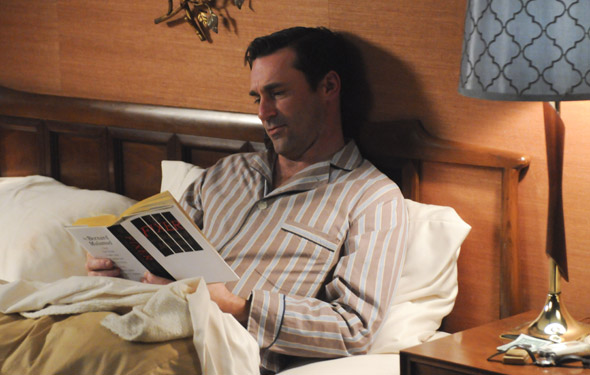
First, Theon Greyjoy captures Bran Stark and Winterfell, betraying the family that raised him for half his life as well as a king he swore allegiance to. Why? Theon’s torn between his blood father and his adopted brother: “I’m a Greyjoy. I can’t fight for Robb and your father at the same time.” He chooses his father, now-King Balon Greyjoy, because that way gives him the opportunity to become a prince, even a king, as long as he impresses his father. If he stays with Robb, he’s unlikely to rise above his current means.

Theon’s ambition makes him look pathetic, which Game Of Thrones plays up. A quick attack with his ironborn takes Winterfell while its troops are away, and Theon comes in expecting to be treated as a conquering prince. Instead, Bran Stark can’t believe that someone he grew up with, someone who saved his life recently, would turn into an enemy. Alfie Allen plays Theon’s confused posturing well, first in the scene with Bran, then in a scene where he tries to force Maester Luwin, then Ser Rodrik to acknowledge him as the lord of the castle. When the latter goes poorly, Theon’s entertainingly pathetic attempts at macho posturing turn horrifying, as he beheads Ser Rodrik in front of everyone.

While Theon may be trying to make his life as a noble better, Danaerys negotiates with the merchants of Qarth for ships to conquer the Seven Kingdoms with, more specifically addressing the issue of class mobility. Her ally, Xaro Xhaon Daxos, argues with his rival, the Spice King, about their origins. The Spice King’s grandfather was poor, his family having worked its way into wealth, while Xaro did the work himself. Meanwhile, Dany’s prime claim to power is her bloodline, and she justifies her entitlement by declaring that her dreams become reality, as they did with her dragons.

Oddly, the arguments used in this scene, particularly by the Spice King, seem particularly anachronistic. He claims that he’s ruled by logic, and he says “I make my trades based on the merits.” These entirely modern arguments stand out from most justifications used by other characters, like Ned Stark’s honor, or Cersei Lannister’s naked grabs at power. Nicholas Blane’s scenery-chewing performance as the Spice King is a delight, yes, but the scene’s attachment to modern tropes gets in the way of its drama.

The Old Gods And The New takes on class envy more directly in King’s Landing. The court sees Princess Myrcella off to Dorne, but on the way back, the people of the city get angry, with one of them throwing trash that hits Joffrey, who immediately escalates the situation into violence. Sansa Stark gets dragged away before being rescued by The Hound. As her handmaiden Shae cleans her, Sansa wonders why one of the men hates her so much. Shae responds: “Your horse eats better than his children.”

We’ve seen Game Of Thrones deal with the effects of war and chaos on its families and individual characters, but it hasn’t depicted those effects on the commoners very well. To be fair, a great deal of this has to do with issues of adaptation. There are only so many actors to hire, and only so many sets or locations to film on. Depicting the burnt-out farmlands of the Riverlands is far easier on a printed page or two than on an expensive show, and it doesn’t literally advance the story. This is part of the reason Littlefinger’s brothel has been used so prominently. Roz’s emotional collapse after the murder of the baby a few episodes back wasn’t just another way to demonstrate how nasty Littlefinger is, but also a way to show how ugly the city becomes as the nobles play their violent games.

That, combined with the appearance of the anti-Joffrey preacher last week, helps set up tonight’s riot as an organic development. The war isn’t just a game of nobles—it creates refugees and burns the crops they need to eat. This was, if you’ll recall, the Lannister strategy when the conflict began, late in the first season. But there are unintended consequences.

North of The Wall, Jon Snow has his first encounter with one of the “free folk,” as his new friend Ygritte calls herself. Yet as free as she may claim to be, she still follows the King-Beyond-The-Wall, wich also makes her an enemy of the Watch. The Watch is one of the few groups in Westeros that looks even slightly egalitarian, with promotions by merit, but still, Jon is somewhat tempted by Ygritte’s promises of freedom. Well, he’s probably more tempted by other charms—Rose Leslie as Ygritte is both dangerous and flirtatious, and it’s fun to watch.

Less fun: Jon’s brother Robb discovers girls as well. His romance with Tylisa remains as stilted as it was a few episodes ago, not surprising since it’s so detached from everything else going on (although the arrival of Catelyn and Brienna may change that). A bigger surprise: the episode’s weakest scene involves Arya, Tywin, and Littlefinger. Since Lord Baelish can recognize her, Arya tries to hide her identity, resulting in a farcical scene where she moves repeatedly to point her face away from his line of sight.

Turning Arya’s disguise into a sitcom trope is a misstep. Fortunately, the rest of the episode works around its few minor errors: the scenes at Winterfell and King’s Landing are particularly strong. The show gets better as its characters start to reach the point of no return. Theon Greyjoy has passed that point, and the other characters are approaching it.

Adaptation:

My belief that many of the show’s best scenes were invented for the show takes a beating tonight. The Spice King was specifically invented for the show, making his anachronistic conversation even more baffling. The problematic scenes with Dany, Arya, and Robb were all fabrications. Some of the better scenes, it turns out, were those that were adapted. (A more amusing anachronism: Jaime Lannister is dyslexic, but Tywin forced him learn to read conventionally anyway.)

The thing I’m most concerned about is the show’s altering of events to change motivations. In the novel, Qhorin Halfhand deliberately allows Jon to let Ygritte go, and Jon immediately returns—there’s no chase scene, no initial seduction. This has happened several times, like with Littlefinger offering to exchange Jaime for Cat’s daughters. In many cases, in attempting to be simpler, Game Of Thrones makes its story more confusing.

Rowan Kaiser is a freelance pop culture critic currently living in the Bay Area. He is a staff writer at The A.V. Club, covering television and literature. He also writes about video games for several different publications, including Joystiq and Paste Magazine. Follow him on Twitter @rowankaiser for unimportant musings on media and extremely important kitten photographs.

MAD MEN RECAP 6: AT THE CODFISH BALL

MAD MEN RECAP 6: AT THE CODFISH BALL

"It’s the future. It’s all I ever wanted."

nullAfter weeks of dense, intricate episodes of Mad Men that have challenged my skills as a writer, it's something of a relief to experience the plain ol' symbolic, interesting, well-written, enjoyable quality of At the Codfish Ball. I strongly suspect that I don't have to spend the rest of my life analyzing this episode, and that I can derive all its meaning in two or three viewings.

Which is not a criticism! I loved this episode, and I love the more complex ones. I do, however, see the difference.

The lyrics of the song "At the Codfish Ball" are about dancing fish. Twice we see Sally confronted with the task of eating fish. The first time, she's served spaghetti—you know kids, they just won't eat grown-up food. The second time, at the banquet, she tries it, and it seems like she might be learning to like it. But, while the kids in Megan's commercial are having beans rather than spaghetti, in either case comfort food and comforting adults aren't available to girls who eat fish and stumble upon illicit blow jobs. (Watch if you dare!)

At the Codfish Ball is about passing the torch, about generations, about growing up, and about the changes from one generation to the next. It's especially apropos in 1966, which is approximately when the term "generation gap" was coined, but it's true for all of us, from cave men to people who eat beans on the moon. Because this is Mad Men, it aims to take a more honest look at the generations than Megan's commercial does, and it ends on a dark note (that tableau at the end of dinner—in the video above—is as striking as the elevator tableau at the end of The Beautiful Girls). Yet about three-quarters of the way through, I was wondering if I was watching the most optimistic episode of Mad Men ever made. As dark as some of it was, I still feel that way.

How is the torch passed? Let me count the ways. At work, Peggy is proud of Megan and explicitly states that she is seeing the torch passed. Joan is proud of Peggy, and happy for her. Perhaps for the first time she sees Peggy striking out on a path that isn't the one Joan herself laid out for Peggy in the very first episode of the show. Joan serves as a surrogate mother for Peggy, since Peggy's own mother refuses to approve of her, and even withdraws Peggy's father's approval from beyond the grave. That torch didn't pass quite so successfully. Sally is praised as a mature young lady, and she heroically saves the older generation—but she's still too young to wear makeup. Nonetheless, attending the banquet is a significant "graduation." When she sees Roger, she asks if he's her sitter, and in a way he is: He's her "date," and he passes a kind of torch to her, teaching her how to be an account person and a "wing man."

We've already discussed the way that Sally's journey into adulthood turns suddenly darker. Megan's journey into maturity is also both joyful and dark. Those are some tough parents! They seem to have trained Megan well for marriage to Don, accustomed as she is to adultery and drunkenness. Another torch passed.

I loved Pete's conversation with Emile Calvet. If you recall, way back in Season 1 (Episode 1.04: New Amsterdam), Pete's own father said he didn't understand what Pete did, and was disdainful. Now Pete has an answer for the question, and an elegant one. Pete's been difficult to like this season, but he has grown up!

One of the great things about this episode was the core character development. Every episode of Mad Men is structured around a theme, and almost everything happens because of that theme. What makes these writers extraordinary is that their characters still behave like themselves as their lives move forward. It would be hard enough to write these people authentically without making it all flow from one subplot to another! Yet, while we have to see Joan living with her decision, and Roger with his, and see how Don and Megan's marriage is doing, and so on, we must do so within the thematic context.

"I for one am not going to let a bunch of dirty teenagers in the paper disrupt the order of things."

Roger's conversation with Mona (video below) was one of the highlights of the episode, not because it was thematically important (although the quote above is certainly about the generation gap), but because these two actors are great together, because Mona has always been a terrific and underused character, and because the interplay sparkles.

So much of this episode simply sparkled. Hey everybody, catch a deep breath, let go of interpretation, and just enjoy! Peggy looked so cute in pink, and Katherine Olson is a great character, every mean bit of her. Mona and Katherine are two people the fans always want back, Glen Bishop's return is another treat, and as if that weren't enough, we have the stellar Julia Ormond as Marie Calvet, and Ray Wise's return as Ken's father-in-law. A real Codfish Ball of a guest cast!

Another motif of At the Codfish Ball is seeing others as they are, and not simply as they relate to you. Roger has suddenly discovered he's a member of the human race, and he thinks he's the first person to ever notice, bless him. It's funny, of course, and Don is bemused, but Don hasn't previously seen his new wife entirely as her own, separate human being either. Last week he treated her as no more than an extension of his whims. This week, he discovered Megan is actually a person with talent and ability, and lo and behold, it turns him on! Peggy is discovering the same thing about herself; that she has her own desires and needs, and that she may not need to live under the thumb of expectation.

Peggy expected the worst news from Abe. Oh, honey. Then Joan woke her up, and she was so . . . so . . . girlish. With a pink dress with a pink bow on the front and an unshakable grin. She was living the childhood dream of a wedding, one she thought was only for prettier girls, but even though she didn't get what she thought she wanted, she made an adult choice. She changed from little girl pink to a beautiful and womanly dress to talk to "Ma." In this case, Peggy is figuring out that she is a person.

Some additional thoughts:

  • Meta-generational fun: Creator Matt Weiner's son Marten plays Glen Bishop. Ray Wise was on Twin Peaks as someone who killed his own daughter (thanks to my sister Roberta for pointing that out). Julia Ormond played Sabrina in the remake of the same name (a remake of a Hollywood classic is, after all, a kind of "next generation").
  • Sally should simply stop opening double doors. There's always sex behind double doors.
  • Quote of the week usually goes to Roger, and he certainly had several runner-ups, but nothing beats Emile Calvet with: "Don, there’s nothing you can do. No matter what, one day your little girl will spread her legs and fly away."
  • The motif of wealth also played itself out in this episode. I haven't the space to explore it properly, although I probably will on my blog as the week unfolds. Emile is a Marxist who disapproves of what unearned wealth does to Megan's soul. Mona counsels Roger not to feel guilty for wealth (check the second video, above). The wealthy "establishment" doesn't trust Don, according to Ed Baxter (Ray Wise).

Deborah Lipp is the co-owner of Basket of Kisses, whose motto is "smart discussion about smart television." She is the author of six books, including "The Ultimate James Bond Fan Book."

Watch Mad Men Moments, a series of videos on Mad Men, produced by Indiewire Press Play.

GIRLS RECAP 3: ALL ADVENTUROUS WOMEN DO

GIRLS RECAP 3: ALL ADVENTUROUS WOMEN DO

nullRemember those Cosmo-ish "Which Sex & the City character are you?" quizzes that every single editorial outlet featured during that show's run? Of course you couldn't take the results seriously; you can't "be" one of those people, because those people weren't people. They were slices of people, meant to illustrate (and easier to write than) the composite, contradictory whole.

nullIt was reductive to say that I "was a Miranda" (a workaholic who ate cake from the trash) ( . . . What? It was still in the box!), and it's just as reductive to say that I'm in large part a Marnie (controlling, responsible, paralyzed, gorgeous) (just kidding; I'm not that responsible). But I do relate to Marnie's rigidity, self-righteousness, the frustration and fear of change that manifest as meanness, and maybe that's why I completely hated Marnie's story in "All Adventurous Women Do."


I hated Marnie during it at times, for sure. Charlie surprises her with a stubbly new haircut, and it's actually an improvement over the previous floppy style, but Marnie's face falls straight off her head (nice work by Allison Williams, here and throughout). She hates it, sneering that he looks like "Mickey Mouse without the ears." She's basically mad that he didn't clear it with her first, and she's even madder when he reveals that he shaved his head to support a woman at work who has ovarian cancer, because now Marnie looks like a total bitch. That’s because she is a total bitch here.

We didn't need another illustration of the idea that Marnie and Charlie should split up already, but the show moves the ball at least a few feet later . At an opening at the gallery where Marnie works, Marnie's inappropriate boss (she reads as tipsy, but you get the feeling she's always like that; kitted out in a low-cut blouse, she sends another assistant to get her "tit tape," and nobody in the scene even flinches) introduces Marnie to a snotty artist, Booth Jonathan. The "introduction" takes the form of the boss yelling at Booth for sleeping with some other lady of a certain age, and noting that Marnie says she has a boyfriend, "but I've never seen him." Marnie, flustered, shares that she's a big fan of Booth's; Booth sizes her up and advises her to "try and give less of a shit." My immediately saying, out loud, "The correct usage is 'try to," means I'm not in the demo for Booth's cocky whatever, but Marnie is intrigued. Flirting. She feels obligated to inform him that she's not going to kiss him. More flirting.

And here's where I get annoyed. Booth gets right up close to her and murmurs, "But I want you to know: the first time I fuck you, I might scare you a little, because I'm a man, and I know how to do things." He walks off to enjoy being That Guy and wearing his blazer collar turned up. Marnie rushes inside, locks herself in a bathroom, and masturbates. . . . Girls, please. It's not that a line like that has never worked, but the entire sequence felt, to me, like a man's take on what Marnie needs, i.e., "That filly wants breaking to harness!" Yes, people should stand up to Marnie, but 1) I don't care for the idea that that's a result of her gender, or that the opposite gender is what's required to "take her down a peg"; and 2) snideness and pat line delivery do not a man make in the first place. Maybe I'm overthinking this, but the cure for uptight-bitch-itis is not necessarily cock.

We're seeing more than enough peen-alization on the show as it is. Hannah puts on war paint (high five on the tights-and-Chuck-Taylors wardrobe choice, though) and goes over to Adam's house, where he's lifting weights (natch). The next morning, in bed, he's making her tummy fat "talk," which she's both charmed and terrified by; he asks whether she's "tried a lot to lose weight." Mildly irritated, she tells him she decided to make other things more important in her life, but I liked the way the scene highlighted that the average straight man's cluelessness about matters lady-weight is exactly that: cluelessness. He doesn't mean to be hurtful, because he absolutely has not noticed whichever five-pound pocket his lady friend thinks is flagrantly hideous, unless it is a third breast, which he thinks is rad.

The tickly, teasing development of their bond is rudely interrupted by a call from the clinic, informing Hannah that she has HPV. Lena Dunham kills it here: Hannah is near tears as she relays this to Adam, and he continues to earn points by hugging her and saying he's sorry. Think it's all about to go pear-shaped? Correct! Hannah grumps, "Are you sorry because you gave it to me?" Adam is promptly and completely offended, claiming that he got tested recently "and I don't have that." Even if there were a screen for HPV for men, which there isn't, his claim to have gotten tested would smell like bullshit just because he’s the one making it. Hannah promptly backs down, though: she's sorry, she's only slept with two people (down from "two and a half" in a previous ep) and she doubts it's her college boyfriend, surely he can see how she might assume Adam is the source, is he mad at her? "Will you still have sex with me?" Adam, coldly: "When it's appropriate, sure." What a prince. When Hannah asks for a hug goodbye, he's too "busy" doing a shoulder-stand and cycling his legs.

Water having found its insensitive level once more, Hannah goes outside to call Marnie, who starts crying about how it's so unfair because Hannah is so careful with condoms. They discuss whether Hannah could have gotten HPV from the college ex, Elijah, and do a dead-on riff on the stupid details you inevitably have handy about your exes' exes—viz. Elijah's previous girlfriend, a cellist with a "loose-joint disorder," who annoys Hannah by "liking" her Facebook statuses. Hannah assures Marnie that she's fine, so Marnie reminds her that rent is due in a week, and asks about Hannah's job hunt. Hannah's not that fine. "I have pre-cancer!" she snaps, and hangs up on Marnie. Looks like Hannah is putting her theory from last week—that an STD is a great excuse not to bear down on looking for a job—into practice.

Hannah heads over to Shoshanna's to change clothes. Shoshanna is still kind of a cartoon at this point in the series, but Zosia Mamet is doing a great job with the broad strokes she's given. This scene doesn't do much for Shoshanna's depth, but it's still kind of fun: she's cuddled up on her couch, eating cereal, stroking a furry décor pillow in a Blofeldian manner, and watching Baggage. Baggage is apparently a real show, hosted by one Jerry Springer, in which contestants put their emotional baggage in various suitcases, and then their partners have to pick one, or something . . . . I mean, what it really is script-wise is an excuse to shorthand some background info about Shoshanna (she has IBS, unsurprisingly), and also to address the etiquette of STDs.

Shoshanna's practical inexperience doesn't hinder her here, as she shrugs that Jessa has "a couple of strains" of HPV (the Parisian and Balinese strains, I presume), and Jessa's typically self-mythologizing take on it is that "all adventurous women do." Hannah doesn't want to have to tell/ask Elijah what's going on, because she doesn't want to see him, because she thinks he's still in love with her (. . . oh, dear), but Shoshanna thinks she has to: "In the STD world, I think it's like kind of courteous." She also thinks it's totally fine if Hannah and Elijah end up having sex (. . . ohhhhhh, dear) because they both already have HPV. I know Shoshanna only has two dimensions, but I love both of them, and the insane clown logic that prevails therein.

The adventurous woman, meanwhile, is on a babysitting job, clad in a transparent floor-length white dress with neon-pink underthings. The mom, rushing off to a shoot, suggests the kids do their "mosaic work," or maybe the older one could let Jessa proofread her (ten-page) novel. Jessa is a natural with the girls, listening attentively to Trixie's grammar-school masterwork while eating string cheese in a makeshift tent in the living room. Dad (James LeGros, a casting decision I found all-caps delightful in my notes—love that actor) comes home to find Jessa snoozing on the couch; something about Jessa's artless report that she accidentally kicked one of his kids in the head appeals to him (or perhaps it's the visible hot-pink brassiere), and they smoke pot together and talk around their shared aimlessness. One of the kids wakes up and wanders into the kitchen before it Goes There, but LeGros isn't generally a throwaway-cameo guy, and the dialogue set his character up as a man who's not working and resents his hard-charging wife's blah blah justified in his own mind to fuck the babysitter blah, so! Expect these two to get it on.


Elsewhere, the Elijah talks break down in a matter of minutes. He thinks Hannah's confronting him because she heard about his emergence from the closet, but she's stunned by the news. What follows is a Horvath's Inferno-esque tour of all the insecurities women have, or could have, about ex-boyfriends who "turn out to be" gay—that they were always attracted to men, that they thought about Doing It with men during the relationship, that they could feign an attraction to a woman because she had mannish traits. Elijah confirms all these things, commenting that "there's a handsomeness to" Hannah, and Hannah snaps that maybe he could have figured his attracted-to-dudes shit out before passing her a disease. Elijah goes to DefCon 1 at that point. It's not clear where all his hostility is coming from; she's just accused him of giving her an STD, then claimed that he's affecting a "fruity little voice," but now it seems like he's been lying in the high weeds for other reasons. In any case, he hotly denies he's the carrier, informs her that Adam is full of shit about testing negative, and snots, "You were always like this." Hannah notes that he was not always like this, or she would have known he was gay. Elijah: "We're only as blind as we want to be." Then he throws a low blow he's obviously been saving: her dad is gay. Elijah cites the stud in Dad's ear, and I totally noticed that on Peter Scolari in the pilot, so it's nice that it gets a callback here. After failing to convince Elijah that her dad is straight, she passive-aggressives that she's going to ask people if they're gay before she sleeps with them from now on. Elijah wishes her a sarcastic good luck with that—"and don't be surprised if people ask you if you keep dressing like that." I agree that Hannah doesn't always dress to flatter her shape, but again, the bile seems unrelated to what's actually going on here. Hannah has had it and announces that she's going to get the last word in. Not so fast! Elijah snaps, "It was nice to see you, your dad is gay," and leaves.

Back at the Hannah/Marniehaus, Hannah is over-thinking a tweet that ends up reading, "All adventurous women do." She gets up to have a solo dance party to a song with on-the-nose lyrics ("I keep dancing on my own"). When Marnie gets home, Hannah does not stop frugging to announce to her that Elijah is gay, which she probably should have known since he "only ejaculated 30 percent of the time. And . . . he seemed gay." Marnie laughs, because you kind of have to. They dance together, but Hannah's determination to hide her hurt feelings in dance soon flags, and we fade to credits on Hannah giving Marnie a huge, almost desperate hug—making the connection she's sought all episode.


Sarah D. Bunting co-founded TelevisionWithoutPity.com, and has written for Seventeen, New York Magazine, MSNBC.com, Salon, Yahoo!, and others. She's the chief cook and bottle-washer at TomatoNation.com.

GAME OF THRONES RECAP 5: THE GHOST OF HARRENHAL

GAME OF THRONES RECAP 5: THE GHOST OF HARRENHAL

 
One of the most appealing things about Game Of Thrones as a fantasy narrative is the lack of magic at the core of its story. Magic exists on the outskirts of the world—Danaerys in the Dothraki Sea with her dragons, Jon Snow and the Others beyond, at the wall—but the bulk of the story, taking place in the Seven Kingdoms, has entirely revolved around human concerns. “Fantasy” as a genre usually means Tolkien-esque heroic quests, filled with prophecies, gods, and wizards, making Game Of Thrones’ focus on entirely human-scale drama a breath of fresh air. All that disappears in tonight’s episode, when Melisandre’s shadow Stannis assassinates King Renly.

nullThe increased importance of Stannis and Renly as characters had built up dramatic potential in previous episodes. Both opposed the Lannisters, and both were sympathetic in many respects. But they also disdained Robb Stark’s claim as King In The North, and were more than willing to fight one another, proving that petty ambition mixed with righteous certainty could be a poisonous combination. That balance is gone, thanks to Melisandre, whose magical ability shattered the rules that govern Game Of Thrones’ world. It feels disappointing, more like a narrative cheat than a fascinating narrative twist. Out of nowhere, an interesting, major character like Renly is simply removed from the board. It feels like it breaks the rules of this world, which is negative, as opposed to Ned’s death, which was positive (if shocking) because it violated the expectations of narrative.

Despite the problematic nature of Renly’s death, it does help tie “Ghost Of Harrenhal” together. Arya Stark puts it best, if a little bit too blatantly: “Anyone can be killed.” The episode’s title comes from an alliance between Arya and Jaqen H’ghar, the odd foreign man she rescued from chains in the midst of a battle two episodes ago. Jaqen promises Arya three deaths for the three lives she saved. With her first, she asks for the torturer known as “The Tickler” to die, which happens. “The Ghost Of Harrenhal” is a pre-pubescent girl, acquainted with violence well beyond her years.

The chaos unleashed by the war and intrigue of Game Of Thrones doesn’t kill just “anyone,” though. It’s primarily the men that die. In some cases, it turns women into warriors. Arya Stark has killed before, stabbing a stable boy who attempted to capture her in the first season. Now she’s a righteous ghost, assassinating the most evil men when they hold too much power.

Brienne of Tarth, the show’s other female warrior, gets the spotlight in this episode. Serving as Renly’s guard when he gets assassinated by Melisandre’s shadow, she is instantly blamed for Renly’s death and is forced to kill two knights. She and Catelyn flee, and eventually, Brienne, confused about her future and shocked by Renly’s death, swears her allegiance to her fellow fugitive. It’s a wonderful little scene, about how war destroys the social order. The patriarchs—Renly and Ned, in this case—are dead, so these two women re-enact one of the strongest bonds of Westerosi patriarchy, the knighthood ceremony. Brienne’s confusion, and her immediate attachment to Cat’s strength, are more over the top than Gwendolyn Christie, but it works in the end: she really was that loyal to Renly, and that shaken up by his death. That scene appears below.

Two other women are thrust into power by death during this episode. Margaery Tyrell, with her husband dead and many of his lords transferring their loyalty to Stannis, has choices to make. Littlefinger approaches her and asks: “Do you want to be a queen?” “No. I want to be the queen.” His sly smile suggests a plan, and with Margaery embodying the powerful, wealthy House Tyrell on Game Of Thrones, this could be interesting as it develops.

There’s also Dany, a woman thrust into power by the deaths of two patriarchs: her brother Viserys, the former heir to the Targaryen crown, and her husband Drogo, the Dothraki Khal. Dany’s name, connections, and dragons maintain some level of power for her. But with only the power of influence, she has to negotiate constantly to maintain it, while increasing her more direct forms of power. I like where the show is going with Danaerys in Qarth. The city and its people are off-putting: her host proposes marriage, a warlock performs apparent magic for her, and a strange woman with her face almost entirely covered by a scaled mask talks to Ser Jorah. There’s a strong connection between the oddness of Dany’s surroundings and the precariousness of her situation. The foreign nature of Dany’s location of the story acts as an interesting balance to the more conventional culture of the Seven Kingdoms.

Anyone can be killed in the world of Game Of Thrones for any reason now, including magic. And while I may dislike the magical assassination that drives “The Ghost Of Harrenhal,” this is a story about the effects of war and death. If anyone can die, then anyone can pick up the pieces. And if it’s always the men who die, the pieces are left for the women.

Adaptation:

Many of the best scenes in “The Ghost Of Harrenhal” were actually taken primarily from the novels, like Catelyn and Brienne’s exchange, instead of being created for the show. There were a few minor changes, but seeing Littlefinger start negotiating with Margaery and demonstrating the specificity of her ambition to become queen was the only major change.

The most successfully adapted scene, though, was in Winterfell, as Bran filled in as lord with more confidence, quickly responding to petitioners with apparently beneficial effects, as when he sent two orphans to help an overburdened shepherd. Bran is probably the character who has been treated the worst in the adaptation from page to screen, as most of his chapters were primarily internal monologues, as he comes to terms with his injury as well as his connection to his direwolf. It may be a little late, but it’s a demonstration that Game Of Thrones remembers that there are important characters and places away from the front lines.

Rowan Kaiser is a freelance pop culture critic currently living in the Bay Area. He is a staff writer at The A.V. Club, covering television and literature. He also writes about video games for several different publications, including Joystiq and Paste Magazine. Follow him on Twitter @rowankaiser for unimportant musings on media and extremely important kitten photographs.