“No redneck is this creative”: TRUE DETECTIVE and the Horror of Folk Art

“No redneck is this creative”: TRUE DETECTIVE and the Horror of Folk Art

null

Now and then a television series comes along that seems to
define its own, unique genre: think of Twin
Peaks, The X Files, The Singing Detective

Now think of True Detective,
which might be described as the first Cult Ritual Serial Killer Southern Gothic
Weird Procedural.  Which is not to say it
is without precedents: since its debut the series has spawned a plethora of online
discussions and commentaries tracing the show’s connections with, and
references to, a host of texts, from pulp fiction to true crime, nihilist
philosophy to urban myth.  Especially
fascinating in these discussions is the way in which a background of seemingly
unrelated stories and images magically click into place, as if they had been
waiting for a narrative that would connect them. 

One of the more distinctive and grimly fascinating elements
of True Detective is its preoccupation
with weird folk art, or what could be called outsider art.  Odd and intricate wooden sculptures are found
carefully arranged around the dead body of the series’ first victim, Dora
Lange.  The body itself is decked with
antlers and arranged against a tree in an elaborate display of sacrificial
obeisance, the victim’s back tattooed with a mysterious spiral symbol.  When Rust Cohle (Matthew McConaughey) returns to the scene years
later, this spiral seems to have taken wooden form, in an elaborately
sculptured circle, reminiscent of Andy Goldsworthy’s environmental art.  When clues lead to an abandoned religious
academy, Cohle finds a veritable forest of wooden sculptures inside the
derelict building.  The walls are also
decked with drawings of sinister angels, in a primitive style resembling a
painting discovered earlier in a burnt-out church depicting a horned being that
looks like Dora Lange’s dead body. 
Whatever might be said of the killer responsible for Lange’s death, he certainly
is prolific.  Had he found the right art dealer,
he might have become the next Henry Darger or Judith Scott.

The association of horror and folk art in True Detective, like its many other
thematic strands, has a rich and peculiar history, most notably in film.  Much has been written about folk elements in
British horror, as seen in such classics as Wicker
Man, Witchfinder General
, and Blood
on Satan’s Claw
, and more recently in a new wave of low-budget British
horror films, including The Fallow Field,
Overhill,
and A Field in England.  But relatively little has been said about the
parallel tradition in American horror, one that is every bit as rich, and which
True Detective helps us to see anew.

Folk art shouldn’t necessarily be equated with what is
called, alternately, outsider, visionary, or naïve art, but they do share a
quality that might be described as obsessiveness.  In folk art this is generally a healthy,
robust quality, reflecting as it does extreme care in the application of
time-honored traditions, while in outsider art this obessiveness imparts a
certain strangeness, perhaps from the fact that the artist is usually working
in isolation, outside of an enabling tradition. 
The similarity between the obsessiveness of artists and serial killers
may be an arbitrary one, but it is one that many filmmakers have
exploited.  Cohle explains why: when
his partner, Marty Hart (Woody Harrelson), compares their suspect to one in an earlier case,
Cohle replies, “That’s just drug insanity. That’s not this, this has
scope.”  A drugged-up killer is
frightening; one with scope is terrifying. 
This killer, says Cohle, “articulated a personal vision. Vision is
meaning. Meaning is historical.”  The
same might be said of folk art.

One of the most terrifying instances of folk art in American
horror is The Texas Chainsaw Massacre,
in which a family of demented slaughterhouse workers make grotesque sculptures
out of bones and skin.  When one of their
victims enters their house, she discovers a veritable art gallery of gore: rib-cages
and broken turtle shells hanging like mobiles; human and animal bones
intricately connected to form elaborate standing sculptures; teeth, feathers,
and other parts festooning a primitive gas generator; a perverse chaise longue
built of bones and skulls. 

Such images clearly derive from the loathsome objects d’art fashioned by notorious
serial killer Ted Gein from his victims’ remains, but director Tobe Hooper
brings to these objects a demented element of pure form that distinguishes this
sculptor as a kind of twisted visionary. 
Remembered largely for its gore and violence, Hooper’s film is as
remarkable for its almost mythic evocation of sadism joined to creativity.  If the meat sculptures of Texas Chainsaw Massacre convey a
particular zeitgeist, it is one best captured by Rust Cohle’s pessimistic view
of Homo sapiens: “I think human
consciousness is a tragic misstep in evolution. We became too self-aware.
Nature created an aspect of nature separate from itself – we are creatures that
should not exist by natural law.”

While Hooper took murder as folk art to a new extreme, his
imagery has precedents, most notably in Alfred Hitchcock’s Psycho.   Norman Bates was,
of course, a talented taxidermist, and his revivified birds loom over the
fateful conversation with the aptly named Marion Crane that precedes her murder.  His sculptural talents are shown in their
fullest expression later, when Marion’s sister, Lila, discovers the preserved
body of Norman’s mother sitting in the cellar. 
Such perverse craftsmanship suggests the kind of concentrated attention
Bates brings to all of his work, including murder.

In contrast, the sculptures of Texas Chainsaw Massacre derive much of their horror from their
association with folk art, an association seen in a film like Deliverance that plays upon the cultural
prejudice that connects backwoods folk culture with the sinister or malevolent.  The brilliance of John Boorman’s film (as with
the James Dickey novel on which it was based) is that it places much of this
associated horror in the eye of the beholders, those Atlanta businessmen who
use the remote Georgia wilderness as their playground.  In the famous “dueling banjos” scene, the
character of Drew is barely able to keep up with his accompanist, despite the latter’s
obvious disabilities, and the scene culminates with Drew prophetically shouting
“I’m lost” as he accepts defeat.  Though the backwoods banjo player’s birth defects mark him—and by extension his
music—as grotesque in the visitors’ eyes, the inability of the urbanite to master his arcane art
serves as a measure of folk music’s richness and complexity.

The association of rural culture and the macabre is further
explored in The Blair Witch Project,
where the hapless team of documentary filmmakers stumbles on a backwoods site
filled with primitive cairns and elaborate hanging stick sculptures, the clear
precedent for those that appear repeatedly in True Detective.  When Cohle
shows his drawings of these sculptures to a pastor, he says they look “like
something my old auntie taught us to make when I was a tyke . . . some folks call
them ‘bird traps.’ Old Auntie told us that they were ‘devil nets.’ You put them
around the bed, catch the devil before he gets too close.”  In such moments, the line between madness and
tradition becomes blurred, in a manner that reflects on True Detective’s compelling sense of place.  While the Gen-Xers in Blair Witch are horrified at what these sculptures portend, since
“No redneck is this creative,” True
Detective
is more intent on exploring the connection between rural culture
and the sinister in the popular imagination. 
Cohle’s fascination with the weird folk art he uncovers turns this
association back on the increasingly obsessive investigator himself, and, by
extension, the perversely fascinated viewer who follows his investigation, episode after episode.

Jed Mayer is an Associate Professor of English at the State University of New York, New Paltz.

You Got the Miley You Paid For, America

You Got the Miley You Paid For, America

Just days after Miley Cyrus’
bizarre, off-putting performance at the 2013 MTV Video Music Awards—which saw
the twenty year-old performer rubbing herself provocatively with a foam finger,
“twerking” against the genitals of thirty-six year-old singer Robin Thicke, and
gleefully slapping the buttocks of her backup dancers—Camille Paglia wrote a
piece for Time decrying Cyrus’
decidedly unsexy three-ring circus primarily on artistic grounds. Miley has
never been given “the time or space to develop emotional depth or creative
skills,” and therefore lacks “professional focus,” wrote Paglia. Paglia ended
her essay with an impassioned exhortation: “Miley, go back to school!” Instead,
Miley went to New York City, where she hosted Saturday Night Live and
announced to a cheering studio audience that her reasonably well-behaved Disney
Channel alter ego, teenage schoolgirl Hannah Montana, had been “murdered.”
Played for laughs, the gag was funny in part because it was true: the Disney
Corporation, with a subtle but equally reckless assist by Miley’s
fans, killed Miley’s childhood dead, and neither wishes nor revisionism
will ever bring it back. It’s a cycle we’ve seen played out with
nausea-inducing regularity: America, its legions of consumers just as much as
its faceless institutions, siphons away any sense of normalcy its artist-heroes
might ever have enjoyed, then stands in mock outrage above the debris field
that invariably results.

The idea that performing artists need time and space—perhaps
even the time and space afforded by a school-like setting—to learn something
about the history of their art and thereby develop so-called “professional
focus” makes a certain sense in the music industry. Because touring brings in
as much or more revenue than album sales do, there’s a strong incentive for
recording artists to stay perpetually in the limelight. The utility of time,
space, focus, and professionalism is less clear in other art-making genres.
It’s easy to see why singers ought to sometimes flee the glare of the national
spotlight and the equally searing heat of their record companies’
profit-margin assessments, but what about poets, sculptors, painters, potters,
and the millions of other artists working daily in unprofitable and rarely
acknowledged sectors of America’s art culture? What (and when and how) should they
be fleeing?

One possible answer: the ravages of a culture that annually
finds ever more ingenious ways to screw up the lives of profit-driven and
profit-blind artists alike. The means of such systemic destruction may be
different in different genres, but the end result is all too frequently the
same—whether it’s for Miley Cyrus or Lindsay Lohan, Justin Bieber or Britney
Spears, Corey Feldman or Danny Bonaduce. Whenever an artistic sensibility is
given too much or too little leash, the risk of a public or private disaster
resulting is high. A young singer with little proper schooling (Miley was home-,
set-, and tour-schooled following middle school), a perpetually abnormal social
life, only sporadic parenting, and too much expendable income to use
responsibly will often enough end up—using Miley as just one example—twerking
on the privates of someone almost twice her age for a screaming national
audience. Likewise, a writer with no job, no health insurance, no stable and
affordable housing, no reliably encouraging community, a spotty sense of
history, and a virtual rogues’ gallery of indifferent role models is equally
likely to end up in an emergency room as making Great Art. When
individuals as emotionally and psychologically temperamental as artists
habitually are lack access to high-quality healthcare, employment, and support
networks, they all too often under-medicate, 
under-insure, under-employ, and over-isolate themselves into episodes of
financial and spiritual despair.

Because often it’s lack, not surfeit, that’s most conducive
to artistic greatness, we can’t really say that instability is always unhealthy
for budding artists in the short term. What we can say is that the Muse
of suffering ought not be foisted upon all artists indiscriminately, as even
those who benefit from it often don’t benefit from it for long, and even when
and where suffering inspires an artist one can’t know whether a different
medium might have worked as well or better as a conduit for genius. In any
case, at no point in the process of watching artists’ lives play out do
audiences earn the right to expect more from their artists than the
pitfall-riddled lives to which they’ve been left. You (that is to say, we) get
the Miley we overpaid for, just as we invariably get the poets, sculptors, painters, and potters we’ve habitually refused to pay for at
all. While formal schooling only lends focus to those artists already inclined
to be focused or to benefit from a particular emphasis on skill-development and
historical awareness, the time, space, depth of seriousness, and range of
skills Camille Paglia wished for Miley in her Time essay should be
wished for for all our nation’s artists—and so we shouldn’t be
surprised when the lack of any of these leads an artist to a public or private
meltdown. 

This isn’t to say that denying artists time and space for
the development of serious ambitions and a versatile skill-set invariably leads
to disaster, merely to note that the fact that it may is
foreseeable and therefore unworthy of public shamings in Time or
elsewhere. Likewise, none of this is to say that artists should face no
censure for poor behavior; they can be, they should be, and they frequently are held
to account (often unfairly) for bucking the norms our culture so
authoritatively insists upon. A media outlet like TMZ, for instance, exists for
no other reason than to shame artists for their ill-considered antics; the vicissitudes
of the academic and corporate job markets do similar work in ensuring that
literary and visual artists never stray too far from the behavior employers
expect from their investments.

Yet even if we account for all of this, it’s still the case
that public criticism of artists should not be willfully ignorant of the
personal and professional milieu of working artists generally. Those
criticizing Miley Cyrus should somewhere in their critiques give some
indication that they know they’re criticizing a socially maladjusted
teen-equivalent who’s been surrounded by uncaring, selfish, morally incompetent
adults her entire life. Should Miley’s mother be managing her daughter’s most
important professional decisions, thereby confusing two roles with entirely
different expectations, responsibilities, and prerequisites? Should someone
have stopped a fifteen year-old Miley from granting what appeared to be a
topless photo-shoot to Annie Leibovitz? Should the bosses at the Disney Channel
have granted the then-thirteen year-old Miley a shooting schedule that
permitted her to be schooled amongst her peers rather than hurriedly and
on-set? Could Miley’s father, the one-hit wonder country singer Billy Ray
Cyrus—who recently said that Hannah
Montana
“destroyed my family . . . I’d take [Miley being on the show] back in a
second”—have resuscitated his own fading career via something other than a co-starring role alongside
his teenage daughter? Absolutely. A bevy of poor decisions—personal,
professional, educational, and otherwise—led Miley to where she is now, and
only a few of those decisions were solely Miley’s to make.

Miley’s decision to appropriate black culture for financial
gain was certainly an elective act—but it shouldn’t be deconstructed in the
same way one academic takes another to task. Rather,  critics should in some way acknowledge that
however foolish and race/gender-insensitive Miley’s shtick may be, she’s still
a young woman with little education who’s had no reasonable limits on her
spending since she was a child, who’s grown up in full view of the nation’s
hundred million living rooms, and who hasn’t lived the sort of life that
induces more temperate conduct since, well, never. Miley gets paid an
exorbitant amount of money to have no sense whatsoever of musical history or
even the barest standards of professionalism, and she gets paid that money by
the very same culture that subsequently derides her misbehavior as though it
were evidence of a system failure rather than a young person’s temperamental
decision-making. In other words, Miley’s been exploited by corporations,
unscrupulous charlatans, and blindly adoring fans her whole life, and almost certainly
hasn’t enjoyed a truly “normal” moment in more than a decade. Under the same
circumstances, you’d be twerking, too.

*

That an artist’s life is a relatively easy one is as much an
invisible presumption of American culture as is the idea that no culture can
long survive without Art. You’d think that decades of celebrity mug-shots, Behind
the Music
episodes, and checkout-aisle gossip rags would have convinced us
that the last thing you’d want your son or daughter to become is an artist of
any kind. Yet somehow America still encourages its children to pursue their
artistic inclinations, and celebrates their ambitions and successes as unambiguously
healthy and just. What’s the harm, after all? Sure, we know from mountains of
academic and pop-culture biographies that an alarming number of the literary,
musical, dramatic, and material artists whose work we most enjoy have died
penniless in ditches, or by their own hand, or with their hands on a bottle, or
choking on their own vomit following a drug overdose, but wasn’t that song
sublime? That poem? That novel? That sculpture? We know making Art often takes
a terrible toll on the psyche, on one’s mental health and physical well-being,
and on one’s finances—think Sylvia Plath, Kurt Cobain, Gary Coleman, or any one
of a thousand other young, much-heralded artists. But nothing can stop American
culture from consuming the energies of its artists so voraciously that hardly
any time or space is left them to catch their breath.

No one but Miley Cyrus’ doctor
and closest family and friends know her mental health status specifically or
her current medical condition generally, and no one outside that circle should
deign to speculate authoritatively on either. But here’s what we do know: Miley
has been in the public eye since she was eleven. When I was eleven, I was still
alone in my room trying to figure out how to masturbate properly. So to
converse about Miley Cyrus as though she were a normally socialized twenty
year-old defies both the evidence and common sense.

This isn’t a matter of crying
“Leave Britney alone!”, it’s a question of knowing the cost and value of the
throes of American culture. In other words, with Miley, as with all artists,
you get what you pay for, America: If you offer your artists no jobs, no
patronage, no supportive communities, and no means for coexisting with any
measure of comfort alongside their fellow citizens, you end up with artists
whose lives are unstable, uncertain, and in at least some identifiable
percentage of instances, psychologically and/or physically unhealthy. Moreover,
you end up with artists who begin to falsely associate infelicities with
predestination, who believe that being at loose ends emotionally and
financially is the only way to make Art that they and—on occasion, perhaps—other
Americans will respect. On the other end of the spectrum, if you throw millions
of dollars at children before they’ve reached puberty, if you pull them from
their local middle school to “help” them avoid paparazzi they shouldn’t have to
deal with in the first instance, if you juxtapose the roles of parent and
manager, if you reward ethical misbehavior or profligate spending or shoddy
songwriting with ever larger and larger royalty checks, you are ruining a
childhood and you’ll undoubtedly see that ruination play out on your television
set in a few short years. The conversation about Miley Cyrus isn’t dull because
we’ve done it before—it isn’t dull because it’s hard to see much daylight
between Paris Hilton, Amy Winehouse, Justin Bieber, Lindsay Lohan, et cetera—but
because it’s so cynically and insidiously hypocritical it’s nauseating. Miley
isn’t shocking; in fact, she’s so predictably derivative of the way our culture
condones the abuse of young artists across all genres that it’s painful to see
all our self-servingly unreasonable expectations unfolding in real time.

Those who take Miley to task for appropriating black
culture, or for undercutting responsible notions of femininity—as Sinead
O’Connor infamously did recently—are willfully missing the point. The time for
cultural critics to have intervened in the fiasco Miley’s life has become was
when she was a corporate wunderkind on the Disney Channel. Time and time again
we’ve seen children ruined by early success go on to harrowing tribulations as
adults—for every resurgent Christina Aguilera or Justin Timberlake, there’s a
whole dollar-bin of Britneys—yet we speak of an unsocialized teen’s predictable
nervous breakdown (or, the apparent non-clinical equivalent) as though it takes
a gaggle of scholars to sort it all out. Though the analogy is by no means a
perfect one, I for one am no more surprised by Miley appropriating black culture
or undercutting third-wave feminism’s political gains than I would be by an
abused child re-enacting the horrors once visited upon her by insidious
elders. 

If indeed Miley has offended or done damage with her
straight-from-the-playbook youth rebellion, I’m more insulted by those who are
insulted than by the one purportedly doing the insulting. If you don’t want
your consumer dollars going directly to the abuse of children whose antics
you’ll later find repugnant and comment-worthy, don’t watch the MTV Video Music
Awards, don’t watch Miley’s YouTube videos or follow her on Twitter, don’t buy
her albums or attend her concerts, and most of all don’t participate in
farcical remonstrations over Miley’s antisocial displays. Not because Miley
does or doesn’t deserve your patronage, but because America’s moral degradation
is long past the point you’ve any right left to ignore it. After all, this is a
country that establishes national campaigns to protect urban youth from the
ravages of drugs—on the theory that many such youth have few or no responsible
adults available to help them avoid drug addiction—and then pounces on them
when they turn sixteen, as the nation’s anti-drug campaign, having failed to
save any of those it was charged to save, turns on a dime into a nationwide,
incarceration-happy flash-mob. Miley bears a good deal of responsibility for
Miley, certainly, but the responsibility of a child to raise herself in a nest
of vipers is by no means limitless. America helped raise Miley in a very real
way—indeed, it did so carefully, consciously, and conscientiously over
more than a decade—so it has little right now to decry its own failure to
protect a vulnerable, impressionable, and naive young artist. To Camille Paglia
I would say, Miley doesn’t need a better school; what she’s long needed, and
what she never got nor will ever get, is a better country to grow up in.

Seth Abramson is the author of three collections of poetry, most recently Thievery (University of Akron Press, 2013). He has published work in numerous magazines and anthologies, including Best New Poets, American Poetry Review, Boston Review, New American Writing, Colorado Review, Denver Quarterly, and The Southern Review.
A graduate of Dartmouth College, Harvard Law School, and the Iowa
Writers’ Workshop, he was a public defender from 2001 to 2007 and is
presently a doctoral candidate in English Literature at University of
Wisconsin-Madison. He runs a contemporary poetry review series for
The Huffington Post and has covered graduate creative writing programs for Poets & Writers magazine since 2008.

Turning 40 with the Help of THE ROCKFORD FILES

Turning 40 with the Help of THE ROCKFORD FILES


This
is Jim Rockford. At the tone, leave your name and message. I’ll get back to you
.

The
party plans had been elaborate: my wife had invited all of my friends,
including several from out of town who bought airplane tickets for the
occasion, to surprise me at a steakhouse in Chicago’s South Loop. The party was
to have an eighteenth-century “Clubb” theme, inspired by my love of James Boswell’s
Life of Johnson and his journals, and
by the elaborate dinners often enjoyed by Jack Aubrey and Stephen Maturin of
the Royal Navy, as depicted in Patrick O’Brian’s series of novels. There would
be costumes; there would be wigs; there would be speeches and heroic couplets
and all the prime steak and good Scotch we could swallow. But: two or three
days before I turned forty, I came down with a fever. The fever became severe
and the glands in my neck swelled to the size of golf balls. The doctors
concluded that I had a particularly virulent strain of strep throat, or maybe
it was mono. I could barely speak or swallow, and the pain in my neck,
shoulder, and especially my sinuses was excruciating: it felt as if a sadistic
clown were inflating a giant party balloon inside my skull. The party, which
was going to be a surprise party, was canceled, and Emily tearfully narrated
all the details of it to me so that I could imagine it, almost taste it. Then I
retreated upstairs to our bedroom, scarcely to emerge for the next two weeks, while
Emily played the unfamiliar roles of nurse and single mom, and my colleagues in
the English Department scrambled to cover my missed classes. The antibiotics
weren’t helping and neither were fistfuls of ibuprofen. I was too dazed to
read. I was forty years old. I had one comfort: my iPad, Netflix, and James
Garner in The Rockford Files.

Who
is Jim Rockford? The opening credits show him practicing his vocation as
private eye: tailing people, asking questions on the street, arguing with cops,
covering his face with an enormous bug-eyed pair of binoculars in one still.
But we also see him on dates, breaking into a grin as he gets a laugh out of the
woman he’s with. We see him in his trailer, cigarette on his lip, hanging up
the phone, pulling a jacket on, heading purposefully out the door. We see him
nonplussed in the frozen food aisle of a supermarket, recalling, at least for
me, Allen Ginsberg: “In my hungry fatigue, and shopping for images, I went into
the neon fruit supermarket, dreaming of your enumerations!” Ginsberg is talking
about Walt Whitman, but he could just as easily be talking about the six
seasons and 123 episodes of Rockford,
not to mention the eight TV movies released in the 1990s. I saw you, Jim Rockford, childless, lonely old grubber, poking among
the meats in the refrigerator

But Jim’s
loneliness is not as essential to his character as it is for other fictional
PIs, and this is affirmed most resonantly by the last images in the credits,
which show Jim fishing with his dad Rocky. Played by Noah Beery, Jr. during the
show’s regular run (another actor played him in the pilot), Rocky is the show’s
secret weapon, its emotional anchor, the tip of the iceberg of Rockford’s
bottomless likability. Jim has a dad, and they care for and squabble with and
go fishing with each other: that simple emotional fact roots Rockford’s heroics
in something more human than the chilly abstract chivalry of a Philip Marlowe.
It helps too that Rockford, though perennially unattached, doesn’t have a
misogynistic bone in his body: here is a man who genuinely loves and
appreciates women, whose body in no way shrinks or tightens in the presence of
the opposite sex, who has the enviable gift of becoming larger and more like
himself when he talks to a woman and makes her laugh. The Rockford Files was often a vehicle for an un-showy 70s
feminism, embodied most frequently in Gretchen Corbett’s Beth Davenport. Beth
is Rockford’s attorney and sometime love interest, whose mental toughness and
sharp comebacks to preening judges and leering small-town cops mark her as Jim’s
equal. Her sometimes brittle vulnerability makes her a good match for Rockford,
who is averse to physical violence and rarely resorts to carrying the small
revolver that he keeps tucked into a cookie jar in his kitchen.

There’s not much
else to Rockford’s back story: we know that he did time in prison for a robbery
that he didn’t commit, that he was pardoned for the crime but maintains a
network of contacts from those shady days that help and more often hinder him
in his work. Most memorably there’s Stuart Margolin’s Angel: squirmy, febrile,
cowardly, honest about nothing except his own brazen self-interest, the venal
Pancho to Rockford’s wearily forgiving Quixote. But Jim has a never-ending
series of friends from the old days always coming out of the woodwork to
provide plots and motivations deeper than the two hundred bucks a day (“plus
expenses”) that he routinely demands and very rarely receives from his clients.
More often than not, he gets emotionally invested in his cases, and he follows
them through to the end, invariably outwitting the bad guys without ever lining
his wallet in the process.

Jim’s capacity for
friendship is emblematic of the most enduring of the old pre-cable network
shows, before HBO turned scripted television dramas into serialized
nineteenth-century novels, fundamentally literary in their storytelling
resources and techniques. Don’t get me wrong, I like many of those shows: The Sopranos, Deadwood, and The Wire form for me, as for many
others, a profane trinity of high-quality storytelling, not least for their
remarkable feel for language. And no one will ever compare The Rockford Files to Shakespeare or Dickens, as routinely happens
with the three shows mentioned (though it’s worth noting that Sopranos creator David Chase cut his
teeth as a scriptwriter on Rockford).
But those shows’ unfolding intricacies of darkly thwarted patriarchies and institutions—the
moral bleakness, the frustration of aspirations that inevitably spirals into
gruesome violence—had little appeal for me during the sickness that knocked me
down on my birthday. I lay in bed and watched episode after episode, becoming
quietly addicted to the theme music (especially the bluesy harmonica bridge)
and the square aspect ratio that fits an iPad perfectly. The Rockford Files is ghostly and homeless on a modern widescreen
TV, with two black bars running down either side of it, as if parodying the
horizontal letterboxed bars signifying that one is worshipping at the shrine of
the dead god Cinema. That squareness extends to the show’s worldview: in spite
of its veneer of post-Watergate cynicism, in spite of Jim’s willingness to bend
and break the rules (most often by posing as some sort of businessman or
official, usually with the help of business cards that he cranks out using a
little printing press he keeps in the trunk of his iconic Pontiac Firebird), the
arc of The Rockford Files bends
always toward justice.

When I watch the
show, I am comfortably enclosed in a decade that eerily resembles ours, with
its breakdown in trust in public institutions, its vague guilty consciousness
of environmental degradation, its retreat from political life into narcissism and navel-gazing. That feeling
of regression is amplified by the show’s imagery, which recalls my 1970s
childhood: the hairstyles, the clothes, the fragments of outdated slang, the
gigantic boat-like cars that chase or are chased by Jim’s Firebird in seemingly
endless, frankly boring sequences that serve now as tours of a seemingly
pre-capitalist semi-urban landscape, devoid of product placement or corporate
brand-names, long shots of empty sun-flooded boulevards and parking lots
through which the essential dead desert of Los Angeles makes itself visible in
winks and flashes. The desert of the present: sweating into pillows, the day
and its business passing out of reach, my wife’s tightening face or my
three-year-old daughter’s voice from downstairs asking how much longer Daddy will
be sick. Steady on: here’s Jim tracking down missing girls, breaking a corrupt
ring of truckers and unraveling insurance scams, and tracking down more missing
girls, without ever losing his sense of humor. This isn’t the same as never
losing his cool, because Jim Rockford is not cool, even in sunglasses: he lives
in a trailer and drives a car the color of a polished turd and wears shapeless
sportcoats and lives on tacos with extra hot sauce. Jim is warm: the character
exudes compassion, cracks jokes at his own expense, bleeds when he gets
punched, and has a capacity for enjoying life on and off the case that is so infectious
that to me, ebbing on the bed, it felt like an almost adequate substitute for
life itself.

Nostalgia encased
me and buffered me from the ravages of my infection, and protected me for a
while from something even more irresistible: the reality of aging. I never
watched The Rockford Files when it
was originally on the air: my parents only let me and my sister watch a little
PBS, though when I was a little older I snuck episodes of Knight Rider and Airwolf and
the Tom Baker Doctor Who whenever I
could. I guess I’ve always been susceptible to stories of lone investigators
and solitary knights (though they rarely lack female company). There was an odd
purity to my nostalgia in watching the show, then, since nostalgia is always a
longing for something fundamentally imaginary. The show had formed no part of
my real experience. And yet lying there watching it through my haze of
antibiotics and prescription painkillers was
a real experience: there was a halo, a boundary, surrounding the washed-out
colors flickering across the screen, and I was all too conscious of what that
boundary was keeping out. In my vulnerable state I feared the future as I never
had before: it was not just my own aging that worried me, but what seemed to be
the rapid aging of the world: the ever-accelerating Rube Goldberg machine of
climate change was often on my mind, and in my fever dreams I could see the
desert of Jim Rockford’s Los Angeles growing and spreading and rippling outward
to cover the earth. To a hallucinatory synthesized bluesy beat, the gold
Firebird wove its way through the empty, sunbaked streets as if it were tracing
a mandala, past poker-faced houses and burnt umber hills, a vast landscape made
tiny and inconsequential. Then Jim’s face again, that grin. Action: a fist to
the jaw, a hail of harmless bullets. Another case closed. Another fit of banter
between Jim and his companions, his friends, of whom I was one.

 That’s what a certain kind of television can
do at its best: scripted series television, not reality shows or intricately
plotted season-long plots or funny cat videos on YouTube. The Rockford Files, Taxi, Barney Miller: the old shows
characterized by their smallness of scale, their putting plot in the service of
characters or a mood. These shows weren’t Seinfeld;
they weren’t “about nothing,” not exactly. They function, strangely, like
poetry. In its very inconsequence, its mere being, The Rockford Files makes nothing happen:

                                                            it
survives

In the valley of
its making where executives

Would never want to
tamper, flows on south

From ranches of isolation
and the busy griefs,

Raw towns that we
believe and die in; it survives,

A way of
happening, a mouth.

                                                (W.H.
Auden, “In Memory of W.B. Yeats”)

It survives, a way
of happening, in the face of James Garner in the years 1974—1979, a man in
his forties rueful, grinning, scolding, surprised, sly, smiling. Perpetually
unattached to any woman, perpetually childless, yet saved always by his
relationships: with his father and with Beth and with Angel and with Sergeant
Dennis Becker, the irascible but upright policeman who is Jim’s only friend on
the force. Wise to the ways of the world, yet capable of being shocked: Jim’s
fundamental innocence (he is, remember, that rara avis, an innocent jailbird)
is the show’s hallmark: the hallmark of a decade whose pervasive cynicism is rendered
moot by the simple fact of its being encased impregnably in a past that looks
less fundamentally damaged, more reparable, and more fun than our present. The
Seventies has become a small town, populated by familiar faces, an object of
nostalgia, a homeland that never was. MeTV, indeed.

Yet Rockford’s unglamorous
Los Angeles is also a raw town, and in every episode he encounters the desolate
inhabitants of “ranches of isolation” with their “busy griefs.” There’s real
darkness on the edges of some of the early episodes. Season One’s “Slight of
Hand” presents us with a tale of Jim’s disappeared girlfriend, who vanishes
from his car after a trip up the coast with the woman’s daughter, who
hauntingly murmurs the phrase, “Mommy didn’t come home with us last night.” Jim
solves the case but it leaves him bruised, bitter, and as close to noir as The Rockford Files ever comes. In Season
Three’s “The Family Hour,” Jim and Rocky get mixed up with a twelve-year-old
girl who has seemingly been abandoned by her father, played by the ubiquitous
Burt Young (the sweaty cuckolded husband in Chinatown;
the sweaty brother-in-law of the title character in the Rocky movies, the sweaty trucker Pig Pen in Convoy, etc., etc.). In a wrenching confrontation late in the
episode, Young’s desperate father challenges a drug-dealing federal agent to
kill both him and his daughter, who’s standing right there. The bad guy
flinches and the day is saved, but the raw anguish on the father’s face stayed
with me long after the smirky or sentimental freeze-frame that ends every
episode and which, by freezing on a single image, usually of Jim’s grin, separates
this universe from the universe of future episodes.

These fragments of
real terror, real feeling, are hermetically sealed off from each other, and so
we are shielded from the full impact of the sunlit noir that may be the
decade’s most enduring contribution to pop culture. The Conversation, Night Moves, The Long Goodbye, The Parallax View,
Chinatown
: the great neo-noirs of the Seventies always end in the
corruption, if not the outright destruction, of the hero, whose personal code
proves to be no match for the systemic pervasiveness of the evil that he
confronts. Jim is saved in part by not having a code: only warm responsiveness,
and wisecracks, and a network of relationships that never really let him down:
even Angel is reliable in his venal unreliability. But what really preserves
him is the show’s illusory continuity, fundamental to the form of episodic television.
There are recurring characters and very occasional references to past events,
but it’s as if the show and its characters were created anew each time the
credits roll. That’s the nature of nostalgia: we never play, we re-play. And
I’ve seen enough episodes of The Rockford
Files
to feel like each new one I see is something I’ve seen before. The
déjà vu is built in.

I got over my
infection and got over turning forty, but I never did get over Jim Rockford.
He’s still out there, somehow, waiting for the call of imaginary friendship.
When you’re finished watching you may feel the chill of the twenty-first
century, of real relationships rendered somehow intangible by social media or
distraction or sheer carelessness. You might remember the news, or Mad Men, or the weirdness of the
weather, and be impelled back toward—or father away—from what we’ve agreed to
call reality. But if you’re like me you’ll also remember friendship: how
fragile it is, how necessary. Nostalgia can be self-indulgent and escapist, yes.
It’s also a form of friendship with the self. So the next time you’re feeling
low, defenses down, the world too much with you, spend an hour with Jim
Rockford. You’ll be glad you did.

Joshua Corey has two books forthcoming in 2014: Beautiful Soul, a novel (Spuyten Duyvil); and The
Barons and Other Poems (Omnidawn Publishing). Author of the poetry
collections
Severance Songs (Tupelo Press, 2011), Fourier Series
(Spineless Books, 2005), and Selah (Barrow Street Press, 2003). With
G.C. Waldrep he edited
The Arcadia Project: North American Postmodern
Pastoral (Ahsahta Press, 2012). He is Co-Director of Lake Forest College
Press / &NOW Books and lives in Evanston, Illinois. He tweets
here and blogs here.

Press Play Hosts Dear Television: Letter # 4: Ghosts of Emmys Past

Press Play Hosts Dear Television: Letter # 4: Ghosts of Emmys Past

null


This
week, Dear Television—Jane Hu, Lili Loofbourow, Phillip Maciak, and new
addition Anne Helen Petersen—will be hosting a very special Emmy Anti-Prom here
at Press Play. Why Anti-Prom? We love the Emmys—the red carpet, the goofy
speeches, the spectacle of Jon Hamm and Jennifer Westfeldt’s perfect
relationship—and we love reading Emmy coverage—the dissection of the host, the
hand-wringing, the Poehler-worship. But the world has enough think-pieces about
whether or not Emmy voters need to chill on
Modern Family—they
do! Instead, we’ve decided to exploit the generosity of Press Play and get all
abstract, in order to showcase the snubbed, the losers, and all the other kids
who didn’t get invited to the dance. 
This Emmy week, we will attempt the possibly foolish task of having a
conversation about the Emmys without stepping into the
who-will-win/who-deserves-to-win maelstrom. We have plenty of personal
investments in the outcomes of this crazy program, but, for the moment, we want
to ask: What are we really talking about when we talk about the Emmys?

(To read Phillip Maciak’s previous post, click here.)

(To read Anne Helen Petersen’s previous post, click here.)

(To read Jane Hu’s previous post, click here.)

Dear TV,

The Grammys won two Emmys this year. As the viewing public gets more fickle
and viewing platforms expand, TV circles are getting tighter, y’all.

If so far we’ve focused on the social dynamics
in our Anti-Prom—the obsession with
who got snubbed at the dance, the
misfit cluster
all the miniseries get shoved into, and how the Emmys King (Primetime) is more
Likely To Succeed than the womanish Emmys Queen
(Daytime)
, cooler than the AV and drama kids (Creative Arts), more
urbane than the jocks (Sports Emmys), and less pedantic than the Model UN (News
and Documentary Emmys)—I want to close our Anti-Prom by talking about the dance
itself. How’s the décor? The Grammys got two Emmys. Do the Emmys deserve an
Emmy?

The answer is, by popular consensus, a giant NO.
The Primetime Emmys are famously boring, so much so that many an Emmy opening
monologue dwells lovingly on its dullness. So much so that Ryan McGee has
pleaded compellingly
for a change in format. The Emmys are so dull
that even an internet obsessed with documenting everything—including old
insurance commercials, including this—lets the glittery Emmys slip, unframed, out of
the archive. I’ve been trying to find old Emmys to rewatch as research for this
here Anti-Prom, you guys, and it cannot be done. Not even on the Emmys site. No
one, it seems, wants to throw an Emmys-Rewatching Party. All that survives is a
small, sometimes desperate cluster of skits that show an entire industry straining
to make the awards show on television, about television, mildly watchable.

I’m exaggerating. There are survivals: some
encyclopedic pellet-wikis of who won what, lots more photosets of who wore
what—but what’s striking is how completely the content itself just disappears.
Like Prom, which everyone tries to repress in their own way, substituting for
The Awkward Thing Itself the Cheesy-But-Tolerable photo structured by pose and
the theme and the big corsage, the Emmys is both forever nostalgic and forever
erasing last year’s failure to live up to its own myth as entertainment. And
the culture, just as it forgives Prom, forgives this. It doesn’t cling to or
punish the Emmys of yore; it has rigorously respected the evanescence of the
format.

So let’s look briefly at the handful of stuff
that didn’t slip through the internet’s fingers. I discovered this Emmys
Amnesia Hole, I repeat, because I was looking for footage—footage of Eddie
Murphy and Joan Rivers hosting in 1983, for instance. There is none. I did find
this opening skit from 2011, when Jane Lynch hosted, though, as well as Jimmy Fallon’s 2010 skit and Jimmy Kimmel’s 2012
skit
. All three of these, remember, are scripted and produced, so
they really do represent the Emmys trying to do good TV, even apart from its
live format and the tedium built into the awards show as a genre:

Jane Lynch is a lanky fantastic charisma
factory. The production values on this thing are good. (Who knows, maybe they
even got a Grammy!) As TV, though, it’s pretty terrible, and the skit knows it:
“I know this seems stupid and schlocky and already feels overly long,” Lynch
sings, “but it’s the Emmys!” “TV is a vast wasteland where good ideas go to die
and mediocre ones make zillions of dollars,” Sue Sylvester says to Emmys Host
Lynch in the next segment, doing that self-deprecating thing the Emmys do.

(AHP just informed me this is a famous quote from FCC chairman Newton Minow’s 1962 speech, “Television and the Public Interest,” which contextualizes that self-deprecation in a longer history of TV criticism and makes the move a lot more interesting.)

Still, one of the only things worth salvaging from that
opening is the sexy look Lynch shares with Elisabeth Moss’ Peggy on the set of Mad
Men
. Its value is that it dares to say something other than “This is good!”
Or “This is great!” Or—because we live in the age of the meta-put-down—“We are
terrible!” It’s a sliver of content, of commentary on content, even, in
what otherwise amounts to an avalanche of cameos in search of a plot. That the
joke is as satisfying as it is, despite being easy and paper-thin, illustrates
what I think we’ve been saying throughout this Anti-Prom, namely, that the
Emmys has a problem. The competing shows are so staggeringly different from one
another in such a sustained way that what we hunger for, as viewers, isn’t an
empty declaration of supremacy but rather an articulation, however small, of
the relationship between them.

That’s true of Prom too: the stakes of the vote
for Prom King and Queen are never reducible to simple popularity. Nobody cares
what a giant undifferentiated mass of high schoolers think. The juicy story,
the interest—the thing that makes for good TV—lives between the
contestants, in the subdivisions, in the differences.

There’s no reason to make the case that the
Emmys skits have gotten worse (I don’t have enough data to make that
determination anyway), but Conan’s 2006 skit—where he survives a plane crash,
fashions a blow-drier out of twigs on the island from Lost, then has a
moment with Pam on the set of The Office—is pretty good TV in
comparison:

The Lynch skit was written under the assumption
that the fun, for viewers, consists in watching beloved actors interact. What
we really want, and what Conan’s skit provides, isn’t the interaction of actors
but rather characters. (The Lynch Emmys have some of this too; at one
point
Pinkman comes into The
Office
to sell Creed meth, and those thirty seconds overshadow
most of Lynch’s seven-minute opening.) This is why Jon Stewart and Stephen
Colbert are such good Emmy announcers; few celebrities have blurred character
and persona as adeptly as those two, and their real-life friendship gives the
thing a reality-tv frisson.

So let’s talk now about the live but scripted
stuff. There are a few “canonical” Primetime Emmys moments that survived the
Black Hole, but their goodness, again, tends to be a function of how they
expose the intersections between shows. This one’s a favorite, and it’s
easy to see why.

(If you can’t watch, don’t worry.) “Awards show
banter is not pabulum,” says Jon Stewart indignantly to a ranting Colbert who
opens with “Good evening, godless sodomites.” Ever the obedient straight man,
Stewart restores discipline and reads from the teleprompter. His voice gets
small and ashamed as the script gets more and more emptily approving: “Reality
television celebrates the human condition by illuminating what’s extraordinary
in the ordinary,” he begins, and trails off with “the results are dramatic and
often unexpected.” It’s a statement about the Emmys, obviously, which are
supposed to be dramatic and unexpected but continually fail to be either.
Still, if Emmy-bashing is constitutive of the Emmys, what gives this clip its oomph
is the way it develops Stewart as himself and the ideal Emmys announcer
in a real-life context and Colbert as himself and the Emmys’ disruptive id even
as it does the expected self-deprecating schtick.

This one, in
contrast—in which Jon Stewart and Stephen Colbert announce the nominees for
best miniseries—falls pretty flat. It’s built around a prune gag, doesn’t
connect with either of their shows or capitalize on their characters, and just
doesn’t quite land. The former rewards our TV knowledge and uses it to mock the
event; the latter leaves that knowledge less than completely used, (sort of
like the recent season of Arrested Development). We leave the clip
dissatisfied.

The most satisfying Primetime Emmys footage in
Youtube memory doesn’t just go meta on the Emmys or bridge the gap between two
shows, it does both and builds an actual serial storyline. This Colbert-Stewart
exchange from 2007 starts with Colbert and a leafblower and ends with a
meta-joke:

“Perhaps we shouldn’t even have an awards show,” Stewart says after admitting to using a “private jet sandwich” to get to the Emmys.
“What?” says Colbert. “If entertainers stop publicly congratulating each other,
then the earth wins!” (Emmys burn: check.) Then they announce the nominees, and
the show takes an amazing turn in which they give Ricky Gervais’ Emmy to Steve
Carell and all three sometime Daily Show dudes hug ecstatically over The
Office
. And then—and this is what made the Emmys seem like maybe it
could do TV after all—a full year later,
Ricky Gervais took the
Emmy back
.

The Primetime Emmys has yet to top that.

Okay, you might say, but the Emmys are only
tangentially about the scripted stuff. What we’re ostensibly watching for is
the competitive aspect: the suspense on the faces of the nominees and (less
enthusiastically) the winner’s acceptance. I don’t need to go into how
magnificently dull this formula is in practice—the fact that we all go bonkers when anyone does
anything even slightly unexpected
at any of these awards shows
testifies to the rigidity of the format. It might not be possible for the
Primetime Emmys to escape its own lacquered formula. It’s trapped in a weird position
where it has to commit to bombast and cloying sincerity even as it tries to
entertain us by mocking its own commitments.

But here’s an interesting thing: in trawling the
internet for clips, the two most entertaining and moving unscripted moments I
found came not from the Primetime Emmys but from their less prestigious, less
“masculinized”—to Anne’s point—and less popular brethren. The first is Fred
Rogers’ acceptance of the Lifetime Achievement Award at the 1997 Daytime Emmys
(start at 1:30), where he invites everyone present to take ten seconds to think
of the people who “wanted the best for you in life”:

“Whomever you’ve been thinking about, how
pleased they must be to know the difference you feel they’ve made,” he says.
“You know, they’re the kind of people television does well to offer our world.”
It’s a moment that makes good television not just for the explicit content, but
because we get to watch Fred Rogers definitively erase the terrible possibility
of difference between himself and his character. (What if he were Bob Saget? Or
Peewee Herman?) It stitches television to reality. The second is more recent: Bob Newhart wept at the Creative Arts Emmy Awards
when he finally won an Emmy for his role on The Big Bang Theory after a
lifetime in showbiz.

Newhart crying and Mr. Rogers gently donating
ten seconds of his acceptance to asking a roomful of giant egos to think of others? That’s good reality TV. Not to mention
other magical moments at the non-Primetime Emmys—take Bob Barker’s “I wish I
had a refrigerator for every one of you” at the 1999 Daytime Emmys, Frontier
Airlines’
big win for
its commercial, “Leather Seats,” at the Heartland Regional Emmys. The odd, the
off-kilter, the weepy and weird happens, at Prom and award shows alike, in the
corners people aren’t watching quite so hard while the Prom royalty brandish
their scepters in the scripted limelight.

The Emmys’ return this year to a less
stringently pre-recorded format with Neil Patrick Harris, a man capable of actually doing pageantry well in the old vaudevillian tradition—holds out hope that we might get a little more air in our Emmys
and spark in our statues.

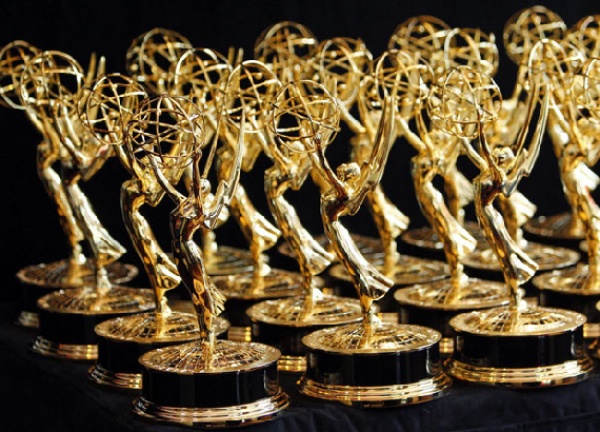
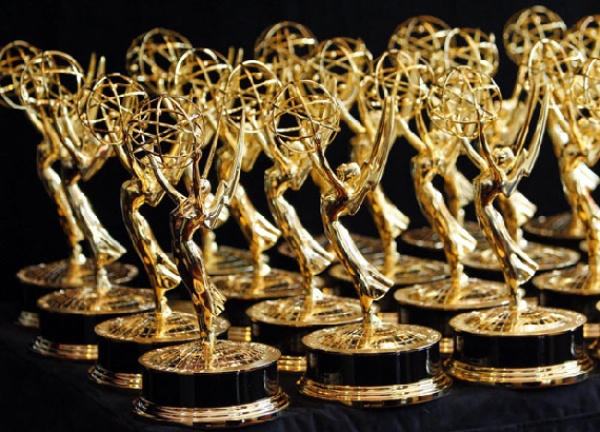
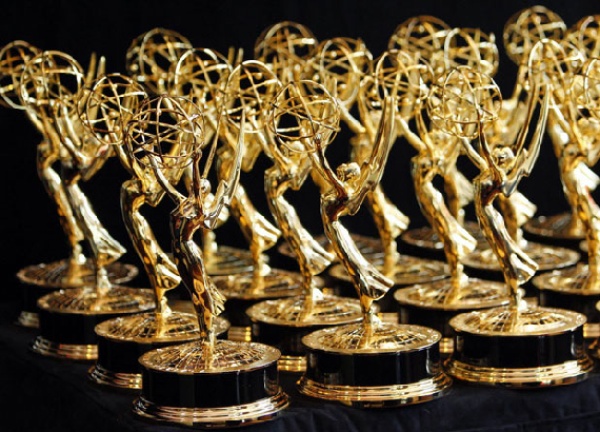
Speaking of which, I found out today that the
Emmy’s statuette
is supposed to be a muse
holding an atom
: “The wings represent the muse of art; the atom the
electron of science.” I love this. It’s so spectacularly backwards. And it is
spectacle for an atom to represent the electron orbiting it, for Ahab to
represent his leg, for the whole to represent the part. But the Emmys’
commitment to parts is sort of its charm, yes? Here’s hoping the glittery frame
is worth watching before it drops lightly out of its own televisual history.

Yours in the electron of science,

Lili

Lili Loofbourow is a seventh-year graduate student who works on early
modern constructions of reading as a form of eating—theologically,
physiologically, etc. In addition to her research and teaching, Lili
writes for a number of publications, including
The Hairpin, The Awl, The Los Angeles Review of Books, and The New Republic, where she contributes TV criticism to the Dear Television series. She also maintains a personal blog called Excremental Virtue. Follow her on Twitter here.

A head’s up: Dear Television will be blogging each week at the Los Angeles Review of Books this fall, so keep an eye out for them there!

Press Play Hosts Dear Television: Letter # 3: In Praise of the Haven’t-Seens

Press Play Hosts Dear Television: Letter # 3: In Praise of the Haven’t-Seens

null

This
week, Dear Television—Jane Hu, Lili Loofbourow, Phillip Maciak, and new
addition Anne Helen Petersen—will be hosting a very special Emmy Anti-Prom here
at Press Play. Why Anti-Prom? We love the Emmys—the red carpet, the goofy
speeches, the spectacle of Jon Hamm and Jennifer Westfeldt’s perfect
relationship—and we love reading Emmy coverage—the dissection of the host, the
hand-wringing, the Poehler-worship. But the world has enough think-pieces about
whether or not Emmy voters need to chill on
Modern Family—they
do! Instead, we’ve decided to exploit the generosity of Press Play and get all
abstract, in order to showcase the snubbed, the losers, and all the other kids
who didn’t get invited to the dance. 
This Emmy week, we will attempt the possibly foolish task of having a
conversation about the Emmys without stepping into the
who-will-win/who-deserves-to-win maelstrom. We have plenty of personal
investments in the outcomes of this crazy program, but, for the moment, we want
to ask: What are we really talking about when we talk about the Emmys?

(To read Phillip Maciak’s previous post, click here.)

(To read Anne Helen Petersen’s previous post, click here.)

Dear Television,

Happy to be here with you all at our first Emmys Anti-Prom! Not
that I ever expected an actual invitation from the Emmys, but I think I like
this better anyway. Not being invited to the dance is the new being invited to
the dance! Or something. And from what I’ve gleaned of the Emmys, actual prom
doesn’t look all that gratifying anyway. (Though those dresses—I will say that
the sartorial surprises of the Emmys can make up, at least for me, for some of
its other disappointments.) But “Will cream colours rule the red carpet this
year” questions aside (not that these aren’t taken
seriously
, let’s turn to some more pressing questions asked by
critics.

The annual Who-Will-Who-Won’t (Who-Should-But-Won’t) predictions
and buzz anticipating the Emmys will never flag, but let’s be serious: it can
only end in heartache. We even know to prepare, as HitFix’s
Alan Sepinwall and Dan Fienberg separate their thoughts into who should win and who will win. As Phil and
Anne have already noted, some things don’t change about the Emmys—and one of
them is that this award show that purportedly celebrates television has a
rather narrow, indeed bland, view of what exactly television is today. At least
in America, the Emmys’ TV might not really coincide with viewers’ (and
critics’!) TV. The Homecoming Queen rarely turns out to be who you hoped, as
the women of Mad Men might sympathize.

So Anti-Prom starts looking less and less like a collection of outliers
than like the majority. And we all know that to rage against the machine is,
partly, to be absorbed into it. It’s hard to talk against
the conventions of the Emmys without falling into speaking in conventions
ourselves (as Phil’s “snub-bait” might attest). Ah yes, Parenthood’s
Monica Potter
: a classic Emmy snub. In a way, though, this gives us
more leeway in how we celebrate Anti-Prom—as well as how we approach who won’t
be attending (that’s not to mention those that simply
can’t
, and I want to stretch this expansive space of the snubbed to
include those who, though they are attending, might still feel a little out of
place.

null

Yes, I’m talking about Outstanding Miniseries or Movie category.
That thing that happens in the final third of the awards show, and which has
that palpable force of making the ceremony suddenly feel verrrry drawwwn
outttt. You might not remember the Miniseries/Movie section from last year if
you, like so many, stopped watching at that point. Most Emmy viewers have seen
at least some scenes of Modern Family or
Two and a Half Men. But what
percentage of them have watched, say, Phil
Spector
or Behind The Candelabra?
I’m not trying to affirm HBO’s elitist judgment that “It’s not TV,”
but it’s good to remind ourselves that “It requires a subscription to
watch” 1/3 of the shows nominated under this category. This year, also
nominated are FX’s American Horror Story:
Asylum
, the History Channel’s The
Bible
, USA’s cable miniseries Political
Animals
, and Sundance’s miniseries Top
of the Lake
. More and more, this loosely-grouped set of odd nominees feels
like they could stand in for a kind of insurgent Anti-Prom themselves. We have
two Oscar-studded HBO films, an Oscar winner film director’s miniseries, a
commercial hit docudrama from the History Channel, a campy season of horror
that you might read as a miniseries by virtue of the fact that it is contained,
and a cable miniseries that never really caught on. Also, it’s partly a
category of convenience—how else would film talent get their EGOTs
otherwise??

Though in the current heat of week-to-week exegeses on the
current final season of Breaking Bad,
there might be especially something vital to be said about not just what gets
snubbed and subsequently mourned, but what is never really noticed to begin
with: what is untimely, or watched on one’s own time, or belatedly. There are
some things you can’t live-tweet; for everything else, there’s the Outstanding
Miniseries and Movie category. There cannot be enough said about the sheer fact
of access and convenience that would hinder a person from watching even one,
not to mention all, of the nominees under the category, but we should also take
into consideration that because most of these nominees don’t fit the
traditional season-long week-by-week episode format, it makes generating viewer
interest or investment that much harder.

null

The rhythm of a miniseries like Top of the Lake is dramatically different from that of a two hour
film, or a season of American Horror
Story
. Jane Campion’s miniseries—when it did finally find its way to
television—aired its seven episodes on three separate nights. To split the
seven hours of Top of the Lake—originally
aired without breaks at the Berlin Film Festival—into three chunks of seven
episodes each feels not just odd, but arbitrary. (My desire to keep watching
only speaks to the power of Campion’s storytelling—maybe this season’s Breaking Bad episode cliffhangers can
take a page out of her book,

 e.g., you can give your audience enough credit that if they’re still
watching at this point, they don’t need episodes to black out with literal questions
of life and death.

) Still, the very otherness of the
Miniseries/Movie-On-TV genre makes me wonder if we can find a better way to
fit, say, Campion’s miniseries into the context of our television sets. Or, is
it best to just think of it as a long film, however interrupted? You can always,
after all, stream it on your computer. And for TV bingers, seven hours is
hardly an outlandish commitment. The slipperiness of miniseries into movie is
also affirmed by the Emmys’ choice to group them together (funny for an award show
that acknowledges the genre differences between comedy and drama!)—a pairing
that happened only 2011, when the Emmys realized there weren’t enough
miniseries in production. But the miniseries has also recently made a
comeback—just this time in extended and pay cable, rather than in its previous
realm of broadcast. Due to FX’s and Sundance’s newfound interest in the genre,
though, might this change again in the future?

Whether we consider it a miniseries or an extended film, Top of the Lake didn’t create too much
buzz when it premiered on the Sundance Channel. Michelle Dean and I found that
by the time we had time to complete the second instalment of our
yak about the show
, it was no longer, as they say, timely. Hence, no
second instalment. But speaking with filmmaker Barry Jenkins afterward (who
came to the series months after it aired), he expressed how much he wished we’d
written on how the show ended. And even if we were looking for pegs, Top of the
Lake has something the rest of its fellow nominees this year don’t: it was
available on Netflix Instant almost immediately upon completing its run on the
Sundance Channel, giving the miniseries a chance to experience another surge of
interest. People watched it. Of course they did—it’s really, really good.

But will Top of the Lake win
among its category of outcasts come Monday evening? Certainly more people have
watched American Horror Story or The Bible, both of which are important
experiments in genre and storytelling especially when it comes to television.
Sepinwall and Feinberg agree that the Emmys are too conservative to vouch for
AHS, and that “‘Top of the Lake’ is probably too challenging and Sundance is
probably too inexperienced at making the push,” so HBO’s Candelabra will probably, in the end, bring home the goods. Perhaps
one cheering aspect of the Outstanding Miniseries or Movie subset is that
almost any win will feel like a virtuous act on behalf of the Emmys. These
nominees! They’re so different. Let’s not forget them; let’s throw them
into this crazy category we don’t really know what to do with. Still, it’s a
category that rewards experimentation to a point. We still
want our glossy prestige film to win, for goodness sake.

The fact that the Emmys can be, well, unpredictable at times, by
virtue of not giving prizes to what, as Phil said, might be judged as
Most Aesthetically Inventive or Most Subtle Acting Range (can you imagine
Elisabeth Moss might get her first Emmy not because of Peggy Olson, but because
of her portrayal of Robin? I mean, I sort of can!) can also mean that the Emmys
can also go so far as to surprise us. And as Anne said, television qua
television isn’t getting much respect out there in Promland, so when it
does—when the mundane and milquetoast gets recognition—it sort of results in
a mixed delight. Remember when a burgeoning Modern
Family
racked up all those awards after its first season? Such results give
viewers hope that they’ve got a say in their television.

So this year, don’t turn off the television when the Emmys turn
to their miniseries and movies. Because the question “Who Cares?” is
tied to the more simple question “Who Has Seen It”—and the best way
to start is to tune in. This Anti-Prommer wants more American Horror Stories, more Top
of the Lakes
, more Behind The
Candelabras
, just as much as she wants Elisabeth Moss to get her damn Emmy.

It’s not just TV, it’s the Emmys,

Jane

Jane Hu is a writer and student living in Montreal. You can follow her on Twitter.

A head’s up: Dear Television will be blogging each week at the Los Angeles Review of Books this fall, so keep an eye out for them there!

Press Play Hosts Dear Television: Letter # 2: The Emmys Anti-Prom Continues

Press Play Hosts Dear Television: Letter # 2: The Emmys Anti-Prom Continues

null

This
week, Dear Television—Jane Hu, Lili Loofbourow, Phillip Maciak, and new
addition Anne Helen Petersen—will be hosting a very special Emmy Anti-Prom here
at Press Play. Why Anti-Prom? We love the Emmys—the red carpet, the goofy
speeches, the spectacle of Jon Hamm and Jennifer Westfeldt’s perfect
relationship—and we love reading Emmy coverage—the dissection of the host, the
hand-wringing, the Poehler-worship. But the world has enough think-pieces about
whether or not Emmy voters need to chill on
Modern Family—they
do! Instead, we’ve decided to exploit the generosity of Press Play and get all
abstract, in order to showcase the snubbed, the losers, and all the other kids
who didn’t get invited to the dance. 
This Emmy week, we will attempt the possibly foolish task of having a
conversation about the Emmys without stepping into the
who-will-win/who-deserves-to-win maelstrom. We have plenty of personal
investments in the outcomes of this crazy program, but, for the moment, we want
to ask: What are we really talking about when we talk about the Emmys?

(To read Phillip Maciak’s previous post, click here.)

Dear Television,

Here’s the thing about the Emmys: it doesn’t
matter who wins so much as how we talk about it. Which is why we’re having an
Anti-Prom—we want to change the tenor of the conversations that have previously
been organized around the awards and their merit.

It’s notable, for instance, that what we know as
“The Emmys” are but one of six Emmy Awards ceremonies—it’s just that the
primetime Emmys honor the shows that are ostensibly watched by more people and,
as such, are more important. But that assumption belies a general understanding
that primetime offerings are, by default, more important than what airs at all
other times, because primetime is when serious adults, with their serious
tastes, come out to watch. Under this rubric, everything that airs during the
day is either kid stuff or sappy soap operas for bored housewives: juvenile,
feminized, less than.

That might sound a bit old fashioned, which it
is. But it’s also just one of the ways that we cordon off “quality” television
from “trash,” creating an explicit hierarchy with pay cable primetime at the
top and daytime broadcast at the bottom. Quality television looks better; its
seriality demands sustained engagement; it’s for smart people, people who like
novels and films, Dickens and Tolstoy—or so the rhetoric goes. The rise of the
cult of the showrunner is thus just one of many narratives, woven by the
industry and embraced by its public, positing that quality television is art,
e.g. everything that its commercial cousins are not.

But you’ve heard this before. The giddy haze of
the so-called “golden age” has begun to fade, and several authors, our own Phil
Maciak included, have attempted to complicate this overarching narrative of
quality, in which we can only appreciate television if we wrap it in the
rhetoric of other, more highbrow mediums. It’s only okay to talk about
television, in other words, if we’re not talking about that television.

It’s hard to think of this division as anything
other than elitist. Television has long been “the democratic medium,” a
distinctly American mode of entertainment, distinguished by its intermingling
of commercials and spectacle. The vast majority of Americans are still
consuming television in this traditional mode, commercials and all. Many
critics, especially those “slumming” in television from the fields of film and
literary criticism, only want to talk about what people aren’t watching:
it’s a curious form of hipster logic, one that I’ve seen defended in and
outside of the academy with the type of condescension usually reserved for,
well, hipsters.

The Emmys have been tasked with negotiating this
divide. How can the Academy of Television Arts and Sciences (ATAS) acknowledge
and flatter the legions of “quality” television fans, many of whom pay
attention to the Emmys for the sole reason of having their tastes validated,
while remaining dedicated to television qua television?

I’d argue that much of the Emmys’ irrationality
can be traced to this divide. Like the Academy of Motion Picture Arts and
Sciences, the ATAS is divided into “peer groups” according to who does what on
set—actors, directors, set designers, etc. Also like the Oscars, each peer
group votes on its own category, but everyone gets to vote for the
“Outstanding” categories (Best Drama, Best Comedy, Best Actress in a Comedy,
etc.). Shows, performers, and writers “present themselves” for nomination, then
the entire academy—15,000 members!—gets to vote on those nominations. I’m
sure the return rate is somewhat akin to wedding RSVPs (meaning: middle-aged
and old people do it; young people forget how to use stamps) but you can
understand how many varied understandings of television, its purpose, its
future, and definitions of “outstanding” are vying against each other.

null

Take, for example, the somewhat bonkers
nominations for Outstanding Lead Actress in a Drama Series. You have Vera
Farmiga in A&E’s Bates Motel, a show that garnered mixed reviews at
best but has a sort of nostalgic support: it’s not that people were nostalgic
for incestuous relationships so much as Hitchcock, Psycho, and the early
days of the high concept era. There’s Michelle Dockery in Downton Abbey,
a show labeled as quality simply because it airs on PBS, it’s a costume drama,
and the actors speak with posh accents; and Connie Britton in Nashville,
a pale shadow of her turn in Friday Night Lights in a primetime soap
with dismal reviews, disappointing ratings, and a fabulous soundtrack. There’s
Kerry Washington’s showy performance in Scandal, yet another primetime
soap; and Robin Wright’s understated turn in House of Cards, the
Netflix-Emmy-Generator-That-Could that is also notably less than the sum of its
beautiful parts. Finally, there’s the perennial bridesmaid Elisabeth Moss for Mad
Men
and the incumbent Claire Danes for Homeland.

So we have seven shows, six “channels,” a mix of
broadcast, public broadcast, extended cable, pay cable, and internet
delivery. The sheer number of nominations—each category is normally limited to
five—betrays the diffusion of voter tastes. But to return to Phil’s argument
about the type of performances that the Emmys prefer, whether they’re more
“naturalistic” or showy, this list runs the gamut: bordering on camp (Farmiga),
high melodrama (Britton, Washington), mannered and traditional (Dockery),
psychological realism (Wright, Moss), and the showy illness route (Danes). It’s
like Joan Crawford, Bette Davis, Katharine Hepburn, Shirley McLaine, and
Elizabeth Taylor vying for a single award, which coincidentally happens to be
my idea of heaven.

The relative diversity of the nominations makes
the voting members of the ATAS look pretty savvy: they’re resisting being sticks
in the mud about Netflix, instead essentially inviting the bully to the party
in the hopes that he’ll play nice. They’re acknowledging that excellence
manifests in different genres and in different performance modes. They’re not
just watching pay cable. Just like us, they’re willing to forgive Connie
Britton’s weak vocals if it means they can get close to her hair.

But what happens if, say, Kerry Washington wins?
After Danes won last year, many wanted to believe that the Emmys had come to
their senses: they’d put away childish things—like awarding actresses on Law
& Order SVU
, Brothers and Sisters, and other primetime soaps and
procedurals—and joined the adults at the quality tv table.

I can’t overemphasize what an aberration Danes’
win was. For the last ten years, the winners have been from shows that share
DNA with quality television (Damages, Medium, The Good Wife, The West
Wing
) but are never grouped with the “golden era.” Apart from Edie Falco’s
three wins for The Sopranos c. 1999 – 2003, all of the winners have been
from broadcast or broadcast’s cable siblings (FX, TNT). A win for Washington,
then, wouldn’t be surprising—but I can only imagine the sort of critiques it
would inspire, rife with the implication that awarding an “old-fashioned” show
(read: non-quality) is yet another testament to the Emmys’ irrelevance.

null

In truth, Scandal might be the best
reflection of the current state of television. It’s on a broadcast channel but
it garnered much of its fandom through its availability on Netflix. It boasts
an outspoken, successful showrunner—it just so happens that that showrunner is
a black female, and that her previous projects have also been primetime soap
operas. It mixes series qualities (a new case opened and solved every episode)
with serial ones; over the course of season two, the serial arcs have almost
wholly overtaken the “case of the week.” It has steamy sex—arguably as much as Game
of Thrones
—which is all the more titillating because of the creative ways
the show employs montage to suggest hotness instead of lazily throwing
boobs in your face. And its devoted fans have made it the Most Tweeted Show on
television, underlining the new modes of engaging with televisual texts and
shattering the myth that audiences refuse to watch in real time. It’s proof of
the ways in which the markers and modes of quality have “trickled down” from on
high, but it’s also a testament to their mutability.

Like Justified, The Americans, and The
Good Wife
, Scandal is a quality mutation. It confuses the hierarchy;
it resists classification. Which is part of why I love all of those shows: I
have little interest in sustaining the bifurcation between “quality” and
non-quality, especially since that divide, at least as popularly propagated,
has very little room for women, whether in the role of stars, showrunners, or
writers. Indeed, so much of the discursive labor invested in turning television
into something of value has, in essence, been to distance it from its feminized
roots. The feminine soap opera becomes the masculine “serial”; the passive
viewer of broadcast becomes the active viewer of quality.

These quality mutations have but a smattering of
nominations and are unlikely to win. But my hope, again, is that you think less
about who wins and whether you agree with it, and more about the language
employed to circumscribe “good” television and various programs’ refusal to hew
to that definition. If we are, to some extent, the media we consume, we are
also the shitty things we say to separate “our” television (“it’s not TV!”)
from others’.

Game of Thrones is a soap opera with swords,

AHP

Anne Helen Petersen teaches media studies at Whitman College in Walla Walla, Washington.  Her first book, Scandals of Classic Hollywood, is forthcoming from Plume/Penguin Press in 2014.  She writes on scandal, celebrity, and classic Hollywood for The Hairpin and on her own blog, Celebrity Gossip, Academic Style.

A head’s up: Dear Television will be blogging each week at the Los Angeles Review of Books this fall, so keep an eye out for them there!

Press Play Hosts Dear Television: Letter # 1: The First Annual Dear Television Emmy Anti-Prom

Press Play Hosts Dear Television: Letter # 1: The First Annual Dear Television Emmy Anti-Prom

null


This
week, Dear Television—Jane Hu, Lili Loofbourow, Phillip Maciak, and new
addition Anne Helen Petersen—will be hosting a very special Emmy Anti-Prom here
at Press Play. Why Anti-Prom? We love the Emmys—the red carpet, the goofy
speeches, the spectacle of Jon Hamm and Jennifer Westfeldt’s perfect
relationship—and we love reading Emmy coverage—the dissection of the host, the
hand-wringing, the Poehler-worship. But the world has enough think-pieces about
whether or not Emmy voters need to chill on
Modern Family—they
do! Instead, we’ve decided to exploit the generosity of Press Play and get all
abstract, in order to showcase the snubbed, the losers, and all the other kids
who didn’t get invited to the dance. 
This Emmy week, we will attempt the possibly foolish task of having a
conversation about the Emmys without stepping into the
who-will-win/who-deserves-to-win maelstrom. We have plenty of personal
investments in the outcomes of this crazy program, but, for the moment, we want
to ask: What are we really talking about when we talk about the Emmys?

Monica Potter’s Field

by Phillip Maciak

Dear television,

Last year’s Emmy red carpet
rolled out in a completely different world. Host Jimmy Kimmel was not yet the
P.T. Barnum-meets-The-Grinch figure he was to become post-Twerkgate; Lena
Dunham was not yet running a Tammany Hall-style influence machine for the NYC
comptroller elections; and Netflix was still just the place where I would
compulsively watch The Office episodes
until I fell asleep every night, not the place where I could pile all of my
irrational hopes and dreams about the future of serial narrative. But here we
are in 2013, the Emmys are back, G.O.A.T. awards show host Neil Patrick Harris
is at the helm, and I am excited!

Before I start getting all gooey
about it, though, let’s take a step back. This is an Anti-Prom, after all—we’re
dancing to 70s-era punk music, everybody’s cross-dressing, we’re all using air
quotes about everything. So now is not the time to start pinning corsages. As
the first poster in this Anti-Prom, I want to try to shatter some paradigms,
deconstruct cultures of value, put my distant-reading goggles on. But, as a
human person with a heart and tear ducts, I also have an intense desire to moan
about snubs! So, in order to split the difference, I want to talk a little
about a performance I instinctively felt was snubbed and then think a little
bit about why maybe my instinct was a false one.

null

Let’s begin with my instinctive
reaction: Parenthood’s Monica Potter
should have been nominated for an Emmy. If Judd Apatow and John Cassavetes had
a baby boy, and that baby was raised by Connie Britton, he would grow up to be
Jason Katims.  Katims cut his teeth on
the brilliant, belated My So-Called Life,
he was head writer and showrunner for the pop naturalist epic Friday Night Lights, and, in 2010, he
created NBC’s Parenthood, a show that
many critics consider among the best ensemble dramas on TV and that Emmy voters
have seemingly never heard of. The observational realism, improvisatory acting,
and fragile humanity of the series he writes make them feel almost avant-garde
compared to their network mates. And you would quickly run out of fingers and
toes trying to count the number of previously unassuming actors who have given
transcendent, career-best performances under his guidance. Chief among those
actors, at the moment, is Monica Potter.

This past season on Parenthood, partly as a result of
Potter’s own suggestion, her character Kristina received a breast cancer
diagnosis. Her arc was predictably tough and redemptive—she weakens physically,
goes through chemo, hides aspects of her illness from her college-bound
daughter, and struggles with sex, drugs, and the oppressive support of her
adoptive family before ultimately going into remission by season’s end. It
sought a particular, almost polemical, sense of audience empathy, and it attempted
to turn Kristina into a kind of Everywoman survivor. While the beats might have
been familiar, Potter played them with heartbreaking comic style and a
startling lack of vanity. A career television actress was handed a
traditionally sentimental role, and what emerged was a performance that both
embraced and challenged that sentimentality. Monica Potter crafted, this past
year, a radiantly intelligent performance about the costs and benefits of feeling, at all.

In turn, I figured that Potter
was a lock for an Emmy nomination. (And I was not alone—at least among the
twitterati.) She was a dark horse—coming from a series that had, in its four
seasons, received only a guest actor nomination—but the role was so juicy and
so well-played, so topically direct even, in a way other Emmy-repellent Katims
roles often resist, that many felt this was Parenthood’s
breakthrough moment. Monica Potter as Kristina Braverman, in other words, had
become “Emmy-bait.”

But the Emmys did not bite.
Potter was “snubbed” in favor of Breaking
Bad
’s Anna Gunn, Game of Thrones
Emilia Clarke, The Good Wife’s
Christine Baranski, Homeland’s Morena
Baccarin, Mad Men’s Christina
Hendricks, and, of course, the Dowager Countess Dame Maggie Smith. Gunn,
Baranski, Hendricks, and Smith are all repeat nominees, coming from series that
are also repeat nominees. Clarke and Baccarin are central ensemble members for
two of the biggest Premium Cable sensations since The Sopranos.  It’s not a
surprise that Potter wasn’t included here—though it’s certainly dispiriting,
considering the aimlessness of Baccarin’s performance. (It’s a surprise we ever
thought Potter could be nominated in the first place.)

The role Potter played was identified
as Emmy-bait almost as a knee-jerk reaction, but, looking at the above list—and
others like it over the past number of years—it’s hard to find another
performance like it. Do the Emmys really like to reward performances like
Potter’s? In 2012, Smith won for her wit and gravitas; in 2011, Margo
Martindale won for her matriarchal villainy on Justified; in 2010 Archie Panjabi won for the dangerous sexuality
of her Kalinda on The Good Wife. In
fact, you have to go back to 2007’s Katherine Heigl to find a supporting
actress winner whose role was even remotely comparable to the emotionality that
characterized Kristina Braverman and mistakenly marked the role as a perfect
fit for the Emmys. And Katherine Heigl is no Monica Potter.

What we’re talking about when we
talk about Emmy-bait in this way is really, to some extent, Oscar-bait.  The Emmys, in this category’s recent history
at least, don’t seem that interested in the kind of broad sentiment and deep
tearful emotion of a performance like Potter’s. The Oscars, however, eat that up.
Anne Hathaway, Octavia Spencer, Melissa Leo, Mo’Nique, Penelope Cruz—for the
past several years, the best supporting actress Oscar has primarily been a
prize for raw emotion. If Parenthood had
been a film, Monica Potter would be picking out a dress and borrowing designer
jewelry Shirley MacLaine-style.

But what does all of this mean? I
certainly don’t claim that I’ve definitively disproved the concept of
“Emmy-bait,” but the past few years in this one category certainly don’t hold
up as evidence. So if it’s not based on precedent or logic, why do we sometimes
have a tendency to conflate what the Emmys want with what the Oscars want? I
think part of this is aspirational. Online writers like us continue to claim
that either television is becoming more like cinema or that television is now
the place where a certain mid-budget mode of filmmaking now lives and breathes,
and we want the Emmys to act like it. Not only do we feel these awards should nominate a certain type of
performance, we retroactively insist—despite evidence to the contrary—that they
traditionally do reward a certain
type of performance.  

The Oscars, for their part, have
notable and exploitable pressure points. Mental or physical illness, historical
roles, complex villains, alcoholics, old actors making last stabs at
profundity, young actors taking ambitious first stabs at it, attractive
actresses “going ugly”—these are reliable prejudices that provide entry-points
for marginal performances or major performances in marginal films. Moreover,
they are archetypal roles, roles that define certain traditions in American
screen acting. The Oscars have prejudices, but they are based in what we are
constantly reminded is a storied and glorious—and conservative and misguided
and sometimes pretty racist—history. Asking the Emmys to have prejudices like
these is a way of asking television to have a more prestigious—more
cinematic—history. And this perspective—an admittedly snobbish one—invites
disappointment. Monica Potter’s performance was less Emmy-bait than it was
snub-bait.

null

On the other hand, there’s also
a tendency to apply a qualitative logic to a profoundly non-qualitative
selection procedure. Sure a lot of those performances are great, but a lot of
the nominations are based alternately in habit and trend. Performances like
Clarke’s and Baccarin’s get swept up in fever for their shows, and Dame Maggie
Smith will have a slot in this race until the day she dies, if that ever even
happens. Christina Hendricks will likely never have the clout or the momentum
to win this category, but she’s been nominated four times and likely has a
fifth coming for next year’s final season. Hendricks is and has always been
sensational on Mad Men, but you have
to ask yourself why the voters keep nominating an actress they never intend on
awarding. The quality of a performance is often secondary to the context in
which it occurs, and the Emmys are not often friendly to breakthrough
performances that are not otherwise a part of some larger zeitgeist. (It’s
worth noting that Connie Britton basically had to become a meme before the
Emmys would even nominate her supernaturally good lead performance on Katims’ Friday Night Lights.)

And then there’s the question of
popularity, viewership, and cultures of taste. Hopefully, you all will delve a
little further into this than I have, but I just want to note here that Adam
Sternbergh’s recent spectacular spread on popularity in the New York Times Magazine is particularly
enlightening here. For every TV critic who felt Potter was snubbed, there is a
viewer who doesn’t know Parenthood is
a show on television. The viewing world is made up now of micro-cultures, some
of which are silent, others of which are loud and influential. The snubbing of
Monica Potter is, in some sense, the result of some weird Venn-diagramming of
these cultures. As Sternbergh says of HBO’s Girls,
“By one measure, no one watches Girls.
By another, it’s fantastically popular.” Parenthood
has fallen under the bleachers of this popularity contest. The season four
finale of Parenthood was watched by
nearly five times the number of people who watched the season two finale of Girls. But Girls has captured popular culture in a way that Parenthood never will. Likewise, despite
its commanding lead over Girls, Parenthood has by no means the same kind
of numbers that The Big Bang Theory—another
Emmy favorite—has. We talk optimistically about the idea that small-scale, naturalist,
emotional adult drama has found a home on television after having been evicted
from Hollywood, but, in between prestige and popularity, does it really have a
home at the Emmys? And who else is hanging out with you, me, and Monica Potter
beneath the bleachers?

Clear eyes, full hearts,

Phil.

Phillip Maciak is Assistant Professor of English and Film Studies at Louisiana State University, and he is at work on a book about secularism and U.S. culture at the turn of the twentieth century. His film and television criticism has appeared at Salon, The House Next Door, Slant Magazine, In Media Res, and The New Republic. He is co-founder—with Jane Hu, Evan Kindley, and Lili Loofbourow—of the weekly television criticism blog, Dear Television. He tweets @pjmaciak and keeps a website at phillipmaciak.com.

A head’s up: Dear Television will be blogging each week at the Los Angeles Review of Books this fall, so keep an eye out for them there!

John Luther and the New Face of Evil

John Luther and the New Face of Evil

Those
with only a passing interest in the BBC detective drama Luther, or
who’ve watched the program only half-heartedly, will wrongly say that this is a
show about a dirty cop. In fact, what it is is a program about a man trying to
be heroic in all the wrong ways. The show’s title character, John Luther (Idris
Elba), is a Detective Chief Inspector working for London’s Serious Crime Unit;
while Luther has a set of skills that come in handy in homicide investigations,
this by no means confirms his career choice as a wise one. The show seems to
intimate that this is often the way with heroes: They misidentify the optimal
utilities of their skill-sets, blinded by the clarity of their ambitions. As a
former cop turned murderous flunky says of Luther at one point, “He’s not
a dirty cop. He’s a man over a barrel. There’s a difference.” 

While
I’ve never myself been a police officer, I have been a public defender, and
public defenders are known for having an even more complex and self-destructive
Jesus Complex than do patrolmen and detectives. For the seven years I defended
children and adults in criminal cases ranging from marijuana possession to
first-degree murder, I had nightmares almost every night. But they weren’t
nightmares about my clients, or about the things my clients may or may not have
done—as 99.8% of alleged crimes are of the most banal sort—they were nightmares
about failure. About letting down those I’d sworn to protect. And those
nightmares made me work even harder during my waking hours, or, when too
exhausted to work harder, caused me the worst sort of guilt about not being at
my best. That sort of internal struggle is slowly but surely destructive, which
is why I ultimately left the law, and why it’s particularly wrenching for me to
see John Luther so tied to a job that’s slowly killing him. Indeed, it’s not too
much to say that Luther is a documentary of suicide-by-profession.
The lead is always intimating he’s about to leave the force—a strange conceit,
for a detective drama—but the viewer never quite believes it. Luther without a
badge is merely a broken man without a purpose, not because his skills aren’t
transferable but because he lacks the imagination to conceive of such a
transference.

In
the second season of Luther, a teenage porn actress who claims to
enjoy her job—a job that entails being gang-raped while unconscious—is
admonished by Luther to call her mother. Her response: “It’s not my voice
she wants to hear. She’s no different from the freaks who get off on these
films. It’s not who I actually am that matters, it’s who they wish I was.”
Throughout the three seasons of Luther that have aired on the BBC
so far, the show’s lead is constantly being given hints like these—by porn
stars, actresses, even sociopaths he’d once hoped to arrest and prosecute—that
he himself is the one most in need of self-knowledge and salvation. Indeed, even
those who’ve never worked in the public service sector can see in Luther a
series of traits readily recognizable to anyone who’s ever wanted to be a hero,
or who’s ever relied overmuch on someone else who wanted to be a hero, or who’s
ever had the misfortune of being the spouse or child of someone who wants to be
a hero. In short, Luther sacrifices his mental health to be very, very good at
what he does, and he does so because he places a higher premium on the well-being
of others than on his own. The readily predictable result: Those he loves get
hurt, and he himself begins a slow descent into despair.

For
all its quirks, Luther does have many of the usual trappings of a
detective show: a smart and strangely charismatic leading man whose weaknesses
undermine his professional life and ensure persistent chaos in his personal
life; a cast of loyal compatriots, sprinkled with the occasional two-faced
villain in policeman’s gear; a series of brutal crimes that can only be solved
by a man nearly as troubled as the perpetrators themselves. What’s unusual
about Luther, apart from the stunning brutality of some of the
crimes it depicts—viewer discretion ought be repeatedly and urgently advised—is
the sense it provokes that it’s always mere seconds from going off the rails
completely. It’s not that John Luther is unpredictable, though he is; or that
he’s perpetually surrounded by intrigues of the most scandalous and destructive
sort, though that’s also true; it’s that Luther is a psychological drama
disguised as a detective show, not, like Monk
or another recent BBC hit, Sherlock
Holmes
, a detective show masquerading as a character portrait. So the
inherent instability of Luther’s circumstances indeed cuts at the very structure
of the series itself.

null

Rarely
have I been so repeatedly surprised by a television program. Issues which seem
likely to linger for several episodes are neatly resolved in minutes, only to
reappear much later as significantly more complicated destructive mechanisms.
Wise decisions made by characters are shortly reversed, with disastrous
consequences. Natural allies, including most of Luther’s administrative
superiors, become enemies under circumstances in which neither party is truly
to blame. Minor characters who’ve been minor for some time suddenly receive
promotions to “major” status. Killers are not always caught; in fact,
they don’t always remain villains, as one of the show’s primary characters, Alice
Morgan, is a known killer Luther now uses as a clandestine advisor on other
investigations. The genre of the show oscillates between police procedural and
horror flick, as undoubtedly the crimes portrayed on Luther are
some of the most heinous ever to appear on television. The show’s habitually
tight shots, particularly of victims at crime scenes, create a sense of
claustrophobia mediated only by an occasional wide shot of sterling beauty.
Ultimately the very structure of the show, as to both its plot and its
cinematography, is every bit as chaotic as the life and times of Luther
himself. As Luther unravels, so do (and so must) our expectations for what his
world should and will look like.

What’s
superlative about Luther is that it draws no attention whatsoever
to its oddities. The show’s lead plays Russian roulette with himself while
sitting alone in a room, but it’s merely one scene among many with more bells
and whistles; he assaults a suspect while in disguise to capture a DNA sample,
and it seems strangely apropos rather than creepy and illicit; Alice Morgan turns from a villain into Luther’s ally by a process of osmosis so slow it’s
almost imperceptible; the basis for a shifting allegiance five
episodes down the line is put repeatedly under your nose, only you don’t
realize it until you’re trying to put together the pieces later on. One can
only conclude, from all this, that Luther is seeking to normalize
that which cannot be normalized, in much the same way that Luther himself—who
wants very much to be a hero, however understated his body language is—must
normalize his psychic degeneration in order to keep doing the job he loves so
much.

Luther
poses for the attentive viewer an important question about the daily
manifestations of evil, and our own complicity in their devastations. How many
of us make erroneous assessments of what we do or don’t need in our lives? Or
of what we are or are not called upon to do, or who we are or are not capable
of being good to, or of what we can or cannot withstand? Luther is
a show about the crime of having both too much and too little self-knowledge,
not the harrowing and intricate gorefests staged by the show’s murderous
rogues’ gallery. It’s a show worth watching because it’s a cautionary tale, not
because we feel the vindication of justice served or heroic instincts validated
by merely watching it. Such instincts aren’t validated; in fact, they’re
revealed as poisonous, and in time we see them cause as much injustice to the
innocent as to the guilty. 

Luther—the
man as much as the show—is an emotional train-wreck it’s impossible to look
away from. The series is so cunningly disguised as entertainment that we can almost
(but not quite) forget how many of our own errors in judgment it reflects back
at us. Evil at its most pure, as Luther says in Season 2, quoting verbatim
(ironically) an unrepentant murderer, is a “black hole”—anything that
“drags you in and crushes you to nothing.” Earlier, another
unrepentant murderer is heard distinguishing between the banality of evil,
which he considers rightly taken for granted, and the much less feared but
considerably more insidious “evil of banality.” Detective work is a
civic function—a workaday banality—John Luther feels compelled to
execute, but which he cannot participate in without self-harm;
it’s just the sort of black hole that slowly and almost invisibly crushes
a man into nothingness. Like many detective shows, Luther is
finally about the insidious mechanisms of evil: it’s just not the sort of evil
you’d ever expect, nor the sort of self-destruction you’d ever see coming.

Seth Abramson is the author of three collections of poetry, most recently Thievery (University of Akron Press, 2013). He has published work in numerous magazines and anthologies, including Best New Poets, American Poetry Review, Boston Review, New American Writing, Colorado Review, Denver Quarterly, and The Southern Review.
A graduate of Dartmouth College, Harvard Law School, and the Iowa
Writers’ Workshop, he was a public defender from 2001 to 2007 and is
presently a doctoral candidate in English Literature at University of
Wisconsin-Madison. He runs a contemporary poetry review series for
The Huffington Post and has covered graduate creative writing programs for Poets & Writers magazine since 2008.

Tatiana Maslany in ORPHAN BLACK: An Acting Feat Wrapped in a Larger Accomplishment

Tatiana Maslany in ORPHAN BLACK: An Acting Feat Wrapped in a Larger Accomplishment

null

[Warning: This piece contains what could be considered to be spoilers.]

The recent Emmy
nomination snub of Tatiana Maslany, the star of BBC America’s Orphan Black, has been almost immediately
regarded
as one of the most painful in recent memory. In the months since the show’s Season
1 finale, artists
and critics
alike have raved about this 27-year-old surprise breakout. Few actors, established
or otherwise, could have pulled off the feat of acting virtuosity the show’s
star accomplished so powerfully: playing seven different roles in the same show,
characters that often share screen time. Sure, the clone thing may have been
done before, but never in this way or to this extent; on more than one
occasion, her characters—hailing thus far from Canada, the United States,
Ukraine, and Germany—actually impersonate each other, meaning Maslany must often
endeavor with Kirk Lazarushian magnitudes (“I’m the dude playin’ the
dude, disguised as another dude!
”). Comedy aside, Kirk Lazarus is an apt
comparison—Downey Jr., in Tropic Thunder,
is himself parodying Daniel Day-Lewis, whose method acting is mirrored in Maslany’s
own
practice
. What’s more, it turns out the actress is every bit as tenacious
as her on-screen personae, undertaking an exhaustive regimen of promotional interviews
and panels
on the warpath to awards season. In the wake of her snub, just watch her acceptance
speech from her Critic’s Choice Award win and try to keep your heart from
melting:

But amid the award
hullabaloo, it’s easy to overlook the show’s merits, which lie with its
writing, itself a stunt of character differentiation. Without good writers,
Maslany would have no acting feats to pull off in the first place. After
Brit-punk Sarah Manning—the first clone introduced and the show’s core
protagonist—witnesses a woman, who appears to be her identical twin, commit suicide,
she begins to discover that she is one of a series of clones scattered all over
the world, and part of a conspiracy to boot. Despite genetics, the clones have
led different lives. From a writing standpoint, these characters need to be
varied enough to generate interest, but still only as different shades of the
same person. And the writers execute handily; for such a diverse bunch, these
women feel surprisingly consistent. Each is crafty, intelligent, and
tough—willing to fight when the need arises, but tinged nevertheless with a compassionate
center. It’s always refreshing to see strong female characters in the
male-dominated antihero era, but it’s even more refreshing to see them
presented in a way that doesn’t call attention to that strength. In the manner
of politically inclined shows like Borgen
and Homeland, these women aren’t
idealized, and, like their canonical male counterparts, their most endearing
qualities often double as their vices. In some sense, this collection of
characters is the most complex character study in television history. Instead
of speculating, for instance, what Sarah would be like in a different life, we
get to watch it play out firsthand. From a production standpoint, the show
assists its audience in differentiating among its characters via motif. Helena,
a feral, tortured zealot, is often presented with rack focusing tilt-shift,
off-center shot compositions, and recurring minor key scoring. Cosima, a
dread-locked doctoral student, is typically offset with patterned reds and
oranges, visually reminiscent of the DNA double helix, befitting her course of
study (Experimental Evolutionary Developmental Biology). Meanwhile, scenes that
focus on Alison, a suburban housewife, are balanced in composition, featuring
muted pastel tones and still camera.

However hackneyed a
device, it is through the central conspiracy that the show instigates and
explores its deep moral questions—with a broader scope than its conceit may
initially imply. Though it probes the ethics of cloning, it doesn’t outright demonize
it, even while holding its perpetrators accountable. Paying homage to the
growing canon of clone narrative, the show first presents advocates of
“Neolution”—the process of self-directed evolution that functions as the “justification”
for human cloning—as sinister. But that slick veneer of scientific evil has
chinks. Seemingly, some of those involved are conducting what they believe to
be morality-oriented (or at least socially pragmatic) research, even if their
methods may be questionable. The obvious pro-con discussion of cloning’s ethics
is unavoidable. It could benefit the larger population, but at the potential cost
of identity crises or other unforeseen problems among its subjects. The show,
however, is most interested in examining the idea in terms of the human processes
that shape it and result from it. Which personality types are drawn to this
sort of study, and what are their motivations? What is the government’s role in
this process, if any? Should private corporations be given license to conduct
experiments outside of the government’s direct purview? As technology advances
at an ever-quickening pace, old decision-making structures become increasingly
obsolete, and this is as true of cloning as it is for plenty other emerging
capabilities—whether political, economic, or technological—in modern society.

But for all its
conspiracy, Orphan Black is a
character drama, and its creators don’t let these ruminations usurp priority
over the narrative. Through narrative decisions, though, they take implicit
stands on a number of cultural hot topics. Principal among them is nature vs.
nurture, exhibited most notably in Cosima’s sexual orientation. So far, she’s
the only one of the bunch with a pronounced attraction to women (the others
haven’t proven a definite disinterest in women, but appear heterosexual). If
she’s technically the same person as her counterparts, this implies that circumstance,
not nativism, is at work. And if there is observable nativism, it is only insofar
as genetic predisposition. Even if homosexuality were to be considered a “choice,”
why would Cosima choose this lifestyle for herself when her counterparts so
clearly chose heterosexuality—meaning, by this logic, that she could too—amid a
still
less-than-ideal sociocultural climate? Whatever the rationale, the existence of
this disparity asserts the equal significance of “nurture” in personality
formation alongside “nature.”

These debates don’t end
with era-defining scientific ones; the show’s creators are also interested in
exploring fundamental ideas of identity and family. What exactly are these clones to each other? Do they
count as family? In a sense, they know each other better than anyone else, but
that is only based on what they already know of themselves, and, given the
clear significance of “nurture,” even that is subject to review. So, when Sarah
discovers that Helena is a psychologically troubled flagellant, her horror is
not just theoretical—it’s personal. Unlike normal family dynamics, there’s no
guesswork in the implications of each other’s actions; if one is capable of
something, so are the others. In this way, the show elicits a deeper form of empathy
from its characters and its audience.

Despite a sometimes
action-heavy plot, the show reveals itself in its character moments. There’s an
uncanny delight in watching these women exacerbate each other. Obstinacy and
individuality are core traits to all, and while this knowledge helps guide
attempts at predicting each other’s actions—a process made muddy by a lack of knowledge
as to the others’ life experiences—they also know to suspect ulterior motives
in even the most benign circumstances. Further complicating the landscape of
trust and paranoia, Orphan Black doesn’t
default to easy alliances (even if it gives the impression of doing exactly the
opposite)—a feature that swells in significance when the notion of “monitors”
comes into play, where anybody could be withholding their true identity for as of
yet unknown purposes.

Like its medley of
clones, Orphan Black is an amalgam of
disparate influences. Simultaneously a conspiracy drama, speculative science
fiction, and a quasi-entry into the budding “Slow TV” movement, it
exists at the intersection of The X-Files, Lost, and Six Feet Under. Of course, its first season had some rough edges,
but the same could be said of Seinfeld,
The West Wing, The Simpsons, and Parks and
Recreation
. Its flaws are forgivable because the show refuses to push light
fare—even in its playful moments, its weighty questions have complicated
implications—and rather than default to plot action to distract, it uses these dilemmas
to push into complex terrain. Tatiana Maslany deserved that Emmy, but maybe the
slight can serve the greater good by incentivizing the show’s fans to broaden
its exposure during the coming year. On that note: go
watch it
.

Jesse Damiani is Series Co-Editor for Best American
Experimental Writing (Omnidawn, 2014). He lives in Madison,
WI.

Beautiful and Claustrophobic: MAD MEN’s Inferno

Beautiful and Claustrophobic: MAD MEN’s Inferno

nullWhen I
started taking classes in creative writing, one of my teachers told our class
that all we had was one story we would spend our entire lives rewriting. At the
time I found the prospect of this frightening. In a home of Cuban-Jewish
refugees I had grown used to two concepts: the impermanence of material things
and the permanence of loss. Both themes were ones I strove to break away from.
I nurtured an intense fascination with born-again Christianity. There seemed
something glorious to me about the idea that you could start again, fresh in
the world, free from the past. 

The longing
for rebirth is a motif, which dominates our literary imagination and our
spiritual and emotional lives. The rebirth narrative is often constructed as a
narrative of resolution. We long to read about characters who are constantly
making choices which propel their life forward and we love reading about heroes
and heroines who are brave enough to make the choices that will ultimately lead
to some kind of change. In real life we are creatures of habit. We love a
routine, because it makes an unruly universe seem manageable and safe. In
fiction we open a box in one scene and in the next we close that box for good.
In real life, we keep—consciously or subconsciously—reopening that box.

Mad Men, which at first glance seems to
be a period drama, has actually proven to be a drama that explores how every
rebirth is a repetition. When I first started watching, I’d feel a deep,
overwhelming sense of dread with every episode. Ever swig of a martini, every
suck on a cigarette, every fuck behind another spouse’s back filled me with great
anxiety. On Mad Men, no character
(except, arguably, Peggy Olson) is ever able to change, even as the world is rapidly
changing around them. Our desire to rebuild our lives is shown to be just as
much of an illusion as anything else Don Draper or Peggy or Pete Campbell tries to sell to a
client. Both Don and Betty Draper repeat patterns from their old marriage in their new
ones. The new ad agency may look different from the old ad agency, but the same
ugliness that hid beneath the surface of the old polished veneer is there under
bright lights, mod fashion and art deco design.   

In many
ways, Mad Men’s insistence on denying
us the pleasure of resolution is the secret to its success and the reason so
many of us are hooked on it, despite being frustrated that nothing ever really
changes, time and time again. Repetition of experience is electric. It grounds
us in the past and connects us to the present. We think what we seek is an
experience, which is new, but what we really want to feel connected to is an
experience that makes us feel happy and safe, in a way we once felt happy and
safe before. All addictions are nurtured by our love of repetition, a need to
feel as high as we once were, as loved as we once were loved. Don’s continuous
cheating has always had a somewhat addictive quality to it. In every case Don
wants the simultaneous thrill of the new, along with the comfort of the old.           

The
repetition of familiar collective memories and period fashions has always given
Mad Men a kind of warm intimacy,
which is strange because many of its most fervent viewers haven’t personally
experienced the 60s. In an article for Vanity
Fair
, “You Say You Want a Devolution,” Kurt Anderson claims that this
yearning for the past is a peculiar development of the 21st century,
which he claims is a reaction to constant technological newness. In Anderson’s
view we would rather rehash the past, rather than create anything new at all. We
watch television shows that are episodic, where characters continuously revisit
experiences, and we live in the age of the remix, where we borrow snippets
from the past as a way to reinvent the present.

But, in reality, I don’t think that
our desire for repetition is anything new at all. There is something very human
about our love of patterns. Our obsession with the past is more than just
fashion. It is built into our bones. We harvest food according to different
seasons. We pray for different purposes at different times of the day and
different times of the year. Ceremonies like graduation and weddings are built
into the very fabric of our culture, in both religious and secular settings. Poets
and lyricists have long been seduced by repetition. You can find the repeated
word or line in a classic love poem, and you can find it in contemporary songs.
We sing song refrains ranging from, “Hey Jude” to “Mmm Bop.” 
The repeated onomatopoeia word can be sing-songy, as in children’s
songs, or visceral and raw. Kanye West’s brutal album, My Beautiful Dark Twisted Fantasy, is often about obsession and
addiction and its most brutal, harrowing lines are repeated words. When Kanye West sings “bang, bang, bang, bang, bang,” so icy and
perfectly metered, on his new album, are these words the sound of a gang-bang
or a gunshot? The more we hear a word repeated, the stranger it sounds and the
more we re-think meaning.

Anyone who
has participated in a writing workshop knows that there is a danger in treating
art as personal therapy. Often, especially for beginning writers, we do repeat
the same story over and over, until we reach the sense that we have finally get
it “right”—we’ve made sense of the motifs we were continuously drawn back
to.  My writerly “coming-of-age” was no
different. In grad school most of my writing focused on two relationships: my
relationship with my mother and a romantic relationship that broke my heart in
two.  

One story resolved. For months after
the relationship was over the repetition of words from my ex’s poems would
drift through my brain at odd intervals, like a song I knew all the words to,
until one day, I didn’t remember many of those words at all. At that stage I no
longer loved this person any more and it felt like what it had become: a tiny,
tender loss, wholly different than the dramatic poems I wrote when I was still
angry and passionate about a love I didn’t want to see die.

In contrast, the relationship with
my mother evolved. We learned to understand each other. I’m not sentimental by
nature. I don’t obsess over pictures. When I move I throw stuff out. My mother
is the opposite. She takes forever to get rid of anything. Whenever I go back
home, my room is a museum of me, except it isn’t a museum of me at all: it is a
museum of the girl I was when I was 15 years old. Whenever I go home I am
stunned at how much I’ve changed and how I haven’t changed at all.

Repetition reminds us of that gap within each
of us: between that part of us that stays constant and that part of us that is
willing and able to evolve. It reminds
us that if everything is ephemeral, repetition is all we have. It reminds us
there are lovers we will leave behind and mothers we will love forever.

The opening image of Mad Men shows a man falling to his
death; in reality, the path down is a spiral rather than a straight line, which
means it is ultimately going to take a longer time to bottom out.  This season the space between Don’s domination of
Sylvia and his tiny voiced “please” begging her to stay is getting narrower
and narrower. This season’s first Mad Men
episode opened with a scene on the beach and Don reading The Inferno. It ended with an ad that Don created: the image of
an empty beach, bare tracks in the sand, discarded clothes, the open ocean. For
Don this was an image of escape. For his clients it was an image of a suicide. Escape and suicide have always been
dangerously close throughout the series, but this season, we are reminded
over and over how it is impossible to only love the beginning of things, when
everything that begins is ultimately going to end.

Arielle Bernstein is a writer living in Washington, DC. She teaches
writing at George Washington University and American University and also
freelances. Her work has been published in
The Millions, The Rumpus, St. Petersburg Review, and South Loop Review, and she has twice been listed as a finalist in Glimmertrain‘s Family Matters Short Story Contests. She is Associate Book Reviews Editor at The Nervous Breakdown.