WATCHABLES Podcast #1, Feat. Arielle Bernstein and Mike Spry! From Beyonce to BOYHOOD to BIRDMAN To…

WATCHABLES Podcast #1, Feat. Arielle Bernstein and Mike Spry!

nullWe’re proud to present the first installment of Press Play’s new podcast, Watchables! This segment features our columnists Mike Spry and Arielle Benstein; future installments will bring Seth Abramson into the mix! On a semi-regular basis, the brave podcasters will discuss anything that’s… well… watchable, from film to TV to viral videos to Instagram. Today, Bernstein and Spry ruminate on their favorite things from 2014. What does this mean, for them? It means Beyonce meets Boyhood meets Birdman meets Obvious Child meets John Oliver meets… well, you’ll see. (Note: it was recorded some time ago, so forgive some references to certain holidays that might cause a slight time-machine effect.) The link is at the bottom of the page. And: if you need a visual reinforcement for some of the watchables discussed, we’ve provided a couple of those as well!

ARIELLE BERNSTEIN: Out of the WILD

ARIELLE BERNSTEIN: Out of the WILD

nullThe
explorer is, often problematically, a part of America’s cultural heritage. We
still revere early American colonizers like Christopher Columbus in the same
way that we idolize the modern American cowboy. The explorer is portrayed as an
admirable adventurer in America’s literary landscape too, from Henry David
Thoreau’s Walden to Jack Kerouac’s On the Road. We cheer on the male leads
in films ranging from Indiana Jones
to Lord of the Rings, from children’s movies like The Lion King, to dark dystopian
landscapes like The Road.

What
does it mean to be a woman in this largely male-dominated history? In The Power of Myth, Joseph Campbell
argues that the hero’s journey is universal and serves a fundamental
psychological purpose, in that it allows us to overcome our demons, to pursue
our passions, to become who we need to become. But Campbell also argues that
women have a distinctly different journey, one that is turned inwards, rather
than outwards. He attributes this to basic biology—that boys need to do
something external to symbolize the transition to manhood, while girls simply
don’t have to. He argues that a girl’s natural biological changes are the only
ushering she needs into womanhood.

I
deeply resented reading Campbell’s descriptions of what it meant to become a
woman when I first read The Power of Myth
in high school. I didn’t feel like changes in my body made me any more prepared
for adulthood. I longed for experiences that would catapult me out of my
childhood and into the world.

Attitudes
about girls and women have changed substantially since I was a young girl
hungering for female characters with agency. The influx of female heroes during
the past several years has ushered in a kind of mainstreaming of female power.
Today we have heroes like The Hunger
Games’
Katniss Everdeen, and shows like Orange
is the New Black
, where the lives and experiences of women are central.

Still,
many female travel narratives are often presented as the domain of the
pampered. Movies like Eat, Pray, Love
and Stealing Beauty showcase the
female journey as pure escapism, in which a privileged white woman gets to take
a journey of personal fulfillment, a voyage that is often maligned in our
popular culture for being vapid and self-absorbed.  

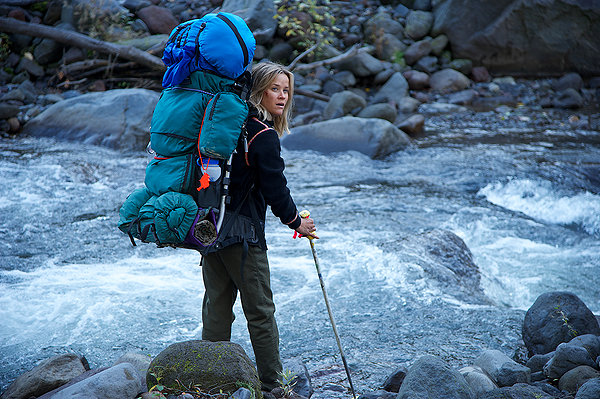
Wild, though still tinged with a soft Oprah self-help glow, is
doing something fundamentally different—reimagining the female journey as
existential quest. 

Based
on her memoir by the same name, Wild
is about a woman who takes risks and makes choices in struggling to find a way
out of her grief after the death of her mother, the self-described love of her
life. Along the way she develops a heroin habit, cheats on her incredibly
patient and loving husband, and decides, ultimately, to walk the Pacific Coast
Trail alone as a symbolic gesture to try and reclaim a sense of self. The story
is often told in flashbacks—scenes from when Strayed was a child and a teenager
and early twenty-something, scenes from her young marriage and its
disintegration, scenes of Strayed’s ensuing addiction to casual sex with
strangers and drugs—with moments in the present as Strayed overcomes hurdle
after hurdle of being alone in the very literal wild.

Strayed,
the real life author, is a fantastic writer, and while the director of Wild, Jean-Marc Vallee, strives to
capture her tone through voiceover, I found myself longing for Vallee to translate
Strayed’s experience to film with a greater emphasis on the images she
encounters on the way. Vallee’s storytelling throughout tends to be overly
directive, from the opening scene where we hear Strayed’s heavy breathing in
the background and assume she is having sex, only to find her struggling to
remove an injured toenail at the top of a cliff, to the use of an elusive,
beautiful fox following her around her journey. In scenes like these, Vallee
directs how we should feel emotionally and how we should view Strayed’s
character, as well as her journey. Witherspoon is a talented actress and
Strayed’s memoir is so ripe with emotion that I felt the film could benefit from
more subtlety and a greater focus on the landscape itself. Often I wanted us to
be given the space to really discover ourselves in Strayed’s journey.

Of
course, this was probably a challenging film to make, not least of all because
of the gender of its brave protagonist and the fact that we often don’t see
female characters as being naturally relatable. Many film reviewers, myself
included, could not see Wild without
considering the novelty of the solo female traveler. In “Why Every Man Should
See Wild
,” Julianne Ross talks about ways in which the film is instructional in
showing men the way that sexism and micro-aggressions from men impact the
experience of solo female travelers. And I was impressed by the nuance with
which male reviewers like Andrew O’Hehir noted how the experience of travel is still
very gendered in today’s world. “There
are times in every woman’s life where her safety depends on the goodwill, or
just on the whims, of men. That can only be exhausting and depressing,” he
reflects in his review for Salon. 

Some reviewers have still struggled with empathy. David Denby, in his New Yorker review, focuses on the shock
at how small Reese Witherspoon is, how she “doesn’t have the muscular legs of a
hiker,” even though it’s clear from the film that Strayed outlasts several more
experienced male hikers on the trail. (And he also, unnecessarily, fixates on
the fact that Witherspoon’s Strayed is tiny, while the real-life writer Strayed
seems “big-boned.”)

That a woman could be at the center of that kind of narrative is
exciting, but the way we talk about that narrative is also still relatively loaded.
I sometimes worry that we simply don’t have a vocabulary for talking about this
type of narrative without positioning woman as the “other.” Today’s Internet
culture has created rich discussions about the ways in which white, male
protagonists have historically been positioned as the default, but the creation
of special interest groups on the web also seems to play directly into that
belief. When my Facebook newsfeed is covered with articles telling me what 10
female writers I had to read in 2014, I am proud that women are getting the
attention they deserve, but I also can’t help but feel disappointed that women
and minorities still need to be separated out in order to get the recognition
they deserve.

One of the reasons that Strayed’s Dear Sugar column at the literary
magazine The Rumpus was so successful was that it was anonymous—we
couldn’t be sure of the gender or age or ethnic background of the columnist,
even as those details slowly emerged over time, over the course of every
column. In the end I don’t want Strayed’s story to get attention because it
could be seen as instructional or representative of women’s experiences more
broadly. I want us to tell women’s stories because they have teeth. 

While viewers may be surprised to see a petite woman on the trail alone
in Wild, Strayed’s arc is less about
portraying the female experience specifically, than showing us how the female
experience is a human experience. The
most poignant scenes in Wild showcase
Strayed’s regrets. In flashbacks, we consider her sadness about moments when
she was dismissive towards her mother, or treated her with condescension or
disrespect. We empathize with Strayed about whether she should have shot her
mother’s beloved horse, when they had no money to take it to a vet. I wanted
Strayed’s journey into the wild and back to civilization to interrogate these
moments more fully, for us to spend less time thinking about how a petite
blonde could survive on the road, and more time thinking about the ways we are
each forced to contend with a world that takes away as much as it gives.

Arielle Bernstein is
a writer living in Washington, DC. She teaches writing at American
University and also freelances. Her work has been published in
The
Millions, The Rumpus, St. Petersburg Review and The Ilanot Review. She
has been listed four times as a finalist in
Glimmer Train short story
contests
. She is currently writing her first book.

RIP Edward Herrmann (1943-2014): A John Cheever Memory

RIP Edward Herrmann (1943-2014): A John Cheever Memory

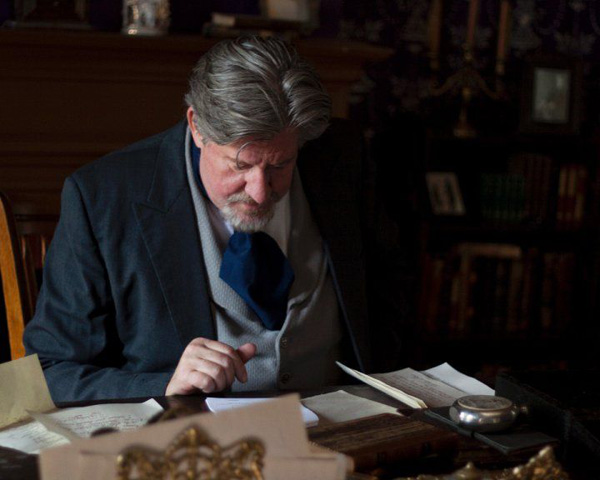
nullEdward Herrmann’s acting talent will always be emblazoned in my memory for one performance he gave, in a television adaptation of the John Cheever story "The Sorrows of Gin" in 1979. He starred with Sigourney Weaver, (who would turn heads, that same year, for her groundbreaking part in Alien) and the adaptation was done, interestingly enough, by Wendy Wasserstein, in the days when she was only just beginning to get acclaim as a playwright. The story describes a husband and wife who, unthinkingly, fail as parents through their boozing, and partying, and self-absorbed decadence; we receive the narrative through the eyes of their child, who pours her father’s gin down the sink and then tries to run away from home. The failure is bigger than that; these two individuals fail each other as members of a relationship, but rather than allowing them to redeem themselves, Cheever leaves them hanging, as he so often does, in their despair. The teleplay was one of three in a series called "3 By Cheever," which, because I was a rapt Cheever fan in 1979, I watched with complete attention; the other two equally melancholy stories in the series were "O Youth and Beauty!" and "The 5:48." I can’t say why, as a youth at a single-digit age, I found these dramas so fascinating; what I can say, though, is that even at that young age, I could recognize the skill and intelligence Herrmann brought to his sad, sad part. It was mainly in his face, both slack and taut, perfect for showing a patrician lifestyle in the early stages of decay. As he and Weaver spoke the poetically charged lines from Cheever’s story, you could tell instantly that they understood the words they were speaking, grasped the message they carried, which is half the battle for an actor. As I think about that trio of dramas (Herrmann was in "O Youth and Beauty!" as well, but did not make as strong an impression on me in that part), I’m given a little bit of pause. We claim to live, over and over, in a "golden age" of the idiot box, and yet would we be in the midst of this age if programs like this had not come first, as models? Well-produced, well-acted, with attention to quality, not calling too much attention to themselves, responsible renderings of literature by a true American master: there is little in today’s programming offerings to match this performance level, and there are few actors working at any time who could have served as agents of the subtlety in "3 by Cheever" as well as Herrmann. He’s had justified recognition for his work in Gilmore Girls, in Reds, in The Lost Boys and many other roles, at other times, but when I heard of his death, this was the first performance I thought of. For your viewing pleasure, below, is a clip from "The Sorrows of Gin."


KICKING TELEVISION: The Good, The Bad and the Lorre (2014 TV in Review)

KICKING TELEVISION: The Good, The Bad and the Lorre (2014 TV in Review)

nullI’m not big on lists, especially
in columns. I’ve indicted the BuzzFeed generation and their listicles in many
publications. But as our calendars fumble their way towards irrelevance, the
hour and our editors ask us to review the year as it fades into memory. As a
writer who published his
third book
this year to great fanfare among close relatives, “Best of” columns only serve as a reminder of the failures of our offerings,
and how much of our advances we owe back to our publishers. But 2014 was
another exciting year for television, which now regularly challenges film in
terms of narrative and aesthetic acumen. And 2014 was the year that Kicking
Television stole from Wilco and entered into the fray of TV commentary. So not
to be outdone by my new peers, here for your consideration is what I saw as the
good, the bad, and the ugly Lorre of the year in television.

The Good

You’re the Worst (FX)I’ve previously
declared my undying affection for this show in this space
. It is
quite simply the best sitcom on television, and the most interesting
dissemination of love in 22-minute intervals since Sam and Diane. Love and hate
aren’t opposites, they’re twins. And love is stupid. It’s a godawful waste of
time. Intimacy is ridiculous and often revolting. Honesty is exponentially more
difficult than deception. You’re the
Worst
celebrates these painful disparities without caricature or the
promise of inevitable reconciliation. Aya Cash (Gretchen) and Chris Geere
(Jimmy) are near flawless as a couple on the brink of love and in fear of
happiness, and Desmin Borges (Edgar) and Kether Donohue (Lindsay) defy the
tired tropes of supporting cast BFFs in creator Stephen Falk’s triumphant
production. You’re the Worst is the
shining hope that the sitcom is not dead.

The Walking Dead (AMC) — I was late to the party that is The Walking Dead. While I love
post-apocalyptic narratives, I’m afraid of zombies. And blood. And Andrew
Lincoln’s Mark from Love Actually. And while I liked the first few
seasons of the show, I wasn’t addicted to it like many. I tired of Hershel’s
farm. I skipped scenes involving The Governor. But, as soon as the show escaped
the confines of the prison, and put its band of survivors on the road, it
stepped into a higher echelon. The
Walking Dead
has become more about the challenges of surviving a world
without amenities than about stabbing extras in the head. Additionally, it takes the
time to develop characters and yet doesn’t remain static in its narrative. And
in a television landscape absent of diversity, The Walking Dead boasts the most racially varied cast perhaps ever.
Pedestrian white male actors everywhere should be in fear of this becoming a
trend.

Streaming Television — Streaming video services have compelled the film and television industries to become more conscious of the
wants and needs of their audience. By providing programming and viewing options
outside of the formulaic and staid proclivities of traditional television, the entire
industry had changed for the better. Network television is now not only being
bested by cable, but outflanked by streaming services. NetFlix is the HBO of the
medium, with Amazon and Yahoo auditioning for the roles of AMC and Showtime. (Hulu,
inexplicably, seems content as a cross between The WB and TBS.) House of Cards (NetFlix) and Transparent (Amazon) are two of the best
shows on television, and could not exist in the formulaic realm of
traditional TV. Next year will see streaming services bring viewers more of the
Marvel Universe, the third life of Community,
a talk show from Chelsea Handler, shows from Paul Feig, Jason Reitman, Tina
Fey, Mart Kaufmann, and other auteurs who have found their interest in TV reinvigorated
by the possibility and versatility of a new medium. CBS plans on combating
streaming television by sending the cast of NCIS directly to your home for
table readings.

Last Week Tonight with John
Oliver
(HBO) —
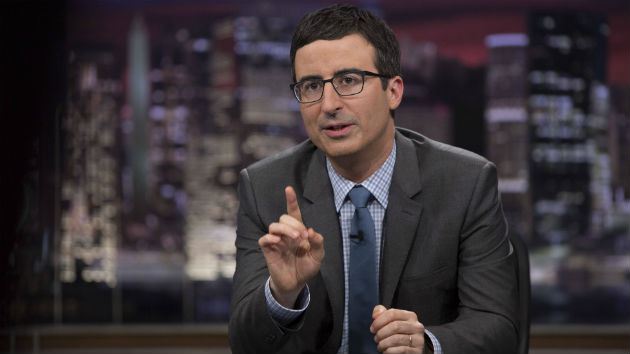
I didn’t tune into Last Week
Tonight
immediately when it debuted this past summer. I stopped watching The Daily Show some time ago. The Comedy
Central stalwart has essentially become an indictment of incompetent media, and
though that’s certainly an argument that needs to be advocated, it made for a
stale production. When Oliver made the jump to HBO, my fear was that his show
would be a pale imitation of something I had grown tired of. I couldn’t have
been more wrong. Oliver has taken satirical current affairs programming to a
new level, deftly combining progressive in-depth journalism with pitch perfect
humor. No other show ever could disseminate LGBTQ rights in Uganda, net neutrality,
and lotteries with the journalistic precision of 60 Minutes and still be funny. If Oliver doesn’t win a Peabody, they
should stop giving out the award.

True Detective (HBO) — Look, I know nearly everyone has
True Detective on their “Best of 2014”
lists. The acting was superb, the writing was sublime, and the aesthetic was
unlike anything television has ever seen. And the six-minute take from episode
four is something that will be taught in film school for generations. But my
affection for it has more to do with its format than its acting or content. The
idea of a series of mini-series is not revolutionary, but one that has had more
success in the UK than in the US. True
Detective
, along with Fargo and American Horror Story, have found new
ways to tell stories using the medium of television, and a unique way to get
big talent (Matthew McConaughey, Woody Harrelson, Vince Vaughn, Cary Fukunaga,
Martin Freeman, Kirsten Dunst, Billy Bob Thornton et al.) to have an affair with TV
without committing to it.

Transparent (Amazon) — Transparent (I didn’t catch the double-entendre until Episode
8) is a series that would never have seen the light of day on a network,
perhaps not on cable, and certainly not five years ago. Jeffrey Tambor is
transcendent (see what I did there?) as Maura, who self-identifies as a woman,
and the challenges of their upper-middle class LA family. Tambor is excellent.
Judith Light (their understanding ex-wife) is embodying the role of a lifetime.
And Jill Soloway’s deft touch as creator and showrunner takes the narrative to
places never before seen in TV. But what I think makes it not just one of the
best shows of 2014, but a promising piece of art for 2015, is the manner in
which it fills the cast with unlikable characters. Maura is not without
faults, his children are self-involved and spoiled, and even Light’s Shelly was
happily planning on euthanizing her new husband. But, like Breaking Bad, Transparent proves there is interesting art in the
unlikable, despite what creative writing programs might tell you.

Banshee (Cinemax) — If someone walks in on you
watching Banshee at the wrong moment,
they’ll think you’re watching porn. Soft core porn, but porn nonetheless. And
there’s no shortage of sex and nudity in the show, but it’s on Cinemax, so it’s
kind of a given. But behind discarded panties and reverse cowboys is a show
that is simply one of the best on TV. The premise is sublime: Fresh from
serving time for a jewelry heist, our anti-hero witnesses the murder of a newly
hired small town Pennsylvania sheriff and assumes his identity. Throw in the
Amish, an ex with her own secrets, the Ukrainian mob, a Native American reserve, and a
hell of a lot of violence, and you’re left with a show that reminds me a lot of
a graphic novel, in its imaginative narratives and refined aesthetic. Also:
porn.

The Bad

Sons of Anarchy (FX) — I never understood this show and
was happy to see it end. It always seemed like The Sopranos on bikes to me, but with bad writing and poorly
realized characters. Charlie Hunnam spent seven seasons chewing scenery and his
British accent. Ron Perlman appeared ready to crawl back into the sewers to woo
Linda Hamilton, or just to hide from the scripts. Katie Sagal seemed shocked
that they were still in production, and she was on Married… with Children for twenty-eight seasons. The Shakespearean
influence was so heavy handed it might as well have been called Son of Hamlet. And the endless parade of
guest stars, culled from a list of celebrities who wear leather (Dave Navarro,
Henry Rollins, Sonny Barger, Marilyn Manson, Danny Trejo) brought the show to
the very edge of parody. Except I like parody.
 

How I Met Your Mother (CBS) — I really enjoyed HIMYM. It is perhaps the last of the
great multi-cam sitcoms. It wasn’t just a TV show, but part of the cultural
landscape. The Bro Code, lawyered, and slap bets are, for better or worse,
engrained in our lives. But the show’s final season was atrocious, and it killed
most of my affection for the preceding eight seasons. Handcuffed by the schedules
of its stars, HIMYM’s final season
took an unwelcome departure from the formula that made it a success. Set not in
New York, but at a rural wedding destination, and taking place over the course of a just few
days, season 9 was the equivalent of Cheers
finishing up its run set in a New York Starbucks. The cast shot scenes
separately; the scripts seemed cobbled together by a writer’s room unaccustomed
to their new aesthetic, and the desperate plot twist that killed off the
titular mother left the audience angry and confused. I know we’ll never again
meet the high water mark of the finales of M*A*S*H,
or St. Elsewhere, or even Newhart, but the poor choices of HIMYM’s producers in managing the challenges
of their ultimate season destroyed the legacy of the series, its
re-watchability, and even worse (wait for it) a spinoff, How I Met Your Dad.

State of Affairs (NBC) — After watching this Katherine
Heigl comeback vehicle, a friend who had been a fan of hers asked me to
describe the show. My response:It’s
like West Wing and Homeland were a gay couple that adopted
a baby that grew up to be Scandal who
married Revenge but then had a torrid
affair with Homeland that resulted in
a baby who was kidnapped from the hospital by Shonda Rhimes who raised her with
her husband, the mummified body of Tom Clancy.” Heigl’s character’s name is Charleston
Tucker, Alfre Woodard appears embarrassed to be collecting her paycheck, and
the rest of the cast looks like they’re already in line for next fall’s pilot
casting. This show is an argument for libraries. It’s so awful I fully expect
it to be renewed for 2015/2016.

The Lorre

The Sitcom — This section needed to be named for Chuck Lorre,
the producer of Two and a Half Men, Mom, Big
Bang Theory
, and Mike & Molly.
It begged to be something more than just ugly. I mourned
the death of the sitcom a few weeks ago
, and put much of the blame at
the feet of Lorre and those who have pandered in his footsteps. With the
exception of You’re the Worst, and in
the absence of Parks and Rec, I don’t
know if there’ll be a sitcom in television worth watching in 2015. (I don’t consider
Transparent to be a sitcom.)
Certainly not on network TV. I have high but tempered hopes for the upcoming Matthew
Perry/Thomas Lennon remake of The Odd
Couple
and Denis Leary’s Sex&Drugs&Rock&Roll,
but I fear that we’ll see State of
Affairs: Los Angeles
before we see a return to the heyday of the sitcom.

Wasting Talent — I understand that actors, producers, and gaffers
have mortgages to pay. Hell, I do writing for people I won’t add to my resume
or admit to my parents. But it’s heartbreaking to see talent so frivolously
wasted on TV. Margo Martindale and Will Arnett doing fart jokes on The Millers. John Mulaney having his
career set back five years by Mulaney,
not to mention wasting Martin Short and Elliott Gould. Ken Marino enduring
Casey Wilson in Marry Me. The entire
cast of The Newsroom choking their
way through Aaron Sorkin recycling discarded West Wing scripts. Jon Cryer being wasted on Two and a Half Men. No, wait. That’s where Cryer belongs. There’s a
short window in an artist’s career to attain the success we all aspire to. To
see those years wasted on efforts like the aforementioned makes you truly
appreciate when the medium reaches the heights of True Detective and You’re the
Worst
.

Social Issues and Sports Broadcasters — Sports,
as I’ve written many times before, is the last collective experience in the
television medium. You can watch NCIS or CSI or NCSI on your own schedule. You can stream, legally or illegally,
any episode of any show anytime you want, from anywhere in the world. But
sports telecasts still need to be seen live, to witness the narrative as it evolves in
real time. And, in a year that saw domestic abuse and LGBTQ rights at the
forefront of the public discourse in the world of sports, the inability of the
sports media to disseminate and discuss social issues served as an indictment
of their industry. During Sochi, very little was made of Russia’s archaic
anti-gay legislation. Even as athletes did their best to confront the issue,
NBC ignored it. Michael Sam was the first openly gay player drafted by an NFL
team, and bigoted reactions by NBC’s Tony Dungy were dismissed under the thin
excuse of religion. When Ray Rice was caught on tape beating his then-fiancée
unconscious, NFL partners ESPN/ABC, NBC, CBS, and FOX bumbled their way through
the conversation, without experts or, you know, women, added to the discussion.
Adrian Peterson was arrested for taking a switch to his 4-year-old child, and
networks debated its effect on fantasy leagues. Perhaps most indicative of the
sports media’s failures was ESPN’s Ray Lewis, who should probably be in jail
for double manslaughter, opining on the subject of domestic abuse, like having D.C. Stephenson discuss the integration of baseball.

White Men in Late Night — In a year that saw David
Letterman, Jay Leno, Jimmy Fallon, Craig Ferguson, and Stephen Colbert shuffle
into retirement or new roles, the opportunity was ripe for television to
attempt to revolutionize or contemporize late night television. Instead, they just
brought in more old white dudes. With the exception of Larry Wilmore’s The Nightly Show (replacing Comedy
Central’s Colbert Report) late night
TV will remain old and white with penises for at least another generation. I
find it impossible to believe that some more interesting choices could not have
been made to replace Fallon and Ferguson in their 12:35 timeslots. Instead,
predictably, NBC and CBS chose Seth Meyers and James Corden over every woman
and minority possibility on earth. Though, in defense of their diversity policies, Meyers
is Jewish and Corden is an Anglican. Probably. It’s frustrating enough for
insomniacs that these shows are about as progressive as an NRA convention and
funny as a TV Land sitcom, but to simply serve us more white men jokes, written
by white men, delivered by white men is discouraging for those of us who
appreciate the possibilities of the medium, not to mention those with uteri or
have a skin colour other than pasty.

Help us, Larry Wilmore and You’re the Worst; you’re our only hope.

Mike Spry is a writer, editor, and columnist who has written for The
Toronto Star, Maisonneuve, and The Smoking Jacket, among
others, and contributes to MTV’s
 PLAY
with AJ
. He is the author of the poetry collection JACK (Snare
Books, 2008) and
Bourbon & Eventide (Invisible Publishing, 2014), the short story collection Distillery Songs (Insomniac Press,
2011), and the co-author of
Cheap Throat: The Diary of a Locked-Out
Hockey Player
(Found Press,
2013).
Follow him on Twitter @mdspry.

An Effete New World: Why We Need THE GRAND BUDAPEST HOTEL

An Effete New World: Why We Need THE GRAND BUDAPEST HOTEL

nullWes Anderson is more or less at a midpoint of his career:
well past being the hip newcomer, he has established a trademark style that has
both earned him a devoted following and attracted a host of critics.  The latter found much to dislike about his
most recent film, The Grand Budapest
Hotel
, which is as lush and eccentric a celebration of style as anything
Anderson has yet created.  The opening
scene might be read as depicting both sides of the Anderson divide: into a
deliciously bleak European cemetery walks a hipster girl who might represent
Anderson’s ideal fan—quiet, bookish, nattily dressed, with a beret and a
quaintly retro smattering of badges on her lapel.   Outside the cemetery stands a disaffected
boy, who’d rather stand alone in the cold than pay homage to the anonymous
“Author” whose memorial lies within.

Later, the film’s protagonist, M. Gustave (Ralph Fiennes),
praises his protégé’s new fiancée, Agatha (Saoirse Ronan), and when he learns
that she also feels fondly about him, replies: “That’s a good sign, you know.
It means she ‘gets it.’  That’s
important.”  With Anderson, it’s clear that
plenty of critics don’t “get it.”  Stephanie
Zacharek of The Village Voice
complains: “This meticulously appointed dollhouse of a movie just went on and
on, making me want to smash many miniature plates of plaster food in frustration,”
while David Thomson condemns it as “an avalanche of sickening sweetness … a
remorseless succession of pretty frames with frosted colors.”  What is implied by these criticisms is that viewers have to make a choice between prettiness and seriousness, between frivolity
and politics.  But maybe there’s another
choice—maybe prettiness is political.

One of the film’s harshest critics, Kyle Smith for the New York Post, actually seems to get it
just right when he notes that: “The most Wes Anderson-y moment … is the
arrival, at a prison security desk, of foodstuffs meant for the inmates. A loaf
of bread? Violently stabbed. A sausage? Sliced to bits. Then comes an
enchanting little pastry, a frail folly of icing and butter. To check it for
the hidden and forbidden would be to destroy it. So the guards (unseen,
unremarked upon) simply pass it through untouched. It contains, of course, digging tools with
which our heroes will break out of prison.”  Those who love Anderson’s films
would likely agree with this interpretation: some things are too precious to be destroyed, and that’s exactly what this film
is about.

So what’s so wrong, exactly, with a couple of toughened
prison guards refraining from destroying a preciously decorated pastry?  If such a response is considered too
implausible, this says more about our ideas of beauty, and of how men respond
to it, than it does about Anderson’s particular brand of beauty.  What Anderson offers us in this film is an
idea of masculinity and of culture that finds strength in making and preserving
beautiful things rather than destroying them. 
It’s no surprise this idea would be a hard sell in some quarters of
American cinema.  Whether it’s blowing
things up at the Cineplex, or remorselessly tackling topical issues at the Art
House, Americans seem bent on seeking darkness and violence rather than life
and color. 

Contrary to popular opinion, Anderson does not shy
away from violence: it’s there, even in his effete protagonist, M. Gustave.
When his protégé, Zero (Tony Revolori), visits him in prison, he finds his face
horribly bruised.  We first assume that
the perfume-wearing concierge has been beaten (or worse), but instead, he
explains: “What happened, my dear Zero, is I beat the living shit out of a
snivelling, little runt called Pinky Bandinski who had the gall to question my
virility—because if there’s one thing we’ve learned from penny dreadfuls,
it’s that, when you find yourself in a place like this, you must never be a
candy-ass. You’ve got to prove yourself from Day One. You’ve got to win their respect.”  But after he spits out a mouthful of blood
into his coffee mug, he adds, “He’s actually become a dear friend.”  There is violence in this world, the film
tells us, but also grace, manners, and wit.

The character of M. Gustave, in what is surely
Ralph Fiennes’ finest performance in many years, represents the Anderson ethos:
among men dressed in black, he is the purple-clad servant of beauty.  The concierge glides through his pink hotel
like the spirit of a lost world, one where color, form, and pleasing scents are
more important than money and power. 
True, the hotel where he works is the exclusive dwelling place of old
Europe’s one percent, but Anderson’s heroes are those who make that world, the
concierges, the lobby boys, the baker’s assistant.  They sustain a beautiful illusion while all
around them Europe is giving way to the brutalities of war.  In one crucial scene, Gustave and Zero are
saved by a police officer (Edward Norton), who remembers the concierge’s
kindness to him when he “was a lonely little boy.”  After he leaves, Gustave turns to Zero and says:
“You see? There are still faint glimmers of civilization left in this barbaric slaughterhouse
that was once known as humanity. Indeed, that’s what we provide in our own
modest, humble, insignificant,” and at this point Gustave seems to recognize
he’s getting on a soap box and concludes, “Oh, fuck it.” 

This is a key Anderson moment, and in some ways a key (or
crossed key) to the film itself: there’s a message here, something important to
be said, but by all means let’s not be boring about it.  The mannered delivery of his characters, the
stylized sets, and the meticulous mise en
scene
are not substitutes for ideas: they are the ideas.  When Gustave steps off the soap box here, he’s
not evading making a statement—he’s letting the medium itself make that
statement.  And at the risk of being
ponderous where Anderson’s characters are elegantly restrained, the statement
might be something like this: meet violence with grace, austerity with color,
meanness with beauty. 

If the response of financial experts and governments to hard
times is to impose austerity measures, we might at least avoid imposing them on
our films.  In America, in particular, we
are uncomfortable with beauty.  We equate
it with frivolity, with weakness.  In M.
Gustave, the film presents us with a kind of stand-in for the director himself,
clad in vivid colors and fussing over every beautiful detail.  Though the villains in the film call Gustave
a “fruit” and a “fucking faggot,” he represents a model of behavior that
reconciles qualities traditionally designated male or female.  Confronted by bullies, he responds with
manners and wit, and though he gets knocked around quite a bit, he never loses
his impeccable color sense, or his moral sense. 
For Anderson, these two sensibilities are inextricably entwined.  They may also be of another era. 

The film is ultimately an elegy, but perhaps one to a time
that never existed except in the imagination. 
The anonymous author who narrates the film asks the now-aged Zero
Moustafa what The Grand Budapest, that “costly, unprofitable, doomed hotel,”
means to him: “Is it simply your last connection to that—vanished world?  His [M. Gustave’s] world, if you will?”  But he disagrees: “To be frank, I think his
world had vanished long before he entered it—but, I will say: he certainly
sustained the illusion with a marvelous grace.” 
And this, Anderson’s work suggests, is really the point of making
films.  Isn’t it, darling?

Claire Hero is the author of Dollyland (Tarpaulin Sky), Sing, Mongrel (Noemi Press), and two other chapbooks: afterpastures (Caketrain) and Cabinet (dancing girl press). Her poems have appeared in Black Warrior Review, Columbia Poetry Review, Denver Quarterly, Handsome and elsewhere. She lives in upstate New York.

Jed Mayer is an Associate Professor of English at the State University of New York, New Paltz.

KICKING TELEVISION: Not So Christmas Special

KICKING TELEVISION: Not So Christmas Special

nullDecember is the worst time of
year for television connoisseurs, and has been since Philo Farnsworth first
slapped the magic box for better reception. December television’s doldrums are
not the result of obtrusive college football or unexpected repeats. They’re not
the fault of lackluster scheduling or Chuck Lorre. No, December television
disappoints because of the relentless and superfluous inundation of
Christmas specials.

I don’t hate Christmas. I don’t
bah humbug my way to January. I Yuletide as much as the next fella. I like
nogs. But when it comes to television, a medium for escapism, I’ve never
understood programmers’ desire to fill our early winter hours with saccharine
and sanctimonious Christmas fare. Isn’t that what the mall is for? Besides the
annual marathons of A Charlie Brown
Christmas
, Rudolph the Red Nosed
Reindeer
, and Dr. Seuss’ How the
Grinch Stole Christmas
, each and every network show feels the need to get
in the holiday spirit by adding a special episode to its commitment. This
week’s NCIS: New Orleans features a
special Christmas naval murder. Jon Cryer will make Yuletide log double
entendres. Jimmy Fallon and Justin Timberlake will wear bad sweaters. It’ll all
be awful.

Television, at its best,
celebrates the medium itself while discussing broader issues or
providing introspective views on societal complexities. Shows of the past few years that have
garnered the most critical attention (True
Detective
, Breaking Bad, Mad Men et al.) have done so because
they understand television as an art form, not simply a vehicle to pay Tim
Allen’s mortgage. TV should be a reflection of society, and occasionally an
indictment of it. Christmas is an opportunity for television to explore our
faults which are most evident during the festive season: greed, consumerism,
falsity, obesity, or wearing red and green at the same time. A true and
interesting use of the medium would be to hold it up as a mirror and reflect
upon not just the virtues of giving but our exercises in withholding, and to
use it as a mode to discuss more than just reindeer discrimination.

I spent last week on the couch
with some kind of virus that was a cross between Ebola and a Jägermeister
hangover. Armed with a remote control and 300+ channels, I set off to waste
away my days and nights in a semi-medicated haze. But, being December, instead
I was drowned in a digital sea of holiday noise. Several channels only played Elf on a loop. Another showed 24-hour Burl
Ives. Ellen, The View, and Good Morning, Tulsa,
were all adorned in pine and tinsel and myrrh. None of these shows dared to ask
about the hypocrisy of Christmas, or questioned its virtue. Adults spoke openly
of Santa, sometimes to Santa. I’m not arguing for an anti-Christmas campaign
from NBC, but perhaps some use of television to address Christmas in an
interesting manner could’ve saved me from my feverish dreams.

I know this all seems very
Scrooge-ish. My sister would certainly disagree with my feelings. From the time we were very
young, she has reveled in the majesty of the holiday special. From Frosty the Snowman to a Friends Christmas to the eight days of The Mentalist Hanukkah, my elder sibling
has spent each December raising eggnog to every Holiday-themed broadcast her
digital cable package provides. And she’s passed this on to her children,
perpetuating a disappointing affliction. My nephew Finn, all of eight years
old, now holds up Elf not only as a
Christmas favourite, but an arbiter of truth. Some chestnuts from my sister’s
wee chestnut:

Did you know it’s a fact that elf babies are smaller than human
babies?

Did you know it’s a fact that Santa’s sled is powered by Christmas
spirit?

Did you
know it’s a fact that every year Santa picks a new reindeer to lead the sled so
they don’t get too tired?

So not only does Christmas
programming perpetuate cultural deception and reinforce a superficial need
for things, but it’s also spreading playground lies. Everybody knows that
Santa’s sled is powered by candy canes and gin.

At this point I know what you’re
thinking. It could be, perhaps, that my shoes are too tight. It could be my
head isn’t screwed on just right. And the most likely reason of all may be that
my heart is two sizes too small. Hell, even as I write this, I want to slap me
with a bowl full of jelly. But I have such an affection for television, and an
appreciation for it at its best, that it pains me to see the medium wasted. To
me, the Christmas special is like a discarded canvas, an empty page, or a Foo
Fighters album. It’s a discarded opportunity to have done something
interesting. We’ve got more than enough Christmas programming in our collective
DVR to last an infinity of lifetimes. Is it asking TV too much to give us
something new and provocative in our stocking?

I like Christmas. I like
drinking on a Tuesday afternoon wearing Santa caps. I like staff holidays. I
like getting my sock and underwear supplies replenished. I like being Canadian
and knowing what Boxing Day is. I like gravy, and figgy pudding, and drunk
relatives. I like seeing my family and friends. I like the look in my niece and
nephews eyes on Christmas morning, a look of belief and innocence that we all
lost somewhere along the way. And I like the distant sound of caroling, a
church choir on Christmas Eve, and a fresh Clementine in the bottom of my
stocking. I like snowflakes lit by a winter moon. I like the promise of a year
ending, and the hope of a new calendar. But I don’t see the dichotomy of these
affections in Christmas specials. Instead I see the capitalization of a
holiday, the bastardization of spirit, and another wasted canvas.

Mike Spry is a writer, editor, and columnist who has written for The
Toronto Star, Maisonneuve, and The Smoking Jacket, among
others, and contributes to MTV’s
 PLAY
with AJ
. He is the author of the poetry collection JACK (Snare
Books, 2008) and
Bourbon & Eventide (Invisible Publishing, 2014), the short story collection Distillery Songs (Insomniac Press,
2011), and the co-author of
Cheap Throat: The Diary of a Locked-Out
Hockey Player
(Found Press,
2013).
Follow him on Twitter @mdspry.

On Paul Thomas Anderson’s INHERENT VICE: Between the Pavement and the Beach Lies the Shadow

On Paul Thomas Anderson’s INHERENT VICE: Between the Pavement and the Beach Lies the Shadow

null

Doc (Joaquin Phoenix), the hero of Inherent Vice,
is a hippie but not a radical. He just wants to get stoned, laid and
left alone. However, his job as a private eye, as well as his
involvement with some women he’s dated, involves him in 1970s politics. I expected Paul Thomas Anderson’s film, adapted
by the director from Thomas Pynchon’s most accessible novel, to be a
stoner goof, and I wondered if it would have any more present-day relevance
than Cheech & Chong’s Up In Smoke, even if it comes from a
far more literate sensibility. On the other hand, even stoner goofs play
to a political climate in which four U.S. states have legalized
marijuana.  There’s more than a little melancholy beneath Doc’s
euphoria, brought out by Phoenix’s performance. The cultural idealism
around drugs was running low by the time Inherent Vice is set,
and it’s largely dead now. Those who advocate legalizing marijuana argue that
it’s a healthier alternative to alcohol, with fewer social costs, not
that a cultural revolution would come about if beer drinkers switched to
vaporizing kush. 
Like most of Pynchon’s work, Inherent Vice is soaked in conspiracy theories. This isn’t new for him: The Crying of Lot 49 and Gravity’s Rainbow
pioneered countercultural paranoia when the counterculture was still
fresh. Pynchon’s fascination seemed skeptical yet open-minded. In the
late ‘60s and early ‘70s, conspiracy theories were mostly the property
of leftists. Now, some individuals argue that Barack Obama isn’t really a U.S.
citizen, venting thinly concealed racism. I’m sure Pynchon would hate to
think he helped pave the way for birthers and truthers. For example, the website vigilantcitizen.com,
which mostly analyzes music videos for their supposed hidden messages,
seems to simultaneously come from a far-left and far-right position: it
vociferously attacks the CIA, yet almost all the singers and rappers it
denounces as Illuminati pawns are black and/or female. Thom Andersen
was right to point out the conservative potential of conspiracy theories
in Los Angeles Plays Itself, yet conspiracies do happen, as in
COINTELPRO, the FBI’s secret plot to undermine radical American politics
in the late ‘60s and early ‘70s. Inherent Vice refers to it by name, and alludes to other programs as well. 
Oddly,
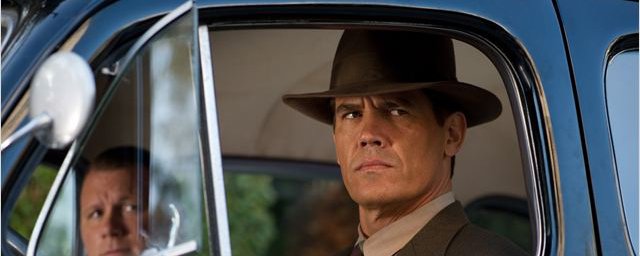
Josh Brolin, who plays straight-laced, flat-topped cop “Bigfoot”
Bjornsen, has more chemistry with Phoenix than any of the women in the
cast. This may be due to the nature of his character: picture Jack Webb
gone to seed, clearly envious of hippies’ freedom even as he verbally
bashes them. (In one of the film’s more bizarre scenes, he finally tries
pot.) In
a weirdly homoerotic touch, he’s often seen with a chocolate banana in
his mouth. The film is extremely well-cast. Even small roles are played
by actors like Michael Kenneth Williams and Martin Donovan. Yet it has a
tendency to relegate women to the level of sex objects. In handing the voice-over to
indie folk singer Joanna Newsom, Anderson seems aware of this problem,
but she sounds like an archetypal “hippie chick”—one imagines Joni
Mitchell fulfilling a similar role in an early ‘70s Robert Altman film. 
The
few times Anderson uses master shots, he gets some beautiful, painterly
vistas of the Southern California landscape. But he seems to shy away
from them in favor of a tighter style, favoring close-ups, putting the
focus on performance. The acting holds up, but the writing doesn’t
translate from novel to screen, even though much of it is taken directly
from Pynchon. Pynchon’s deliberate use of dated slang dampens the script’s wit—in fact, much of the film’s humor feels more theoretical than real. A
key passage about the co-opting of the counterculture is thrown away as
voice-over during a party scene at a rock band’s house. Even though Inherent Vice
is Pynchon’s simplest novel, the problems of Anderson’s screenplay
suggest the dangers of adapting such a complicated writer. The film
plays like a stoner’s version of Howard Hawks’ The Big Sleep, with a coherent narrative getting lost in clouds of pot smoke. To some extent, that’s the point—Inherent Vice’s characters have only one foot in reality. But it doesn’t make for articulate filmmaking. 

In
the film’s press kit, Anderson asks, “Do we still have that sense of a
lost American promise that can be reclaimed?” For all its attempts at
humor and its characters’ hedonism, Inherent Vice is pretty
bummed-out: critic Howard Hampton described it as mapping “the
Manson-Nixon line.” However, I think New German Cinema and the ‘70s
films of Jean Eustache and Jacques Rivette did a better job of exploring
the hopes and failures of the counterculture. Part of the problem may
be that Anderson was born in 1970 and is depicting the dreams of his
parents’ generation. Films like Rainer Werner Fassbinder’s The Third Generation, Eustache’s The Mother and the Whore and Rivette’s Celine and Julie Go Boating
offered reports from the front. From the perspective of 2014, it’s easy
to say that the hippies lost or, at best, some of their values won in a
roundabout way decades later, as the sexual revolution led to same-sex
marriage. To return to the Situationist slogan “(Under the pavement, the
beach!”) used as the epigraph to Pynchon’s novel, the distance between
the pavement and the beach seems further and further away.  Making a
movie that simulates the experience of watching film noir on pot
brownies seems somewhat beside the point, even if it has its pleasures.

Steven Erickson is a writer and
filmmaker based in New York. He has published in newspapers and websites
across America, including
The Village Voice, Gay City News, The Atlantic, Salon, indieWIRE, The Nashville Scene, Studio Daily and many others. His most recent film is the 2009 short Squawk.

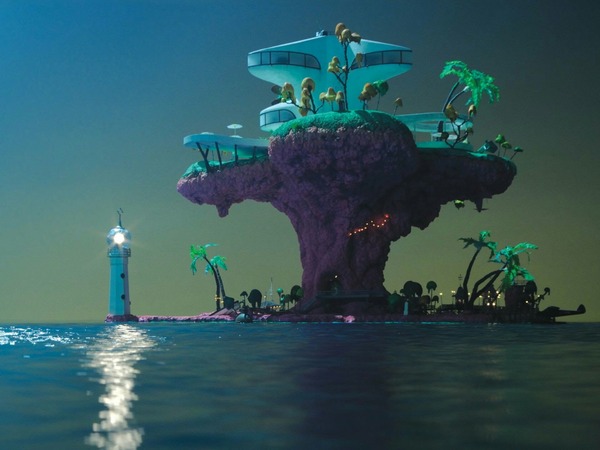
METAMERICANA: Gorillaz’ PLASTIC BEACH Is Our A HARD DAY’S NIGHT

METAMERICANA: Gorillaz’ PLASTIC BEACH Is Our A HARD DAY’S NIGHT

Fifty
years ago, at the height of Beatlemania, The Beatles released a
black-and-white film depicting their lives as rockstars in 1964. The
Oscar-nominated A Hard Day’s Night
took a quartet whose superstardom was positively cartoonish and
depicted it in gritty terms, delivering a clear message: The Beatles were now fame’s prisoners. As the band once put it in helping A Hard Day’s Night
scriptwriter Alun Owen encapsulate their experience in the public eye,
“our lives are a train and a room and a car and a room and a room and a
room.” Owen’s film depicted the Fab Four trying to
escape—unsuccessfully—from those geographic and spiritual
restrictions.

Now
it’s 2014, and we’ve come entirely round the bend: the gritty realities
of rock stardom have been so carefully detailed in decades of tour
documentaries and biopics that bands now long to fictionalize themselves
the way The Beatles finally did in Yellow Submarine (1968). But where Yellow Submarine
was an animated musical fantasy with comic overtones, popular culture
today allows for the intervention of comic fantasy only where the
cynicism of the music industry is implicitly acknowledged. In other
words, in the 2010s we get the alternately dark and sublime Plastic Beach,
a fan-constructed musical fantasy (published online just over a year
ago) that takes animation clips released in conjunction with the
Gorillaz album Plastic Beach
(2010) and orders them sequentially to create the album the "band"
itself likely intended. As of last month, well over 4 million people
have viewed Plastic Beach
on YouTube, and that number seems certain to climb much, much higher as
the film’s value as a High Art/Low Art hybrid is more widely
appreciated.

It’s only appropriate that this generation’s A Hard Day’s Night
be partly a piece of fan fiction–even if its component parts are all
band-produced. In a world of remixes, mash-ups, photoshopping,
virality, and spinoff memes, each of us can participate in our
collective culture-making project much more than sixties Beatles
fanatics ever could. And it’s only appropriate that it be Gorillaz
who come in for this sort of cinematic treatment, as from the start
Damon Albarn and Jamie Hewlett (the real-world duo behind the four
animated bandmates comprising Gorillaz) have been exploring how
conspicuously aestheticized realities often channel our contemporary
reality more clearly than gritty realism.

It won’t do to say here that Plastic Beach
was largely meant to be watched by citizens of Colorado, Washington,
Oregon, and Alaska—states whose voters recently made possible watching
this film in a state of benign intoxication—but it is important to note that Plastic Beach
is a “happening” more so than a linear narrative. There’s
unquestionably a well-storyboarded storyline at work (in fact, you can
read the whole thing here), and that narrative self-consciously echoes A Hard Day’s Night, as the
four fictional members of “Gorillaz” flee the trials and villains of
the civilized world to cut a new album on an island composed of
congealed first-world trash. However, the larger throughline here is that the
best music today is at once silly and skin-deep and raw and urgently
political. Plastic Beach
is therefore half archetypal “musical fantasy” and half a politically
committed statement about institutionalized violence and environmental
degradation.

It
certainly doesn’t start out that way. It starts (following a brief 3D
fly-by of the Gorillaz studio on “Plastic Beach”) with a hilarious
homage to Yellow Submarine: Snoop Dogg dressed like a fifth Beatle from the cover of Sgt. Pepper’s Lonely Hearts Club Band,
standing before an animated yellow submarine lifted straight from the
Beatles’ 1968 film. Snoop Dogg deserves credit for delivering here an
acting performance so inscrutable that after forty views of the clip you
still won’t know if he’s taking himself seriously or not.

What’s
for certain is that the lyrics of the Snoop Dogg/Gorillaz collaboration
“Welcome to the World of the Plastic Beach” belie the light-heartedness
of the attached visuals. “The revolution will be televised,” says Snoop Dogg, reversing the famous proclamation of seminal rapper Gil Scott-Heron, “and
the pollution from the ocean.” After urging “kids [to] gather around”
and hear his message, Snoop tells them, “I need your focus; I know it
seems like the world is so hopeless. It’s like Wonderland!” Which is a
pretty good summary of the Plastic Beach of the film, Plastic Beach the
album and film, and Gorillaz themselves: a Wonderland of
hopelessness that entices and even genuinely pleases with its fictions
even as it obscures its dark realities. We’d call the whole thing
cynical if it wasn’t so earnest about its political commitments. We’d
call it morose if Albarn and Hewlett weren’t so clearly having the time
of their lives animating the four fictional members of Gorillaz.

The
members of the band are distinct and memorable. There’s 2D (lead
vocals, keyboard, and melodica), a kindhearted and hapless waster whose
naive immersion in this cartoonish Limbo suggests a sort of everyman
Millennial. There’s Murdoc Niccals (bass and drum machine), a likely
Satan-worshipper whose nihilism and oily creepiness implies an
unthinkable penchant for violence just beneath the surface. There’s Noodle
(guitar, keyboard, and backing vocals), a Japanese girl whose tweener
otherworldliness seems simultaneously born of innocence and a possibly
alien consciousness. And there’s Russel Hobbs (drums and percussion), intended
by his creators to be hip-hop made flesh—so much so that this kind,
protective older brother-like figure can actually channel the ghosts of
former hip-hop superstars and inflate his own size to Iron Giant-like
proportions.

There’s no point in detailing all the shenanigans these four get into in Plastic Beach,
except to say that they involve machine guns, warplanes, Snoop Dogg,
cruise ships, giant manatees, ghosts, a pirate ship, a fleet of
submarines, a giant, a killer-robot version of Noodle, Bruce Willis,
sportscars, a terrorist organization known only as “The Black Cloud,”
and a devilishly well-conceived, gas mask-wearing, black-cloaked villain
named “The Boogieman.” What brings it all together, however, is first
and foremost the music—hip-hop soaked in a pop-tart reduction—and also
its political message, which (briefly summarized) is, “Stop killing each other and the planet, assholes!”
Plastic Beach is, at its heart, a rhetoric-conscious seduction. If A Hard Day’s Night asked us to wake up to the dark recesses of popular culture, Plastic Beach
is the allure of popular culture challenging us to “just like that,
wake up!” (lyrics from “Welcome to the World of the Plastic Beach”). Although we’re drowning in a 24/7/365 Wonderland of manmade stimuli, this very immersion can allow us to see our current dilemmas
with new eyes.  Albarn and Hewlett understand that living in the present
cultural moment is like having to force yourself awake–daily–from a
dream that’s 50% sublime and 50% a nightmare. Is a dream like that
better classified as entirely nightmarish, or is it somehow worth
inhabiting in the moment and worth remembering clearly later on? The
answer is: both. And that makes the interaction of the dream state and the
reality we find in Plastic Beach an existential question whose resolution is of dire importance to us all.

Seth Abramson is the author of five poetry collections, including two, Metamericana and DATA,
forthcoming in 2015 and 2016. Currently a doctoral candidate at
University of Wisconsin-Madison, he is also Series Co-Editor for
Best American Experimental Writing, whose next edition will be published by Wesleyan University Press in 2015.

ARIELLE BERNSTEIN: Feminist Camp: Reclaiming the Booty in a Digital Age

ARIELLE BERNSTEIN: Feminist Camp: Reclaiming the Booty in a Digital Age

nullI grew
up with thin white girl icons—with angry girl rockers like Fiona Apple crawling
half naked and hungry all over the floor, and Poe’s deep sultry voice, shifting
from ethereal to mad, everything about her skinny-armed longing. The feminist
rockers when I was a teen wilted and cried and clawed and spit. In the late 90s
a loud voice was always about rage, and female artists often sold a seemingly
contradictory image—a strong heart and fragile body.

My
mother, who emigrated from Cuba to America in the late sixties, could never
understand my obsession with thinness as a teenager. She drank water with heaps
of sugar in it to try and put on weight—curviness was seen as a sign of
sensuality, of sexiness. Certainly, there were curvier icons I could have looked
up to. The waif craze was in many ways a reaction to the aerobics-inspired look
of the 80s, with super models like Cindy Crawford and Naomi Campbell and pop
sensations like Madonna ushering in an era of sexuality that was large-bosomed
and muscular. And throughout the 90s, pop stars from J-Lo to Beyonce were famous
for their impeccable curves.

The waif
look appealed to me because it seemed defiant and dangerous. In reality it just
offered a different type of body as a fashion accessory.

To my mother,
my preference for thinness was more than a trend; it represented a kind of
cultural abandonment, a desire to be perceived as WASP-y and white, rather than
who I really was: a daughter of immigrants, a Latin American Jew. Two specific
markers of American assimilation—my thinness and blond hair, coupled with my
not having an accent, seemed to grant me access to things my mother never felt
she had access to.

But I
never felt as though I had complete access either, even if on the surface I
seemed to have it. I always felt like an imposter, as if I was wearing a mask I
could never take off.

We are all reduced to
our body parts.

The past several months
have been particularly depressing for anyone with a female body. Headlines
describing rape and sexual assault are virtually everywhere, from the numerous women speaking out against Bill Cosby, to the attention placed on
college campuses and how they could be doing more to prevent rape and sexual
assault.

In his essay on the rape
allegations against Cosby, Ta-Nehisi Coates reflects on the horrors of rape,
saying, “Rape
constitutes the loss of your body, which is all you are, to someone else.”
Likewise, in a recent essay, Roxane Gay considers the language of a sexual
assault from a Rolling Stone article that chronicles the experiences of a UVA
student who describes being gang raped at a frat party, how she was reduced to
an object and referred to as an “it.” In her essay, Gay implores her readers to
think long and hard on that word, to let that “it” haunt us.

What does it mean to acknowledge that our bodies are all that we are?

And where does this “it” stand in relation to the droves of young,
female pop stars today commanding us to look at “it,” to check “it,” to
smack “it,”—“it” being, in this case, their twerking behinds?

To
some, these close up images of the booty dehumanize and victimize women,
reducing us to sexual playthings. But I actually see something else here: a
reclaiming of the “it,” a defiant assertion of bodily autonomy, a demand for women
to be able to be as big and sexual as we damn well please.

The recent big booty craze is still fashion, of course, and some aspects
of the current trend, from Miley Cyrus’s use of black women as props in her
2013 VMA performance to Kim Kardashian’s photo spread for PAPER Magazine, are
infuriatingly disrespectful to black women in particular. And, of course, while
songs like Meghan Trainor’s “All About That Bass” preach body positivity, the
big booty trend really only praises a particular brand of curve, one belonging
to Kim Kardashian rather than Melissa McCarthy.

Yet
there is something also exciting about the way that some female performers are
reclaiming and celebrating the female body, about the way Nicki Minaj takes parts and
pieces of Sir Mix-A-Lot’s ode to women’s backsides in “Baby Got Back” and
transforms the booty from an object to be admired to a symbol of female sexual
appetite in “Anaconda.” The playful,
kitschy, over-the-top big booty shenanigans on Nicki Minaj’s video for the song are about self-love and swagger. “You love this fat ass,” she
manically cackles. It’s that cackle—wild, unhinged, defiantly unpretty—that
made me grow to love “Anaconda,” where the big booty becomes a symbol of
excess, sexiness, and silliness, all at once. Minaj’s “Anaconda”
doesn’t offer women a kind of empowerment fantasy, where women’s sexual
liberation will bring about a feminist revolution, but it does give women the
chance to reclaim that “it”: rather than being an object of someone else’s
consumption, it becomes a symbol of female sexual appetite and power.

The same thing could be said for Beyonce’s video for “7/11” where the
self-described feminist is seen hanging around in her underwear, having fun and
being silly, throwing her hands in the air and shaking her butt. Unlike her
classic ballads, or even her sexually explicit songs about getting it on with
her husband, this video focuses instead on women just having a good time, being
as loud, ridiculous, and playful as they want to be.

For the female body to be perceived as a source of pleasure, rather than
an object that is always on the brink of violation, is an incredible subversion
of our expectations about what it means to live in that body. The act of
reclaiming a word or an image is, of course, always fraught. I’m sure many
people feel there is simply no difference between a male-gaze-centric focus on
female curves and the booty-centered fashions surfacing in all sorts of media
today. Certainly, J.Lo and Iggy Azalea’s collaboration on the video for “Booty”
is no work of high art, and is replete with product placement and traditional
artifacts of the male gaze, but the delightfully campy videos of Nicki Minaj
and Beyonce, which showcase the female body as a source of unending amusement,
happiness, and power, are in fact changing the way we see that body. They
dare us to not only appreciate greater female involvement in the creative
process, but also challenge us to see a woman’s body as something inherently
powerful—as something, which can, and should, take up space.

Arielle Bernstein is
a writer living in Washington, DC. She teaches writing at American
University and also freelances. Her work has been published in
The
Millions, The Rumpus, St. Petersburg Review and The Ilanot Review. She
has been listed four times as a finalist in
Glimmer Train short story
contests
. She is currently writing her first book.

KICKING TELEVISION: NASHVILLE is the Best Network Drama on TV

KICKING TELEVISION: NASHVILLE is the Best Network Drama on TV

nullI can already hear the denizens
of Good Wife fandom anger-typing
emails in dispute of my title. And I’ll admit to a bit of click-baiting here,
but as much as I
bemoaned the death of the sitcom in my last column
, the
network drama stands in equal peril. The medium of dramatic television is
successful only if it’s interesting, entertaining, or a form of escapism. At
its best, it’s all three, and a survey of the current network television
landscape finds little if any of these qualities. The frustrating lack of
dramatic programming worth indulging in on ABC, NBC, CBS, Fox, and the CW is
almost enough to drive audiences to pick up a book or listen to a podcast. But
hold on y’all, before you put on the latest episode of Serial and mosey on down to the local bookery to fetch a new
hardcover, take a minute or forty-two and settle in to ABC’s Nashville.

Networks lack imagination in
their programming. They have long ceded creativity and ambition to cable,
satisfied with an unhealthy affection for naval crimes and criminal forensics. Primetime
network dramas are exclusively about fighting crime, fighting the supernatural,
fighting disease, or fighting government. The only exceptions are Once Upon a Time, a show that from what
I can gather is about House’s Allison
Cameron slipping into a coma in which she exists in world populated by drunken
fairytale characters; Parenthood, a
show about actors who were once on good shows; and Jane the Virgin, which I have not seen nor read of, but assume
borrows its plot from Tom Waits’ story from the preamble to “Train Song” on Big Time, in which a stray bullet pierces
the testicle of a Union soldier, and then lodges itself in the ovaries of an
eighteen year old girl.

Nashville is a throwback to primetime soap operas of
yesteryear. It’s about beautiful people doing exceptional things while getting
laid and singing about it. And it is absolutely fearless and unapologetic about
its intentions. In the adolescence of my affection for television, I was raised
on the saccharin frivolity of Beverly
Hills 90210
and Melrose Place, which
themselves were the TV offspring of Dynasty
and The Love Boat, Aaron Spelling
productions so wondrously escapist that we forgive him for Tori and Randy. These
shows serialized the medium, and created loyal fan bases who, in the absence of
DVRs, needed to find themselves in front of a TV at an appointed hour to find
out if Dylan would choose Brenda or Kelly, and how long our sideburns should
be.

There was nothing revolutionary
about these programs, and they didn’t aspire to revolution. They weren’t
preaching. There was very little in the way of murder. Vampires and aliens only
appeared in Halloween episodes. The beauty in shows like Spelling’s were that
they didn’t condescend to the audience, they weren’t written to be lauded by
critics, or celebrated by those who claim to not watch television except for
Ken Burns documentaries and The Wire.
Primetime soaps were built for escape, to provide a breath from the day, to
revel in the frivolous.

Nashville is wonderfully reminiscent of those programs
without being derivative. The show is soapier than a Dove factory and often as cloying
as that simile. Set in and around the country music industry in Music City,
USA, Nashville boasts what few other
dramas can: Two strong female leads. Connie Britton’s established country
superstar Rayna James and Hayden Panettiere’s embattled rising star Juliette
Barnes anchor the program in their representations of polarized embodiments of
the American dream. Rayna is old money privilege. Juliette is a trailer park
rescue. They’re the old and new country . . . music that is.

The show is rounded out by a
cross-section of not quite stock but not quite unique characters. Deacon Claybourne
(Charles Esten) is the lovelorn recovering alcoholic. Gunnar Scott (Sam
Palladio) is the aw-shucks fella doomed to heartbreak. Scarlett O’Connor (Clare
Bowen) is the shy talent waiting tables. Will Lexington (Chris Carmack) is the
rising star with secrets. Avery Barkley (Jonathan Jackson) is alt-country,
where punk meets Patsy. Maddie and Daphne Conrad (Lennon and Maisy Stella) are
Rayna’s daughters who aspire to be just like Momma. And though there’s nothing
exceptional about these characters by description, each actor and actress
portrays them with an honest simplicity and subtle tweaks that eschew any
notion of stock.

Oh, and they sing.

The soundtrack of each episode
is a marvel, and a testament to the exceptional work of music supervisor
Frankie Pine and established by Season One’s supervisor, Grammy and Oscar
winner T. Bone Burnett, who just happens to be married to Nashville’s creator and showrunner Callie Khouri. Being set and filmed
in Nashville allows the show to use the city’s exceptional talent pool of
professional songwriters, not unlike the ones on the show portrayed by Esten,
Palladio, Jackson, and Bowen. The original compositions, the Tennessee set, and
that the actors play and sing themselves gives the show an authenticity that is
rare on television. And counter to Hollywood tendency, the authenticity escapes
contrivance. Executive producer Steve Buchanan is president of the Grand Ole
Opry Group. The actors playing Scarlett, Avery, and Gunnar have all worked at
the legendary Bluebird Café, where Rayna and Deacon are known to drop in for a
quick set, and which the show has reproduced as a set of its own. Nashville’s sincerity is augmented by
the producers’ inclusion of contemporary country music artists in the show and
its narrative (if peripheral), which contributes to the audience’s comfort and Nashville’s genuine and natural
escapism.

[And, if you’ll indulge me and
pardon a quick digression: Connie Britton is a criminally underappreciated and
under-celebrated actress. Very few performers have the range to play such a
diversity of roles and in different genres. She makes Christopher Walken look
limited. Britton has starred in a hit sitcom (Spin City), a seminal TV drama (Friday
Night Lights
), a redefining mini-series (American Horror Story), and owns “y’all” like she invented it.]

In an era of instant gratification
and unparalleled media attention, shows are rarely given time to grow into
themselves, to discover what they truly are. Nashville went through its growing pains. In Season One, it tried
to be Dallas set in Tennessee. Powers
Boothe played Rayna’s baron-like tyrant of a father, who perhaps killed her
mother, and was manipulating her husband, who had committed fraud in a land
deal, who burned papers in the fireplace while drinking scotch, and perhaps
wasn’t the father of their eldest child. The show created complex mythologies,
but they seemed contrived and tired. Granted a second season by ABC, the show
quickly retooled, and made the country music industry the centre of the show’s
universe, an industry that comes complete with heroes and villains, defying the
need to create them from borrowed characters like Boothe’s. Nashville’s music, authenticity, and placement within the actual
Nashville and industry immersed the show’s characters into the mythology of
country music, and gave it a life it lacked in in its first season.

And that’s what sets Nashville
apart. It aspires to be itself and nothing else. It’s amplified by well-crafted
characters and measured performances. It’s a soap opera, but one that the
audience can invest in because it feels genuine. It’s at once a tribute to
country music and a bygone era of primetime television. And you can tap your
toe to its both its musical and narrative exposition in that they’re familiar
and new. Each episode is a new album from a band you’ve loved since you were a
kid.

The network drama is in dire
straits. Lost is but a distant
memory. Friday Night Lights was
perhaps the last of the medium to truly excel in craft and creation, and is the
last to be nominated for a Best Drama Emmy (along with The Good Wife in 2011). Grey’s
Anatomy
is long past its expiration date, now that Derek and Meredith’s
grandchildren work at Seattle Grace. Scandal
is parody that refuses to admit its parody. Madam
Secretary
is West Wing-lite. CSI’s legacy will be the poisoning the
national jury pool with false science. Blue
Bloods
, Elementary, NCIS: Bowling Green, The Blacklist, et al. are all ultimately
forgettable. I’ll admit I’ve never seen The
Good Wife
, but I couldn’t bear the experience of another show about
lawyers. Hidden within the cacophony of nondescript programming is a burgeoning
gem. Nashville is not a seminal
masterpiece, nor does it want to be. It’s an homage to a genre of television
that is inexplicably absent from the current network programming landscape.

Mike Spry is a writer, editor, and columnist who has written for The
Toronto Star, Maisonneuve, and The Smoking Jacket, among
others, and contributes to MTV’s
 PLAY
with AJ
. He is the author of the poetry collection JACK (Snare
Books, 2008) and
Bourbon & Eventide (Invisible Publishing, 2014), the short story collection Distillery Songs (Insomniac Press,
2011), and the co-author of
Cheap Throat: The Diary of a Locked-Out
Hockey Player
(Found Press,
2013).
Follow him on Twitter @mdspry.