RAISED IN FEAR: LET’S SCARE JESSICA TO DEATH and the Perils of Country Living

RAISED IN FEAR: LET’S SCARE JESSICA TO DEATH and the Perils of Country Living

null

Most
potential viewers would expect a film made in 1971 with the title Let’s Scare Jessica to Death to be a
teen slasher picture, but in fact, it is a subtle, moody piece of cinema that
explores the fragility of the mind and the persistence of the past, achieving
moments of rich psychological insight. 
It is also one of the most powerful treatments of the dream of getting
away from it all, and the horrors that ensue when we seek refuge in places we
little understand and where, in the end, we may not really belong. 

The story
is told largely from Jessica’s point of view, and creates a disturbing sense of
uncertainty in the gap between her own perceptions and those of the other
characters. This is nicely captured in
the opening scene’s voice-over narration, spoken by Jessica (Zohra Lampert):
“Nightmares or dreams … madness or sanity … I don’t know which is which.”  Her seemingly tenuous grip on reality is
partially explained in the back-story given in the early scenes of the
film. Jessica has just spent several
months in a mental institution, and she and her husband Duncan (Barton Heyman)
have decided to escape from the confines of their Manhattan apartment to try
the curative powers of country living on an apple orchard in rural
Connecticut.  Later, they encounter an
antiques dealer who made the same move, and he recognizes in them fellow
“refugees from urban blight.” But despite this antique dealer’s idyllic
portrait of the area they’ve just moved into, the newcomers are given many
signs that something is seriously wrong in this superficially bucolic retreat.

In the nearby
small town, they encounter hostility from the native population, which seems to
consist almost exclusively of old men. 
While the newcomers are all evidently in their thirties, the enmity
seems largely to derive from a generation gap, one that is reinforced by the
hippyish appearance of Jessica and Duncan’s friend Woody (Kevin O’Connor). Though their unfriendly encounters appear to
be the expected clash of anti-establishment baby boomers with the so-called
“greatest generation,” these tensions also derive from a more ancient enmity,
one between country folk and city folk. Many great films of the seventies address this theme, notably Deliverance, Straw Dogs, and The Texas
Chain Saw Massacre
, but what makes Jessica’s
treatment unique is the brooding ambiguity that shrouds the true nature of this
rural community. Since portrayed events
are filtered through the protagonist’s melancholia and relentless self-doubt,
it becomes impossible to be certain whether we are witnessing mere uncultured
rudeness and suspicion of newcomers or something much less benign.

My wife
and I moved to the mid-Hudson valley five years ago. At that time, we often felt such
doubts. The demographics of this area
are difficult to read from an outsider’s point of view, and we often felt
uncertain of the nature of our adopted community and its environs. Driving through the countryside on weekend
rambles, we would be mystified by the sudden transitions from quaintly
gentrified little towns with espresso cafes and antique shops to run-down
whistle stops with little more than a gas station and a grain silo, where
locals sip 40 ouncers and stare malevolently as you drive by.  While generally I find New Yorkers to be the
most friendly people of any state I’ve lived in, I have also walked trails in
the Catskills where people pass by stonily ignoring my hello, or worse, glaring
back silently.  Though I have come to
know my neighbors for the wonderful people they are, when we first moved in,
they frankly gave me the creeps.  Perhaps
this is because one of them introduced himself by saying that he had watched me
carry my wife over the threshold when we first moved in.  Moving into a new place has its perils, in
the city as well as the country, but there’s something especially unsettling
about the country’s unique sense of isolation. If your country neighbors turn out to be monsters, who you gonna call? I’ve seen enough horror movies to be wary of
the local sheriff’s connections. At the
end of the day, one’s doubts and suspicions most often turn out to be
groundless; but then again, what if they’re not?

As with
Roman Polanski’s Rosemary’s Baby,
Hancock’s film carefully choreographs our doubts by selectively withholding
information and calling its protagonist’s perceptions into question. And yet, as with Rosemary, Jessica’s point of view
is richly, sympathetically rendered, and as the film progresses we begin to
feel that the men in the film are the naïve, deluded ones. Jessica’s world is magical and strange, an
effect largely achieved by Joe Ryan’s complex sound design, in which
non-contextual sounds and voices form a constant countercurrent to the film’s
narrative flow. Wind blows even when the
trees are still, and queasy, seething electronic noises provide an aural
equivalent to the characters’ unease. Jessica’s disembodied voice offers a running disjointed monologue, often
uttered over spare piano or melancholy acoustic guitar figures. The increasing claustrophobia of this
would-be idyll is as much a product of the protagonist’s psychological
isolation as the characters’ rural equivalent.

With the
entrance into the story of the enigmatic character Emily (Mariclaire Costello),
Jessica’s internal monologue begins to incorporate other voices. Emily appears to be a free-spirited wanderer
squatting in the house newly purchased by the film’s protagonists, but as the
film progresses she seems more deeply connected to the town’s history.  Jessica seems uniquely attuned to this, a
connection furthered by a séance scene in which she declares her receptivity to
“everyone who has ever died in this house.” 
The abiding presence of the dead and their stories is a theme struck
early by the film, when the three main characters (who drive a hearse, by the
way) stop at an old cemetery so that Jessica can take rubbings from
tombstones. These rubbings adorn the
walls of her and Duncan’s bedroom and seem to summon further voices in
Jessica’s head.  In some respects she is
a visionary, attuned to the local spirits.
Yet this potentially empowering receptivity gives way to powerlessness as
the characters begin to reenact the family dramas of those long dead. Let’s
Scare Jessica to Death
moves subtly from being a film about retreating to
an idyllic place to being about the spirits of that place reasserting themselves.

Although
the spirit of place in Jessica is
clearly malevolent, the film’s cinematography, saturated with color and
suffused with shimmering natural light, continues to seduce us into its dark
pastoral world. Like all great horror
films, this is not so much about what horrifies us in our daily lives, but also
what entices us, revealing two seemingly conflicting sides of the same
experience. One of the voices in
Jessica’s mind often repeats the phrase “You’re home now,” but after a certain
point it becomes difficult to tell if this is the incorporated voice of the
mysterious Emily, or Jessica herself; the seemingly malevolent voice of the
rural township or the consoling voice of Jessica’s own city-bred mind, hoping
to reconcile herself to her country retreat. 
At the conclusion of the film we return to where we began, with the
voice-over musing on whether we are living a dream or a nightmare.  Though horror films can show us how easily
one can turn to another, they can also muse upon those paradoxical moments when
our life choices seem to unleash an uneasy combination of both.

Jed Mayer is an Associate Professor of English at the State University of New York, New Paltz.

BIG PRESS PLAY NEWS!

BIG PRESS PLAY NEWS!

Some big changes are happening at Press Play!

For
those of you who haven’t heard, our friend and co-founder, Matt Zoller
Seitz, is now the Editor-in-Chief of RogerEbert.com. Congratulations,
Matt, and the very best of luck! Ebert Digital could not have chosen a
better person to replace Roger.
Matt’s integrity and humanistic, very personal
style of critical writing is a quality Ebert himself
possessed, in spades.

Also
in Press Play news, Max Winter will shoulder the (big) job of
Editor-in-Chief. Under his leadership, the site will continue to publish thoughtful and enlightening writing, both critical and
journalistic, as well as video pieces that can be watched over and
over again.

Ken Cancelosi, Publisher
Max Winter, Editor-in-Chief

The Dangers of An Empty Suit: Marvel Comics’ War on War Continues

The Dangers of An Empty Suit: Marvel Comics’ War on War Continues

null(Warning: This article contains spoilers for the film Iron Man 3.)

The implicit argument of every comic book and
comic book-inspired movie is that the world outside comic books is a better
place for having no superheroes in it, and a far worse place for having so many
warmongers. Iron Man 3 is Marvel
Comics’ strongest argument yet on both scores. True, the Iron Man films have always been conspicuously anti-war—Stark
removes his privately-funded R&D enterprise from U.S. Defense Department
involvement in the first entry in the now-trilogy—but Iron Man 3 is a uniquely instructive exemplar of Marvel’s war on
war by way of Hollywood.  

In Iron
Man 3
, the United States, in the person of billionaire playboy and
self-described “mechanic” Tony Stark (Robert Downey Jr.), has perfected the
drone as a weapon of mass destruction. Whereas Stark actually had to be in his specially-designed metal-alloy
suit to become “Iron Man” in both Iron
Man
and Iron Man 2, the man is
now superfluous to the machine: Downey’s titular character has a veritable army
of man-shaped drones (a metaphor that ought not be lost on us) ready to do his
bidding at a moment’s notice.

In one particularly charged scene toward the
end of the film, Stark says to his nemesis, of girlfriend Pepper Potts, “she’s
perfect as she is.” As action-flick dialogue goes, this is pretty insignificant
stuff, yet it’s also a good summary of the chief theme of Iron Man 3, which ultimately pits men who believe they’ve perfected
machines against men who believe they’ve perfected humans. It’s no spoiler to
say that neither pipe dream is realized in the end; the question is just how
lifelike both the dream and its perpetual deferral really are.

Stark’s technological breakthroughs don’t fall
very far from our own reality, given that just a couple weeks ago the real-life
United States Navy launched a drone from a nuclear-capable aircraft carrier for
the first time. This means that American drones can now officially drop
cluster-bombs on anyone, anywhere, at any time, as if that weren’t already the
case in practice. Meanwhile, the Obama Administration recently launched an
initiative to map the human brain—in the same way scientists mapped the human
genome several years ago—and in this well-intentioned effort there’s an eerie
reminiscence of the baddies of Iron Man 3,
who believe they’ve perfected the human body by (you guessed it) mapping the
human brain to create an army of super-soldiers. In short, Iron Man 3 asks us to ponder the question: Is the perfect man any
less dangerous than the perfect machine, and isn’t Pepper Potts (Gwyneth
Paltrow) actually perfect just the way she is?

But Marvel Comics’ increasingly cerebral and
interconnected film productions are wont to do much more, now, than simply
throw mud at all corners of the global military-industrial complex. The
presidential administration portrayed in Iron
Man 3
, which appears to be vaguely Republican (much is made of the White
House doing nothing to investigate a major oil spill, an oversight an oilman
president, say, might be wont to make) dresses up its Don Cheadle-cum-War
Machine drone in patriotic colors, redubbing it The Iron Patriot, and it’s this
obsession with re-marketing drones as a nationalistic imperative that nearly
gets Marvel’s imaginary President Ellis blown to Kingdom Come. The message is
clear: The more attractive-looking the drone, the more likely it can be used as
a Trojan Horse for dangerous geopolitical initiatives and even more dangerous
first principles.

Likewise, the villain of Iron Man 3 is not, as it turns out, a gnarly Ben Kingsley—whose
primary job in the film is to look dirty, foreign, asexual, and (worst of all)
old—but rather a blond, perfectly-coiffed Lothario who (as it happens) can
literally breathe fire. Here, too, the message is clear enough: Dress up a
villain in something like the clothes we’d expect a “winner” to wear, and it’s
not much different from dressing up a nation’s foreign policy in those
metaphoric clothes we expect “winner” nations (that means us Americans) to
favor. Each of these premises is equally alluring; each is even—at the risk of
taking the analogy too far—equally sexually intoxicating. Yet both are a threat.
The upshot is that we don’t need or want perfect men or women, any more than
we’d want perfect war machines. This isn’t to say we shouldn’t map the human
brain, or strive to perfect certain strains of military-industrial innovation (recent
advances in non-lethal weaponry come to mind), but rather that it’s the perpetual
search for perfection and self-perfection that often leads us to destruction. This
theory can be applied with equal force to men and women who judge others
primarily by their physical appearance and voters who judge elected officials
by how good a game they talk on anti-terrorism and national defense.

What Tony Stark ultimately learns in Iron Man 3—we’ll see if the lesson
sticks in Iron Man 4—is that he needs
to be more fully human, not more fully superhuman. He finally has the metal
shards lodged in his heart removed so that he can once again function without
the aid of blood-pumping machinery; he turns aside from his “mechanic” identity
by destroying the fruits of his labors in spectacular fashion; he re-dedicates
himself to his relationship with the already-perfect Pepper Potts by increasing
their face-time and decreasing his log-times (after first paying for surgery to
reverse artificial “perfections” performed upon Pepper by the villainous
Mandarin); and he concludes, in a final voiceover, that he’s the “Iron Man”
even if all his high-tech toys are taken away—something many a Marvel fanboy
would dispute. In other words, Stark discovers that it’s not enough to turn
aside from direct complicity with warmongers, what’s required of a strong and
capable human is the ability to turn aside from the fallacy of perfectibility,
too. 

This message is one particularly at odds with contemporary
American culture, which convinces us more easily than we’d like to admit that
there isn’t a single facet of our physical or emotional well-being we can’t
perfect with a crash diet or a brain-boosting iPad app. Likewise, Marvel seems
to take a dim view of the current penchant for political panaceas: The idea
that a single political solution exists (whether in the form of a politician or
a policy) for the complex problems of the nation and the world is one with
little backing in any of the recent Marvel films. Indeed, it’s not too much to
say that Marvel Comics is reminding us anew, with each successive film in the Avengers network of storylines, that
the worst sort of war is the war we wage daily against our own fears of
fallibility and failure, as it’s this sort of windmill-tilting that ultimately
leads us down the path to ruin. Tony Stark’s realization that his desire to
protect Pepper from alien invaders is fueling the destruction of both their
relationship and his psyche—in the same way the fictional United States of Iron Man 3 fuels its own demise by
up-jumping its fear of terrorism to ever more frenzied levels—is just the sort
of thing Yoda always warned us about (“Fear leads to anger, anger leads to
hate, hate to suffering”).

Ironically, it’s a yearning after perfection that
sells untold millions of comic books to young male and female consumers the
world over, so we ought to read Marvel’s Avengers
films as a particularly ingenious bit of reverse psychology. If we actually
took the lesson of Iron Man 3 and its
ilk to heart, we too would blow up our personal anxieties, demand real rather
than Hollywood courage from ourselves and the many empty suits in political
office, and plant a long, lingering kiss on the already-perfect lips of
whichever Gwyneth Paltrow is presently brightening our days.

Seth Abramson is the author of three collections of poetry, most recently Thievery (University of Akron Press, 2013). He has published work in numerous magazines and anthologies, including Best New Poets, American Poetry Review, Boston Review, New American Writing, Colorado Review, Denver Quarterly, and The Southern Review.
A graduate of Dartmouth College, Harvard Law School, and the Iowa
Writers’ Workshop, he was a public defender from 2001 to 2007 and is
presently a doctoral candidate in English Literature at University of
Wisconsin-Madison. He runs a contemporary poetry review series for
The Huffington Post and has covered graduate creative writing programs for Poets & Writers magazine since 2008.

RAISED IN FEAR: NIGHT OF THE HUNTER and the Horrors of Childhood

RAISED IN FEAR: NIGHT OF THE HUNTER and the Horrors of Childhood

null

The most harrowing film ever made about childhood opens with
a lullaby that is anything but soothing: “The hunter in the night / Fills your
childish heart with fright / Fear is only a dream / So dream, little one,
dream.”  As we stand on the threshold of
Charles Laughton’s haunted masterpiece Night
of the Hunter
, this lullaby sings us into the world of a scared child who,
strangely, is being encouraged to dream a dream of fear, which is a fair
description of the film that follows. While
Night of the Hunter wonderfully
defies classification, blending elements of expressionism, gothic, fairy tale,
and film noir, I would like to offer a reading of the film as a very particular
kind of horror film, one that enables us to see the world from a victim’s point
of view. Such films are anything but
empowering, in the sense used by the kind of self-help guides and memoirs of
personal struggle that litter our nation’s bookshelves. Rather, these films teach us sympathy and
compassion through a humbling sense of disempowerment,
which, in the case of Night of the Hunter,
involves taking us back to the horrors of childhood.

The tale is set in West Virginia during the Depression, and
the scarcity of those times drives the cruel deeds that unfold. We first see little Pearl and John Harper playing
happily in their yard when suddenly their father appears, on the run from the
police for a bank job in which two people were killed. He thrusts the stolen money on young John, which
will soon make him the object of murderous greed. Fear is John’s inheritance, yet the film
implies that even children who don’t experience his and his sister’s unique
form of persecution are born to suffer. Later in the film, as they flee from danger, they are forced to beg for
food along with other children. Their
grudging benefactor gives them each a potato before shooing them off, as she
muses: “Such times: when young’uns run the roads….” Near the end of the film,
when their guardian, Rachel Cooper (Lillian Gish), recites the story of Herod’s
slaughter of the innocents, she reflects: “It did seem like it was a plague
time for little ones, those olden days, those hard, hard times.” The film subtly parallels “those olden days”
with the “hard, hard times” of the Depression Era, and in its prolific use of
fairy tale motifs, connects this with the struggling peasant culture that
spawned the classic folk tales collected by the Brothers Grimm.

Although oral folk tales were traditionally recited to old
and young alike, they have a special resonance for children because of their
prominent place in the narratives, a place that is, as we all remember, often
terrifying. Whether being abandoned by
one’s parents in the woods because there isn’t enough food to go around, like
Hansel and Gretel, or being chopped up and fed to father in a stew, like the
child victim in “The Juniper Tree,” the children of fairy tales have much to
fear, especially from their parents. Once their father burdens them with the secret location of $10,000 in
stolen bank money, John and Pearl Harper’s story enters the dark dream world of
the fairy tale as they are pursued by Harry Powell (Robert Mitchum), a sinister
self-anointed preacher who is alluded to several times as “a wolf in sheep’s
clothing.” Yet the children are the only
ones able to see Harry Powell for the Big, Bad Wolf that he really is, and Night of the Hunter deftly captures that
sense of powerlessness all of us felt when, as children, we sensed something
wrong but weren’t able to do anything about it.

nullThe film is a virtual catalogue of iconic images of
childhood fears: closed basement doorways, crescent moons in night skies, empty
barns, shadowy attics, dark forests, and treacherous swamps make up Night of the Hunter’s haunted
landscapes. One of the film’s most
frightening scenes takes place in the Harpers’ basement, when Powell drags the
children down to help him find the stolen money. When the supposed cache turns out to be
empty, he turns viciously on John, who manages to extinguish the light and
overturn a shelf of canning jars on the villain’s head. Powell’s usually sly, seductive patter turns suddenly
into an animalistic wail. In the claustrophobic darkness of the basement, this
transformation is especially chilling, recalling many a downstairs journey and the accompanying fears.  The children
flee up the stairs, shot expressionistically as a thin
corridor of angular light hanging in a sea of blackness.  As in many scenes, the light and dark contrast here
is so strong as to make the image look like an old woodcut illustration. The children barely escape, slamming the
basement door, as vicious animal growls emerge from behind it.  As he continues relentlessly pursuing them as
they flee downriver, at one point John hears him singing his signature hymn,
“Leaning on the Everlasting Arms,” and wonders, “Don’t he never sleep?”  Fairy tale threats never do: they only take
on new forms as we grow older.

It’s striking to note that this film was produced amidst the
optimism and economic recovery of the nineteen-fifties, and perhaps this is why
the film initially flopped. Though
dream-like and fanciful, it nevertheless presents an unpleasant reminder of
hard times that remained all too real in the memories of older filmgoers.  Seen now, this classic takes on new life as a
dark fairy tale for an age of austerity. The world we are entering will indeed be, as the children’s guardian,
Rachel Cooper, says, “a hard world for little things.” Yet, given the grim outlook for our
collective future, it seems surprising that so many people remain so eager to
bring more little things into it. It is
this, as much as the perversely self-satisfied culture of child-rearing, that
inspired my previous piece on the film Who
Can Kill a Child? 

Climate scientists recently announced that we’ve reached a
dreaded milestone for CO2 levels, an announcement that received surprisingly
little attention.  But last year a
similar, and to my mind even more disturbing, milestone was passed, and some
actually considered it, perversely, as a cause for celebration. On March 12, 2012 the world population reached
seven billion, and while we might hope for a future in which this growing
population will be able to reduce its carbon footprint, there is no denying the
simple fact that more people means more mouths to feed, and if the wasteful way
we produce our food doesn’t change in a drastic way, those little mouths are
going to be very hungry. This is one of the things I think of when I hear
Rachel Cooper’s words during the Christmas scene that ends Night of the Hunter: “Lord save little children.  You’d think the world’d be ashamed to name
such a day as Christmas for one of them, then go on in the same old way. My
soul is humble when I see the way little ones accept their lot.”

The triumph of Laughton’s masterpiece is to make us
similarly humble by imaginatively putting us in the vulnerable position of
children.  It is a vulnerability they
share with other creatures, a point clearly established in the film’s most
memorable scene: John and Pearl’s nighttime flight down the Ohio River. As they pass a series of animals on the
Ohio’s banks—frogs, owls, turtles, foxes—they eventually come to a herd of
sheep corralled behind a fence. Time
hangs suspended as the children and the sheep stare at one another, sharing a
mutual recognition that the film has prepared us for by frequently referring to
John and Pearl as “little lambs.” This
mutual recognition anticipates the later scene of Powell’s capture by police,
when John cries out in pain at his former persecutor’s suffering. He later refuses to testify against him at
the trial, with compassion which stands in stark contrast to the vengefulness of the
townspeople, who form a lynch mob bent on Powell’s blood.  It is the virtue of great horror movies to
remind us what it was like to be a child, and to sympathetically identify with
victims, whatever their age might be.

Jed Mayer is an Associate Professor of English at the State University of New York, New Paltz.

RAISED IN FEAR: Who Can Kill a Child?

RAISED IN FEAR: Who Can Kill a Child?

null

Having
children is one of those bourgeois activities that leave me baffled, like
playing golf, eating sushi, or watching Downton Abbey.  Although I remain on speaking terms with
friends who, regretfully, choose to have children, there’s no denying the gulf
that separates the baby-haves and the baby-have-nots. And there’s nothing like the chill that grips
me when couples my wife and I have known for years, and who always claimed they
would remain child-free, suddenly announce: “We’re going to have a baby!”  From that point on all previous conversations
about how annoying kids are will be forgotten, to be replaced with the silent
assumption: yes, but ours are different. 
At such moments I turn to horror films for solace, and while Village of the Damned, The Brood, and The Omen all help, there’s only one film that truly captures the
experience of being trapped in a world of children and those who adore them.

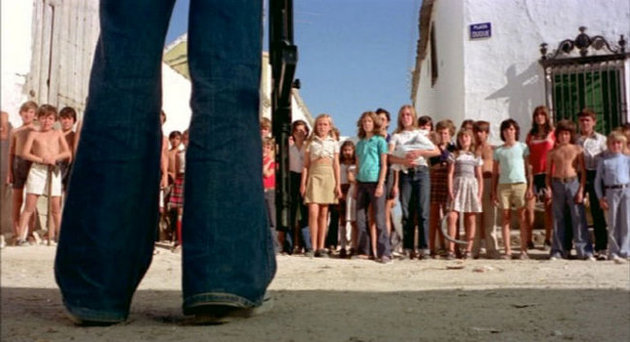
Who Can Kill a Child (1976) is a
relatively obscure Spanish horror film directed by Narcisco Ibanez Serrador,
but it should be much better known, and not only by people like me, who are sick
of having to pretend to be awed by how wonderful children are. It is a challenging, confrontational work
that raises difficult questions concerning overpopulation, inequality, and the
nature of evil. The film tells the story
of an English couple vacationing on the Spanish coast as they enjoy their last
weeks of freedom before a very pregnant Evelyn gives birth to their third
child.  Distracted by the noise and
crowds of Benavis, where a festival is being held, they rent a boat and go
alone to the island of Almanzora, which they find strangely deserted, except
for occasional bands of vacantly smiling children, who grow increasingly
threatening, and eventually homicidal. While the premise is admittedly unoriginal, if tantalizing, the power of
the narrative emerges through its sense of quiet unease, complex character
development, and provocative intrusions of topical and historical sound bytes
into the film’s otherwise eerily isolated world.

Taking its cue from the Mondo Cane films—those
pseudo-documentary films of the sixties and seventies that shocked audiences
with their depiction of violent rituals and grotesque behavior from around the
world—Who Can Kill a Child’s opening
credit sequence runs over a disturbing montage of twentieth-century atrocities,
beginning with the Holocaust and spiraling through numerous wars and civil
conflicts, in each case emphasizing the overwhelming toll on children.
  Disturbingly, the sound of children’s
laughter can be heard over the grim stock footage, as well as a child humming a
haunting melody reminiscent of Krzysztof Komeda’s indelible theme to Rosemary’s Baby. As the death roll finally reaches its height, we cut to black and white footage of barely clad children crouching
in the dirt, which seems to signal another abject image of orphaned destitution
until the camera pulls back, transforming to bright color footage of a beach
crowded by leisurely European tourists. This striking contrast
underscores the film’s later meditations on the thin borderlines between
comfort and chaos.

As Evelyn
and her husband Tom later enjoy the spectacle of a local parade, they discover
that their camera has run out of film and duck into a shop.  As they wait for the clerk to bring their
rolls of Kodak, they turn to a television on the counter, broadcasting
footage of a massacre in Bangkok. When
the clerk returns, he shrugs and observes: “The world is crazy. In the end the ones who suffer the most are
the children. From war: the
children. From famine: the children.” It
is an observation that will echo in the English couple’s minds as their
vacation continues. After making this
morose speech, however, the clerk smiles and says: “What a lovely day to take
pictures!” In the following scene, disturbingly enough,
Evelyn wades in the ocean while Tom tries to snap her picture. The thin membrane between the first world
privilege that safeguards their “lovely day” and the disorder that lurks beyond
their borders is suddenly broken by an ambiguous disturbance in the distance, a
disturbance that is later revealed to be a body washing ashore. These early scenes are loaded with many such
moments of horror lurking just beyond the vacationers’ perception.

The answer to the question of why a film that is about to present us with packs of homicidal
children is so preoccupied with reminding us how vulnerable children are in a
treacherously unstable global economy remains ambiguous, but some hints seem to
be given in the conversations between Tom and Evelyn on the night before their boat
trip.  As they walk down a crowded
street, Tom asks, “Would you like to sit down?” and she replies, “Where, it’s
so crowded.”  Looking down at her
pregnant belly, he observes: “Well, we’re not helping the situation, are
we?”  Later, as Tom broods over the
events of the day, he recounts a story from Fellini’s La Dolce Vita about a man who kills his two children, his wife, and
later himself. When Evelyn asks why, he
answers, “I imagine he was trying to save his children from the future.”  This prompts his wife to mention that they
were almost going to “kill this one,” pointing to her belly, and asks if he’s
glad they didn’t.  Tom doesn’t seem
entirely sure, and he equivocates that they had two children already, before
reassuring his wife as they go to sleep. 
Such scenes suggest a certain parallel, if not complicity, between their
household population and the rest of the world’s.  Overpopulation, the film indicates, is a problem we like to
project onto other countries when it often happens under our very noses, and it
is our privileged, first world children who are going to leave the largest
carbon footprint, and consume the most resources, indirectly fueling the
violent conflicts that hover around drought and famine like flies.

All this
might seem like a rather ponderous set-up for a horror film, but what is
astonishing is how deftly these elements are woven into the fast-paced establishing
shots. Soon we find ourselves on the
island of Almanzera, where we enter a very different reality. From the raucous crowds of the mainland we
shift to an almost silent, dreamlike space reminiscent of Val Lewton’s great
noir-thrillers of the 1940s, like I
Walked with a Zombie
, and Isle of the
Dead
, but with one significant difference: while classic horror films use
darkness as their medium of fear, Who Can
Kill a Child
uses light, an almost blinding, stark Mediterranean light, as
relentless and omnipresent as the increasing sense of menace to which it seems
tied. Like a mischievous child, the film
plays hide and go seek with the violence lurking just behind every corner. One particularly disturbing scene shows
Evelyn calling Tom’s attention to an old man huddled in a doorway in a distant
angle of a narrow but brightly lit street. A girl appears in the distance, smiling pleasantly as she walks towards
them. Once she reaches the old man she
looks happily to her right at him, though we still can’t see anything more than
his arm holding a cane. After smiling
guilelessly towards the couple, whose point of view the camera shares, she
turns to the man again, seizes his cane, and sets to beating him violently to
death, though we only see the evidence of this from the increasing amount of
red visible on the cane as it repeatedly rises and falls and the girl laughs
with glee.

Such
moments of barely concealed horror parallel the couple’s reluctance in
admitting the children’s monstrousness, a reluctance shared by another adult
whom they encounter, who tells them the story of how the children suddenly
changed. As he describes how they killed his wife, he notes with amazement that
nobody moved to stop them, because, of course, “who can kill a child?” It is an
understandable reluctance that the English couple have a hard time getting
over, putting them in even graver danger. As the film progresses towards its harrowing conclusion, it forces the
viewer into the uncomfortable position of the protagonists: though the children
are often shown blank-faced and coldly malevolent, there are also many scenes
where they are depicted as infinitely charming, seemingly innocent.  When they nevertheless show themselves
capable of horrendous violence, we are tempted to ask, along with Evelyn,
“Isn’t a normal child incapable of killing another human being?”  When we recall how violent the 1970s were,
this line has a disturbing historical resonance.  It’s sad to think there was once a time when
adults could be so innocent as to ask such a question.

Jed Mayer is an Associate Professor of English at the State University of New York, New Paltz.

On an Animation of a Sentence by Nathan Englander

On an Animation of a Sentence by Nathan Englander

It seems to me there are several different things going on
in Drew Christie‘s animation of a sentence from the Nathan Englander story “The Reader.”
The sentence itself runs as follows:

And with all these
headlights floating divided in his rearview mirror, Author can never tell which
belong to his reader, which pair is his beacon, a North Star, split, cast back,
guiding him on.

Your first question might be, if you haven’t seen one of
these brilliant animations literary magazine Electric Literature has been posting for years now, where’s the rest of the story? What are we to do with a single sentence?

That is the question the editors want you to ask: in
isolating these sentences in this way, they want to raise the estimation of the
individual sentence, to remind us of its part in making a story, or even a
novel. They have taken sentences from authors ranging from Jim Shepard to Amy
Hempel to Mary Gaitskill to A.M. Homes, paired them with animators, and
produced a remarkable series of small films.

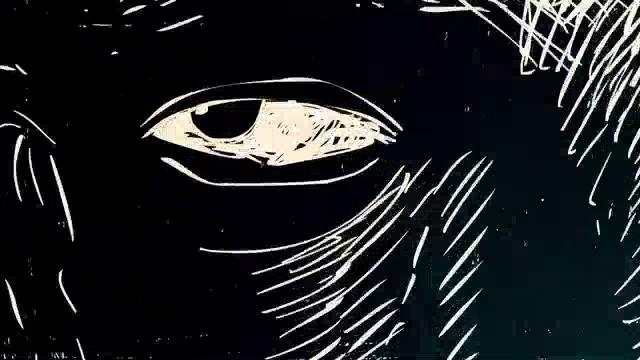
The film built around this sentence is fairly simple on its
surface, a study in white lines against a black background, all vibrating
slightly, partly an effect of the medium, partly an effect of the sentence
itself (I’d like to think, though I’m probably wrong). A polar bear stands on top of a rising and descending moon-like (or maybe Earth-like) orb,
suggesting… what? The mythic importance of the polar bear for certain cultures? The isolation we all
sometimes feel, as if the world were a desert island and we were all standing
on it, waiting for a ship? The sense that we are all, somehow, crushed, that we
think we are free but we are actually stick beneath the paw of some enormous
unseen beast?

The rest of the small film, just under two minutes long, does
little to discourage or answer these sorts of questions, and in fact it expands
on them. As we move onto the open road, with a seldom-seen driver, all kinds of other concerns begin to
crowd in: what is the driver’s destination, or better put, what is the writer’s
destination? Should he be concerned that he is being followed—or, conversely,
should he be happy that he’s being followed, should he consider it part of the
natural way of things? Even the handmade scrawl of the sentence suggests a kind
of desperation, or nakedness—which, interestingly, contrasts with the sentence
itself, loaded with auspiciousness, with the ambiguity of the idea of a Reader,
or a Beacon, or an Author, or the mysteriousness of a light that directs
someone from behind. What the filmmaker has taken his cue from is the motion of
the sentence: the way it starts with a pair of long, establishing phrases and
then slowly breaks apart into smaller phrases which carry more symbolic weight
as the sentence progresses.

So: watch it again.

Max Winter is the Managing Editor of Press Play.

Raised in Fear: The Superdynamational Horrors of Ray Harryhausen

Raised in Fear: The Superdynamational Horrors of Ray Harryhausen

nullYou never forget the
first time you fall in love, especially in the movies. My moment came when I was eight years old, at
a Saturday matinee in a cramped multiplex theater.  Setting my sights high, the object of my
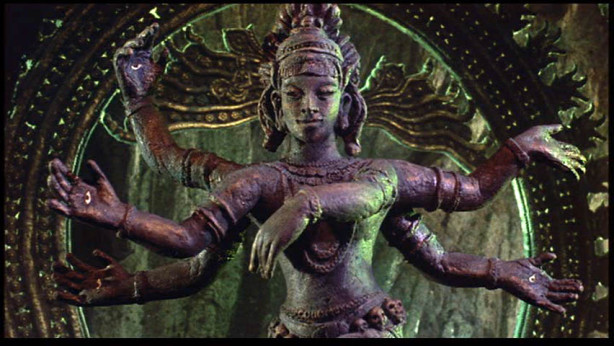
adoration was Kali, Hindu goddess of Time, Change, and Death; or, rather, a
statue of her, brought to life by the magical powers of Ray Harryhausen, the
special effects wizard who, sadly, passed away this week at the age of 92. His influence on the development of cinema is
incalculable, but in many respects he will be representative of an age that is
likely never to be reborn, a time when special effects were created with the
hands as well as the mind, with clay instead of pixels, with palpable objects rather
than streaming data. By showing us how
malleable cinematic reality could become in the hands of an artist, he
anticipated the wholesale manipulation of the visual field brought off by CGI technicians,
yet the texture, the movement, and the presence of his animated creatures belong to
an entirely different realm from that of the smooth, seamless, and ultimately lifeless
digital beings wandering somnambulistically across today’s screens.

The animated statue of
Kali with whom I first fell in love appears in The Golden Voyage of Sinbad (1974) the first Harryhausen film I’d
ever seen—certainly not his best, but filled enough with wonder for anyone with
imagination. The feelings I felt for
Kali, or at least her animated model, were different from those I felt for the
sexy slave girl Morgiana (Caroline Munro), whose I Dream of Jeannie-style costume left little to my boyish
imagination. The love I felt for
Harryhausen’s Kali was pure, a sense of reverence for something beyond me, a
power outside my understanding, a life form fundamentally different from my own,
yet no less alive. Harryhausen’s
animated figures burn with a hard, gem-like flame, a quicker pulse than the one that beats
in the rest of us. Like many of the
animator’s best creations, the statue of Kali moves all of her limbs at the
same time, particularly impressive given the fact that she’s got six arms, each
wielding a scimitar. As befits her
statuesque origins, Kali’s face never moves, but she nevertheless conveys a
distinct personality in her carefully choreographed movements: graceful yet
relentless, cool yet malevolent, hard yet supple, not unlike the goddess on
whom she is based.

Harryhausen’s creations
have an undeniable presence on the screen, often eclipsing the flesh and blood
actors with whom they perform.  Yet their
life remains on a different order than that of mere mortals, and in that they
are purely cinematic. The statue of Kali
is set into motion by the evil wizard Koura, played with high camp by the
fourth Doctor Who, Tom Baker. It has
often been said that the magician Prospero from Shakespeare’s The Tempest can be read as a kind of
self-portrait, of the dramatist as maker of magic. Similarly, Baker’s Koura could be seen as a
kind of stand-in for Harryhausen himself, the wizard who brings life to
lifeless things and sets them dancing before our amazed eyes. The remarkable thing about Harryhausen’s
effects is how they never fail to convince us of their unique powers of life,
even while they remain unremittingly artificial, thing-like. Kali’s unmoving face, her claylike texture, her
blocky feet keep her firmly bound to her material origins, yet this only
makes her performance as a living thing all the more beguiling.

As with all of Harryhausen’s
creations, we know Kali is fake, but this enhances rather than diminishes her
power, since we can watch and watch and still never fully understand what makes
her move. There are documentaries that
show stop-motion animators like Harryhausen working at their painstaking craft, so that
we can more or less see how it is done, but like cinema itself, there remains
something essentially magical in what happens between the frames. Film, or at least the analog kind that moves
in frames per second, works through persistence of vision, the overlapping of
impressions left on the eye by a rapid series of photographic stills to form a
seamless illusion of movement. When we
watch Harryhausen’s animation, it is as if we see this process happening before
us, as if his creatures are embodiments of the cinematic process within the
film itself. 

nullEach movement made by Harryhausen’s
creations is made up of countless tiny sub-movements working together to
produce a living whole. This is perhaps
most dramatically demonstrated by the famous scene in which Jason battles seven
fighting skeletons in Jason and the
Argonauts
(1963). No matter where
the eye turns, it sees diverse movement: this skeleton raising a sword; that
lifting a shield; this stalking around the scene of battle, looking for an
opening; that recovering after being knocked down. Under closer scrutiny each of these figures
reveals a further host of movements, the raising of the sword involving the
lifting of the upper arm, the extending of the forearm, the extension of the
wrist, the back arching, the thigh bone connected the knee bone, etc. The more we look, the less we perceive this as
constructed by a master-craftsman and his crew: something else is happening
that ultimately evades simple cause and effect.

This “something else”
Harryhausen named “Superdynamation,” which, besides being a wonderfully
appealing branding of his distinct visual style, is also an apt description of
its peculiar appeal. The life he gave
his creatures exists in a kind of hyper-reality, their movements more dynamic
than mere organic motion. Though given a
distinctly 1960s American brand name, Superdynamation has much in common with a
visual effect that is quite ancient, one dubbed the “uncanny” by Freud. The hair-raising frisson of the uncanny is
experienced “when there is intellectual uncertainty whether an object is alive
or not, and when an inanimate object becomes too much like an animate one.” One need only mention the idea of a
ventriloquist’s dummy coming to life to convince us that Freud was on to
something here. Doors screeching,
windows rattling, shadows moving: these are all stock elements of gothic terror, but
there is something uniquely creepy about the “too much like” animation
perfected by Harryhausen. 

nullAlthough
he created a few cute and amiable beings, monsters were Harryhausen’s métier,
and the best are those that are explicitly artificial. After falling in love with Kali I needed to
see more of her sisters, brothers, and others, scanning the TV listings for
late-night showings of Harryhausen’s films. One of my favorite monsters is another statue, in this case of Talos,
the mythical Greek man of bronze, who is set into motion in an early scene of Jason. The sound effects contribute marvelously to the peculiar power of this
brazen being, whose every movement screeches like rusty metal. His brute materiality, his thingness, is,
paradoxically, what makes him a believably living being on the screen, yet it
is also what makes him vulnerable: Jason defeats him by simply unscrewing a
plug on his heel, from which his life-blood relentlessly flows. There is something grotesque yet moving in
Talos’ slow death, like Superdynamation in reverse, motion bringing death
instead of life. It remains for me one
of cinema’s, and Harryhausen’s, great moments.

Although
I will inevitably be accused of technophobic nostalgia, I can’t help but feel
that the possibility of such magical movie moments have passed away, along with
their creator. Younger viewers who have
grown up with CGI don’t seem to have the problem with it that I do. To them the special effects of yesterday
appear “fake,” yet surely the effects of today don’t look any more “real.” I’m not sure that was ever the point. When the poet Rilke stared at an “Archaic Torso
of Apollo,” the message it spoke to him was that he needed to change his life,
to aspire to the superdynamic quality embodied in great art. The question isn’t what is fake or what is
real, the question is what quality of life does it achieve. Ray Harryhausen’s uniquely analog art wasn’t
merely alive, it was in Superdynamotion, and as far as I’m concerned it’s a
life with which digitized special effects will never catch up.

Jed Mayer is an Associate Professor of English at the State University of New York, New Paltz.

BADLANDS: Terrence Malick’s “early, funny film”

BADLANDS: Terrence Malick’s “early, funny film”

null

You know, when we showed [Badlands] at the New York Film
Festival—for the very first time—you could just hear a pin drop. No one
laughed. Now when Badlands is
screened, people laugh because . . . I guess our society has changed. But then, I
expected people to laugh at Badlands,
but when they didn’t it was very unnerving. Things were different then.”—Sissy
Spacek in the featurette documentary Making
Badlands

Often,
Terrence Malick’s cinema is pigeonholed as one of artful, beguiling, and obtuse
solemnity, and his most recent film To
The Wonder
will probably do little to change that. But Malick’s 1973 debut Badlands is, thus far, the only film in his oeuvre in which humor is a significant component. Strange, since it’s
a lover-on-the-lam movie about a charming, sociopathic serial killer (Kit, as
played by Martin Sheen) and an affectless, somewhat delusional teenage girl
(Holly, as played by Sissy Spacek) that isn’t exactly an ultraviolent outré
black comedy like Man Bites Dog (1992)
or American Psycho (2000). But low-key,
dry, and absurd humor is a noticeable and well-woven element of Badlands which helps it play well with
contemporary audiences. If it isn’t a black comedy, then it is a singular and
timeless art-house crime drama infused with greyish-brownish comedy.

Malick’s
films usually have a contrapuntal nature, embodied by images,
intrinsically serious, that enhances the films’ themes: the sheer wonder of
the world contrasted with terror, fear and destruction, or a human drama dwarfed by the seeming indifference of nature. These characteristics are
evident in Badlands, but with humor
in the mix, much of which comes from Kit’s unusual behavior and Holly’s voiceover
narration. To those familiar with Malick’s other films but not with Badlands, the idea of a Malick film
being funny might seem odd. But considering that humor
generally depends on contrast or contradiction, to me it’s surprising
that Malick has yet to make another partly or completely comedic film. (Considering that Malick is reportedly a big fan of Zoolander, it seems that he still likes to laugh, even if the
majority of his directorial work doesn’t indicate that.)

*******

In Badlands, Kit says odd, tangential things like “I’ll give you a
dollar if you eat this collie” to a coworker when he finds a dead dog. He also
has a capricious collecting habit; for instance, after he deflowers Holly in
the outdoors, he carries a souvenir rock to commemorate the event, but, after
observing its heaviness, he throws it away and gets a smaller stone. And
throughout the movie Kit alternates between James Dean coolness and erratic
compulsion, making him charismatic and unnerving in equal amounts. “It
takes all types,” Kit often says, and his type is the sometime-murderous,
strangely comical Manic Pixie Dream Boy who does things like preening his hair
in the car’s rearview mirror while being pursued by law enforcers. He’s a
sociopath who can make you laugh.

In the
film, Holly’s toneless, diary-esque voiceover narration augments the
story and provides insight into the minds of Kit and Holly, but there are also a
number of moments in the narration that are humorous. At one point, while Kit is trying to
catch fish in a river as Holly looks on, she narrates the scene like so: “We
had our bad moments, like any couple. Kit accused me of only being along for
the ride, while at times I wished he’d fall in the river and drown so I could
watch.” At another point, as Kit and Holly’s stolen getaway car drives across a
barren landscape, Holly narrates, ““Kit told me to enjoy the scenery and I
did.” There is a deft quality to these remarks, and they’re only made funnier
by Spacek’s naïve and deadpan delivery. The comments also lend pathos and likeability
to Holly, a character who could have easily become an irredeemable, underdeveloped
cypher in the hands of a less imaginative writer and director.

Another comical aspect of Badlands is its ironic plot. For
instance, after Kit murders Holly’s father (Warren Oates) and immolates his
body along with Holly’s home, do Kit and Holly hideout in a cabin or hotel room,
or a crony’s place, like wanted criminals have done in so many crime movies?
No—they go off and live a “domesticated,” Swiss
Family Robinson
existence in the woods. And later, when Kit flees from the
authorities alone in his car, does he run for long? Nope—he stops, builds a
preemptive monument to his surrender by piling rocks on the side of the road and
gives himself over to the cops, peacefully. Then Kit manages to charm his
captors and holds court amongst law enforcers and armed soldiers in an airport
hangar before being taken to jail. And if the story’s resolution isn’t quite a
social commentary, it is an ironic acknowledgement of a truth: frequently,
sociopathic individuals or characters become celebrated standouts in our culture.
(Don Draper, anyone?)

*******

Distinguishable filmmakers tend
to have stylistic quirks earlier in their career that go missing from
their later works. Along with Badlands,
the screenplays that Malick wrote or co-wrote for Pocket Money (1972), Deadhead
Miles
(1973), and The Gravy Train
(1974, aka The Dion Brothers) show
that he was once a filmmaker who integrated a type of comedy into his work similar to the humor of writers Flannery
O’Connor or Walker Percy. Also,
the early to mid 70s was a period in American cinema in which many
up-and-coming filmmakers were making idiosyncratic, off-the-wall movies influenced by the European Art Cinema of the 60s as well as countercultural
tastes and sensibilities. The artistic inclinations of Malick’s younger self
seem to have been amenable to that trend. Consequently, Badlands is symptomatic of the New Hollywood zeitgeist.

Malick must follow his muse, which
probably involves making more films that are grand, serious and abstract, but I
can’t help but wonder what it would be like if he made something akin to Badlands that generated laughs from
viewers while being enigmatic and impressionistic, and maybe with someone like
Bill Murray. To echo Oscar Wilde, life is too important to be taken so seriously,
and I hope that a talented filmmaker like Malick who is interested in the
bigger questions will once again recognize that sentiment in one of his movies.
Or, he could at least make a cameo in Zoolander
2
like he made a cameo in Badlands.

Holding
degrees in Film and Digital Media studies and Moving Image Archive
Studies, Lincoln Flynn lives in Los Angeles and writes about film on a sporadic
basis at
http://invisibleworkfilmwritings.tumblr.com. His Twitter handle is @Lincoln_Flynn.

Nobody Gets Out of Life Alive: THE MAN WHO WASN’T THERE

Nobody Gets Out of Life Alive: THE MAN WHO WASN’T THERE

null

“Nobody gets out of life alive. The world’s so full of
crap a man’s going to get into it sooner or later, whether he’s careful or
not.”–Hud

Originally an advertisement for professional bloodletting
services, the red stripes of barber poles still remain today, despite the fact
that hair is the only thing modern barbers remove from their clients’ bodies.
The Man Who Wasn’t There begins with a languorous opening shot of a spinning
barber’s pole. Since the film is a Coen brothers neo-noir, it’s safe
to assume there will be a different kind of bloodletting before the film
is over. 

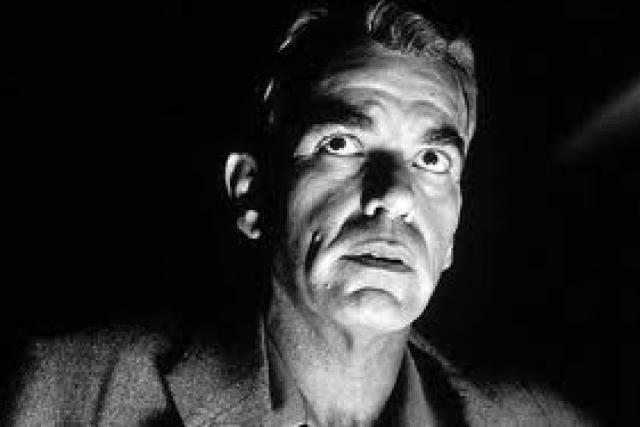
The year is 1949, and the barber we are about to meet is Ed
Crane, played with a perfectly calibrated laconic calm by Billy Bob Thornton.
He is an existentialist anti-hero, as if Bartleby the Scrivener had chosen an
alternate career path and became tragically enmeshed in a blackmailing scheme
gone wrong. 

Ed is an absence punched into the fabric of the film, a
black hole around which it orbits. His primary response to the world is one of
violent underreaction. He is inert with passivity, an American buddha, beatific
with a placid glow of naivete and repression. He’s like an unspoken thought.
This film chronicles his unfortunate late-blooming experiments with taking
action and his resulting demise. The process of his destruction commences the
moment he goes from being an unexpressed thought to an utterance, the moment he enters the world through
activity and decision. And his destruction is also the vehicle by which he
realizes himself.

In the noir cosmos, it is normal for a timid character to be
lured out of a safe but unsatisfying zone of normalcy by mirages of wealth and romance. This is what happens to Ed when
he gets suckered into a swindle that involves becoming a silent partner in a dry
cleaning business. He acquires the money for this by blackmailing his wife’s
boss, with whom she is having an affair. The plan appears to have a perfect
symmetry. He would seem to be able to enter his dream of wealth while getting
revenge against his rival with a single action. He wants to reach goals he has
unthinkingly and hastily stumbled upon in a manner that involves little to no
effort. We know it is not going to end well.

Like many of the Coen brothers’ characters, at no point does
Ed gain an understanding of how he works. The one aspect of his revolt against
his life is his inappropriate attachment to the gamine Birdy, played with a
compelling subdued clarity by Scarlett Johansson. Their
relation is one of genuine friendship, but Ed himself has no idea that his
intentions are also amorous.

This is because he can’t see himself. No learning curve is
possible in this world, only the transformation of circumstances. The rules of
the film’s universe dictate that the ultimate sacrifice must be paid for the
crime of wanting to be a dry cleaner. He mutely picks his moment to enter the
stream of phenomena from the suspended animation of seemingly prosperous, happy
post-WWII America, and he is briskly swept away in the acrid waters of brutal
existential comedy. It isn’t that he is dispatched following a
naively lazy attempt to escape from his life, but that his existence doesn’t
begin until the elaborate process of his undoing has commenced.

Some people find it disturbing that in Coen brothers films,
the characters don’t often have clear realistic referents and appear at first
glance to be stereotypes, playthings created only to be sadistically ground
up in the gears of a machine in which unfortunate patterns of human behavior, bad
decisions, bad luck, and stupidity converge to mete out a punishment so
arbitrary and so astronomically out of proportion to the crime that one can
only laugh. I’ve never understood this objection. Placing doltish,
unrealistically drawn, powerless
characters in an uncertain, comically brutal universe is what the Coen brothers
do best, and it’s what makes their films so entertaining, thought provoking,
and appealing.

The fact that the brothers were faculty brats who went
respectively to NYU and Princeton and sometimes make cartoonish movies about
dim-witted people has led some to the misguided conclusion that they are
condescending to their characters. Dave Kehr, writing about Raising Arizona, opined that “the distinction between satire and sincerity doesn`t mean much to the
Coen brothers, who treat everything that passes before their camera with
the same smarmy condescension…. The elaborate, self-conscious stylistics serve only to proclaim how much
more sophisticated the Coens are than the bumpkins they have chosen to
populate their movie. At the same time, the empty technique invites the
audience to share the Coens` sense of superiority….” Coming to this conclusion requires ignoring the glaringly burlesque fable-like atmosphere that permeates their
films, and falling into the trap of looking in vain for realistic characters
and settings to emotionally identify with, when the films are working with
totally different dynamics and materials. The Coen brothers clearly have a real
affection for their stylistically rendered characters, and this is reinforced by
the degree to which other people love these characters as well. The Coens
create the characters not to be mocked, but to be destroyed with extreme prejudice. The brothers
seem to be poking fun at creations they love. In the process of
humiliating, damaging and annihilating these figures, they render them in an extremely vivid
and often hilarious way.

Though today the Coens are widely critically lauded and
their films are usually discussed in a way that comprehends the spirit in which
they were meant,  their work is still polarizing.
It seems that gleefully subverting conventions never seems to lose its power to
piss people off. Some critics found their first films grating and insincere,
especially critics at the more genteel publications which might not have been
ready for the Coen dynamic, which usually incorporates slapstick, noir, brutal
violence, and wry humor into an entertaining but disorienting mélange. Even the
inordinately perspicacious Pauline Kael held up the first two Coen films beside a template of expectations which rendered them somewhat
illegible to her. On Blood Simple: “[T]he reason the camera whoop-de-do is so noticeable is that there’s
nothing else going on. The movie doesn’t even seem meant to have any
rhythmic flow; the Coens just want us to respond to a bunch of ‘touches’
on routine themes. (These art touches are their jokes.) Blood Simple
comes on as self-mocking, but it has no self to mock.” Critics might be able to accept stylized
wry brutality and black humor, but to be accepted it must be served with a large
side order of transcendence, and that is a dish that is not usually available
on the Coen menu.

When filmmakers don’t
leave clear markers as to how sincere or sarcastic they are, critical anxiety is generated, and this can cause us to miss how much obvious joy is being taken in playing with genres and dynamics.
This has sometimes resulted in a pattern of priggish critical harrumphing that
continues in some quarters even to this day. Rather than letting the sincere
and sarcastic elements work together in a thought-provoking manner as a kind of
essay, the ambiguity is sometimes mistaken for ridicule. Some critics have assumed
that the tradition of realistically drawn, emotionally relatable characters and
settings is being smugly dismissed. After all, it’s the critic’s job to provide
a grading system to determine how well filmmakers provide this traditional
service. 

The Man Who Wasn’t There might prove off-putting if
approached with this conventional set of expectations. But it’s funny,
thought-provoking, and mesmerizing if you let its themes and questions, and its
gorgeous, silky black-and-white cinematography work more in the spirit in which
they seem to have been created: as a wry, poetic thought experiment within a
technically impressive formal genre structure. The Man Who Wasn’t There offers
the stability of being one genre rather than several at the same time, but it
doesn’t offer a stable railing of seeming emotional truth. It works by keeping
the viewer continually off balance, so the only stability is to be found by
continuing to ask questions.

The Coen brothers’ warmer, more wildly entertaining films
like Raising Arizona, The Big Lebowski, and Fargo do provide opportunities for
the traditional dynamic of emotional identification. But even their sweetest
and most uproarious films also contain their trademark opposite pole of
punishing nastiness. Allowing these contradictory polarities to work
simultaneously to some degree is a large part of what gives their films a
unique sense of tension and unpredictability.

There are many things that critics agree the Coens do well,
including themes of friendship, theatrically arresting violence, 
humor, suspense, elaborately complex, perfectly choreographed set
pieces, perfectionist music editing and overall technical panache. Not least
among the things they’re known for is unforgettable dialogue, often done with
in a comically inappropriate literary style. They’re fond of voiceovers,
usually from unreliable narrators such as H.I. in Raising Arizona. Their films
use a contrast between the narrators’ blinkered perspective and the
considerably broader perspective accorded to the camera. The voiceovers are
dramatic monologues competing with the images rather than explaining them. Ed’s
voiceover in The Man Who Wasn’t There is eventually revealed to be a men’s
magazine article about his journey to the electric chair. It is, literally, an essay.

nullThe movie begins with Ed talking about how little he talks.
“I just cut the hair.” Disparities between subjective narratives and
the gaps of knowledge between characters fuel some of the tensest scenes of
conversation in the film, as when Ed is first speaking to the menacing Big Dave Brewster,
played by James
Gandolfini, with his trademark Tony Soprano blend of menace and
affability. We are not sure how much Big Dave knows or what he’s capable of, as
he is speaking to Ed as though in confidence about some other blackmailer. He
slowly reveals how much he does know, which is everything, and then asks him in
mounting rage, “What kind of man are you?” before attempting to beat
him to death. Ed semi-accidentally kills him in self-defense with a lucky jab
of Big Dave’s cigar cutting knife straight into the jugular. The shot of Ed
being strangled by Big Dave is done from outside the room, behind glass he is
being pressed against. The glass, our view of the scene,  cracks joltingly during the struggle, and
this marks the first start of the machine of Ed’s fate. The scene
ends with the ticking of a clock.

Not all the verbal narratives in the film are unreliable.
The Coens are not nihilists. Several pieces of information are framed as if they were
objectively the case. The first comes from Ed’s lawyer’s private detective, who
reveals that Big Joe was faking his war hero resume. He turns out to have been
just a bar room brawler with an anger management problem. The other comes from
the piano tutor Ed contacts to evaluate Birdy’s level of talent, and whose evaluation is unusually
frank. Neither piece of truthful information is particularly important in the
film.

The film’s basic dynamic involves simple reversal of the passive
and the active. Instead of shaving his wife’s legs for her and cutting other
people’s hair, at the end of the movie Ed is the one being shaved, with
orderlies scraping away the hair on his leg to ensure a good contact for the electric chair. He is not even being
executed for any crime he committed, but he doesn’t mind. He’s in the driver’s
seat.

Drew Gardner’s books include Chomp Away (Combo, 2010), and Petroleum
Hat (Roof Books, 2005). He tweets at @chompaway and lives in New York
City.

Are Animated Gifs a Type of Cinema?

Are Animated Gifs a Type of Cinema?

Well, are they? I’m
inclined to argue that they are. Indeed, I’ve already done so, in two posts I
wrote a couple years ago elsewhere: “How Many Cinemas Are There?” and “Why Do You Need So Many Cinemas?” There, inspired
by comics scholar Scott McCloud’s ultra-lean definition of comics (“sequential
art”), I proposed that cinema be thought of simply as “moving images.” Making
that mental leap expands the cinema to include not just feature-length films
and shorts, but also television shows, music videos, YouTube videos, video
games, flash animations—and animated gifs. (I even argued that cinema should
include certain “non-electronic” forms, such as flip books, magic lanterns, and
shadow puppetry.) I won’t rehash that whole argument here; instead, I want to
look solely at animated gifs. Are they cinema?

Admittedly,
I don’t know anyone who is arguing that they aren’t. But I also don’t
know anyone (with one exception) who’s arguing that they are. Indeed, no
one seems overly concerned with the matter. But I think it makes sense to
examine the relationship between animated gifs and other forms of cinema, as
well as to try describing the format’s unique cinematic aesthetic. Here are a
dozen reasons why.

1.
They’re often taken from cinema, as people extract smaller moments from longer
films. Here’s a famous example:

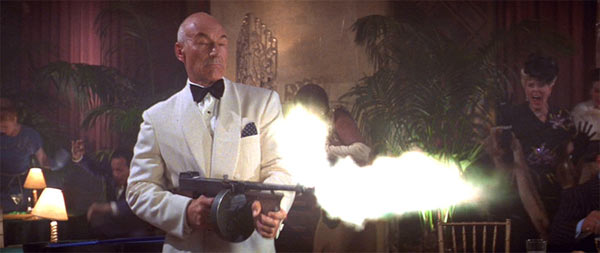
Picard tommy gun

This
gif basically consists of two shots, roughly two-and-a-half seconds, taken from
Star Trek: First Contact (1996).

2.
If that’s all animated gifs were, then they would be truly derivative
works—very short video clips (with a reduced color palette). But animated gifs
can be used to create new works, by combining moments from different films. For
instance, you might often see those two shots in the Picard gif followed by a third:

picard-vs-chunk

Or:

picard-vs-brown

These
examples edge us closer to the world of video art, or earlier experimental
films that derived their effects from juxtaposing footage from different films.
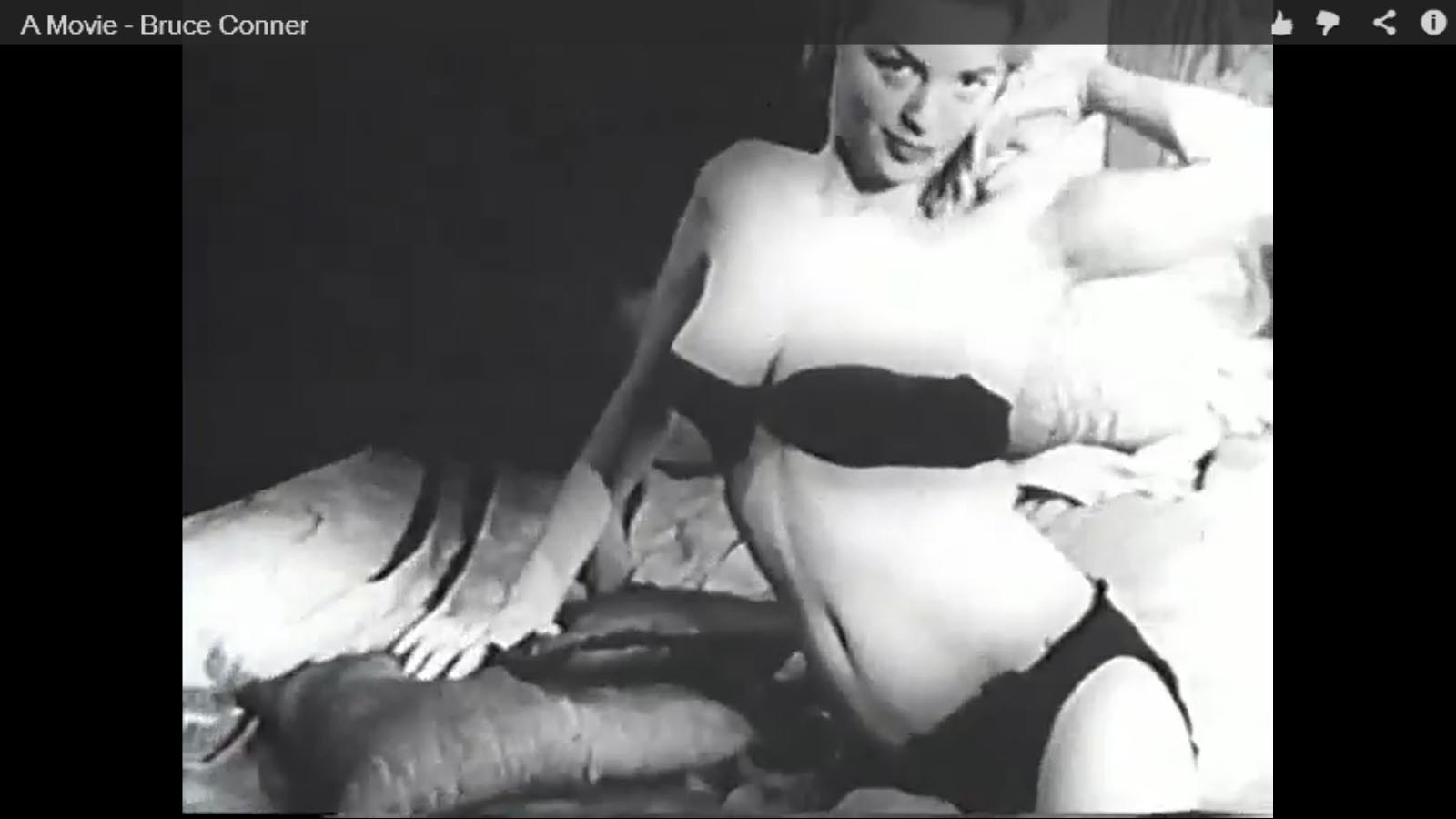
These Picard gifs remind me of the moment in  Bruce Conner’s classic 1958
film A MOVIE where the submarine captain looks
through the periscope (4:17–4:19):

A MOVIE - periscope

.
. . to spy a pin-up model reclining on a bed (4:19–4:24):

A MOVIE - bikini

(You can watch A
MOVIE
here
, which is where I took these screen captures from.)

Both
A MOVIE and these animated gifs employ some common cinematic principles.
The cuts create an eyeline match, which make it appear as though the
characters are looking at one another, and obey the 180-degree
rule
(meaning that if you draw a straight line between their eyes,
our perspective stays to one side of it). (Incidentally, the juxtaposition in A
MOVIE
works better than the above images might suggest, because right
before the cut, the submarine captain is shown twisting the periscope from left
to right.)

I’ve
seen a different version of the Picard vs. Chunk gif:

Picard vs Chunk facing right

.
. . and I’d argue that it doesn’t work as well as the first one we considered:

picard-vs-chunk

.
. . which better matches the eyelines, and obeys the 180-degree rule.

This
suggests that animated gifs possess an aesthetic similar to cinema’s.

3.
Besides combining shots taken from different films, animated gifs can also
juxtapose different types of cinema, such as live-action and animation:

picard-vs-rabbit

.
. . or even live action and video games:

picard vs duck hunt

This
second example suggests that we might also consider video games a type of
cinema—though we need not get into that now.

4.
Gifs can also composite different types of footage within the same image.
Here’s a particularly notorious one that I’ve written about at the lit blog HTMLGIANT:

FreshPrince911

Here
we have two different pieces of television footage combined in a single image.
And leaving aside the (deliberately offensive) content, we can see another
potential for the form. Composite editing is by no means unique to gifs;
Georges Méliès discovered double exposures soon after filmmaking was
invented—see for instance Un homme de têtes, aka The Four Troublesome
Heads
(1898), viewable here. But gifs, being a natively digital format,
might more easily encourage such recombination. (Méliès is their milieu?)

The
Picard vs. Chunk gif above, in fact, contains composite editing. Here’s a screenshot
taken from the scene in The Goonies (1985) where Chunk originally
performed the Truffle Shuffle:

Truffle Shuffle (screen capture)

Whoever
made the gif removed Chunk from that setting, and placed him front of another.
I’ve spent more time than I care to admit scrutinizing scenes in The Goonies
and First Contact, and I still can’t tell where that second background
hails from. Here’s a capture of the shot in First Contact that follows
the close-up of Picard firing:

dying Borg (screen capture)

(Of
course the footage behind Chunk might not even have come from First Contact,
but some third film.)

Still
more work has been done on this gif. The bullet tracer effects have been added.
And we can now see why Chunk is facing right in that one gif—that’s the way he
was facing in the original shot. This suggests that the right-facing gif came
first, after which someone changed it by turning Chunk to face in the opposite
direction. (Since anyone who can view a gif can, in theory, also edit it, gifs
are arguably a wholly populist form of cinema.)

Look
again at the first Picard gif, at the very top of this article, and compare it
to the others. You’ll see that its first shot is different: it’s been extended
by rolling the footage backward, then forward. (In First Contact, Picard
moves only forward in that shot.) If we wanted to, we could now take that
extended footage of Picard and paste it into the left-facing Chunk gif.

5.
Another way that gifs differ from their sources is that they often reframe
shots—which is part of why it’s difficult to determine where Chunk is standing.
The shot has been whittled down to focus on just him. The shots of Picard
firing have also been narrowed; compare the gif with these screenshots:

Picard firing 1 (screen capture)

And:

Picard firing 2 (screen capture)

Because
animated gifs are lower resolution than film—not to mention often postage-stamp
sized—they benefit from focusing the viewer’s attention on a single central
image. Picard + Tommy gun = all that’s really needed.

This
might suggest that gifs have a different aesthetic than filmmaking, but I’d
argue it’s more a matter of desired effect. In First Contact, the focus
of the shots is certainly Picard’s attack on his Borg foes, but the scene
occurs within a richer environment. The scene takes place roughly an hour into
a film in which most of the action is set aboard the Enterprise, which is under
siege from the Borg. Picard lures two of those aliens onto the ship’s holodeck,
trapping them in a simulation of a hard-boiled detective novel. The movie needs
to portray a convincing-enough environment in order to keep its audience
immersed in the somewhat outlandish fantasy. Along the same lines, when
watching The Goonies, it’s important that viewers understand that Chunk
does the Truffle Shuffle outside a house in Astoria, Oregon.

But
the animated gifs we’ve been looking at aren’t concerned with that kind of
world-building, being much more concentrated on a narrower and more immediate
effect. Their makers probably wanted us to recognize the source material (they
took footage from very well-known films), but the focus is relocated to the
comic juxtapositions. Cutting out most of the background helps the viewer to
get the joke. Viewed in this light, I’m surprised the Picard/Chunk gif’s
original author bothered editing Chunk into a matching background. The other
gifs work fine without going to that degree of trouble. (Indeed, you might
argue that the shift in setting heightens the joke.

6.
Here we have a hint of a way in which gifs possess a different aesthetic than
feature-length movies, or at least operate differently given similar concerns.
Someone makes a gif where Picard seems to be shooting Chunk. Then someone makes
one where Picard seems to be shooting Doc Brown. What’s next? Well, someone
could make yet another gif where Picard seems to be shooting another popular
1980s movie character—but aren’t returns already starting to diminish? To keep
the joke alive, we need something unexpected. So someone makes a gif
where Picard seems to be shooting at a Tiny Tunes character. Or at the
ducks in Duck Hunt.

I
haven’t seen it myself, but I imagine someone’s made a gif where Picard appears
to be firing at some documentary footage—video taken from a real-life shooting.
Or even footage of the Twin Towers collapsing.

Makers
of full-length movies definitely have to work to one-up each other. But that
cycle might be accelerated in the world of gifs, where the impact is much more
immediate.

7.
Along these lines, we can see that animated gifs are often greatly concerned
with emphasis, by:

  • Isolating a particular moment;
  • Focusing on a single element within the shot;
  • Creating a startling juxtaposition (through either
    composite or montage editing).

Gifs
also tend to emphasize movement. When I told a friend that I was writing this
article, she argued that “animated gif” was redundant, because the only gifs
people care about are animated ones. I nonetheless decided to keep “animated”
because it is possible to make static gifs, and I don’t want to argue that
static gifs are cinema. (Cinema is moving images.)

But
my friend was right. Who wants to see a static gif? In fact, it seems to me
that the best gifs often involve a flurry of motion, or remain static
until a crucial moment, which usually comes at the end of the loop:

anigif_enhanced-buzz-8204-1355940729-1

And:

untitledhgvy

Gifs
select footage and emphasize it. They focus attention.

8.
That’s not all that animated gifs can do, however. Some are longer, and as such
closely resemble short films. For instance, here’s an animation that traces the development of the NYC
subway system
:

subwayhistory480

Once
again, I’m reminded of an existing film: Ray and Charles Eames short movie Atlas
(1976), which presents “A Sketch of the Rise and Fall of the Roman Empire.” (You can watch it
here
.)

To
be sure, these are different works. The NYC subway gif lacks sound (music,
voice-over narration). But the presence of sound isn’t essential for cinema.
(The five-minute-long Eames film presents its animation twice, and the second
time it drops the narration.)

Animated
gifs arguably benefit from their silence, which becomes another way to focus
attention on visuals themselves.

9.
We’re gradually constructing a case that the value of gifs stems from their
poverty of resources—from the limitations inherent in the format. Along these
lines, gifs possess unique cinematic value due to their brevity.

The
earliest films, made by the Lumiere Bros. and Thomas Edison, usually ran at
least thirty seconds long. Since then, the movies have mostly gotten longer.
Now animated gifs are exploring another side of cinema—movies that run under
thirty seconds, and often under five. If they are cinema, then they rank among
the shortest movies ever made.

10.
Gifs also explore the opposite end of the spectrum: infinity.

While
some gifs present what amounts to a scene, others employ the form’s looping
quality to create an endless ongoing video. Here’s a famous example, taken from
a
mid-90s internet meme
:

DANCING_BABY_1_

The
gif version of this video forgoes the original meme’s accompanying music
(“Ooogachaka, ooga, ooga . . . “). But its dancing baby will dance forever

11.
All of this suggests that animated gifs have their own cinematic purpose. Hence
their effectiveness as erotic artworks: gif makers can distill crucial moments
from larger pornographic films, enabling people to watch them on repeat.

In
her recent Salon article, “Better Than Actual Porn!“, Tracy Clark-Flory
ponders whether pornographic animated gifs are more like short videos or longer
photographs. I’d argue that they exist on a spectrum between those two forms,
capable of moving more toward one side or the other. The above Picard gifs are
more like short videos. But the NYC subway gif and the dancing baby gif are
arguably more like enhanced photos. (The subway gif is like an enhanced
diagram.)

The
important point, however, is that animated gifs are novel—similar to, but not
exactly the same as movies as we’ve known them. They are, in other words, a new
form of cinema. (Clark-Flory comes to something of the same conclusion when she
writes that gifs are becoming an alternative form of pornography, but aren’t
replacing videos or photographs.)

12.
Cinematic viewing habits are changing: more and more movies are being watched
online. Folks still go to the cinema, of course, and they still rent DVDs. But
they also watch movies on their cell phones and laptops, which is where
animated gifs thrive. In this way they might be modern-day versions of the Kinetoscope
or Mutoscope:
a private form of cinema limited to a particular type of device (although it
probably won’t be long before gifs start popping up on electronic billboards).
This is yet another way in which gifs resemble the movies as we known them, and
yet diverge, providing a new incarnation of the familiar.

In
summary, animated gifs partake in the broader aesthetic of cinema, even as they
use their formal limitations to craft effects that we experience in
non-traditional film environments. I have no doubt that they will eventually
come to be regarded a unique form of movie-making, just as gallery-bound video
art eventually was, and that certain gifs will be singled out for their
aesthetic and historical import. Already I’d claim that there’s value in
preserving and teaching some of them, such as Picard vs. Chunk and the
Fresh Prince/9-11 one . . .

And
it probably also won’t be long before feature-length movies start borrowing
effects from gifs, the same way that the recent spate of “found footage” films—Paranormal Activity (2007), [Rec]
(2007), Cloverfield (2008), Chronicle (2012)—have drawn key
aspects of their aesthetic from YouTube. And while writing this I encountered
the only other argument I know of that animated gifs are a type of cinema: Twohundredfiftysixcolors, Eric
Fleischauer and Jason Lazarus’s feature-length compilation of 3000 gifs,
scheduled to screen on 18 April at
Chicago’s Gene Siskel Film Center
. (I’m planning to attend.)

Your
thoughts on all of this?

A.D Jameson is the author
of the prose collection
Amazing
Adult Fantasy
(Mutable Sound, 2011), in
which he tries to come to terms with having been raised on ’80s pop culture, and the novel
Giant
Slugs
(Lawrence
and Gibson
, 2011), an absurdist retelling of the Epic of
Gilgamesh. He’s taught
classes at the School of the Art Institute of Chicago, Lake Forest College,
DePaul University, Facets Multimedia, and
StoryStudio Chicago. He’s also the
nonfiction / reviews editor of the online journal
Requited. He recently
started the PhD program in Creative Writing at the University of Illinois at
Chicago. In his spare
time, he contributes to the group blogs
Big
Other
and HTMLGIANT. Follow him on Twitter at @adjameson.