FESTIVAL VIDEO: Rotterdam Sunset Chat with IndieWire Press Play + The House Next Door + Cine Qua Non

FESTIVAL VIDEO: Rotterdam Sunset Chat with IndieWire Press Play + The House Next Door + Cine Qua Non

null

The International Film Festival Rotterdam (IFFR) has been called a cinephile’s festival. This year’s edition (January 25-February 5) is living proof. Indiewire/Press Play editor-in-chief Kevin Lee talks with fellow critics Aaron Cutler (The House Next Door/Cine Qua Non) and Michal Oleszczyk (The House Next Door) about what films to see, old and new, in and out of competition. Recorded February 1, posted February 3. (pictured above: Awakening of the Beast, from the IFFR series "The Mouth of Garbage")

Index of video highlights:

0:20 – Why Rotterdam Matters
1:10 – Rotterdam vs. Sundance
2:52 – Competition Favorites
5:13 – Our Favorite Things from the Festival: Brazil's "The Mouth of Garbage", China's "Hidden Histories," James Benning's "small roads"

FEATURE FILM WITH VIDEO ESSAY: Brian De Palma’s RAISING CAIN is re-cut

VIDEO ESSAY WITH FEATURE: Brian De Palma’s RAISING CAIN RE-CUT

Raising Cain Re-cut is my attempt to approximate Brian De Palma’s original vision of Raising Cain, before the director chose to compromise its structure in post-production. The re-cut uses all of the scenes in the theatrical release and puts them back in the order they were intended, giving rise to a dramatically different viewing experience.

Acquired taste

Within Brian De Palma’s already divisive filmography, appreciation of Raising Cain (1992) is thought of as something of an acquired taste. While some critics consider the film minor De Palma, others claim it’s his overlooked masterpiece. No matter what the consensus, it is clearly the work of a formalist at the top of his game, having a ball screwing around with audience expectations. If you like your storytelling plain and unobtrusive, look away: this movie is not for you.

De Palma is a full-blooded visual stylist. So visual, in fact, that he’s the polar opposite of an invisible narrator. Like any other filmmaker, he manipulates. What sets De Palma apart is that he’s frank enough to show his hand. This refusal to cover his tracks, I feel, is the main reason why people either love or hate his work. De Palma directs classic suspense with a deliriously postmodern sensibility. He’ll have you trapped inside a cinematic moment at the same time he’s commenting on it. The fourth wall be damned!

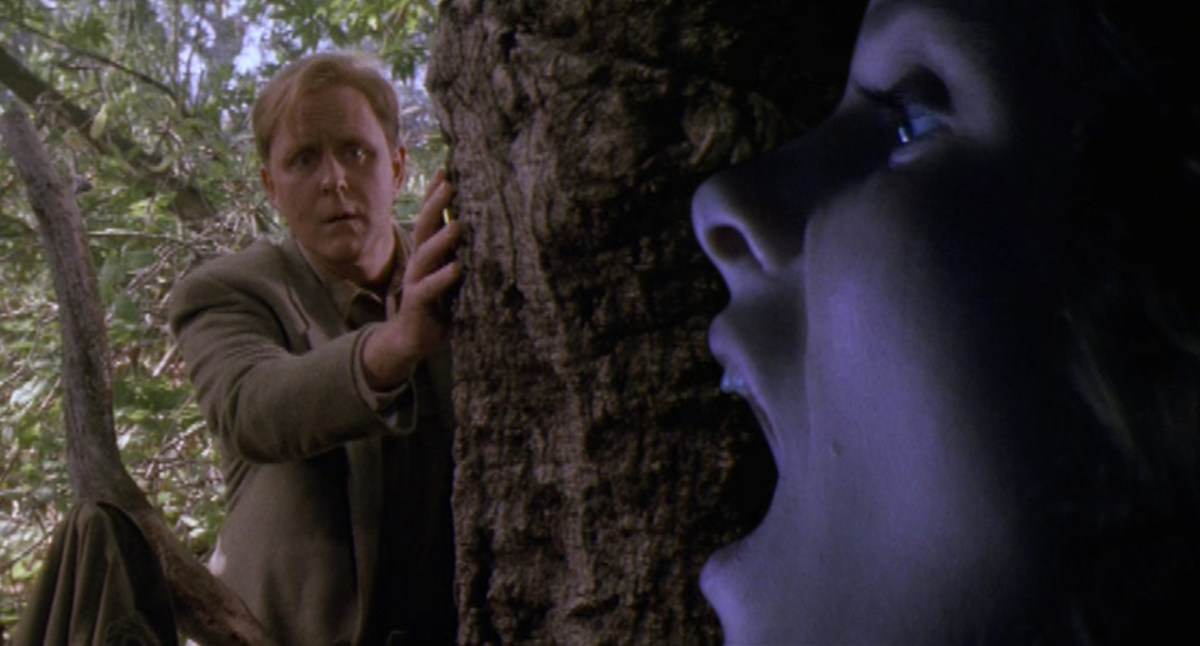
nullRaising Cain combines all of the elements of a vintage De Palma thriller and raises the stakes for both maker and spectator. It’s easy to get lost in the film’s labyrinthine framework centered on Dr. Carter Nix (John Lithgow), a murdering child psychologist with multiple-personality disorder, and his unfaithful wife Jenny (Lolita Davidovich). But for those who are able to keep up with the various role reversals, dream-like transitions and densely interwoven plot threads, the journey is all the more rewarding.

Second thoughts

Such artistic playfulness can be a tough balancing act. Even De Palma himself wondered throughout the process of making Raising Cain if he was going too far. In the final stages of post-production, he drastically re-arranged his film and settled on a more or less chronological order, mainly to avoid a drawn-out flashback that may have alienated the viewer.

In an interview with CHUD.com in 2006, the director admitted to regretting this last-minute decision:

“The interesting thing about that movie is that I could not make the beginning work, and it drove me crazy. (…) I always wanted to start the movie with (the woman) and her dilemma instead of with the Lithgow story.”

The Lithgow story is front and center in the theatrical release. One of the strongest readings of the film is that of John Kenneth Muir, who explained Raising Cain as a caustic social satire on the crisis in masculinity in the heyday of Mr. Mom. This analogy makes perfect sense, particularly because the film introduces Carter Nix straight off the bat as a caring husband and parent, very much in touch with his feminine side—until his suppressed “inner macho” shows up in the form of Cain, his id-ridden imagined twin brother.

nullIn the book Brian De Palma by Samuel Blumenfeld and Laurent Vachaud (in French and currently out of print), the director explains how this first act hurts the film:

The problem with the current cut is that it starts with scenes featuring Cain. Because I'm starting the film in an atmosphere of schizophrenia, with this guy with 25 personalities, the audience is not ready to accept the romantic fantasy that follows, which is what Jenny's story is about.”

I tend to agree with De Palma that Jenny’s story pales in comparison to what precedes it in the theatrical cut. And judging from the puzzled reaction of the audience I first saw the movie with, a case could be made that the overall narrative derails a little too quickly. The switch to chronology may have made Raising Cain easier to follow, but the trade-off is unevenness in tone and minimal build-up.

A different beast

Film critic Jim Emerson once wrote that the opening shot of a movie teaches you how to watch it. Seen in this light, the restructuring of Raising Cain Re-cut couldn’t be more radical. Right from the very first shot after the credits, it’s a different beast altogether.

Now, we start with the camera shooting from Jenny’s point of view, leading us to her recorded image on a television screen, caught in a heart-shaped frame. Presented as such, Jenny almost literally casts herself in the leading role of a romantic melodrama, where Jack awaits her as the ultimate Prince Charming, holding the keys to another life.

nullCrisis in masculinity isn’t even part of the equation anymore. This is going to be a movie about self-projection, about imagined lives, shifting perspectives and the collapsing present. The deliberate soap-opera framing of Jenny’s section, featuring lots of talking heads and over-the-shoulder shots that are atypical for bravura filmmaker De Palma, feels all the more fitting when isolated from parallel storylines.

For over 22 minutes, the focus of the re-cut stays on Jenny—not unlike the way De Palma put the spotlight on Angie Dickinson in the first half hour of Dressed to Kill. We watch Jenny fall in love with old flame Jack, feel the pain of her dilemma, fool around, wake up the next morning in the wrong bed, hurry back home, die, and wake up all over again. Meanwhile, her husband Carter is nothing more than a figure in the background. Then something unexpected puts an end to the romance and a string of flashbacks shows us that there’s more to Carter’s personality than we thought. Much, much more…

Problems and solutions

Of course, I didn’t have access to footage left on the cutting room floor. After a few disastrous test screenings, De Palma felt compelled to make drastic cuts in Jenny’s story for the theatrical release to work. A leaked second draft of the screenplay – entitled Father’s Day at that point – reveals deeper layers of complexity in the form of a quickie in the changing room, additional flashbacks (including Carter’s marriage proposal to Jenny), Jack doing a private investigation following Jenny’s disappearance, and a vengeful Jenny attacking Carter at the playground using twin carriages as bait. Fortunately, most of these missing elements had already been scrapped or rewritten by the time of shooting and none of them are crucial to the plot.

nullOne transition in the re-cut proved particularly tricky. To make up for a lack of coverage, I deployed a technique De Palma repeatedly relies on in the second draft of his screenplay: repetition. By quickly playing back a key moment earlier in the film, the viewer is reminded of where the upcoming scene fits in the overall chronology. To soften the transition, I lifted an establishing shot from the epilogue.


Does it work?

Whether De Palma was right to regret the theatrical cut or my attempt to approach his original vision improves on it— that’s for you to decide. To my eyes, however, the re-cut plays spectacularly well. While it’s heartbreaking to think of deleted scenes that will never see the light of day, it’s very well possible that the cuts that were made to improve the chronological version have made a tighter re-cut possible, easier to digest than the first time around.

I wouldn’t be surprised if the average filmgoer agrees. Since the release of Raising Cain, the language of cinema has continued to evolve. Elliptical head scratchers such as Pulp Fiction (1994), Memento (2000) and 21 Grams (2003) broke with classical continuity and were all the more successful for it. There’s a chance that a new generation of non-linear features has primed today’s audiences for the wild experiments De Palma had in mind earlier. Perhaps it’s high time, then, to unleash Raising Cain in its most uncompromising form.

null

Special thanks to Laurent Vachaud, Geoff Beran and James M. Moran

For a limited time the complete Raising Cain Re-cut can be seen right here (for critical and educational purposes only).

Raising Cain Re-cut from Press Play Video Blog on Vimeo.

Peet Gelderblom is a freelance director/editor/motion-designer from the Netherlands. He drew the weekly webcomic Directorama for Slant’s The House Next Door and Smallformat magazine. Between 2004 and 2008, he was the founding editor of 24LiesASecond, a now-defunct platform for provocative film criticism with an underdog bite, for which he wrote a number of essays. For commercial assignments he’s represented by In Case of Fire/Firestarter, Amsterdam. A selection of his work can be found on his personal website Directorama, where he also keeps a blog.

VIDEO: The Existential Noir of Michelangelo Antonioni

VIDEO: The Existential Noir of Michelangelo Antonioni

null

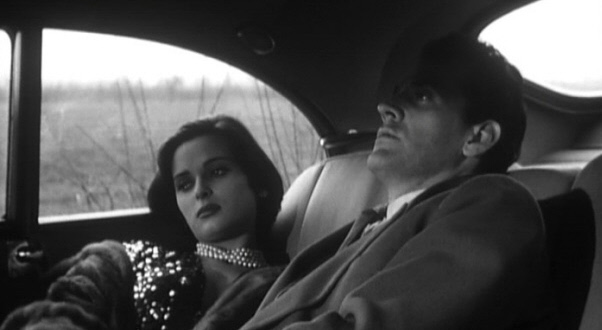
"With the Noir City Film Festival in full swing in San Francisco, we felt it was the right moment to revisit the doomed romance in Michelangelo Antonioni’s The Story of a Love Affair. Though Antonioni is best known as the Italian master of art cinema, his Antonioni’s first film, Story of a Love Affair, was fashioned after ’40s Hollywood films noir like Double Indemnity, Shadow of a Doubt and The Naked City. Watch this video essay to get a sense of what noir Antonioni-style looks like."

To read the full transcript of the video and watch The Story of a Love Affair at Fandor.

VERTIGOED: A Press Play mash-up contest

VERTIGOED: A Press Play mash up contest

EDITOR'S NOTE: You may have heard that Kim Novak, costar of Vertigo, took out an ad in Variety protesting the use of Bernard Herrmann's Vertigo score in Michel Hazanavicius’s modern silent film The Artist. "I WANT TO REPORT A RAPE," the headline blared. "I FEEL AS IF MY BODY—OR, AT LEAST MY BODY OF WORK—HAS BEEN VIOLATED BY THE MOVIE, “THE ARTIST," Novak wrote, and went on to decry the “USE AND ABUSE [OF] FAMOUS PIECES OF WORK TO GAIN ATTENTION AND APPLAUSE FOR OTHER THAN WHAT THEY WERE INTENDED.” Novak's word choice was unfortunate — more than one person, including yours truly, said that was akin to somebody sitting through the Star Wars prequels and witlessly declaring, "George Lucas raped my childhood."  

Press Play contributor and film editor Kevin Lee followed this Novak/Lucas line of thought to its logical — or illogical — end. Just for the hell of it, he matched the Vertigo cue used in The Artist with the last three minutes of the Death Star battle in Star Wars, Episode IV: A New Hope, uploaded it, and sent the link to several Press Play contributors to get their reactions.  

nullAnd it's here that things got interesting: rather than generate cheap laughs at the expense of Novak, Lucas, The Artist or Star Wars, the mash-up inspired delight. Simply put: Kevin's experiment confirmed that Bernard Herrmann's Vertigo score is so passionate and powerful that it can elevate an already good scene — and a familiar one at that — to a higher plane of expression. Score one for the master of film scoring!

We encouraged Kevin to put the same piece of music under a bit from Star Wars: Episode I, The Phantom Menace and the training sequences from Rocky and Rocky IV. Same result: The scenes seemed deeper, subtler and more haunting, solely because of Herrmann's music.

Kevin joked that these clips had been "Vertigoed" — a reference to the low-budget "Swedeing" of Hollywood movies in the cult classic Be Kind, Rewind. The term stuck, and inspired us to declare a Press Play "Vertigoed" contest. 

THE RULES:

1. Take the same Herrmann cue — "Scene D'Amour," used in this memorable moment from Vertigo — and match it with a clip from any film. (You can nick the three-minute section from one of Kevin's mash-ups if it makes things easier.) Is there any clip, no matter how silly, nonsensical, goofy or foul, that the score to Vertigo can't ennoble? Let's find out!

2. Although you can use any portion of "Scene D'Amour" as your soundtrack, the movie clip that you pair it with cannot have ANY edits; it must play straight through over the Herrmann music. This is an exercise in juxtaposition and timing. If you slice and dice the film clip to make things "work," it's cheating. MONTAGES WILL BE DISQUALIFIED.

3. Upload the result to YouTube, Vimeo, blipTV or wherever, email the link to pressplayvideoblog@gmail.com along with your name, and we'll add your mash-up to this Index page. 

The Press Play Vertigoed contest ends at 5 PM Eastern time on FRIDAY, JANUARY 20.  No mash-ups posted after that time will be considered. Press Play staff will choose a winner over the weekend and award a $50 Amazon gift certificate. The pairing that our judges decide is most imaginative and altogether satisfying will win the prize. The victor will be announced Monday, January 23. 

Now get Verti-going!

–Matt Zoller Seitz

1. STAR WARS: EPISODE I – THE PHANTOM MENACE by Kevin B. Lee

2. ROCKY by Kevin B. Lee

3. ROCKY 4 by Kevin B. Lee

4. THE GREAT DICTATOR by Jonathan Amerikaner

5. ALIEN by William D'Annucci

6. BONNIE AND CLYDE by James Grebmops

7. STRAW DOGS by James Grebmops

8. AKIRA by Greg Stevens

9. VAMPIRE'S KISS by Jake Isgar

10. THEY LIVE by Chris Mastellone 

11. INGLOURIOUS BASTERDS by Brandon Brown

12. GIRL WITH THE DRAGON TATTOO by Miguel Martinez 

13. OLDBOY by Steven Santos

14. SWINGTIME by Rocco Sardoni 

15. THE JETSONS by Rocco Sardoni

16. Mädchen in Uniform by Matthew Cheney

17. WALL-E by Donka Aleksandrova

18. Edward Dmytryk's THE SNIPER by Catherine Grant

19. NIGHT MOVES by John Levy

20. BLOODSPORT by Andre Khazar

21. INDIANA JONES AND THE RAIDERS OF THE LOST ARK by Brad Hansen

22. BADLANDS by Emma Phelps

23. FERRIS BUELLER'S DAY OFF by Hugh Lilly

24. THE BIG LEBOWSKI by Will Woolf

25. EASY RIDER by James Grebmops

26. 127 HOURS by Jason Bellamy

27. DESTINATION INNER SPACE by R.Q. Dale

28. Martin Arnold's ALONE. LIFE WASTES ANDY HARDY by Hoi Lun Law

29. BRAVEHEART by Michael Pollard

30. MINORITY REPORT by Cole Smith

31. TOP GUN by De Maltese Valk

32  THE ROOM by De Maltese Valk

33. HAROLD & KUMAR ESCAPE FROM GUANTANAMO BAY by Lynn Guest

34. HARRY POTTER AND THE DEATHLY HOLLOWS, PART 2 by Rob Cooper

35. THE THIN RED LINE by Cole Smith

36. TROLL 2 by Gustavo Costa

37. DEEP IMPACT by Richard Bellamy

38. ANIMAL HOUSE by Chip Midnight

39. ZOOLANDER by Athena Stamos

40. HANGOVER 2 by Richard Haridy

41. BLACK SWAN by Jason Bellamy

42. THE RIGHT STUFF BY Matt Rosen

43. AN AMERICAN WEREWOLF IN LONDON by Bri Frazier

44. GOD TOLD ME TO by John Keefer

45. GUMMO BY David Jenkins

46. JEANNE DIELMAN by David Jenkins

47. WET HOT AMERICAN SUMMER by Brandon Nowalk

48. PEE-WEE'S BIG ADVENTURE by Emmy Serviss

49. THE LION KING by Brandon Nowalk

50. LITTLE DARLINGS by Tanya Goldman

51. THE NOTEBOOK by Tanya Goldman

52. ED WOOD by Justin Smith

53. TOY STORY 3 by Bri Frazier

54. MEAN GIRLS by Kate Aldworth

55. BOOGIE NIGHTS by Jonathan Pacheco

56. HEAT by Jim Gabriel

57. STAR TREK II: THE WRATH OF KHAN by Jake Isgar

58. MEAN STREETS by Anthony Vitello

59. Fritz Lang's METROPOLIS by Guy Handelman

60. TRADING PLACES by Peter Scully 

61. SECONDS by Matt Maul

62. TOY STORY 2 by Jason Haggstrom

63. MELANCHOLIA by Maximilien Proctor

64. BLADE RUNNER by Dan Seagraves 

65. SILENCE OF THE LAMBS by Brittany Carter

66. SPEED RACER by Jim Gabriel

67. THE WIRE by Jason Mittell

68. PSYCHO by Matt Cheney

69. MY VIDEO FOR BRIONA (viral video) by Joseph Carson

70. VERTIGO by Matt Rosen

71. EL TOPO by Maximilien Proctor

72. DON'T LOOK NOW by Maximilien Proctor

73. DRIVE by Maximilien Proctor

74. MATILDA by Barrak Sitty

75. PLAYTIME by David Blaylock

76. THE 400 BLOWS by David Blaylock

77. CHILDREN OF MEN by Matt House

78. E.T. by Chris McCullah

79. 4 MONTHS, 3 WEEKS & 2 DAYS by Matt Rosen

80. A PERFECT WORLD by Ethan Murphy 

81. OUT OF SIGHT by P.J. Rodriguez

82. OLD SCHOOL by Colleen Koestner

83. RISE OF THE PLANET OF THE APES by Steven Boone

84. FREDDY GOT FINGERED by Dan Seagraves

85. TERMINATOR 2: JUDGEMENT DAY by Dan Seagraves

86. OBSESSION by Brandon Brown

87. Hannibal by Arnzilla

88. SEVEN by Sasha Stone

89. NO COUNTRY FOR OLD MEN by Sasha Stone

90. JACKASS NUMBER TWO by Kevin B. Lee

91. PAN'S LABYRINTH SCENE 1 by Alex Mekos

92. PAN'S LABYRINTH SCENE 2 by Alex Mekos

93. EVANGELION 2.22 by Larson Yellowhair

94. KISS MY DEADLY by P.J. Rodriguez 

95. TOY STORY 2 by David Blaylock

96. NORTH BY NORTHWEST by David Blaylock

97. THE FIVE OBSTRUCTIONS by David Blaylock

98. VINTAGE DODGE CAR COMMERCIAL by Jeremy Butler

VIDEO ESSAY: DEEP FOCUS: SUPERMAN RETURNS, Angel of America

VIDEO ESSAY: DEEP FOCUS: SUPERMAN RETURNS, Angel of America

[EDITOR’S NOTE: The inspiration for this piece, Deep Focus: Superman Returns – Angel of America, comes from a review Matt Zoller Seitz wrote for the New York Press in 2006 at the time of the film’s release. We have reprinted that piece below with this video essay as point of comparison.]

Review:

Bryan Singer’s Superman Returns is no masterpiece. The movie’s first act is hobbled by weird misjudgments (including a criminally underused Eva Marie Saint as Ma Kent), and it’s so choppy that it seems to have been edited with a meat axe. Kevin Spacey’s snidely campy performance as Lex Luthor unbalances the film’s otherwise sincere tone. It’s also so dependent upon our knowing what happened in 1978’s Superman: The Movie and its follow-up, Superman II, that at times it feels like a long-delayed sequel in which the principal cast has been replaced.
Yet these flaws don’t diminish the film’s impact. From the moment that its hero (Brandon Routh) returns to the sky to rescue Lois Lane (Kate Bosworth) from a plummeting jet, Superman Returns flirts with greatness. Its greatness originates in its respect for Superman’s decency: Routh’s graceful incarnation of the character, and Singer’s decision to express the hero’s goodness in a cascade of iconic images as beautiful as Superman himself.

Superman (aka Jor El, aka Clark Kent) left earth years ago to revisit Krypton to see if there was anything left (there wasn’t). He returns to earth in a meteor that lands near his Smallville homestead—a mirror image of his arrival in Superman: The Movie, and a tipoff that we’re about to see a bubblegum epic about loss, renewal and the continuity of values. Singer expresses this continuity by reviving elements from the Reeve movies, including John Williams’ score, the designs of Krypton, the Daily Planet, the Fortress of Solitude, the Kent Farm and—most strikingly—the late Marlon Brando’s hambone performance, revived through archive footage.

nullLuthor’s out of prison (thanks to the absent hero’s failure to testify at his trial) and up to his old tricks, scheming around Metropolis with his thug henchmen, his wiseass gal pal (Parker Posey) and two yippy but vicious little dogs. In Superman’s absence, Lois Lane (Bosworth, swapping stoic warmth for Margot Kidder’s abrasive ’70s kookiness) won a Pulitzer for an editorial about why the world doesn’t need him, and then settled down with Daily Planet colleague Richard White (James Marsden), nephew of publisher, Perry White (a brusque yet warm performance by Frank Langella).

She also has a moody, asthmatic son (Tristan Lake Leabu) whose existence puts a period at the end of a relationship, which Superman and Lois would rather treat as an ellipse. The tension between Lois, Richard and Clark/Superman forms the film’s bittersweet core; she loves him but just can’t be with him. Superman and Lois’ nighttime slow dance in the skies of Metropolis is richer than the similar scene in 1978’s Superman because of its acknowledgment of unrealized dreams. In scene after scene,  implicitly asks what it might feel like to be Superman and to live in a world that has the Man of Steel in it. Routh articulates the first part of that equation with sweet precision. Though he lacks Reeve’s sunbeam warmth, he compensates with a soft-spoken, Boy Scout melancholy that’s unique among superhero performances.

Singer backs Routh by deftly illustrating Superman’s casual mastery of his own powers. When a frazzled Lois leaves the Daily Planet newsroom and takes an elevator to the roof to smoke a cigarette, Clark’s X-ray vision allows him to peer through walls and elevator doors and observe every step in her short journey. Then he joins her on the roof as Superman, slyly announcing his presence by blowing out her flame from afar.

nullWhere most comic book movies are paradoxically inclined to make their points verbally—bulldozing heaps of raw data in our faces, a la The Matrix movies, Batman Begins and Singer’s own X-Men films — Superman Returns is conceived as a visionary spectacle, a series of mythic tableaus that brazenly liken Superman to Mercury, Jesus, Atlas and Prometheus. It’s a sensory—at times sensuous—experience, modeled not just on great comic book art, but on the crème-de-la-crème of machine-age spectacles: 2001: A Space Odyssey and Close Encounters of the Third Kind. (Warning, that segue means possible spoilers ahead.)

A slow Kubrickian pull-out from Krypton diminishes Superman’s homeworld against a boiling sun, and then obliterates it like a shotgunned chandelier. When Luthor experiments with pilfered kryptonite to produce a new crystal continent, the miniature prototype punches up through a model train diorama like the scale model of Devil’s Tower in Richard Dreyfuss’ rec room. The film’s powerful, often intensely violent final act—in which Superman tries to thwart Luthor’s plan, falls into a devastating trap, only to endure a Passion of the Christ-style beatdown and a plunge into the sea—climaxes with a biblically awesome panorama of a Texas-sized landmass ascending heavenward like the mother ship going home.

Singer never stops being amazed at the very idea that a man could fly. Yet, he treats his protagonist as an adult man who pays a price for his goodness. He is physically almost invulnerable, but he is not omnipotent: He can’t be everywhere at once, and he doesn’t always want to be.

The film’s most haunting scene finds Superman floating above the earth, eavesdropping on layers of conversation, then becoming overwhelmed and shutting them all out. He could be a two-fisted cousin of the angels from Wings of Desire. He feels guilt over needing not to be needed, if only for an instant. He’s an extraordinary ordinary man—the better angel of our nature.

A critic, journalist and filmmaker, Matt Zoller Seitz is the staff TV columnist for New York Magazine and the founder of Press Play. Ken Cancelosi is a writer and photographer living in Dallas, Texas.

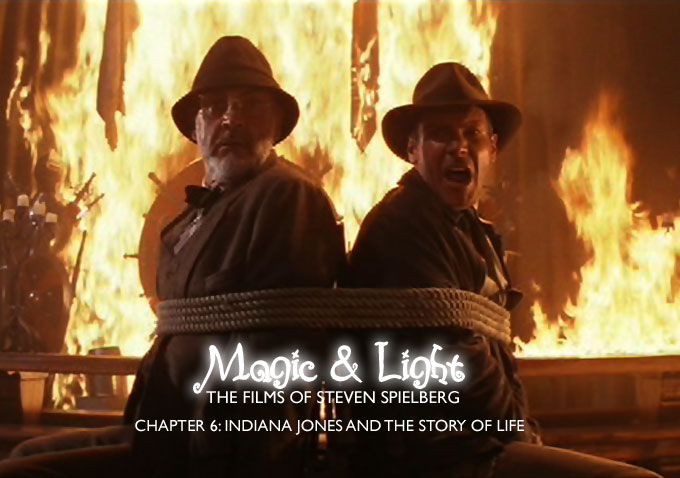
VIDEO ESSAY: MAGIC AND LIGHT: THE FILMS OF STEVEN SPIELBERG – Chapter 6: Indiana Jones and the Story of Life

VIDEO ESSAY: MAGIC AND LIGHT: THE FILMS OF STEVEN SPIELBERG – Chapter 6: Indiana Jones and the Story of Life

[Editor's Note: Press Play is proud to present Chapter 6 of our first video essay series in direct partnership with IndieWire: Magic and Light: The Films of Steven Spielberg.  This series examines facets of Spielberg's movie career, including his stylistic evolution as a director, his depiction of violence, his interest in communication and language, his portrayal of authority and evil, and the importance of father figures — both present and absent — throughout his work.

Magic and Light is produced by Press Play founder and Salon TV critic Matt Zoller Seitz and coproduced and narrated by Ali Arikan, chief film critic of Dipknot TV, Press Play contributor, and one of Roger Ebert's Far Flung Correspondents. The Spielberg series brings many of Press Play's writers and editors together on a single long-form project. Individual episodes were written by Seitz, Arikan, Simon Abrams and Aaron Aradillas, and cut by Steven Santos, Serena Bramble, Matt Zoller Seitz, Richard Seitz and Kevin B. Lee. To watch Chapter 1: Introduction, go here. To watch Chapter 2: Blood & Pulp, go here.  To watch Chapter 3: Communication, click here. To watch Chapter 4: Evil & Authority, click here. To watch Chapter 5: Father Figures, click here. ]

Narration:

What does it mean to be a father? What does it mean to come of age without a father? These questions have been at the center of many Steven Spielberg films. Both light entertainments and dark historical dramas have considered them.

The director’s evolving views on fathers and fatherhood are on surprisingly vivid display in the Indiana Jones series, which were produced by his longtime friend and Star Wars mogul George Lucas. Taken as a whole, the films feel like markers in Spielberg’s maturation.

Raiders of the Lost Ark introduces us to Indiana Jones, an archeologist who is more excited by grave-robbing and cheating death than by lecturing to Ivy League students. Indy holds a position of authority at the university, but were it not for the fact that he’s somewhat older than most of his charges and stands at the front of a classroom, he could be mistaken for a student.

There is no clear parental figure or even parental influence in the film. If anything, Indy is in his late thirties but has no visible entanglements. He even seems to treat his home merely as a crash pad, a base of operations.

When Indy decides to go looking for the Ark of the Covenant, he is cautioned by his older colleague of its power – the power of God, the ultimate father – and warned that maybe it shouldn’t be disturbed. Indy’s response is a blithe dismissal.

nullIn later films we will learn that Indy has taken on the vocation of his father as a way to impress, and then one-up, the old man, a stern and distant academic. In Raiders, Indy is presented as almost a runaway kid, a grown-up Bowery Boy who doesn’t give much thought to others. He possesses the shallowness of youth, complete with the clichéd woman in every port. He’s a heartbreaker, this one.

The most uncomfortably adult moment in the film might be the scene where he re-encounters his great love, Marion. We learn that he loved and left her cruelly, and that she was much younger than he was. Their affair ended badly enough to drive Marion to go tend bar in the Himalayas. There’s an unsavory hint of cradle-robbing.

Although chronologically it’s a prequel, the hard-edged Indiana Jones and the Temple of Doom is actually a direct continuation of Spielberg’s coming to terms with adulthood.

Made on the eve of his marriage to Amy Irving — a marriage that would eventually end in divorce, and a second marriage to Temple of Doom costar Kate Capshaw — Spielberg channels the hesitation that can paralyze some men when deciding to make the ultimate commitment. The entire movie positions Indy in relation to various configurations of family – good and evil, functional and dysfunctional. The film is dotted with images of fathers, from the Chinese gangster Indy barters with to the dignified general who protects the palace to the numerous guards in the Thugee cult. And the entire story is infused with a son’s primal fear that his father will fail him — and a father’s primal fear that he’ll let his wife and children down.

The movie finds the hero slowly forming his own bickering makeshift family, with Indiana Jones as reluctant, grouchy father, nightclub singer Willie Scott as mother, and orphaned pickpocket Short Round as their son. Early in the film we’re casually informed that Short Round’s parents were killed in a bombing. Willie could be a gold-digging female equivalent of Indy, an eternal teenager who’s mainly interested in having fun and acquiring nice things. Three people who are used to living alone and relying only on themselves are thrown together, and forced to depend on each other to survive. Their trivial concerns will be beaten and burned out of them, in the Indiana Jones film which for long stretches is essentially a horror movie.

nullWhen Indy, Willie, and Short Round come across a village, they discover all of the children have been kidnapped and forced into slave labor in the mines of the Thugee cult. In effect, the bad guys in this film have made the entire village childless, and turned all the kids into orphans by kidnapping them.

The image of the cult is like a child’s nightmare made real as it consists of nothing but horrible, evil fathers. When Indy is forced to drink a potion he comes under the spell of the cult and his behavior is that of an abusive alcoholic dad.

Temple of Doom, along with Gremlins – which Spielberg produced, and which was also released that same summer – represent Spielberg’s final hurrah as a pure pop storyteller. These are tonally very strange movies, by turns charming and vicious, buoyant and horrific. When he directed the movie in the summer of 1983, Spielberg was edging up on 40, star Harrison Ford was actually turning 40, and George Lucas was dealing with the fallout from a painful and costly divorce. There’s a sense of looking backward on innocence, and forward, toward something darker.

In the 5 years between Temple of Doom and Indiana Jones and The Last Crusade Spielberg had become a father himself. The film’s opening origin sequence shows Indy risking life and limb to get his father’s approval, only to be dismissed when he tries to show his dad his big discovery. His newfound understanding of what that means can be seen in the way that the film presents Indy’s relationship with his own father, a brilliant but rather distant man whom Indy instinctively calls “Sir.”

Like Roy Neary in Close Encounters, Indy’s father is obsessed with a vision, in this case the location of the Holy Grail – the cup from which Jesus Christ, perhaps theology’s most piteously suffering son, drank during the last supper.

nullWhile the elder Jones didn’t literally abandon his family to pursue his obsession, we have no doubt that a lot of the time when Indy was growing up, the old man was mentally or emotionally checked-out. You can see it in the way they communicate – or more accurately, don’t communicate.

Estranged from his father for years, the two are forced to work together when the Nazis attempt to also find the Grail.

Their rivalry is a constant source of father-son friction. It even plays out in Freudian ways as they sleep with the same woman.

In earlier films Spielberg might’ve been more inclined to empathize with Indy’s resentment towards his absentee dad. But in the scene in which Indy tries to lay a guilt trip on his dad, and his dad grows impatient with such childish complaints, Spielberg’s identification is with pretty clearly with the father.

For Spielberg, hanging onto resentment and anger over a parent’s failings is ultimately pointless, a sign that one has failed to evolve. At the same time, though, The Last Crusade acknowledges that a father is still capable of learning late in life, and that for good of both father and child, such evolution is desirable, and necessary.

When Indy is hanging on for dear life as he attempts to grab hold of the Grail, his father gives him one last order. The son puts his pride aside and listens. And it saves his life. It is the same lesson that the elder Jones had to learn – that the emotional reality of one’s family is more important than the abstract goal of pursuing one’s dream. Both father and son learn the value of letting go.

nullReleased almost twenty years after the last Indiana Jones film, Indiana Jones and the Kingdom of the Crystal Skull feels like a coda. Indy seems to be re-thinking his decisions, and having pangs of regret. Although the sixty-something Indy is still a snarling, leathery ass-kicker, and in what might be his surliest mood since the middle section of Temple of Doom, the movie’s overall tone is rueful and melancholy.

The whole story is suffused with feelings of displacement and regret. Indy is a man out of his element, and out of his time – perhaps out of time, period. Nobody who’s endured so much punishment should have lived this long. And emotionally, what has he got to show for it? Nothing. Or so he thinks….

Set in the 1950s – the decade of Spielberg’s childhood – Kingdom of the Crystal Skull shows Spielberg bringing everything full circle on both a story level and as his final musings on what he’s learned as a husband and father.

Kingdom of the Crystal Skull is about rejuvenation and the passing of knowledge. As a young man Indy thrilled to the globe-trotting search of artifacts of history without giving much thought to their historical significance. He sees them as prizes, showing little interest in context or for all that has come before him.

Indy’s discovery that he has a son forces him to realize that – in his own more physically fearless, two-fisted way – he’s as emotionally isolated as his father ever was. As he embarks on an adventure with Mutt, he doesn’t just become a father figure, he realizes he actually IS a father to the young man. He sees himself in Mutt, and tries to impart wisdom to the boy. Of course, coming out of Indiana Jones’ mouth, a lot of this sounds hilariously feeble. But he means well.

As father and son tentatively come together in order to rescue the boy’s mother – Marion, the relative baby that Indy robbed from her cradle in Raiders – their adventure becomes a meditation on a father’s legacy. It becomes

Indy’s last – and most important – adventure while simultaneously representing a son’s first step into true manhood. For Spielberg the gaining and passing of knowledge is the greatest legacy a father can give his son.

The changing of the guard – and the handing down of knowledge and wisdom – is symbolized in the film’s closing shot, which pairs Indy’s long-delayed marriage to Marion and Mutt’s final ascent into functional adulthood. There’s a gravitas to the young man’s swagger. His adventures with his mom and dad have seasoned him. For a moment we believe he might be ready to take possession of Indy’s iconic hat.

But the old man’s not done with it yet.

San Antonio-based film critic Aaron Aradillas is a contributor to The House Next Door, a contributor to Moving Image Source, and the host of “Back at Midnight,” an Internet radio program about film and television. Matt Zoller Seitz is publisher of Press Play. 

TRAILER: Terrence Malick’s TREE OF LULZ (Hey, it could have happened. . .)

TRAILER: Terrence Malick’s TREE OF LULZ (Hey, it could have happened. . .)

“For of all sad words of tongue or pen,

The saddest are these: ‘It might have been!

Maud Muller, by John Greenleaf Whittier

 Annals of film history are filled with masterpieces that never were.  Cineastes spend many a sleepless night thinking of Stanley Kubrick’s unproduced epic on Napoleon’s life.  Film historians still search every nook and cranny to possibly locate Orson Welles’ first cut of The Magnificent Ambersons. Then there is the original script for John Huston’s Freud: The Secret passion that a little known philosopher by the name of Jean-Paul Sartre wrote; and Aldous Huxley’s Alice and the Mysterious Mr. Carroll, which was an amalgam of Alice’s Adventures in Wonderland, Through the Looking Glass, and the biography of Lewis Carroll, of which Walt Disney said: “[The script] was so literary I could understand only every third word.” There are many, many more, and probably none of these intriguing projects will ever get to see the light of day.

But don’t despair, gentle reader.  As a late Christmas present, PressPlay is proud to offer you a glimpse of another masterpiece that could have been.  Drown your cinephile sorrows in this.

— Ali Arikan

Kevin B. Lee is Editor in Chief of Fandor, a new video on demand website featuring the best of independent and international films. He is also a film critic and award-winning filmmaker. In addition to editing Keyframe, Kevin contributes to film publications and produces online video essays. Ali Arikan is the chief film critic of Dipnot TV, a Turkish news portal and iPad magazine, and one of Roger Ebert’s Far-Flung Correspondents. Ali is also a regular contributor to The House Next Door, Slant Magazine’s official blog.

VIDEO ESSAY: MAGIC AND LIGHT: THE FILMS OF STEVEN SPIELBERG, Chapter 4: Evil and Authority

VIDEO ESSAY: MAGIC AND LIGHT: THE FILMS OF STEVEN SPIELBERG, Chapter 4: Evil and Authority


[Editor's Note: Press Play is proud to present Chapter 4 of our first video essay series in direct partnership with IndieWire: Magic and Light: The Films of Steven Spielberg.  This series examines facets of Spielberg's movie career, including his stylistic evolution as a director, his depiction of violence, his interest in communication and language, his portrayal of authority and evil, and the importance of father figures — both present and absent — throughout his work.

Magic and Light is produced by Press Play founder and Salon TV critic Matt Zoller Seitz and coproduced and narrated by Ali Arikan, chief film critic of Dipknot TV, Press Play contributor, and one of Roger Ebert's Far Flung Correspondents. The Spielberg series brings many of Press Play's writers and editors together on a single long-form project. Individual episodes were written by Seitz, Arikan, Simon Abrams and Aaron Aradillas, and cut by Steven Santos, Serena Bramble, Matt Zoller Seitz, Richard Seitz and Kevin B. Lee. To watch Magic and Light: The Films of Steven Spielberg Chapter 1: Introduction, go here. To watch Magic and Light: The Films of Steven Spielberg Chapter 2: Blood & Pulp, go here.  To watch Magic and Light: The Films of Steven Spielberg, Chapter 3: Communication, click here. To watch Chapter 5, Father Figures, click here. To watch Magic and Light: The Films of Steven Spielberg Chapter 6: Indiana Jones and the Story of Life, go here]

Narration:

The antagonist, in Steven Spielberg’s films, has many faces.  It can be government scientists involved in seemingly shady plots.

It can be unstoppable behemoths such as the shark in Jaws or the tanker truck in Duel. Warped ideologies, as in Schindler’s List.  Or the tangled and self-defeating allure of vengeance, as in Munich.

What’s essential is that none of these could truly be considered “evil” in the classical — or theological — mould. You can’t blame the T-Rex for being a T-Rex in Jurassic Park. You can’t blame a Martian for being a Martian in War of the Worlds. They are what they are. And even in the most menacing moments, even the most outwardly inhuman antagonists display qualities that could even be described as, well, almost human.
 
Evil, in Spielberg’s movies, is almost purely elemental. As strange as it might sound, it seems almost value-neutral — a menacing force that is simply there, like the terrifying, almost Biblical storms that gather in the skies of many of his films.

nullThe human version of this element is authority. In Spielberg’s movies, evil, such as it is, always comes back to the use or abuse of power. The relative good or evil of people in a Spielberg film can be discerned by looking at how they use whatever authority they have in a given situation – how they tap into, and apply, power.  This is how morality is measured. It is how good or evil is measured. In the words of WH Auden, “Evil is unspectacular and always human; And shares our bed and eats at our own table.”

Individual villains in Spielberg’s films are, if not totally guiltless, then definitely warped.  Indiana Jones’ French nemesis Belloq, in Raiders of the Lost Ark, is an overly-ambitious careerist, his reason for shacking up with the Nazis.  

The American billionaire Walter Donovan does the same in Indiana Jones and the Last Crusade for greed and glory: he is a cartoon villain in the mould of Montgomery Burns.

Even in The Color Purple or Schindler’s List, central villains have a certain complexity.  

Amon Goeth, hideous as he might be, is a deranged, damaged person, and clearly not wired right – a pathetic alcoholic with a bloated beer belly.  

Albert Johnson, a drunk and violent letch who goes by the nickname Mister, transfers his resentment of the old south and Jim Crow on his household. The casual viciousness of the system is an unseen force that seems to amplify his worst qualities, and Celie bears the brunt of his self-loathing.

nullBoth Goeth and Mister are monsters and emotionally twisted; and, evil does manifest itself — but only through characters that are morally and psychologically defeated.  They’re in with the power structure set out by society; even though they’re just individuals, in another sense they ARE authority.  

It is often society’s authority that is the true enemy in the Spielberg canon.  Many of Spielberg’s antagonists are but human extensions of it. The true evil in Munich is that the state of Israel feels entitled to do anything it feels is necessary to avenge the murder of its athletes by Palestinian terrorists. As the story unfolds, it turns into a classic case of what soldiers call “mission creep.” A mission with a clearly defined, and perhaps morally defensible objective keeps getting new and more questionable duties tacked onto it.

Over time it becomes harder and harder for the heroes to tell who they’re killing — and what (if anything) the targets had to do with the original Olympic massacre. And yet they’re expected to do what they’re told without question or doubt, because the government’s representatives tell them it has to be done, and to question authority would be an offense against the motherland.  It’s yet another example in Spielberg’s films of authority slowly clenching its iron fist around the individual. Nobody in Munich is evil – not the assassins, not their handlers, not the PLO targets they’re hunting. But they all are collectively responsible for evil acts.

In Raiders of the Lost Ark, Belloq is not Satan: Like Vichy France itself, he’s cowardly, weak, and opportunistic. And he has willingly let himself be corrupted by the system.  

Goeth is a sadistic son of a bitch, but he’s been given total power by the system — and, as such, by Nazi Germany itself.

nullSpielberg’s slave-era drama Amistad pointedly avoids giving us a single, cartoonish, Mandingo slave master that we can direct our righteous ire against. The villain is a corrupt, debased and complacent system that everyone has grown used to, and that treats humans as property – a system that must be recognized as such, and resisted.  Here, as in Schindler’s List, the representatives of corrupt authority are rather bland, even borderline faceless people. They embody Hannah Arendt’s notion of the banality of evil.

Even the hero’s fellow Africans are implicated in this. Without their greedy viciousness, the noble Cinque would never have ended up in chains.

We see the government operatives clandestinely eavesdropping on the little suburb in E.T.: The Extraterrestrial — a vision of terrors to come.  

Saving Private Ryan offers a different riff. Every single GI in the group searching for the titular soldier — including the leader of the outfit, Captain Miller — gets killed because of a PR exercise. They are literally dying for a symbol.

In Jaws, it is the mayor’s decision not to shut down the beaches after the first shark attack that leads to more tragedy.  Spielberg’s adaptation of Peter Benchley’s novel is like a high seas adventure version of Henrik Ibsen’s An Enemy of the People – a play in which the citizens of a small resort town discover that the runoff from a tannery is polluting the waters of the local baths, and collectively decide not to hurt their bottom line by doing something about it. There is one authority figure in the Spielberg canon who is particularly fascinating in this respect: John Hammond, the industrialist who created Jurassic Park.

Hammond is outwardly pleasant, but ultimately very dangerous.  The character comes across as a benevolent Santa Claus or old Walt Disney figure, but is actually a genial Dr. Frankenstein. And he is ultimately responsible for every maiming and killing that happens on his tropical islands.  

This sympathy for Hammond – unique to the film since the character is a right bastard in the original novel – seems to betray something of Spielberg.  Despite the filmmaker’s inherent distaste for authority, it is undeniable that he is one of the most powerful men in the film industry.  

Frankly, Steven Spielberg IS Hollywood.  Could it be that he sees himself not only his everyman heroes, but also as the figures of authority, even the seemingly malevolent or destructive ones? The ambiguity would be very much in character for Spielberg.

nullJohn Hammond, the creator of Jurassic Park, at first seems a charming old man who just wants to dazzle people and make them happy. But if you total up the body count of all the films in the series, he seems infinitely less adorable. Hammond is a cross between Dr. Frankenstein and Walt Disney, purveying spectacular wildlife attractions that end up killing the customers.

Yet the man behind this film series, director-producer Steven Spielberg, never condemns him outright. We get the sense that he understands him and even sympathizes with him – that he sees him as a kindred spirit.

Steven Spielberg is, of course, an authority figure himself, so it should not surprise anyone that he’d have sympathy for this particular devil. He is the most financially successful filmmaker in the history of motion pictures. Many of the top-grossing movies are ones he directed or produced. He is co-owner of his own studio, and has licensed his characters and situations to theme parks and toy manufacturers. He is not just a filmmaker but a mogul … a brand .. and a cultural force. As such, his portrait of authority figures always contains a certain amount of empathy and understanding, whether the character is kindly but destructively clueless impresario like John Hammond, or a more overtly repulsive and menacing character, like some of the ones presented in the first part of this essay. Even the mayor of Amity in Jaws seems more pathetic than purely evil – a man whose moral sense was suffocated by the almighty dollar.

Spielberg’s knowing and often mordantly funny depictions of commercialization and branding flow into this as well. The filmmaker consistently manages to have it both ways — imaginatively presenting some of the comical or oppressive aspects of commercialism, while showcasing actual products and corporate logos within his films. The richest and most contradictory example of this is the slow pan across the merchandise in the original Jurassic Park.

The logos are identical to those of the Jurassic Park franchise itself. The movie is advertising itself and critiquing itself at the same time. It is a pat on the back that doubles as a warning: Let the buyer beware.

Over time, Spielberg has maintained the mentality of an independent filmmaker — an auteur director standing apart from the very system that he of course embodies as a producer, a studio boss, a multiple Oscar winner, and all-around purveyor of stuff.

This manifests itself onscreen in Spielberg’s complex and often conflicted portrait of the individual’s relationship to authority: be it the government of a small town in Jaws; the Jim Crow south in The Color Purple; the blandly menacing futureworld societies of Minority Report and A.I.: Artificial Intelligence; and military and law enforcement agents in Close Encounters of the Third Kind, E.T., Saving Private Ryan and Catch Me If You Can, which impede, manipulate, control or pursue the film’s heroes.

Spielberg’s heroes survive, and sometimes triumph, by being tough, smart, and lucky.  Most of all lucky.  

But for the sympathetic characters to survive – for their narratives to have a personal tipping point – they also require the help of a sympathetic person in authority.  

This type of character is the flip side of the more menacing or corrupt authority figures we talked about earlier. He is a regular fixture in Spielberg’s films – a reliable type. He’s inside the power structure, such as it is. He draws a paycheck from the establishment and does its bidding. And yet he maintains an outsider’s mentality and responds — perhaps nostalgically, perhaps even a touch guiltily — to true victims, rebels, and heroes.  

This type of character cannot help but admire the pluck of a resourceful hero, fugitive or troublemaker – and feel sympathy for the beleaguered, the exploited, and the dispossessed.  

We can feel his empathy and understanding even when he’s acting in concert with the forces that make life hell for the good guys. And when the chips are down, when it really and truly matters, he does the right thing.

nullThe UFOlogist Lacombe in Close Encounters might be the first major character in a Spielberg film that fits this description – the ally within the establishment. It is Lacombe who spies the escaped UFO obsessives heading for the Devil’s Tower but refrains from tipping off the army.  It is because of Lacombe that Roy is able to don a red jumpsuit and join the other extraterrestrial pilgrims. It is because of Lacombe, a government agent, that Roy ultimately gets his wish, and walks up that ramp into the mothership.

In both Close Encounters and in E.T., the military and the government scientists initially seem sinister – and inasmuch as they impede the progress of our heroes, they are definitely forces to root against. But their faceless, threatening appearance early on eventually gives way to a more nuanced portrait. Once we’ve gotten a closer look at them, we can see that they’re just people — and that they’re as curious as anybody.

The fifth column, the inside man, is often critically important to the Spielberg hero’s success. During the finale of E.T., all that Keys needs to do to bring down the alien ship is to get on his walkie-talkie. He doesn’t. Instead, he watches the ship land and the alien depart. He is happy – privileged – just to be there. He’s a cleaned up, respectable version of Roy Neary – what Roy would have turned into if he’d stayed on earth and joined the government.

Indiana Jones should have been caught and killed on that steamship in Raiders of the Lost Ark. He survived only because the owner of an African freighter intervened — supposedly a no-good scoundrel who’s only in it for the money.

The mutineers in Amistad only get a shot at freedom because one of the most influential men in America — former president John Quincy Adams no less — decides to take up their cause.  

In Catch Me if You Can, the FBI agent Carl Hanratty offers a lifeline to Frank Abagnale JR, who seizes on the opportunity, thus saving himself from life-long imprisonment.

And in Minority Report, Spielberg turns the tables on an essential wheel in the machine, the supercop John Anderton — who realizes that a conspiracy is afoot, kidnaps the precog Agatha, and becomes a hounded fugitive, and an enemy of the state.

nullOskar Schindler deserves a special mention as the ultimate Fifth Column. He is a subversive infiltrator deep in the heart of the Nazi apparatus, fueled by the moral impetus to do the right thing, even though he is almost completely inscrutable, and justifies his goodness on mercenary grounds. Initially, Schindler is a cad and a dandy; an incorrigible womaniser; an exploiter of slave labour; a boorish bully; and a member of the Nazi party.  

Earlier in the film, Schindler is an opportunist, in cahoots with the National Socialists not out of ideological sympathy, but merely because they happen to be the ones in power.  He is a cut-throat capitalist, and his first act of rescue is for blood-curdlingly self-serving, business reasons.

Later, in 1942, Schindler witnesses the initial stages of Operation Reinhard in Krakow, the annihilation of the city's Jewish ghetto.  These visceral scenes of liquidation, degradation, and execution are haunting; and leave an indelible mark in Schindler.  This moment of truth is not met with angst-ridden introspection: Schindler proves himself, and changes, through his deeds.  Through bribery, collusion, and deception, he sabotages the Nazi war effort while saving 1100 Jews from the savagery of the Holocaust.

Of course, this sort of miracle could only be achieved by someone who was in with the overall authority of the powers-that-be.  That Schindler is a member of the Nazi party, that he is an insider, is necessary to the success of his plans.   Schindler mitigates the machine from the inside by using his own connections.  He is a businessman of fine-standing with the National Socialists, who hardly bat an eyelid as Schindler pulls the run under them in order to save his Jewish workers.  In the grand scheme of things, only a wanton, libidinous, money-grubbing and wholly-inscrutable industrialist – and dyed-in-the-wool authority figure — could have flown under the radar of the Nazi machine and pulled off that sort of a miracle.

Matt Zoller Seitz is the publisher of Press Play, the staff TV columnist for Salon.com and a finalist for the Pulitzer Prize in criticism. Ali Arikan is the chief film critic of Dipnot TV, a Turkish new portal and iPad magazine, and one of Roger Ebert's Far-Flung Correspondents. Kevin B. Lee is Editor in Chief of Fandor.

MAGIC AND LIGHT: THE FILMS OF STEVEN SPIELBERG: Chapter 1: Introduction

VIDEO ESSAY: MAGIC AND LIGHT: THE FILMS OF STEVEN SPIELBERG: Chapter 1: Introduction

[Editor's Note: Press Play is proud to present Chapter 1 of our first video essay series in direct partnership with IndieWire: Magic and Light: The Films of Steven Spielberg.  This series examines facets of Spielberg's movie career, including his stylistic evolution as a director, his depiction of violence, his interest in communication and language, his portrayal of authority and evil, and the importance of father figures — both present and absent — throughout his work.

Magic and Light is produced by Press Play founder and Salon TV critic Matt Zoller Seitz and coproduced and narrated by Ali Arikan, chief film critic of Dipknot TV, Press Play contributor, and one of Roger Ebert's Far Flung Correspondents. The Spielberg series brings many of Press Play's writers and editors together on a single long-form project. Individual episodes were written by Seitz, Arikan, Simon Abrams and Aaron Aradillas, and cut by Steven Santos, Serena Bramble, Matt Zoller Seitz, Richard Seitz and Kevin B. Lee To watch Chapter 2, "Blood and Pulp," about the presentation of violence in Spieberg's movies, click here. To watch Chapter 3, "Communication," click here. To watch Chapter 4, "Evil & Authority," click here. To watch Chapter 5, "Father Figures," click here. To watch Chapter 6, "Indiana Jones and the Story of Life," click here.]

Narration:

Steven Spielberg is one of the most popular storytellers of all time. Based solely on box-office receipts, that’s an inarguable fact.

It's been true since 1975, when the box office take of his breakthrough Jaws redefined the the word "blockbuster."

Look at the top grossing movies of all time, and you'll see that a startling number were produced or directed by Spielberg. And yet this almost forty-year streak hasn't been enough to insulate him against charges that he's a frivolous director – or that, at the very least, his success is an example of style, or more accurately technique, over substance. That he does not persuade or even seduce viewers, but that he overwhelms them. With sound. With light. With music. And special effects.

But a closer look at the Spielberg canon betrays a remarkable depth of feeling and consistency of vision; a recurring set of interests, expressed with increasing subtlety and dexterity over time; a distinctive moral sense; a philosophy of life.

The sheer inescapability of Spielberg makes it tempting to ignore all this; to deny it and refute it; to write him off as an essentially juvenile showman, unworthy of serious consideration, even when he's dealing in quote-unquote serious subject matter.

nullThese complaints have persisted well into Spielberg's fourth decade as a pop culture force, and it's not hard to see why. He is not a confrontational or particularly edgy filmmaker, nor for the most part does he try to be. Even his most stylistically or thematically daring films are conceived in populist terms, to reach the widest audience – the widest MARKET – possible.

The raps against Spielberg are legion, and many are hard, even impossible, to refute.

That his sensibility is fuelled primarily by movies and television and other 20th century media, rather than novels or opera or painting or other, older art forms. 

That his populism, his sentimentality, and his love of neat endings with clearly stated lessons mark him as a mainstream, perhaps even middlebrow, storyteller.

That he is the Peter Pan of cinema: The boy who refused to grow up.

And there is something so overwhelming about Spielberg, even at his subtlest, that some may be inclined to resist as a matter of course. His is a cinema of apocalyptic finales and miraculous visions. A cinema of eye-filling, eardrum-shattering immensity.

Think about Spielberg's signature images for a moment. What do you picture? The sun. The moon. Shooting stars. Menacing skies filled with biblically awesome storm clouds.

You know how students love to talk about the idea of the storyteller, or the director, as God? Well, Steven Spielberg turns that subtext into text. He makes it official. Here is a director who inscribes his signature on the elements… on the cosmos. A director, who literally or figuratively raises entire historical periods, civilizations, even SPECIES from the dead.

The fact that Spielberg is perfectly attuned to the commercial aspects of cinema does not preclude the idea that he is a master artist, who's worthy of appreciation and study. J.G. Ballard, whose memoir-novel Empire of the Sun was adapted by Spielberg back in 1987, once wrote:

"The qualities that the cineastes see as weaknesses, I see as Spielberg's strengths, and as the reason why he is one of today's most important film-makers – the producer-director who single-handedly saved the Hollywood film when it threatened to founder in the Seventies. Besides, sentimentality and spectacle have a valuable place in the arts, as in the operas of Puccini – though there are puritans who feel slightly queasy at the thought of Tosca and Madama Butterfly. In many ways Spielberg is the Puccini of cinema, one of the highest compliments I can pay. He may be a little too sweet for some tastes, but what melodies, what orchestrations, what cathedrals of emotion.""

nullIn recent decades, the notion that Spielberg is somehow trying to prove himself, or re-brand himself, or be quote-unquote serious when he moves away from action-adventure or fantasy, has come to seem increasingly quaint, shorthand for a truism that's not true anymore. It's a critical relic from a long-gone era, akin to marvelling at the notion that, say, Woody Allen or Pedro Almodovar has directed a bleak drama. Indeed, hardly anyone under the age of 40 expresses even mild surprise that Spielberg would make a film such as Schindler's List, Munich, or A.I.

The longer Spielberg directs movies, the more apparent it becomes that his is a chameleonic talent, more versatile in some ways than the talents of two of his most profound cinematic influences, Alfred Hitchcock and Walt Disney.

The phrase "A Steven Spielberg Film" no longer refers to a certain genre, or even a particular mood or mode. Over the decades it has become more elusive, mysterious and much harder to pin down. And that visible evolution – that muddying and deepening – has had a retroactive effect on his movies. Just as the so-called "serious" films reveal themselves as undeniably, obviously, overwhelmingly Spielbergian, in the late 1970s and early 1980s sense, so too do Spielberg's earlier, supposedly "lighter" films reveal their own kind of seriousness. Spielberg’s idea of personal growth is a crucial aspect of all his films. He puts his characters through almost Biblical tests that would have made Job say, "Well, that's a bit much, isn't it?" They come out of the other side as better, more mature, more sensitive people, but at terrible cost.

Simply put, Steven Spielberg was always a serious filmmaker, just as Disney and Hitchcock, and John Ford and Howard Hawks, and Sam Peckinpah and Martin Scorsese, were always serious. Spielberg is, and always was, an auteur by any measure. A reliable purveyor of richly imagined, thoughtfully constructed entertainment and art.

nullThis series will examine just a few of Spielberg's key obsessions and motifs, as expressed over a wide range of films, released over four decades. We'll look at the influence of pulp fiction, serials and comic books on Spielberg's skillful depiction of violence – and how he learned to modulate it over time, in ever more varied ways. We'll look at the importance of communication and translation in Spielberg's films: the director's evident conviction that curiosity and goodwill can overcome superstition, bigotry and fear. We'll examine Spielberg's multifaceted portrait of evil and authority, and how the two intertwine, and express themselves in some of his most important characters. And we'll look at the director's sometimes warm, sometimes harrowing portrait of family life, with its negotiations and compromises, disappointments and tragedies — and the pivotal role played by father figures. Cold and loving. Present and absent.

As we shall see, Spielberg is in some ways a more complex and multifaceted filmmaker than even his fans give him credit for.  Beneath the explosions and effects; the slapstick and thrills; the emotion and wonder; lies an acute sense of right and wrong.  An appreciation of human weakness. An awareness that we are capable of great cowardice and cruelty. And that, even under the worst of circumstances, we can do great things. He is an exuberant showman. A stealthy artist. And a master of magic and light.

A critic, journalist and filmmaker, Matt Zoller Seitz is the publisher of Press Play, the staff TV columnist for Salon.com and a finalist for the Pulitzer prize in criticism. Ali Arikan is the chief film critic of Dipnot TV, a Turkish news portal and iPad magazine, and one of Roger Ebert’s Far-Flung Correspondents. Ali is also a regular contributor to The House Next Door, Slant Magazine’s official blog. Occasionally, he updates his personal blog Cerebral Mastication. In addition, his writing appears on various film and pop-culture sites on the blogosphere. You can follow his updates on twitter at twitter.com/aliarikan. Serena Bramble is a rookie film editor whose montage skills are an end result of accumulated years of movie-watching and loving. Serena is currently pursuing a Bachelor's degree in Teledramatic Arts and Technology from Cal State Monterey Bay. In addition to editing, she also writes on her blog Brief Encounters of the Cinematic Kind.

VIDEO ESSAY: Moment of wonder: THE SPIELBERG FACE

VIDEO ESSAY: Moment of wonder: THE SPIELBERG FACE

null

[Editor's Note: Press Play is proud to present our first video essay series in direct partnership with IndieWire: Magic and Light: The Films of Steven Spielberg.  This series examines facets of Spielberg's movie career, including his stylistic evolution as a director, his depiction of violence, his interest in communication and language, his portrayal of authority and evil, and the importance of father figures — both present and absent — throughout his work.

Magic and Light is produced by Press Play founder and Salon TV critic Matt Zoller Seitz and coproduced and narrated by Ali Arikan, chief film critic of Dipknot TV, Press Play contributor, and one of Roger Ebert's Far Flung Correspondents. The Spielberg series brings many of Press Play's writers and editors together on a single long-form project. Individual episodes were written by Seitz, Arikan, Simon Abrams and Aaron Aradillas, and cut by Steven Santos, Serena Bramble, Matt Zoller Seitz, Richard Seitz and Kevin B. Lee. To watch Chapter 1: Introduction, go here. To watch Chapter 2: Blood & Pulp, go here. To watch Chapter 3: Communication, go here. To watch Chapter 4: Evil & Authority, click here. To watch Chapter 5: Father Figures, click here. To watch Chapter 6: Indiana Jones and the Story of Life, click here. ]

Narration:

If there is one recurring image that defines the cinema of Steven Spielberg, it is The Spielberg Face. Eyes open, staring in wordless wonder in a moment where time stands still. But above all, a child-like surrender in the act of watching, both theirs and ours.  It’s as if their total submission to what they are seeing mirrors our own.

The face tells us that a monumental event is happening; in doing so, it also tells us how we should feel. If Spielberg deserves to be called a master of audience manipulation, then this is his signature stroke. You can’t think of the most iconic moments in Spielberg’s cinema without The Spielberg Face.

Expressive close-ups of faces reacting to events offscreen. This is a common device in Hollywood filmmaking, perhaps due in part to Spielberg’s influence. Sometimes these shots even make explicit homage to his movies. This is not to say that Spielberg invented the technique.  The expressive close-up existed as early as the days of D.W. Griffith, and has long been a staple of both international and classical Hollywood filmmaking.

But it’s safe to say that none have come close applying this technique as prolifically throughout their filmmaking career as Spielberg has. He has used it in a variety of genres in any number of situations: sudden shock or creeping dread, the trauma of remembering the past or of confronting the future, discovering humanity in another person, or discovering humanity in oneself.

You can read the rest of the transcript here at Fandor.

Kevin Lee is Editor in Chief of Fandor, a new video on demand website featuring the best of independent and international films. He is also a film critic and award-winning filmmaker. In addition to editing Keyframe, Kevin contributes to film publications and produces online video essays.