The Double Life of James and Juliette: Mysteries and Perceptions in Kiarostami's Certified Copy from Peter Labuza on Vimeo.
Narration:
 The newest film from Iranian director Abbas Kiarostami, Certified Copy, is a complete and total enigma. Many films pose mysteries at their centers, including detective stories, thrillers with multiple twists, and now often art films that pose ambiguous endings. But Certified Copy emerges as something of a different order, because it challenges the spectator to explore the mystery yet never come to any particular solution. But by examining the clues Kiarostami gives us, we, the audience, can understand the philosophical ideas of what our answers may suggest.
If you haven't seen the film, I should note that this essay will include spoilers, which is unavailable on DVD in the United States but now on Netflix Instant. That actually includes people who have actually seen Certified Copy, as there's much that one may miss a first and even a seconding viewing, a testament to the art of Kiarostami.
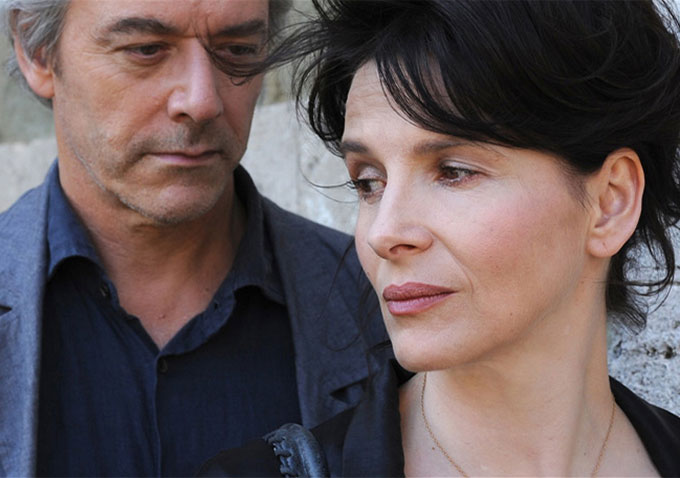
Certified Copy follows an art philosopher named James Miller, played by William Shimell and an unnamed character played by Juliette Binoche, only known as "She" in the credits. For simplicity sake, I'll be referring to the character as Binoche. The two strangers meet after he gives a lecture, and walk around a small Tuscan village without much of an agenda. But suddenly the film seems to switch – these are no longer strangers, but a married couple struggling through the day after their fifteenth wedding anniversary.
Kiarostami has said in interviews that there is no direct answer to whether the two protagonists had a previous relationship or not. However, that doesn't mean we shouldn't search for the clues to answer it. Certified Copy is one of those rare films that ties its emotional stakes to its philosophical stakes. If we believe one solution, it means we must assume some proposition about the nature of art that James discusses in his book. At the core of Certified Copy is Kiarostami's own philosophical proposition, explained by James in his opening lecture:
What I want to do is discuss here are three theories related to the film and its central mystery, and explore how Kiarostami hints at them with visual details, the use of particular dialogue (including the delivery of that dialogue), and the metatextual elements of the film, a crucial key in many of Kiarostami's films.
There's a particular turning point in Certified Copy where we realize the film we thought were watching completely turns into something different. While sitting in a café, the owner begins talking with Binoche while James is away.
Binoche tells this to James, who does not dispute.
It is after they leave this café where the movie changes from something more reminiscent of Before Sunrise to something much more dramatic.
James and Binoche stop acting like strangers having a somewhat awkward first date, and begin to act like they've known each other for years. My theory here is that both parties have never met, but Binoche wants to test James. Earlier in the film, we learn that she disagrees with certain points from James's book on the idea of whether a copy can be just as authentic as the original. So Binoche's game is this: If James and her can recreate the emotions of a real couple, and make their drama as authentic as any other, then he wins, so to say.
The question here, however, is who is this game being played for. But Kiarostami presents the answer quite simply.
Us.
We are the judges in Certified Copy, and Binoche directly challenges us. I started to notice this when James and Binoche first sit down at the café. She's staring directly at us, and while Kiarostami gives us her point of view of James, he does not do the same. His look is just off center, and thus that intense connection we get with Binoche through her eyes, we never feel with James.
 This puts us in the position of James, who always seems to be one step behind in keeping up in his role as "husband." He doesn't remember the events that Binoche seems utterly convinced of, and she seems to have the whole scheme planned, trying to lead him on to as many details as possible.
This also brings up the nature of casting in film. Binoche is an international superstar, so big that the year Certified Copy premiered at the Cannes Film Festival, it was her face on the festival's poster. But Shimell, who gives a remarkable performance, is someone we don't recognize at all, something he actually comments on at the beginning of the film.
His origins are in the British opera, so for most audiences, it is easier to identify with him as an unknown, especially given that he has a name, James, while she remains to us as simply Binoche, an actress giving a performance on top of a performance. If we consider what an actor is supposed to do, his or her job is to copy the emotions of life and present them on screen. And thus, Binoche does exactly that, whether it is her, the actress, or the character pretending to be someone else.
In fact, much of the film's background feels like copies upon copies. The streets seem to mimic each other; the cypresses that line the drive to the town. And then there's the case of weddings. As soon as we arrive in the town, we see bride…
After bride…
After bride…
After bride.
Kiarostami has chosen marriage and weddings as a running background theme in Certified Copy not just because of the emotional stakes that weddings suggest, but the idea of marriage as a sacred ritual that is supposed to be a one-time event.
Kiarostami plays with this during one of the film's masterful shots, as a couple pleads with James to be in their wedding photo, having believed that Binoche and him took a similar photo fifteen years ago.
James initially resists, but he soon gives in, and Kiarostami makes a masterstroke by showing another bride lining up, the woman already tearing up over the importance of this event. Weddings thus become copies among copies, each a fleeting moment in the lens of Kiarostami, and an essential reminder that traditions themselves are copies of events from the past, but none are ever given less value.
As the weddings remind us of the joy of marriage, our two protagonists act out their fifteen years of strife and turmoil, trying to discover what went wrong. The two bring up stories to challenge the other – his choice to never be around, her lack of understanding for his situation. Kiarostami constantly brings us closer to the more intimate into the details of their relationship. As they try to cross boundaries, so do we.
One of the major keys is a discussion James has with a French man, who suggests that James simply approach Binoche from the side, and put his arm around her. Doing this action is of course nothing original, but when we see James do it.
Can we really say we don't feel it emotionally? Kiarostami makes this moment a literal bridge as they pass by a tree. Where they were once separate, they are now together. Their emotions may not be authentic, but from our perspective, they certainly are.
When James and Binoche first meet, the two seem like amicable strangers. Why they are meeting, we don't exactly know, but everything seems perfectly fine. As they drive in the car and begin to talk, Kiarostami pulls this in all one straight single take. And then…
This precise cut shows the breaking of a boundary, not only between James and Binoche, but us, the audience, and them. There's also is something curious about Binoche's performance here, a sudden desperation in her voice, a worry not present before. We see the first crack in her armor, perhaps of a secret she's not ready to reveal.
 So what I'm suggesting in this theory is that the illusion of the copy is not what comes during the second half of the film, but what comes from the first half. What appears as illusion or just a game may actually be truth, and their pretend date is actually a copy of perhaps a date fifteen years ago.
The crucial point comes right before the moment that changed the narrative. James tells a story about seeing a son following 50 feet behind her mother. It doesn't seem to have any particular relevance, but then Binoche changes the stakes through one line of dialogue.
To even many diligent viewers, this may seem like a odd story for Binoche to tear up at, especially given that we, the audience, don't necessarily understand the circumstances of the situation. However, it was on my third viewing that I noticed something that changed how I read this scene. It's right after Binoche and her son leave the lecture to go get food…
The story that James tells could be coincide, or perhaps, a copy that Binoche responds to, but this seems to be too sensitive of a detail, too shocking of a memory to recall, to simply be a story.
And thus, it is this spark that allows the two to finally admit to their true selves, or some version of it. Consider how the film uses different languages. Kiarostami is of course an Iranian director, and this is his first narrative feature film outside his home country. As a European production – financed mostly by France, shot in Italy, with a cast of one Englishman and one French national – Kiarostami uses different languages throughout the film to clue us in. For the first part of the film, James and Binoche only speak English to each other. Later, when talking to the owner of café, Binoche remarks on his lingual abilities…
However, when the "game" begins, so to say, James decides to switch his linguistic tendencies.
We could simply believe that James is playing along, making stories as quickly as she is, and the two are working together to form a fabricated history. But there's one detail that proved for me this cannot be the case. It deals with James's facial hair, which comes up at the café.
And then again near the end of the film.
Kiarostami relays this important moment while striking an essential visual clue with his characters. As Binoche rests her head on James, we immediately hearken back to their previous discussion about a statue of a man protecting a woman, who laid her head on his shoulder just the same.
If they replicate this statue, do the feelings thus translate between the original work of art and the humans imitating the pose? Because, of course, the artwork itself is an imitation of a gesture the artist of the sculpture must have seen. And thus, the dilemma continues…
 To say Kiarostami made Certified Copy without an answer in mind is a little bit of a constructive lie. I think the director has built a film that allows us to believe whatever answer we want. This deals with Kiarostami's real theme of the film – the nature and role of perception.
This brings me to my third theory, which is something of a strange mixture between the two previous ones. If we begin to think about answering the mystery, there are issues we can take with both theories.
Obviously, if James has lied about knowing French and can recall specific details of their relationship, he is certainly no stranger.
However, if Binoche's son has no idea who James is, when he should clearly know his father as the story suggests, then the two can't be the married couple they pretend to be.
Plus, James argues with the role himself…
There is a third option, however – one bizarre but worth proposing. It returns us to the moment on the piazza that has inspired James's book.
James explicitly says that it was five years ago. If they've been married for fifteen, why did this story take place five years ago?
References to five years ago keep coming up and up. My suggestion is this: James certainly knows Binoche, not from their marriage, but being a close friend and perhaps lover that she has hidden over the last five years. So, why the game?
The first part is to stay secret while in a town where someone may recognize the two together, but I think Binoche is interested in creating a copy. Binoche's husband is obviously absent, not only physically, but also emotionally as well. The town she takes James to might be the one she was married at, but she hopes to make a copy of her anniversary, using the man she truly loves, James, instead of her husband.
This theory, tenuous at best, does seem to explain a lot of issues. It proves why James is ambivalent about taking the picture with the couple. Or why he can't recall the hotel they stay at for their wedding night.
It also answers why he knows so many intimate details about the relationship between Binoche and her husband. Perhaps he was a best man at their wedding.
This theory, and all the theories really, get to the meaning of what Kiarostami really wants to talk about when discussing art: its really all about perception.
This is an issue that James and Binoche discuss at length. It comes up when Binoche takes James to a small museum that holds a copy of a painting that they continue to cherish as much as they did when they thought it was an authentic original.
James and Binoche not only discuss this theory as related to art, but in personal and human connection.
 Each person in Certified Copy is obsessed with perception. During the sequence in which Binoche tries on the different earrings and makeup in the mirror, she is considering the perception of what James will think of her. She is still the same person, but the different lipsticks and earrings may change how he sees her.
Perception is also a theme that has appeared in many of the works of Kiarostami. In Taste of Cherry, a man who plans on committing suicide, for no reason told to the audience, receives three different answers to why he, or any man, should live. In Close-Up, Kiarostami makes a fake documentary about a man who pretends to be a famous Iranian director. When he is asked in court whether he is acting because there are cameras there, the man tells us "I'm speaking of my suffering, that is not acting." Perhaps, but that's only one perception.
And it is perception that will change how we look at James and Binoche, and whether they've been married or not. This is what Certified Copy is truly about. It's not what the art is, it's how we, the audience, view it. Which is why Kiarostami's film is so open to many different interpretation. However we want to view the film – based on our emotions, our intellect, our philosophy – will create a different picture for us.
In the final moments of Certified Copy, James finally looks at us in the camera. He stares into the mirror the same way Binoche has the entire film. What does he think? What do we think? When he leaves the frame, we see the church bells, but through the frame of the window. If we perceive it through the frame does that change our perception? Kiarostami's beauty as a filmmaker is that he never gives complete answers – he has been quoted as saying that he removes elements from his films, and it is up to the audience to finish the film for him. In this essay, I've tried to complete some of those gaps, but anyone can do so, and create a completely different film. After all, it is how you perceive the object, not what the object truly is.
Peter Labuza is a film writer in New York City originally from Minnesota. He was the former film editor for the Columbia Daily Spectator and has contributed pieces for the CUArts Blog, Film Matters, and MNDialog. He plans to attend graduate school and focus on the history of American film genres. He currently blogs about film at www.labuzamovies.com, where this article was cross-posted. You can also follow him on Twitter.


 Yet, the most striking of this year's nominees is the underdog sports film Undefeated. Following what at first seems to be a hopeless season with the Manassas High School varsity football team in Memphis, Tennessee; Undefeated emerges as one of the more impressive examples of cinema verite, otherwise known as "direct cinema." Nearly every shot is handheld; in fact much of the film seems to be unfurling in real time, in front of our very eyes. The camera is free flowing and reacts to the reality of every situation. Like other great examples of direct cinema, from Don't Look Back to the thematically similar Hoop Dreams, Undefeated breathes with an immediacy that is void of headline political agenda, broad-stroke narrative fallacies and any sort of forced sentiment. This is observant, go-for-the-throat filmmaking.
 Woody Allen's Midnight in Paris is not a love letter to nostalgia or a trite piece of idol worship. Instead, it's a mature artist realizing his own folly. It's a melancholy film, yet Allen's direction is full of hope, with the final choice of the hero underlining the pointlessness of living in the past and the necessity of having to trudge on. Michel Hazanavicius' supreme achievement in The Artist is making people talk about the silent era again and argue about whether the film accurately represents it. Terrence Malick's canvas is as wide as they come in The Tree of Life, where he explores life, death, the universe and everything in a spasmodic stream-of-consciousness narrative. He finds the personal in the expansive. The theme of loss permeates the film. Malick arranges the beautiful movements with grandeur. The Descendants is perhaps Alexander Payne's most conventional movie to date. Loss, once again, is prominent in this family drama deftly directed by Payne with a loving eye for the minute details in the grand scheme of life.


 Brad Pitt’s performance is an almost old-fashioned, movie star one. In another universe, one could imagine Jimmy Stewart or Cary Grant taking the part. He brings to the role an assured quality on overzealous, yet understated, lust for ultimate success that was forged in the fires of years and years of failure. He's charming and cheeky and funny, and very good looking (despite the hideous early naughties’ haircut and lumbering fashion sense). Pitt brings a subtle comedic take to what could have been a rather boring central role; his various dealings with other managers, his scouts and players, betray genius-level timing and mimicry.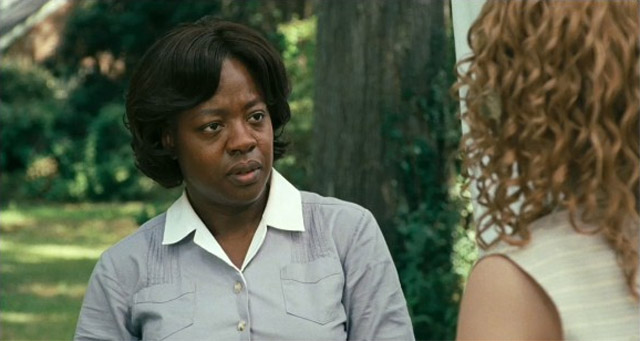
 The power of the performance is in Davis’ eyes. They take in everything – tossed-off racist remarks, a child’s need to be comforted. And her voice, which never rises above a formal submissiveness, quivers with a boiling anger that stands for generations of women whose hard work goes unnoticed. It’s a voice that needs to be heard.
 [EDITOR'S NOTE: Press Play presents "Should Win," a series of video essays advocating winners in seven Academy Awards categories: supporting actor and actress, best actor and actress, best director and best picture. These are consensus choices hashed out by a pool of Press Play contributors.]
 Press Play Video Blog