VIDEO ESSAY: Horror Films and the War on Women (Siding with the Victim, Part 2)

VIDEO ESSAY: Horror Films and the War on Women (Siding with the Victim, Part 2)

[Original script follows:]

Everyone loves a winner. 
This is why most films have happy endings.

Such films seem empowering, especially when the characters
have to struggle through difficulties before rising triumphant.

Although we all know these are fantasies, they also mirror
our real life aspirations.

In the 1970s women demonstrated in the hopes of realizing
their aspirations to be treated equally.

But the most striking films from that decade tell a
different story.

There are two sides to any social movement, tales of victory
and tales of defeat. 

Horror movies tell us tales of defeat, usually involving
women.  Most people would say that horror
films are generally anti-feminist, even misogynistic.

But the stories of victims are just as important as those of
victors. The war on women has been going
on for many years, and the stories of its victims still need to be told.

Before the modern horror film, the melodrama told such
stories to women. Most melodramas follow the lives of people who encounter
great misfortunes. In the golden age of Hollywood, melodramas flourished. Such
films came to be called “women’s pictures.” Back then, women were expected to
be seen and not heard. There was no open forum where women’s issues could be
discussed. But women could connect with others through the medium of film. They
saw their own stories reflected in those of characters played by their favorite
stars. These lives were generally filled with suffering, and this suffering was
largely caused by men.

The modern horror movie takes this scenario to an
extreme.  This is the melodrama’s dark
unconscious.  Victimization is taken to
an extreme, and this makes us uncomfortable. 
In the best horror films, the viewer learns what it’s like to have every
last vestige of power and control stripped away.

For all of Roman Polanski’s own questionable behavior with
women, his films are uniquely attuned to their plight.  Rosemary’s
Baby
, from 1968, anticipares the 70s and horror by focusing on the vulnerability of women in a male-dominated world. This scene cuts in and out of Rosemary’s dreams. This emphasizes the
fact that we are seeing the world from a female character’s perspective. That
world is a very scary place, filled with very scary men. Such scenes linger in
the mind. They create a sense that anything can happen, and all is not as it
seems.

Or is it? Polanski leaves this in doubt until the ending of
the film.

After keeping her feelings bottled up inside for several
months, Rosemary spills out her troubles. 

Her husband then tries to regain control, but this only
makes Rosemary more suspicious.

But at last Rosemary makes a decisive break from the
sinister circle that seems to be tightening around her.  Farrow’s marvelously fragile and nervous
delivery draws us in to her vulnerable state. We share her nervousness:
certainly no one will believe her.  When
he does, a door of possibility opens and we share her relief. 

But as the door to her examination room is about to open,
the camera shifts to her perspective. When the door opens to reveal her
husband, and the sinister Dr. Sapirstein, we share her entrapment. 

The moral of the story? 
Don’t hire Charles Grodin as your obstetrician.

One of the worst injustices against women is when a
complaint of sexual harassment or charges of spousal abuse are disregarded as oversensitivity or the
delusions of female biology. Rosemary’s Baby captures that experience of being a
victim who isn’t taken seriously.

Unlike melodramas, horror films don’t simply negate the
experience of suffering by tacking on a happy ending in which everything comes
out right. This can make for grim
viewing, but it also challenges us to endure even when hope seems dim or even
non-existent.

Whether it’s physical abuse, rape, or simply a quiet life of
desperation under the glass ceiling, you don’t just get over it. There’s no “closure” for women living in a
sexist society, but most Hollywood films would like to make us forget that. 

Thankfully the horror film has a way of shutting
that whole thing down.

Ken Cancelosi is the Publisher and Co-Founder of Press Play.

Jed Mayer is an Associate Professor of English at the State University of New York, New Paltz.

VIDEO AND TEXT: Nelson Carvajal and Amber Sparks on Guillermo del Toro

VIDEO AND TEXT: Nelson Carvajal and Amber Sparks on Guillermo del Toro

Guillermo del Toro: The
Unlikely Auteur

As Guillermo del Toro’s Pacific Rim release date fast
approaches, I can’t help but feel a little depressed.

Don’t get me wrong. I’m a huge fan (pun intended) of the kaiju—or giant monster—film, so I really
am looking forward to the release of this film, director and ultimate fanboy
Guillermo del Toro’s attempt to reboot giant monsters and mecha warriors for a
new generation. I seriously can’t wait to see Idris Elba and Ron Perlman battle
giant monsters from the deeps.

That said, I’m still in mourning for The
Hobbit
-that-could-have-been, a film that—instead of a lesser Lord of the Rings for small children and
people who love dwarf slapstick—might have featured an entirely new Middle
Earth. Imagine a brilliant, sadistic dragon-against-type; imagine troll-like dwarves
and sylph-like hobbits inhabiting an alien, immersive new world (instead of
wandering around in the digital landscape of LOTR like wide-eyed tourists:
“Look! There’s Galadriel!”); imagine Tolkien’s book, transformed utterly, in
the hands of a true auteur.

That’s right. An auteur. But,
you might say, shocked and appalled—he does genre
pictures
!

Yes. And?

His body of work reveals a filmmaker
who, along with a handful of contemporaries (both Andersons, Malick, Haneke,
Von Trier, etc.) has transformed his source
material so that it reflects absolutely his personal vision. And after
all, Hitchcock did genre, as Kurosawa often did. In del Toro’s case, the
personal vision was shaped by perhaps less
traditional sources
: by Forrest Ackerman’s Famous Monsters of Filmland, by Universal Horror classics and
Godzilla and Gamera films, by a childhood in Mexico steeped in Catholicism, and
by a self-confessed nerd’s affinity for children, outcasts, and monsters.

His interest in film began as an interest in makeup
and effects
, and his films are his
films precisely because of the love and care he takes in designing his
creatures and his unreal worlds: the pagan, organic nature of his creatures is
uncanny and frightening—even the mechanized creatures resemble insects or
animals or very old gods. In a Hollywood in which horror movies routinely make
monsters and demons from a few ready-made molds, when comic book films
(with a few exceptions) follow a format that doesn’t deviate too much from the
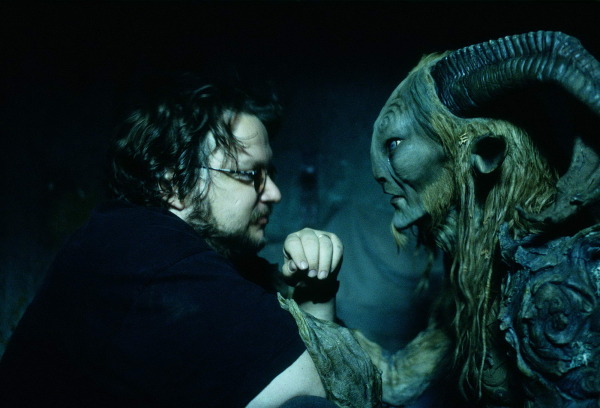
standard—del Toro makes films like Pan’s
Labyrinth
, with possibly the most terrifying creature in all of recent
cinema—The Pale Man, Norn-like and flesh-draped and utterly original. He makes
films like The Devil’s Backbone,
which turned the ghost story genre on its head. He makes films like Hellboy and Hellboy II: The Golden Army,
which took a wildly popular comic book and transformed it completely. The Troll
Market in Hellboy II is worth the
price of admission alone, as are the bizarre and frightening tooth fairies.
These creatures are unlike any you will find in any other film, because they
don’t come from formula and they aren’t lifted from other films. As Daniel
Zalewski wrote in his fascinating New Yorker profile of del Toro, “When movie monsters look largely the same, Del
Toro’s reach deep into the past and into mystic and pagan iconography to
present something else entirely—something far more terrifying and familiar . . . A
del Toro monster is as connected to a succubus in a Fuseli painting as it is to
the beast in ‘Predator.’ His films remind you that looking at monsters is a
centuries-old ritual—a way of understanding our own bodies through gorgeous
images of deformation.”

Del Toro himself seems motivated to keep moving, to keep
making it new. On
his sources of inspiration:
“The worst thing that you can do is be inspired
solely by movie monsters. You need to be inspired by National
Geographic,
by biological treatises, by literature, by fine painters, by bad
painters.” Indeed, in Pacific Rim,
del Toro has said he wants to create something entirely new, despite the
Godzilla and Gamera-like kaijus of
the genre’s heyday. He was instead inspired by perhaps not such an unlikely
source: Goya’s
The Colossus.

But a visual feast alone would make del Toro a great artist,
not a great filmmaker. The compelling and very dark stories he chooses to tell
are what animate the films and give them their haunting quality. Beauty holds
hands with horror, two sides of a coin in all of his films. Del Toro seems much
more in debt to Grimm’s Fairy Tales
than to The Texas Chainsaw Massacre.

One gets the impression that perhaps del Toro deals in
horror because of his dark view of human nature. People are the real monsters
in most of his films, not the fantastic, often ambivalent, only cruel-as-nature
creatures that inhabit his worlds. Humans are the ones who do the real, lasting
damage. He says, “I ended up thinking that monsters are sort of the patron saints
of imperfection. I try to celebrate imperfection in my movies; the really scary
characters are always the ones who insist everything has to be perfect.”

All this is the reason I’m still in mourning. I loved Peter
Jackson’s Lord of the Rings trilogy
just like everyone else, and after that it would have been great to see what a
true auteur could do to put a different spin on the prequel. (I also would have
loved to see Del
Toro’s canceled adaptation of Lovecraft’s At the Mountains of Madness
.) But
I suppose it’s not such a bad consolation prize to get a new and exciting kaiju movie, one that will feature new
creatures but follow the old wild joy of the kaiju orgy of destruction in the (important for a pacifist
director) empty city (thus the scenes
of frantic evacuation in every giant monster movie ever). And maybe I’ll even
(fingers crossed) get to see him team with Charlie Kaufman to make what could
be the first
good screen adaptation of Slaughterhouse Five.

The man with endless creative ideas, who lives
in a mansion he calls Bleak House—filled with monsters, aliens, and comics—seems
perhaps more in touch with a pop-culture obsessed public hungry for good horror than any other director
since Hitchcock. And as del
Toro has said himself
, “Hitchcock would have gone
to Comic-Con. He would have signed collectible shower curtains. He
was a showman and an auteur.”
–Amber Sparks


Nelson Carvajal is an independent digital filmmaker, writer and content
creator based out of Chicago, Illinois. His digital short films usually
contain appropriated content and have screened at such venues as the
London Underground Film Festival. Carvajal runs a blog called FREE CINEMA NOW
which boasts the tagline: “Liberating Independent Film And Video From A
Prehistoric Value System.” You can follow Nelson on Twitter
here.

Amber Sparks’ short stories have been widely published in journals and anthologies, including New York Tyrant, Unsaid, Gargoyle, Barrelhouse, and The Collagist. Her chapbook, A Long Dark Sleep: Stories for the Next World was included in the chapbook collection Shut Up/Look Pretty from Tiny Hardcore Press, and her first full-length story collection, May We Shed These Human Bodies, was published in 2012 by Curbside Splendor. You can find her at ambernoellesparks.com or follow her on Twitter @ambernoelle.

VIDEO ESSAY: Siding with the Victim, Part I: THE SHINING

VIDEO ESSAY: Siding with the Victim, Part I: THE SHINING: Death in the Family

[The script follows:]

From the time we are little children we like hearing scary stories.  Some
psychologists claim it’s because we use these stories to work through our anxieties.
 Fairy tales and nursery rhymes expose us to fearful situations, and along
with Hansel and Gretel, Goldilocks, and Little Red Riding Hood, we see our way
through to daylight.

But for every little piggy who lives, another little piggy has to die…

Maybe there’s another explanation to why we like scary stories, a darker, and
perhaps a richer one than that given by psychologists. Perhaps we don’t
identify with the victors so much as the victims.


Horror films show us the dark underside of the
American dream. As one group rises to power, another is disenfranchised. Often,
violence is visited upon those who are in the minority. 

Thrillers and action films celebrate triumph and
success. Horror films clean up the mess, mop up the blood, and show us what’s
under the rubble after the action hero lays waste.

Many horror movies’ victims, are women and
children, as in real life.

The Shining is
arguably the greatest horror film because it so movingly bears witness to the
suffering of the frightened wife and child of a violent alcoholic.
 

Wendy Torrance’s glassy-eyed smile holds a dark
history and a sense of nervous fear. This is revealed by the enormous ash
perilously dangling from her cigarette. The film will draw her repressed fears
out, writ large in bloody letters across the screen.

If this were a made for TV movie about spousal
abuse, a councilor or friend would come to the abused wife’s aid. That person
would help her to gain control of her life. 

But the narrative and moral logic of horror films
tells us a different story, one that is, perhaps, truer to life: evil never
sleeps, and the dead don’t always stay dead.

It is a common story, sadly enough, but like all
great horror films, The Shining gives this
story the magnitude of a tragic American myth. 

As family tensions mount in the Overlook, each
member of the family goes over the edge in their own special way.


“They fuck you up, your mum and dad. / They may
not mean to, but they do. / They fill you with the faults they had / And add
some extra, just for you.”  Poet Philip
Larkin’s words are particularly relevant to the American horror film.  Many of the best horror films capture the
unique vulnerability of childhood. In the end, the horror movie makes us all as
vulnerable as little children.

The tradition of gothic horror has been replete with beings
whose monstrousness is as much a burden to themselves as a threat to others.  There is no such thing as a victimless crime
in horror movies. Even the victimizers may be said to suffer.

We see Jack Torrance having a nightmare that,
the film suggests, is a kind of a vision brought on by the haunted hotel where he
and his family live. Such visitations vex him, and we can identify with his
anguish. 

Jack can still feel compassion, though, and we sense
his torment and anguish as he confronts and eventually turns toward
derangement. 

As such visitations increase in frequency and
intensity, Jack is transformed into a savage, and yet we continue to see him as
a victim driven to madness. And thus, his final transformation and his
merciless rampage seem all the more tragic. 

Even in the end, he is no monster. 

This is simply the dark side of human power. 

The waxing and waning of power itself—in
cinema as in real life—is merely an illusion.

The horror film: It shows us the dark side of
power, and reminds us that we are all, at some levels, powerless victims.

Power,
in and of itself, is not a moral virtue, but compassion is.


Jed Mayer is an Associate Professor of English at the State University of New York, New Paltz.

Ken Cancelosi is the Co-Founder and Publisher of Press Play.

VIDEO ESSAY: LIE BACK AND ENJOY IT by Jessica Bardsley

VIDEO ESSAY: LIE BACK AND ENJOY IT by Jessica Bardsley

What does it mean to watch, and to record, daily life? Can
plain, simple documentation, which would seem at times to be anti-lyrical, have
its own music? These are two questions raised by Lie Back and Enjoy It, Jessica Bardsley’s driven and dynamic video
essay about JoAnn Elam, an experimental documentary filmmaker who passed away
in Chicago in 2009. Much of what’s here will strike you at first because of its
intimacy: we are forced to look at a dress, or the shoes someone is wearing,
and then you begin to observe these things in a slightly more clinical way, and
then you begin to learn something, if slowly. This is what Chicago’s Logan Square looked like during the 1960s. This
is the way people dressed during the 1970s. This is the way JoAnn Elam smiled
when she was being filmed.
We learn, via printed lines that roll across the screen at irregular intervals, that Elam was a postal carrier for many
years, and that she worked on a documentary about the USPS for a decade. This
only adds to the luminous daily-ness of the film, as we begin to pay attention
to smaller and smaller things, such as the way someone smiles, the way they
tilt their head, or the way Elam delivers mail. Throughout the film, drummer
Tim Kinsella’s percussion runs at differing speeds, depending on which of the
entirely spontaneous and yet also personal images we are watching on screen.
This is an entirely perfect choice for the film at hand, reflective as it is of
motion, of a kind, and evocative as it is of the endless pushing forward of
minutes and hours. The grayness of the sound, too, each drumbeat maintaining a
tone and timbre identical with the next, reminds us that what we are watching
is a document—but also that documents have their own rhythms, and why shouldn’t
they? When, in its second half, the film goes into more abstract territory, as
we learn that Elam discovered she had cancer relatively early in life and then died
at age 60, leaving behind reel upon reel of film, much of which had never been
seen publicly, the drumming slows and we recall, perhaps by design, perhaps by
accident, nothing more loudly than our own heartbeats, nudging us forward. To
watch this piece is to be reminded of just how fascinating the things we don’t
see can be.–Max Winter

Jessica Bardsley is a film
artist and critical writer exploring experimental non-fiction forms. Her
work has screened across the U.S. and internationally at esteemed
venues such CPH:DOX, Visions du Réel, Antimatter Film Festival, European
Media Arts Festival, Kassel Dokfest, Rencontres Internationales
Paris/Berlin/Madrid, Images Festival, Big Sky Documentary Film Festival,
Rooftop Films and more. She is the recipient of a Princess Grace Award
in Film (2010), a Flaherty Fellowship (2011), Director’s Choice at the
Black Maria Film and Video Festival (2012), Grand Prix at 25fps (2012),
and the Eileen Maitland Award at the Ann Arbor Film Festival (2013). She
received an MFA in Film, Video, New Media and Animation as well as an
MA in Visual and Critical Studies at the School of the Art Institute of
Chicago, and is a first year PhD student in Film and Visual Studies at
Harvard University.
www.jessicabardsley.com

Max Winter is the Editor-in-Chief of Press Play.

VIDEO ESSAY: Directed by De Palma

VIDEO ESSAY: Directed by De Palma

It seems that video essayists are emerging every day—and if it
isn’t a new talent crossing our radar, it’s someone whose extraordinary
work we’ve somehow missed. The latter is the case with Joel Bocko, who’s
been making video essays since 2009. It’s remarkable whenever someone
is able to establish a kind of signature with their work in this still
nascent form of online video. In the videos made by Bocko that I’ve
seen, it’s clear to me that he is a weaving artist. 
In “Comedy Countdown,” his two part video on Modern Times, Bocko weaves together voiceover
tracks based on insights by three great writers: Otis Ferguson, Roland
Barthes, and Graham Greene. Even more impressive is his video comparing
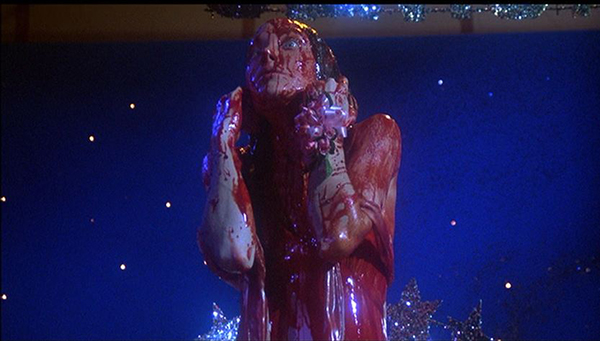
Brian De Palma‘s Hi Mom!, Carrie and Scarface,
weaving together their respective bloody demises. The contrast between
Carrie and Scarface is especially evocative as feminine yin and
masculine yang: ejaculatory vs. menstrual rage. Bocko’s tastes are eclectic, as evidenced by his video essay on Marco Bellochio’s underseen
Fists in the Pocket.”
Taken by Bocko’s work, I interviewed him via email
to learn more about how he got interested in making video essays and his
approach to the form. 
Kevin B. Lee: Tell me about what you do professionally (to the extent you feel
comfortable doing so). specifically, what is your background in
filmmaking and editing? How did you get to be familiar with the
filmmaking tools and techniques that enabled you to make video essays?
Joel Bocko: I do not work professionally in film (aside from some
fleeting freelance experiences years ago), though I would like to. I
mostly learned about filmmaking and editing in childhood and high
school, first when my father had a Hi-8 home video camera and later when
I was able to use Final Cut Pro in my public high school’s media lab.
In the first instance, I was as fascinated with home movies (seeing my
family on TV) as I was by big-screen films in theater. And I always saw
the two as being linked. I used the Hi-8 technology to make a sort of
video mixtape when I was about 15, hooking up wires from VCR to the
camera and editing together clips of my favorite movies in chronological
order, from The Gold Rush to Schindler’s List, a sort of
cinematic panaroma. But with that technique there were a lot of hiccups.
When I discovered Final Cut and digital editing, the ability to time
something to the frame it was thrilling, a real lightning-bolt moment.


Kevin:
How did you become interested in producing video essays?

Joel: The
roots were probably there in those early clip tapes, but the first
self-conscious video essay I recall seeing is one of your own, maybe
around ’07.  I loved the idea, which seemed the logical next step after
DVD commentaries and film-clip documentaries. Nonetheless, I kept
putting off doing one of my own. “Directed by De Palma
was my first video essay, although I didn’t consider it one at the time
(since it didn’t have narration and had a more impressionistic than
analytical vibe), and then it was two years before I created online
video content again. In 2011, I launched a chronological video series
highlighting clips from many of my favorite movies, in 32 different
chapters. It was an extension of that VHS mixtape I made as a kid. It
was followed by another impressionistic video essay on 42nd Street,
but it was not until last fall that I finally made a narrated video
essay. I think it took me so long to turn my excitement into action
because I approach filmmaking and criticism with different mindsets, and
narrated video essays combine both approaches. It’s both right- and
left-brained and thus presents a real challenge, I find.

Kevin: Based on an admittedly small sample size of three works, I sense that
“Interweaving” is a quality that distinguishes at least two of your
works, the Brian De Palma and Chaplin videos. Is this a trait you’d say
is conscious, in terms of the way you think about how to explore films in a video
essay format, or in the way you think about films in general?
Joel: Both. One precedent for the video essays is an
experimental film I made at 21, which freely cut between old home
movies, found-footage (particularly a cartoon adaptation of Wind in the Willows),
and original content shot by myself. It was scored with offbeat pop
music like My Bloody Valentine and Massive Attack, and it followed an
autobiographical theme. So this is how I think not just about video
essays, but filmmaking—and film-watching—in general. It’s a way of
seeing art, and perhaps the world: I love diverse formats and
perspectives, but I’m not a postmodernist, at least in my understanding
of the word, so I try to find some way to tie these divergences
together, to discover their links. I’m fascinated by the infamous
Lumiere/Melies dichotomy and I think great movies contain both
approaches. This goes back to being a little kid, simultaneously
fascinated both by home movies and big-screen blockbusters. When you
find films with something in common, you’re also better able to
highlight what’s different. I do this in written pieces a lot too, for
example using This Sporting Life and Billy Liar to examine a split in the British New Wave around ’63, or comparing Felix Salton’s novel Bambi
to the Disney adaptation, which tells you a lot about both authors.
Bouncing objects or ideas (as in the Chaplin piece) off of one another
sparks more creaitivity and insight, in my experience.

Kevin: How did you get the idea for interweaving three
Brian De Palma films? Was it easy to find the points of intersection
between them?
Joel: The video was created for Tony Dayoub’s Brian De Palma
blogathon in 2009. I knew many people would be covering the films I was
interested in and did not want my contribution to seem redundant. So
for one thing, I wanted to cover several films instead of just one, and I
wanted to take a visual approach. Initially I thought I’d do a
screen-cap visual tribute, and then had the idea of setting screen-caps
to a music/sound collage like a sideshow. Eventually I abandoned the
idea of using only still images (except for the first minute or so), I
guess because De Palma‘s images are so kinetic and visceral they demand movement. Scarface was always my favorite De Palma, even when I wasn’t that keen on him as a director, Hi Mom! was a very recent discovery which led me to value him more as an auteur, and Carrie I
hadn’t actually seen yet when starting the project, but I sensed I’d
like it. Before I watched it, Tony mentioned that the split-screen would
have great visual potential in an image tribute, which may have led me
to the idea of incorporating the other films into the split-screen in
the climax. The points of intersection were turned up while editing the
video rather than being pre-determined—evidence that there are definitely
common themes and motifs running through these movies.

Kevin: There are quite a few inspired
moments of connection created by the montage (sexual shame and violent
sexual expression in both Carrie and Scarface, one very
vaginal/menstrual, the other very phallic/ejaculatory). Were these
connections you had already made going into the making of the video? Did
the process of making the video yield any unexpected discoveries along
the way for you both in De Palma‘s films and in the video essay medium
itself?
Joel: As noted above, the connections were discovered rather
than expected. It’s hard to re-trace the process now, but I remember
that in addition to Tony mentioning the split-screen, Glenn Kenny had a
piece in the blogathon comparing Robert De Niro’s shower monologue in Hi Mom! to what is basically a re-enactment of that scene (visual instead of verbal) in Body Double.
That may have led me back not only to that scene in the earlier film,
which I included in the video, but also the theme of sexual shame or
jealousy. The masculine/feminine aspect arose out of the material, and
the fact that at first I was preoccupied with Carrie before finding a way to bring Scarface
in. Tony arrives at the moment when the sense of insecurity and
vulnerability is at its height—his hypermasculine machismo is both a
counterpoint to Carrie’s initial shyness and also its flip-side; he is
just as insecure and sensitive as she is, but has a different way of
dealing with this—a way (violence) which eventually becomes her way as
well (with the conversation between De Niro and
Salt serving as a kind of bridge between these two gender-coded ways of
dealing with hurt and anger). Most of the specific links, the details
like the stabbing sounds and the gunshots, or the footage of the Hi, Mom home invasion matching the security TVs in Scarface
was discovered in the process of editing. I don’t think you can plan
most of this stuff out, you just keep an open mind and antenna up and
it’s amazing what you’ll find.

What did I discover? Working on this project really solidified for me that De Palma
was not just a flashy surface stylist, as I had once thought—his work
is full of deeply-felt themes and raw visual motifs, even if these
ideas and emotions are hidden by self-conscious film references or a
comic-baroque playfulness. As for the video essay format, and what I
discovered, that’s a
longer answer. I am a bit more conscious about overall structuring than
individual moments, and I had several very strong ideas informing the
video’s creation. One was that I had to build up to the climax, so I
wanted to take my time at first and include several long sequences.
There can be a tendency to want to put your own stamp on something when
“sampling” a film or song, but sometimes it’s best to allow the material
room to breathe and express itself in its own voice—take Carrie
walking down the stairs to her mother or the extraordinary “Be Black,
Baby!” sequence in Hi, Mom! However, at certain points, I really
wanted to mess with the footage, intercut it, and do new things with it,
to make the montage viscerally and kinetically my own, harnessing
De Palma‘s energy in an fresh way. Primarily with the ending, where all
the films kind of converge into one metamovie, all the pent-up sexual
energy finding its outlet in savage violence, against big groups of
people (all three films have a warlike climax). At that point I would
actually look for things to replace or swap out, like how you see Al
Pacino getting shot but hear Piper Laurie getting stabbed. There’s an
indescribable delight when you find two things that aren’t supposed to
go together and they just click. That’s the thrill of montage right
there, in a nutshell.

Kevin: How did you get the idea for interweaving the
words of three writers in exploring the works of Charlie Chaplin? What
was your process in sequencing their words, and in matching them with
footage from Chaplin?
Joel: That idea came very last-minute. I was assigned Modern Times
in the comedy countdown on Wonders in the Dark by Sam Juliano, but the
thing is it isn’t really one of my favorite Chaplins. I’m fascinated by
the themes, and I have a crush on Paulette Goddard, but I connect more
with the comedy and pathos of The Gold Rush and City Lights. Reading essays on Modern Times
(beginning with Roland Barthes’, which a commentator named Shamus
turned me on to), I was more fascinated by their voices than my own and
eventually decided I should roll with that. Jeff Pike and Greg Stevens
volunteered to send me audio clips for Barthes and Otis Ferguson, to
complement my own reading of Graham Greene, literally in the middle of
the night, when I put out a call on my blog about 12 hours before the
video was due. I edited the whole thing that night, by highlighting
certain passages (Ferguson in particular lost a lot of text), linking
them in a call-and-response form so that Barthes discusses the film’s
political outlook and Greene naysays the film’s socialism and then
Barthes makes a subtle distinction between Chaplin’s consciousness and
the film. The clips were chosen because they were interesting, without
knowing where I’d use them, and once they were imported I chose
appropriate moments from my selections. The video track was cut to fit
the soundtrack for the most part, as is often the case (even in the
visually-driven De Palma tribute, there are far more cuts in video than audio, which tends to be laid out continuously; for example, when you “hear” De Niro firing the gun at the end, that’s actually the firehose snapping in Carrie,
whose soundtrack provides the backdrop for most of the video’s climax).
That’s a very documentary approach, which I find works for video essays,
especially narrated ones.


Kevin:
When you first made me aware of your work, you
didn’t refer to the DePalma video as a “video essay” because it didn’t
feature narration. Do you feel that narration is an essential feature of
the video essay? Or more broadly speaking, how would you define what a
video essay is and is not? What does it need to accomplish?

Joel: Good point. I think of video essays as being more akin to
film criticism than filmmaking, which means—to me—that they arise more
out of an analytical, intellectual process than an imaginative, impulsive
urge, although the best will balance both. Since the De Palma
video was created more in the way I’d create an experimental film, it
didn’t seem like a video essay to me at the time. When I finally created
narrated video essays it was really tricky to find my way around the
form. I tried to edit visuals first and then add narration but it just
didn’t work. So it’s a different game. Still, I think maybe these are
just two different forms of video essay—the De Palma
piece definitely has a point to make, an analysis to apply, it just
does so through juxtaposition rather than verbal articulation. I’d like
to experiment with the balance of this in future pieces; say, a video
essay that’s 10% non-narrated/visual, 90%narrated/analytical, or vice
versa, or 40/60, 25/75, whatever. I do think even the most heavily
analytical video essays need to give the visual track space to breathe;
it can’t just be a lecture unfolding simultaneously with film footage
playing as “background.” Which seems like a trap the form could fall
into, although
I haven’t seen enough yet to know if it’s a common one.

Kevin: How has working with these video essays changed
your relationship with movies? Has it sparked new paths of exploration
and interest for you as a cinephile?

Joel: Yes and no. On
the one hand, they tend to articulate pre-existing attitudes and
interests rather than shape new ones; in fact, if anything, they’ve returned
me to a more hands-on, formally-conscious, intuitive approach to film
appreciation which too much analytical writing can distance me from. On
the other hand, they have had a big impact on myself as a filmmaker
rather than a cinephile; after creating my first narrated video essays, I
created a short film which was, in a sense, a video essay in reverse,
applying a fictional narration to nonfiction material (in this case,
real snapshots and home movies) rather than vice-versa as is the case
with most video essays. How this will impact my future films is hard to
say, but I’ve always known that making video essays would be a step
toward making my own movies – which is maybe one reason I nervously
procrastinated so long before taking the plunge. But there’s no turning
back. I think the future of movies, both in terms of cinephilia and
filmmaking, is on the internet. One way or another video essays will be
at the center of that nexus. There’s still a lot to explore—I’ve only
begun to watch the many videos that are out there—and it’s a very
exciting time; death of cinema, maybe, but also a radical rebirth.

Joel Bocko is a 29-year-old writer and filmmaker living in Pasadena, CA.
He has been blogging for five years at
Lost in the Movies,
recently completed the short film “Class of 2002”, and is working on a
feature screenplay to be shot on a shoestring (or credit card) later
this year.

Kevin B. Lee is a filmmaker, critic and video essayist. Follow him on Twitter.

VIDEO ESSAY: Siskel and Ebert: Screen Fighting Men

VIDEO ESSAY: Siskel and Ebert: Screen Fighting Men

Gene Siskel and Roger Ebert were journalists, film reviewers, TV personalities and friends. They disliked each other and loved each other. They needled each other on the air and put on a great show, but it was always in the service of film criticism and education, a means of exciting viewers and drawing them in. Their decades long partnership produced some of the finest televised film criticism of our era; their contentious relationship inspired all of America to think more deeply about lovely images that pass before us, the characters that populate our culture, and the cinematic artists that define our lives. 

This video essay doesn’t attempt to evaluate their important critical legacies. It zeros in on the magic itself, that remarkable chemistry that kept America watching for decades — a relationship copied but never equaled, serious but irreverent, respectable but never respectful. 

They worked together until Gene Siskel’s untimely death in 1999. The title sums up their unique place in American culture and their lasting legacy of inspiration: “Siskel and Ebert: Screen Fighting Men.” 

VIDEO ESSAY: Pacino: Full Roar

VIDEO ESSAY: Pacino: Full Roar

I could not stop laughing as I watched Nelson Carvajal’s “Al
Pacino: Full Roar”—not just because it’s the most entertaining
collection of over-the-top moments since Harry Hanrahan’s “Nicolas Cage
Losing His Shit,” but because Pacino is and always has been a theatrical
actor, delightfully so—a performer who manages to be big even when
he’s trying to be small. There’s an overabundance of every emotion in
every moment Pacino inhabits and in every move he makes. He sings the
body electric; sometimes he screams it. He’s a stripped electrical wire
zapping lightning bolts into the air like those transformers in the old
Universal horror films. Even when his characters are hiding or
repressing things, they seem on the verge of imploding or exploding,
transforming or mutating. When, in The Devil’s Advocate, Pacino’s Satan
launches into his “absentee landlord” monologue and his face is
momentarily lit up by pulses of volcanic red, it takes a moment to
register it as a lighting effect, so naturally does it seem to express
the lethal petulance streaming from the character’s eyes, mouth, and
jabbing fingers. 

We live for these sorts of moments. Pacino can be
wonderful when working small—see the first two Godfather films, the
quiet parts of Serpico and Dog Day Afternoon, his under-seen and perhaps
forgotten Bobby Deerfield, and the more Willy Loman-like interludes in
Donnie Brasco, in which Pacino is more likely to flinch from pain than
dish it out. But introversion and reflection didn’t make him a star;
explosiveness did, and whether he arrives at it via “slow burn” buildup,
as in the Godfather films, or launches into it full-throttle from frame
one and never takes his foot off the gas (Heat, baby), it’s invariably
as thrilling as the sight of Jack Nicholson tearing somebody a new one,
or Sean Penn contorting his face into a wet-eyed ball of anguish, or Nic
Cage being Nic Cage. You listen to the whisper while waiting for THE
SCREAM, OH YEAH! THAT’S RIGHT! ATTICA! ATTICA! I’D TAKE A FLAMETHROWER
TO THIS PLACE! THEY PULL ME BACK IN! CUZ SHE’S GOT A GREEEAAAAAT ASS! —
Matt Zoller Seitz

VIDEO ESSAY: Peter Andrews: The Soderbergh Vision

VIDEO ESSAY: Peter Andrews: The Soderbergh Vision

“My policy is to have my name on a movie only once,” says Steven Soderbergh, so quoted by video essayist Nelson Carvajal. “Having your name once increases the impact of that credit because I think every time you put your name up there, you’re actually diluting it.”

That’s why Soderbergh, who isn’t quite a one-man-band auteur but comes close, doesn’t put “Edited by Steven Soderbergh” and “Director of Photography: Steven Soderbergh” on his movies, even though most of the time it’s true. The filmmaker employs pseudonyms: respectively, “Mary Ann Bernard” for his editing credit (his mom’s maiden name) and “Peter Andrews” for his cinematography credit (his dad’s first and middle names).

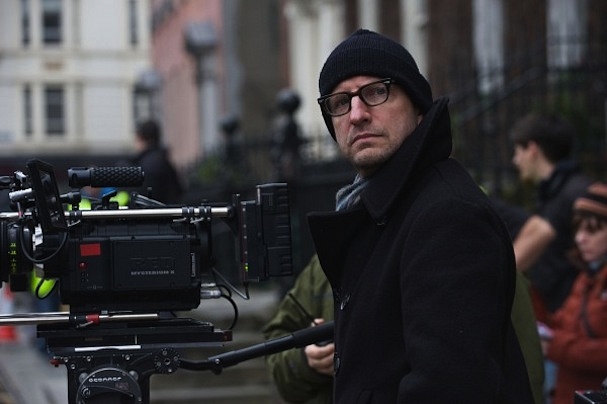
Nelson’s video essay focuses on Peter Andrews, aka Soderbergh the Cinematographer. Soderbergh caused a minor stir back in 1999 when he announced that he was going to serve as director of photography on his drug drama Traffic, an ensemble story with multiple, parallel subplots. Soderbergh was DP on his mockumentary Schizopolis, and he’d had previously served as his own camera operator on other films, even ones that had separate, credited cinematographers, because he likes the intimacy that results when a director personally covers actors’ performances, adjusting framing as he goes and cutting out the middleman, so to speak. Much of the film was shot handheld, with relatively lightweight, 35mm Panavision XL cameras, often from a slight distance, but zoomed in, to give the actors a bit of space and to contribute to a documentary-like aesthetic, intimate yet respectfully distanced. Soderbergh had been moving in this creative direction for years, and arguably perfected the approach in his two previous movies, The Limey and Erin Brockovich (with cinematographer Ed Lachman). Soderbergh shot the film’s three main storylines in three strikingly different visual styles (discussed in some detail here) to help audiences instantly differentiate them. Although he seemed to bite off more than he could realistically chew—half of the first day’s footage proved unusable—he got a handle on things, and the film’s look was widely analyzed at the time and is still imitated. Breaking Bad even cribbed the brown “tobacco filter” used in Traffic’s Mexican sequences for its own south-of-the-border scenes.

“Peter Andrews” became more comfortable and offhandedly ambitious over the years, working both in film and video throughout the aughts; 2001’s Ocean’s Eleven and 2002’s Solaris were shot on 35mm film, lushly so, while the improvised 2002 Hollywood satire Full Frontal, the 2004 HBO series K Street, and the star-free 2005 neorealist crime drama Bubble were shot with rather modest video equipment. Soderbergh has increasingly gravitated toward video as image quality improved and the equipment became increasingly portable. As he explains in this video, he likes to shoot and edit quickly, the better to see the finished product and then move on to the next thing, whatever that turns out to be.

As you can see in Nelson’s compilation, Soderbergh isn’t interested in forcing his media to be something they aren’t naturally inclined to be. When he worked in celluloid, he tended to work with the properties of particular film stocks rather than pushing against them; he didn’t seem to mind graininess or slight under- or over-exposure as long as the story got told, and for the most part he made the capture of performance and the rhythms of cutting more of a priority than visual gloss or compositional perfection. When he started working extensively in video in the early aughts—by which point he was serving as his own pseudonymous director of photography—he didn’t seem to lose a wink of sleep over whether laypersons could tell that something was shot electronically rather than chemically. He wasn’t afraid of blown-out windows (one of the most recognizable tells of shot-on-video movies) and when he shot handheld, he didn’t try to disguise the fact that he was working with very light, at times seemingly weightless cameras. This isn’t to say that he was an aesthetically sloppy cinematographer (the locked-down, meticulously framed images in 2005’s Bubble prove otherwise)—just that, to use a fine arts metaphor, he didn’t pretend that watercolor was oil paint, or that paper was canvas.

Video is more conducive to Soderbergh’s nimble formalist mindset than film, a medium whose images cannot be accurately judged until the movie is completely edited, color timed, and printed. True, it’s possible to check focus and framing of filmed images on set by way of a video “tap,” which shows an approximation of the image on a monitor; but video (especially high-def video from the last decade or so) removes a lot of the guesswork, because when you’re shooting electronically, what you see in the monitor on set is very close to what the movie will look like when it’s done, give or take some exposure tinkering, color correction, CGI, paint-outs and the like. Video is also much more amenable to available light, and Soderbergh has always hated having to light actors and sets; he believes it saps the momentum of performances and kills immediacy, and anyone who’s ever acted for the camera will tell you that he has a point. Prizing available light and emotional momentum over the minute details of light, shade and texture won’t win a filmmaker too many accolades as a stylist. (“He saves time by not going into all that other unnecessary ‘lighting’ stuff DP’s sometimes talk about,” one film buff said in an online forum. “He never seems to let composition, camera movement and, from what I’ve heard, proper exposure dictate story either,” another countered.) But his post-2000 output is striking, albeit in a rough, Ken Loach-like way. And there’s a hell of a lot to nitpick. If “Peter Andrews” had fussed over every frame of a Steven Soderbergh production, Soderbergh would not have directed or co-directed 16 feature films, one cable movie, one cable series, two documentaries and two shorts since 2000.

The last feature film that “Peter Andrews” shot on 35mm film was 2007’s Oceans 13. Every movie after that was shot electronically. After using the high-definition Red video camera  to shoot  2008’s Che—a two-part, four hour biopic of Che Guevara, starring Soderbergh’s Oscar-winning Traffic collaborator Benecio del Toro—the director abandoned film and never looked back. “This is the camera I’ve been waiting for my whole career,” he said at the time. “Jaw-dropping imagery, recorded on board a camera light enough to hold with one hand… Red is going to change everything.” And it did. Soderbergh shot most of his subsequent projects with versions of the Red camera, including The Girlfriend Experience and The Informant! The brand has become one of the workhorse photographic systems for cinema and television; Louis C.K. shoots his series Louie on the Red, and Peter Jackson shot all three parts of The Hobbit with the Red, after having shot the original, Oscar-winning trilogy on Super 35mm film.

“Since I act as my own cinematographer, one thing I’ve had to learn is how to make things look not so good, to be able to go into a space and recognize this is the way this looks, and it’s not always my job to make everything look pretty,” Soderbergh told The Chicago Tribune in an interview about his 2012 hit Magic Mike. “It’s supposed to look real sometimes. I’m weirdly proud of scenes where I’ve let things look the way they look. To me it’s a sign of maturity.”–Matt Zoller Seitz

Nelson Carvajal is an independent digital filmmaker, writer and content
creator based out of Chicago, Illinois. His digital short films usually
contain appropriated content and have screened at such venues as the London Underground Film Festival. Carvajal runs a blog called FREE CINEMA NOW which boasts the tagline: “Liberating Independent Film And Video From A Prehistoric Value System.” You can follow Nelson on Twitter here.

Matt Zoller Seitz is the co-founder of Press Play.

VIDEO ESSAY: Gliding Over All: The Cinematography of BREAKING BAD, Season 3

VIDEO ESSAY: Gliding Over All: The Cinematography of BREAKING BAD, Season 3

Dave Bunting Jr.’s video essay on Season 3 of Breaking Bad opens with time-lapse landscapes, which are de rigueur establishing shots in TV these days. Here, though, they are uniquely awe-inspiring, in part for their exotic nature (most of us watching the show spend our lives in urban and suburban environments nowhere near mesas, plateaus, or even cacti), and in part for how they seem to breathe life into everything—from churning clouds, to rocks whose shapely silhouettes (even in their stillness) manage to suggest personalities, to cityscapes that pop colorfully to life as darkness descends upon them. Vince Gilligan & Co.’s ground-breaking TV series is filmed so as to be as suggestive—as potentially rich with meaning—as possible.

Breaking Bad’s extended shots also fuck with our sense of scale: The vehicles popping in and out of the gas station move with the speed and directness of hummingbirds or bees. Wendy the meth whore flits into and out of the frame like a fly. Contrast this with the extreme close-up of the actual fly that opens Season 3, Episode 10 (“Fly”), a close-up held long enough to give that creature the weight and ominous presence of a significant carrier of meaning. We expect flies to carry disease, of course, not meaning. But in Breaking Bad the two have been flattened together, a la William Burroughs’ statement that language = virus.

Season 3, Episode 1 (“No Mas”) starts with a frame filled with what feel like toxic-colored clouds, then a pan down to reveal a Mexican landscape, moon-like or possibly even post-apocalyptic in its apparent desolation. Things only get weirder—more “foreign”—as we begin to see first one older man, then several men and women of various ages crawling on their elbows and knees through the dusty streets of a remote village. The crawlers are soon joined by two men (revealed later to be “the cousins”) who wear similar deep mauve shirts, gray suits and cowboy boots with silver skull tips. Both men are bald and sport a hint of facial hair—a goatee or maybe (the bottom) half of a goatee.

This dialog-less opening unfolds for a full four minutes—an eternity in television time—as the cousins crawl their way to a shack filled with burning candles and other religious and pseudo-religious detritus, leaving an offering of money and lighting a candle of their own before silently praying to Santa Muerte, the Saint of Death. One of them tacks the object of their prayers to the wall: A crudely rendered but recognizable portrait of Walter White in hat, shades and moustache (the upper half of the full goatee he’ll sport this season). As the plot plays out, the cousins cross the U.S.-Mexico border in order to find and axe-murder Walter, whom they deem responsible for the death of one of their relatives, but are redirected by Gus and wind up seriously injuring Walter’s brother-in-law Hank.

Everything in Season 3 seems to pivot on acts of communication—on the successful or unsuccessful transference of meaning—right up to the final two minutes of episode 13 (“Full Measure”), when Gale’s cell phone begins buzzing frantically on a haphazard pile of CDs. It’s Mike, calling to warn Gale, who can’t hear it over Zhang Fan’s 1938 shidaiqu hit “Flying over the Court.” Because Gale misses Mike’s warning, he opens the front door, allowing Jesse to shoot him in the head before the screen goes black and the season-end credits roll.

It’s probably no accident that Season 3 begins and ends with these plot-propelling examples of foreign exotica. After all, the disease that sets all of Breaking Bad’s story into motion—lung cancer—is the result of exposure to foreign substance (in Walter’s case, most likely radon or asbestos, since he was never a smoker). And it is, in fact, “the foreign”—a fly—that sets Walter off on the most philosophical monologue of the series.

In Episode 10, after becoming deeply concerned when the meth yield isn’t, in his own words, “adding up,” Walter becomes first distracted by and finally obsessed with a fly that somehow gets into the sterile environment of the lab, threatening to contaminate his 99+% pure blue meth. After many hours and countless unsuccessful attempts (including the introduction of what Walter calls “positive pressure”) to kill the allusive insect, Walter reveals to Jesse that, on the night of Jane’s death, he had randomly met her father in a bar.

“The universe is random,” Walter says. “It’s not inevitable. It’s simple chaos. It’s subatomic particles in an endless collision. That’s what science teaches us. But what is this saying? What is it telling us when, on the very night that this man’s daughter dies, it’s me who’s having a drink with him?”

What Walter fails to confess is that he was at least in part responsible for Jane’s death—which is, of course, why he’s now agonizing over it—that, and the randomness of running into her father the same night. The universe, Walter says, is trying to tell him something—but, what? And what does it mean, what horrific truth is revealed, if and when things, finally, “add up”?

Gary Sullivan’s poetry and comics have been widely published and anthologized, in everything from Poetry Magazine and The Wall Street Journal to The Norton Anthology of Postmodern Poetry (2nd Edition, forthcoming). Everyone Has a Mouth, a
selection of his translations of poetry by the Austrian schizophrenic
Ernst Herbeck, was recently published by Ugly Duckling Presse. He lives
in Astoria, Queens, where he maintains bodegapop.com, a music blog devoted to treasures found in immigrant-run bodegas in New York City.

VIDEO ESSAY: The End of Violence: The Conclusions of Clint Eastwood

VIDEO ESSAY: The End of Violence: The Conclusions of Clint Eastwood

It took me years to learn how to watch a Clint Eastwood movie. For one thing, I tended to watch them far apart and to rely on memory of earlier films to prepare myself for current ones. But given the gaps in time between viewings, I should have been more suspicious of how I remembered them. I saw Unforgiven when it first came out on videotape, but I was in my late teens then. It seemed plodding and clunky, and, to my jaded young eyes, old. That original impression solidified in my mind, tarnishing my general impression of Eastwood as a director. (Plodding, clunky, old.) I skipped the Eastwood movies that seemed skippable, the ones that didn’t get much attention. Eastwood was a creature from another era, and I was sure he was just a dumb cowboy at heart. Sure, he’d won Oscars, but that just cemented the idea of Eastwood as the embodiment of middlebrow mediocrity. “Most of the good directors,” I’d say to anyone who would listen, “don’t win that award.”

It’s easy to underestimate Eastwood, even if you’re not relying on vague memories and snobbery. His image as the embodiment of vigilante conservatism slithers through the collective cultural consciousness. He’s Dirty Harry, he’s the Man with No Name. Our assumptions deliver him to us as what we expect him to be. The tough guy, the grizzled guy, the man’s man, the white savior, the relic.

nullThus, it wasn’t until Gran Torino that I could say I really watched an Eastwood movie. The ones I’d seen before were films I looked at as the films I’d expected them to be. But Gran Torino shocked me into seeing it. I’d seen reviews belittling the movie, and I expected it to be a not-quite-vaguely racist heap of claptrap. I don’t remember even when I decided to watch it, or why. But I did.

I didn’t know what to make of Gran Torino on that first viewing, because it sneaked into my amygdala and splattered feelings in all directions. The overwrought Christ imagery at the end was a bit much, but still … the images after that, of Thao driving off into his own, inherited America, pulled true tears from my eyes. This was not claptrap. Eastwood was up to something. And the film was, in its own way, and on its own terms, more subversive than most Hollywood films ever dare to be. (I’ve explored my response to Gran Torino more fully in a previous video essay.)

I watched Gran Torino again and again, seeking the meaning that lodged in the bit of free space between my assumptions, the meaning that had come from being so unexpectedly moved by a movie I’d expected to detest.

With the fervor of a convert, I binged my way through Eastwood’s oeuvre. Again and again I saw what had so fascinated me in Gran Torino: the way Eastwood used his own iconicity against itself, the way he presented masculinity and violence as intoxicating elixirs of destruction, the way he danced (sometimes awkwardly) on a tightrope between exploiting our basest desires and blowing them all to hell.

Drucilla Cornell’s Clint Eastwood and Issues of American Masculinity provided me with ways of working through what Eastwood’s films can mean. I think Cornell sometimes gives the films a bit too much credit, because sometimes these movies are as symptomatic of the world into which they were released as they are critical of it. (But we need to see symptoms. Or, rather, we need symptoms to be made visible. How do you diagnose a disease without them?) Nonetheless, her central point convinced me: if we want to think about the force of American masculinity, the films of Clint Eastwood are a rich and vivid source.

Consider violence, a feature common to most of Eastwood’s films. These are not pacifist manifestos—violence is shown to be sometimes necessary, sometimes useful. But usually it is also destructive and corrupting. It gets people what they want in the short term, or it saves their lives, but the cost is great, and their lives are shrunken and shattered. This is true even in the Dirty Harry films, where we may join the fantasy of wearing the wisecracking, bureaucracy-hating vigilante’s mask of bravado, but would we want to live as Harry lives, to become what he became? As Faust could tell you, fantasies come with a hefty price.

nullWe need to pay close attention to the conclusions of Eastwood’s movies, particularly the ones he directs and stars in, because these films allow him to configure and reconfigure his iconicity. From Play Misty for Me to Gran Torino, he has played jazz riffs on the idea of “Clint Eastwood,” repeating and revising the figure he embodies. Nowhere are the riffs more poignantly played than in The Outlaw Josey Wales (the subject of a previous video essay of mine), one of Eastwood’s most complex and subtle studies of the avenging male hero. The ending is where the meanings swirl old gestures together into something new—the violent hero, ruined by war, exhausted by anger, turns away from killing and rides off into a sunset. He’s quietly wounded, likely bleeding to death. Like so many Eastwood characters, he has saved a ragtag community that now has no space for him. He is the demon that must be expelled. In that, he is less Faust than Mephisto.

Again and again, Eastwood’s characters end up going off into ambiguity. What are we to make, for instance, of the conclusion of Million Dollar Baby? It ends with a sort of triumph and grace, yes, but what are we, the observers, left with at this moment? The film’s story positions us to sympathize with Frankie, to feel the dilemma he feels, but should we conclude from our sympathy that Frankie did the right thing? That death is better than handicapped life? I can fully believe a character like Maggie would, in those circumstances and at that point in her treatment, want what Frankie gave her—that she did, indeed, see it as triumph. But I don’t know if we’re required to agree. The film wraps us in its emotions, but then steps back and at the end leaves us with images of a lost man, a lonely man, an exiled angel of death. Here, Eastwood’s violent character isn’t exiled or exorcised from a community he saved and that will, presumably, prosper without him. Here, he is simply exiled. What meaning we make of that is our own.

Matthew Cheney’s work has been published by English Journal, One Story, Web Conjunctions, Strange Horizons, Failbetter.com, Ideomancer, Pindeldyboz, Rain Taxi, Locus, The Internet Review of Science Fiction and SF Site, among other places, and he is the former series editor for Best American Fantasy. He teaches English, Women’s Studies, and Communications & Media Studies at Plymouth State University.