VIDEO ESSAY: Fast-Mo: Fast-Motion Sequences in Film

VIDEO ESSAY: Fast-Mo: Fast-Motion Sequences in Film

I remember, as a kid, watching The Three Stooges on TV and
always feeling a little baffled to see the Stooges springing
back up from the ground at a hyper-motion, cartoonish speed; these
singular fast-motion moments usually followed a bigger gag, like one of the
Stooges being set on fire or bitten by a large animal. Still, even as a
child, it was quietly unnerving to see human beings moving faster than they . . . should.
The fast forward motion was more acceptable in cartoons like Wile E. Coyote and The Road Runner, for
example. In real life, however, people don’t move like that. But in film and
television, this fast motion effect has become more popular as years have
gone by—especially when one considers how prominent time-lapse photography has
become—so there must be an important reason for that.

In Leigh Singer’s dazzling new video, he explores the
visual rhetoric of the fast motion effect by grouping films together by shared themes and visual motifs. There are the pistol-slinging cowboys
of the Wild West in The Ballad of Cable
Hogue
juxtaposed against the kinetic, gun-wielding rabble-rousers of Baz
Luhrmann’s updated Romeo + Juliet. Also,
there is the meta-grouping of film clips from Funny Games, Click and Caché. Each of those films visually
demonstrates the power of the fast-forward effect via an actual remote control. In Funny Games the remote control is used
to undo a fatal act, in Click it is used
as a time travel device, and in Caché it
is used as a plot-fueling investigative device to discover who has been sending
mysterious surveillance videotapes. (Note: what other video supercut
appropriately mixes an Adam Sandler comedy with a Michael Haneke film?) As
Singer’s video blazes (fast) forward to the tune of Gioachino Rossini’s
“William Tell” overture finale, it becomes clear that Singer is fascinated with
how silly we look when we’re depicted in this fast forward motion. If slow
motion dramatizes the moment, then fast motion injects a comic surge to the mise-en-scène.

Curiously enough, after a couple of viewings, I personally found the
video to be deceptively powerful in its implications of the way we process the
concept of time, especially with cinema. When speaking of the moving image in
cinema, film historian Ivor Montagu once said “No other medium can portray real
man in motion in his real surroundings.” The cinema itself is an art form that
manipulates time in more ways than one. For one thing, it freezes time: actors
are immortalized and live forever on movie screens big and small. Yet, at the
same time, it makes our perception of time decidedly pronounced. When we watch a movie, we’re subconsciously convinced that we’re seeing actions
happen in real time. But it’s not real time. The motion picture itself is
moving at a rate of 24 (or these days 30) frames per second; those are 24
captured moments—24 instances of actions or feelings that have already
happened. Still, this notion of time we won’t get back is remedied by
having at least captured some of it on film. Likewise, that fleeting concept of
speed, or the future even, is validated and realized by the fast-motion visual
effect. In our own lives, time is something we really can’t control; it passes
by with a relentless fervor. Therefore, the fast-motion effect is a
demonstration of tremendous power. If the cinema is our duplicate (or projected)
reality, then the fast motion effect represents our god-like ability to
manipulate time’s reality. It’s a unique opportunity. The kinetic speed of
the fast-motion effect is a universal touchstone; it transcends language and
culture barriers. It’s a visual representation of the voracious thirst driving life. It pushes us forward, even when we’re afraid to take that leap, because
in life, there is no rewind button.–Nelson Carvajal

Leigh Singer is a freelance film journalist, filmmaker and screenwriter.
Leigh studied Film and Literature at Warwick University, where he
directed and adapted the world stage premiere of Steven Soderbergh’s
‘sex, lies and videotape’. He has written or made video essays on fllm for The Guardian, The Independent, BBCi,
Dazed & Confused, Total Film, RogerEbert.com
and others, has appeared on TV and radio as a film critic and is a
programmer with the London Film Festival. You can reach him on Twitter
@Leigh_Singer.

Nelson Carvajal is an independent digital filmmaker, writer and content
creator based out of Chicago, Illinois. His digital short films usually
contain appropriated content and have screened at such venues as the
London Underground Film Festival. Carvajal runs a blog called FREE CINEMA NOW
which boasts the tagline: “Liberating Independent Film And Video From A
Prehistoric Value System.” You can follow Nelson on Twitter
here.
A Video Essay On Jim Jarmusch: Dead Men & Ghosts, Limited

A Video Essay On Jim Jarmusch: Dead Men & Ghosts, Limited

The secret of poetry lies in treading the middle path between the reality and the vacuity of the world.
—Basho
trans. by Robert Hass

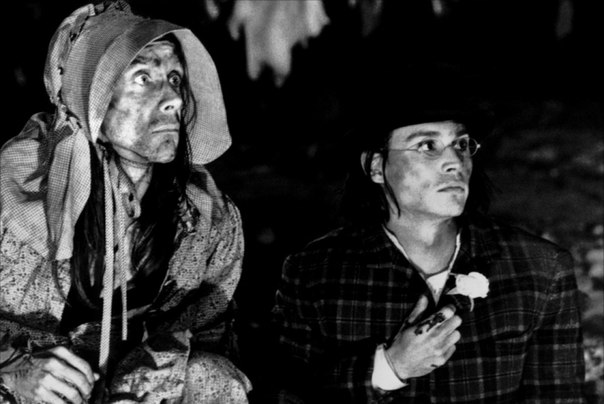
Of the various Jim Jarmusch films I’ve seen, three have nagged
at me, haunted me, teased me until I came back to them again and again. I
was a student in New York City when Dead Man was released, and I saw it
in the theatre, having read a review, having heard Jarmusch’s name
whispered or echoed somewhere, and I wanted to see what the fuss was. I
didn’t know what to make of it then, but if I knew anything at all about
the film, I knew it was beautiful. Ghost Dog was easier to apprehend on
a first viewing (in Boston, if I remember correctly), a film that is,
for Jarmusch at least, relatively conventional in its narrative
progress, its episodes clearly linked together through cause, effect,
motivation. The Limits of Control is the most abstract of the three, a
film to dream to. Indeed, when I first watched it (late one night at
home in New Hampshire), I drifted in and out of sleep. This seems
appropriate, perhaps the perfect first encounter with such an enigmatic,
oneiric movie.

I began to think of the three films together. They appealed to me
significantly more than Jarmusch’s other works, significantly more than
most movies. The reasons could, of course, be personal and
idiosyncratic, but perhaps there was something there, some line of
thought, some mix of imagery and style. Certainly, they share concerns
and motifs: questions of wisdom and wandering, art and death, repetition
and revision. They let genres become ghosts. They propose that white
men are the scourge of reality. I knew the only way to begin an
exploration would be with a movie of my own, made from pilfered pieces,
because while I could analyze with text, it held no appeal: too dry, too
awkward, too much like a manual on taxidermy. I knew I couldn’t script
it, either; I just needed to dig into the sounds and images, to see what
stuck, to trust a certain intuition in juxtaposition.

“Dead Men & Ghosts, Limited” is the result. Its great flaw is that I was awake when I made it.

Matthew Cheney’s work has been published by English Journal, One Story, Web Conjunctions, Strange Horizons, Failbetter.com, Ideomancer, Pindeldyboz, Rain Taxi, Locus, The Internet Review of Science Fiction and SF Site, among other places, and he is the former series editor for Best American Fantasy. He is currently a student in the Ph.D. in Literature program at the University of New Hampshire.

VIDEO ESSAY: The Coen Canon

VIDEO ESSAY: The Coen Canon

Simply put, fear is funny. More clearly put, fear is at the root of much of what we consider humorous in films, even though we might not recognize it as such. We call it by different names—confusion, precariousness, coincidence—but the fear that something, whether it’s a job, a relationship, or some larger dramatic situation, might go wrong is always present in cinematic humor. This tendency goes back to the earliest comic films. In one famous scene in Modern Times, Chaplin’s factory worker is supplied with an eating machine intended to feed him while he works, but he can’t eat and work at the same time, and so he’s bombarded by hot dogs and corn on the cob. We laugh a lot at this—not only because of Chaplin’s droll presentation, but because we fear the machine might never stop. In Woody Allen’s Annie Hall, we laugh at Alvy Singer’s caustic observations on his surroundings partially because of Allen’s cleverness but also partially because it spooks us, momentarily, that someone noticed the same thing about other humans that we did. In Planes, Trains, and Automobiles, we laugh because we envision a future in which Steve Martin and John Candy might never return home, but also because we know they will eventually return, in one form or another. When we watch Groundhog Day, we fear that Bill Murray will never wake up—but we also, in some small, quiet part of ourselves know that he will, so it’s okay to laugh. Fear and comedy are linked in the Coen brothers’ films as well—and more directly. This connection is a large part of what gives the films their power: we come to expect humor borne out of despair from these two minds, and we wonder what variation will arise next.

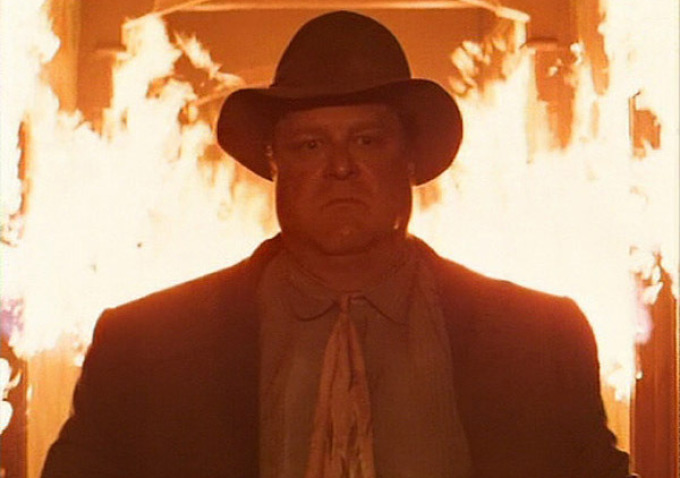
From their earliest films onwards, the Coens have used and exploited varying shapes and forms of the horrific for their comic potential. In Barton Fink, our first glimpse of the titular character (John Turturrro) shows him with a mortified expression on his face. Why is he mortified? Because, while watching his play being performed, he is scared of becoming second-rate. It would be easy enough, as well, to read the film’s conclusion, resounding with Charlie Meadows’ (John Goodman) near-immortal “I’ll show you the life of the mind,” as a suggestion that to truly look into the mind would be more terrifying than any of Fink’s visions of mediocrity; even so, the tone of the statement has a slightly leering quality to it, as if the very idea were a joke.  In Raising Arizona, what do H.I.’s escaped con pals (John Goodman and William Forsythe) do when they realize they’ve lost Nathan, Jr,? They scream, loudly and comically. Why? Because they’re scared of what the baby might be feeling, the baby’s sense of terror being as far from their experience as they can imagine. This exploration continues as the Coens’ films progress. Fargo is memorable not so much as a crime story as for its interweaving of the violent and the comic. When silent, brooding Gaer Grimsrud (Peter Stormare) blows a police officer’s head off from his car seat, the action is horrifying but also delivered with semi-comic timing; when Grimsrud feeds Carl Showalter (Steve Buscemi) into a wood chipper, we’re repulsed, of course, but we also giggle, a little, as we do when Jean Lundegaard, after being tied up in a kidnapping staged by her husband and having a hood thrown over her head, rolls helplessly around in the snow. The comedy here is a strong mix of terror and slapstick, made all the more dramatic by the flat, relaxed quality of its characters’ Midwestern accents. The Big Lebowski balances its share of fear and comedy, as well—the precariousness we witness here is the upending of the daily assumptions by which The Dude (Jeff Bridges) lives, on a daily basis. First his rug is stolen, then he’s attacked, then he’s drugged by a porn king—the obvious question, and the big question, is: what next? And the tumbleweed at the end of the film provides an answer, of sorts: because we don’t know, the best answer is to drift, and to take things lightly if we can. There are many darkly comic moments in No Country for Old Men, which flash by us like bullets, but the brothers slow down to present us with one scene which is pure Coeniana, as well as comic, as well as connected, one one level, to fear: a scene in which a black dog chases Llewelyn Moss (Josh Brolin). The dog runs after him, leaps after him, and, perhaps most memorably, swims after him, through rapids and waterfalls, across fields, over fences. Moss runs, of course, because, despite his courage in some ways, he is in some way scared of the dog, and beyond that, scared of being pinned down. Fear is all over A Serious Man, primarily fear of the future, and what grim events it might hold—and yet the Coens, by their own testimony, considered the torture of Larry Gopnik (Michael Stuhlbarg) to be central to its comedy, right up to the tornado in its conclusion. Fear lurks in Inside Llewyn Davis too, when viewed from the right perspective. There’s the much-chronicled runaway cat scene, in which Davis could be said to be scared of losing a part of himself, maudlin as the chase might be; but there’s also the fear that goes into any sort of performance, the fear that accompanies any launch of self into the void of an audience’s ears or eyes or minds, a fear empowered and increased by the great, great risk of failure. or rejection.

This is not to say that this is the only thing driving the Coen brothers’ movies. It’s certainly not. Their love of interiors, of drowning us in a certain period, along with the mood of that period; or their love of language (from Miller’s Crossing’s “What’s the rumpus?” to “He’s givin’ me the high hat!” to the outlandishly long sentences of True Grit, largely taken from Charles Portis’s book but doubtless part of what attracted them to the project; or their fascination with dream logic, cf. the progress of Barton Fink from a stiff stage play to a burning hotel—all of these things are part of the mixture as well. But without their humor, and without its (ironically) fearless push to the brink of disaster, their work might not be as compelling. The blazing, wild humor in their films serves as the mystery factor, the invisible keystone in an arch of energized idiosyncrasy. — Max Winter

Nelson Carvajal is an independent digital filmmaker, writer and content
creator based out of Chicago, Illinois. His digital short films usually
contain appropriated content and have screened at such venues as the
London Underground Film Festival. Carvajal runs a blog called FREE CINEMA NOW
which boasts the tagline: “Liberating Independent Film And Video From A
Prehistoric Value System.” You can follow Nelson on Twitter
here.
Max Winter is the Editor of Press Play.

VIDEO ESSAY: Monsters Are a Child’s Best Friend

VIDEO ESSAY: Monsters Are a Child’s Best Friend

Most responsible parents will tell you that using the
television as a surrogate nanny is bad for kids. My own experience as a child
would argue against this.  My parents knew that they couldn’t raise me
alone, and the only reliable guides were creatures of the night.

This first became clear to me on Halloween night, 1971, when
my mom promised my sister and me a very special evening’s entertainment.  As the clock ticked towards 8:00 the lights
were dimmed in our basement rec room, the jack o’lanterns were lit, and the
popcorn was popped.  Though I’d probably
seen programs in black and white before, what soon appeared on the TV screen
would surprise me: these images seemed to come from a different world than the
Technicolor landscapes I had known. 

The sense of drama was heightened by a creepy old man coming
onto a dimly lit theater stage, offering viewers a “friendly warning” about the
frights to come.  As the credits rolled,
my anticipation intensified. Soon the first unforgettable images of James
Whale’s Frankenstein rolled across my
five-year old eyes and plunged me into a realm I have never entirely escaped.

In subsequent years I would revisit this world with greater
frequency. Frankenstein opens with a
marvelously constructed graveyard set. The mourners are surrounded by looming
grey sky, skeletal trees, and morbid gravestone figures.  The clanging church bell and quiet sobs of
the grievers sound as if they were recorded in a dank well.

The looming angles and impossibly long staircases of
Frankenstein’s castle draw from the nightmarish qualities of the
Expressionistic German horror cinema of the 1920s.  When I watched UFA productions like Nosferatu, The Cabinet of Dr. Caligari, and Vampyr years later, I would experience these angular horrors in
their purest form.

What struck me as a child watching these old Universal films
for the first time, and what still amazes me, is the concentrated power of their
characters.  The dead stare, wild arm
movements, and disconcerting forward lurch of Boris Karloff’s Creature have
become iconic. They are easy to imitate, as I would come to learn by donning a
“Frankenstein’s Monster” costume the following year. However, there is nothing
quite as compelling as the real thing. 

In the days before VCR, one could experience the most
arresting images of horror classics repeatedly through grainy photographic
reproductions. Magazines like Famous
Monsters of Filmland
, Creepy, and
Fangoria were the pulps of my youth. Their
garish covers splattered across drugstore and supermarket magazine racks across
suburbia.  The amount of time I spent
gazing at still images of movie monsters dwarfs the time spent watching moving
images on the television screen.

Yet the classic Universal monsters also offered a more
profound attraction: compassion.  The
Monster of Whale’s Frankenstein is a
creature more sinned against than sinning. 
He appeals to children because he is a child himself, his momentary joys
pathetic against a background of perpetual torment and tantrums.  In the famous scene in which he throws a
trusting little girl into the stream moments after tossing daisy petals with
her, his regret and shame is as poignant as the horrific senselessness of the
act.

Monsters, like children, can be cruel. However, the tragic
fate of figures like Frankenstein, the Wolf Man, and King Kong taught me
something essential about human behavior. Where strangeness and difference
tread, the torches and pitchforks aren’t far behind.  Classic monster movies don’t just depict the
monstrous. They convey what it feels like to be monstrous.

Since my first encounter with them on that Halloween night
long ago, monsters have helped me cope with feelings of alienation and anxiety,
teaching me a valuable lesson: friends may come and go, but monsters are
forever.

Jed Mayer is an Associate Professor of English at the State University of New York, New Paltz.

Jeffrey Canino grew up editing video on stacked VCRs. He holds a
Master’s in English Literature from the State University of New York at
New Paltz, and he blogs about horror cinema at his website, Nessun
timore:
http://nessuntimore.com

A Video Essay on THE X-FILES: Home Is Anywhere You Hang Your Head

A Video Essay on THE X-FILES: Home Is Anywhere You Hang Your Head

What is the American Dream?

Is it wealth? Power? Or it is something more existential like raising a family with a particular set of values?

By season 4, the X-Files was already considered one of the sickest, most graphic expressions of pop culture ever to be featured on a major network. That reputation could only have encouraged writers Glen Morgan and James Wong to craft “Home,” with imagery so disgusting that it transcends its place in X-Files lore and stands next to the classics of the horror genre.

In October of 1996, 18 million viewers watched their favorite paranormal FBI investigators, Fox Mulder and Dana Scully, enter the realm of The Peacocks, a mysterious family living in an isolated village called Home, Pennsylvania.

A grotesquely disfigured baby has been discovered near the Peacock house, buried at home plate on a baseball diamond frequented by young boys.

But what the writers of this story really want you to know is that this traditional American town is really . . . . Mayberry. 

Yep, that Mayberry. And Mulder can’t help but lose himself to the allure of Main street America, its nostalgia proving too strong to resist.

Sure the town of Home has baseball, cadillacs, a sheriff named Andy Taylor, a deputy named Barney and the traditional small-town architecture. But, don’t be fooled. If this represents the pinnacle of traditional small town American values, then what we see portrayed in “Home” are the rat-infested ruins of those same ideals. But, like Mulder in the opening scenes, Sheriff Taylor doesn’t see the rotting corpse.

An examination of the dead baby’s body reveals the Peacock’s are somehow breeding with each other, producing offspring with serious physical and health defects.

It is at this moment in the episode where Scully and Mulder make the fateful decision to invade the Peacock’s homestead with guns drawn.

Do the Peacocks deserve to be invaded this way? There doesn’t seem to be authentic evil shrouded beneath their lifestyle choices. For certain, an investigation into the baby’s death is warranted. But, is this an FBI matter? When you consider that incest law varies from state to state–in New Jersey, for example, there are no criminal penalties if both partners are over 18–Mulder and Scully’s case looks weak.  They are entering this house under false assumptions. One can argue this is an out-of-control government provoking a confrontation. No one is in danger — that is . . . until Mulder utters this single sentence:

“The mother of the dead baby is listening. She’s not only having sex with her grown boys, but she is also out to protect her children. And that threat to arrest her children leads to this :

The Peacocks remind us that baseball bats have many uses.

Under what circumstances does the government have the power to abridge the civil liberties and personal freedoms of American citizens?

The town of Home had few problems.

Until the FBI got involved.

And besides . . . .

Scully is flat wrong.

And the sheriff and his wife would be alive had the government handled this case differently.

“Home” is beautifully directed by the late Kim Manners, who packs this episode with unforgettable images, all of which contribute to the horror.

In the end, it is Mulder who finally comes to understand the Peacocks. Morally speaking, they are less like humans and more like wild animals.

And as everyone knows, if you do something stupid or dangerous to a wild animal, you might get killed. [cut to Mulder and Scully pulling a screaming Mrs. Peacock out from under the bed.] This is not their finest moment. Agent Scully is the first to realize the case against the Peacocks isn’t open and shut.

With this simple ending, the writers of this episode remind us that with in every cherished axiom — there exists the very opposite of that truth. The Peacocks may not look like your family, but the love and fierce loyalty they have for each other is not hard to understand. Besides, when was the last time you told your mother how much you love her.

There’s always tomorrow. The Peacock’s future is just an American dream away.

Ken Cancelosi is the Publisher and Co-Founder of Press Play.

Serena Bramble is a film editor whose
montage skills are an end result of accumulated years of movie-watching
and loving. Serena is a graduate from the Teledramatic Arts and
Technology department at Cal State Monterey Bay. In addition to editing,
she also writes on her blog Brief Encounters of the Cinematic Kind.

Abraham Zapruder, Errol Morris, the Umbrella Man, JFK, and You

Abraham Zapruder, Errol Morris, the Umbrella Man, JFK, and You

null


Smithsonian Magazine recently printed a wonderful piece by Ron Rosenbaum about a short film Errol Morris made in 2011, in which he placed a few seconds of Abraham Zapruder’s famous film of the 1963 assassination of John F. Kennedy under a critical microscope. One of the dominant protozoans falling within the scope of Morris’s analysis was a figure called the Umbrella Man, a gentleman holding an umbrella despite the lack of inclimate weather on 11/22/63, who gives the film its title. Various theories have hatched about the Umbrella Man, including the idea that he was shooting small blades called fléchettes out of his umbrella, and that one of those fléchettes might have contributed to the President’s assassination. But: the Umbrella Man eventually identified himself, and explained that his appearance was a political statement:

“His name was Louie Steven Witt and he testified that he brought the
umbrella on that sunny day because—wait for it—he wanted to express his
displeasure with JFK’s father, Joseph Kennedy.

“‘Who, Morris says, ‘had been ambassador to England in the 1930s and
[was] known for his policies of appeasement to the Third Reich.’


“’Symbolized,’ I say, ‘by the umbrella that Neville Chamberlain
carried back from Munich, after Chamberlain claimed to have brought
‘peace for our time’ by letting Hitler swallow up half of
Czechoslovakia, giving Hitler the impetus to launch World War II. The
umbrella became the symbol of appeasement in 1938 and here in 1963, this
guy carries an umbrella and thinks, ‘Whoa, people are really going to
be blown away, this is really going to make a statement!’ And it turns
out he becomes a symbol himself. It’s almost like history is a kind of
snake swallowing its tail.’


“‘Part of the problem of rationality and irrationality—and it really
is a problem—is how do you separate the two? Where is that line of
demarcation between nutso thinking and good thinking?’

In any event, you can read the rest of the piece here:

http://www.smithsonianmag.com/history-archaeology/us-history/What-Does-the-Zapruder-Film-Really-Tell…

And, if you wish, you can watch the Errol Morris film here:

http://www.nytimes.com/video/2011/11/21/opinion/100000001183275/the-umbrella-man.html

And, if you can’t get enough, you can watch Alex Cox (director of, among other films, Sid and Nancy and Straight to Hell) contesting the content of that film here:

The whole story has special significance for me because I grew up in Dallas, born seven years after the assassination, perpetually in its shadow, whether I knew it or not. I can’t say that the city’s own reverence towards JFK was that distinguished, given that the JFK Memorial planted in the center of the downtown business district is, historically, more of a public pissoir than anything else. But I can say that the event probably instilled in me a sense of the precariousness of history, in which one minute’s glory can amount to another minute’s downfall–or that one lunatic with a rifle and a reasonable sense of organization can bring about a moment which devastates and intrigues an entire population for decades. 

Max Winter is the Editor of Press Play.

VIDEO ESSAY: Alfonso Cuarón’s Cinematic Canvas

VIDEO ESSAY: Alfonso Cuarón’s Cinematic Canvas

Alfonso Cuarón and
the Prisoner of Azkaban

The following is an
appreciation of my personal favorite film by Alfonso Cuarón, which I fear has
been somewhat critically neglected. But for more on the man’s impressive career
as a whole, see Nelson Carvajal’s video “Alfonso
Cuarón’s Cinematic Canvas
.”

People sometimes ask me whether I think “the kids today” are
all right. That always seems to me a strange question and perhaps a rhetorical
one where the speaker is really suggesting that there’s something wrong with
anyone younger than us. The logic, inasmuch as I follow it, is that
thirty-somethings had the privilege of growing up with movies like The Dark Crystal and Labyrinth and Time Bandits, and those movies fucked us up, and made us the clever
intelligent beautiful sophisticates we are today. Well, I’m not so sure it
works like that, and for every subversive film by Gilliam and Henson, there
were many more popular flicks like The
Karate Kid
, Teen Wolf, and Short Circuit. But, sure, I always
respond, “the kids today” should be totally fine, because they had Pokémon—surely
one of the strangest cartoons I’ve ever witnessed—and what’s more, they had Alfonso
Cuarón’s Harry Potter and the
Prisoner of Azkaban
.

I disliked the
first two Potter films, though I also wasn’t fond of the first two books. But
with Prisoner of Azkaban, J. K.
Rowling started hitting her stride, complicating Harry’s bright happy world with
more intricate plotting and morally ambiguous characters, the prime example of
which was the titular prisoner himself, Sirius Black. And can you imagine what
Chris Columbus would have done with that character? But Columbus bowed out of
the franchise, allowing Cuarón to inherit it—and totally redesign it.

Casting
Gary Oldman as Black was a bit of genius—this is the guy who previously played Sid
Vicious, Dracula, Lee Harvey Oswald, Guildenstern (I mean Rosencrantz), Mason
Verger, Jean-Baptiste Emanuel Zorg, and that deranged cop determined to kill the
pubescent Natalie Portman and her kindly middle-aged French hit man boyfriend.
(Although come to think about it, had Stansfield succeeded, might we have been
spared the Star Wars Prequel Trilogy?) Oldman’s mere presence—recall those
initial glimpses of the man, howling in rage in those animated wanted
posters—made Black feel genuinely dangerous, and made the Potterverse feel suddenly
dangerous. Adding David Thewlis to the mix, as the reluctant, melancholy
werewolf Remus Lupin (he’s rather Hulk-like), pushed that fictional world even
further into some dark corner of the crooked Diagon Alley. Think about it: Azkaban’s the movie where Harry Potter’s
stable of mentors swelled to include not just Oldman, but Johnny from Naked (and were we meant to sense in
Thewlis’s presence a hint of the Verlaine / Rimbaud relationship in Total Eclipse?).

More
importantly, with Azkaban, the Potter
films went from something with the look and feel of an after-school special to the
look and feel of cinema. If you’re
shaky on the details, just compare any scene in Columbus’s version with any
from Cuarón’s—for instance, these two classroom bits:

Note, in that Azkaban
scene, the wide variety of techniques on display—long gliding takes and dramatic
insert shots—as well as the inventive staging. (I particularly like the moment
when Harry steps up to the boggart, and the camera affixes itself momentarily to
the bobbing jack-in-the-box.) Azkaban
was also the movie where Hogwarts—until now a stable, horizontal, and above all
else comfortable boarding school—went
all cockeyed, becoming in Cuarón’s hands someplace sprawling and ancient, a
place with enormous swinging clock pendulums that could kill an unwary kid, and
perched precariously amidst crags and ravines. Here’s what Cuaron did: when
Columbus left the project, the producers initially turned to Guillermo del
Toro. But del Toro declined, having found Columbus’s first two installments “so
bright and happy and full of light.” But a few years later, he
expressed interest in helming a later installment
:

“After seeing the last few films,
however, the director famed for a shadowy imagination and morally ambiguous
characters has begun to reconsider. ‘They seem to be getting eerie and darker
… If they come back to me, I’ll think about it.’”

Thank Cuarón for that eeriness, that darkness (though to be
fair, the books do get more complex with that installment).

He departed
after Azkaban, but he left his mark
on the franchise: successors Mike Newell and David Yates kept the basics of his
approach, even if their direction never matched Cuarón’s. With the exception of
Bruno Delbonnel, who provided the cinematography for Half-Blood
Prince
, no one else ever came across as having as much fun with Rowling’s
sprawling world as Cuarón.

For
my own part, I saw The Prisoner of
Azkaban
three times in the theater. And whenever anyone asked me what I
thought of it, I said, “It’s great. It’s this generation’s Time Bandits.”

Nelson Carvajal is an independent digital filmmaker, writer and content
creator based out of Chicago, Illinois. His digital short films usually
contain appropriated content and have screened at such venues as the
London Underground Film Festival. Carvajal runs a blog called FREE CINEMA NOW
which boasts the tagline: “Liberating Independent Film And Video From A
Prehistoric Value System.” You can follow Nelson on Twitter
here.

A.D Jameson is the author
of the prose collection
Amazing
Adult Fantasy
(Mutable Sound, 2011), in
which he tries to come to terms with having been raised on ’80s pop culture, and the novel
Giant
Slugs
(Lawrence
and Gibson
, 2011), an absurdist retelling of the Epic of
Gilgamesh. He’s taught
classes at the School of the Art Institute of Chicago, Lake Forest College,
DePaul University, Facets Multimedia, and
StoryStudio Chicago. He’s also the
nonfiction / reviews editor of the online journal
Requited. He recently
started the PhD program in Creative Writing at the University of Illinois at
Chicago. In his spare
time, he contributes to the group blogs
Big
Other
and HTMLGIANT. Follow him on Twitter at @adjameson.

VIDEO ESSAY: Female Sexual Agency in a World of Blurred Lines

VIDEO ESSAY: Female Sexual Agency in a World of Blurred LInes

We live in a culture where female
bodies are constantly on display. However, most images of female sexuality we
see are passive and two-dimensional.

For the past two weeks Miley Cyrus’s MTV
VMA performance has been decried by parents’ groups and feminists alike. The
response to Cyrus’s performance is more interesting than Cyrus’s performance
itself. It hit on every cultural nerve about what is appropriate and inappropriate
for a young woman to do with her body. Of course, this dialogue has been going
on for years. Female artists from Madonna to Lady Gaga to Rihanna to Nicki
Minaj all have used sexuality to express themselves.

The main reason that Cyrus’s
performance stood out is twofold. Cyrus grew up in the public eye. Like Britney
Spears, Christina Aguilera, Selena Gomez and other child stars, Cyrus’s sexual
display is not seen as a natural transition to adulthood. Instead, critics are
concerned  to see a coveted virginal
starlet transforming into just another sexual object.

We are still uncomfortable with the
idea that young women have sexual agency. In general, our media depicts
powerful women as direct and aggressive on the streets or on the battlefield. In
the bedroom, however, they are still prizes to be won over. The trope of the
strong female who needs the male lead to work extra hard to win her over is
commonplace. The theme here is that strong women don’t put it out for just
anybody, and sexual and romantic longing make a woman weak.  

This can be seen in any range of shows,
such as Daria and 30Rock, where the smart, savvy female seems
patently disinterested or not good at garnering male attention. In the film Bridesmaids, Annie Walker puts up with
male bad behavior until a sweet guy she initially pushes away wins her heart. In
Iron Man we root for Pepper Potts, a
higher quality woman than the types Tony Stark bangs early on.

Today, strength and sexuality are
perceived as mutually exclusive. This trend became even more readily apparent
this past summer. Look at songs like “Blurred Lines,” for instance, or our
obsession with the female submission narrative 50 Shades of Grey, which is less about a sexually secure woman
exploring her own kinks (a la Secretary)
than a genuinely meek young woman submitting to a man’s control.

Lena Dunham’s Girls has been lauded and reviled
for its focus on young women’s unhappy sexual encounters, which are perceived
as being more authentic than those of Samantha in Sex in the City. Indeed sex is different for young women in 2013
than it was in the late 90s. What is public and private space has changed and
the risks associated with getting naked have increased. In this culture, a
woman’s body can easily become shared public property, whether or not she wants
it.

To me, what is most shocking about Miley
Cyrus’s performance is that it is devoid of pleasure. Cyrus looks gawky and
uncomfortable, her tongue sticks out cheekily, rather than sensually, her
twerking looks like something she practiced in the mirror for a few hours. If
Cyrus was offensively appropriating symbols of “blackness” in her act,
she was also appropriating elements of raunch culture. When Madonna and Lady
Gaga present sexual displays they own it, while Cyrus seems to be figuring out
how she feels about her own sexual awakening.

Most displays of female desire are so
prescriptive that it is hard to differentiate between raw want and
commercialized longing. In many ways the pre-packaged version of sexuality is
less threatening than the unscripted version. We question whether or not
Rihanna really loves S&M, or whether Madonna’s sexually provocative videos
were merely about capturing attention.

Women can rarely be seen as sexual
beings without being reduced to objects or otherwise exploited. This is part of
what keeps women from being viewed as whole people, capable of intellectual bravado,
as well as great desire.

Of course, opening up this kind of
dialogue means listening to women. Films such as Easy A and The To-Do List attempt
to dismantle the stereotype that young women cannot be in control of their
sexuality, but the idea that young women can be sexual agents is still not
mainstream. We believe that young women cannot possibly be sexual agents, and that
sexuality for young women is about display and attention, rather than desire.

Allowing women the space to be sexual,
either in pop culture or in society at large, matters. When female sexuality is
most commonly depicted as either incredibly dangerous or incredibly vulnerable,
the narrative that coming-of-age for a girl is a time of loss needs to change. Girls
and young women deserve to be offered the possibility that their sexual
awakening could signal that a world is opening up.


Arielle Bernstein
is
a writer living in Washington, DC. She teaches writing at American
University and also freelances. Her work has been published in
The
Millions, The Rumpus, St. Petersburg Review and The Ilanot Review. She
has been listed three times as a finalist in
Glimmer Train short story
contests
. She is currently writing her first book. She is Associate
Book Reviews Editor at
The Nervous Breakdown.


Serena Bramble is a film editor whose
montage skills are an end result of accumulated years of movie-watching
and loving. Serena is a graduate from the Teledramatic Arts and
Technology department at Cal State Monterey Bay. In addition to editing,
she also writes on her blog Brief Encounters of the Cinematic Kind.

VIDEO ESSAY: Gliding Over All: The Cinematography of BREAKING BAD, Season 1

VIDEO ESSAY: Gliding Over All: The Cinematography of BREAKING BAD, Season 1

This video essay is a co-production of Press Play and RogerEbert.com.

What is it about the desert?

Put more simply, what is it about the desert that simplifies
human conflicts, desires, and fears as represented in film and literature?

Think of Kobo Abe’s Woman
in the Dunes
, Paul Bowles’ The
Sheltering Sky
, Sam Shepard’s True
West
. Terrence Malick’s Badlands. Sergio Leone‘s Once Upon a TIme in the West.

Or, more relevantly to this discussion, Breaking Bad.

Put more specifically, what is it about the desert that, in
early episodes of this show, threatens to topple the narrative with the
sparseness of its scenery, with shots so dry you can practically taste the
sand?

It’s the emptiness.

The sense that there is nothing but the air between a
character and his problems, and that air is so thin it might as well not be
there.

The sense that a man, when faced with a problem, be it the
legality of his enterprise, death, the ineptitude of other humans, or all
three, might flail in the desert air, and find nothing giving resistance,
moving him forward.

The tedium of all of it. The difficulty.

But, at the same time, the profound importance of it.

There is also the way conversation sounds in the desert: the
way each sentence falls into silence, like a coin falling into a dry well.

We don’t hear the clink of the coin at the bottom of the
well, because it doesn’t have a bottom. Not on this show.

Another thing about the desert, particularly the New Mexico
desert, is that it dehydrates you. It sucks everything out of you. You come to
it with a set of complications, a set of morals, a set of daily worries, and
you find, in almost no time, that they’re all gone, lost in the cold night wind.

All that’s left is you, and the matter that brought you
here.

Another thing about the desert is that it’s where we all
started. (Depending on who you ask.)

Not in the desert, literally—but in the semblance of desert.
With nothing.

Nothing except, of course, that 800-pound elephant,
shimmering in the heat in front of you.

You can either stay where you are, and hope, until the sun
goes down, that the elephant goes away.

Or you can do something. And walk towards it.

And that moment, right there, that first step, is where your
troubles begin.

You think, If I can
just kill that elephant, all my problems will go away. I can leave. I can step
over its corpse, and head back to what I was doing before this.
 

But sadly,

and truthfully,

and unavoidably,

you think you’re walking out, but in reality, you’re just
walking farther in.–Max Winter

For a terrific essay by Nick Schager on the cinematography of Breaking Bad’s inaugural season, go here:

http://www.rogerebert.com/balder-and-dash/cinematography-of-breaking-bad-season-1

To watch the video essay on Season 2, along with an interview with director of photography Michael Slovis, go here:

http://www.rogerebert.com/balder-and-dash/gliding-over-all-the-cinematography-of-breaking-bad-season…

To watch the entire series on Press Play, go here:

http://blogs.indiewire.com/pressplay/tag/dave-bunting-jr

Dave Bunting, Jr. is the co-owner (with his sister and fellow Press Play contributor, Sarah D. Bunting) of King Killer Studios, a popular music rehearsal and performance space in Gowanus, Brooklyn.  He plays guitar and sings in his band, The Stink,
and dabbles in photography, video editing, french press coffee, and
real estate.  Dave lives in Brooklyn with his wife, son, and sister.

Max Winter is the Editor-in-Chief of Press Play.

VIDEO ESSAY: Siding with the Victim, Part 3: We Are All Meat

VIDEO ESSAY: Siding with the Victim, Part 3: We Are All Meat

Warning: This video contains shocking imagery, and so the faint of heart might want to gird themselves before Pressing Play.

[Complete script follows:]

We like to think we are in control, of our lives, of our
bodies, of our futures. If we work hard
and manage our lives, everything will turn out fine. 

We hold these truths to be self-evident . . . until we lose
that fragile sense of control.

Illness, injury, the loss of a loved one: all of us have
experienced moments when we realize we have no control over things, when we are
powerless.

That’s an uncomfortable place to be. But these experiences teach us that just
because we’re human, that doesn’t mean we’re special.

Art critic John Berger has said: “Animals are born, are
sentient, and are mortal. In these
things they resemble man.” In other
words, our most basic selves are animal. The horror movie reveals this, by showing us our mortality, stripping
away our arrogance.

Trapped. Tortured. Hunted. Slaughtered. This is the way of life, and death, for most animals. We’d like to forget this, but the horror film
never forgets. It reminds us that, like the over 50 billion animals killed
every year for human consumption, in the end, we are all meat.

The images of violence so abundant in modern horror movies
may seem prurient, mindless, sadistic. But
they also show us what we would otherwise turn away from: namely, the raw
material fact of our physical bodies, which, at the end of the day, are only so
much meat.

Most of us believe that human beings are more than this, but
horror movies are not so sure.

Plot and dialogue are crucial to a great horror film, but
when it comes time to immerse the audience in fear, the only sound we hear is
screaming. 

And sometimes a string section. 

To be without a voice is to be put in the place of animals:
speechless.

No film better captures this feeling of brute powerlessness
than The Texas Chainsaw Massacre. When a band of twenty-somethings pick up a
hitcher in rural Texas, he tells them about an old slaughterhouse that has been
closed down. He tells them his family’s
always been in meat, a grotesque line that cuts several ways: First, for
generations this community was sustained by the local meat industry; Second,
like the rest of the community, the hitcher and his family are no more
important to big agriculture than the animals they slaughtered; and Third,
driven to madness, they now make meat out of anything that crosses their path,
animal or human, male or female.

This scene is arguably the most terrifying ever filmed. It exemplifies
the moral force of siding with the victim. Here we see a woman stripped of every last vestige of her humanity, her
very fear made an object of derision by her monstrous hosts.

Most striking is the camera’s concentration on her eyes. A
baby’s eyes tell a mother what it needs, what it feels; in a dog’s or cat’s
eyes we can tell if it is happy or sad, scared or confident. Eyes transcend the species barrier, but,
unfortunately, that isn’t going to help this victim.

And this is why horror movies bring us to these horrifying
places: so that we can’t ignore the appeal in a victim’s eyes. In horror we
bear witness to suffering. We recognize ourselves in the victims, and the
victims in ourselves.

This family has always been in meat. For the film’s most frightening antagonist,
known as Leatherface, this is literally true. He wears a mask made from the skin from a human victim.  He is one of the most terrifying creations in
the history of cinema. Yet in this scene, unexpectedly, we feel a grudging
sense of sympathy with a monster we have already witnessed ruthlessly murdering
several hapless twenty-somethings. He is
like a guilty child, uncomfortable in his own skin. Underneath that mask we can imagine a being
stalled at a rudimentary stage of development, and made evil. But we can also recognize,
perhaps even relate to, his anguish.

Our protagonist has clearly been wounded by her experiences,
inside and out, and she can only laugh maniacally as the truck moves away at
the growing distance between herself and her erstwhile attacker. This distance, though, is only an illusion. Her
attacker’s dance of demented victory suggests a kinship between their warped
psychological states, and a reminder that monsters and victims, predator and
prey, are often two sides of the same being.


Ken Cancelosi is the Publisher and Co-Founder of Press Play.

Jed Mayer is an Associate Professor of English at the State University of New York, New Paltz.