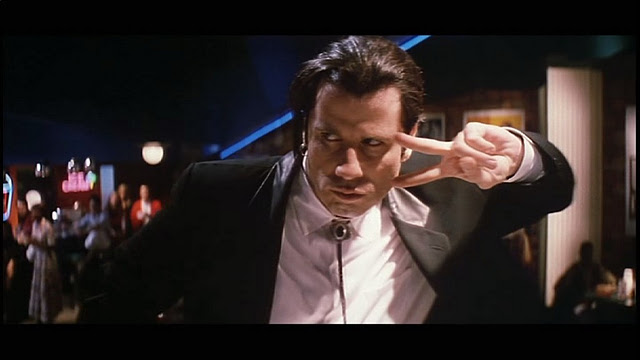
VIDEO ESSAY: ON THE Q.T.: Chapter 2: PULP FICTION (The Cool)

VIDEO ESSAY: ON THE Q.T.: Chapter 2: PULP FICTION (The Cool)

Quentin Tarantino’s films treat talk as action; torrents of words spill out of his characters' mouths, defining and redefining them, in their own eyes and in the eyes of the world. Words as clay, the speaker as sculptor, the rest of the world as spectator, art critic, vandal: this vortex of monologue and dialogue draws the viewer into the curiously theatrical spectacle of people attempting to create, refine, and propagate their own mythology. They are what they say they are, and more, and less. They build themselves up, and the film does, too; then somebody else tears them down, and the film grinds the last remaining pieces of their fragile self-images into powder.

nullTarantino has been doing this from the start of his career, from the moment in Reservoir Dogs when the doomed Mr. Brown (played by Tarantino himself) waxed profane about the supposed true meaning of Madonna’s “Like a Virgin,” then promptly died of gunshot wounds behind the wheel of a getaway car. His second film, Pulp Fiction, moves this tendency into the foreground. Nearly all of the movie’s 150-minute running time features characters talking, talking, talking, about their personalities, their values, their world views, and about other characters, some of whom we don’t get to know—or even meet—for an hour or more. All the film’s major characters are modern, workaday cousins of the Great and Powerful Oz; the film builds them up by having others repeat their (often self-created) legends until they loom in our minds like phantoms, then tears away the curtain to reveal panicked little people desperately yanking levers. “Come on,” Jules tells Vincent in the film’s opening section, “let’s get into character.”

The gang boss Marsellus Wallace is granted a Col. Kurtz-level buildup. Jules and Vincent’s early dialogue about how he threw Tony Rocky Horror out of a window for giving his wife Mia a foot massage establishes that he’s not a man to be trifled with. In the film’s second section, Marsellus orders the boxer Butch to throw a fixed fight, but remains tantalizingly undefined. He’s a big, bald head with a Band-Aid on its neck—a totemic abstraction on par with the fabled briefcase, contents unknown, that emits hellish light when opened. We see him again from the back right after Butch pulls a double-cross, kills his opponent in the ring, and flees with the money he made by secretly betting on himself: again, no face, just a voice and some words. When we finally see Marsellus’ face 95 minutes into the movie, Tarantino instantly demystifies him as a burly man standing in a crosswalk holding a box of donuts—whereupon Butch runs him over. Marsellus’ first close-up represents Pulp Fiction’s storytelling strategy in microcosm: after all that advance press, he’s just a stranger bleeding on the street, his face framed upside-down as if to certify what we already suspected, that his mythology has been suddenly and violently flipped.

nullTarantino does this over and over again in Pulp Fiction. Mia Wallace is introduced as a sex goddess monitoring her date, Vincent, via surveillance cameras while mood-setting music (“Son of a Preacher Man”) thrums on the soundtrack, and then speaking to him through a microphone. Until Vincent’s car pulls into the parking lot of Jackrabbit Slims, she’s just a pair of lips and two bare feet, intriguing by virtue of her remoteness and sense of control. She seems a more strange and special person than the woman described earlier by Jules: a failed wannabe-star turned gangster’s trophy. “Some pilots get picked and become television programs,” Jules says. “Some don't, become nothing. She starred in one of the ones that became nothing.” But the date proves to be a complete disaster, as Mia mistakes Vincent’s heroin for cocaine while he’s in the bathroom and nearly dies of an overdose. And about that needle scene: Vincent and his drug dealer Lance’s terrified babbling about the right way to administer a heart injection refutes an earlier conversation in which they tried to make themselves seem like world-weary bad-asses. (Lance on his smack: “I'll take the Pepsi challenge with that Amsterdam shit, any day of the fuckin' week.” Vincent: “That’s a bold statement.”)

Vincent Vega creates a mythology of a globetrotting hipster on a voyage of self-exploration, but as the movie unreels, it becomes increasingly clear that he’s a bullshit artist whose main target of deception is himself. He can’t take criticism, advice or even notes from other people (“You have to ask me nicely,” he tells the man entrusted with cleaning up Vincent’s accidental shooting of Marvin). And when the film’s fractured chronology is rearranged in linear fashion, we realize that the poor bastard learned nothing from the According-to-Hoyle Miracle that stopped the bullets and spared his life. He dies on the toilet reading Modesty Blaise while his buddy Jules—who had a religious experience after the near-miss, and pledged to stop murdering people and “walk the Earth, like Caine in Kung Fu”—lives on. “I was sitting here, eating my muffin and drinking my coffee and replaying the incident in my head, when I had what alcoholics refer to as a moment of clarity,” he tells his friend, who’s locked away so deep inside his own mythology that he doesn’t recognize that Jules has just handed him a second chance, an opportunity to escape, to be free, to live.

null“There's this passage I got memorized,” Jules tells Pumpkin, the would-be diner robber who has dared to steal his “Bad Motherfucker” wallet. “Ezekiel 25:17. ‘The path of the righteous man is beset on all sides by the iniquities of the selfish and the tyranny of evil men. Blessed is he who, in the name of charity and good will, shepherds the weak through the valley of darkness, for he is truly his brother's keeper and the finder of lost children. And I will strike down upon thee with great vengeance and furious anger those who attempt to poison and destroy my brothers. And you will know my name is the Lord when I lay my vengeance upon thee.’ I been saying that shit for years. And if you heard it, that meant your ass. I never gave much thought to what it meant. I just thought it was some cold-blooded shit to say to a motherfucker before I popped a cap in his ass. But I saw some shit this morning made me think twice. See, now I'm thinking, maybe it means you're the evil man, and I'm the righteous man, and Mr. 9 millimeter here, he's the shepherd protecting my righteous ass in the valley of darkness. Or it could mean you're the righteous man and I'm the shepherd, and it's the world that's evil and selfish. I'd like that. But that shit ain't the truth. The truth is, you're the weak, and I'm the tyranny of evil men. But I'm trying, Ringo. I'm trying real hard to be the shepherd.” – Matt Zoller Seitz

Peter Labuza is a film critic and blogger. He is the host of The Cinephiliacs, a podcast where he interviews the great cinephiles of our time. His written work has appeared in Indiewire, MNDialog, Film Matters, and the CUArts Blog. You can follow him on Twitter (@labuzamovies).
 

Matt Zoller Seitz is a co-founder of Press Play.
In Remembrance of Harris Savides: 1957-2012

In Remembrance of Harris Savides: 1957-2012

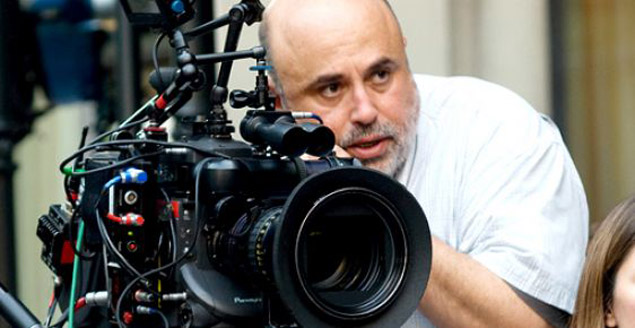
Cinematographer Harris Savides, who died on Tuesday at 55, was a poet of light. He shot some of the most stylistically striking movies of the last two decades: James Gray’s The Yards; Sofia Coppola’s Somewhere; Jonathan Glazer’s Birth; Noah Baumbach’s Greenberg; Gus Van Sant’s Elephant, Gerry and Last Days; David Fincher’s The Game and Zodiac.

Look over that list and you get a sense of his versatility. But there was more to Savides than craft. His mix of artistic restlessness and quiet confidence bridged schools of filmmaking that might seem incompatible: virtuosity and naturalism. He came out of the world of fashion and TV ads and music videos, but when you look at his feature work, you rarely get the sense that you’re being sold anything. There’s a reticence and mystery to his images, as audacious as they often are.

Birth is filled with “How the hell did they do that?” camera moves and astoundingly long takes, but his New York streetscapes and lush interiors aren’t TV-commercial glossy, or even fussed over; they seem like places where real people, not movie characters, might live and work. Coppola’s comfortably numb Somewhere has an early 70s stoner art-film vibe, but its locked-down wide shots, which let us simply watch characters behaving for minutes at a stretch, bespeak powers of concentration that Coppola’s earlier movies only hinted at. Van Sant’s hothouse triptych seems influenced by the work of hypnotically stripped-down European filmmakers who had become critical darlings in the U.S. around that time, Bela Tarr especially; but the casual-seeming quality of the light—radiant, even woozy, yet somehow not sentimentalized—is thoroughly American. Van Sant’s school-shooting psychodrama Elephant, in particular, merges documentary patience and movie-brat showiness in a way that felt strange and new; no wonder it divided critics.

In time, Fincher’s Zodiac might prove the most significant picture of the bunch. Shot digitally with the Viper camera at a time when many directors and viewers were still suspicious of high-definition video, it was at once revolutionary and reassuring. No American movie had revealed the texture of night with such crystalline clarity. At the same time, though, the mid-’70s conspiracy thriller look that Fincher and Savides devised for Zodiac’s daytime and office scenes tied the movie to analog values, and sent an important subliminal message: tools change as technology evolves, but they’re still just a means to an end.

When I heard about Savides’ passing, I reached out to Jamie Stuart, a filmmaker and writer. He’s been doing highly conceptual documentary shorts for the New York Film Festival for years now; Roger Ebert championed his 2010 short film “Idiot with a Tripod.” Stuart was an admirer of Savides’ who interviewed him twice and corresponded with him via email; an edited transcript of our conversation follows.

null

MZS: Harris Savides' death hit me harder than that of most cinematographers, and in trying to figure out why that was, I decided it was because he was a transitional figure in a really volatile period of film history. I can't think of many cinematographers who demonstrated such mastery of both traditional celluloid and new digital technologies.

‪Jamie Stuart: It's interesting. I didn't really see that as his journey so much, because I know he was very dubious of digital and greatly preferred film. I really looked at him as somebody who came from high-end fashion and music videos and commercials—but then transitioned into simplicity and naturalism.   

‪MZS: Can you elaborate on that? Because when I think of Harris Savides, "simplicity" and "naturalism" aren't necessarily words that spring immediately to mind.

nullWhen I look over his filmography I see him acting as cinematographer on movies that seemed stylistically pivotal for their directors. He was behind the camera when Gus van Sant got into his American Bela Tarr phase, and did movie after movie comprised of very, very long Steadicam shots: Elephant, Gerry, Last Days. He was the director of photography on David Fincher's Zodiac, a groundbreaking, digitally-shot feature that revealed all the details of night that celluloid and low-end video couldn't show us before, and the somewhat stately rhythms of that movie signaled a new phase for Fincher. I wonder if the more contemplative The Curious Case of Benjamin Button and the almost live-TV-like claustrophobia of The Social Network would have happened without Fincher’s collaboration with Savides on Zodiac? We’re not talking meat-and-potatoes here. And Birth! My God. That's so daring visually that I can imagine Brian De Palma watching it and thinking, "I wouldn't have gone quite that far, but well-played, sir."

‪Stuart: Yes, but look at the way he shot and the way he lit a lot of those movies. When I first met him and interviewed him in 2003, he had just made Gerry and Elephant, and he found those experiences working mostly with long takes and practical light to be completely liberating. He was afraid he couldn't go back to shooting more controlled commercial work. He suggested he would feel like a caged animal.

I think that's one of the reasons Fincher brought him in on Zodiac — because he knew Harris would be able to give a natural look that also had style. Harris lit the basement scene, for instance, with 40-watt bulbs, I think. He was upset that the Viper couldn't handle low light well, so he was forced to light up a lot of scenes and stop down, when he really wanted to shoot things as they were.  

nullMZS: Interesting. So what you're describing here is a very simple way of shooting, one that tries to make the conditions seem "available" even if they were meticulously contrived. And then on top of that you've got formal daring with regard to camera movement. That closeup of Nicole Kidman in Birth, for example, is spectacular. No pretense of being "invisible" there. You are supposed to notice the artistry. The form is the show; the hugeness of these gestures help move the film into the realm of fable, make it operatic. And yet the exteriors and interiors don't have a fussed-over look. They're inviting, real-seeming. Glazer's previous movie Sexy Beast was daring, too, in its way, but it contains nothing as stunningly, brazenly big as the stuff in Birth. Savides must have had something to do with that change, don’t you think?

‪Stuart: Perhaps. But I wonder how much of that is Glazer and how much of that is Harris? I think Harris would've been perfectly content to shoot everything with natural light and a perfect camera angle. Harris has a quote somewhere about lighting rooms instead of actors. And that's a very specific approach.

He hated rim light or backlight. I once spotted a close-up of Jake in Zodiac that had rim light, took a still, sent it to him convinced that had been done in a reshoot that he didn't supervise. He confirmed. I remember him going on about Ballast, and how realistic it was. He loved The Dardenne brothers.  

MZS: Do you remember the first time you noticed Harris Savides' work? Do you remember when you decided he was somebody significant?

Stuart: I knew Harris' work initially from his music videos with Mark Romanek. The first one they did together was for Teenage Fanclub 20 years ago. It's black and white. Very simple. The band performing with a giant light above them.

Then, I remember when he did The Game and Fincher said he wanted Harris as his director of photography because the movie was really complex, and he needed a cameraman he could completely trust. So when I was covering the NYFF in '03, and he was there with Elephant, I introduced myself. We remained in touch ever since.

We had a similar taste in lighting and composition. We were trading e-mails when my blizzard video blew up, he was joking that I'd become a celebrity. After he first watched the video, he told me he was upset when it transitioned from black-and-white to color, but then he liked the color a lot, too, so he didn't mind.

The last time I think I saw him was at a Q&A Mark Romanek did a couple of years ago. As we were leaving, I remember looking back and seeing Mark and Harris walking together like old best friends.

I can say that, strangely, he was on my mind [Wednesday] night. The New York Film Festival screened my work at Richard Pena's tribute. One of the people featured in it was Noah Baumbach, whom I subsequently bumped into while leaving. I had sent Harris a still photo I took of Noah from a shoot a couple of months ago. I thought about e-mailing him to let him know that my work looked good on the big screen and that I'd just seen Noah.

So, to be honest, I'm a little mixed today. Going from the high of having my work play last night at the NYFF, then finding out about [his death Thursday] morning.  

MZS: Did you get to spend much time with him in person?

Stuart: Our relationship was primarily via e-mail. I interviewed him twice. Once in 2003, then again in 2006 before the release of Zodiac. We randomly discussed getting together to shoot some stills or maybe my tagging along when he was first testing the Alexa [motion picture camera]—but neither materialized.  

‪MZS: What, specifically or generally, do you think you learned from Harris Savides as an artist? Are there any things he inspired you to do, or to do better, or differently?

‪Stuart: He inspired me in the sense that I always sent him my work—and considering how highly I thought of him, I damn well hoped my work would be good enough to show him. He was somebody, a professional, who was there for me as I was embarking on my filmmaking career. And that's something I'm grateful for.

I remember sending him a copy of my first full mini-DV short in early 2004, made for like $50, and he told me his hat was off to me for doing so well with such little money. We thought similarly about lighting and composition. He had a very no-bullshit attitude about work. Whenever he made a movie and I offered my opinion, he always wanted it straight, even if I didn't like it.

He was somebody I always sent links of my work to. I liked his opinion. You know? I liked him. I liked his work.

Nelson Carvajal is an independent digital filmmaker, writer and content creator based out of Chicago, Illinois. His digital short films usually contain appropriated content and have screened at such venues as the London Underground Film Festival. Carvajal runs a blog called FREE CINEMA NOW which boasts the tagline: "Liberating Independent Film And Video From A Prehistoric Value System." You can follow Nelson on Twitter here.

Matt Zoller Seitz is the co-founder of Press Play.

VIDEO ESSAY: BEAVER’S LODGE: CAIN’S CUTTHROATS (1971)

VIDEO ESSAY: BEAVER’S LODGE: CAIN’S CUTTHROATS (1971)

This is the fifth installment of BEAVER'S LODGE, a series of video essays narrated by actor Jim Beaver which will offer critical takes on some of Beaver's favorite films. Jim Beaver is an actor, playwright, and film historian. Best known as Ellsworth on HBO’s Emmy-award winning series DEADWOOD and as Bobby Singer on SUPERNATURAL, he has also starred in such series as HARPER'S ISLAND, JOHN FROM CINCINNATI, and THUNDER ALLEY and appeared in nearly forty motion pictures. You can follow Jim on Twitter.

A great deal of effort was apparently put into making this the worst movie ever made. They didn't pull it off, but the effort certainly shows.

It's a Western with rockabilly songs. It's a Civil War-era movie that was originally released with footage of motorcycle gangs edited into it. It's a movie where single bullet holes look like exploding steak tartare. It's a movie with a black character played by the whitest-looking white woman you can imagine. It's a movie with 20 people in the cast, 18 of whom are the worst collective gathering of actors in the history of motion pictures.

Fortunately, one of the other two actors is John Carradine, who could be one of the best actors alive or one of the worst hams ever to set foot on a stage, depending on the material. Carradine, who should have had an Oscar for THE GRAPES OF WRATH and was reportedly a great Hamlet in his day, is in semi-hammy mode here, but it's more or less right for the character, a preacher/bounty hunter. It's one of the larger roles of his late career, when he clearly took anything that came along. If there's anything worth watching in this collection of uncut banjo picks, it's he.

Scott Brady, who is the only other bearable (or recognizable) actor in the cast, is Justice Cain, a former Confederate officer who is worshiped by his troops, but that doesn't keep them from raping his wife and killing her and his son when he refuses to join them in restarting the war, long after the rebel surrender. So Cain sets out to avenge himself on the men he once led, joining forces with Preacher Simms (Carradine), who spouts Bible verses and keeps a collection of human heads in a barrel of brine.

The movie is nowhere near as good as that description sounds. In fact, it's nowhere near as good as choking to death on a drill bit.

But at least there's a chance at one point to see John Carradine in drag. And Carradine, brilliant or hammy, always brightens up a movie.


The Mystery of Werner Herzog: Two Video Essays and One Text Essay

The Mystery of Werner Herzog: Two Video Essays and One Text Essay

DOES MR. JONATHAN SMITH CRY IN HIS PILLOW AT NIGHT?: THE UNIRONIC WORLDS OF WERNER HERZOG

One of the most revealing statements in the book Herzog on Herzog appears early on, when Werner Herzog tells interviewer Paul Cronin that from the time he was a young child he has suffered a particular "communication defect": he has no sense of irony.

Whether Herzog the actual human being does or doesn't have a sense of irony is itself a minor point, a bit of autobiographical gossip. But there is a useful truth in extrapolating the insight to his work: Understanding and appreciating Herzog's films means giving up on the pleasures of irony. (It is difficult to imagine a satire written and directed by Werner Herzog.) What is entertaining and meaningful in Herzog's movies and his public persona is a peculiar earnestness — the earnestness of the straight man in comedy routines, but less oblivious, more mystical. Various labels can and have been applied to his work: Romantic, Expressionist, Existentialist. But they are inevitably incomplete and unsatisfying because their orientation is toward analysis, systematization, precepts, and principles—where Herzog's philosophy is more like a garden of intuitions, or a collection of koans written on scraps of paper and scattered across the floor of an abandoned monastery atop some far-off mountain where the wind never settles down.

The title of Nelson Carvajal's new video essay, "Werner Herzog Looks at Man's Futility," is full of tricks and traps. What is Werner Herzog: the filmmaker, his films, the actual human being for whom that is a byline, the public figure we know from interviews and guest appearances and YouTube videos? Looks: How? With eyes or camera? Are we looking with him, through him? Man's Futility: "Man" as a macho revanchist term for "humanity"? Or literally of men: the futility of men, the futility of masculinity, men adjusting their lives to the fact of futility . . . (The video's first image, from Stroszek, is of a woman being beaten by men.)

Carvajal's work can speak for itself; its juxtapositions are rich with possibility and ambiguity. The choice of the word futility is what most strikes me. A quick glance at Herzog's oeuvre might cause an inattentive viewer to see it as nihilistic, as celebrating or at least embracing the futility of living: human life is inconsequential, nature is great and unknowable, death and failure are ever-present, hopes and dreams are naïve. But that is not it at all. Instead, Herzog encourages us toward the sublime, toward awe and humility when faced with great mystery—toward, indeed, the seeking and celebration of such mystery. Toward an epistemology that is not irrational but sur-rational, that thrives between the lines of all we could ever know. It is not that we live in a meaningless universe, but rather that our intellectual tools for measuring the meaning of the universe are about as well developed as those of a mosquito contemplating how Manhattan came to be so tall.

Existence is its own meaning. Thus, the need for pushing existence toward its limits and extremes, for exploration and adventure. Every worthwhile encounter happens at the end of some world. Facts are not truth, and truth is not a product of careful measurement and objective observation, but of ecstasy, and ecstasy requires the knowledge of the senses, the trust of intuition, the cultivation of mystery. Teleology leads to ruin, but knowledge and enlightment come from the fact of life's force: Aguirre, on a monkey-covered raft at the end of his adventures, doomed and clearly mad because still he dreams of conquest; Fitzcarraldo failing at what he set out for and achieving much he did not; Dieter Dengler clinging to existence with the same strength as the premature baby grips the doctor's hand in Stroszek. Life's force and the power of chance determine the aesthetic, with shots and scenes included not for reasons of cause and effect, not for obvious or metaphorical association, but because they feel right. Animals and objects take on mercurial meaning: the albino crocodiles in Cave of Forgotten Dreams, the fiery oil fields of Lessons of Darkness, the basketball in My Son, My Son, What Have Ye Done, the chickens in everything. Chance and chaos rule over all: the volcano in La Soufrière might explode at any moment, the actors in Heart of Glass are hypnotized and thus strange and unpredictable, the squirrels in the story told in Into the Abyss could have been killed if not for good brakes on a golf cart.

Herzog's truths emanate from estrangement. The worlds and peoples he portrays are always exotic, and so there is a consistent unity to his work from its earliest days—each film displays a contempt for nothing except dominant normality. No person or place is exotic to itself, but we do not have access to these selves. Few, if any, of Herzog's characters are "knowable" in the sense familiar from the genre of psychological realism. Psychologizing is futile. Worse than futile: boring. The camera's fascination adheres to anyone and anything that confounds simple analysis, that lives outside predictable boundaries, that does not look like commercial, homogenized culture. We discover (through cracks, crevices, abandoned pathways, extremes of distance, altitude, weather) the panoply of ways of living.

"I want the audience with me in wild fantasies in something that illuminates them," Herzog said in an appearance on The Colbert Report in June of 2011. Wild fantasies illuminate. Wild fantasies bring us beyond the banal, commodified dreams that haunt our days of sleepwalking. "You see if I were only fact based—you see, the book of books in literature then would be the Manhattan phone directory: four million entries, everything correct. But it dusts out of my ears and I do not know: do they dream at night? Does Mr. Jonathan Smith cry in his pillow at night?" Knowledge requires imagination, empathy, curiosity. Anything else is at best facts, and, as David Byrne once sang, "Facts are living turned inside out."

Herzog makes a point of differentiating his lack of a sense of irony from a lack of a sense of humor. Irony and humor, he says, are very different things. This is a truth borne out by Herzog's films, which are often filled with sly and absurd humor. By desaturating his work and words of irony, Herzog adds another layer of ambiguity to his films, provoking laughter at moments where we might not know why we are laughing, or what we are laughing at, and complicating those moments with other emotions.

I recognized this effect most forcefully when, on a lark, I re-edited the trailer for Baz Luhrman's upcoming adaptation of The Great Gatsby to be, instead, a preview for a Herzog movie. My intentions were entirely silly. But once I started editing the video, I realized that by inserting Herzog into the glitzy stylistics of the movie, and positing him as a director of the hollow shell of a character that is Gatsby (the opposite of the obsessed dreamers he often films, for Gatsby, though obsessed, lacks their gravitas, their mysticism, their madness), that the silliness of the premise was undercut.

Even when Herzog is at his most humorous and least meaningful, his affect is one of absolute sincerity, which heightens his humor but also adds other layers. When he reads Go the Fuck to Sleep, for instance, there is no fear that he will ever break into giggles, no chance that he will laugh along with us, no suspicion that he is even inviting us to laugh (imagine the contrast if an irony-besotted comedian like Stephen Colbert read it). Irony insists that we know there is a joke, that we see the opposite meanings, that we smirk inside because we get it. It can be a lot of fun, and even quite meaningful. But it's never what Herzog is up to.

A mien of sincerity can be as shallow and tiresome as an endless array of ironies—who wants to live in a world of anchorites, pamphleteers, and true believers? Gnomic pronouncements get old fast when all you want to know is whether you should eat at the restaurant on the corner. But ours is a culture of winks and spins, of campaign slogans, billboards for Jesus, self-help politics, and an endlessly Googled Earth. Every imaginable court bursts with jesters. We need a few people with no sense of irony to see through it all. We need enigmatic images to steal our dreams back from their corporate mergers.

Men are futile, yes, in every sense, and Herzog, whose movie worlds are mostly made of men, knows this as well as anybody. "Get over it," he seems to say. What does our futility matter if we can share our wild fantasies? Give up on the wonders of your gender, stop venerating your species. Are we so different from radioactive albino crocodiles? In the movie, they're just as real as we are. — Matthew Cheney

Nelson Carvajal is an independent digital filmmaker, writer and content creator based out of Chicago, Illinois. His digital short films usually contain appropriated content and have screened at such venues as the London Underground Film Festival. Carvajal runs a blog called FREE CINEMA NOW which boasts the tagline: "Liberating Independent Film And Video From A Prehistoric Value System."
You can follow Nelson on Twitter here.

Matthew Cheney's work has been published by English Journal, One Story, Web Conjunctions, Strange Horizons, Failbetter.com, Ideomancer, Pindeldyboz, Rain Taxi, Locus, The Internet Review of Science Fiction and SF Site, among other places, and he is the former series editor for Best American Fantasy. He teaches English, Women's Studies, and Communications & Media Studies at Plymouth State University.

EYE OPENERS: VIDEO ESSAY: Mickey Rourke: Highs & Lows

EYE OPENERS: VIDEO ESSAY: Mickey Rourke: Highs & Lows

The video essay above, by Jason Bellamy, is a tribute to Mickey Rourke, in honor of his 60th birthday, which is today. Originally posted at Bellamy's blog, The Cooler, It takes us through Rourke's best performances and his moments of distended excess, from Rumble Fish to 9 1/2 Weeks to Angel Heart to Sin City to The Wrestler.  And, as such, it's a moving tribute to the changing career—and changing body—of a remarkably complicated screen actor.

VIDEO ESSAY: Gliding Over All: The Cinematography of BREAKING BAD, Season 5.1

VIDEO ESSAY: Gliding Over All: The Cinematography of BREAKING BAD, Season 5.1

Gliding Over All: The Cinematography of Breaking Bad, Season 5.1 from Press Play Video Blog on Vimeo.

Every great television show has an episode that pushes the medium in some bold, even experimental manner, either visually and/or in the way the plot is structured. It's usually something the writers and director do as a challenge for themselves and the audience to quicken the blood. Historically, cinema has been the arena for directors with a robust visual sense. Television, on the other hand, was the safe haven for writers. This has changed significantly in recent years with the rise of cable networks willing to accommodate writers and directors with ambitious projects. Now, the emphasis on high production values and vibrant imagery is just as essential as a great script. Breaking Bad, with its carefully thought-out look, dependably relies on its cinematography to deliver crucial narrative/thematic information, just as it relies on its characters to deliver significant exposition in a straightforward manner.      

A truly great dramatic series, such as Breaking Bad, tends to show brilliance fairly consistently, but episode ten from the third season—"Fly," directed by Rian Johnson (Brick, Looper) and written by Sam Catlin and Moira Walley-Beckett—sprints ahead as a major creative standout. The entire episode plays out in the confines of the sublevel lab where ex-high school chemistry teacher Walter White (Bryan Cranston), now a big time meth cooker, makes the drug with his ex-student and now-assistant, Jesse Pinkman (Aaron Paul). But through the entire 48-minute episode, Walter and Jesse aren't cranking out batches of meth for their boss, the highly successful fast food entrepreneur and bloodthirsty drug kingpin Gus Fring (Giancarlo Esposito). A fly has somehow gotten into the lab and Walter obsesses over killing it. He can't cook until the lab is sterilized and free from any taint. Of course, it's not really about the fly. Walter is paralyzed by fear and the knowledge that he's about to die. It's only a matter of time before the cancer inside him will reawaken and the stalemate between him and Gus will dissolve. Regardless of which one gets to him first, Walter is a dead man.

Since the writers have trapped Rian Johnson, in a sense, with this plot, he must, along with cinematographer Michael Slovis and editor Kelley Dixon, figure out ways to keep the whole thing visually dynamic. It's a difficult challenge considering the action is primarily contained to one setting and the variety of camera setups are limited to a large degree. They pull it off, but that shouldn't surprise anyone who's been watching closely; Breaking Bad has consistently been one of the most cinematic serial dramas on television.

All of the great serial dramas over roughly the last decade—The Sopranos, The Wire, Battlestar Galactica, Deadwood, and Mad Men—excel in their different ways at the art of storytelling. However, only Breaking Bad, and Mad Men to a large degree, also deliver a strong cinematic visual scheme to accompany the stellar writing. From its first episode, Breaking Bad has told its story of the transformation of nebbish teacher Walter White into sociopathic monster Heisenberg with imagery as much as with writing and acting. The show's sophisticated compositions and its ability to convey meaning and thematic resonance through classic framing and symmetry over the course of its five seasons is something that should interest any serious cinephile. On a visual level, Breaking Bad rivals anything you'll see in the theater.

What makes the show special? It works in a seemingly dormant tradition of classic visual storytelling; what it reveals through its images is just as important as the dialogue. The trust in the audience displayed by the show's creator/showrunner, Vince Gilligan, makes it feel daring and even radical at times. With some major exceptions, this form of bold stylization in major commercial filmmaking (particularly in action and crime features) has fallen out of fashion in lieu of hyperkinetic editing schemes and discordant action sequences, the rivet-headed mode of style in so-called chaos cinema. What Breaking Bad has is visual literacy; it draws on the muscular richness of past masters of the action genre, such as Sergio Leone, John Sturges, Budd Boetticher, Sam Peckinpah, William Friedkin, and Michael Mann, to deliver the goods.

Set in modern-day Albuquerque, New Mexico, Breaking Bad is ostensibly a crime show. It explores the realism and grittiness of urban decay to great effect, but it also uses and reconfigures the visual motifs of the Western and horror genres. What's remarkable and distinctive here is that the show swipes from these genres in a way completely opposite to the approach of a pop postmodernist like Quentin Tarantino. The style and signature visual metaphors of Breaking Bad cannot be extricated from the psychological subjectivity of its characters.

The show frequently jazzes around (as fiction writer John Gardner said of experimentation), positioning the camera in holes, toilets, underneath corpses, at the bottom of a bathtub, in a safety deposit box, submerged in a deep fat fryer, and in crawlspaces, showing us the world from vantage points that are more or less unseen by our eyes in real life. The camera even microscopically observes the movements of a fly. And the show aggressively embraces the musical montage sequence (usually during its meth cooking scenes), as is the norm for contemporary dramas like this.

But the most stirring cinematic moments in Breaking Bad occur during less virtuosic sequences. They rise from the show's visual metaphors, from the way cinematographer Slovis frames the actors (traps them) behind barred windows, in darkly lit hallways and doorways, behind cracked windows, and frequently on their backs peering up at us from the ground, where the symmetry of the image and the existential despair of the characters' psychological headspace meld.

Actors in the frame are typically juxtaposed with advertising signs or dwarfed by urban architecture, a sort of primetime visual semiotics. Although the show ostensibly explores Walter and Jesse's trajectories through the seedy, violent world of drug dealing and crime, it's really about capitalism at its most savage. Walter's justification for his involvement in the meth business has always been his need to financially support his family. That's what he tells himself and his wife Skyler (Anna Gunn). It's a lie, however, since Walter has had many opportunities to walk away with the fortune he's made. Greed and the American need to dominate have taken root in Walter now. Jesse, a low-level drug dealer before hooking up with his old teacher, is seduced by the luxuries of wealth as well, although he's also a victim of its violence. Sometimes, the scourge of unfettered capitalism is portrayed in a humorous fashion, as in the scene when Jesse runs into his drug buddy Badger (Matt Jones) dressed as a $1 bill, trying to draw in customers for a savings and loan. Capitalism offers a bounty of comfort, but it can likewise deliver our doom.

In Breaking Bad, mundane places like fast food joints, big box stores, and strip malls, can easily change from the innocuous to the malevolent. The ingredients and instruments of death can be readily purchased at your everyday building supplies store. Gus, an outstanding member of the community and the proprietor of the Los Pollos Hermanos fast food chicken chain, is a brutal murderer and high-level drug lord. His restaurant is frequently used as a meeting place with associates. Places where families gather for fun, such as a rundown laser tag amusement center that corrupt lawyer Saul Goodman (Bob Odenkirk) tries to get Walter to purchase for money laundering purposes, can be nests for corruption and vice. Not even the beauty and the expansiveness of the high desert country around Albuquerque is free from the corruption. Equipped in their RV, Walter and Jesse cooked meth in the country in the early episodes, a stark reminder of how widespread the drug’s reach can be.

The West has always been violent. It hasn't really changed. It's just that in the world of Breaking Bad, the outlaws sport pocket protectors and wear garish Ed Hardy shirts. In this new American Nightmare, no place and no one is spared its destruction.


null

nullnullnullnull

Dave Bunting is the co-owner (with his sister and fellow Press Play contributor, Sarah D. Bunting) of King Killer Studios, a popular music rehearsal and performance space in Gowanus, Brooklyn. He plays guitar and sings in his band, The Stink, and dabbles in photography, video editing, french press coffee, and real estate. Dave lives in Brooklyn with his wife, son, and sister.

Derek Hill is the author of Charlie Kaufman and Hollywood’s Merry Band of Pranksters, Fabulists and Dreamers (Kamera Books), a study of the films of Charlie Kaufman, Richard Linklater, David O. Russell, Wes Anderson, Sofia Coppola, and others. He is also a movie reviewer for the Athens, Georgia alternative newsweekly Flagpole, contributing editor/movie critic for the online arts journal Sinescope, and reviews books for Mystery Scene magazine.

VIDEO ESSAY: Ninja Turtles: Generation Y in a Half Shell

VIDEO ESSAY: Ninja Turtles: Generation Y in a Half Shell

“Ugh. Where do they come up with this stuff?” groans a frustrated Raphael, the brooding, red-bandana-wearing member of the Ninja Turtles, whilst walking out of a New York movie theater that’s playing the 1980s creature feature Critters. Here’s why this is an important scene in director Steve Barron’s live-action film Teenage Mutant Ninja Turtles: The 1980s saw an explosion of brawny, Reagan-infused cartoon TV series (e.g. Transformers and G.I. Joe) and live-action romps (e.g. the American family battling the furry aliens in Critters is yet another microcosmic representation of Reagan’s war against international terrorism), but when TMNT hit cinemas in the spring of 1990, its band of sewer-dwelling, skateboard-riding (mutant) outcasts aligned themselves with what we call Generation Y (people born between the late 70s and early 90s), leaving behind the pandemic seriousness of the 80s (industrializing economies, wars in the Middle East, etc.) and embracing a childlike irreverence, a burgeoning urban terrain and yes, lots of pizza with no anchovies. The Turtles were in a pop culture class all by themselves. After emerging as an overnight sensation with comic book fans (Ninja Turtles’ creators Peter Laird and Kevin Eastman only printed 3,000 copies of the original black and white magazine-style comic book in 1984), the Ninja Turtles quickly became a phenomenon both onscreen (its popular animated TV series debuted in 1987) and off (Playmates Toys began producing Turtles action figures in 1987, becoming regular “must-haves” for the youth). Considering all of this Turtlemania, it’s remarkable that Barron’s live-action Turtles film was able to thwart the “Saturday morning” innocence of its source material and create a dark, atmospheric film which dug a little deeper into the themes that would interest its target audience—Generation Y.

In many ways, the Ninja Turtles were the perfect mirrors for the angst-driven Generation Y’ers. Take the case of the family unit, for example. Unlike the generation that came before theirs (Generation X), a substantial number of Generation Y’ers were born into single-parent families. The four Ninja Turtles—Leonardo, Michelangelo, Donatello and Raphael—were no different, living only with their father Splinter (a giant rat), in the most poverty-stricken of homes: a sewer lair. And like most young Generation Y’ers, the Turtles dealt with their anxieties by turning familiar behavioral schemes into occasionally distracting daily routines: The Turtles blended the speech patterns of 1989’s Bill & Ted’s Excellent Adventure into their own vernacular (“Cowabunga!”), while also applying the Ninjutsu practices of 1988’s Bloodsport during their ventures onto the battle worn streets of New York.

Throughout TMNT, isolation is opposed to acceptance. Although the Turtles have a haven in their reclusive sewage den, the rest of New York’s teenage population (i.e. the movie’s “real” Generation Y) seeks acceptance (and shelter) from the Foot Clan, an underground gang overseen by the villainous Shredder. In a disarming scene, Shredder addresses his hordes of loyal teen followers: “You are here because the outside world rejects you. THIS is your family. I am your father.” The dark, striking images in these sections of TMNT (pre-teens smoking cigarettes, young kids fighting each other as part of the training to become a “foot soldier”) are a precursor to future Generation Y films of the 90s that follow teens desperately seeking acceptance, even in the midst of violence (e.g. Menace II Society, Juice and The Basket Ball Diaries). And for a PG-Rated “children’s movie,” the Ninja Turtles talk in a shockingly racy way, too (on more than one occasion, Raphael angrily yells out “Damn!”).

Perhaps the one aspect of TMNT that is not directly linked to Generation Y is its technical accomplishment. The Jim Henson Creature Shop (famous for introducing The Muppets to the world) made an indelible impression on young hearts and minds in multiplexes during the spring in 1990. The lifelike turtle bodysuits that the performance actors wore had movable mouths and blinking eyes. Even the skin of these turtle bodysuits seemed to sweat and pulsate. Detractors of the film always point to the obvious absurdity of watching four grown men high-kicking in giant turtle costumes. But to get hung up on that would ignore how special a film like this can be when it’s done right (as in Spike Jonze’s 2009 live-action film Where The Wild Things Are). And TMNT gets it right. Like the best children’s stories, fables and films, the Teenage Mutant Ninja Turtles movie earns its place as a seminal work of popular fiction by acting as a cultural prism through which viewers (in this case Generation Y) can develop a more profound sense of their identity—depending on their cultural and historical vantage point. As the Turtles would say: “Totally tubular, dude!”

Nelson Carvajal is an independent digital filmmaker, writer and content creator based out of Chicago, Illinois. His digital short films usually contain appropriated content and have screened at such venues as the London Underground Film Festival. Carvajal runs a blog called FREE CINEMA NOW which boasts the tagline: "Liberating Independent Film And Video From A Prehistoric Value System."

BEAVER’S LODGE: THE PROFESSIONALS (1966)

BEAVER’S LODGE: THE PROFESSIONALS (1966)

This is the third installment of BEAVER'S LODGE, a series of video essays narrated by actor Jim Beaver which will offer critical takes on some of Beaver's favorite films. Jim Beaver is an actor, playwright, and film historian. Best known as Ellsworth on HBO’s Emmy-award winning series DEADWOOD and as Bobby Singer on SUPERNATURAL, he has also starred in such series as HARPER'S ISLAND, JOHN FROM CINCINNATI, and THUNDER ALLEY and appeared in nearly forty motion pictures. You can follow Jim on Twitter.

There was a time when a certain kind of adventure film was popular. The 1960s were its heyday. Sometimes they were realistic, or even drawn from real life. Sometimes they were fanciful. But almost always they were intelligent and enormously entertaining. I haven't seen a new example of that kind of film in 30 or 40 years. Maybe they exist, maybe I've simply forgotten them or never knew of them. But I don't think they make that kind of movie anymore (though I suspect Hollywood thinks it still makes them). I'm thinking of movies like The Dirty Dozen, Von Ryan's Express, The Magnificent Seven, The Great Escape, The Guns of Navarone, and this one, The Professionals.

The Professionals is about four rugged experts in various fields, hired by a rich man to rescue his wife, abducted by a Mexican revolutionary near the Texas border around 1917. Lee Marvin, Woody Strode, Robert Ryan, and Burt Lancaster are the charismatic title figures, each particularly well-equipped for one aspect of the mission. Ralph Bellamy is their wealthy employer, Claudia Cardinale his buxom Latina wife, and Jack Palance is the revolutionary, Raza, with whom Marvin and Lancaster once rode. And Marie Gomez is Chiquita, a delectable tough girl, *really* tough, in a way that suggests it's her way of life, not something the script called for her to do.

Accompanied by a jaunty, rousing score by Maurice Jarre, the film by Richard Brooks is delirious masculine fun, an adventure filled with derring-do, witty quips, and just enough pseudo-depth to make it seem like it means something beyond the fun. I can't speak for women, but it's the kind of movie no guy can pass up, no matter how many times he's seen it. They don't make 'em like this anymore. And it's a shame.
 

VIDEO ESSAY: BEAVER’S LODGE: OUR HOSPITALITY (1923)

VIDEO ESSAY: BEAVER’S LODGE: OUR HOSPITALITY (1923)

This is the second installment of BEAVER'S LODGE, a weekly series of video essays narrated by actor Jim Beaver which will offer critical takes on some of Beaver's favorite films. Jim Beaver is an actor, playwright, and film historian. Best known as Ellsworth on HBO’s Emmy-award winning series DEADWOOD and as Bobby Singer on SUPERNATURAL, he has also starred in such series as HARPER'S ISLAND, JOHN FROM CINCINNATI, and THUNDER ALLEY and appeared in nearly forty motion pictures. You can follow Jim on Twitter.

A guest at a screening of this masterpiece at my home recently literally leaped out of her seat upon seeing the final, transcendentally beautiful stunt executed by Buster Keaton. I've never seen anyone do that except at a horror movie. Our Hospitality is a comedy, without an ounce of horror element. Yet it has heart-stopping thrills, made all the more heart-stopping by the knowledge that it was Keaton himself risking his neck in stunts that no star until the Keaton-inspired Jackie Chan would approach, seventy years later.

The title Our Hospitality refers to a peculiar brand of rural courtesy that says one can't murder a guest INSIDE one's home. The Hatfield-McCoy feud of legend is the inspiration for this story of a young man (Keaton) coming home to claim his inheritance, unaware of the feud between his family and another that will lead anyone in the other family to try to kill him on sight. Invited by fluke into the Canfield family residence, young Joseph McKay (Keaton) learns of the feud and realizes his only safety lies in never leaving. This is the setting for the central comedic sequence of the film, in which the Canfield family is constantly on the ready to shoot him whenever he gets anywhere near an exit door. It's pretty amazing how many brilliant comic variations Keaton is able to play out with the situation.

The earlier portion of the film is wonderful in its own right, both for the masterful comedy of which Keaton was unmatched at creating and for the wonderfully amusing look at 1830, the period in which the film is set. Manhattan's Broadway and 42nd Street intersection is not much more than a pasture, yet people are already complaining about the traffic. Keaton, who in real life was a railroad buff, recreated the first locomotive for this film, and it is both historically fascinating and wildly funny to watch his trip across country on rails that can be moved out of the way to avoid obstacles and which aren't always even necessary for the train's progress.

The final third of the film is a thrill-seeker's paradise. On the run from his enemies, Keaton finds himself adrift in a cascading river along with the girl he loves (the daughter of the enemy Canfield clan). Keaton's attempts to save himself and then his girl from the spectacular waterfall toward which they race is one of the great comedic stunt sequences of all cinema.

It's difficult for me to pick my favorite Buster Keaton film, but this is usually the one I show to people I want to convert to Keaton idolatry. I've never known it to fail. The word classic gets thrown around a lot—maybe not as much as the dreaded awesome, but far too frequently, nonetheless. But this is a genuine comedy classic. It's awesome.


VIDEO ESSAY: CRUEL SUMMER: BATMAN (1989)

VIDEO ESSAY: CRUEL SUMMER: BATMAN (1989)

The "Cruel Summer" series of articles examines influential movies from the summers of the 1980s. The previous entries in the series have covered THE BLUES BROTHERS (1980), STRIPES (1981), ROCKY III (1982), WARGAMES (1983), PURPLE RAIN (1984), PEE-WEE'S BIG ADVENTURE (1985), TOP GUN (1986), ROBOCOP (1987), and DIE HARD (1988).

Tim Burton’s Batman was a game-changer for summer blockbusters. It closed out a decade marked by light and sunny escapist entertainment by applying a more serious, atmospheric attitude, both dark and thrilling. It also ushered in a new level of hype that became an integral part of the movie-going experience. And it pointed the way for comic-book movies to become the dominant vehicle for summer entertainment.

Before Batman, Hollywood had created comic-book movies as silly, second-tier product. With the exception of the first Superman movie, comic-book movies lacked high production values and fidelity to their source material.

Things began to change when comic-book artists like Frank Miller and Alan Moore offered their takes on the superhero genre. Miller’s The Dark Knight Returns brought a new level of psychological depth and graphic sophistication to comics.

Meanwhile, Hollywood was searching for the new Steven Spielberg or George Lucas, another prodigy with a childlike sense of wonder to dazzle audiences. Enter Tim Burton, who scored two hits, Pee-Wee’s Big Adventure and Beetlejuice, before turning 30. The surprise success of these dark, anarchic films marked Burton as having the ability to be edgy and still appeal to mass audiences. The execs at Warner Brothers could sense that audiences’ tastes were changing and a risk-taker like Burton might be necessary for Batman.

Batman arrived at the end of a decade where greed ran rampant, recession was imminent and people sensed things were getting worse, not better. Burton’s vision of Batman matched his audience’s feelings of restlessness and unease.

Every aspect of the movie was infused with Burton’s desire to present the world of Batman as a reflection of modern dystopia. Anton Furst’s groundbreaking production design took elements of Metropolis, Blade Runner and Depression-era Art Deco Manhattan, heaping layers of urban squalor upon itself.

But if there’s one image that defines the bold new vision of Burton’s Batman, it’s the Batsuit. Designer Bob Ringwood totally rejected the gray and blue image from the camp TV series. Ringwood’s design is a suit that contains drama in itself, something powerful but unwieldy, something closer to Robocop than Adam West. The Batsuit is a vision of man made superior by advanced technology, but also encased and imprisoned by it. It’s a 21st-century suit of armor for a Dark Knight, and it is still the template for how we see Batman today.

At the same time, the new Batman’s rigidness made him a foil for the film’s true protagonist. The Joker, with his anarchic wit and irreverent gags, is the heir to Beetlejuice. the charismatic anti-hero and master of ceremonies of Burton’s funhouse. At the same time, he was the comic alibi that could make Burton’s seriousness acceptable, breathing life and energy into his arty aspirations.

The Joker may have overwhelmed Batman in this film, but looking at the superhero movies that followed, we see the real winner, in a legacy of dark, disturbed protagonists whose vulnerabilities reflect the anxieties of our era. At the same time, Batman’s demons yielded a new dimension of interior drama and fragility that feels real—something that modern-day superheroes with their unlimited CGI powers can’t compensate for.

With its groundbreaking character types and radical visuals, Batman provided a new template for blockbuster storytelling, one that could even overcome its greatest weakness: its script. The plot of Batman may dip into incoherence, revolving around the Joker’s wanting to become some kind of homicidal artist by poisoning the citizens of Gotham until they die with a smile on their face.

Then again, the plot holes didn’t seem to matter to audiences. What mattered was the vision, the mood, the experience of a live-action comic-book movie that treated its source material seriously. Burton’s Batman provided the signal for a new comic-book movie whose ambitions often surpassed its abilities to deliver. These films are often incoherent or overloaded, but at their best, they come through with unforgettable images and moments. The Joker’s master plan has come to fruition. For better or worse, we exit the theater with a smile on our face.

San Antonio-based film critic Aaron Aradillas is a contributor to The House Next Door, a contributor to Moving Image Source, and the host ofBack at Midnight,” an Internet radio program about film and television.