A Video Essay On Jim Jarmusch: Dead Men & Ghosts, Limited

A Video Essay On Jim Jarmusch: Dead Men & Ghosts, Limited

The secret of poetry lies in treading the middle path between the reality and the vacuity of the world.
—Basho
trans. by Robert Hass

Of the various Jim Jarmusch films I’ve seen, three have nagged
at me, haunted me, teased me until I came back to them again and again. I
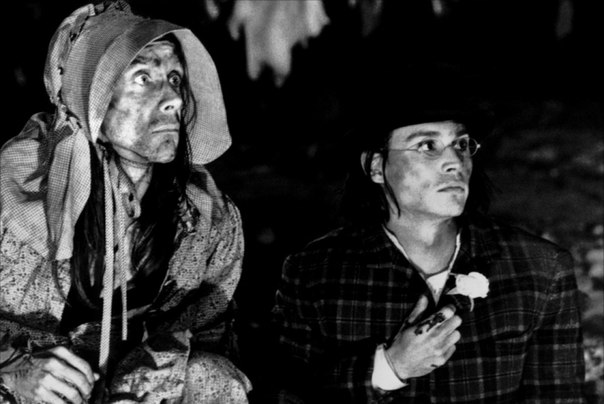
was a student in New York City when Dead Man was released, and I saw it
in the theatre, having read a review, having heard Jarmusch’s name
whispered or echoed somewhere, and I wanted to see what the fuss was. I
didn’t know what to make of it then, but if I knew anything at all about
the film, I knew it was beautiful. Ghost Dog was easier to apprehend on
a first viewing (in Boston, if I remember correctly), a film that is,
for Jarmusch at least, relatively conventional in its narrative
progress, its episodes clearly linked together through cause, effect,
motivation. The Limits of Control is the most abstract of the three, a
film to dream to. Indeed, when I first watched it (late one night at
home in New Hampshire), I drifted in and out of sleep. This seems
appropriate, perhaps the perfect first encounter with such an enigmatic,
oneiric movie.

I began to think of the three films together. They appealed to me
significantly more than Jarmusch’s other works, significantly more than
most movies. The reasons could, of course, be personal and
idiosyncratic, but perhaps there was something there, some line of
thought, some mix of imagery and style. Certainly, they share concerns
and motifs: questions of wisdom and wandering, art and death, repetition
and revision. They let genres become ghosts. They propose that white
men are the scourge of reality. I knew the only way to begin an
exploration would be with a movie of my own, made from pilfered pieces,
because while I could analyze with text, it held no appeal: too dry, too
awkward, too much like a manual on taxidermy. I knew I couldn’t script
it, either; I just needed to dig into the sounds and images, to see what
stuck, to trust a certain intuition in juxtaposition.

“Dead Men & Ghosts, Limited” is the result. Its great flaw is that I was awake when I made it.

Matthew Cheney’s work has been published by English Journal, One Story, Web Conjunctions, Strange Horizons, Failbetter.com, Ideomancer, Pindeldyboz, Rain Taxi, Locus, The Internet Review of Science Fiction and SF Site, among other places, and he is the former series editor for Best American Fantasy. He is currently a student in the Ph.D. in Literature program at the University of New Hampshire.

VIDEO ESSAY: Lars Von Trier: Cinema’s Dancer in the Dark

VIDEO ESSAY: Lars Von Trier: Cinema’s Dancer in the Dark

In my writing group, a friend describes the way that, when
you edit a piece of writing, you should look for hot spots, places where the
strength of emotion is so great that heat radiates outwards. These are the
places that jolt the heart, that cause a vibration in your spine.

In Lars von Trier’s body of work there is nothing but this
kind of heat: piercing, exhilarating, painful, heartbreaking. When you watch
von Trier, every part of you wakes up, even parts you don’t like very much. A
von Trier film is a visceral experience. You can see this in Nelson Carvajal’s
brilliant video essay: a clamor of sounds, an array of confusing images,
panicked cuts. In a von Trier film you aren’t allowed to look away: not from
suffering, not from sex, not from heartache, not from desperation, not from
human evil, and not from the pain of lost innocence either. 

In many of von Trier’s earlier works, like Breaking the Waves and The Idiots, overwhelming emotion is
evoked through quick, jerky camera movements and raw acting. In his Golden
Hearts Trilogy, von Trier is particularly interested in looking at the purity
of altruism, while his more painful films often beg the question of whether
there is anything noble in sacrifice at all. 
Some feminists criticize the way von Trier depicts his heroines, his
obsession with their suffering, but von Trier’s films never struck me as
misogynistic, as some critics claim. His heroines are complex and authentic.
They make choices with conviction, even when those choices end up being the end
of them. In short, von Trier’s female characters are given permission to have a
kind of existential hunger that few “strong female characters” are ever able to
explore.

In recent films, like Melancholia,
Antichrist and Nymphomaniac, von Trier commands this same intensity as in his
earlier movies, while focusing more on languid scenes that showcase the horror
and beauty contained within the natural world. In von Trier’s universe, human
beings are brainy and removed from this landscape, yet also inextricably bound
up in it, constantly coming into contact with their animal selves, naked,
lustful, hungry. At the start of Antichrist a couple makes love to
classical music, while their baby falls out a window to his death. In Nymphomaniac,
a character muses about Fibonacci sequences and the intellectual pleasures of
fly-fishing, in between scenes of animalistic intercourse. And in Melancholia
all the scientific study in the world can’t save humanity from a star quietly
hurling itself into the earth.

While von Trier’s heroines are often presented as
Christ-like figures, he is less invested in exploring the fall from grace than in showing the messiness of the human experience and what happens when
Icarus flies too close to the sun.

In this way, von Trier’s power comes not simply from making
us empathize with another’s pain, but also allowing us to feel the dizzying
hope of free fall: from that moment before we give up, when all we can do is
reach.–Arielle Bernstein

Nelson Carvajal is an independent digital filmmaker, writer and content
creator based out of Chicago, Illinois. His digital short films usually
contain appropriated content and have screened at such venues as the
London Underground Film Festival. Carvajal runs a blog called FREE CINEMA NOW
which boasts the tagline: “Liberating Independent Film And Video From A
Prehistoric Value System.” You can follow Nelson on Twitter
here.

Arielle Bernstein is
a writer living in Washington, DC. She teaches writing at American
University and also freelances. Her work has been published in
The
Millions, The Rumpus, St. Petersburg Review and The Ilanot Review. She
has been listed four times as a finalist in
Glimmer Train short story
contests
. She is currently writing her first book.

VIDEO ESSAY: Rough and Ready: The Return of the Microcinema

VIDEO ESSAY: Rough and Ready: The Return of the Microcinema

Earlier this week, Google
released an app called “Previews” for Google Glass users. The app allows users
to view a film’s theatrical trailer by simply looking at that same film’s
theatrical poster in a theater lobby. This immediacy, this growing interest in
instant access, is another advancement in our culture’s shift from the group
experience to the singular experience, in regard to the cinema. Believe it or
not, there was a time when a moviegoer might go up to the box office cashier
and simply ask: “What’s that movie about?” And get an answer!

In a diabolical twist of fate, the
technological wizardry provided by Google Glass, smartphones and tablets have
in fact put mainstream moviegoers back into archaic roles. Specifically, these
personalized smart devices are removing viewers from their respective, physical
audience groups and positioning them to heavily rely on their own digitized
versions of a Kinetoscope. The Kinetoscope was an early motion picture viewing device that
allowed only one viewer at a time to watch a film through a peephole.
Kinetoscopes were all the rage in 1894. Today, we have the same thing—except
it’s in the form of an iPhone, or a computer.

For all of the gadgetry and instant
gratification that comes with such technological advancements, there has been
one constant in the movie-going world: the limited access to the experimental
(or underground) film catalogue. Sure, one can search for and watch a Stan
Brakhage small-gauge short film on YouTube, for instance, but that is not how a
Brakhage film should first be viewed. It would be like watching Star Wars
on your phone before having seen it in a theater. And while a Brakhage film
doesn’t necessarily require an IMAX screen or stadium seating, it does come
alive in a special way when it’s projected on a screen by a—dare I say
it?—small
-gauge film projector. Why is this? Because that film projector comes
from the same technological arena that gave birth to Brakhage. It’s one thing
to watch a cute cat video (that was more than likely recorded by a smartphone)
embedded on someone’s Facebook page. It’s an entirely different thing to watch
an 8-minute impressionistic work that was filmed, spliced and then further
manipulated on physical celluloid, sitting in a dark room filled with equally
engaged and fascinated cinephiles.

While the access to this catalogue of
experimental film is hindered by the limited places of exhibition to actually
watch them, some cinematic havens exist. These “microcinemas”—as they have
affectionately been called since 1994—aren’t as common as they once were, but
they are still championed by small circles of artists and curators in certain
pockets across the country.  In Chicago,
Illinois, there is a wonderful gem of a microcinema called the Nightingale (http://nightingalecinema.org/)
, located in
the city’s Noble Square neighborhood. Earlier this winter, I visited the
Nightingale for one of their special exhibition programs, where they showed
films that were thematically linked to the writings of Studs Terkel. Artists
read excerpts of his writings to an eager audience between each of the films.
It was quite a sight to see. The level of engagement between orator and
listener, between abstract film work and viewer, was truly special. The
Nightingale was offering an alternative to the instant gratification culture:
it gave viewers intimate gratification instead.

And in a time of such technological haste
and overt content consumption, the microcinema offers up an old-school
rhetoric that invites moviegoers to look back on films that challenged norms,
to look forward to the new works that are breaking the traditional narrative
structure, and to open up an offline, in-person dialogue with their fellow
cinephiles. It’s the kind of feat that no Google Glass app has yet to achieve.

Nelson Carvajal is an independent digital filmmaker, writer and content
creator based out of Chicago, Illinois. His digital short films usually
contain appropriated content and have screened at such venues as the
London Underground Film Festival. Carvajal runs a blog called FREE CINEMA NOW
which boasts the tagline: “Liberating Independent Film And Video From A
Prehistoric Value System.” You can follow Nelson on Twitter
here.

VIDEO ESSAY: Women in the Works of Martin Scorsese

VIDEO ESSAY: Women in the Works of Martin Scorsese

The first time I saw After
Hours
(the first of 9 or 10), I was 15, and I had no idea who Martin
Scorsese was, or even that he had directed the movie. I saw it in a shopping
mall in north Dallas, an unlikely place, perhaps. I was surprised, as a 15-year-old boy, to discover a
man had directed it; I had assumed it was directed by a woman.
Why? Because women ruled the show. The female characters in the film—Catherine
O’Hara’s manipulative Samaritan, Rosanna Arquette’s vulnerable and elusive
temptress, Linda Fiorentino’s frequently topless sculptor, Teri Garr’s
threatening sociopath with a beehive—lorded it over the men. Who represents
“the stronger sex” in this film? Griffin Dunne’s hapless wanderer, John Heard’s
sad-sack bartender, and, two pieces de
resistance
, Cheech and Chong’s local burglars. The film chronicles a trip
into the New York demimonde, as such a place ruled by women. And how does the
journey end? Dunne is sealed in a plaster statue—by a woman. He manages to
break free, but still. Such it is with many of Scorsese’s films: while we
cannot call these works matriarchal, by any means, in the struggle between men
and women, everyone gets punished. No one comes out on top. Scorsese rolls out
dramas for us to behold, in which men act badly towards women, women are
aggrieved, men charge off in a cloud of exhaust, and there is no indication that
the director, in the background, has chosen a side.

And so it is with many of Scorsese’s films. When Lorraine
Bracco’s Karen chews out Ray Liotta’s Henry Hill for standing her up in Goodfellas, she doesn’t do it privately:
she does it publicly, in front of a rapt crowd, the most rapt audience member
being Hill himself, half-smiling as his future wife screams at him. Even the
ever-so-famous restaurant tracking shot, in which Hill leads his girlfriend
into a mobster-hangout restaurant through the back way, showing his knowledge
of the place off to her and then showing her off to his friends, presents as a
grand, performative display, too over-the-top to be believable as anything but
a subtle critique of the way men may place women on pedestals in an effort to
cripple them. In Scorsese’s films, this doesn’t work, or at least not smoothly;
most of the men in Goodfellas,
indeed, end up either dead or emasculated. Scorsese pulls an even grander stunt
in Taxi Driver; the two main female
characters in the film, Jodie Foster’s teen prostitute and Cybill Shepard’s politician,
serve little other purpose than to cast Travis Bickle’s tremendous personality
problems into relief. He views these women as icons of purity, figures of worship,
points of escape—but in reality his interactions with them only drive him
further downwards by reminding him of how far upwards he has to climb.

And yet throughout these films, Scorsese watches: he does
not opinionate. In one of the most seemingly humiliating scenes from Wolf of Wall Street, a woman is covered
in money, quite literally, but she notably remains standing and even banters
with her sleazy Wall Street assailants during the process. When DiCaprio’s
Belfort dares his wife to throw a glass of water on him, the moment is
near-comic: Belfort is scared, genuinely scared, of a glass of water. Could he,
despite his success, be powerless in this arena, in some sense? Yes, he could. And
when his wife states that the skirtage around the house is going to be “really
short” after a heated argument, it’s no joke, rather a statement of power, an
assertion of privilege.

Regardless of how raffish, aggressive, or un-controlled
Scorsese’s characters may be at times (and Wolf
of Wall Street
has come under heavy criticism for just this quality), his
dramas take place on a grand scale, in which largeness is the point. When
Sharon Stone’s Ginger struts through Casino, she knows all eyes are on her, and
Scorsese knows it, too, and yet his camera is not objectifying her: he’s
showing our objectification to us. Her collapse, similarly, is immense, and
theatrical, and threatens to swallow the movie at moments—and yet this fall
from grace is a stage in a story, not a stage in a director’s thought process.
It is appropriate that the film that put Scorsese on the map, or at least
pushed him towards it, was Alice Doesn’t
Live Here Anymore
, the tale of a woman’s slow journey towards self-respect. Viewed this way, historically, we come to a surprising conclusion: that a man whose films have largely been about a male-dominated world might have been showing us that world only to reflect women’s views of it.

Nelson Carvajal is an independent digital filmmaker, writer and content
creator based out of Chicago, Illinois. His digital short films usually
contain appropriated content and have screened at such venues as the
London Underground Film Festival. Carvajal runs a blog called FREE CINEMA NOW
which boasts the tagline: “Liberating Independent Film And Video From A
Prehistoric Value System.” You can follow Nelson on Twitter
here.

Max Winter is the Editor of Press Play.

VIDEO ESSAY: The Coen Canon

VIDEO ESSAY: The Coen Canon

Simply put, fear is funny. More clearly put, fear is at the root of much of what we consider humorous in films, even though we might not recognize it as such. We call it by different names—confusion, precariousness, coincidence—but the fear that something, whether it’s a job, a relationship, or some larger dramatic situation, might go wrong is always present in cinematic humor. This tendency goes back to the earliest comic films. In one famous scene in Modern Times, Chaplin’s factory worker is supplied with an eating machine intended to feed him while he works, but he can’t eat and work at the same time, and so he’s bombarded by hot dogs and corn on the cob. We laugh a lot at this—not only because of Chaplin’s droll presentation, but because we fear the machine might never stop. In Woody Allen’s Annie Hall, we laugh at Alvy Singer’s caustic observations on his surroundings partially because of Allen’s cleverness but also partially because it spooks us, momentarily, that someone noticed the same thing about other humans that we did. In Planes, Trains, and Automobiles, we laugh because we envision a future in which Steve Martin and John Candy might never return home, but also because we know they will eventually return, in one form or another. When we watch Groundhog Day, we fear that Bill Murray will never wake up—but we also, in some small, quiet part of ourselves know that he will, so it’s okay to laugh. Fear and comedy are linked in the Coen brothers’ films as well—and more directly. This connection is a large part of what gives the films their power: we come to expect humor borne out of despair from these two minds, and we wonder what variation will arise next.

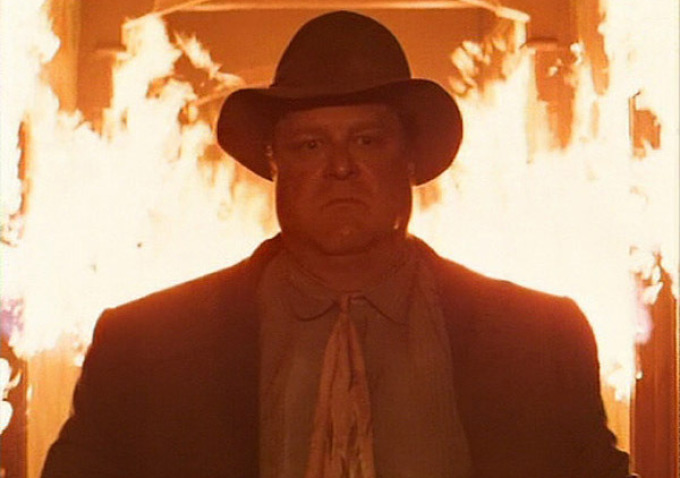
From their earliest films onwards, the Coens have used and exploited varying shapes and forms of the horrific for their comic potential. In Barton Fink, our first glimpse of the titular character (John Turturrro) shows him with a mortified expression on his face. Why is he mortified? Because, while watching his play being performed, he is scared of becoming second-rate. It would be easy enough, as well, to read the film’s conclusion, resounding with Charlie Meadows’ (John Goodman) near-immortal “I’ll show you the life of the mind,” as a suggestion that to truly look into the mind would be more terrifying than any of Fink’s visions of mediocrity; even so, the tone of the statement has a slightly leering quality to it, as if the very idea were a joke.  In Raising Arizona, what do H.I.’s escaped con pals (John Goodman and William Forsythe) do when they realize they’ve lost Nathan, Jr,? They scream, loudly and comically. Why? Because they’re scared of what the baby might be feeling, the baby’s sense of terror being as far from their experience as they can imagine. This exploration continues as the Coens’ films progress. Fargo is memorable not so much as a crime story as for its interweaving of the violent and the comic. When silent, brooding Gaer Grimsrud (Peter Stormare) blows a police officer’s head off from his car seat, the action is horrifying but also delivered with semi-comic timing; when Grimsrud feeds Carl Showalter (Steve Buscemi) into a wood chipper, we’re repulsed, of course, but we also giggle, a little, as we do when Jean Lundegaard, after being tied up in a kidnapping staged by her husband and having a hood thrown over her head, rolls helplessly around in the snow. The comedy here is a strong mix of terror and slapstick, made all the more dramatic by the flat, relaxed quality of its characters’ Midwestern accents. The Big Lebowski balances its share of fear and comedy, as well—the precariousness we witness here is the upending of the daily assumptions by which The Dude (Jeff Bridges) lives, on a daily basis. First his rug is stolen, then he’s attacked, then he’s drugged by a porn king—the obvious question, and the big question, is: what next? And the tumbleweed at the end of the film provides an answer, of sorts: because we don’t know, the best answer is to drift, and to take things lightly if we can. There are many darkly comic moments in No Country for Old Men, which flash by us like bullets, but the brothers slow down to present us with one scene which is pure Coeniana, as well as comic, as well as connected, one one level, to fear: a scene in which a black dog chases Llewelyn Moss (Josh Brolin). The dog runs after him, leaps after him, and, perhaps most memorably, swims after him, through rapids and waterfalls, across fields, over fences. Moss runs, of course, because, despite his courage in some ways, he is in some way scared of the dog, and beyond that, scared of being pinned down. Fear is all over A Serious Man, primarily fear of the future, and what grim events it might hold—and yet the Coens, by their own testimony, considered the torture of Larry Gopnik (Michael Stuhlbarg) to be central to its comedy, right up to the tornado in its conclusion. Fear lurks in Inside Llewyn Davis too, when viewed from the right perspective. There’s the much-chronicled runaway cat scene, in which Davis could be said to be scared of losing a part of himself, maudlin as the chase might be; but there’s also the fear that goes into any sort of performance, the fear that accompanies any launch of self into the void of an audience’s ears or eyes or minds, a fear empowered and increased by the great, great risk of failure. or rejection.

This is not to say that this is the only thing driving the Coen brothers’ movies. It’s certainly not. Their love of interiors, of drowning us in a certain period, along with the mood of that period; or their love of language (from Miller’s Crossing’s “What’s the rumpus?” to “He’s givin’ me the high hat!” to the outlandishly long sentences of True Grit, largely taken from Charles Portis’s book but doubtless part of what attracted them to the project; or their fascination with dream logic, cf. the progress of Barton Fink from a stiff stage play to a burning hotel—all of these things are part of the mixture as well. But without their humor, and without its (ironically) fearless push to the brink of disaster, their work might not be as compelling. The blazing, wild humor in their films serves as the mystery factor, the invisible keystone in an arch of energized idiosyncrasy. — Max Winter

Nelson Carvajal is an independent digital filmmaker, writer and content
creator based out of Chicago, Illinois. His digital short films usually
contain appropriated content and have screened at such venues as the
London Underground Film Festival. Carvajal runs a blog called FREE CINEMA NOW
which boasts the tagline: “Liberating Independent Film And Video From A
Prehistoric Value System.” You can follow Nelson on Twitter
here.

Max Winter is the Editor of Press Play.

VIDEO ESSAY: Dragons in Movies

VIDEO ESSAY: Dragons in Movies

HERE, THERE BE DRAGONS
by Matthew Cheney

In Siegfried’s Death, the first part of Fritz Lang’s 1924 epic Die Nibelungen, Siegfried slays a dragon and bathes in its blood, making himself invincible (except for a spot of skin that was covered by a leaf). The dragon is a lizard-like creature, more dinosaur than mythic god. Siegfried’s triumph is the triumph of a human over the ancient, bestial powers of Nature; it is a short-lived triumph, though, for as the title of the episode states, Lang’s film is a story of death.

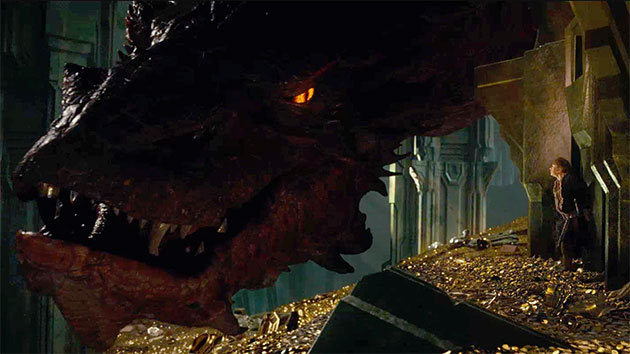
In confronting dragons, humans confront an ancient, alien Nature. Unlike the other popular fantasy figures these days—vampires and zombies—dragons are not transmuted humans, but rather something beyond us, other than us. Often, they are represented as deeply greedy, and this is their fatal flaw (e.g. Smaug in The Hobbit). They guard, hoard, and covet. Within most fantasy stories, they’re part of a medieval environment and their greed stands in contrast to the commons. The triumph of the little human against the dragon is a heroic reappropriation of resources and a signal of the human ability to triumph over the hoard of Nature—the dragon must die for civilization to advance. Sometimes, as with Die Nibelungen, that triumph and advancement is questioned, but most stories of good little warriors triumphing over inherently unknowable, evil dragons are stories of hard-won triumph, with nary a glance to the dark satanic mills ahead. The unspoken truth is that such dragons never die, but instead finds their revenge in human progress, their fire diffused through factory furnaces, their smoke blotting out the sky, as the smog of Smaug chokes and cancers the descendants of the triumphant hero.

And yet there is beauty and wonder in the figure of the dragon, particularly when the dragon flies. This is another dragon story, the story of the improbably lithe creature casting off gravity. Cinema loves to soar, and it is no surprise to see so many cinematic dragons shooting through the sky. In flight, the dragon gains a kind of freedom from the greed that holds it to a single place or particular hoard. Often, humans then can become not the enemies of dragons, but their riders—not equals, perhaps, but partners, a new force greater than either individual. As common as the story of the hero who defeats the dragon is the story of the rider who either tames it or is chosen. The elemental, alien forces of Nature can be turned into a tool and even, perhaps, a friend. The dragon’s power can be harnessed.

Power, indeed. There’s a certain industrial-warriorness to most dragons—flying, armor-scaled, fire-breathing dragons suggest the terror of early aerial warfare. (What is the Blitz but an attack of dragons?) In the sky, dragons move from being Nature to being Gods: the loving, helpful, or at least vaguely friendly God that is the dragon and its rider; the inscrutable, punishing God that is the fire-breather descending from the night. Unless tamed, this power must be destroyed. Controlled, it can be wielded.

As terrifying, elemental, and alien as they are, dragons are not always represented as nightmares. There are countless dragons for children, whether Puff or Pete’s. We seem to have a roughly equal number of scary/archetypal dragons as cute/cuddly dragons. There’s more than one way to tame, and train, your dragon. Taming nature, after all, sometimes just requires a kid to wield a lawn mower.

Because the dragon is so obviously Not Human, it can easily be misunderstood as evil, but sometimes dragons are, as Hagrid tells Harry Potter, just misunderstood. Sometimes, as Disney offered in 1941, they’re a Reluctant Dragon. And then there’s 1996’s Dragonheart, in which a dragonslayer and the last remaining dragon join forces. These are parables of tolerance, of overcoming animosities, of looking beyond the myths. We can learn to love and cherish dragons. We can come to see them as human. But the relationship is never equal. Taming them into our humanity, we dominate them, and, once again, win. (We must trick the scary dragons and tame the cute dragons. If we join forces, it is the dragon that must die, not the human hero.)

In cinema, the dragon must be an effect, its otherness unavoidable because it is a machine or an animation or a computer program rather than a person in a costume. Fritz Lang’s dragon was a giant puppet requiring a dozen operators to push and pull and twist and turn its mechanisms. The result only adds to the alien effect. The same is true of the stop-motion dragons of the mid-20th century films—no matter how careful and accomplished the motion, it is still clearly somehow off, and thus the dragon of ancient Nature is rendered unnatural, odd, scary, funny, wrong. The cute dragons get created in drawn animation so that their colors can be bright, their movement fluid. Their absolute otherness is made obvious, though, when, as in Pete’s Dragon, the dragon is drawn and the humans are live.

Regardless of the level of technical achievement—whether the primitive puppet-machine of Die Nibelungen or the advanced CGI of Harry Potter and the Goblet of Fire—the dragon is always clearly not a human actor. The alien must stay alien. Even today, when the dragons have achieved unprecedented realism on the screen, their only human quality is their voice. Whatever the result of our encounter with the dragon, what we know is that it will not, it cannot, ever be us. No matter how close, the dragon will always be at a distance. No matter the here, the dragon must always be there.

Leigh Singer is a freelance film journalist, filmmaker and screenwriter.
Leigh studied Film and Literature at Warwick University, where he
directed and adapted the world stage premiere of Steven Soderbergh’s
‘sex, lies and videotape’. He has written or made video essays on fllm for The Guardian, The Independent, BBCi,
Dazed & Confused, Total Film, RogerEbert.com
and others, has appeared on TV and radio as a film critic and is a
programmer with the London Film Festival. You can reach him on Twitter
@Leigh_Singer

Matthew Cheney’s work has been published by English Journal, One Story, Web Conjunctions, Strange Horizons, Failbetter.com, Ideomancer, Pindeldyboz, Rain Taxi, Locus, The Internet Review of Science Fiction and SF Site, among other places, and he is the former series editor for Best American Fantasy. He is currently a student in the Ph.D. in Literature program at the University of New Hampshire.

VIDEO ESSAY: Monsters Are a Child’s Best Friend

VIDEO ESSAY: Monsters Are a Child’s Best Friend

Most responsible parents will tell you that using the
television as a surrogate nanny is bad for kids. My own experience as a child
would argue against this.  My parents knew that they couldn’t raise me
alone, and the only reliable guides were creatures of the night.

This first became clear to me on Halloween night, 1971, when
my mom promised my sister and me a very special evening’s entertainment.  As the clock ticked towards 8:00 the lights
were dimmed in our basement rec room, the jack o’lanterns were lit, and the
popcorn was popped.  Though I’d probably
seen programs in black and white before, what soon appeared on the TV screen
would surprise me: these images seemed to come from a different world than the
Technicolor landscapes I had known. 

The sense of drama was heightened by a creepy old man coming
onto a dimly lit theater stage, offering viewers a “friendly warning” about the
frights to come.  As the credits rolled,
my anticipation intensified. Soon the first unforgettable images of James
Whale’s Frankenstein rolled across my
five-year old eyes and plunged me into a realm I have never entirely escaped.

In subsequent years I would revisit this world with greater
frequency. Frankenstein opens with a
marvelously constructed graveyard set. The mourners are surrounded by looming
grey sky, skeletal trees, and morbid gravestone figures.  The clanging church bell and quiet sobs of
the grievers sound as if they were recorded in a dank well.

The looming angles and impossibly long staircases of
Frankenstein’s castle draw from the nightmarish qualities of the
Expressionistic German horror cinema of the 1920s.  When I watched UFA productions like Nosferatu, The Cabinet of Dr. Caligari, and Vampyr years later, I would experience these angular horrors in
their purest form.

What struck me as a child watching these old Universal films
for the first time, and what still amazes me, is the concentrated power of their
characters.  The dead stare, wild arm
movements, and disconcerting forward lurch of Boris Karloff’s Creature have
become iconic. They are easy to imitate, as I would come to learn by donning a
“Frankenstein’s Monster” costume the following year. However, there is nothing
quite as compelling as the real thing. 

In the days before VCR, one could experience the most
arresting images of horror classics repeatedly through grainy photographic
reproductions. Magazines like Famous
Monsters of Filmland
, Creepy, and
Fangoria were the pulps of my youth. Their
garish covers splattered across drugstore and supermarket magazine racks across
suburbia.  The amount of time I spent
gazing at still images of movie monsters dwarfs the time spent watching moving
images on the television screen.

Yet the classic Universal monsters also offered a more
profound attraction: compassion.  The
Monster of Whale’s Frankenstein is a
creature more sinned against than sinning. 
He appeals to children because he is a child himself, his momentary joys
pathetic against a background of perpetual torment and tantrums.  In the famous scene in which he throws a
trusting little girl into the stream moments after tossing daisy petals with
her, his regret and shame is as poignant as the horrific senselessness of the
act.

Monsters, like children, can be cruel. However, the tragic
fate of figures like Frankenstein, the Wolf Man, and King Kong taught me
something essential about human behavior. Where strangeness and difference
tread, the torches and pitchforks aren’t far behind.  Classic monster movies don’t just depict the
monstrous. They convey what it feels like to be monstrous.

Since my first encounter with them on that Halloween night
long ago, monsters have helped me cope with feelings of alienation and anxiety,
teaching me a valuable lesson: friends may come and go, but monsters are
forever.

Jed Mayer is an Associate Professor of English at the State University of New York, New Paltz.

Jeffrey Canino grew up editing video on stacked VCRs. He holds a
Master’s in English Literature from the State University of New York at
New Paltz, and he blogs about horror cinema at his website, Nessun
timore:
http://nessuntimore.com

A Video Essay on THE X-FILES: Home Is Anywhere You Hang Your Head

A Video Essay on THE X-FILES: Home Is Anywhere You Hang Your Head

What is the American Dream?

Is it wealth? Power? Or it is something more existential like raising a family with a particular set of values?

By season 4, the X-Files was already considered one of the sickest, most graphic expressions of pop culture ever to be featured on a major network. That reputation could only have encouraged writers Glen Morgan and James Wong to craft “Home,” with imagery so disgusting that it transcends its place in X-Files lore and stands next to the classics of the horror genre.

In October of 1996, 18 million viewers watched their favorite paranormal FBI investigators, Fox Mulder and Dana Scully, enter the realm of The Peacocks, a mysterious family living in an isolated village called Home, Pennsylvania.

A grotesquely disfigured baby has been discovered near the Peacock house, buried at home plate on a baseball diamond frequented by young boys.

But what the writers of this story really want you to know is that this traditional American town is really . . . . Mayberry. 

Yep, that Mayberry. And Mulder can’t help but lose himself to the allure of Main street America, its nostalgia proving too strong to resist.

Sure the town of Home has baseball, cadillacs, a sheriff named Andy Taylor, a deputy named Barney and the traditional small-town architecture. But, don’t be fooled. If this represents the pinnacle of traditional small town American values, then what we see portrayed in “Home” are the rat-infested ruins of those same ideals. But, like Mulder in the opening scenes, Sheriff Taylor doesn’t see the rotting corpse.

An examination of the dead baby’s body reveals the Peacock’s are somehow breeding with each other, producing offspring with serious physical and health defects.

It is at this moment in the episode where Scully and Mulder make the fateful decision to invade the Peacock’s homestead with guns drawn.

Do the Peacocks deserve to be invaded this way? There doesn’t seem to be authentic evil shrouded beneath their lifestyle choices. For certain, an investigation into the baby’s death is warranted. But, is this an FBI matter? When you consider that incest law varies from state to state–in New Jersey, for example, there are no criminal penalties if both partners are over 18–Mulder and Scully’s case looks weak.  They are entering this house under false assumptions. One can argue this is an out-of-control government provoking a confrontation. No one is in danger — that is . . . until Mulder utters this single sentence:

“The mother of the dead baby is listening. She’s not only having sex with her grown boys, but she is also out to protect her children. And that threat to arrest her children leads to this :

The Peacocks remind us that baseball bats have many uses.

Under what circumstances does the government have the power to abridge the civil liberties and personal freedoms of American citizens?

The town of Home had few problems.

Until the FBI got involved.

And besides . . . .

Scully is flat wrong.

And the sheriff and his wife would be alive had the government handled this case differently.

“Home” is beautifully directed by the late Kim Manners, who packs this episode with unforgettable images, all of which contribute to the horror.

In the end, it is Mulder who finally comes to understand the Peacocks. Morally speaking, they are less like humans and more like wild animals.

And as everyone knows, if you do something stupid or dangerous to a wild animal, you might get killed. [cut to Mulder and Scully pulling a screaming Mrs. Peacock out from under the bed.] This is not their finest moment. Agent Scully is the first to realize the case against the Peacocks isn’t open and shut.

With this simple ending, the writers of this episode remind us that with in every cherished axiom — there exists the very opposite of that truth. The Peacocks may not look like your family, but the love and fierce loyalty they have for each other is not hard to understand. Besides, when was the last time you told your mother how much you love her.

There’s always tomorrow. The Peacock’s future is just an American dream away.

Ken Cancelosi is the Publisher and Co-Founder of Press Play.

Serena Bramble is a film editor whose
montage skills are an end result of accumulated years of movie-watching
and loving. Serena is a graduate from the Teledramatic Arts and
Technology department at Cal State Monterey Bay. In addition to editing,
she also writes on her blog Brief Encounters of the Cinematic Kind.

Self-Projected Artifice: The 49th Chicago International Film Festival

Self-Projected Artifice: The 49th Chicago International Film Festival

It was almost like a movie. Amat Escalante’s harrowing and
unapologetically bleak film Heli—which
looks at the crooked law enforcement and low-totem pole players of Mexico’s
drug cartel scene—came to a an ambiguous closing shot before dipping to white
for the end credits. The auditorium house lights came on at the press screening
I was at. No one moved from his or her seat. Utter silence. Then suddenly, a
critic in the row in front of me let out a groan. A very loud one. He wanted to
be heard. After 104 minutes of wince-inducing violence and despair, Heli offered no logical retribution for
its audience. The groaning critic was expressing one of two things: that he’d
witnessed a carefully nuanced, searing cross-section of a very real dilemma
south of the border—or that he’d just seen another arthouse trash film filled
with hot air. As other critics began leaving the auditorium, they started
chuckling at the thought of the groan. The groan seemed to carry an echo too,
as if it was a shared movie review, a unanimous proclamation that the Chicago
International Film Festival had once again managed to bring some of the more
polarizing films of world cinema to the Second City for the 49th consecutive
year. This year’s lineup was particularly dark in nature, from crude historical
narratives (James Gray’s The Immigrant,
Steve McQueen’s 12 Years A Slave) to
timely, devastating documentaries (the border crossing Purgatorio, the brotherly survival tale in Kenya’s Tough Bond). For all of its variety,
this year’s Chicago film fest found itself hovering over the theme of the
self-projected artifice, which was explored in three grossly differentiating
films.

You see, unlike most marquee U.S. film festivals such as
Sundance or SXSW, the Chicago International Film Festival has done a consistent
job of flying just below the radar of mainstream but several cuts above other
notable film festivals. Sure, there are “movie stars” who make appearances at
opening night and certain gala events, but the main crux of the Chicago Film
Fest is focused on its usually impressive program of world cinema. The fest’s
red carpet schmoozing takes a backseat to the discovery of new artistic voices
from international films that would be hard to find stateside.

Consider the above-mentioned Mexican film, Heli. For most of its running time, the
camera is deliberate in its movements. Slow pans reveal awful imagery: a boot
pressed against a man’s face, a man being forced to roll face down over human
vomit, and the devastating reunion of a woman with her husband after he was
savagely beaten. These images are all the more powerful because the characters
in the narrative are desperately trying to fool themselves into thinking they’re
bound to escape or even create a new life. In the violent landscape ruled by
the drug cartel, these poor Mexican peasants are disillusioned at best. In an
early scene, the protagonist’s wife visits a local psychic in hopes of hearing
the possibility of a new venture or at least to give validity to her current
situation. Later, during the film’s gruesome torture scene, a group of
adolescents in the background gleefully plays their American video games on
consoles. At one point, a young boy whips out his cell phone to film a victim
being tortured with fire and thinks out loud about the idea of uploading the
footage to YouTube. It’s that self-projected artifice—that daily routine to
dilute the horrors of one’s reality—which is what’s really striking about Heli. Lots of drug films have shocking
violence, but few observe the nameless people at the peripheries of the
screen’s frame and examine their ways of coping with their environment.

Sometimes this artifice is therapeutic. Part of the
festival’s documentary program, Rithy Panh’s The Missing Picture shows us one filmmaker’s in the 70s transcendent
retelling of his unfathomable childhood experience as a prisoner of the Khmer
Rouge in Cambodia by way of hand-made art; rather than relying solely on
historical archival footage, Panh used small whittled-down clay figures as
stand-ins for a majority of the film’s recreations. The title of the doc
resonates exponentially as the simple toy-like sets suddenly become vessels for
ghostly imagery. We can only imagine how the scenes played out in real life and
thus are forced to project our own anxieties and shock onto the stoic faces of
the tiny clay models on the screen. The effect is heartbreaking and, more
importantly, is never played for gimmickry. 

Finally, taking a hard right turn from subject matters of
drug cartels and Cambodian genocide, we land at the Cannes Palme d’Or winner,
France’s Blue Is The Warmest Color,
directed by Abdellatif Kechiche—which was one of Chicago’s festival highlights
to be sure. Centered on a remarkable lead performance by Adèle Exarchopoulos, Blue chronicles several years in the
relationship of a lesbian couple. Exarchopoulos, the youngest of the pair, has
to carefully micromanage each of her self-projected artifices. At her high
school, she “dates” a male classmate in order to ward off any suspicion or
prejudice toward her actual sexuality from her peers. At home, she deceives her
parents by insisting that her partner Emma (played by Léa Seydoux) is just a
tutor. Emma even assists with the mirage and fabricates a boyfriend during a
dinner conversation. These self-projected artifices are juxtaposed with Emma’s
own vocation. She’s a painter, using Adèle as her model for many of her works.
So, on display in the walls of Emma’s art galleries, is her true love—but for a
good portion of the film’s running time, their relationship is taboo for most
of their public appearances. When Adèle and Emma are older and living together
during the second half of the film, their struggles and strife link to the restraint
from those earlier scenes. The film floored me: Exarchopoulos is the
front-runner for the Best Actress Oscar.

With these three varied film selections—Heli, The Missing Picture,
Blue Is The Warmest Color—the theme
of the self-projected artifice rose to new challenging heights. Maybe by
looking through the eyes of our fellow foreign artists, we are able to peel
back some of our own layers of artifice (at least in what we produce in
American cinema) and see some fundamental similarities in our ways of handling
those scenarios, fiction or non-fiction. And as the 49th Chicago
International Film Festival drew to a close, I thought back to the groan from
that early press screening. If it did signify a sentiment towards a festival
that vehemently sought out challenging and polarizing titles from world cinema,
then I hope to hear the same groan next year.

Nelson Carvajal is an independent digital filmmaker, writer and content
creator based out of Chicago, Illinois. His digital short films usually
contain appropriated content and have screened at such venues as the
London Underground Film Festival. Carvajal runs a blog called FREE CINEMA NOW
which boasts the tagline: “Liberating Independent Film And Video From A
Prehistoric Value System.” You can follow Nelson on Twitter
here.

VIDEO ESSAY: Rob Zombie and the Cinema of Cruelty

VIDEO ESSAY: Rob Zombie and the Cinema of Cruelty

CINEMAS OF CRUELTY!

The
feature films that Rob Zombie has made between 2000 and 2013 create new
styles of emotional and perceptual disturbance from the corpses of
cultural products past. True to his name, Zombie reanimates dead tropes,
turns, and troubles into powerful attacks on our expectations and
desires.

By
summoning the spirit of previous movies, particularly, Zombie
encourages us to think we are watching a familiar pattern of story and
character. We think we know how and where to be shocked or repulsed,
whom to put our faith, trust, and hope in. We let down our guard.

Into the gap between our expectations and the reality of the film in front of us, Zombie sets traps to shred our desires.

It
was sort of like Ken Russell films or like Polanski or some Argento
films or Kubrick. There’s only certain filmmakers who really do this –
and David Lynch does it—where just the vibe of the movie is odd all
the way through. A David Lynch movie is just odd even when people are
doing normal things. You’re like, “Why does this feel so weird? What’s
happening here?”

—Rob Zombie, The Playlist interview with Drew Taylor, 29 April 2013

Zombie’s
movies are explicitly, extravagantly, and defiantly products of low
culture. The only sort of filmmaking less reputable than gory horror
movies is porn. Both traffic in sensation and exploitation. This is why
we need them. They’re all that’s left to break through the cool surface
of protective irony and oh-so-earnest, respectable emotionalism that so
many of us perform and parade and reward every day — to break through
into some part of our selves that few of us want to share with the rest
of the world. Such movies are the antidote to mumblecore and emo and
Oscar bait. We should watch these movies in seedy theatres where the
floors are covered with entire archaeologies of dirt, grime, rot, and
petrified bodily fluids. We should stare down at those floors and look
for our reflection, for it is there that we will find ourselves best
preserved.

Which
is why I thought of Antonin Artaud when I was putting together this
video essay. I want us to reclaim Artaud from the high cult of goodness,
where so many academics and critics have made excuses for him, tried to
tame him, tried to make him fit the higher cults. Those of us with some
academic persuasions need more shit in our systems.

I go to the library and grab a book off the shelf: Antonin Artaud: A Critical Reader, edited by Edward Scheer, where, in an essay titled “Cinemas of Cruelty?”, Francis Vanoye writes:

If
we want to stay close to Artaud while betraying him, as we must, since
we are trying to promote a cinema of cruelty, we must exclude all pure
and simple representations of cruelty (Sergio Leone?), all reductions of
cruelty to violence, crude sadism and blood, we must therefore exclude a
good part of the cinematic production of the past and especially the
present. Quentin Tarantino, for example, and his emulators, French or
American, who make of cruelty an object of representation and of
spectatorial pleasure.

Maybe
such a betrayal of Artaud is necessary in France, but it sure isn’t
necessary for me, an American, someone whose tax dollars have funded
atrocities throughout the world, whose political system is nothing if
not cruel, whose economic system is designed to strengthen the powerful
and marginalize the weak. No no no, we need a cinema of cruelty that
matches the cruelty of our hearts and citizenship. We need
representations that show us ourselves. We need images that make us want
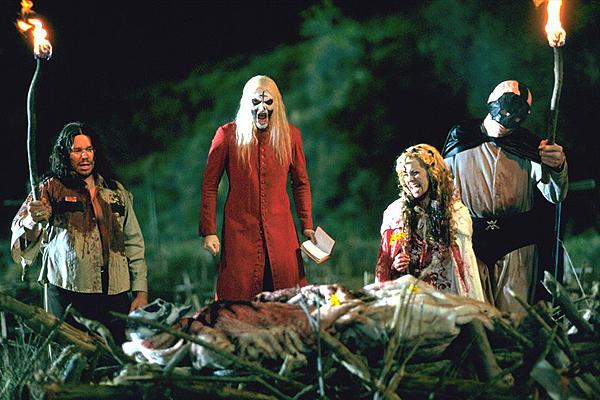
to look away at the same time they make us want to watch. The Devil’s Rejects
shows us, for instance, sadists we at first fear and detest, and then
it shows us that these are our heroes, and it gives us just enough of
the necessary tropes to make us want them to suceed in what we know is
sadistic. These, the film says to us, THESE are your heroes. They could be tour guides at Abu Ghraib.

What Zombie recognized in his Halloween movies is that our slasher films are character studies in disguise. The 2007 remake of Halloween
tempts us to learn to love Michael Myers, tempts us to recognize him
within the realm of child psychology, tempts us to recognize him as our
child or ourselves. He is no mere cypher, no flat archetype, but rather a
black hole of desire to attract our matter. Halloween II
is another world altogether, the beginning of a new (more explicitly
Lynchian) direction in Zombie’s work, an oneiric trap. Real and unreal
don’t exist in such a world: they are each other. We seek realities, but
Halloween II and The Lords of Salem refuse to give in to that desire, and instead show us that our need for the real is a need for comfort.

We
want our movies to be respectable, we want the feelings they give us to
be ones we don’t mind exalting to our families and friends. Those are
the movies we’ll give Oscars to, those are the movies we’ll assign our
students to watch, those are the movies we will proudly display in our
living rooms, those are the movies we’ll invite our friends to. Movies
that confirm our respectability. Movies that help us feel good about who
we are.

In
the practice of cruelty there is a kind of higher determinism, to which
the executioner-tormenter himself is subjected and which he must be determined
to endure when the time comes. Cruelty is above all lucid, a kind of
rigid control and submission to necessity. There is no cruelty without
consciousness and without the application of consciousness. It is
consciousness that gives to the exercise of every act of life its
blood-red color, its cruel nuance, since it is understood that life is
always someone’s death.

—Antonin Artaud, “First Letter on Cruelty”, trans. Mary Caroline Richards

If Rob Zombie’s movies understand nothing else, they understand that life is always someone’s death.

Why
does this feel so weird? What’s happening here? Our perspective is
being readjusted, our shame exposed. We have not earned the comfort we
desire. For a moment, we must recognize what perhaps we have
unconsciously known, the horrid truth we have repressed: that we are not
the innocent victims, but rather the executioner-tormenters. And deep
down, that’s what we’d rather be.

Matthew Cheney’s work has been published by English Journal, One Story, Web Conjunctions, Strange Horizons, Failbetter.com, Ideomancer, Pindeldyboz, Rain Taxi, Locus, The Internet Review of Science Fiction and SF Site, among other places, and he is the former series editor for Best American Fantasy. He is currently a student in the Ph.D. in Literature program at the University of New Hampshire.