Watch: L.A.I.: Spike Jonze’s HER Meets Ridley Scott’s BLADE RUNNER: A Video Essay

Watch: L.A.I.: Spike Jonze’s HER Meets Ridley Scott’s BLADE RUNNER: A Video Essay

This video amalgamation of Spike Jonze’s Her and Ridley Scott’s Blade Runner by Drew Morton has a sad, sweet quality about it, as if Morton were depicting two parts of the same film. Indeed, the movies show two sides of the same city, which in this case is futuristic Los Angeles. Los Angeles is a ripe creative playground for filmmakers, and they tend to exercise their recess privileges with great abandon. Jonze imagines the daytime city as a place built for both human convenience and soul-crushing anonymity; Scott imagines the nighttime city as a James-Joyce-meets-Buck-Rogers-meets-Raymond-Chandler stew, in which anything might happen, on the one hand, but the results might be depressingly predictable on the other. Similarly, blending the films this way makes one think that Joaquin Phoenix’s Twombly and Harrison Ford’s Deckard could be two halves of the same person–one vulnerable and open, the other jaded and wary. Both actors stepped out of their habitual roles for these films; Phoenix broke from his normal scenery decimation to play someone who was approachable, almost boring, and Ford played a character scarred by seeing the worst of life for too long, on his way to acquire still more scars, fresh from playing Indiana Jones. Morton skillfully allows the two films to bleed into each other, as when the music from Blade Runner becomes the music for Her–or does it?–and thus shows how two visions, separated by several decades, might possibly speak to each other, sending universal messages about loss and loneliness that echo and expand with repeated viewings, and with consideration.

Watch: What Is It, Kevin B. Lee Asks, That Makes a Video Essay Great?

Watch: What Is It, Kevin B. Lee Asks, That Makes a Video Essay Great?

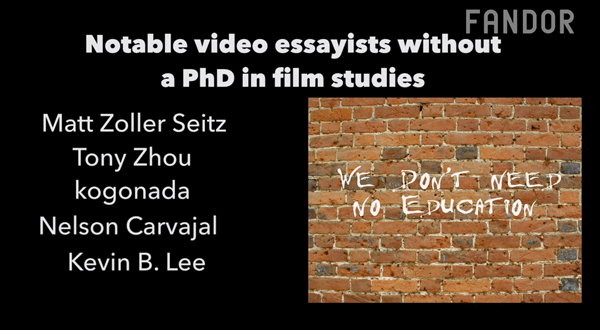
This excellent video piece by Kevin B. Lee for Fandor should be of interest to anyone who reads this blog regularly. If you go to the home page for Press Play, you’ll see a quote by Roger Ebert at the (more or less) upper left corner: "The best video essay source on the Web." And, if you’ll notice, a healthy percentage of the content posted here is, well, of the video essay variety. Faces in the work of Jonathan Glazer. What are the links between Martin Scorsese and Elia Kazan? The sublime in Michael Mann’s films. How has the treatment of rape changed in film and television–or has it? What is composition? The experience is simple. You press the play symbol, as the blog’s title suggests, and then what rolls in front of you is either a set of film clips spliced together with a voiceover or a set of related film clips bound together only by a (usually) catchy soundtrack and a fairly broad theme. And, there’s some accompanying text, either a transcript of the video essay’s script, or some text by me or someone else, an interpretation of or rather a response to the video you’re watching. Lee is asking a simple question in this video essay, in an animated and dynamic fashion, alluding to many of the acknowledged masters of the form, such as Matt Zoller Seitz, Nelson Carvajal, and Tony Zhou: what makes one of these pieces better than the other? How do we distinguish a meaningful video essay from a not-so-meaningful one? What’s the value of these pieces? You could learn a tremendous amount by watching Lee’s video: about Lee’s own erudition in film history, about the purposes and forms these pieces may assume, and also about the ways in which we (you, me, the person reading over your shoulder) watch films, these days. We interrogate. We dissect. We connect. We sever. We compare. We measure. We evaluate. The message here isn’t apocalyptic, i.e. Movies are done for! Embrace the video essay! Hug your iPhone, because soon it will be all you have left! Instead, it’s speculative: there’s more than one way to watch films, think about them, or discuss them–in fact, a plethora of ways. And the video essay, be it a 2-minute supercut or a scholarly work with MLA-approvable attributions in the credits, is one of those forms. It’s an enjoyable one, a moveable lecture. Take it or leave it, but give it a chance to wash over you first.

Watch: A Video Essay on the Links Between Martin Scorsese and Elia Kazan in THE DEPARTED

Watch: A Video Essay on the Links Between Martin Scorsese and Elia Kazan in THE DEPARTED

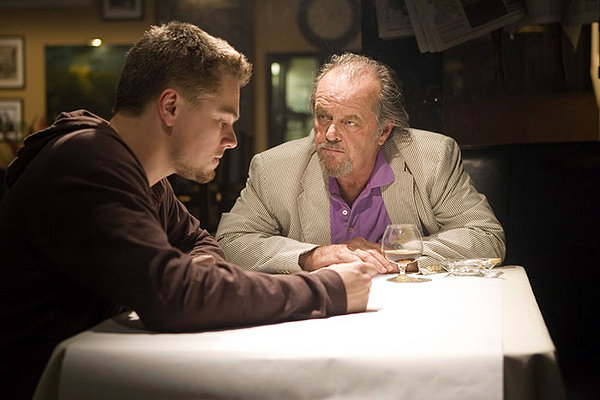
Cole Smith’s recent video essay on the links between Martin Scorsese and Elia Kazan brings a few important things to light, with an unusual amount of command and fluidity. One of these is the turbulent story of Kazan himself; Smith includes footage of the 1999 Academy Awards, at which Kazan received a Lifetime Achievement Award, presented by Scorsese, and at which only some of the audience members clapped. Why was this? Well, it was because, as many know, Kazan worked with the House Un-American Affairs Committee to name many Hollywood professionals suspected of having Communist leanings; it’s been said that On the Waterfront was an apology of sorts for this misstep. Smith leapfrogs over this moment to look at the Kazan film itself, along with A Streetcar Named Desire, to show how important the assumption of different points of view is for telling a story in these works, as in the contrast between Blanche DuBois’s and Stanley Kowalski’s vantage points in Streetcar or Terry Malloy’s and Johnny Friendly’s vantage points in Waterfront. It’s an easy transition, then, to a discussion of The Departed, one of Scorsese’s most successful films of recent years, and an examination of the way in which playing off Costigan’s (Leonardo DiCaprio) point of view against Sullivan’s (Matt Damon) point of view heightens suspense, stretches it to an almost wire-thin degree. Indeed, Scorsese’s films are at their best when they are taking us inside someone, whether it’s Travis Bickle in Taxi Driver, Jake LaMotta in Raging Bull, Henry Hill in Goodfellas, Teddy Daniels in Shutter Island, or, more recently, Jordan Belfort in The Wolf of Wall Street. Without that voyage into a character’s interior, there can be little empathy, and without empathy, the story can’t come to life inside viewers themselves.

Watch: Faces in the Work of UNDER THE SKIN Director Jonathan Glazer: A Video Essay

Watch: Faces in the Work of UNDER THE SKIN Director Jonathan Glazer: A Video Essay

In looking at Shaun Higgins‘ video homage to Jonathan Glazer, director of Under the Skin, Birth, and Sexy Beast, what is most striking is the presence of the human face. Or rather, the human face made vaguely unhuman. If you repeat a word long enough, as we know from childhood, it will eventually lose its meaning. And if you stare at a human face long enough, its components will eventually stop adding up to the thing we call "face" and will eventually seem much more like a random collection of bones, arranged into an image which is familar to us but which we can’t quite place. Consider, for instance, the face of Scarlett Johansson, the star of the most recent of the three films addressed here. In her other dramatic work, we expect that look from her face, a highly sexualized and yet open stare, somewhat as if, before her gaze rose to meet the camera, her eyes have made a scooping motion, as if she were either taking something in or simply taking her time to look upwards. Here, she’s numb, raw, dead-eyed, in some senses not animalian, but quite literally alien, as if the vantage point from which she views her male victims and the world around her is so far removed as to be incomprehensible to us. Nicole Kidman’s mother in Birth, far from the animated, mischievous taunting woman she played in Moulin Rouge, Eyes Wide Shut, or even Flirting, is so frightened and disoriented by the experiences depicted in the film that to say she is "beside herself" is not far from accurate. And what’s most visible in the amalgamation of gangsters’ faces from Sexy Beast shown here are different degrees of toughness under strain, most memorably displayed in Ben Kingsley’s craggy mug. These films are obviously quite complex, balancing hosts of elements, too many to adequately summarize, but characters’ faces, as this video piece accurately points out, make focal points for the films, entryways into their beautifully orchestrated madness.   

Watch: What’s at the Heart of the Sadness of Christmas Movies? A Video Essay

Watch: What’s at the Heart of the Sadness of Christmas Movies? A Video Essay

This touching and wise new video essay made for Criterion by Michael Koresky and Casey Moore highlights an idea which you’ll see plenty on the news but highlighted very little on the streets: that the holidays are not, necessarily, happy times for all. In fact, the pressure  to be happy, to be cheery, to celebrate, to gather with others, to bloviate on "the milk of human kindness" may make some of us want to crawl into bed and stay there for several days, getting up only to open the blinds, look out at a populace buying unnecessary mittens to the (weird) tune of "Santa Baby," and then go back to bed, pondering what stores might be open, what take-out options will be available on this holiday when so many businesses are closed and when human commerce, indeed, seems to close up like a shell for 48 hours or more. Too bleak? Okay, sure. In any event, these two film scholars extraordinaires have gathered a collection of movies that celebrate the dourness of the holiday in melancholy writ large. The three they choose to focus on, out of a list that includes Fanny and Alexander, A Charlie Brown Christmas, Gremlins, Metropolitan, and Eyes Wide Shut, are remarkable documents of yuletide emotional froth: Claude Jutra’s Mon oncle Antoine, a tale of coming of age admist financial desperation set in Quebec; Eric Rohmer’s My Night at Maud’s, a story of sexual and moral temptation set on a snowy Paris Christmas night; and Arnaud Desplechin’s A Christmas Tale, which concerns that famed institution of the holiday season, the family gathering–with many twists. Throughout the essay, we see one gorgeous, haunting scene after another: snow-filled, empty streets; huge apartment buildings checkered with glowing signs of absence or presence in their half-off, half-on windows; ice-covered countrysides with one or two figures running across them. The accumulation of these images serves to remind us of an intelligent point which Koresky and Moore make in the film, which is that the holiday season is as much about absence as it is about presence, and it’s important to give both parts their due.

Watch: My Life as a Swedish Pop Star: The ABBA Videos of Lasse Hallström: A Video Essay

Watch: My Life as a Swedish Pop Star: The ABBA Videos of Lasse Hallström: A Video Essay

[The script of the video essay follows.]

Agnetha, Benny, Bjorn, Anna-Frid: their initials spell ABBA,
a nonsense word, childish, almost preverbal, as much a brand name as a
band.  Their distinctive image,
indivisible from their sound and their success, was in large part crafted by Lasse
Hallstrom, a director better known for his quirky comedies, like My Life as a Dog, What’s Eating Gilbert
Grape, Chocolat
, and The Hundred Foot
Journey
. Hallstrom was getting his start as a television director in
Stockholm when he was approached by ABBA’s manager, Stig Anderson, in 1974. Anderson
wanted Hallstrom to produce a series of promotional spots for the group.  He would go on to direct over thirty ABBA
videos. These videos created an indelible pop image and documented the
super-group’s meteoric rise and tragic fall. 

Before MTV, music videos were a novelty.  Elvis’ fifties musicals and Richard Lester’s
films for the Beatles in the 1960s established many of the conventions of the
genre. Swoony close ups, rhythmic jump cuts, and intimate, casual footage of
the band goofing off captured the experience of listening to the music, and
indulged the audience’s fantasy of hanging out with the group. Singers like Nancy
Sinatra and Lee Hazlewood filmed television specials that ran like mini-movies,
juxtaposing performance with narrative film-making, setting the singers against
exotic landscapes, creating fantasy visions of the songs’ lyrics.

Then along came ABBA. 
After struggling for years as solo artists, the members of the group
began looking beyond the shores of their native Sweden for popular
success.  They first gained it with their
victorious performance of Waterloo at the Eurovision song contest in 1974.  Already the band’s signature elements are in
evidence: Anna-Frid’s imposing perm, Agnetha’s flowing mane, glowing Swedish
complexions, and costumes that look like they were made by two teenage girls
left for an afternoon in the attic of their stage-actress grandmother.  By the time they approached Hallstrom,  their charming smiles and unaffected pleasure
in performance were so irresistible they almost disguised the rudimentary
choreography. Also, the singers’ sex appeal nearly made up for their goofy
looking male cohorts. ABBA may have been the first video stars in pop history.

Hallstrom’s earliest videos for the group were all seemingly
shot in a day in the same studio, with costume changes between songs. The
videos laid down a basic visual vocabulary that perfectly complemented the
music’s elegant simplicity.  Camera zooms
in, mascara, lipstick, dazzling smiles fill the screen; pan right, taking in
the whole band, swaying with the music’s rhythms; quick cuts in time with the simple
four/four beat.  The men, fixed in place,
rooted to their instruments, lend a visual anchor for the minimal movements of
the women, by contrast making them seem dynamic, vibrant.  And through it all, what costumes: flashes
of David Bowie, Marc Bolan, Gary Glitter, but always with a quaintly home-made,
theatrical quality that made ABBA approachable, and silly, but in a good way.

One of Hallstrom’s visual signatures came from an unlikely
source.  In Persona, fellow Swede Ingmar Bergman juxtaposed the faces of
actresses Liv Ullmann and Bibi Andersson in dreamlike sequences suggesting the
gradual merging together of their identities and the mental and emotional
confusion that follows.  Hallstrom
employed this motif in a humbler context to create a visual counterpart to the uncannily
sympathetic voices of the band’s two singers.

Eventually Hallstrom took the band out of the studio,
setting them against landscapes that complemented the band’s Nordic image;
frozen tundra, sunset at sea, eagle over mountains.  As their songs began to take on more esoteric
topics, Hallstrom created mini-films that dramatized their peculiar lyric
narratives.  It’s easy to forget how
preposterous it is for two Swedish women to be reminiscing about some long-ago
revolutionary battle with the song set against a roaring fire, Bjorn strumming
away on his acoustic guitar…at least until the camera pans back to reveal an
obviously fake starry sky above.  The
video for their most successful single, “Dancing Queen,” avoids disco glitz for
a decidedly more downmarket club experience; the dancers all seem to be
underage, underscoring the song’s wistful nostalgia, as the singers look across
the generation gap at a girl having the time of her life. 

As the band continued to climb international pop charts,
Hallstrom responded to their global fan base with videos that allow us to hang
out with ABBA, strolling down the streets of Stockholm, even sharing
breakfast.  These intimate moments made the
band resemble the most successful double date in pop history. 

But this happy intimacy wasn’t to last.  In January of 1979, Agnetha and Bjorn
announced their plans to divorce. 
Anna-frid and Benny followed in 1981. 
Although they’ve repeatedly claimed that “The Winner Takes it All” was
not autobiographical, the video begins with a montage of the band in happier
times, before cutting to Agnetha, her curls hanging limply, mascara smudged,
face pale from crying: this is one of more nakedly honest images of despair
ever shown in a music video.  Hallstrom’s
lighting is natural, intimate, the editing restrained, with only the occasional
freeze frame to suggest the happier moments are snapshots of a time now
lost. 

“One of Us” is even more abject, portraying Agnetha
unpacking alone in a new apartment.  The
lighting is stark, the contrast harsh; this is ABBA’s first film shot on actual
videotape, and the colors seem drained of all their former vibrancy.  For one brief moment there is a splash of
yellow across the screen, recalling happier days, brighter costumes. 

Played from beginning to end, Hallstrom’s videos for ABBA
can be watched like one of his wistful comedies, youthful eccentricity and
goofy innocence giving way to bitter experience. Beyond telling us more about
one of the great pop bands than any of the numerous documentaries and tell-all
biographies that followed the band’s last performance, these small films created
a visual vocabulary for the video era that followed.

Nelson Carvajal is an independent digital filmmaker, writer and
content creator based out of Chicago, Illinois. His digital short films
usually contain appropriated content and have screened at such venues as
the London Underground Film Festival. Carvajal runs a blog called FREE CINEMA NOW which
boasts the tagline: "Liberating Independent Film And Video From A
Prehistoric Value System." You can follow Nelson on Twitter here.

Jed Mayer is an Associate Professor of English at the State University of New York, New Paltz.

Watch: A Beautiful Film Based On Criterion DVD Covers

Watch: A Beautiful Film Based On Criterion DVD Covers

This dizzying short film made by ::kogonada for Criterion’s web site is a moving gallery of cover images from the company’s ever-expanding collection of DVDs and Blu-rays, created to advertise the book Criterion Designs, which presents more than 30 years of art from the company’s products. As one image after another clicks by, covers along with clips from films by Wes Anderson, Akira Kurosawa, Harold Ashby, Alfred Hitchcock, Roman Polanski, Francois Truffaut, Fritz Lang, and anyone else you might name, a thought might arise: what’s in a cover? We’re told not to pay attention to it, to remain focused on what’s inside the packaging rather than outside it, but how can we do this? It’s not that we’re superficial beings, when all is said and done; it’s clear that the film inside the DVD box must be a more moving experience than the still image on the cover. And yet the cover represents something. It’s our last reminder, before we watch samurai go sword to sword, before we watch young Harold mock-kill himself before falling in love with batty Maude, before we dance around in circles with Jules and Jim and everyone we know, that what you are watching is a manufactured thing. It took years for someone to make, a tremendous amount of discipline, the coordination of hundreds of skilled laborers, all for the creation of something which flies across our retinae quite easily, something which was designed to be received by us without a thought for the toil that goes into it. What’s interesting about these Criterion covers is how much personality there is in them, and how handcrafted they seem, how much and how meaningfully the seams show, as if they were designed to appeal to the part of us that understands that a filmmaker is an artist, as much prey to quiet, personal moments of inner torment as anyone, just with an ancient medium for sharing them, whose challenges constantly vie for primacy over its rewards. 

Watch: A Video Essay on Pilgrims in Film: Tarkovsky, Powell and Pressberger, Marker, Ford, Denis

Watch: A Video Essay on Pilgrims in Film: Tarkovsky, Powell and Pressberger, Marker, Ford, Denis

For moviegoers flocking to see Jean-Marc Vallée’s film adaptation of Cheryl Strayed’s Wild, this beautiful Film Comment video essay on pilgrimages, written by Max Nelson and deftly edited by Violet Lucca, comes at a good time. It’s helpful to take a look back at cinematic pilgrimages from the past, as shown here in the films of Andrei Tarkovsky, Michael Powell and Emeric Pressberger, Chris Marker (incidentally considered by many to be the father of the video essay), John Ford, and Claire Denis. Doing so raises the question: What is a pilgrimage, after all? If the journey is, as it is in these films, secular, rather than a religious trek, then what’s the significance of the destination? Often that destination has profound meaning for the traveler which may not exist for anyone else. In Tarkovsky’s Stalker, the pilgrims seek a solution in magic; in Powell and Pressberger’s A Canterbury Tale, the soldiers march towards a military victory, however that might be defined; Marker, in delving into the Tarkovsky film at hand to distort it through his own experimental methods in Sans Soleil, could be said to be progressing towards the culmination of a vision, inch by inch; the widows traveling to France during the years following World War I in John Ford’s Pilgrimage are journeying towards acknowledgment of grief; the protagonist of Claire Denis’ The Intruder has removed himself to Tahiti to cope with guilt and self-disappointment over poor life choices. None of these destinations are tangible, tied though they may be to physical locales. The destinations seem to be points within, rather than without. The image we see most often in the samples collected here is a long look, off into the distance. What is that look at, precisely? Out to sea, up into the sky, into the eaves of an ancient cathedral: regardless of the actual endpoint of the gaze, this essay suggests that what the figures in these films are all looking at is the enormity of their journey, and what they are all feeling is the sense that the journey is larger than their capability to grasp it.

METAMERICANA: Gorillaz’ PLASTIC BEACH Is Our A HARD DAY’S NIGHT

METAMERICANA: Gorillaz’ PLASTIC BEACH Is Our A HARD DAY’S NIGHT

Fifty
years ago, at the height of Beatlemania, The Beatles released a
black-and-white film depicting their lives as rockstars in 1964. The
Oscar-nominated A Hard Day’s Night
took a quartet whose superstardom was positively cartoonish and
depicted it in gritty terms, delivering a clear message: The Beatles were now fame’s prisoners. As the band once put it in helping A Hard Day’s Night
scriptwriter Alun Owen encapsulate their experience in the public eye,
“our lives are a train and a room and a car and a room and a room and a
room.” Owen’s film depicted the Fab Four trying to
escape—unsuccessfully—from those geographic and spiritual
restrictions.

Now
it’s 2014, and we’ve come entirely round the bend: the gritty realities
of rock stardom have been so carefully detailed in decades of tour
documentaries and biopics that bands now long to fictionalize themselves
the way The Beatles finally did in Yellow Submarine (1968). But where Yellow Submarine
was an animated musical fantasy with comic overtones, popular culture
today allows for the intervention of comic fantasy only where the
cynicism of the music industry is implicitly acknowledged. In other
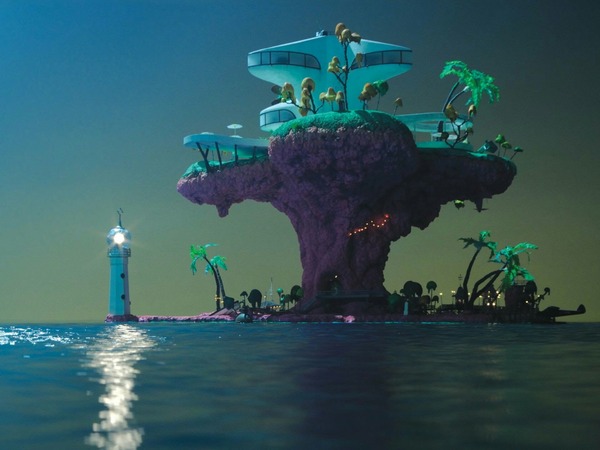
words, in the 2010s we get the alternately dark and sublime Plastic Beach,
a fan-constructed musical fantasy (published online just over a year
ago) that takes animation clips released in conjunction with the
Gorillaz album Plastic Beach
(2010) and orders them sequentially to create the album the "band"
itself likely intended. As of last month, well over 4 million people
have viewed Plastic Beach
on YouTube, and that number seems certain to climb much, much higher as
the film’s value as a High Art/Low Art hybrid is more widely
appreciated.

It’s only appropriate that this generation’s A Hard Day’s Night
be partly a piece of fan fiction–even if its component parts are all
band-produced. In a world of remixes, mash-ups, photoshopping,
virality, and spinoff memes, each of us can participate in our
collective culture-making project much more than sixties Beatles
fanatics ever could. And it’s only appropriate that it be Gorillaz
who come in for this sort of cinematic treatment, as from the start
Damon Albarn and Jamie Hewlett (the real-world duo behind the four
animated bandmates comprising Gorillaz) have been exploring how
conspicuously aestheticized realities often channel our contemporary
reality more clearly than gritty realism.

It won’t do to say here that Plastic Beach
was largely meant to be watched by citizens of Colorado, Washington,
Oregon, and Alaska—states whose voters recently made possible watching
this film in a state of benign intoxication—but it is important to note that Plastic Beach
is a “happening” more so than a linear narrative. There’s
unquestionably a well-storyboarded storyline at work (in fact, you can
read the whole thing here), and that narrative self-consciously echoes A Hard Day’s Night, as the
four fictional members of “Gorillaz” flee the trials and villains of
the civilized world to cut a new album on an island composed of
congealed first-world trash. However, the larger throughline here is that the
best music today is at once silly and skin-deep and raw and urgently
political. Plastic Beach
is therefore half archetypal “musical fantasy” and half a politically
committed statement about institutionalized violence and environmental
degradation.

It
certainly doesn’t start out that way. It starts (following a brief 3D
fly-by of the Gorillaz studio on “Plastic Beach”) with a hilarious
homage to Yellow Submarine: Snoop Dogg dressed like a fifth Beatle from the cover of Sgt. Pepper’s Lonely Hearts Club Band,
standing before an animated yellow submarine lifted straight from the
Beatles’ 1968 film. Snoop Dogg deserves credit for delivering here an
acting performance so inscrutable that after forty views of the clip you
still won’t know if he’s taking himself seriously or not.

What’s
for certain is that the lyrics of the Snoop Dogg/Gorillaz collaboration
“Welcome to the World of the Plastic Beach” belie the light-heartedness
of the attached visuals. “The revolution will be televised,” says Snoop Dogg, reversing the famous proclamation of seminal rapper Gil Scott-Heron, “and
the pollution from the ocean.” After urging “kids [to] gather around”
and hear his message, Snoop tells them, “I need your focus; I know it
seems like the world is so hopeless. It’s like Wonderland!” Which is a
pretty good summary of the Plastic Beach of the film, Plastic Beach the
album and film, and Gorillaz themselves: a Wonderland of
hopelessness that entices and even genuinely pleases with its fictions
even as it obscures its dark realities. We’d call the whole thing
cynical if it wasn’t so earnest about its political commitments. We’d
call it morose if Albarn and Hewlett weren’t so clearly having the time
of their lives animating the four fictional members of Gorillaz.

The
members of the band are distinct and memorable. There’s 2D (lead
vocals, keyboard, and melodica), a kindhearted and hapless waster whose
naive immersion in this cartoonish Limbo suggests a sort of everyman
Millennial. There’s Murdoc Niccals (bass and drum machine), a likely
Satan-worshipper whose nihilism and oily creepiness implies an
unthinkable penchant for violence just beneath the surface. There’s Noodle
(guitar, keyboard, and backing vocals), a Japanese girl whose tweener
otherworldliness seems simultaneously born of innocence and a possibly
alien consciousness. And there’s Russel Hobbs (drums and percussion), intended
by his creators to be hip-hop made flesh—so much so that this kind,
protective older brother-like figure can actually channel the ghosts of
former hip-hop superstars and inflate his own size to Iron Giant-like
proportions.

There’s no point in detailing all the shenanigans these four get into in Plastic Beach,
except to say that they involve machine guns, warplanes, Snoop Dogg,
cruise ships, giant manatees, ghosts, a pirate ship, a fleet of
submarines, a giant, a killer-robot version of Noodle, Bruce Willis,
sportscars, a terrorist organization known only as “The Black Cloud,”
and a devilishly well-conceived, gas mask-wearing, black-cloaked villain
named “The Boogieman.” What brings it all together, however, is first
and foremost the music—hip-hop soaked in a pop-tart reduction—and also
its political message, which (briefly summarized) is, “Stop killing each other and the planet, assholes!”
Plastic Beach is, at its heart, a rhetoric-conscious seduction. If A Hard Day’s Night asked us to wake up to the dark recesses of popular culture, Plastic Beach
is the allure of popular culture challenging us to “just like that,
wake up!” (lyrics from “Welcome to the World of the Plastic Beach”). Although we’re drowning in a 24/7/365 Wonderland of manmade stimuli, this very immersion can allow us to see our current dilemmas
with new eyes.  Albarn and Hewlett understand that living in the present
cultural moment is like having to force yourself awake–daily–from a
dream that’s 50% sublime and 50% a nightmare. Is a dream like that
better classified as entirely nightmarish, or is it somehow worth
inhabiting in the moment and worth remembering clearly later on? The
answer is: both. And that makes the interaction of the dream state and the
reality we find in Plastic Beach an existential question whose resolution is of dire importance to us all.

Seth Abramson is the author of five poetry collections, including two, Metamericana and DATA,
forthcoming in 2015 and 2016. Currently a doctoral candidate at
University of Wisconsin-Madison, he is also Series Co-Editor for
Best American Experimental Writing, whose next edition will be published by Wesleyan University Press in 2015.