LONGMIRE RECAP 2: A DAMN SHAME

LONGMIRE RECAP 2: A DAMN SHAME

Only two scenes in “A Damn Shame”  don’t depict Walt Longmire. The opening scene depicts a fire in a barn, with horses panicking, dying, and trying to break free. It’s interwoven with Walt in a sweat lodge, in a deliberately artistic style that pays off well here, making it clear that though Walt’s not in the scene, it’s still his story. The threat to the horses also ties the audience and the show’s characters to the case emotionally. (Click on the video above to view this scene.)

nullThe second scene without Walt takes place in the middle of the investigation, when a man claiming to be an FBI agent shows up at the station with the three main cops from the office. The most junior deputy, the bumbling Ferg, attempts to calm the agent, and in so doing, gives him the location of the family he’s looking for as well as the sheriff’s location. This is necessary to the plot, but we haven’t spent much time with Ferg yet at all, and “A Damn Shame” hasn’t given much previous indication that he’s going to get this much attention. More notably, the absence of Walt, Vic, or Branch at the office makes it clear just how dependent the show is on those characters, and how much stronger the narrative is for Walt's presence.

Once that brief break with Walt’s perspective occurs, it becomes much more apparent how much the episode is built around him. Though he’s not the main character, every shot in "A Damn Shame" focuses intently on Walt, or takes his perspective, or both. (Click on the video below to view the scene.)

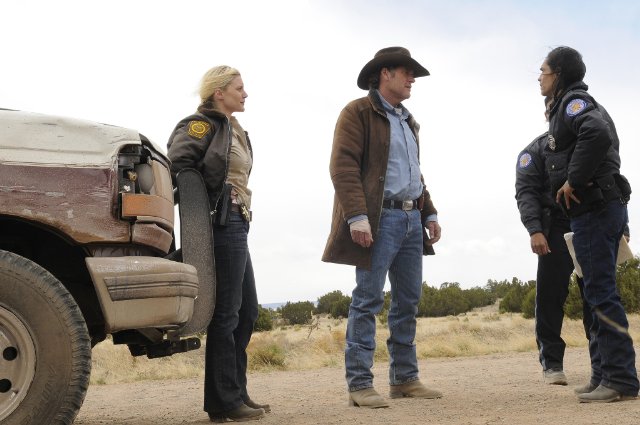
As the story and characters converge on a ranch house, the most dramatic moments occur. Walt and Vic start to walk towards the house, shots are fired, they take cover behind the police truck. The camera appears to take cover behind them. When new characters show up, he’s shown arriving in the distance, then he moves to the center of the shot. There are some brief wider shots, but the bulk of them are right alongside the show’s protagonist.

The tight focus on Walt and his perception here helps Walt’s tension become our tension. This can be claustrophobic at times, but in a good way. Were this a few seasons down the road, when Longmire has a larger cast of characters and more story threads to deal with, it might seem like a gimmick or worse, a waste of time. But we’re not at that point. Right now, the show really does seem like it’s just Walt’s show, and for the moment it works.

This tight focus also helps build the tension and set the stage for the solving of the mystery. Longmire, quite effectively, gives Walt as much information as the audience has, so when we’re suspicious, he's suspicious. If the audience is smarter than the main characters, a mystery show starts attracting disdain. On the other hand, if the characters are too much smarter than the audience, then the characters start seeming inhuman or the mystery begins to seem gimmicky. This show's respect for its audience’s patience shows up early in the episode, when a note from the apparently dead man in the barn fire appears. Each of the characters reads it, their reactions showing that the most likely reason for the note—suicide—is also what the note seems to indicate. Yet Longmire lets the reactions take precedence over the text, only substantiating those reactions later.

Through impressive technical competence, surprising for a show so early in its run, “A Damn Shame” maintains a down-to-earth tone in the story it tells, the characters’ reaction to the story, the way the story is shot, and the way the story is constructed. 

Yet all that competence is put into the service of a story that, well, doesn’t actually say all that much. A local man, Ray, appears to have committed suicide. But there’s just enough oddness in his pre-death behavior and the forensic investigation that Walt gets suspicious. Ray is eventually revealed to have been a mobster who bailed on his family and went on the run, and who then faked his death when he was discovered by the mob. Walt discovers Ray hiding in a basement, and confronts him on his cowardice for hiding while his family has been taken hostage, and refuses to believe otherwise based on his murder of the horses. Ray swears he’s not a coward, and wants the chance to redeem himself. Walt cuffs him, but Ray calls attention to himself anyway, helping Walt save Ray’s family, even as Ray himself ends up dead. It’s a conventional, dull redemption story, and sidelines his wife and son, who had been more interesting in the first part of the episode.

I’m much more impressed by Longmire’s ability to tell a story well than I am disappointed by any lack of creativity in its storylines. That sort of depth should come with time, character development, and world-building. Having a stand-out technical core makes the idea that the show will turn special more likely, and even if not, it should still remain high-quality.

Rowan Kaiser is a freelance pop culture critic currently living in the Bay Area. He is a staff writer at The A.V. Club, covering television and literature. He also writes about video games for several different publications, including Joystiq and Paste Magazine. Follow him on Twitter @rowankaiser for unimportant musings on media and extremely important kitten photographs.
GIRLS RECAP 10: SHE DID

GIRLS RECAP 10: SHE DID

Did she ever—no matter which of the main she's on Girls you might mean. Marnie makes good on her end of her and Hannah's big fight in the last episode; uber-responsible (read: uber-controlling) to the last, she pays the rent up to the end of the month, and then she moves out, leaving Hannah to find a new roommate.

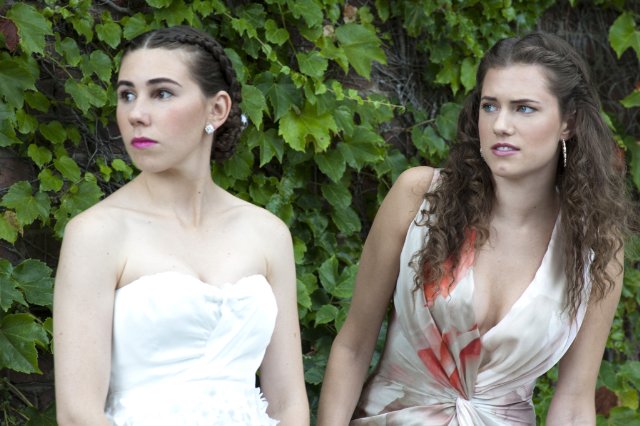
nullJessa also has a new roommate—her husband, Thomas John, a.k.a. the sad guy from the failed three-way. Apparently they went on a couple of dates; confused "new sexual partner, delirium caused by" with "lasting commitment, fitness for"; and invited all their friends to a party that's actually a surprise wedding. Everything about the event is quintessentially Jessa, from the idea that she'll mess with everyone's preconceived notions about free spirits to the "veil" that looks like she picked it out of the trash behind Beacon's Closet. Not only will the ensuing plots for Season Two write themselves (see: the months of material "Felicity" got out of this when Noel Crane married the Doritos girl), but a season-finale wedding is the perfect deus ex cake-ina for throwing characters together and stirring vigorously.

For example: Ray and Shoshanna. As predicted, Ray is really into Shoshanna; Shoshanna is really horrified that, not knowing that the party was a wedding, she dressed in white, and she's almost too preoccupied with that to overthink what she's agreeing to when Ray proposes taking her home that night. Later, in bed, Shoshanna's suffering from her usual logorrhea (observing that her aunt told her that losing her virginity felt like "scratching a sunburn" . . . wow, what?), but Ray is seemingly undeterred, and we're probably to assume that Shoshanna is relieved of her V card shortly thereafter.

Marnie, meanwhile, runs into Charlie at the wedding; he's sans new girlfriend—she's evidently live-blogging a tortilla-soup contest, or something?—and it seems like he and Marnie might go on a reunion tour together, but she isn't quite banged up enough on bubbly to go there . . . yet. The end of the night finds her draining yet another glass of champagne, eating cake with her hands, and making out with the Seth-Rogen-esque wedding emcee.

Even Elijah has moved on—to a new, older boyfriend named George, who's apparently hiding his relationship with Elijah from his homophobic teenage son. Elijah's having to live in an SRO until the kid graduates, which is the plot machination that allows Elijah to stay on the show: Hannah invites him to bunk with her, solving both their problems. (It doesn't hurt that he admits that he probably did give Hannah the HPV after all.)

But while it's a solution, it's also Hannah not moving forward, not growing up—staying stuck, facing backward. Marnie's moving out, without a plan, trying new things (or boys); Jessa's married, which is forward motion even if it's ill-considered; Shoshanna is dumping the virginity that keeps her a girl. Hannah is moving in with her gay ex-boyfriend from college, a known and safe quantity who won't challenge her. Adam has already suggested himself as the new roommate, pairing the proposition with a speech about moving on from toxic relationships without guilt, but Hannah just assumes he doesn't mean it, or that he just wanted to help. "Nobody does anything because they want to help; I did it because I love you!" he snaps.

Hannah doesn't know what to do with that information, and Adam doesn't sympathize at all, going off on her for following him "like [he's] the Beatles" for months and then giving him a "shrug" when he commits to her. The actor does a great job with a scene that, for Adam, is basically delivering an audience-proxy checklist of all the ways in which Hannah is an obnoxious, self-absorbed hypocrite: he yells that this is what Hannah wanted, and now she's not giving back. He bellows that she's pretty and a good writer and a good friend, but she doesn't believe those things about herself. Hannah tries to defend herself, to explain that she's scared, the most scared that anyone is, all the time, which I empathize with, and then Adam basically orders her to get over it, which I also empathize with. And then Adam gets clipped by a passing car, and he refuses to let her ride with him in the ambulance: "Don't let her in here. She's a monster."

The monster gets on the F train by herself.

Sarah: "Girlfriend is totally falling asleep and waking up in Coney Island with no purse, bet you a dollar."

Dirk: "No bet."

Sure enough, that's what happens—been there; walked home from that—and Hannah, who's lost her purse but managed to hold on to the slice of wedding cake, wanders out of the station and down onto the boardwalk as the light is coming up. Sunrise finds her on the beach, the Wonder Wheel behind her, sitting at the edge of the world eating cake. In a way, it's a reflection of her sitting in the bathtub eating a cupcake from the premiere—but everything's changed. But nothing has.

The finale showcases everything the show does well—which, I think, closely follows the list of reasons the show grates on people. Not everyone likes the girls of Girls, their self-absorption, their top-heavy ratio of theoretical to practical experience, their workshoppy ways of living, but Dunham and her co-writers have a perfect-pitch ear for how those people speak to and about each other. Not everyone wants to revisit the "thought we knew everything; actually knew fuck-all"-ness of their twenties, but Girls is a painstakingly researched document of that painful cluelessness.

The finale is also a great stage for the Adam character, who started out as a wince-inducingly accurate and familiar, but two-dimensional type of That Guy—dating around, waxing smug about wood craftsmanship while taking money from Grandma, not remembering where Hannah's from—and evolved into a nicely realized human being. He's also the embodiment of everything Hannah is afraid she'll never have, and at the same time that she will have—and then lose. She's still thinking like her high-school self. (And dressing like she doesn't own a mirror. I would love to know if this is intentional, because the problem is not Dunham's figure. It's that there is always always bunching. I'm just going to assume it's a character beat, because as such, it's quite effective.)

It's a strong end to the season; the writing feels confident, without the overworked or canned bits we got partway through. The show isn't for everyone, and it's about hardly anyone—and the niche appeal of/audience for what Dunham does is a legitimate reason not to watch the show or care about the characters. At the same time, though, you have to take the work for what it is. What's the expression—writing that tries to be for everyone ends up being for no one? Dunham's doing Dunham; she's doing it really well, and it's possible to hear some universals in it.

Sarah D. Bunting co-founded TelevisionWithoutPity.com, and has written for Seventeen, New York Magazine, MSNBC.com, Salon, Yahoo!, and others. She's the chief cook and bottle-washer at TomatoNation.com.

FALLING SKIES RECAP 1: WORLDS APART and SHALL WE GATHER AT THE RIVER

FALLING SKIES RECAP 1: WORLDS APART and SHALL WE GATHER AT THE RIVER

Falling Skies is back for its second season with a two-hour premiere that, as is so often the case with "special premiere events" these days, is actually two episodes shown back-to-back. So, Episodes 2.01 Worlds Apart and 2.02 Shall We Gather at the River constitute our relaunch into the post-invasion world of Tom Mason and the Second Massachusetts. It was not perfect, but definitely was tightly constructed and presented some solid science fiction in a watchable two hours..

nullIf you're just joining this series, it's not too terribly difficult to get caught up. Last season, aliens swooped in and attacked the Earth, winning the war in relatively short order through surprise and superior technology. Now resistance armies are fighting the occupation. Our hero is Tom Mason (Noah Wyle), a history professor whose knowledge of battles of the past proves useful (sometimes cloyingly so, when he rambles on about historical context) to the current situation. In tonight's Season 2 premiere, Tom's impromptu history lectures are mentioned with fond irony by people who've been irritated by them in the past, and maybe that's a sign the show will try to be a little less heavy-handed in that regard (although I really like the conceit that a history professor is useful here; history is, after all, one way to learn battle tactics). Tom has three sons, who are part of the 2nd Mass. Weaver (Bill Paxton) is the head of the division and a career soldier. Pope (Colin Cunningham) is a smart-ass gang leader who has joined forces with the division to the consternation of many, sometimes including the audience.

How the alien thing goes is this: There are nasty creatures we call "skitters" who look like giant reptilian spiders. There are big mechanical soldier types called "mechs." Teens are kidnapped by the aliens, who attach harnesses to the teens which appear to enthrall and change them. The 2nd Mass has been able to remove harnesses from two kids, both of whom experience residual effects, including enhanced physical abilities. One of the kids missed the aliens and rejoined them, the other, Tom's son Ben, hates them.

Late in Season 1, Dr. Glass (Moon Bloodgood) dissects a skitter, discovering a harness inside it. It was obvious to me at that moment that the harness is meant to turn people (and probably other beings) into skitters, but in the S2 premiere we hear two characters wondering how skitters reproduce, so perhaps it's not meant to be as clear as I think.

In addition to skitters and mechs, at the end of S1 we learn there are "overlords," essentially Roswell-style "grays." In the finale last year, Tom Mason boarded an alien vessel to negotiate with an overlord. Now you're all caught up. See? Not painful at all.

There are places where Falling Skies is not bad, specifically, but rather too corny. Tom returns to the 2nd Mass three months later, found, at random in a battle situation, by none other than his son Ben. Corny! Tom awakens from anesthesia at the exact moment that his flashbacks bring us up to the present moment. Corny! Reunions are a skosh too touching, and musical cues a skosh too moving. It's as if the writers don't quite trust that the inherent drama of the situation will entertain anyone. Which is ridiculous because: alien invasion! Earth destroyed! Children kidnapped! No hot running water!

It really is a shame because these situations do have drama, and they are largely well-played. The world of Falling Skies is a world where everyone has post-traumatic stress, and the heightened emotions of such a world do not need clichéd musical cues to deliver the goods.

Our first two hours this year are mercifully free of inspiring speeches, self-righteous prayer, and extended rumination on the Meaning of It All. Instead, there was some very strong television and exciting science fiction adventure, including some engineering trickery and Tom's journey through other parts of the U.S., which helped create real perspective on how far-reaching the war actually is, as well as a creepy alien parasite.

Creepy alien parasite! On the same day I saw Prometheus! UGH.

The creepy alien parasite (without spoiling anything) encapsulates much of what is excellent and also what is weak about Falling Skies. On the one hand: Creepy alien parasite! That is alarming. It's a shivery, oogy journey into science fiction that makes the world of the show as dark and "other" as it needs to be. On the weak side, it is simply not taken seriously enough. The 2nd Mass has both career soldiers and civilian survivors, but the civilians simply refuse to live as though, you know, there’s an alien invasion. There are always too few guards and too little fear.

Any post-apocalyptic entertainment works by showing us how much and how little we've changed, how hard the new life is and how traumatic the loss. It awakens us to what we have, stirs our fears of what we could lose, and plunges us into a fight for survival. This is true not just of Falling Skies but of The Walking Dead, Battlestar Galactica, or any number of others. When these shows succeed, they rouse all these intense feelings. When they fail, they make us feel like the end of the world is a lot like any other television show.

Deborah Lipp is the co-owner of Basket of Kisses, whose motto is "smart discussion about smart television." She is the author of six books, including "The Ultimate James Bond Fan Book."

TRUE BLOOD RECAP 2: AUTHORITY ALWAYS WINS

TRUE BLOOD RECAP 2: AUTHORITY ALWAYS WINS

You know the endlessly self-amused Nazi prick Christoph Waltz played in Inglourious Basterds? Well, someone over at True Blood casting found a prim-o Waltz-alike in the actor Christopher Heyerdahl.

nullHeyerdahl plays Dieter, a sociable sadist and Vampire Authority operative. His vampire theology monologue—shared while torturing Bill (Stephen Moyer), no less–finally gives Alan Ball, who's leaving the show this season, a chance to actually offend people.
Dieter asks Bill if he recalls what’s special about the Vampire Bible.

And we learn that what’s special about this Bible isn’t that it predates The Old and New Testament. Or that it’s the original Testament, telling how God created Adam and Eve as food for vampires and for God’s greatest creation—Lilith. 

No, what’s remarkable in this time of election year Fundamentalist fever is that God created Lilith in his image, as God is a vampire.

As Dieter editorializes, “Powerful stuff indeed!” (To view this scene, please click on the video above.)

If this episode is any indication, Season Five will indeed be powerful stuff. I’m just not even certain what genre it is anymore.

I mean, sure, there are vamps and shifters and werewolves. But Ball is also fusing the zero sum war between Fundamentalism and sanity inside large institutions, with allusions to splintering U.S. conservatism in an election year. And making no bones about it.

But there’s much more. There’s an ongoing, Andrew Sullivan-style "death of gay culture" subtext argument, an import of the main theme of Buffy’s Season Six necro-existential crankiness, courtesy the turning of Tara (Rutina Wesley) into a vampire—or as I’ll call her from now on, the Tarapire.

And at least half the show is finally showing us the Vampire Authority. Damned if their underground realm, all chrome, sleek curving plastics amid a mid-century futurism that never happened doesn’t evoke a Swingin’ 60s spy film, equal parts Phillipe Starck and Ken Adam (the master designer behind Thunderball, Dr. No, and The Ipcress File), 

At the center is Roman, the Authority himself, played by Christopher Meloni with the a brand of hyper-intense, top-dog, apocalyptic Type A times Pi machismo imported from an edgy production of Glengarry Glen Ross.

Roman, the ultimate sanguine super CEO, who loves to toss off non sequiturs like “Do you think that the whole concept of the common good is hopelessly naïve?”—which allows Eric the drollery of “I try to stay away from politics.”

But True Blood certainly doesn't.

But on to recapping. Much of this week is devoted to the Tarapire’s freak out, when she tears down down Sookie’s house.

Dying has been a really positive thing for the Tarapire—she’s very assertive (bam, there goes the fridge), has a killer deathly stare, and most of all, she doesn’t complain.

When she does snarl to Sook and Lafayette (Nelsan Ellis) that “I will neither forgive either of you,” there’s the delicious possibility that she’ll be promoted to full-blown bad guy. (To watch Tara in vampire form, please click on the video below.)

Things are going from bad to incredibly terrible for Bill and Eric (Alexander Skarsgård).

An Authority operative new to the show named Salome (Valentina Cervi) escorts them to the 60s design extravaganza I mentioned earlier, and jails them in a facility where they’re tortured with artificial sunlight and liquid silver and interrogated by sophisticated sociopaths like the aforementioned Dieter.

Over in our werewolf subplot, Alcide (Joe Manganiello) is refusing to join the pack in eating the corpse of ex-pack leader Marcus. Among the ritual diners is Marcus’s mom, Martha (Dale Dickey).

Clearly signed up for her gnarly, white thrash outlaw Sons of Anarchy appeal, and this impressively gross scene aside, Martha is a terrific addition to the cast, a gravel-voiced biker chick in her deep fifties with a worn regal vibe that fascinates.

Martha insists in several scenes that her daughter Emma, child of Marcus and Luna (Janina Gavankar), has more in common with her werewolf father than with her. This is a teaser for a scene that is astonishing, that demands you not drink fluids for you may gag or spit them up.

But right now, we’re talking Terry flashing back to Iraq and saying, “It’s coming for us.”

Will this show ever tire of crazed Iraq storylines? Can’t Terry get possessed by fairy lemurs or something, just once?

Then, a sweet cookie of a backstory is tossed to Pam (Kristin Bauer) fans. It’s a bawdy house in San Francisco, 1905. After a Campari, she hits the street. A creep tries to kill her, but in a flash Eric, in full Victorian eveningwear, kills the guy, licks the blood off his fingers and gives Pam his charm-face. There’s something oddly tentative about the show’s depiction of pre-vamp Pam, like Ball isn’t certain what he think of her quite yet. Still, that dress is a keeper. (Pam meets her maker, Eric, below.)

Sam (Sam Trammell), meanwhile, is recovering from his own wounds when Martha shows up, again insisting that Luna and Marcus’s toddler has supernatural canine blood in her veins. “She’s wolf—I can feel it!”

Are you sitting down? If not, do.

You’ll next see a scene where Jason goes to Hoyt’s mom’s, only to be rebuffed as by Hoyt (Jim Parrack) yet again as a girlfriend-fucker. And then we’re back at Luna’s house.

Suddenly, director Michael Lehmann cuts to a puppy in pajamas.

No CG, no make-up. Just a puppy in jammies. Only on True Blood.

There’s no way to follow that, but the show must go on. We end up deep in vampire Authority HQ, where Dieter is explicating that theology we started with, ending with what I assume will be the crux of this season’s drama:

That there are Vampire Bible fundamentalists who believe in a utopia where humans are farmed for food and human/vampire intimacy is blasphemy.

And there’s the Authority and Roman, who believe in “mainstreaming” and peaceful co-existence with humans.

In their secret chambers, the congress of the Authority lorded over by Meloni, dressed in the ultimate Hugo Boss-style pinstripe power suit.

Roman considers Bill and Eric, and says, “I’m in a real pickle here, boys.”

The pickle is—he needs to mete out justice to the killer of Authority member Nan Flanagan. Who Bill and Eric did kill.

Roman is the king of the mainstreaming cause, and he tells about it in detail, which is cool: I’ll listen to Meloni yell at me about a Google search for superior celery, he’s that violently entrancing.

Meloni wants to stake Eric and Bill. Bill has something to trade: the news that psycho-vamp Russell Edgington (Denis O'Hare) is alive.

Russell the anarchist psycho-vamp who would love nothing more than to destroy the Authority’s mainstreaming initiative for the sheer fun of it.  

As Meloni considers the import of this news, Lehmann cuts to Russell in a cart, his skin cracked into a thousand bloody fissures.

In true Edgington style, he licks his ruined lips. Gross! (Awesome.)

This week’s vestigial subplots:

Luna

She falls victim to Bon Temps’ most prevalent illness: unmotivated Sudden Character Reversal Syndrome. Last year, Sam became a murderous asshole for no apparent reason. Now Luna’s becoming a mean jerk, apropos of nothing.

Steve Nawlins

Steve Nawlins claims vampires for Christ. Will this dovetail with the Authority’s interests?

Jessica (Deborah Ann Woll)

Nawlins tries to buy Jason from her. Jessica says she does not sell her friends. Like, ever.

But mainly this week is owned by  Meloni’s Roman, the Tarapire, and the puppy. Good times.

Ian Grey has written, co-written or been a contributor to books on cinema, fine art, fashion, identity politics, music and tragedy. Magazines and newspapers that have his articles include Detroit Metro Times, gothic.net, Icon Magazine, International Musician and Recording World, Lacanian Ink, MusicFilmWeb, New York Post, The Perfect Sound, Salon, Smart Money Magazine, Teeth of the Divine, Venuszine, and Time Out/New York.

LONGMIRE RECAP 1: THE LONG ROAD

LONGMIRE RECAP 1: THE LONG ROAD

null

While a mystery procedural isn’t the most revolutionary premise for a television series, there were several aspects of the Longmire pilot that indicated that it might be particularly interesting. First, it had a distinct visual style. The opening scene of the pilot, with Longmire in the shower, the camera bouncing around, and messages left on the answering machine conveys character and tone superbly—and simply—through style.

The show’s setting is also compelling, though not in such a positive way. The rural county in Wyoming is not a common location for a TV show, and Longmire effectively conveys how small and interconnected Absaroka County is. The placement of a Cheyenne reservation nearby also adds specificity, but tensions between the reservation police and the protagonist create an uncomfortable dynamic. The heroic white man, unfairly vilified for exposing native corruption, ends up a hero after reuniting a lost Cheyenne girl with her mother. It’s very White-Man’s-Burden, and quite awkward because of it. I’m hopeful that the show will grow more nuanced in its portrayal of the Cheyenne. Given its competence elsewhere, this seems likely, but the focus on the whites as the primary cast members is less promising.

The show’s use of an election as its main hook for long-form serialization mosyt appealed to the part of me that enjoys analyzing structure. Walt Longmire is the show’s hero, the character it’s named for, but he’s a mess. Branch Connally, his deputy, has recognized that Longmire is a mess, and decided to run against him. Connally’s reasons seem entirely valid—Longmire’s been an absentee sherriff since his wife died, a year ago, and has left the running of the station to the deputies. Had you framed most of the scenes from Connally’s perspective, he would have looked like the hero of this story. “Quality television” is often based on male anti-heroes, but Longmire’s not quite there. He’s more of a broken hero, teetering on the edge of failure. And his failure comes from inaction, not from making the wrong choices—at least, that's the show’s premise.

For better or mostly worse, not many of these qualities are on display in the second episode, “The Dark Road.” Second episodes of dramas are usually weak, to be fair. They’re produced well after the pilot, and they generally serve to reintroduce the characters and world for people who are theoretically tuning in based on word-of-mouth after the first episode. This tends to make second episodes feel watered-down, which describes “The Dark Road.”

The biggest component of the pilot missing here is any mention of the election. Branch Connally is shown as a somewhat cocky member of the department; the only visible tension between him and Longmire is a slight young pup-old dog dynamic. This makes the revelation at the end of the episode—that Connally is sleeping with Walt’s daughter Cady—lose most of its impact.

Instead,  a flashback represents the show’s serialization. Walt is having a scar on his back sewn up, as he talks to his friend Henry, saying that his daughter must never know. That’s the entirety of the scene. This is far less auspicious than the election as a hook for viewers. I tend to be quite wary about overarching mysteries like these. Here, the characters have information that the audience lacks. By not allowing us to see it, the show is essentially taunting us, and that’s not a great way to start a relationship.

This episode also doesn’t deal with the Cheyenne, either, choosing instead to focus on another group of people more common in the rural west than most other places in America: Mennonites. One of their teenagers, a girl on her “rumspringa” outside of the community, has ended up dead. She’s also a stripper, which Sheriff Longmire figures out because the show uses the TV shorthand of saying she’s covered in glitter (because as everyone knows, married men who go to strip clubs love coming home with glitter on them, as it spares them even needing to bother discussing where they’ve been).

The Mennonites come across worse here than the Cheyenne did. The only family we see in any detail is ruled by a patriarchal iron fist, which ends up being the cause of the girl’s death. Her father, knowing she was a stripper, doesn’t care about her death. Her mother is more sympathetic, but paralyzed by the fear of the patriarch. And the mystery’s resolution is that the girl’s brother accidentally killed her while chasing her, because he saw her drifting away from the culture by becoming a stripper, and he had been told that he couldn’t go back unless he returned her as well. This is also a traditionally American argument—that secular laws allowing freedom are superior to religious fundamentalism. The show strongly implies that this is intentional, showing the state flag immediately after the scene where the Mennonite mother admits she wanted her daughter to escape the household tyranny.

There’s an essential conservatism to mystery shows, especially those based around law enforcement. Longmire’s focus on “lost girls” as the victims of the first two episodes—helpless, threatened, needing rescue, or dying—instead of telling their stories shows a fear of girls doing sex work. This may be an entirely valid anxiety, but the decision to talk about the sex workers in both episodes, without actually letting them tell their story, says a lot about Longmire. It’s too early to see if that conservatism is a core feature, and I’m not sure if Longmire intends for it to be. But where the pilot involved an examination of those concepts through the struggles of the characters, “The Dark Road” plays it entirely straight, which is a shame.

Rowan Kaiser is a freelance pop culture critic currently living in the Bay Area. He is a staff writer at The A.V. Club, covering television and literature. He also writes about video games for several different publications, including Joystiq and Paste Magazine. Follow him on Twitter @rowankaiser for unimportant musings on media and extremely important kitten photographs.

GIRLS RECAP 9: LEAVE ME ALONE

GIRLS RECAP 9: LEAVE ME ALONE

The climactic argument between Marnie and Hannah in "Leave Me Alone" is soooo satisfying—and it's not merely because Marnie is acting as the viewer's proxy in calling Hannah fully and completely on her bullshit. That's fun, but Marnie isn't even alone in that this week, because Hannah's finally gotten a semi-, sort-of, part-time coffee-shop job . . . and her manager is Ray. Ray not only sends Hannah home to change when she shows up in a stain-tempting white dress, ordering her to "forget all the BBC you watch at home with your cats" and put on something appropriate; he also advises her on what to buy at American Apparel, complete with hand gestures ("slim leg! slim leg!") (not for nothing, but a skinny jean is about the only thing that would be less flattering to Lena Dunham's figure than the dresses Hannah already wears).

null

Ray also gives explicit voice to the anxieties of young writers about their material—specifically, whether it's "serious enough." I had to accept years ago that I'd never make that cut, because when I was Hannah's age, the internet was considered the JV, at best, never mind writing about television on the internet, or telling funny stories about karate class or doing your laundry. I didn't have an agent, I didn't write literary fiction, and it didn't really matter, at all, but back then, if a guy like Ray had blown off my subject matter as frivolous—"How about divorce? How about death?  . . . How about death?"—I would have taken it to heart, and I would have tried to write a somber, well-researched, mindful, high-fiber piece about municipal politics, and it would have bombed, just like it does for Hannah at her reading. Hannah's former writing prof is very encouraging throughout, and seems to understand what Hannah's writing strength is, whether it's one that Hannah wants to own or not. (He's also played by Michael "Christopher Moltisanti" Imperioli. Imperioli has other, more recent credits, but I have to think the casting is meant to recall "Christophuh"'s struggles with the written word over the run of The Sopranos.)

But Hannah feels that snarky essays about dating a hoarder and spending the night on a stack of flattened Chinese-food cartons won't get you onto "Fresh Air." Of course, that very sort of observation by Dunham has gotten Dunham herself onto "Fresh Air," via "Girls"; the episode really nails the insecurity and toxic envy of starting out as a writer, although I'm not sure it's something Dunham has really experienced in that way. Maybe episode co-writer (and New Yorker cartoonist) Bruce Eric Kaplan helped shape the bits with Tally Schifrin, Hannah's creative-writing program-mate who already has a memoir out. Tally's a perfectly drawn cartoon of the non-fiction classmate we all despised, the well-connected mediocrity just clever enough to leverage a single incident or tagline into a hardcover deal. If you thought Hannah snarking that Tally's "lucky" to have a boyfriend who killed himself so she could write about it was too over the top, even for Hannah, you haven't spent that much time around writers. (And you shouldn't start. We are ruthless.)

Professor Imperioli is comforting, telling Hannah the thing every struggling, lost essayist wants to hear from someone in authority—that Tally's a "shitty" writer, and Hannah is good. It's more than Marnie has mustered; asked her opinion of the hoarder-date essay earlier, Marnie deemed it "a little bit, like, whiny." But when Hannah whines that Marnie could be a bit more supportive, Marnie sighs, "Hannah, I support you. Literally."

And when Hannah comes home from the reading and bags on Marnie for throwing clothes away instead of donating them to Goodwill, it sets off a very rewarding showdown. As I said before, it's partly because Marnie is ranking on Hannah for all her friendship sins: Hannah's selfish; she uses her self-loathing as an excuse to be a narcissist; she has no other subject but herself. Hannah gets a few good shots of her own off—Marnie is too focused on achievement and comparing herself to others; her woe-is-single-me routine is getting old (we haven't really seen that, but I'm fine with inferring it from Marnie's sad-sackishness last week); this is about Hannah having a boyfriend and Marnie not having one, because it throws off the balance of power. Now, Hannah doesn't use exactly those words, and it's a topic so nuclear that most women friends would never go near it out loud—but Marnie is used to having the boyfriend, feeling the pity instead of needing it, fitting into the size 6 (a fact she makes glancing reference to by saying that one of her old dresses might fit Hannah a bit snugly—exactly the right tone and wording for that kind of slight).

It's possible that Hannah isn't only selfish and lacking in empathy for Marnie; it's possible that, as the one who's feeling more settled emotionally for a change, she doesn't know how to support Marnie. But . . . it's more likely that, just as she herself says, being a good friend "isn't a priority for" her right now. Marnie's icy "thank you" when Hannah admits this echoes of the audience—because no shit, first of all, and second of all, it's not just Hannah. It's Marnie; it was me, I think, at that age. I'm not sure I had "friends," exactly, so much as "people I stood next to while holding a beer, in order to hate myself outside my apartment now and then."

All of Hannah's scenes, and the post-collegiate writing-competition stuff, totally resonated with me—and pretty much made up for a baffling plot "development" for Jessa in which Kathryn Lavoyt shows up at her apartment to ask her to come back as her daughters' nanny in spite of everything. It's unclear what Kathryn thinks happened, or how she found out about it—Jeff could have confessed, but it seems like something Jessa would do to quit and explain exactly why—but she takes the opportunity to share a very on-the-nose dream she keeps having about stabbing Jessa and eating her body while her mother is breastfeeding her husband. Kathryn gets a speech about how Jessa causes dramas like this, to distract herself from becoming who she is. Jessa looks intrigued by that possibility, and asks who she's becoming, then; Kathryn's response is more speechifying about how that person might not have a cool job or hair "like a mermaid," but might be happier than Jessa is now. Or . . . something. I really can't tell whether we're meant to hope that Jessa hears something for herself in these Now The Married Lady Will Tell You Your Life pearls of wisdom, or to think that Kathryn's condescending and out of touch. I have to go with the latter, although I don't think the scene came out the way it may have been intended.

And speaking of things that perhaps weren't intended . . . is that a jar of mayonnaise next to Hannah's bed? And do I want to know either way?

Sarah D. Bunting co-founded TelevisionWithoutPity.com, and has written for Seventeen, New York Magazine, MSNBC.com, Salon, Yahoo!, and others. She's the chief cook and bottle-washer at TomatoNation.com.

MAD MEN RECAP 12: THE PHANTOM

MAD MEN RECAP 12: THE PHANTOM

Most nights I watch Mad Men on my living room couch with a computer in my lap. Tonight I watched at a terrific New York City bar, at the Basket of Kisses Season Finale Party, sitting next to Rich Sommer. It was a fantastic experience: Cheers, applause, shock—there's truly nothing like sharing the show with a large, respectful, enthusiastic audience. Respectful, because they're quiet enough that no dialogue is missed, but enthusiastic enough to burst into cheers when Pete gets punched out, and then punched out again—at which point I said, "Joan was right—everybody does want to take a pop at Pete Campbell." Watch the clip:

When Don was watching Megan's screen test, I whispered to Rich, "Do you need to leave the room crying?" Obviously, that scene was meant to remind us of Don's famous "Carousel" speech in the Season 1 finale, The Wheel, in which Don looks with love and longing at a slideshow of his family, including his then-wife Betty. Now he looks at his second wife, and his longing and love are again visible.

nullThis episode was filled with doubles and references, doublings back and reboots. Just as the screen test revisits the slideshow from the Season 1 finale, the meeting with Topaz Pantyhose revisits the finale of Season 4, Tomorrowland. In that episode, Peggy won the Topaz account, saving the then-desperate SCDP. Now, SCDP is in great shape, but they might lose Topaz because Peggy is no longer there. "We've never had problems with this client before," Ginsberg says, but they have to start from scratch. Ginsberg is also a double—for Peggy. He is Don's new whipping boy/protégé and junior genius.

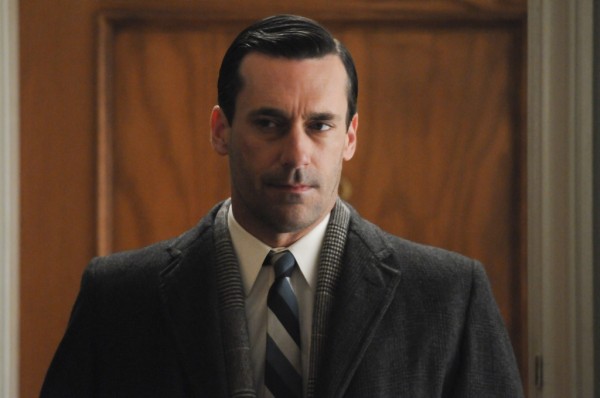
Adam Whitman is a revisit, a "phantom" from the title, and Lane's suicide by hanging is the second such suicide of the series. Adam did it first, in Season 1, and Don is haunted by the memory. Phantoms are not just the ghosts of the dead, of course. As Megan's mother, Marie, so cruelly notes, they are the ghosts of our dreams as well. We believe there is a thing that will make us happy, but it is a phantom. When we grasp for it, it eludes us, as Beth eludes Pete. Pete's monologue to Beth is itself haunting, and too beautiful to leave unwatched:

There are three interwoven motifs in The Phantom, that of depression, that of restarting, and that of doubling. Obviously they connect to each other; Beth's cure for depression is a restart, a literal wiping out of her memories so she can start fresh without knowing what caused her pain last time, while Roger's cure for it (or for the fear it will come) is a doubling: He wants to do LSD a second time. Megan drinks wine at home during the day like Betty did, and Rebecca's remarkable, angry slap-down of Don and his check reminded me (and my sister) of Anna Draper's sister in Season 4, who called Don "just a man in a room with a check." Neither woman felt like Don's money gave him any right to access a family's private grief.

I pretty much told everyone that Matt Weiner inserted the James Bond references as a personal gift to me. That may not be accurate (it's fun to say, though), but we share our love of 007. There were two James Bond references in The Phantom–the movie Don and Peggy are seeing is Casino Royale (the comedy starring David Niven). 1967 was a year with two Bond movies, which kind of doubles down on the double identity theme. The second reference is the closing song: You Only Live Twice (considered by many to be the greatest Bond melody), which references doubling not only in the name but in the theme, which addresses rebirth after a faked death (Dick Whitman, anyone?).

So, everything reverts, returns, and wipes out. Everyone is in shock therapy. Partly, there's a lot of real human grief here. Roger wants to see Marie so he can find life again after death came so close. Don wants to give something to Rebecca that will make him feel some closure. Pete sees death everywhere he looks, and even though he verbally rejects suicide, the swimming pool he wanted suddenly looks like a drowning pool. Joan wants to know why, and, after prostituting herself to become a partner, she finds a way to believe she should have done so for Lane. Joan struggles in two ways to find value after what happened to Lane and to her: First, by proving herself as a partner, from her mannish suit to her assiduous assessment of numbers, and second, by believing, nonetheless, that her only value is sexual. The only way to have saved Lane, she thinks, would have been to sleep with him. Poor Joanie!

An awesome crew of two was at our Finale Party, filming people naming their favorite quotes and characters, as part of the DVD extras for Season 5. I had to say, much to my own surprise, that Joan Harris is my favorite. Her extraordinary vulnerability and need to please sits in such strange and beautiful contrast to her competence and brains. I never thought, in Season 1, that I would come to love her so.

So, tonight was a beautiful experience for me. An excellent episode, an exciting party among a hundred or more excited fans, and a whirlwind of emotions to chronicle. It was not, I have to say, exactly conducive to writing a careful episode review, since I took no notes and started writing a good forty minutes later than usual. I hope you'll forgive a slightly choppy review in exchange for sharing some of that experience with you. Tonight is also the wrap-up of my first season of writing for Press Play. It's been exhausting and gratifying, and I hope I'll be able to continue my contributions about Mad Men and possibly other media.

Some additional thoughts:

  • I had a dentist in the spire of the Chrysler Building, this is the truth, my hand to God.
  • Please don't ask me about two dogs fucking. I have no idea.
  • John Slattery has a much nicer ass than I would have anticipated. Also, I never imagined I'd have the chance to write that sentence.
  • Quote of the week is tough without my usual meticulous note-taking, so I'll go with "What is Regina?" because it's funny and a little smutty and I remember it (thanks again, Roger Sterling, who wins this and every season with the most quotes of the week).

Deborah Lipp is the co-owner of Basket of Kisses, whose motto is "smart discussion about smart television." She is the author of six books, including "The Ultimate James Bond Fan Book."

Watch Mad Men Moments, a series of videos on Mad Men, produced by Indiewire Press Play.

TRUE BLOOD RECAP 1: TURN! TURN! TURN!

TRUE BLOOD RECAP 1: TURN! TURN! TURN!

I love True Blood, and I pray this is the end of it. The tea leaves all read "buh-bye," but in this first episode, we’re mainly talking mop-up from last season’s remarkably messy—even by Blood  standards—finale. But before we get into the particulars, some thoughts from this devoted Trubie.

I know there are people who feel the show was great when it was an elegant, fleet, and witty anti-intolerance fable. And feel that, as early as Season Two, when Maryanne the cannibalistic Maenad (Michelle Forbes) started having psychedelic Southern-style Burning Man-ish parties on Sookie's impeccably well-maintained lawn, the chronicles of everyone’s favorite fairy telepath—Sookie Stackhouse (Anna Paquin)—had already fallen into their shark-jumping phase.

Me? I always said that, like that lawn or the improbably ever-fresh pitcher of lemonade in Sookie’s fridge, there were things about True Blood you just accepted. I said, “Cannibalistic Burning Man run by a Mad Maenad? I’ve waited my whole life for this!”

And then when Seasons Three and Four gave us the batty-beyond-belief Russell Edgington (Denis O'Hare), Vampire King of Mississippi, a white trash were-panther named Crystal Beth, the lounging vampire Queen Sophie-Anne Leclerq (Evan Rachel Wood), who loved nothing more than to play Yahtzee (!), the revelation that Sookie was a fairy, that Jesus (Kevin Alejandro), the love of darling Lafayette (Nelsan Ellis), was in fact a powerful Mexican bruja, and a curse caused Pam (Kristin Bauer) to embark on the holy grail of finding the right foundation—Smashbox? MAC? Maybelline?—to cover her rotting face, some called foul.

But me, I was in seventh heaven as the show gave up even the slightest lip service to realism on the road to becoming the most faux Southern fried nü-Hammer, blood-Romantic, were-vamp gore-show, splat-palooza of all time,and it became clear that Blood creator Alan Ball would not drive 55, and the only way he’d stop was if he were six feet under.

And now it must end. It must not be allowed to become an undead parody of a parody of itself, like Dexter.

My sense of Season Five, from its tagline—“Everything is at Stake”—onwards points towards end games from which the show will not be able to renew itself without becoming a faint Xerox of past bloody wonders.

So with the prayer of “I love you—now die,” some highlights:

The episode opens one minute before the very end of last season’s finale, whipsawing from Sookie accidentally shooting Tara—whose fate will have to remain a secret for a spell, sorry—to a hilarious frenzy of tidying as, a few miles away, Bill (Stephen Moyer) and Eric (Alexander Skarsgård) clean up the sticky remains of Nan Flanagan (Jessica Tuck) who’d just outed herself as anti-Authority before meeting the True Death at Bill’s hands when he learned she desired some of Sookie’s fairy power.  

Alas, a pack of ninjas (or is that a flock, a murder or a bushel?) bag them in silver netting and stick them in a limo trunk. Eric’s shout of “That’s the Authority we’re up against!” not only IDs their attackers, it suggests a more epic storyline that would render any little tales from humble Bon Temps, LA passé.

Meanwhile, the Rev. Steve Newlin (Michael McMillian), ex-head of the Fellowship of the Sun, shows up gay and glamouring himself into Jason’s apartment, availing himself of that law of physics that says for every standing body of flesh there is a correlative moment when that body WILL fuck Jason Stackhouse (Ryan Kwanten).

But then the door slams open, Jessica (Deborah Ann Woll) declares herself “the progeny of the king of Louisiana!” and Newlin’s old news for now, as Jessica mounts Jason.

Shock cut to: A spy-movie-style male and female pair listening to Paul McCartney’s “Silly Love Songs” in a limousine. In the trunk, Bill and Eric are bound in silver netting (take note, slash fiction folks—this will be a good year for you).

One of the show’s more casually ridiculous escapes transpires: Bill finds an umbrella and stabs the car’s gas tank, which, after he asks Eric for some fire, blows up. Seriously. Bite this, believable solutions!

Crawling from the wreckage, the McCartney fan, whose name is Nora (Lucy Griffiths) finds Eric, and the two embrace and smooch deeply.

Nora is Eric’s sister and yeah—more TV incest. Boardwalk Empire, Game of Thrones, Bored to Death, Dexter, Supernatural, WTF?

At first I had no idea. But then a seeming cop-out, Eric’s revelation to Bill that he and Nora are “only connected through our maker” had me thinking. Because their “maker” is Godric (Allan Hyde), who died, or ascended heavenwards in a swirl of light and ecstatic disintegration season two’s “I Will Rise Up”.

With “everything at stake,” why would the show bring on someone who is Eric’s only living connection to the person he loved more than anyone or anything in his life, Godric?

Okay, before I mull myself into a coma, back to what Nora was actually doing. She’d planned to save Bill and Nora before their umbrella-gas-tank maneuver because, hot taboo sex aside, she’s a ruling member of the Authority working to tear the damned thing down from the inside.

So, Vive la révolution! Except Nora, Bill and Eric get caught by more Authority ninjas and there’s something about the way one of them bullhorns “Do not fucking move!” that makes me think Bill and Eric are screwed for quite a while.

Otherwise, here are the updates you need:

Captain Andy. An APD to all you Wire fans desirous of Chris Bauer nudity—your prayers are answered. Captain Andy is seen consorting with witch Holly (Lauren Bowles). Nice butt, Chris—who knew?

Terry. Terry (Todd Lowe) is now playing guest to his old Iraq war pal Patrick (Scott Foley). Flashbacks, fistfights, hallucinations occur—within, like, five minutes of screen time. How do you ratchet things up from there? A: Terry has kids, a wife, a life, oh dear.

Lafayette. Is this horrible? I want him to die so he can be with Jesus (boyfriend Jesus). Of everyone on True Blood, nobody has suffered more and gained less than Lafayette. So when he and Sook look for Jesus’ body and it’s not there, I’m thinking that if my end game theorem is true, maybe there’s a way Lafayette can peaceably slip this mortal coil and be forever with his beloved Jesus.

Right.

Jason. This whole episode is like a Stations of the Cross redemption trip for Sookie's older brother.

He tries to apologize to Hoyt (Jim Parrack), but Hoyt just calls him a girlfriend-fucker, accurate but hardly sporting.

He goes to Bill’s house, where Jessica is having a party with college kids her own age in a kind of adorable/pitiful simulation of what her life would have been like if the whole vampire thing hadn’t happened. After Rock Banding The Runaway’s “Cherry Bomb” (one of those True Blood moments sure to become a viral animated GIF), Jason leaves with some hottie but gives her an impassioned speech on how he wants be a better man instead of having sex with her, and still the space/time continuum did not collapse. Which leaves . . .

Alcide (Joe Manganiello). Who saves Sam (Sam Trammell)—whose problems with Luna (Janina Gavankar) are just confusing at this point—from becoming puppy chow for the werewolf pack that thinks he killed Marcus (Dan Buran). Alcide tells the pack that he’s a lone wolf now, and then he hightails it to Sookie’s to offer his protection from Russell, who, despite being buried under a few thousand tons of concrete the last time we saw him, is somehow back!

Russell. The only American vampire willing and able to punch his fist through someone’s chest on national TV and gloat about it. Russell (Denis O'Hare)—the one-vamp/one-man guarantor of True Blood quality!

Me, I’m going out on a limb here and predicting a terrific, apocalyptically satisfying season of over-the-topper-most True Blood. May it be its last.

Ian Grey has written, co-written or been a contributor to books on cinema, fine art, fashion, identity politics, music and tragedy. Magazines and newspapers that have his articles include Detroit Metro Times, gothic.net, Icon Magazine, International Musician and Recording World, Lacanian Ink, MusicFilmWeb, New York Post, The Perfect Sound, Salon, Smart Money Magazine, Teeth of the Divine, Venuszine, and Time Out/New York.

GAME OF THRONES RECAP 10: VALAR MORGHULIS

GAME OF THRONES RECAP 10: VALAR MORGHULIS

nullOne of the key questions facing Game Of Thrones the series, as well as its source material, is: “What’s this about?” And by this I mean: “What is this story? How is it being told? Where is this leading?” Certainly there’s drama, and characters change, grow, collapse, or die, but it’s difficult to see a clear structure at times. “Valar Morghulis,” as a season finale, did provide appropriate resolutions for most of the characters’ stories this season. But it struggled to collect them—it’s just a bunch of stuff that happens, in the words of Homer Simpson. Still, it’s a compelling bunch of stuff that happens.

nullThe Hero’s Journey is the default reading of most fantasy stories, and Game Of Thrones gives that opportunity with two of its characters: Jon Snow and Danaerys Targaryen. Both are born of noble blood, but are also outsiders. Both are young, and they are undergoing journeys of self-improvement as well as quests of external improvements. Both are also dealing with the most magic of any of the characters. Dany has her dragons, and Jon has fought one of the White Walkers, while the threat of more wraiths hangs over the Night’s Watch.
I’m not sold on this interpretation—Game Of Thrones seems too delighted to subvert fantasy tropes to fully follow through on the monomyth—but each character continues their journey in “Valar Morghulis.” Danaerys has had a bad season, sounding increasingly shrill over the course of her time in the unfriendly city of Qarth, but the climax of the episode finally justifies the time spent on her this year. Heading into the home of the warlocks led by Pyat Pree, she finally has the chance to demonstrate in action what she’s been shouting about all season, burning the magician and regaining her power. Yet her most important action isn’t her connection with her dragons, inciting them to violence. It’s rejecting the illusion of her dead husband and child. Her more youthful dream of a happy life with Khal Drogo is gone, and the steely Emilia Clarke realizes this quickly, giving her agency over her life again.

On the other hand, Jon Snow’s climactic act, a duel with the veteran ranger Qhorin Halfhand, represents arguably Game Of Thrones biggest failure this entire season. There is a reason for the duel—Qhorin mentioned it in a quick whisper two episodes ago—but if you can’t remember and extrapolate from “I hope you can do what you need to do” followed by a series of louder insults, I can’t blame you. We’re supposed to understand that Qhorin is doing this so that the wildlings will accept Jon, which will make him a more effective spy. But that relies on a single whispered line from two episodes ago. So, for all appearances, Jon is just a dupe, on multiple levels. For a character who could easily be described as the most traditional hero in the series, this is a serious problem.

A second interpretation of the overall story of Game Of Thrones is that it’s the story of the Stark family in a complicated civil war. Our main characters, after all, are Cat, Jon, Arya, Sansa, Bran, Robb, and formerly Ned (also little Rickon, attached to Bran). Dany and Tyrion are major as well, but under this theory, they exist largely to flesh out the story.

Sansa, for example, is our Stark gateway in King’s Landing. We see the new alliance between the Tyrells and the Lannisters both as the political intrigue that won the biggest battle of the civil war so far, but we also see it through Sansa’s eyes. Sophie Turner demonstrates her embarrassment at being publicly humiliated, yes, but also her joy at being free of her betrothal to the sociopathic Joffrey (though this is negated when the increasingly creepy Littlefinger promises to “help” her).

Her older brother Robb has a simpler story—he’s in love with Talisa, and decides to marry her. Cat, still under arrest for freeing Jaime Lannister, tries to talk him out of doing anything foolish, but she has no ground to stand on. Robb both follows his heart and his honor, marrying the woman he had sex with. It’s a sweet scene, and it parallels other loving scenes the episode surrounds it with, but it lacks depth.

Arya Stark has a similar issue, resolving her story with Jaqen H’ghar, but little else. I’ve complimented the child actors on the show before, but there are some issues here. Jaqen invites Arya to learn his killing strengths, but Arya says no, remembering her family. This is all good, but the struggle to remember her sister Sansa is a bit too obvious. It’s still amusing from a character perspective, but it’s quite transparently “television” in a way that Game Of Thrones, and HBO house style, tend to avoid.

A third response to the “What does it mean?” question is the most complex, subtle, and in my opinion rewarding: Game Of Thrones is about war and its effects. One of the things that has disappointed me about this season of the series, compared to the novels, is the lack of portrayal of the war’s effects. The best scene of “Valar Morghulis” finally depicts the brutality of the war, as well as the complexity of morality during civil war: Brienne of Tarth is still escorting the ever-snarky/charming Jaime Lannister to the capital, when she comes across a set of corpses.

They’re three women, hung with a sign saying that “They lay with lions.” The single image conveys brutality: we’re supposed to believe the Starks are good and the Lannister (lions) are evil. Yet here are three women killed for the crime of supposedly having slept with members of the Lannister army. The men who show up to confront Brienne—and explain the deaths—show the issues of civil war. They don’t take initial credit for the killings. They’re not dressed in uniform. They ask Brienne who she serves, but only after mocking her. And they are cruel men, quickly and violently dispatched.

Despite the initial thrill of seeing Brienne—the insulted woman—succeed in her violence, the scene is still discomfiting. The northerners are supposed to be, at the least, more heroic than their southern counterparts. These men are rapists and murderers. But worse than that: Are they even evil than Jaime Lannister, the charmingly sarcastic prisoner being saved by Brienne? Jaime is handsome, clever, and in the main credits, but he’s also Ned Stark’s rival, a man who tried to kill a 10-year-old boy, and he's conducting an incestuous, adulterous affair with the queen. Jaime survives because he’s important. These men die because they’re not. This is the war of Game Of Thrones, and it’s a difficult and bloody war at that.

The episode’s other most powerful scenes also avoid the heroes and Starks. Tyrion Lannister is surviving his wounds from the battle of Blackwater, yes. But his exploits in the battle have been ignored. His father Tywin receives the accolades while Tyrion gets moved to more modest quarters. His only ally is Lord Varys, the eunuch whom the show depicts as having been outmanuevered by Littlefinger’s successful arrangement of the Tyrell-Lannister alliance. Varys brings Tyrion his mistress Shae, leading the to the most affecting scene of the episode, wherein Shae professes her loyalty to the scarred Imp. Both Kekilli and especially Dinklage act the hell out of this scene, providing a stellar emotional core to “Valar Morghulis.”

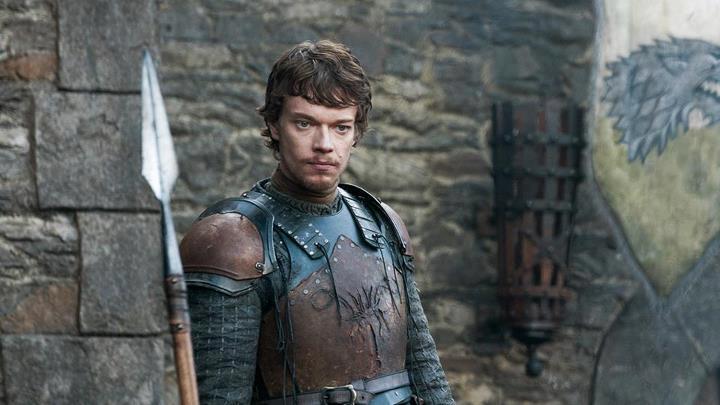
Finally, the most complete part of the episode occurs in Winterfell. Theon Greyjoy is surrounded by the Bastard of Bolton and his troops, with 500 men against 20. Maester Luwin provides Theon with council, and Theon (and Alfie Allen) lay his entire life, his motivations, and his insecurities out for the viewers and the Maester to see. Here, Theon turns from a ridiculous figure into a tragic one. He has no home and no one to trust, so he relies on his masculinity and ambition to give his pathetic life some meaning. This urge manifests itself in a speech he gives to his men, wonderful both for its position within Theon’s narrative and because it's a joke: he's cut short by his men, who just want to use Theon’s body as leverage to get home. At every point, Theon has been given chances to be better. He has wasted them, trying to gain the respect of men who never would have respected him anyway. This may be Game Of Thrones at its smartest: Theon is trapped by his attempts to be as masculine and powerful as possible. He’s not. Maybe he never has been. Everyone, including him, recognizes this. But he feels that he has no choice but to continue.

Add these stories all up, and what is the sum? I don’t think there is one, other than that the third season, ten months away, can’t arrive soon enough in plot terms. The final two episodes have demonstrated the dynamism that Game Of Thrones’ tight serialization can provide, like no other show on television right now. On the other hand, there are serious issues with Game Of Thrones’ structure. They can certainly be masked by momentum, but the connection—or lack thereof—of the myriad of stories has to be a constant concern for the series’ fans and creators.

Adaptation:

Most of the stories portrayed in “Valar Morghulis” are significantly different from those in the book, yet most of these still point to an endpoint of the later books, used as major reference. The Bastard Of Bolton may not have made his appearance here, but the ambiguity about the sack of Winterfell leaves room for interpretation. Likewise, Jon Snow’s arc as an idiot may have been painful, but it leaves him in a position to be less terrible in the future.

My biggest disappointment with the episode—apart from the lack of redemption for Arya’s story mistakes two weeks ago—comes from the Cat—Robb interaction. In the novels, both Cat and Robb discover each others’ crimes at the same time. Robb gets married in the west, then returns to discover that Cat has freed Jaime. His forgiveness for her act based on love is a defense of his own act of love, a manipulation which both impresses and frightens Cat. We only get a tiny part of that in a conversation where an ineffectual Cat attempts to persuade Robb of the virtue of arranged marriage, which Robb can dismiss thanks to her release of the Kingslayer. It’s good—but the scene in the book was great.

A final word has to be given to the cliffhanger at the end of “Valar Morghulis.” The White Walkers have been an ominous threat since the cold open of Game Of Thrones’  first episode, but have rarely been physically threatening. Now, we see an army. And while in story terms, the army of wraiths attacking the Night’s Watch is certainly ominous, the CGI used to depict the supernatural threat just can’t quite manage it. The pseudo-zombies shown are just a bit too cartoonish, and some of the horde that follows are all too obviously just topless actors’ backs staggering in front of a bluescreen. But this is the way the novels’ story goes, so some depiction is necessary. We have to see the undead threat, even if that threat, treated literally on-screen, is insufficient compared to the danger on the page. The episode’s other most powerful scenes also avoid the heroes and Starks, focusing instead on the effects of the war on two of this season's most dynamic characters, Tyrion and Theon.

Rowan Kaiser is a freelance pop culture critic currently living in the Bay Area. He is a staff writer at The A.V. Club, covering television and literature. He also writes about video games for several different publications, including Joystiq and Paste Magazine. Follow him on Twitter @rowankaiser for unimportant musings on media and extremely important kitten photographs.

MAD MEN RECAP 11: COMMISSIONS AND FEES

MAD MEN RECAP ELEVEN: COMMISSIONS AND FEES

"Everything you think’s going to make you happy just turns to crap."

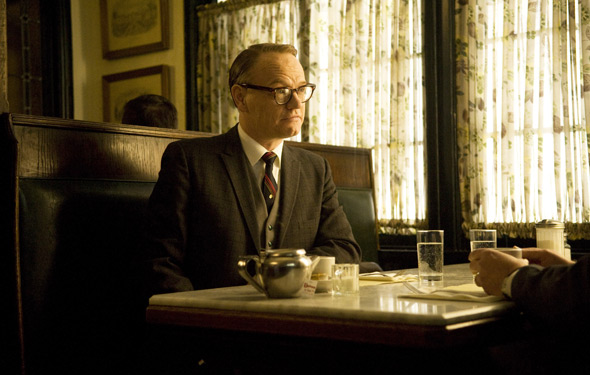
nullLast week, Megan was annoyed with the Jaguar ad campaign. A wife is a Buick in the garage, she said with a touch of bitterness, but a mistress is an exotic and temperamental Jaguar. I don't know what kind of car Don Draper drives these days, but it's not a Jaguar, and at the end of Commissions and Fees, the person driving that ordinary car was the only one who was happy.

Rest in peace, Lane Pryce.

I've been doing this recap dance long enough to know that even when I imagine I have nothing to say, there are plenty of words to come. Yet I am in the strange position of feeling that the very act of writing is disrespectful to what I have just seen. Lane felt, tonight, like a person, not a character. A person we lost. A person Don tried desperately to treat with dignity. A person who deserves, not a recap, but a eulogy.

Rest in peace, Lane Pryce.

The things we want, the magical, out-of-reach things, they just don't work. Glen knew it, in the end, as quoted above. Don pitched the living shit out of Dow Corning. He pitched desire. He pitched never being happy enough as a net positive, as a sign of life. McManus (the current agency) is just bringing them happiness, just bringing them success, but Don insists that's not enough.

In Episode 5.01, A Little Kiss Part 1, Trudy said to Pete, "Dissatisfaction is a symptom of ambition." This is, essentially, Don's pitch: "What is happiness? It’s a moment before you need more happiness."

The magical, impossible, unmanageable thing, the thing we think we want but which cannot satisfy us, is clearly represented by Jaguar. That's the pitch. Remember last week: "If they weren’t temperamental, if they weren’t beyond our reach and a little out of our control"? Jaguar is so fundamentally unsatisfying you can't even kill yourself in it. Poor Lane, so desperate, and relying on such notoriously shoddy engineering. Watch the failed attempt:

The clip is funny, and its bona fides have been fully established, with the two prior episodes making sure we understand that Jaguars just don't start. It's also tragic, since lousy English technology won't stop Lane, who loves the U.S. and weeps that he will lose his visa—he kills himself instead in an office lavishly decorated in Americana. The position in which he hung himself meant that one of his last sights was his replica of the Statue of Liberty. Ah, Lane, the American Dream failed you, and you didn't even enjoy that moment before you needed more happiness.

Don will blame himself, you can already see that. He has shame and remorse all over his face when he hears the news. Last week, Joan touched him kindly and said, "You're a good one." It's likely he married Megan because she believed he was good, but it's the one thing he never believes of himself. He often does terrible things, but Megan was right in Tomorrowland, he always tries to do better.

How impotent his efforts to do good must feel to him now; that much is obvious in the bitter way he condemned the partners for voting last week without him: "Should I leave so you all can do whatever you want?" he pointedly asks.

He couldn't save Joan from Herb. He couldn't save Lane from himself. In the back of his mind, always, is that he couldn't save Adam (his brother, who hung himself in Season 1), and probably that he couldn't save the real Don Draper (whose death can be blamed on Dick Whitman). The only one he could save was Glen Bishop, for whom he could fulfill a simple wish. "We’re worried about you," he said of young people in Episode 5.03, Tea Leaves. He can't prevent Sally from becoming a woman (and "spreading her legs to fly away" as Emile Calvet would have it), or save lives that should be saved. But he can take Glen driving. Sometimes we can only do little things.

Megan, too, is intensely protective of children, protecting Glen, she says, because she wasn't able to protect Sally. Substituting a lesser form of protection for a more necessary one is a motif this episode.

But instead of talking about themes or motifs, I would rather describe streams: two directions in which this episode flows. One is towards dissatisfaction, dissolution, and death, the other is towards life, rebirth, and becoming. Creation and destruction, momentum and inertia: the two great forces of life. Don tried to talk to Lane about starting over, and in fact, I think Don was as kind as humanly possible. When he says, "I’m doing the most decent thing I could possibly do," he is telling the truth. But Lane is not flowing towards rebirth as Don advises, he is unwinding, and the only kind thing Don can do is lay Lane gently to rest on the couch.

Sally, on the other hand, flows towards rebirth as a woman. Her first "date" with Glen may not have been very romantic, but it was very satisfying for her (until it became too much, physically and metaphorically). Her movement towards sexuality, innocent as it is, is life-affirming, just as Roger's boredom with sex is life-denying. Roger, whose enlightenment "wore off," is in the stream of dissolution with Lane.

There are a lot of ways to talk to a young girl about her first period. What Betty said was lovely, and also important; she talked about babies, and about a healthy body, and about Sally joining in the grand cycle: the stream of becoming that will come around to Sally's someday being in the mother role that Betty is in today. Ask any mother—when we have children of our own, our relationships with our own mothers are transformed. Betty, with her arms around Sally, sees Sally becoming herself, sees her own mother and her future granddaughter in a stream as circular as Betty's arms when they envelop her daughter.

Easter is mentioned several times, and Lane specifically talks about resurrection to Joan—all this while snow is visible through the window. Winter and spring. Death and rebirth.

Rest in peace, Lane Pryce.

Some additional thoughts:

  • Suicide has been foreshadowed heavily all season. In this episode, it was Betty's turn: "I wanted to know if you would have any problem with me strangling Sally." Sally, of course, is not the one who ends up strangled.
  • Betty's could be the quote of the week, but instead I'm giving it to Kenny: "I don’t mind waiting 20 minutes for an unspecified meeting with my boss. I mean, it’s not like your imagination would run wild."
  • For her museum date, Sally wore the go-go boots Megan had bought her in At the Codfish Ball: the boots that Don made her take off because they were too mature.
  • The drive from Park Avenue to Hotchkiss Academy in Lakeville, Connecticut is just about 100 miles each way.

Deborah Lipp is the co-owner of Basket of Kisses, whose motto is "smart discussion about smart television." She is the author of six books, including "The Ultimate James Bond Fan Book."

Watch Mad Men Moments, a series of videos on Mad Men, produced by Indiewire Press Play.