The Three Burials of NO COUNTRY FOR OLD MEN; Three Takes on Its Overrated Status

The Three Burials of NO COUNTRY FOR OLD MEN; Three Takes on Its Overrated Status

null[Editor’s note: The following is a collection of essays on the critical overestimation of No Country for Old Men, by Lincoln Flynn, Stacia Kissick Jones, and Alan Pyke.]

No Country for Old Men? Overrated!!!

When the Coen brothers’ eponymous film adaptation of Cormac McCarthy’s novel No Country for Old Men was released in 2007, it received near-universal critical acclaim; after the subpar efforts Intolerable Cruelty and The Ladykillers, it indicated an artistic comeback for its directors.

In general, the honed and virtuosic filmmaking skills of the Coens, combined with their postmodern storytelling sensibilities, give their detractors reason to call them talented but glib. Yet with No Country, the Coens-as-adaptors had ostensibly harnessed their usual instincts in the service of McCarthy’s source material, while using their talents as directors to make it a dynamic and multifaceted movie that had proved their salt as genuine auteurs.

Though many consider No Country to be an untouchable classic in the Coens’ oeuvre, it remains tonally flawed. Consequently—and at the risk of putting “my soul at hazard” by receiving invective from die-hard fans of the Coens and No Country—I consider it to be overrated and feel that A Serious Man and the Coens’ True Grit adaptation are more artistically successful later career films.

Effectively, No Country’s plot can be divided into two parts. The first part tells of the flight and pursuit of Llewellyn Moss (Josh Brolin) by Texas Sheriff Ed Tom Bell (Tommy Lee Jones) and psychotic hit-man Anton Chigurh (Javier Bardem) after Moss takes money from the scene of a drug-deal-related massacre. The second part resolves the three-tiered chase and further develops Bell’s melancholic nature.

Well within the Coens’ wheelhouse, the first part is basically a thriller that incorporates aspects of film noir and the western and is filmed or stylized in an artful and “resplendently austere” manner. The violence is gruesome, the editing is efficient, and the action and humor are darkly entertaining. The second part, on the other hand, is more restrained and less gruesome and humorous, in order to amplify the tragic and bleak resolution of the story.

This dichotomization of No Country is my main issue with the film: if Sheriff Bell’s resigned fear of entropy is where the basic theme of No Country lies, and if that fear is exemplified by the mayhem that is instigated by Llewellyn and Anton in the first half of the movie, then why did the Coens decide to represent that violence as slick and thrilling Grand Guignol? This is an inconsistency that makes the two parts of No Country incongruous and its resolution less devastating and resonant than it should be.

As I understand the character of Sheriff Bell, he doesn’t see anything fun or exciting in any of the chaos that he observes as a person and lawman. To him it is soul crushing and proof of the absence of God or any greater, noble meaning. Therefore, the film’s violence shouldn’t be kinetic or vivid. Likewise, if Bell’s saturnine worldview is thematically important in the end, then why is his apathy used as a source of much of the film’s gallows humor? This aspect feels appropriate to the Coens’ style but inappropriate to the story’s point.

When talking to a friend about the most recent James Bond film, she joked that “another name for Skyfall could’ve been No Country for Old Women.” Both No Country for Old Men and Skyfall feature Javier Bardem playing relentless villains who wear odd coiffures; also, both films were shot by cinematographer Roger Deakins. Moreover, both films have older authoritarian characters, played by Tommy Lee Jones and Judi Dench,, who respectively underscore the similar theses of each movie. Yet, as Skyfall is a franchise movie that had the added bonus of being dramatic and exquisitely made, for me No Country for Old Men is a well crafted yet thematically compromised art house version of a Terminator movie.–Lincoln Flynn

Holding
degrees in Film and Digital Media studies and Moving Image Archive
Studies, Lincoln Flynn lives in Los Angeles and writes about film on a sporadic
basis at
http://invisibleworkfilmwritings.tumblr.com. His Twitter handle is @Lincoln_Flynn.

null

Why Blood Simple Towers Over No Country for Old Men

Characters in the films of Joel and Ethan Coen tend toward the archetypical, but rather than existing in their expected cinematic habitat, they’re placed in ridiculous and macabre situations they simply are not prepared for. Though it is usually a delightful conceit, in No Country for Old Men (2005), it starts to become a belabored what-if scenario rather than a meaningful set of juxtapositions. No Country is a meditation on mortality and the eternal fight between humanity and inexplicable evil, set in rural Texas in the early 1980s, the same locale and era as the Coens’ early neo-noir Blood Simple. Both feature postmodern aesthetics, pitch-perfect and witty dialogue, the celebration of regional variances in language and culture, and characters suffering from a surfeit of poor decisions. They are both without question exceptional films. Comparisons between them are unavoidable, though in terms of style and substance, Blood Simple is the more successful of the two.

In Blood Simple, a series of misunderstandings and double-crosses combine with darkly comic undertones in a situation that could be resolved, or at least improved, if the two main characters had just talked to each other. The characters are at times very silly, an endearing trait in a film that examines the tragedy of poor choices. The Coens have since ceased caring whether the audience sympathizes with characters or not, though that tack is quite effective in No Country for Old Men. While Blood Simple is about lack of communication, No Country shows us that, sometimes, communication makes no difference at all. A flattened affect throughout the film heightens the realization that emotional connections simply do not matter in the face of true evil.

Where this flatness of emotion goes wrong is in No Country‘s tendency to leave moments unfinished. The Coens at one time were more than willing to let audiences figure things out for themselves. Ambiguity in No Country, such as not showing a key death  or ending a scene abruptly, is not meant to lead the audience to fill in points of the narrative themselves, but rather to allow the filmmakers to limit the emotions available to the audience. It’s artifice designed specifically to deny catharsis, grief or resolution, all part of the Coens’ rigorous cinematic control, but at great expense to realism.

Blood Simple, like most Coen brothers films, is clearly referential. One of the best such moments is the brazen borrowing of the famous ground-level swooping shot from Evil Dead (1981), a film which Joel Coen had worked on as assistant editor. The reference simultaneously invokes humor, the horror genre and a nod to burgeoning indie film movement of the film’s time. But where references like these in Blood Simple are natural and lighthearted, in No Country they are cold, calculated moments of manipulation. No Country, for example, copies the restaurant scene from Fargo; in these scenes, police officers in both films achieve necessary moments of clarity. It’s heavy-handed and out of place in No Country, a lazy quotation of their own cultural milestone without thought for its relevance.

Early in the Coens’ filmmaking careers, contempt was not a successful trait in a character. M. Emmet Walsh’s P.I. in Blood Simple possesses an undisguised derision for everyone around him, but it is undermined by the resourcefulness and luck of those he’s trying to con. For the Coens, the purpose of contempt has changed, and is now often the single biggest factor in resolving conflict: A character who shows contempt almost always wins out.

This is especially true in the case of the psychotic Anton Chigurh (Javier Bardem) in No Country, a killer whose contemptuous attitude is proven right time and again. It is his most important and identifiable characteristic, one that allows his particular brand of evil to succeed. Meanwhile, small-town sheriff Ed Tom Bell (Tommy Lee Jones) is just as exasperated with the folks around him, though he keeps his contempt in check, leaving him powerless against the sociopath’s self-imposed moral superiority.

The disdain for humanity in No Country, as in many of their other films, spills over into the filmmakers’ contempt for the audience. The Coens seem loathe nowadays to even acknowledge there is such a thing a worthwhile everyday person. In Blood Simple, Ray (John Getz) is an everyman archetype, on the surface as bland as John Gavin in Psycho (1960), yet we’re fascinated by his actions and sympathetic with him when things go wrong. In No Country, a series of everypersons, both men and women, are grotesques, stubborn and dull and frustrating. In an attempt to lead the audience into the mind of a killer, the Coens want us to be as unimpressed with these everyday people as Chigurh is; once you resist, Chigurh becomes caricature, just another dead-eyed psycho with a gimmick.

In the process of subverting themes in No Country for Old Men, the Coens often dispense with narrative altogether, preferring to use the film as a vehicle for delivering their own signature style. The film never quite gets around to challenging the validity of conventional cinematic narrative techniques, though it clearly means to do so. Blood Simple, in contrast, challenges common genre constructs precisely because it uses standard narrative techniques, and also allows for a humanity that encourages viewers to more closely engage with the moral and ethical dilemmas presented. Though both films are fine works in their own right, Blood Simple is a more exceptional one—even if it is more traditional.–Stacia Kissick Jones

Stacia Kissick Jones is a recovering literature major, freelance editor
and film critic. She is a regular contributor at
Spectrum Culture Online
and
ClassicFlix, and blogs at She Blogged By Night
(
http://www.shebloggedbynight.com).

nullNo Breathing Room: The Crucial Flaw of No Country for Old Men

A movie can be great and overrated, and so it is with the Coen brothers’ No Country For Old Men. The Coens’ trademark deftness with light and framing and showing a story rather than telling it gave us the best cinematic treatment of Cormac McCarthy to date. But much praise for the film conflates its technical brilliance with an imagined depth and detail of thought. In reality this film manages only to sketch ideas that have been more fully explored in other, similar films.

Considering the challenges of recreating the ideas from Cormac McCarthy’s notoriously thorny and meditative prose with visual language, No Country For Old Men achieves some wondrous things. The choice to eschew music almost entirely is particularly inspired as a reflection of McCarthy’s harsh, amoral world, and excellent performances help animate his ambivalent, despairing take on nostalgia for a simpler time that never quite was. A few things get lost in translation, but it’s a mistake to get too caught up in comparing book and film here.

The problem instead is that in effecting their translation, the Coens produced a film that only engages the story’s themes at arm’s length. The pulpy churn of the main plot crowds out any deeper meaning the three main characters’ pursuits of their respective fables might have.

Llewelyn Moss (Josh Brolin) pursues the simple self-deception that he’s cunning enough to steal $2 million from a cartel and live to enjoy it. That sets the captivating plot into motion, but the Coens excise some significant chunks of his flight, and freeze-dry the thematic nutrition out of his arc in the process. He’s fun to root for, but exists solely to necessitate the chase.

Anton Chigurh’s (Javier Bardem) fable is that the underworld’s predatory jungle law responds to fate and luck, and can be influenced by how men tend to their sense of honor. That’s a promising concept, but it’s only hinted at, never fleshed out. No Country‘s most memorable moments involve Bardem leaning his full weight into dazzling lines that don’t add up to anything coherent. “If the rule you followed brought you to this, of what use was the rule?” is a great bit of language, but Carson Wells (Woody Harrelson) is right: Chigurh just sounds insane. Beyond the grace of his syntax, his pseudo-existentialist riffs carry no more weight than a Bond villain’s cackling soliloquy about the motives for his evil plot.

Sheriff Ed Tom Bell’s (Tommy Lee Jones) fable is that men committed to rightness and legality are seeing a decay in their ability to preserve moral rectitude. Ed Tom’s weary grappling gets a fuller treatment, getting critiqued by fellow lawmen—“What you got ain’t new,” his uncle tells him—and reflected in the inter-generational tensions that crop up repeatedly at the edges of the story. Ed Tom’s statements are the closest No Country comes to actually biting down on some ideas rather than showing us the chain restaurant picture menu versions of them. But he, too, is just along for the ride of the main plot, popping in and out whenever it’s convenient.

There’s a better Tommy Lee Jones film on all these themes: The Three Burials of Melquiades Estrada tackles fatally bad luck, nostalgic male honor fulfillment, and modernity’s infringement on cowboy nobility without the sexy crime potboiler stuff that makes No Country so great an entertainment and so lightweight a film. The Coens have also done more with these ideas, in Blood Simple. The nominal stakes in these two movies are far lower than No Country‘s $2 million satchel of cash, but Blood Simple wrings more reflection on violence, mistrust, and self-deception out of a $10,000 wad. There’s no bouncing ball of cash to follow through Melquiades Estrada, but rather the corpse and memory of a man far unluckier than anyone on the wrong end of Chigurh’s cattle gun. The grand allure of the underworld pursuit makes No Country more fun, but it also reduces the big ideas its characters are chasing to window dressing for a nervy, unpredictable slaughter. The comparative simplicity and mundanity of the core stories in Blood Simple and Melquiades Estrada mean that those same ideas have room to breathe.–Alan Pyke

Alan
Pyke is a writer and commentator on film, television, fiction, music,
and politics, with a particular fascination for hiphop. He writes film
reviews for
TinyMixTapes and BrightestYoungThings, cultural criticism at The Daily Banter, and occasionally posts at his own site.

VIDEO ESSAY: Who Should Win the Oscar for Best Supporting Actor

VIDEO ESSAY: Who Should Win the Oscar for Best Supporting Actor

Part of "Who Should Win," a series of video essays co-presented by Indiewire Press Play and Fandor.

This year’s Best Supporting Actor nominees are all previous Oscar winners, which eliminates some of the career achievement concerns that can affect these awards. Let’s hope that puts more emphasis on the quality of the performances, which are all worthy of consideration.

As a wisecracking, world-weary Hollywood producer, Alan Arkin gives a light-hearted lift to Argo’s political thriller proceedings. In Lincoln, Tommy Lee Jones plays the salty senator Thaddeus Stevens. Jones’ performance lives in his eyes. It shows the mental activity of an old man challenged to rethink his politics in order to achieve his lifelong dream of abolishing slavery. Jones is currently the narrow favorite to win the Oscar, but I think there are three performances better than his.

In Django Unchained, Christoph Waltz is a ruthless bounty hunter whose conscience awakens when he helps a freed slave on his quest. Waltz is a master of playing surface-level civility. But in this film, he peels away those layers ever so gradually to reveal his moral outrage seething underneath.

Robert De Niro gives his best performance in years in The Silver Linings Playbook. He plays a football-fixated father, whose attempts to help his son are undermined by his own manic temperament. It’s a display of late-career virtuosity, showing the emotional range he’s mastered over a lifetime: from explosive menace to wisecracking warmth. In this film, he adds an extra dimension through a sense of advanced age and frailty, which he uses to disarming pathos in this scene. But as it turns out, this emotional display is a put-on, as he just wants to loop his son into a crazy scheme. De Niro’s character is an inspired creation of demented obsession, charged with startling vitality.

But I have to give the top prize to Philip Seymour Hoffman for his work as the self-help guru Lancaster Dodd in The Master. It surprises me to say this because I’m not even sure if it’s a complete performance—by the end, his character seems to disappear into the movie’s unresolved clouds of ambiguity. But for the first 90 minutes of The Master, Hoffman is key to making this film work. He’s a pillar of authoritative self-control, a counterbalance to Joaquin Phoenix’s utterly unhinged lead performance.

But Hoffman is doing more than just playing the straight man. There’s an unforgettable scene where Hoffman’s Dodd first processes Phoenix. From Dodd’s face and his line of questioning, we see a refined man fascinated by a wild beast of a human, but we catch a glimpse of that same wildness lurking in him as well. That wildness explodes in a later scene when Hoffman is ambushed, and his lack of self-mastery is exposed. In just these two scenes, Hoffman is able to chart out the entire three-dimensional psychic landscape of a character. It’s this richness that keeps us watching even as the film takes us to increasingly difficult territory.

Kevin B. Lee is Editor in Chief of IndieWire’s PressPlay Video Blog, Video Essayist for Fandor’s Keyframe, and a contributor to Roger Ebert.com. Follow him on Twitter.

VIDEO ESSAY: MEN IN BLACK: Three Reasons for Criterion Consideration

VIDEO ESSAY: Three Reasons: MEN IN BLACK

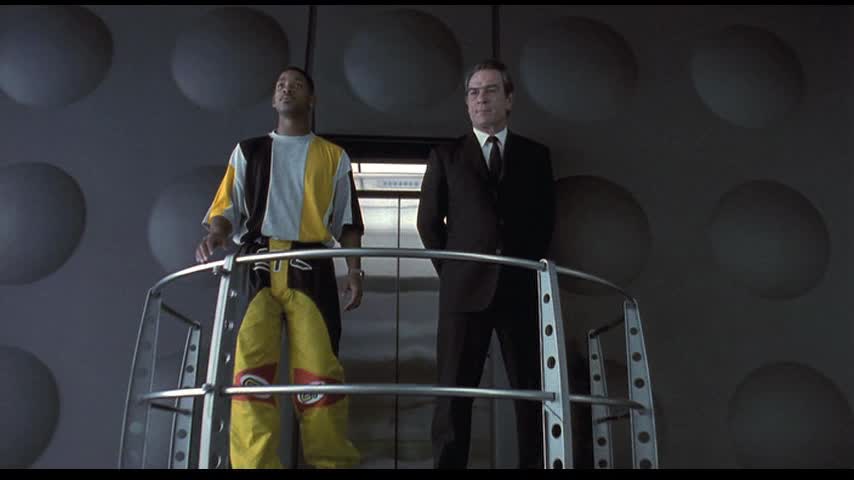
For this month’s Criterion Consideration, coming up with a suitable equivalent to Barry Sonnenfeld's latest film, Men in Black III, was a bit of a challenge.  In many ways, the franchise can’t be compared to other films of the genre.  How exactly would you categorize MIB?  An odd couple buddy-cop sci-fi comedy?  Immediately I thought of Ghostbusters, which has been threatening recently to corrupt its origins with an unnecessary sequel, but Ghostbusters had already had its day in the sun when Criterion was still pumping out laserdiscs. I could easily have tried to loosely tie a thousand different titles to MIB III, but really, the only reasonable association is the first film in the franchise.  Like most things, the original is always the best, leaving its successors in the dust.  It's been a decade since we all sat through the utterly intolerable MIB II, and no matter how fresh and shiny Sonnenfeld's latest effort may attempt to be, it will ultimately only remind us of the power of the original film.

Based on the comics by Lowell Cunningham, the original film was an inventive reworking of the Men in Black mythology, a phenomenon that emerged in American pop culture shortly after that supposed UFO-crash incident in Roswell, New Mexico in 1947. Sonnenfeld took further inspiration from the resurgence of conspiracy theory permeating 1990's pop culture. The paranoid visions that pervade The X-Files are rendered to ridiculous extremes as Earth's resident aliens hide in plain sight. What makes Sonnenfeld's film work is the business-as-usual approach that the Men in Black take toward in their daily routine. The black-suited men of mystery are merely intergalactic immigration officers, content to anonymously survey all alien activity in the New York area. Contrary to the shameless marketing strategies that would befall the franchise, the film's offbeat deadpan sensibilities were a welcome break from those of the mainstream blockbusters of that time.

This perfect combination of elements made MIB exceptionally ambitious and artistically innovative.  Sonnenfeld's experience behind the camera (notably with the Coen Brothers' early films) brought a subtle visual wit to an otherwise flashy elaborate blockbuster.  The decision to cast underrated comedians in minor character roles also added class to seemingly minor scenes.  Ed Solomon's writing provided some endlessly quotable one-liners, and helped reinforce the chemistry between Tommy Lee Jones and Will Smith.  The way they play off each other appears genuine, with Jones' straight-faced delivery pitted against Smith's posturing wisecracks.  Rick Baker, the special effects wizard behind every notable sci-fi/horror film from the past thirty years, is allowed to let his imagination run wild, creating some remarkable alien life.

Oddly enough, the qualities that made the first MIB so engaging are exactly what killed its first sequel.  The formula for its success became so immediately apparent that even the original risked losing its charm.  Celebrities quietly suspected of being aliens were now given needless cameos, CGI took over most of the creature effects, and although the relationship between Agent K and J still works quite well, the rest of the film does not.  Early reviews of MIB3 have been mixed, but overall the formula remains unchanged.  Try as Sonnenfeld might to neurolize any trace of Men in Black II, his latest installment might very well be the long-awaited end to a nearly forgotten franchise.

Robert Nishimura is a Japan-based filmmaker, artist, and freelance designer. His designs can be found at Primolandia Productions. You can follow him on Twitter here.

Close Cuts: The Adaptation Process in NO COUNTRY FOR OLD MEN

Close Cuts: The Adaptation Process in NO COUNTRY FOR OLD MEN

null

That No Country For Old Men (2007) constitutes one of Cormac McCarthy’s “lesser” works probably says more about McCarthy’s genius than it does about the book’s individual strengths or weaknesses.  Nearly five years after its release, it stands beside great modern adaptations like One Flew Over the Cuckoo’s Nest and Silence of the Lambs. But the understated greatness of the movie, stemming as it does from the book, must be attributed to the Coen brothers as well, who were able to capture the heart of the book even after shedding some of its most key sections.

Cuts or no cuts, the Coens showed intense loyalty to McCarthy’s work in many ways.  With the exception of about ten scenes, they retained every bit of the book in one form or another, with one broad exception: the larger story of Sheriff Ed Tom Bell (played by Tommy Lee Jones).  The way they altered Sheriff Bell’s dialogue and development is a sterling example of their skillful adaptation of the book, their tightening of McCarthy’s story for the screen.

McCarthy structures the book so that Bell provides its backbone and, in fact, its title. While the movie was marketed around the charismatic characters, the resourceful Llewellyn Moss (Josh Brolin) and the chilling Anton Chigurh (Javier Bardem), Sheriff Bell remains not just the main character, but the very moral compass of the narrative.  McCarthy shows Sheriff Bell’s disillusionment with the world around him through a series of thirteen internal monologues by Bell which open each chapter of the book.  In these monologues, Bell details his unease with life and the pervasive criminal brutality he sees, as well as his back story of painful service in World War II and the dead daughter who haunts him. Bell’s ruminations are long-winded, heavily descriptive, and often dryly monotonous and repetitious; it would probably be fair to say that they make up the weakest collective part of the book, though they remain crucial to McCarthy’s story. Leaving Bell’s monologues out of the movie was likely one of the Coens’ easier decisions.   

The Coens instead synthesized these segments, along with several of Bell’s other scenes, and any mention of his personal story, into three scenes which help the film retain the book’s core: Tommy Lee Jones’s outstanding scenes to open and close the film, and probably the movie’s most mysterious part, near the end, where Sheriff Bell “confronts” the killer Chigurh. 

The Coens solved the problem of how to implement these sections by whittling them down to their bare essence in the opening.  There, Sheriff Bell delivers a short monologue as he discusses his family’s law enforcement lineage, his distress with the crime by a boy he sent to the electric chair, and the larger growing violence of the age.  Constructed with parts of the book’s first, third and fourth chapters and delivered in Tommy Lee Jones’s gravelly, craggy voice as the film pans over the colorful, empty expanse of West Texas, the two minute opening is exquisite, to be watched over and over, and may be the film’s finest sequence.

We hear Sheriff Bell’s winsome, homey, nostalgia become an anxious description of the criminal violence he’s seen, melting into an open, dark despair of the coming storm – embodied seconds later when we see Chigurh viciously strangle a sheriff’s deputy and then shoot down a motorist like cattle.  The film’s ability to effect that difficult transition from McCarthy’s complex prose to the screen while fully retaining the book’s moral direction is a crucial reason for the film’s massive success.

One generally overlooked change the Coens made elsewhere, near the end of the film, further helped streamline the story.  The scene is also fairly mysterious and has vexed many audiences precisely because of how the Coens used it to unpack McCarthy’s text. More than just about any other scene from the book they retained, the Coens altered this scene significantly, and they did this for a central purpose.  They created a more dramatic sequence, yes, but used the scene and Sheriff Bell’s’s imagination to further distill the direction of the cut monologues and show Bell’s breakdown from stalwart veteran sheriff into a conflicted lawman.

The book and the film depict the same basic event in two very different ways, ultimately making the events themselves different. McCarthy’s telling of the scene provides guidance here. After Moss is killed, Sheriff Bell goes back to investigate Moss’s deserted motel room late at night. In the book, Bell approaches and enters the motel room as Chigurh watches him from his truck, driving off before the sheriff can find him. The Coens implemented another sequence.

In the film, Sheriff Bell sits in his cruiser, staring at the police tape and breathing uneasily, before getting out. The camera follows him on each heavy step to the turquoise door.  When Bell creeps up and sees the lock popped out—Chigurh’s calling card of entrance to a closed space via his ever-present cattle gun—he hesitates several times before holstering his gun.

A moment before he does enter, we see Chigurh with his frightening silenced shotgun held tight against his chest, the golden light of the disemboweled lock shaft shining just to his left, the clear intimation being that he is hiding in Moss’s room. A moment after this cutaway, Sheriff Bell pushes open the door, his dark shadow and lowered gun in silhouette against the ugly room. As the audience gasps for his safety, he moves around the room, then, finding no one, he settles on the bed and relaxes before seeing the cover of the vent on the floor, next to several screws and a discarded dime—a tell-tale sign that Chigurh took the case of money out of Moss’s standard hiding place after the police left the crime scene.

This scene begs, where was Chigurh and why didn’t he kill Bell? The answer holds significant implications for the Coens’ adaption.  Based on how we see Chigurh, he appears to be standing, and with light clearly on him, but when Bell enters, Chigurh is neither by the window nor possibly in the open, narrow vent. That leaves one possible hiding space: the door. Here the Coens tease the audience.  When Bell pushes open the door, we can’t see completely behind it, making it just possible that something—or someone—could be there. 

Chigurh may be there behind the door, waiting with his beer can-sized silencer, as the Coens’ clever hint never provides confirmation, but really they don’t have to. From a purely technical standpoint, it’s unlikely that the large killer, holding both his shotgun and the bulky briefcase full of two million dollars could ever fit. Some watchers have stretched to postulate that Chigurh is in the adjacent room.  These views miss the point, based on what the Coens are trying to do with this scene, behind their sleight of hand. 

In the book, Bell approaches and enters the room as Chigurh watches him from his truck, driving off before the sheriff can find him.  While we are led to believe that Chigurh is there, he is also used here as a product of Bell’s imagination, a creature growing out of his fears and revealing of his broader dread, established by the intro and negatively developed. Throughout the course of the movie, Bell has seen Chigurh’s heinous violence as he has murdered people in the coldest blood imaginable. Bell even refers to Chigurh as a ghost right before he goes back to the motel. But while Bell says "it's not that I'm afraid of" the crimes he sees in the opening, he clearly is afraid by the end. This change, developed by McCarthy through his thirteen monologues, is reduced by the Coens to their opening and this scene, where we see Bell relieved that Chigurh isn’t in the room, simultaneously realizing he can no longer serve. The scene leads into Sheriff Bell’s visit to his disabled Uncle Ellis (Barry Corbin), where we learn Bell’s plans to retire.

The final scene, in which Bell reveals two disturbing dreams about his father—and his failure to live up to his legacy—and expresses fear about what is to come, is developed from McCarthy’s thirteenth and final monologue and is as poignant as the first scene is captivating. Interestingly, in an early version of the screenplay, the Coens intended the end of this scene to be given as a voiceover delivered around images of a snowy mountain pass, in much the same way as the beginning was done. Thankfully, they changed their minds, ultimately keeping the camera directly on Bell.  For it is better to see the despair on his haggard face than just to hear it. As he speaks, he is clearly affected and upset by his dreams, and at no point in the film has he looked weaker or more vulnerable than when he finishes and looks to his speechless wife for validation.

Adapting any book, particularly a rich, nuanced one, to screen is an immensely difficult balancing act; the director and screenwriter must create a watchable two-hour product but also can’t cut too much, so as not to risk sacrificing the book’s moral spirit. The Coens perform that balancing act brilliantly, for at that final frame, Tommy Lee Jones captures the soul of McCarthy’s foreboding book and wraps up the Coens’ perfect adaptation.

Mark Greenbaum's work has appeared in The New York Times, Salon, The LA Times, The New Republic, and other publications.