

[EDITOR'S NOTE: Fearless Sarah D. Bunting of Tomatonation.com is making it her mission to watch every single film nominated for an Oscar before the Academy Awards Ceremony on February 26, 2012. She is calling this journey her Oscars Death Race. For more on how the Oscars Death Race began, click here. And you can follow Sarah through this quixotic journey here.]
I loved the Muppets as a kid — The Muppet Show is one of the few programs my parents' ambitious first-child rules about TV would allow — and I remember them fondly. But I had misgivings about The Muppets going in, for two reasons. The first is that, while I like Jason Segel, he works better for me as a seasoning and not the main course.
 The second reason, which I admit knowing full well that this is the internet equivalent of climbing Wolf Mountain wearing a steak suit, is that I don't like Miss Piggy, at all. I never did. The "hiiiii-YA!", the "moi," the Scarlett-O'Hara-class come-here-go-away nonsense with Kermit: no thanks. If it was always intended as a meta commentary on high-strung actresses or something, well, my bad, but I don't care for it.
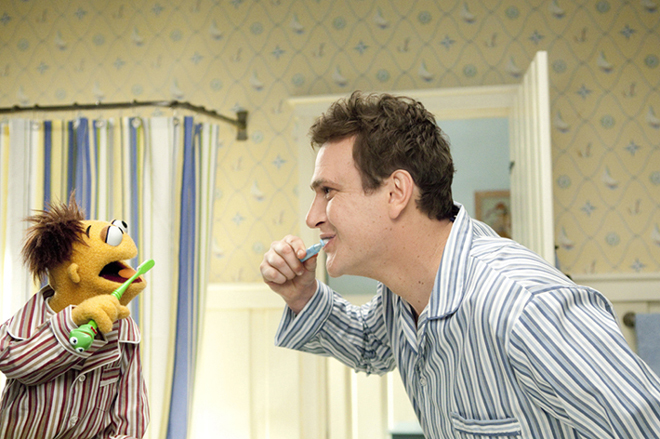
I didn't care for The Muppets either, and Miss Piggy is kind of a bitch in it but it isn't her fault (or Segel's; he fully commits to Gary and his various soppy subplots). It's the storyline about Walter, Gary's Muppet brother and world's biggest Muppets fan, finding his place in the world and believing in himself and whatnot — a perfectly functional concept whose execution here is problematic. Again, Gary (a human) and Walter (a Muppet) grew up together. Gary is apparently around 30, which would put Walter in his late 20s, probably, and yes, it's a kids' movie, but what's up with their still sharing a twin-beds Bert-and-Ernie domicile? If that's the house they grew up in, what became of their parents? This isn't even getting into the arrested-development issues Gary's having: son, you don't keep a girlfriend played by Amy Adams waiting ten years for a ring. She teaches a car-repair class, in a circle skirt and pumps! Also, she's Amy Adams. I know that's the point, but the problem here…is that it's Amy Adams. (She's charming in the film, in spite of the "it's me or the dog" bit she has to play.)
And then you find yourself troubled with all these larger existential questions about Muppet aging — they split up how long ago? Which makes them how old now? Are they…old old? The Eighties-Robot gag is okay (I enjoyed visiting with vintage soda-can fonts), but then you can't stop wondering how we're meant to understand "Muppet years" and whether they can die or they just get unstuffed or what.
And then you down a half-inch of bourbon and wander back to your point, and here it is: the movie treats Walter like he's still a child. That doesn't really line up timing-wise, and Walter is just kind of a wet end in the second place. It's great that he finds his people (well, "people"), and he's a hell of a whistler, but that subplot draaaaags. The main plot, in which the Muppets must reunite to save their theater from an evil land developer (Chris Cooper, who tries heroically, but I hope he fired his agent after he had to rap), is also a foregone conclusion, but between the meta jokes from Waldorf and Statler about how they're announcing plot points; the Scandinavian diacritical marks on the Chef's subtitles; the Chiba-esque credits sequence for kidnapping Jack Black; and sundry cameos, that story is more spritely. The Walter stuff that felt shoehorned in for children/people unfamiliar with the franchise felt damp and simplistic.
The nominated song, "Man or Muppet," is why we're all here. It's not good, and not just because forces Walter to sing that he's "a very manly Muppet." Blech. Still, expect to see Mr. The Frog up at the podium on Oscar night.
Sarah D. Bunting co-founded Television Without Pity.com, and has written for Seventeen, New York Magazine, MSNBC.com, Salon, Yahoo!, and others. She's the chief cook and bottle-washer at TomatoNation.com. For more on how the Oscars Death Race began, click here.
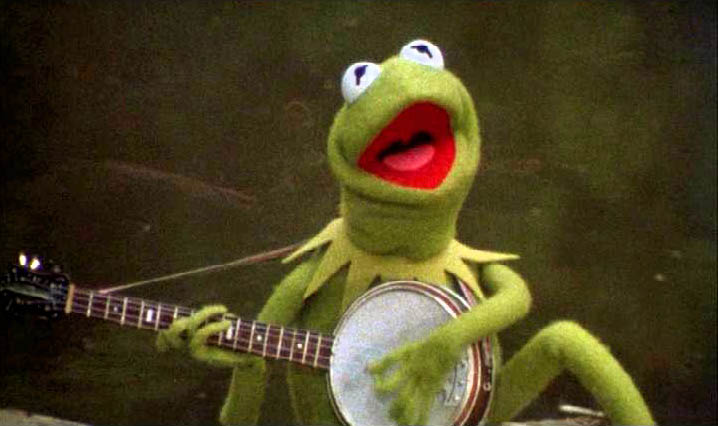


 For a guy who so clearly gets the Muppets, Segel should be the first person to realize how utterly un-Hensonian this is. Henson’s Muppet movies are full of big musical performances, but always with the Muppets at the center of the action. In The Great Muppet Caper alone, there’s the black-tie dance sequence that includes Miss Piggy tap-dancing, the synchronized swimming number, also starring Piggy, and “Couldn’t We Ride,” with the whole crew on bicycles. The thrill of these Henson numbers is their audaciousness, the way Henson dared to make the Muppets part of the action in scenarios in which it seemed logistically impossible. Segel’s opening dance number takes the opposite approach. One moment Walter and Gary are singing their way through the streets, and the next moment Walter is gone, literally kicked from the frame, never to return until he’s wheeled in on luggage at the very end of the sequence as dozens of humans dance behind him. Audacious? Hardly. And it’s a sign of what’s to come. Segel’s core mistake is to repeatedly push the Muppets to the margins in a movie designed to give them the spotlight. Case in point: Of the more than 20 songs in Henson’s three Muppet movies, only one of them has a non-Muppet performer (“Piggy’s Fantasy” in Caper, in which Kermit vies with a voice-dubbed Charles Grodin, which is part of the joke). Yet of the six original songs in Segel’s film, only one of them is Muppets-only. One.
 Press Play Video Blog