
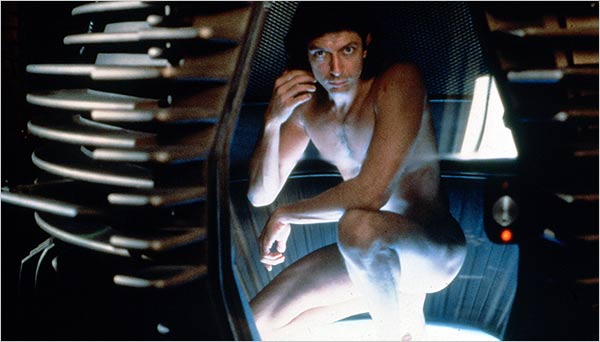

I’m glad I re-watched David Cronenberg’s 1986 version of The Fly on Blu-ray. I haven't watched it in decent resolution since I saw it in a theater on first release. It's still brilliant and perfect, and profoundly moving—maybe Cronenberg's greatest and most perfect film; a horror tragedy that doesn't cop out, ever. Deftly combining aspects of romantic comedy, science fiction, gross-out midnight movie, and parable of the consequences of hubris, The Fly also works as a metaphor for what happens to couples and individuals when the body breaks down, decays, or merely ages. (When the hero’s “disease” starts to snowball, he totters into the lab on two canes like an old man; something about the makeup reminded me of the “old” Joseph Cotten in Citizen Kane.)
Charles Edward Pogue's original script was heavily rewritten by Cronenberg, who fleshed out the main characters and the central love triangle and infused the whole story with his distinctive brand of pulp poetry, which is fundamentally rational yet prone to flights of romantic obsession and grandiose theatrical monologues. Since the film's original release, Pogue has been very open about Cronenberg’s contributions, and why wouldn't he be? They give the film much of its flavor. The Fly is filled with quotable lines and phrases, including "the poetry of steak" and "insect politics" and "Not to wax, uh, messianic" and "Drink deep, or taste not, the plasma spring! Y'see what I'm saying? And I'm not just talking about sex and penetration. I'm talking about penetration beyond the veil of the flesh! A deep penetrating dive into the plasma pool!"
 It's also a genuinely sexy film, at least at the start, before the body parts start falling off. (That closeup of the "Brundlefly Museum" of "redundant" body parts in the hero's fridge still makes me gasp; his cock is in there!) Jeff Goldblum’s Seth Brundle and Geena Davis’s Veronica “Ronnie” Quaife are one of the most real-seeming screen couples of the ‘80s. You can tell the actors were lovers during this period: they know each other's bodies as well as they know each other's senses of humor. They even share physical and vocal tics, as couples who've been together a while always do. Neither has ever looked more beautiful, but they’re attractive in a real way, not an airbrushed Hollywood way. Cronenberg treats them as real people whose wit and intelligence are as attractive as their bodies. The way Veronica plucks that bit of circuit board from Seth’s back post-coitus, and helps him clip those “weird hairs” as he's eating ice cream from a carton later; all the scenes of them eating in restaurants and walking through city marketplaces, doting on each other, exchanging the sorts of glances that only real lovers trade: these details and others make it feel as though we are observing a relationship, not a screenwriter's construct. Ditto the wonderful little character-building touches, as when Seth, who suffers from motion sickness, gets out of a taxi before it has even come to a full stop, and Ronnie gripes about a substandard cheeseburger, then eats one of the pickles first before biting into the sandwich.
When Goldblum sheds his geeky facade and embraces what he thinks is his Super Fly destiny, he becomes even more attractive because he's so dangerously confident; he walks with a swagger, tossing his long hair like a Persian prince in a fairy tale. (This film is my favorite take on Frankenstein ever, because the hero is both Dr. Frankenstein and the Creature—it's one-stop shopping!) Seth and Ronnie seem perfect for each other, which of course makes the ensuing tragedy so much harder to take. The third point in the triangle – Ronnie’s ex-lover and boss, John Getz's Stathis Borin, at first seems a caricature of an 80s Yuppie swine, but he deepens as the film goes along; we see that he's still hopelessly in love with his ex-girlfriend and wants to protect her, and we get that his more asshole-ish remarks are the product of self-loathing, a way of trying to distance her from him, perhaps for what he believes is her own good. (Weird that the character's name has the same first letters as the hero's. Surely it was intentional, but it’s one of the few touches Cronenberg doesn’t elaborate on.)
 Ronnie goes from cynical opportunism to deep and true love, but without ever losing her rationality. She looks out for herself, and not once does she seriously consider giving into Seth's, um, messianic waxing. But she never stops loving Seth. In the film’s final third, she’s wracked with guilt over finding her dream man suddenly repulsive and sad. The script is wise about how people in relationships keep feeling love and lust even when one or both are changing. When Ronnie realizes she’s pregnant with Seth’s probably-mutant baby, she decides to abort it, and it’s the correct decision; and yet when Seth crashes through the glass-bricked window of the hospital operating room to “rescue” her and their unborn larvae, she lets herself be swept into his arms anyway. It’s as if she’s in thrall to vestigial, or perhaps primordial, feminine desires to be protected and to bear a lover’s offspring. Her relapse into love is extinguished by horror once she returns to the lab and realizes what Seth has in store for her: a genetic sifting operation designed to minimize the physical presence of Brundlefly by merging him, Ronnie and the “baby.” But there’s never a sense that The Fly is copping out by trying to have things both ways—that it can’t make up its mind what it thinks of the situation. It’s fiercely true to life even though its physiological details are fiendishly unreal. Every stage of Ronnie’s emotional journey rings true. Extricating yourself from a failing relationship while pregnant is a predicament that countless women have experienced; ditto the pain of being in love with a man who’s dying and/or losing his mind, and becoming ever more frightening and repulsive, instilling his survivor with feelings of guilt and shame that she’ll never shake, only learn to manage. Mainstream movies rarely dare to depict such fraught situations in all their messy realness. The Fly does so in a science-fiction setting, with telepods and freaky prostheses and an operatic Howard Shore score that could be the music Franz Waxman heard in his head as he lay dying. It’s all quite astonishing.
Cronenberg is one of the most sophisticated chroniclers of romance in modern cinema, and I’m surprised critics haven’t made more of this over the decades. Why? Perhaps it’s because Cronenberg deals in symbols and metaphors as well as witty dialogue and plausible behavior. It can be hard to sense the human heart beating beneath the blood and goo that engulf some of his finest adult dramas. The Fly is a rare horror film—and a rare big-budget Hollywood movie, period—that is adult in all the ways that count. I would never show it to a child, or even a young adult, not because of the sex and gore, but because they would have no way of processing the feelings it evokes. You have to have lived a bit to truly appreciate this movie, and it only becomes more powerful as you grow older.
Matt Zoller Seitz is the co-founder of Press Play.
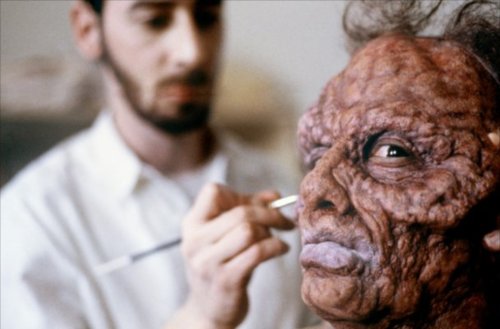
 David Cronenberg’s 1986 remake of The Fly would have been a shoo-in for a theoretical best collaborative performance Oscar. What makes it truly special is its empathy for its arrogant scientist hero, Seth Brundle, who tests his revolutionary new matter transporter on himself and becomes genetically fused with a fly that was not supposed to be in the telepod with him. Jeff Goldblum’s performance as Seth Brundle is a nexus point for all the film’s creative elements: direction, writing, acting, makeup, optical effects, miniatures and puppetry. Goldblum’s work here brings everything together. It’s kind of a thespian telepod.
 The effects are layered on incrementally, scene by scene, and they are showcased almost entirely through a single character, Seth Brundle, and a single performance, Jeff Goldblum’s.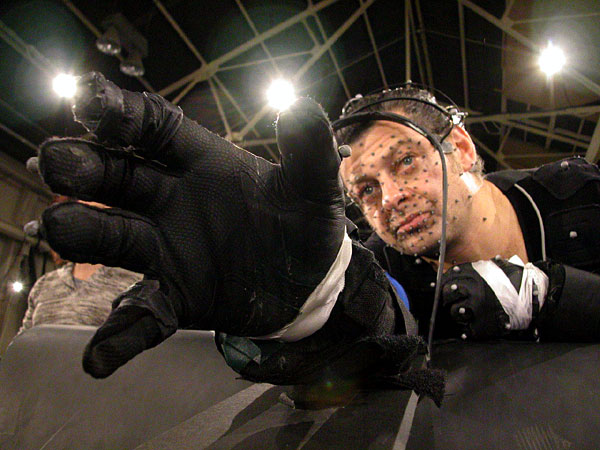
 This series argues for a new Oscar category that would honor characters brought to life through a combination of acting and behind-scenes-craft. This new category would not just acknowledge the important role that motion capture plays in modern cinema; it would open the door for honoring other forms of performance that have traditionally gotten snubbed by awards groups, including puppetry and acting under very heavy makeup.
 It also didn't happen for Tom Hanks or Jim Carrey, who played multiple roles in Robert Zemeckis' The Polar Express and A Christmas Carol respectively, or Crispin Glover, who was brilliant as Grendel in Zemeckis' Beowulf; all three films used motion capture technology.
 However, Serkis' motion capture acting can be compared, sort of, to Brad Pitt's work in 2008's The Curious Case of Benjamin Button, in which the star played a man who ages backward. Pitt's performance generated the expressions and body language that CGI artists needed to create Button's gnarled-old-man physique in early scenes, as well as the "youthful" face and body that he acquired later. Pitt earned an Oscar nod as Best Actor for Button but did not win; I would not be surprised to learn that the special effects disqualified him in voters' minds. Some people consider this kind of performance to be "cheating," and think the same of performances given under immersive makeup. John Hurt's makeup-submerged performance as the disfigured John Merrick in The Elephant Man (1980) was nominated as Best Actor that year, but didn't win, maybe for similar reasons. That year's eventual Best Actor winner Robert DeNiro sported heavy makeup in the fat-middle-aged scenes of Raging Bull, but you could always tell it was DeNiro; he wasn't swallowed up like Hurt
  For example: "The Oscar for Outstanding Collaborative Performance of 1980 goes to: Yoda in The Empire Strikes Back. Frank Oz, performance and voice; Jim Henson's Creature Shop, fabrication; Industrial Light and Magic, motion control."
 Press Play Video Blog