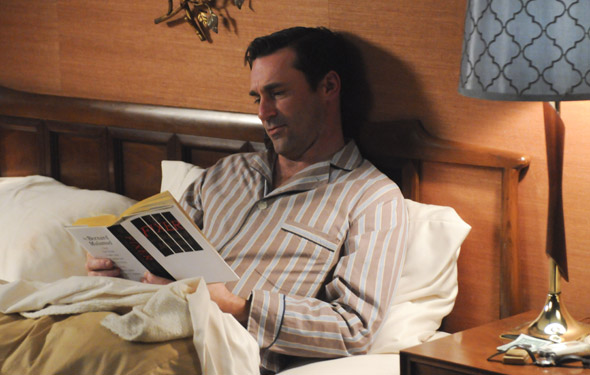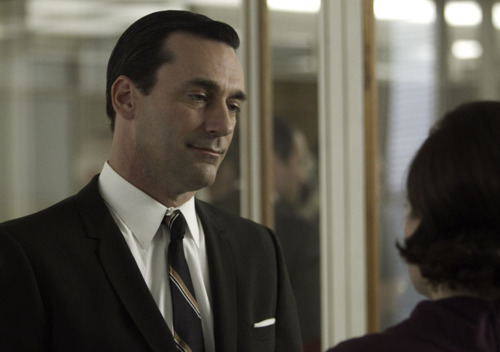
MAD MEN RECAP 10: THE OTHER WOMAN

MAD MEN Recap 10: The Other Woman

Girl, you really got me going, you got me so I don't know what I'm doing.

nullThe Other Woman may be the most disturbing episode of Mad Men ever. We've seen bad things happen to characters we love, some of their own doing. We've seen Don drink himself into a stupor, Roger lie the company almost into ruin, and Lane embezzle. We've seen the way both ambition and love can cause people to sacrifice themselves, but has anyone suffered more than Joan, or sacrificed more?

The fans have gone back and forth on Pete this season. In my recap for Signal 30, I called Pete a shit. I got some blowback from fans for that, and indeed, in subsequent episodes, Pete has again appeared more sympathetic. His pathetic adoration of Howard's wife, Beth, in Dark Shadows, touched people's hearts. But now I think more people will agree with my earlier assessment. Pete is a low-life and a shit, not just because he asked Joan to prostitute herself, but because he insisted there was nothing wrong with asking. Watch:

When Joan said "You couldn't afford it," it was not, in fact, a counter-offer, but a way of shutting Pete down; only Pete's insensitivity made him think otherwise. Pete takes seriously the old joke, often attributed to Winston Churchill: Churchill is said to have approached a lady at a party and ask, "Madame, would you sleep with me for one million pounds?" She agreed that she would. "Would you sleep with me for ten pounds?" he asked.  "Certainly not! What kind of girl do you think I am?" "Madame," he answered "We have already established what you are. Now we are merely discussing price." (I've read various versions of this story, with different price points.)

The joke has a serious underpinning, as so many jokes do. All women are whores, we are being told, and are merely negotiating price. Joan literally prostitutes herself for a partnership, but Gail, who "raised her to be admired," has been prostituting herself in her own way to Apollo, in exchange for household repairs. Megan must prostitute herself in a small way, by being displayed. Turning around and showing her ass has little or nothing to do with the callback; she thought she was safe because the director was "a fairy," but with three men on the couch it's clear she doesn't feel safe at all. At the office, her friend Julia is happy to sexually display herself to a roomful of writers in the hopes of getting a job as a Jaguar girl.

Even Peggy had money thrown at her, quite literally, and even Peggy knows she has to sell a woman's sexuality (Lady Godiva, "as naked as we are allowed to make her") to keep an account.

The most telling, most obvious, quote about the theme of this episode is what Don says in the Jaguar pitch, right down to the tagline:

Oh, this car. This thing, gentlemen. What price would we pay, what behavior would we forgive, if they weren’t pretty, if they weren’t temperamental, if they weren’t beyond our reach and a little out of our control? Would we love them like we do? Jaguar: At last something beautiful you can truly own.

While women are being prostituted, bought, and sold because they are things, the way beautiful, temperamental cars are things, men imagine they are the ones who suffer, because sometimes they can't quite control the transaction. The tagline itself is shown as being born from anger at women: Ginsberg sees Julia prancing and says "She just comes and goes as she pleases. Huh."

Why shouldn't she? I mean, she's human, isn't she? Isn't that what humans do—use self-will to make their own decisions? But to Ginsberg and many other men, a woman isn't a human, she's an object of desire, and her ability to make herself desirable and then still have self-will is enraging. To Ginsberg, the lyrics of the closing song (You Really Got Me by the Kinks) make him mad: "You really got me going" is something women do to men, which men can't control.

It's disturbing. The whole episode is disturbing, and Semi Chellas and Matt Weiner pull no punches, juxtaposing every inner cringe Joan experiences with the pitch so that there is no doubt they are the same thing. Don wants to control Megan and keep her home, Pete wants to control Trudy and 'put his foot down', his greatest anger being simply that he cannot get her to obey him, that she wants things he doesn't want. Pete, who wants a prostitute in a brothel to treat him like her king, cannot abide the fact that any woman has self-will. This is the same Pete who, in Episode 1.05: 5G, asked Trudy to sleep with an editor in order to get him published—no wonder he thinks Joan shouldn't be insulted.

But there's another quote that speaks to the heart of women being bought and sold. In the conference call about Chevalier Blanc, the client asks, "Why would a woman buy a man anything for Valentine’s Day?"

Why indeed? Valentine's Day is transactional: A man buys flowers or perfume or jewelry, a woman responds with sex. Men are the subjects, they have self-will; they make their selection and choose the purchase price, while women are the objects being purchased.

I could write for hours about this episode, but we really have to talk about Peggy.

Her decision has been a long time coming, and may be necessary. I mean, people didn't job-hop in the 1960s the way they do now, but advertising was its own animal, and as a career decision this was probably one hundred percent right.

Here's the thing: in business, you sell yourself. Ted Chauogh wants to hire Don's protégé, and he negotiates with Peggy over price and title. It's not sexual; Peggy's gender is not part of the transaction. Yet the negotiation perfectly parallels what Joan did with a percentage and a partnership. We all do sell ourselves for work, for ambition, to succeed.

Certainly a lot of feminist and other theory would tell us it's all prostitution: Marriage, dating, Valentine's Day, casting couches, and every other transaction in which men are the buyers. But when we look at it that way, we can forget how painful this particular act of prostitution is for Joan, and let's not forget that. Last episode we saw her say she has some control at work, and how important that's been for her. This wasn't just a sexual transaction, it was one that stripped Joan of her sense of control, of self-ownership, and left a dark place behind her eyes, brilliant portrayed by Christina Hendricks.

Meanwhile, Peggy sacrificed love for ambition, because truly, she and Don love each other: Watch him kiss her hand, and her choke up in response:

This clip parallels the end of Episode 4.07: The Suitcase. Don kisses the hand that he held then, he honors the love they share. But as Roger said last episode, it's every man for himself, there can be no loyalty in business.

Some additional thoughts:

  • Welcome back, Dale! Mark Kelly played copywriter Dale in one episode of each of the first three seasons, and was last seen stripped to his t-shirt after getting spattered with blood in Episode 3.06: Guy Walks Into an Advertising Agency.
  • I'm giving quote of the week to Pete, because "It’s an epic poem for me to get home" is a gorgeous bit of hyperbole.
  • Ted Chaough, Freddy Rumsen, and a call back to Tom Vogel all in one episode (plus Dale). This season has been so great about connecting the dots to past seasons.

Deborah Lipp is the co-owner of Basket of Kisses, whose motto is "smart discussion about smart television." She is the author of six books, including "The Ultimate James Bond Fan Book."

Watch Mad Men Moments, a series of videos on Mad Men, produced by Indiewire Press Play.
GIRLS RECAP 7: WELCOME TO BUSHWICK, A.K.A. THE CRACKCIDENT

GIRLS RECAP 7: WELCOME TO BUSHWICK, A.K.A. THE CRACKCIDENT

null

Was anyone else surprised that the crack in this week's episode title was crack cocaine, and not the crack of an ass? We've seen stunt penises, non-stunt pubic hair, and breasts of all ages; I figured that the crackcident would involve pants falling down somehow. And it did, sort of.

nullThe "Welcome to Bushwick" part is easy: it's the location of a big loft party where all of our main characters converge.  The crack is cocaine, which Shoshanna, of all people, ends up accidentally smoking, thinking it's pot. We don't see that mistake being made, but I hope that scene makes it onto the DVD outtakes, because what we do see is brilliant. Shosh leads off with a rant about her kick-boxing class, picks compulsively at her ear, and points a lot at Jessa; then Jessa, minutes after reassuring Shoshanna that she'll be Shoshanna's "crack spirit guide," reassigns that duty to Ray. Ray balks—"I'm not a fucking JAP daycare, absolutely not"—but Jessa says it's no big deal, just make sure Shosh doesn't jump off a roof "or get fingered by a beat-boxer." Jessa swans off. (More on that in a sec.) Shoshanna strikes a thoughtful pose.

Beat.

Shoshanna sprints off. Ray sprints after her. Niftily timed slapstick ensues: Ray runs one way, and Shoshanna runs past him the other way (waving her skirt over her head). Ray chases her down an alley while she dodges and weaves as if dodging gunfire. (Any other Archer fans here? "ZIG-ZAG, BABOU!") Ray gets a cramp and slows down; Shoshanna runs back up to him (skirt now MIA), orders him to quit chasing her, and fells him with self-defense-class moves. Ray is piqued by her freakish strength, which she attributes to the crack, although it's starting to wear off. Not entirely, though, as she's still got enough aggression in her bloodstream to offer him a "non-sexual" massage. Of his groin, in which she just kneed him. Typically, she learned massage in a sports-therapy class she took to "meet jocks." Shoshanna kneels beside Ray and massages his "area" as he eyes her speculatively. Has crack forged a love connection? If so, this is the show’s second couple brought together by bad-trip baby-sitting (see also: Charlie and Marnie).

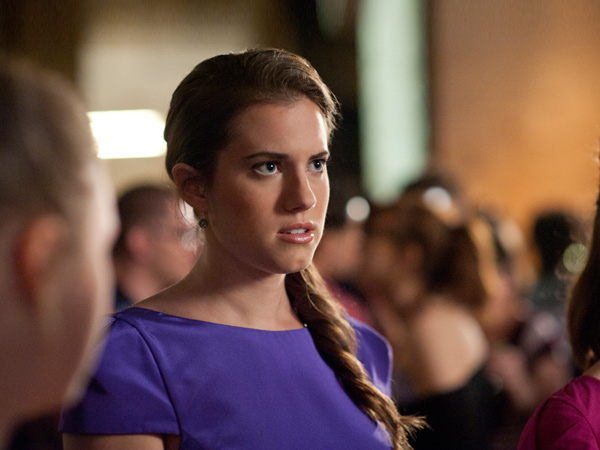
Wait: don't see them. It's horribly awkward. Marnie is nervous because Charlie's band is playing at the party —she's not nervous to see him, mind you. She's nervous that he'll see her and feel sad. Marnie approaches Charlie after his band finishes playing and compliments him on the set, and happily comments that it's mature and pleasant between them, but then of course a girl in a headband (referred to later by Marnie as "a tiny Navajo") jumps right into Charlie's arms and starts raving to him and Marnie about the band. It's clear that "Audrey" is dating Charlie and that she has no idea who Marnie is, and Allison Williams makes Marnie's face work (beautifully) through confusion, sadness, and rejected rage, but Marnie herself is totally unsympathetic when she calls Charlie a sociopath for dating another girl, just two weeks after their break-up.

The rest of the party is a trial for her. Oh, excuse me—for anyone who runs into her. Her obsession with Charlie's two-weekrebound becomes an understandable, but obnoxious, refrain (I finally started calling Marnie "Money Pit"in my notes). First she bitches about it to a stranger, who punctuates her remarks by getting up and leaving while she's talking. Then she spots Elijah slow-dancing with his boyfriend and runs up to him to say hello—if by "say hello," you mean "complain about Charlie, and how selfish Hannah is." Elijah rolls his eyes so hard, he nearly sprains his neck, then notes that if anyone's selfish, it's Marnie, because Marnie made out with him sophomore year while Hannah had mono. Marnie snorts that it doesn't count because it was at Rent rehearsals, and besides, Elijah's the one who dated Hannah for two years and secretly liked boys the whole time. Elijah's like, not so much with the "secretly" part, sneering, 'RENT rehearsals!" It's not realistic to keep working this character into the scripts, but I don't care, because Andrew Rannells is perfect. Marnie sneeringly asks him whose dick he sucked to get a part, because his voice "sounds like a bag of dying babies," and I am so stealing that comment, even if it gets me slapped in the face like it does Marnie. (I don't know why the blocking on that smack is so amateurish and fake, either, but I assume it's intentional, and I know it's hilarious.)


On top of everything else, Marnie's now marooned at the party by herself, because Jessa has accidentally invited Lavoyt to the party and now has to deal with the inevitable ugliness. While explaining to Hannah why every party could be the best party ever, Jessa gets a text from an unknown number, asking what she's up to. Hannah tells her to ask who it is, but Jessa puts adventure above common sense once again and invites the mystery texter to the best party ever. The mystery texter is, of course, Lavoyt; the wife and kids have gone out of town to visit family, and he stayed home to work. Jessa wonders why he bothered, when he doesn't have a job. To try to get a leg over you, obviously, and as Lavoyt looks sadly down at the bottle of wine he brought to a Bushwick party with a reggae band playing, he has a realization: "Oh my God, I'm That Guy."

It's probably not a "realization," given what we see later; it's probably just another way of trying to get her to pity-fuck him. She tells him to "put a pin in [his] midlife crisis" and dance with her, but then she hurls the bottle of wine over the railing and hits someone, and that guy rolls up to them and punches Lavoyt in the face, and he and Jessa end up in the ER watching a junkie try to cadge Vicodin from the desk clerk. Lavoyt starts crying; what is he going to tell his wife? Jessa looks a little scared by the tears, and suggests telling Mrs. Lavoyt the truth. Lavoyt, facedown in her lap, wails through his bloody nose and (likely fake) tears, "Let's spend the night together," adding that they "won't do anything," and now it's Jessa having the realization. Hers is about playing with fire: "I can't do this kind of thing anymore." Lavoyt is apparently used to the sad-sack routine working, because his face hardens instantly and he calls her a tease. Jessa parries with a line she's clearly used to shut assholes down before: "I liked you better when you were being a good guy." "Ain't that the way," he grunts, and gets up to leave. Why pretend his bloody nose needs medical attention if his dick isn't going to get Jessa's? Jessa suggests they can stay friends, but he grumbles, "We were never friends to begin with. You work for my kids." Ouch: Lavoyt thinks he's cutting Jessa down with that line, but Jessa isn't the one trying to take it to the hoop with the nanny instead of finding a job or spending time with his own kids. Great job by James LeGros in shifting the character from "aimless and pathetic" to "entitled douche."

Hannah, meanwhile, has spotted Adam in a dance circle of the "best dyke friends" he's alluded to previously, doing a series of weird moves probably based in theoretical mathematics. Hannah complains to the others that, after the conversation in which he said he missed her, he hasn't responded to a text in two weeks. She also observes that she's never seen him outside his house: "I've never seen him with a shirt on." I'm not going to take credit for the insight; I'm just going to feel grateful somebody on the show pointed it out.

She hides behind a wall unit and spies on him, then flees rather than talk to him, but at the bar, she's approached by one of his "best dyke friends," Tako. (Tako makes sure to note that it's not spelled "Taco." Snerk.) Tako offers Hannah a friendly drink, but Hannah notes that she doesn't really drink after an incident with Brie and hurling on her cell phone. . . . Cute line, but it's really just to set up the big reveal for Tako, wherein she asks if that's how Hannah knows Adam—from Alcoholics Anonymous. Hannah is gobsmacked, and while Tako rambles on about how this is one of the things that defines Adam (the other, obviously, is his "love of books"—and that we've seen, at least), Hannah can't decide how to feel. Should she feel hurt, again, some more, by the fact that this isn't something Adam trusted her enough to share with her? Or should she feel even more attracted to what she sees as a new and tragic dimension of Adam?

Either way, it's Hannah making a dimension of Adam about herself, so she settles for "both." Adam invites her to join him on a dumpster-diving mission, to collect scrap for a boat he's building that's designed to fall apart as it goes along . . . in the Hudson. Instead of 1) notifying her friends that she's leaving or 2) refusing on the grounds that this nautical "plan" is excessively Alexander-Supertrampy, Hannah hops aboard Adam's bike handlebars, and off they go. But he's pedaling too fast for her, and when she wails at Adam to stop the bike and let her walk, he stops suddenly, and she face-plants. I really hope for Lena Dunham's sake that they got that on the first take . . .

…but I don't think they did, because when we cut back to the pair, Hannah's got a fat lip. She's also got a chip on her shoulder, ordering Adam not to talk to her while she sends Marnie her coordinates, and she blows up at Adam for not telling her he was in AA. He responds, gently at first, that it's been a big part of his life since he was 17, but when she won't let it go, he blows up, yelling that she never asked: "You never ask me anything!" Well, she does—but only about herself, how she's doing, does this feel good, does he like her skirt. Adam does have a great point: for a woman who wants to "rate" as his girlfriend, she hasn't done much to earn the spot. Marnie pulls up in a cab and orders Adam to get away from Hannah. Finally, Adam rounds on Hannah: "Do you want me to be your boyfriend? Is that it? Do you want me to be your fucking boyfriend?"

And then, in an episode full of them, the best cut yet: Adam, Hannah, Marnie, and Adam's bike all crammed into the back seat of the cab. Hannah is trying valiantly not to grin . . . and gloriously failing.

"Welcome to Bushwick" is the most sure-handed work we've seen yet from the show. The physical humor is edited flawlessly, including the credits sequence, a little send-up mash-up that includes Asian characters and rave-y touches. 

The one-liners are confident and don't over-explain themselves or veer into dorm-monologue territory (Ray snapping into the mic, "Don't bring a baby to a party like this"; Shoshanna responding to the crack revelation with "Don't tell my parents; don't tell me!"; the throwaway "Age of Innocence fan club" exchange between Ray and Jessa, which this Wharton nerd adored). Marnie's attempted kiss-off of Adam, "Enjoy going through life as . . . yourself," encapsulates the ep really well, because it's as though the show is doing that—enjoying itself, laughing with its characters, instead of trying to be capital-D definitive all the time. Don't get me wrong, I like the show's ambitions. But when it's "just" doing this, it does it well.

Sarah D. Bunting co-founded TelevisionWithoutPity.com, and has written for Seventeen, New York Magazine, MSNBC.com, Salon, Yahoo!, and others. She's the chief cook and bottle-washer at TomatoNation.com.

GAME OF THRONES RECAP 8: THE PRINCE OF WINTERFELL

GAME OF THRONES RECAP 8: THE PRINCE OF WINTERFELL

One of the recurring discussions about this second season of Game Of Thrones concerns how much the television show is changed from the novels. While the merits of the specific changes are debatable, a running theme of both my reviews and those of other critics is that the show is more confident in its adaptation, becoming its own entity.

nullAs obvious as it might sound, we should remember that entity is a television show, and a particular form of a television show, at that: highly serialized with multiple interweaving plots, much like many of the great dramas of the last decade-plus. But the TV show-ness of Game Of Thrones works against it slightly in “The Prince Of Winterfell.” This episode leads towards the climax of the season, so it’s almost all build-up. Episodes like this are traditional in television, but they don't work so well for Game Of Thrones.

The two series associated most with the “build-up” episode are two of the most important for the current form of serialization, Buffy The Vampire Slayer and The Wire. Buffy helped develop a model of the standalone episode, with clues in each week's show leading towards a larger finale each season. After a few seasons, the overarching plot became such an important part of the show that the last batch of episodes became a string of heavily serialized “mythology” episodes, barely working by themselves. The Buffy episode “The Prince Of Winterfell” reminded me most of is “The Weight Of The World,” the fifth season's penultimate episode, in which Buffy, having lost all hope and motivation, has to be emotionally wrestled back into heroic shape for the season’s climax—the emotions before the storm. While both of these episodes may be competent, they’re fairly unmemorable out of context.

Game Of Thrones is significantly more complicated than Buffy, though, taking place across multiple geographic regions, with exponentially more major characters; in this sense, it’s more similar to The Wire. The Wire’s serialization was even more focused than Buffy’s, or any other show, really. Each of its seasons was 10-13 episodes, focused generally on a component of the society of Baltimore, and specifically on a drug case worked by the main characters. Most of the season would be build-up, the second-to-last episode would contain the climax of the investigation, and then would come the finale, the denouement. Game Of Thrones mostly followed that model in the first season, and is certainly following it here: several different plotlines are leading to what should be an explosive conclusion.

Here’s the problem: Games Of Thrones is even more scattered and geographically disjointed than The Wire. While The Wire had almost as many characters and motivations to keep track of as this show, all the events were working towards the same climax: the conclusion of the drug investigation, and then the rippling effects of that climax (although, to be fair, the fourth season deviated from this specific form). In Game Of Thrones, each smaller story seems to be moving towards a different climax.

The chief upcoming event we hear discussed is Stannis’ attack on King’s Landing, the capital. This would be the biggest battle of the war so far, and a total Stannis victory might even end that war altogether. Preparing for it makes sense. Jon Snow, now captured by wildlings and being led to their king, is also clearly moving toward a climax of some kind, as is Dany, desperate to get her dragons back. And the tension is clearly escalating in Winterfell, as Theon refuses to leave with his sister, even as a northerner army approaches.

But that’s only half of the show’s stories, maybe fewer. Robb Stark’s romance may be climaxing, but its effects are unclear, as are the actions of his mother, who has released Jaime Lannister in exchange for her children, escorted by Brienne of Tarth. This is a new story thread and an interesting choice for the show to make (these events happened relatively later in the novels than they do here). Samwell Tarly and the rest of the Night’s Watch haven’t been mentioned in several episodes, but their discovery of a cache of obsidian weapons is deemed important enough to show up here. Yes, the show is moving towards something, but the important ones can’t help but be  diluted among all the other events taking place.

Three different things make the lack of action in this episode disappointing. First, last week’s episode was also relationship-heavy and event-light. It was so good that this episode pales in comparison, though of course two high points in a row isn’t always wise structurally. Second, the eighth episode of the first season, “The Pointy End,” managed to contain several different momentous events: the death of Arya’s dancing instructor; the undead attack at the Night’s Watch, Robb Stark summoning his bannermen and gaining their respect. Meanwhile, “The Prince Of Winterfell” seems intentionally non-momentous.

Why “intentionally”? The most dramatic moment of the episode occurs when Arya and her friends leave Harrenhal by walking past a bevy of dead men, all killed off-screen by Arya’s murder genie, Jaqen H’ghar. There is craft here: the build-up to this moment involves the Stark girl's desperation and cleverness, telling Jaqen to kill himself, or aid her. When he says, “A girl lacks honor,” Arya gives a quick shrug. Honor is meaningless to her. She’s trying to survive, and win. This is all good.

There’s just one tiny problem with the resolution, though: it’s not what happened in the novels. The changes the show made from the novel end up removing Arya’s agency, the importance of her actions, the intensity of the actions themselves, and not one but two of her most badass moments. There’s still some time for the show to make it up to her, I suppose, but I simply cannot fathom why it would remove arguably the best scenes of the second book . . . unless it was to deliberately rearrange events to fit a Wire-like structural framework. It doesn’t have to work that way. Game Of Thrones has so many different characters, working on a complex enough narrative, that it could have action and preparation in each episode.

Despite a disappointing lack of events and warping of Arya’s story, there was still a lot to like about “The Prince Of Winterfell.” Its theme of finding romance and comfort in the midst of war and intrigue successfully built the emotional tension in advance of the impending climax. Robb Stark’s scene with his new crush Talisa was a major step forward for this storyline. And Peter Dinklage acted the hell out of his romantic scene with Shae, showing a vulnerability only hinted at before. Additionally, Tyrion’s scenes with Varys are among the best the show has done, filled with wit, danger, foreshadowing, and charm. (“We could throw books at his men.” “We don’t have that many books.”) This demonstrates that Game Of Thrones is telling its multiple stories well. The issue is how it’s editing those stories together into a story, and into a series.

Adaptation:

In addition to the tremendously disappointing changes in the Arya Stark story, another Stark is ill-served by the adaptation. Arya's mother Cat Stark has had her agency largely removed as well, due to a couple of changes. When Littlefinger made the offer to exchange Jaime for her daughters, her decision to free Jaime was changed from one she made on her own to one she merely accepted. In the novels, Cat also made that decision after receiving the “news” of Bran and Rickon’s death; here, she’s pushed into it by the Karstarks demanding Jaime’s death after his failed escape last week. Cat Stark’s strength made her arguably my favorite character in the novels, but the show regularly weakens her.

Rowan Kaiser is a freelance pop culture critic currently living in the Bay Area. He is a staff writer at The A.V. Club, covering television and literature. He also writes about video games for several different publications, including Joystiq and Paste Magazine. Follow him on Twitter @rowankaiser for unimportant musings on media and extremely important kitten photographs.

MAD MEN RECAP 9: CHRISTMAS WALTZ

MAD MEN RECAP 9: CHRISTMAS WALTZ

In watching Mad Men episode 5.10, Christmas Waltz, my first thought was not about the episode's theme. In fact, at first, a theme didn't emerge. Instead, my first thought was how much fun this episode is. I haven’t been complaining about the season; last week got some bad reviews but I was fine with it, and the season overall has had some amazing episodes (Mystery Date and Far Away Places in particular), but this feels different. This feels like perfect Mad Men, everything we love about it. Scary, unpredictable, heart-stopping in its tense moments, laugh-out-loud funny, sexy, insightful . . . all the great Mad Men things. In fact, I’m pleased that a theme didn't present itself in an obvious way tonight. By being fun, funny, and surprising, Christmas Waltz engaged our interest without having to announce itself. The episode is also brilliant and unassuming, in that it doesn't have to stand on a chair and tell you how meaningful it is. But don't worry, there's meaning, and we'll get to that.

nullAs soon as I saw the "previously on" clips, I thought, 'We're getting everything the fans have been clamoring for.' More Lane, more Joan, less of a laser-focus on the Draper marriage to the exclusion of wonderful secondary characters. But I had no idea, no idea, that the longed-for return of Paul Kinsey was in store, and what a return it was! (I want you all to know that my son has to be at work at 5 a.m. on Monday, and my loud laughter was very inappropriate while he was trying to sleep. But I just couldn't help it. This scene is hysterical. Oh, Paul, we missed you so.) Watch his first scene here:

Paul, by the way, is the perfect access point to what the episode is about thematically: people turning themselves into things they aren't; people layering false identity onto false identity until they don't know, truly, who they are. Paul is a Krishna devotee, except he isn't. He knows himself, to a certain extent: He's still the jerk who wants people to like him but nobody does, and even in the act of serving his guru, Srila Prabhupada (yes, they depicted the real founder of the Krishna Consciousness Movement), he is sure that the guru likes everyone else better. This is the same old Paul who was jealous of Peggy's talent, and realizing he's the same person, whether in ad-man guise or spiritual guise, is actually a profound insight that might someday help him achieve true happiness, but for the moment, it makes him miserable.

Paul has a false image of his own creativity, made embarrassing by his ridiculous Star Trek script (when fans talked about Paul coming back to the show, Star Trek was often mentioned, so this was quite satisfying). He pretends to be a devotee to stay with Lakshmi; he is a twisted mass of false fronts and self-deception. Lakshmi, hilariously, is equally false, trading sex to undermine Paul's dreams, wanting a drink, slapping Harry, and calling Paul a great closer: neither the spiritual teacher she pretends to be nor the vulnerable, frightened girl Paul sees is anywhere in the person she presents (ass-first) to Harry.

Virtually by definition, a Joan episode is a great episode. Christina Hendricks  knocked it out of the park again. I am frustrated that we've seen almost nothing of Joan since episode 5.04, but this is a welcome return. Have we seen her melt down before? I don't think so. Oh, Joan, melt down for us:

This scene has everything; Joan Harris losing it, the magnificently silly receptionist, Mohawk's airplane getting crushed (a little foreshadowing for their late-episode strike announcement–historically accurate, natch), and Don coming to the rescue.

Joan, too, has layers of false identity, pretending to be a happy wife at SCDP for over five months when she knows her marriage is over, pretending that Greg is Kevin's father, and managing Roger's efforts to act as Kevin's father, which could pull the curtain away from her story. Joan had an identity she understood: "My mother raised me to be admired." But she also had an identity she thought she understood: Mrs. Harris. Now she just doesn't know. She's as lost as Paul, but without the ponytail. The sweetness of her connection to Don has always been a delight: Everyone loves the scene at the end of Guy Walks Into an Advertising Agency where they just get each other, because they know that being admired and feeling admirable are two very different things, and because they know each other as two people who have the appearance part down but not the rest of it. Will they or won't they? I kind of hope they won't, because I love the mutual respect, but I may be the only person on the entire Internet who feels that way, and I have to admit the potential visuals of a Don-Joan hookup make my head spin.

Roger, too, is juggling identities. He thinks his LSD experience exempts him from falsity, but he's still playing Roger games. Like Paul, whose shaven head doesn't drive out his old self, Roger is still trying to manipulate Joan with money and a puppy-dog sort of longing for her that shows no real commitment. He's never had a clue what she really wants and needs.

I haven't talked about Lane yet, and his falsity is most obvious, most pivotal, and most dangerous. All we know by the end of the episode is that he's set himself up to be caught, and probably by Joan, since she's the one who goes over the books. Forging Don's signature was an ugly move by a desperate man; he was so sure he'd figured it all out! At the beginning of the season, Lane was riddled with unarticulated longings; it's almost wrong to say he has a false front because, like Paul and like Joan, he hasn't a clue who the real Lane is. There's no true self hiding behind a false front, just a series of facades that fail to give him any satisfaction.

If there is a flaw in Christmas Waltz, it's that we can feel the machinery of this episode moving towards the conclusion of a later episode. Obviously, early episodes have to set up later ones, and also stand alone. When you experience the set-up more than the stand-alone, that's a structural flaw, and in the Lane storyline, that flaw is present. But: great episode? Yes! I am on pins and needles about Lane's fate.

Don is the mystery at the heart of it here: Who is he and who is he becoming?  While we have a pretty clear idea of the positive and negative trajectories of every other character (Paul, Joan, Roger, Harry, even Lakshmi), I honestly don't know who Don is defining himself as in Christmas Waltz.

Unaffected by work earlier, Don is suddenly, at the end, throwing himself into it. Missing Megan, he's angry at her, happy with her, and unhappy with her all at once. He doesn't understand her temper tantrum, at first taking it for sex play, and I'm not sure she understands it either. You know what's hard? Suddenly being home all day. Suddenly being "the wife," and preparing a simple, low-effort dinner and then having nothing else to do. The "problem that has no name" is worse in the suburbs but not only found there. Megan doesn't know who she is now either, and so the circle is complete.

Some additional thoughts:

  • We could tease out a second theme of people helping, or withholding help: Harry genuinely helped Paul, Don genuinely helped Joan. Lane got what he thought was the help he needed from the bank, but it proved not to be so. Joan also refused Roger's help, seeing strings attached.
  • Quote of the week goes to Don: "You’re going to need to define some of these pronouns if you want me to keep listening." Ha!
  • Megan throws food! Joan throws airplanes! Lakshmi slaps Harry! Even though nobody punched out Pete, that was still a lot of violence, and I loved it. Call me shallow.
  • We finally see Scarlett! She's been mentioned in many episodes but this is the first time she's appeared on-screen.
  • Don quotes Bobbi Barrett from episode 2.03: The Benefactor, "I like being bad and then going home and being good."

Deborah Lipp is the co-owner of Basket of Kisses, whose motto is "smart discussion about smart television." She is the author of six books, including "The Ultimate James Bond Fan Book."

Watch Mad Men Moments, a series of videos on Mad Men, produced by Indiewire Press Play.

GIRLS RECAP 6: THE RETURN

GIRLS RECAP 6: THE RETURN

null

One of the things I liked most about The Return—and I liked a bunch of things—was its title. Nearly every series has an episode like The Return, in which the hero returns to his/her place of origin to find things much changed for the smaller; after years of recapping serial television, on seeing that title, I'd originally expected the customary uncreative variation on one of the plots sure to follow—"Going Home," for instance, or "Homecoming," or a pun on the idea that you can't go home again or it's where the heart is.

null"The Return" was written by Lena Dunham and Judd Apatow, who pick up the clichés that surround "home" and see what icky bugs run out from underneath by sending Hannah to her parents' house in Michigan for the weekend, for their thirtieth anniversary. The episode defines and redefines "home" as it applies to Hannah: as an oblivious twentysomething, as a New Yorker, and as an adult only child. And it starts with the "oblivious" part when Hannah's heading to the airport. Marnie—Hannah's mother hen by proxy—leans out the window to remind Hannah that rent is due next week, and admonishes her to "be nice to your parents. Okay?" "I'm the nicest!" Hannah chirps.


She tries to be, but not very hard. Hannah slogs off the plane, lugging the garbage bag full of laundry that's serving as her suitcase. (In what post-2001 fantasy-land would the Hefty luggage get past TSA? Marnie would have made her borrow a duffel bag, I think.) Mom and Dad are waiting over-eagerly at the curb (next to their Volvo, natch); Dad is holding a sign with a picture of bananas on it, and mentions on the ride back to the house that they couldn't think of a better way to spend their anniversary than with "our best friend, who we just happened to create." That idea, simultaneously sweet and inappropriate, comes up repeatedly in the ep; her parents seem to have always treated Hannah as a sort of peer, but now that she's a real voting adult, nobody quite knows how to deal with that reality.

Mom responds to Dad by mentioning local job listings; she's doing it because she misses Hannah, but Hannah is immediately defensive. Mom also mentions the "fun Netflix" they've got at the house, a spot-on parental detail that Hannah is too busy texting, then stomping out of the room when Mom suggests she's hungry, to appreciate. (The movie they're watching: Million Dollar Baby. Rimshot!) Hannah flops on her bed, stares at her Party Girl poster, ignores a text from Marnie asking if she got the rent money from her parents, and calls Adam's phone but hangs up after one ring—she's put herself in his mind, but can plausibly claim that she just butt-dialed him.

And Dad assumes that Hannah is going on their anniversary "date," but Hannah declines—not because it's kind of weird, although she does mention that, but because she has a date of her own. Eric , whom Hannah meets when her frantic mother sends her on a mission to pick up hot-flash meds, is a sideburned cutie who co-owns a local pharmacy with his father, and a stark contrast to Adam in every possible way: traditionally good-looking; makes good money in a non-creative field; reacts with disbelief when Hannah tries to put a finger in his poop chute during sex, then murmurs to him, "I'm tight like a baby, right?" The look on Hannah's face when he initiates no-kink missionary intercourse is almost pitying.

He's a pleasant, solicitous young man with a business-like, adult relationship with his father, and he's definitively Not Adam. He's also definitively Not New York, and the automatic, unearned superiority Hannah feels to her high-school classmates—one perpetrated by New Yorkers of all ages—is another theme of the episode. It's made explicit in the pep talk Hannah gives herself in the mirror as she's getting ready to go out: "You are from New York, therefore you are just naturally interesting, okay? It is not up to you to fill up all of the pauses. You are not in danger of mortifying yourself." The latest in a line of unbecoming vintage frocks would beg to differ on that last point, as would the moment where she mentions offhandedly to Eric that she gave up on vegetarianism because Adam had nothing to eat at his place except meat—and because she thought that, if she went out for food, Adam wouldn't let her back in.

Hannah's New York bias in favor of, well, herself is even stronger in her interactions with Heather, an old high-school friend. We've seen framed pictures of Hannah and Heather in Hannah's old room, but they haven't kept in touch; Hannah hasn't heard anything about "the benefit"—the fundraiser Heather has put together for her friend Carrie, who got Natalee Hollowayed on a spring-break trip. Hannah also hasn't heard that Heather's about to move to Los Angeles to pursue a dance career, and when she asks whether Heather has any contacts out there to help her get started, Heather shrugs airily, "I know enough to know that you don't really have to know anybody."

In a way, she's right, because based on the moves we see, no contact short of Alvin Ailey could get Heather a job that wouldn't involve a pole—but it's Hannah's attitude we're meant to look at, and she believes that she knows better than Heather simply by virtue of living in "the big city" herself. Heather's belief that she merely has to move to L.A. and go on auditions to "make it" sounds innocent, even silly, but we've seen that Hannah cherished the publishing-world version of that belief. (And may yet cherish it.) Yes, the "benefit" is low-rent (to underscore the point, Edwin McCain's obnoxiously ubiquitous "I'll Be" is playing when Hannah and Eric walk in), and when Hannah buries her face in her pint to keep from laughing, it's sad for Heather and her inappropriate booty-dance of tribute to Carrie. It's also sad for Hannah, who thinks she knows something Heather doesn't about how to make it in a creative field.

Hannah's rant to Eric afterwards is revealing; Eric concedes that Heather's show "was a little cheesy," and Hannah wails, "It was very cheesy, and nobody's telling her! She's gonna go to L.A. and live in some shitty apartment and feel, like, sad and scared and lonely and weird, all the time, but she's got a good life here. I would like her life." Noooo kidding—that speech isn't a prediction for Heather's life, it's a description of Hannah's. When Eric jokes that he knows the florist has a job opening, Hannah retreats to the safety of Gotham-centric condescension, saying she'd get "a real job, like a teacher or something." Eric, bless his heart, doesn’t point out that she'd need a master's or certification to do that, just asks what her real job in New York is. She snaps that she's a writer, like she told him. Eric is surprised: "That's how you make money?" Hannah non-answers, "I don't have any money." I had that "no no no, it's not what I do, it's what I am" conversation about my career several times. In those conversations, it’s impossible not to sound like a stubborn jackass who should suck it up and sit for the LSATs before she winds up in bankruptcy court, and that's exactly what Hannah sounds like. But I can relate.

So can her father, as it turns out, but his "relating" to Hannah is more like "projecting." He's filling the space she's left at the dinner table by worrying aloud about her. "What does a person like that turn into?" he wonders, adding that she's funny and likable, "but that and ten cents . . ." Such a dad-ly expression, that. Mom thinks his assessment is harsh, but it’s really about Dad's own disappointments: "At what point will she realize, she's not gonna get to be what she wants to be when she grows up?" Like Hannah's comments about Heather moving to L.A., this isn't so much about the subject of the remarks as it is about the utterer; apparently Dad's life didn't turn out like he'd dreamed. Mom is taken aback by his lack of faith, and asks how he knows. "You know that, you're the one who forced us to cut her off to help her realize that!" Interesting take on what we saw; Mom did force the issue, but according to her, she wanted to have a lake house. Now she's singing a different tune: "I cut her off so she'd have something to write about!" Dad grumbles that "we don't even know if her writing is any good." It's hard to tell if this is a comment on how Hannah doesn't produce much in the first place, or if her parents just don't read it (remember how they left the pages she'd brought them behind in their hotel room?), but Mom thinks that Hannah knows how to have fun, "and she thinks about that fun, and she learns from that fun." The pronouncement is completely irrelevant to what makes a good, or successful, writer—but it also shows exactly how parents misunderstand what a writer does.

Certainly her parents try to supply Hannah with material later that night. Dad, vigorously pumping Mom from behind in the shower, slips and hits his head on the bathroom floor. Hannah comes home to find them dishabille, Mom trying to revive Dad, Dad naked and worried about a back strain, and has to help Mom haul Dad off the floor and into bed, suggesting repeatedly that he put a towel or a robe on.

After Dad's safely tucked in, Mom makes a gentle "not Mr. Right, but Mr. Right Now" observation about Eric that Hannah's surprised to hear the truth in, then asks if Hannah's doing okay financially, admitting that they cut her off rather abruptly. But they're proud that she's "making it work"—and Hannah, after taking a moment to consider asking for rent money anyway, chooses to pretend that she is making it work. Or vows to actually make it work.

Later, Adam calls. When Hannah says she's at home, he duhs that he is too, but she clarifies "home home," at her parents' house. She tells Adam about Dad's "sex injury," and about her own Eric-scapade, asking if it's "weird" that she told Adam that she slept with someone else. She's hoping it is, and the fruitlessness of this attempt to arouse his jealousy is as familiar to her now as her old high-school life no longer is. But Adam—wearing black undies and a lacy green satin sleep mask—doesn't react, so she changes the subject to Eric's gigantic, cheap apartment, wondering why they kill themselves to stay in a city that doesn't want them. Adam misses her. She's pleased, because she misses him—but what she really misses is home, the city, her life. She asks Adam to tell her what's going on out his window, and as he narrates a neighborhood crackhead's perambulations, Hannah stands on her parents' silent, dark front lawn, listening.

The Return is well crafted, subtle and smart about that day in every adult child's life when she refers to "home" as college, or her current city, and her mom goes quiet. It portrays Hannah's New York tunnel vision accurately without expecting us to sign off on it, and it asks what the definition of "home" is without answering its own question. Nice work by the supporting cast, especially Becky Ann Baker and Peter Scolari as her parents (and Little Scolari, heh), as the show itself "returns" to the exact observations that make it work best.

Sarah D. Bunting co-founded TelevisionWithoutPity.com, and has written for Seventeen, New York Magazine, MSNBC.com, Salon, Yahoo!, and others. She's the chief cook and bottle-washer at TomatoNation.com.

MAD MEN RECAP 6: AT THE CODFISH BALL

MAD MEN RECAP 6: AT THE CODFISH BALL

"It’s the future. It’s all I ever wanted."

nullAfter weeks of dense, intricate episodes of Mad Men that have challenged my skills as a writer, it's something of a relief to experience the plain ol' symbolic, interesting, well-written, enjoyable quality of At the Codfish Ball. I strongly suspect that I don't have to spend the rest of my life analyzing this episode, and that I can derive all its meaning in two or three viewings.

Which is not a criticism! I loved this episode, and I love the more complex ones. I do, however, see the difference.

The lyrics of the song "At the Codfish Ball" are about dancing fish. Twice we see Sally confronted with the task of eating fish. The first time, she's served spaghetti—you know kids, they just won't eat grown-up food. The second time, at the banquet, she tries it, and it seems like she might be learning to like it. But, while the kids in Megan's commercial are having beans rather than spaghetti, in either case comfort food and comforting adults aren't available to girls who eat fish and stumble upon illicit blow jobs. (Watch if you dare!)

At the Codfish Ball is about passing the torch, about generations, about growing up, and about the changes from one generation to the next. It's especially apropos in 1966, which is approximately when the term "generation gap" was coined, but it's true for all of us, from cave men to people who eat beans on the moon. Because this is Mad Men, it aims to take a more honest look at the generations than Megan's commercial does, and it ends on a dark note (that tableau at the end of dinner—in the video above—is as striking as the elevator tableau at the end of The Beautiful Girls). Yet about three-quarters of the way through, I was wondering if I was watching the most optimistic episode of Mad Men ever made. As dark as some of it was, I still feel that way.

How is the torch passed? Let me count the ways. At work, Peggy is proud of Megan and explicitly states that she is seeing the torch passed. Joan is proud of Peggy, and happy for her. Perhaps for the first time she sees Peggy striking out on a path that isn't the one Joan herself laid out for Peggy in the very first episode of the show. Joan serves as a surrogate mother for Peggy, since Peggy's own mother refuses to approve of her, and even withdraws Peggy's father's approval from beyond the grave. That torch didn't pass quite so successfully. Sally is praised as a mature young lady, and she heroically saves the older generation—but she's still too young to wear makeup. Nonetheless, attending the banquet is a significant "graduation." When she sees Roger, she asks if he's her sitter, and in a way he is: He's her "date," and he passes a kind of torch to her, teaching her how to be an account person and a "wing man."

We've already discussed the way that Sally's journey into adulthood turns suddenly darker. Megan's journey into maturity is also both joyful and dark. Those are some tough parents! They seem to have trained Megan well for marriage to Don, accustomed as she is to adultery and drunkenness. Another torch passed.

I loved Pete's conversation with Emile Calvet. If you recall, way back in Season 1 (Episode 1.04: New Amsterdam), Pete's own father said he didn't understand what Pete did, and was disdainful. Now Pete has an answer for the question, and an elegant one. Pete's been difficult to like this season, but he has grown up!

One of the great things about this episode was the core character development. Every episode of Mad Men is structured around a theme, and almost everything happens because of that theme. What makes these writers extraordinary is that their characters still behave like themselves as their lives move forward. It would be hard enough to write these people authentically without making it all flow from one subplot to another! Yet, while we have to see Joan living with her decision, and Roger with his, and see how Don and Megan's marriage is doing, and so on, we must do so within the thematic context.

"I for one am not going to let a bunch of dirty teenagers in the paper disrupt the order of things."

Roger's conversation with Mona (video below) was one of the highlights of the episode, not because it was thematically important (although the quote above is certainly about the generation gap), but because these two actors are great together, because Mona has always been a terrific and underused character, and because the interplay sparkles.

So much of this episode simply sparkled. Hey everybody, catch a deep breath, let go of interpretation, and just enjoy! Peggy looked so cute in pink, and Katherine Olson is a great character, every mean bit of her. Mona and Katherine are two people the fans always want back, Glen Bishop's return is another treat, and as if that weren't enough, we have the stellar Julia Ormond as Marie Calvet, and Ray Wise's return as Ken's father-in-law. A real Codfish Ball of a guest cast!

Another motif of At the Codfish Ball is seeing others as they are, and not simply as they relate to you. Roger has suddenly discovered he's a member of the human race, and he thinks he's the first person to ever notice, bless him. It's funny, of course, and Don is bemused, but Don hasn't previously seen his new wife entirely as her own, separate human being either. Last week he treated her as no more than an extension of his whims. This week, he discovered Megan is actually a person with talent and ability, and lo and behold, it turns him on! Peggy is discovering the same thing about herself; that she has her own desires and needs, and that she may not need to live under the thumb of expectation.

Peggy expected the worst news from Abe. Oh, honey. Then Joan woke her up, and she was so . . . so . . . girlish. With a pink dress with a pink bow on the front and an unshakable grin. She was living the childhood dream of a wedding, one she thought was only for prettier girls, but even though she didn't get what she thought she wanted, she made an adult choice. She changed from little girl pink to a beautiful and womanly dress to talk to "Ma." In this case, Peggy is figuring out that she is a person.

Some additional thoughts:

  • Meta-generational fun: Creator Matt Weiner's son Marten plays Glen Bishop. Ray Wise was on Twin Peaks as someone who killed his own daughter (thanks to my sister Roberta for pointing that out). Julia Ormond played Sabrina in the remake of the same name (a remake of a Hollywood classic is, after all, a kind of "next generation").
  • Sally should simply stop opening double doors. There's always sex behind double doors.
  • Quote of the week usually goes to Roger, and he certainly had several runner-ups, but nothing beats Emile Calvet with: "Don, there’s nothing you can do. No matter what, one day your little girl will spread her legs and fly away."
  • The motif of wealth also played itself out in this episode. I haven't the space to explore it properly, although I probably will on my blog as the week unfolds. Emile is a Marxist who disapproves of what unearned wealth does to Megan's soul. Mona counsels Roger not to feel guilty for wealth (check the second video, above). The wealthy "establishment" doesn't trust Don, according to Ed Baxter (Ray Wise).

Deborah Lipp is the co-owner of Basket of Kisses, whose motto is "smart discussion about smart television." She is the author of six books, including "The Ultimate James Bond Fan Book."

Watch Mad Men Moments, a series of videos on Mad Men, produced by Indiewire Press Play.

MAD MEN RECAP 5: FAR AWAY PLACES

MAD MEN RECAP 5: FAR AWAY PLACES

"You always say I never take you anywhere."

nullThere are episodes of Mad Men that I've had to watch over and over. There are secrets hidden in the way scenes are cut, the way shots are composed, the way words are repeated. Last night I saw something beautiful, and confusing, and challenging. There's no way I can do it justice after only one viewing, but I'll try. 

Far Away Places was about a lot of things. It was about echoes: about memory, reliving, and things that recall other things. The echoes begin, but don't end, with the same day repeated—relived—three times. The episode was about time—it was filmed in a time-distorted way (the same day motif was not Rashomon, although I imagine someone will say it is; unlike that great film, Far Away Places took us to three different far away places). Jane says that time is just numbers on a clock, Don and Peggy both reference the time, and we see Don looking at his watch. At the LSD party, the Beach Boys sing “I Just Wasn't Made For These Times,” which sounds like a shot at Roger, worrying over his white hair, but Roger seems, suddenly, to be genuinely renewed. Maybe he is made for these times after all.

When I wrote about Signal 30, I suggested it was about identity and secret selves. Certainly, Far Away Places addresses that as well, but it's more about being known, rather than about being secret. Peggy's pitch is about being included, and feeling safe, but no one feels safe. Jane is sure that Roger is laughing at her, and Don is sure that Megan and her mother talk about him behind his back. Paranoia runs deep around here; Ginzo wants private conversations when he's in an open office and when he's standing in a public hall—like that'll happen, ever.

No one here feels truly known: Am I a Martian? An orphan? A covert sex goddess? (Hey, let's watch Peggy give another hand job—that'll never get old!) Perhaps we are all more than anyone imagines when they look at us.

Most importantly, it's about relationships. The three fights these three couples had are hard to describe because they swirled around the very heart of what it means to be in a relationship, to try to touch another soul, to know and be known, and inevitably, to fail, because even the most loving and connected couple is composed of two people who are separate individuals and will never fully know each other.

All that blather at the LSD party about truth and reality and neurosis and logic never really got to the point for Roger or Jane, but it is about truth: Jane wants Roger to like her, and to know her, and to really see her, to notice she's there. When Jane realizes that Roger never even heard her say they were going to drop acid, she knew exactly how invisible she was.

Roger, too, wants the truth, although he'd be the last person to admit it. But the truth, even the truth that he doesn't like his wife or want to be married to her, is liberating. Roger, of all people, has been freed.

Why this order, though? Why Peggy, then Roger, then Don? Ending with Roger might have created more of a sense of optimism, since the truth was told—or pessimism, since the relationship was over. (It's striking how much younger and prettier Jane looked in the post-LSD scenes, as if artifice and unhappiness aged her.) Maybe Roger's story is a kind of warning for Don: Tell the truth to one another before it's too late.

"Every time we fight it just diminishes us a little bit."

When Roger and Jane tell each other the truth, they are lying on their backs on the rug. When Don and Megan get to the end of their fight, they are in the same position. (Watch it again here–it's an amazing piece of physical acting.)

Throughout the episode, what we see is couples fighting over the intersection of work and life, unable to find a way to just be together, but needing one another for comfort. Roger and Jane don't fight about work; she's trying to bring him into her life. Don and Megan are struggling to find a balance. It's funny that she doesn't want to get pulled away from the Heinz team, just as Bert Cooper doesn't want Don to pull her away—it's like everyone is lining up and telling Don to just work already, while it's pretty clear that the message for Peggy is the opposite: don't work so much. Again, that's the message from Abe and from Bert, who tells Don quite pointedly that he's making a "little girl" do his work for him.

It's almost ridiculous to ask how Peggy's story parallels Don's; it's never been so clear that Peggy is Don, and yet simultaneously wants nothing more than to be Don. We see a close-up of her smoking, we see her berate a client about having feelings, we see her drinking, we see her leaving the office in the middle of the day to see a movie, we see her having illicit, unfaithful sex in the middle of the day and then washing up afterwards (remember Don washing his hands in disgust after a similar encounter with Bobbi Barrett?), we see her fall asleep on her office couch, and we see her being woken up by a secretary—Don's secretary, in fact. We've seen Don Draper do every single one of these things, and I look forward to analyzing certain scenes shot-by-shot, because I'm pretty sure that the compositions of some of them are identical (the hand waking Peggy, for example).

Peggy declares her fidelity to Don in the opening scene, when she's looking for the special candy he gave her as a good luck charm before the pitch—candy, we learned in Season 2, that Don associates with a memory of his father. Can Don be painted any more clearly as Peggy's father-figure?

While she's in the process of finding her "I am becoming Don" magic candy, she's having a fight with Abe that is clearly every fight Don ever had with Betty: You don't include me, all you do is work, I'm an afterthought. Peggy is so sure she's being abandoned at every moment that she doesn't know how to just have the fight: she just can't speak truthfully with Abe without being sure he's leaving her. Abe doesn't want to leave, he wants to connect. He wants what Jane finally got, but too late. And Peggy wants someone she can please: hence a hand job. She moved Stoner Guy's hand away from pleasing her. She wasn't seeking her own pleasure, she just wanted to know, at the end of the day, that someone was happy with her. If it wasn't her boyfriend and it wasn't her client, Stoner Guy (politely credited as "Man") would do.

Another way the three couples parallel each other? Each main character has a partner who declares his or her foreignness. Abe says "I'll say a  brucha" (the Hebrew word for a blessing prayer). Roger recalls that Jane spoke Yiddish while she was tripping (he thought it was German). Megan and Don argue over the fact that Megan speaks French with her mother.

Finally, this episode is about parents, and about being an orphan: parents who are foreign, inaccessible, or both. Don talks to Marie (his mother-in-law). Megan thoughtlessly tells Don to call his mother. Ginzo is visited by his father, but then declares, "He’s not my real father." Roger sees Bert—a father-figure for him—in his money. Peggy wants Don's good luck candy, which is multi-generational; it's from his father, and it symbolizes him as a father to her. Don, trying to be a good father, forgets Gene, who he claims will never even know that he was slighted (like Don never knew his mother, like Ginzo never knew his mother).

Parenting is somehow identified as foreign: Megan's mother is French, Jane's father speaks Yiddish, Ginzo's father has a thick accent. Ginzo was born in a place of death, a Concentration Camp, which so disturbs Peggy that she needs Abe (reaching for comfort and safety, like her college kids by the campfire eating beans).

Some additional thoughts: 

  • Don did talk to his mother—last week, when he visited a whorehouse.
  • Was the advertisement of the guy with gray/black hair a real one? I bet it'll be all over the Internet by the time I get up in the morning.
  • Quote of the week again goes to Roger: "Well, Doctor Leary, I find your product boring."
  • I love that Mad Men is a show that doesn't force Contractually Obligated Scenes with characters who aren't integral to each week's episode. This week we had no Harry, no Betty or Henry, no Lane or Joan, because none of them were necessary for the story Far Away Places had to tell.
  • LSD was legal to possess in the United States until 1968. California was the first state to make it illegal, in October of 1966.

Deborah Lipp is the co-owner of Basket of Kisses, whose motto is "smart discussion about smart television." She is the author of six books, including "The Ultimate James Bond Fan Book."

Watch Mad Men Moments, a series of videos on Mad Men, produced by Indiewire Press Play.

GIRLS RECAP 2: VAGINA PANIC

GIRLS RECAP 2: VAGINA PANIC

http://www.hbo.com/bin/hboPlayerV2.swf?vid=1250877


"Vagina Panic" is an attention-getting episode title—but nobody's really panicking in the second episode of Girls except Hannah, whose takeaway from a childhood viewing of Forrest Gump is an obsessive fear of contracting AIDS from "stuff that gets up around the sides of condoms." "Vagina Denial" might cover the subject a bit better.

nullHannah is, of course, still in denial about Adam's potential as a nurturing whatever-mate. We open with another awkward-because-it's-completely-on-point Hannah/Adam sex scene, in which our favorite graduate of Berlitz's porn-talk immersion course is jackhammering Hannah while carrying on about how she's a tween junkie in an alley carrying a Cabbage Patch lunchbox. Hannah plays along with "you're a dirty whore and I'm going to send you home to your parents covered in come"; and with Adam sort of clumsily choking her out with a cat-steps-on-your-face-at-6-AM maneuver; and with him ordering her to call him for permission to have an orgasm if she's touching herself at home. "You want me to call you?" she asks, touched; this is the part she chooses to hear, not the submissive role she's supposed to play for him . . . and does play, more or less. After Adam finishes, she sighs, "That was so good. I almost came," and instead of making sure she does come, he takes the comment as a compliment, and offers her a Gatorade.

It's utterly obvious to everyone but Hannah that Adam is not and will not become the guy she's telling herself he is, but kudos to the script for giving Adam's character a moment that explains why women tolerate that type for so long. During a grim convo that makes it clear Adam is 1) sleeping with other women and 2) not using condoms with them, he muses that Hannah's insistence on rubbers must be why it takes him forever to "nut" with her. Hannah's face collapses like a Vegas building demolition, but Adam catches his snap for once, saying she has "total freak-out face" and quickly reassuring her that he's "fine" with the sex they're having. And that's how Adams keep you on the hook, too—that one moment of acknowledgment, every few weeks, that you're doing a rockin' job as VP of Doormats.

Marnie's assessment of this situation is sugar-free. She informs Hannah that Adam isn't allowed to say the little-whore stuff to her: "He's not your boyfriend." Leaving aside the idea that apparently hooker-john role-play exists only in the privileged relationship space, the "not your boyfriend" nerve is the raw one.

Not that Marnie's interested in any truth-telling about her boyfriend, who she can't bring herself to look at during sex. That sex scene opens with Charlie suggesting that they stare into one another's eyes when they come; Marnie has her head turned away and eyes screwed shut. Her next move is to propose switching to doggie-style, so she's not even facing him, but it's still Charlie back there, and he seems to have confused "thrusting" with "continental drift." The next day, Marnie bitches at Charlie to . . . well, act more like Adam, to get pissed at her and not care what she thinks: "It's what men do." Then she mocks his testicles.

Hannah, eating a yogurt, observes that it's okay if Marnie is just bored. Marnie defensives, "That is a really simplistic explanation of what's going on." It's also . . . the actual explanation of what's going on, and Marnie should just break up with Charlie, but she doesn't want to be the kind of girl who breaks up with The Most Solicitous Man In New York, so she tells herself it's more complicated than that.

Jessa is also in denial, to a degree. She's moody during the first half of the episode, broodily smoking pot with her headphones on, then lashing out at Hannah and Shoshanna when they have the gall to defend a The Rules-ish self-help book about dating. (Hannah doesn't defend it so much as laughingly admit that she "hate-read" it at the airport, which is exactly what I did with the actual The Rules.) After bombasting that she's "offended by 'supposed-tos'" like those the author posits, Jessa bitches at Hannah for studying her face for "one of [her] novels," then announces that she wants kids someday, and she's going to be "amazing" at it. Of course you do, Hannah says, and of course you are—but Jessa's not done: "I want to have children with many different men of different races."

This United Jessa of Benetton declaration seemed random at first, and I didn't know how to react to it initially, other than to conclude that a character who considers her future offspring multi-racial-chic accessories should absolutely not have a baby right now. But I think that's the point—and it's touched on elsewhere in the episode, too, when Adam and Hannah discuss the abortion. Adam deems it "kind of a heavy fucking situation," but Hannah wonders if it really is: "I mean, I feel like people say that it's a huge deal, but how big a deal are these things actually."

Hannah then gets concerned that Adam thinks she's too flip about the issue, because of course it's a big deal—but the dialogue raises some interesting, sticky questions about how our culture and our narratives treat abortion. Specifically, I mean the tendency of many, many films and TV shows to classify an abortion as an incomparable trauma, as Marnie does in so many words; Hannah's raised eyebrows note, sans dialogue, that she can think of more traumatic situations—sexual assault, for example, or the death of a partner. And this is on the few occasions when the script goes through with it, versus having the character miscarry or otherwise sidestep the issue (see: Julia on Party of Five, et al.). Is that appropriate? Or do writers default to that position because it's the least likely to cause offense? Of course an abortion is a game-changer for some women, and not a positive one—but for others who avail themselves of that choice without regrets, I think there's a pressure to suffer, to grieve, to be seen as paying somehow.

The show is not necessarily equipped to answer these questions, and wisely doesn't try. Certainly Jessa isn't delving into them; she's dressed for the procedure in harem pants and complicated lace-up heels. She's also late for the procedure because she's in a bar, drinking White Russians, pontificating about the sinking of Venice (of course she is), and making out with a stranger who borrowed her cell phone—which is how she finds out she won't need the procedure in the first place, because her period is late too, but now it's here. Menses ex machina!

Everyone else has gathered at the clinic, though, to support Jessa and/or get tested for STDs. Marnie is incensed that Jessa is late, except she actually loves it, because she gets to feel a better, more responsible martyr than Jessa, which is what her whole relationship with Jessa is about. But when Hannah goes in for her appointment, Shoshanna can't maintain her denial any longer, confessing to Marnie that she's a virgin. Marnie is taken aback, but shrugs that it's no big deal and sex is "overrated" anyway. She assumes that Shoshanna has given BJs, right? "Yes! . . . No!" Maybe it's because we just saw Chris Eigeman in last week's ep, and he's a lead in Kicking and Screaming, but that put me in mind of the running gag with Otis in that movie. "Is that a pajama top, Otis?" "No! . . . Yes."

We end the episode with Hannah facing one fear head-on as she slides into the stirrups. This is Hannah, so she's babbling more or less uncontrollably to the GYN about how having HIV does in fact have its up sides: it's a great excuse to bail on your job hunt, say, or get really mad at the guy who gave it to you. (She should do that anyway, of course, but: you know. Denial.) Maybe she's not afraid of getting AIDS, she says; maybe she actually wants to get it. The GYN informs her that that's a ridonkulous thing to say, and disgorges a PSA's worth of stats about women's infection rates, and that response is no doubt the result of a network note to the effect of "please make it clear that we're not expected to think this is funny." (It put me in mind of the My So-Called Life pilot, and Angela Chase observing that Anne Frank was "lucky" because she was stuck in an attic with a boy she really liked.)

I didn't think we needed the prod, because the episode keeps coming back to a question about certain charged topics and conversations, namely: How much of what we do, of our reactions, is what we think we "should" do? It's in Adam's "little-whore stuff," which is cast as goofy rather than threatening. It's in Hannah’s wondering if abortion is always a really big deal every time, for everyone, and her frightened Googling about rogue semen. It's in Marnie’s not wanting to come off like a bitch, and coming off like an even bigger bitch as a result. And it's in that disastrous job interview Hannah goes on, when she starts out acing it on a vibing-with-the-interviewer level, then unfortunately feels comfortable enough to make a date-rape joke and shoots herself in the foot. She's supposed to feel that that isn't an "office-okay" topic or tone, because obviously it isn't—but why will she censor herself and her disappointment with Adam, then push the "humor" envelope in an interview? Why does what she "should" do, the idea of "being good," pertain more in this farkakte romantic relationship?

I don't know the answers; I don't think the show does either. But in spite of some kludgy, on-the-nose dialogue in spots this week, the episode successfully showed that issues and people are complicated, and don't resolve in 30 minutes. Or ever, sometimes.

Sarah D. Bunting co-founded TelevisionWithoutPity.com, and has written for Seventeen, New York Magazine, MSNBC.com, Salon, Yahoo!, and others. She's the chief cook and bottle-washer at TomatoNation.com.

GAME OF THRONES RECAP 4: GARDEN OF BONES

GAME OF THRONES RECAP 4: GARDEN OF BONES

null

Garden Of Bones was perhaps my least favorite episode of Game Of Thrones, period. The show has been such a success that seeing it struggle so much is a surprise. It’s still competent and watchable, but Garden Of Bones was frayed at the edges.

nullThe novel this season of Game Of Thrones is based on is called A Clash Of Kings, which makes the story clear: that of the civil war that followed Cersei’s coup and Ned’s execution. Despite the presence of multiple kings, none of them have “clashed” directly, either with blades or with words. Ever since the trailer showed bits and pieces of Stannis’ confrontation with Renly, I’ve been waiting for this scene, prepared to do an in-depth analysis of how it demonstrated the show’s themes surrounding power and legitimacy. Instead, what I got was an example of what’s wrong with Garden Of Bones, which could also make bigger problems for the show in the future.

Watch the scene here:

Two narrative questions arise immediately with the scene: why are Stannis and Renly fighting each other, and where are they fighting? Game Of Thrones’ issues with geography are highlighted here: we don’t know where Renly’s camp is, so we don’t know why this confrontation is meaningful. Shouldn’t Renly be surprised that his brother is attacking him, instead of the Lannisters? But there’s no buildup in either case—previous scenes from Renly’s camp are about the presence of Littlefinger, and it’s the first time in the episode we see Stannis at all. The stakes of this meeting are as high as any we’ve seen in the show, and instead, it’s confusing. 

Clarity has been lost in the translation from the page to the screen. In the novel, location questions are clearly answered. Renly has the strength of two of the Seven Kingdoms, Stannis, one weak kingdom. So Stannis launches a surprise attack against Renly’s capital, which makes Renly stop his march against Joffrey in the capital. There are both strategic and character-based reasons for the confrontation. The location is unclear, which tends to be when Game Of Thrones is at its weakest. (This is worsened in the episode’s final scene, when Davos smuggles Melisandre . . . somewhere?)

Once the characters start speaking, the confrontation becomes more he-said-she-said than tense and meaningful. Stannis makes small talk with Catelyn, she responds. Renly teases Stannis, he responds. More teasing, and Melisandre responds. It sounds a little bit like a radio play, where the actors record their lines in a studio at different times. This may be an intentional choice by the director: the Baratheon brothers have never gone to war with one another, so perhaps Game Of Thrones is portraying their internal struggle as externally stilted.

And it rings falsely. The worst offender is Cat Stark, whose “Listen to yourselves. If you were sons of mine I would knock your heads together until you remembered that you were brothers” is monumentally misguided (though the line is from the novel, it’s taken almost entirely out of context here). So far this season, Catelyn has been the voice of reason, telling Robb that sending Theon to Pyke was a bad idea, and recognizing Renly’s “summer knights” last week.  Here she comes across as peevish and undiplomatic, ruining whatever tiny chance this meeting had at being good for the realm.

Stephen Dillane’s performance as Stannis also leaves something to be desired. He’s supposed to be rigid, so certain of his claim to the throne that he doesn’t comprehend anything else. But what comes across is confusion and boredom. He tells Renly, “You think a few bolts of cloth will make you king?” and tilts his head like a cat. There’s no anger here, nor really anywhere in the entire scene, which would help it make more sense.

Some drama is salvaged at the end, after Stannis delivers an ultimatum. Melisandre turns to Renly and says, “Look to your sins, Lord Renly. The night is dark and full of terrors.” This is the first thing that gives any of the four characters speaking in the scene any pause, as Renly finally realizes the implications of the civil war he’s engaging in.

This scene isn’t the only weak one in Garden Of Bones. Robb Stark returns to our screen, winning a battle and then dealing with the aftermath. First he meets with one of his bannermen, a flaying-happy Lord Roose Bolton, then he meets a woman aiding the injured. I suppose we’re supposed to see some romantic chemistry here, but it comes across as just one more thing to keep track of.

Littlefinger’s visit to King Renly’s camp was dull as well. Why he’s there is never made clear—is he upset at Tyrion’s withdrawn promise of a new lordship? And how long did it take him to get to the camp? Is Renly so close to the capital? His scene with Margaery Tyrell frustrates as well. He bothers her about Renly’s sexuality, but this is such an ill-kept secret that Lannister soldiers were joking about it at the start of the episode. And there’s no real conclusion to the episode, simply Melisandre giving “birth” to something supernatural. It’s ominous, but detached from the story. Garden Of Bones has no narrative arc.

The other half of the episode does far better. Dany’s introduction to the city of Qarth, “the greatest city that ever was and ever will be,” gives it an immediate sense of place. Tyrion’s attempts to combat the worst impulses of Cersei and Joffrey are as entertaining and tense as ever, and he gets the line of the night with, “That was a threat. See the difference!” And Arya’s introduction to the Lannister stronghold of Harrenhal is ominous enough before she gets invited to be Lord Tywin Lannister’s cup-bearer. Garden Of Bones lays the groundwork for dramatic things to happen later with Robb Stark, Danaerys discovering Qarth, and Arya in the belly of the Lannister beast, but it’s worrying that the episode botches the most important scene of the season .

Adaptation:

Littlefinger’s presence in Renly’s camp at this point is a huge deviation from the novels, possibly the biggest of the series to date. It’s also an entirely negative deviation. The scene with Margaery was unpleasant. It’s his explicit offer to Cat from Tyrion that changes things the most, although most of that will take place in the future.

On the brighter side, I’m all for Arya interacting with Tywin Lannister, something that didn’t happen in A Clash Of Kings. And the depiction of Joffrey’s sociopathy, forcing prostitutes hired by Tyrion to beat each other for his pleasure, was different from the page in a way that was fairly necessary, since it had been shown previously via memory.

Still, I can’t help but compare the Stannis/Renly confrontation and shake my head at the missed opportunity. In the book, Renly eats a peach in the middle of it, adding an air of symbolic ambiguity that haunts Stannis afterward. There’s no peach on-screen, even though it probably would be better visually. And poor Cat looking like an idiot compared to lines like this:

“This is folly,” Catelyn said sharply. “Lord Tywin sits at Harrenhal with twenty thousand swords. The remnants of the Kingslayer’s army have regrouped at the Golden Tooth, another Lannister host gathers beneath the shadow of Casterly Rock, and Cersei and her son hold King’s Landing and your precious Iron Throne. You each name yourself king, yet the kingdom bleeds, and no one lifts a sword to defend it but my son.”

Where was this depth on the screen?

http://www.hbo.com/bin/hboPlayerV2.swf?vid=1249940


Rowan Kaiser is a freelance pop culture critic currently living in the Bay Area. He is a staff writer at The A.V. Club, covering television and literature. He also writes about video games for several different publications, including Joystiq and Paste Magazine. Follow him on Twitter @rowankaiser for unimportant musings on media and extremely important kitten photographs.

MAD MEN RECAP 1: A LITTLE KISS

MAD MEN RECAP 1: A LITTLE KISS

Megan knows about Dick Whitman.

Say what you will about this episode, discuss the meaning and the symbolism and the complexity and whatever else you like, but it all boils down to just one thing.

Megan knows about Dick Whitman.

nullLeaping into Mad Men after a long delay is a thrill, and I'm as eager to gobble down this episode as anyone. It's been agony, but all is forgiven after these two amazing hours. At the end of Season 4, the Surprise Marriage Proposal prompted an awful lot of people to say that Don would never have married Faye, because Faye knew his secret. I may be the only writer on Mad Men in all of cyberspace who didn't say, when Don revealed Dick-in-a-Box to Faye, “Well, that's over.” Honestly, I felt kind of stupid, like all the other writers had more insight than me. But I still couldn't bring myself to say it. It felt too simple, too much of an equation: This, then that, and therefore… That's not Matt Weiner's style.

So just a wee little bit, I feel vindicated. (A wee bit? Like Pete looking out a big window!) 

In Episode 4.10, Don said to Faye, “I'm tired of running,” and told her his secret. Then he said, “Now I think that’s over.” And now? Now he's decided it was a good idea. He really was tired of running, really was relieved when he thought it was all over, and despite his terror that day, despite his hand being forced, it seems it has become a decision. Eight months later we see him living the results.

For those of you keeping score, A Little Kiss* takes place May 30 through June 6, 1966, seven months after the Season 4 finale, Tomorrowland.

About Megan, Don says to Peggy, “You don't know her at all.” It almost doesn't matter why he says it; what matters is that he really does know his second wife, as he never knew Betty. And Megan knows Dick Whitman. She has a lot to learn about her husband, and she made a real miscalculation with the party, but he's given her the means to know more: something he never gave to Betty until she forced his hand.

Looking at the broader themes of this episode, let's start with babies. There are an awful lot of babies in this episode: Tammy Campbell is just off-screen, Kevin Harris gets passed around, Gene Draper is with his siblings (I guess now that Don has a wife, he's not afraid of having the baby along with the older kids), and there's a hint that Megan is next (Joan says it outright, plus Megan feels inexplicably sick—maybe it's morning sickness, maybe it's foreshadowing, maybe it's just a hangover—we'll have to wait and see). Does it symbolize renewal? Rebirth? Is it Matt Weiner winking at the audience since his series is "reborn"? We'll have to wait and see, but the motif is plain enough.

Thematically, we're looking at the interplay of work and domesticity. Consider: The Drapers come to work together, leave together, and finally, the show ends with a discussion of that intersection. Joan, coming to work with a baby, also provides a clear illustration of home and work intermixed. The visual references (couples at work, babies at work) open the door for a wide-ranging exploration. Joan misses work, and she doesn't even have the language to express that. She tells her mother she wants to go back to work because “I don't want to break my promise.” Like Peggy, I'm inclined to say “bullshit.” She wants to go back to work because it's interesting, and diaper rash just isn't. I've been there, honey.

Don is happy at home and nice to clients, while Pete is frustrated at home and surly at work, even in response to success. Lane and Rebecca are unhappy at home, and Lane is lost at work, missing Joan (who is something like his “work wife,” in the most positive sense of that phrase), fantasizing about having something, or someone, different. He refuses to allow money to be spent on pranks at work (but is overruled) and refuses to allow his wife to write checks (and isn't). Roger is miserable at home and increasingly meaningless at work. He's trying to buy his way out of emptiness. (He should try actually working and see if that's satisfying, but I may be asking too much.)

Two quotes encapsulate this theme: Trudy says to Pete, “This becomes a home the minute you walk through that door.” Later, Lane says to Joan, “It's home but it's not everything.” In truth, both work and home need to be satisfying, and when one is broken, it drags down the other.

Matt Weiner likes to start us in the middle, and teasing the audience into catching up. By making the party the centerpiece of everything, the episode accomplishes so much. It plays on the theme, as coworkers interact in a home environment. It sets a lot of the conflicts of the era: It's 1966, Megan is in a mini-dress. Look around the party and you can see the beginning of the “Generation Gap;” more than in past decades, people are dividing into age-specific groups (“key demographics,” Harry might say), and you can see it in the clothes, makeup, and dance styles. And it re-introduces most of the key players and their current situations. We hit the ground running, which is fun, without the structural tedium a re-introduction could have in weaker hands.

Rebecca: “Don't forget to get the name of Megan's real estate agent.”
Lane: “Yes dear.”

Rebecca: “And her decorator.”

Because that's what makes a happy home. Rebecca wants a piece of that happy marriage and that exciting life, and she's hoping the surfaces will somehow provide it. Lane is going for the surface too, falling for a picture in a wallet. Do you think we ever meet Dolores? I bet we don't, but that Lane has an affair with someone else. Dolores is like the mechanic that Betty encounters at the beginning of Season 2; the beginning of a sexual experiment, not its culmination. (Infidelity of a different magnitude than what Lane did while his wife was out of the country and when he believed his marriage was over.)

I haven't even talked about Pete. He is an inflamed cyst of dissatisfaction right now, and is also Don Draper minus ten years (and a lot of charm). He doesn't like the suburbs, he doesn't like the way Trudy has changed post-baby, and nothing satisfies, not even winning. Pete gets the client, he gets the bigger office, he even gets to successfully prank Roger, but none of it is the same as feeling good.

By the end of Season 3, it was hard to remember that Pete was very much the villain of Season 1, but after A Little Kiss, I feel confident that Pete Campbell's Bitchface will have plenty of material. My goodness, what a petulant little brat. Talk about "love to hate"!

There are a lot more subjects worth exploring in these two hours. In a little over a thousand words, I feel like I've just scratched the surface, and I'll be writing a lot more about this episode on my own site.

The racial subplot is going to become very important. I predict a new cast member, hired as a result of this improbable prank. Tanner Colby wrote a recent article in Slate about race, Mad Men, and Madison Avenue. He got the year wrong, but I think he got the trajectory right. Predictions?

Speaking of getting the year wrong, most people did. I've been saying since Season 2 that things won't continue to skip too far ahead, because Matt Weiner loves the sixties and doesn't want to see their end too soon.

A lot of money changed hands in a lot of different ways, and serves as a secondary motif, after babies and domestic life.

At this moment, I have no idea what the title means. Thoughts?

Don Draper is so sexually complex. I can't even.

No Betty this week. Don't forget they were working around January Jones's pregnancy.

*For the sake of cohesiveness, I'm treating A Little Kiss Part 1 and A Little Kiss Part 2 as a single episode.

Deborah Lipp is the co-owner, with her sister Roberta, of Basket of Kisses, home of "Smart Discussion About Smart Television," and the premiere Mad Men blog. Deborah has written six books, including The Ultimate James Bond Fan Book. She lives in Rockland County, New York with her son, two cats, and an assortment of unfinished projects.