FALLING SKIES RECAP 3: YOUNG BLOODS

FALLING SKIES RECAP 3: YOUNG BLOODS

null

This week's Falling Skies gave us some very earned emotional release. Like almost every episode, the action sequences were kick-ass, but the heart of the episode this week was in its emotional moments. While some of the set-up leading into the key dramatic sequences was schmaltzy, and some dialogue was schmaltzy, I do feel that, if you've been following the series, then the emotion will feel earned and you will have come away feeling the dignity and pathos of these characters.

nullYoung Bloods again proves that Season 2 is a vast improvement over Season 1 of this show. Season 1 faltered mostly in the stupidity area: Characters not taking the war seriously. There was too much sloppiness, as if we were watching an ordinary drama and not a life-and-death invasion scenario. Season 2 is far more serious. There have been some of the same problems this year (leaving the jar with the alien parasite inside it unguarded last week), but the overall effect now has much more gravity. In addition, this week's episode relied too much on sentiment in spots, yet it's definitely improved in that area as well.

What I wish most of all is that the show would trust itself. Guys, you don't have to underline every touching moment with piano music! You don't have set up scenes about the tragedy of disconnection. There's so much terrific drama developing organically that overplayed scenes like Lourdes' discovery that her family's small village has been destroyed, and then playing that emotion a second time for her Love Interest's benefit (and the audience's, just in case we hadn't figured it out), is almost cruel to the audience. (Love Interest's name is Jamil, by the way.) It's so unnecessary; we got it. I like this show a lot; it's got a strong cast and premise, creepy aliens, and is frequently fresh and surprising; for these reasons I recommend it to anyone who asks. But that's like; what I love on TV is a show that trusts its audience to come along for the ride, to understand the nuance, to hear things the first time they're said. Falling Skies hasn't risen to that level yet.

The episode opened with a thrilling action sequence (watch it below). I was fairly sure early on that curly-head Matt was purposely acting as bait, but that didn't take the excitement away. At its best, this show has a killer combination of creepy (the skitter's long fingers coming around the corner), high-octane (the shoot-out), and appealing characters (Matt saying it was "awesome" to get splattered with alien blood). See for yourself:

Last week I called for some hardcore passion between Tom and Anne, consistent with the intensity of the situation they're in. In emergencies and tragedies, people jump into sex and passion to reaffirm their own aliveness. The kissing was a nice start, but they were both a little too coy about the whole thing for my tastes. The scene did remind me, though, that Noah Wyle is a fine actor. His years on ER as John Carter were peppered with dozens of seductions—he was quite the ladies' man, was Dr. Carter. Here we can see why—in the way he tilts his head in towards her, creating intimacy just by angling his body, there's a sweet sexiness that establishes real chemistry.

Anyway, on with our show. Ben has super-hearing, another ability derived from having been harnessed. Man, oh man, are we going to learn that the aliens are from Krypton? Ben's new abilities risk becoming too much of a deux ex machina, but they also inform us who and what the skitters are. It's a fine line the writers must walk. We don't want Ben solving every problem for everyone, but his skitter-acquired abilities are a way of letting us know how well the alien creatures hear, swim, climb, and so on. Fortunately, Ben's angst is becoming more interesting, his isolation more justifiable, and his desire to fit in entirely forgivable. Even if that does mean glowing spikes get a pass for another week.

The theme of this episode was childhood and growing up. Some of it was done with great subtlety. For example, in the love scene, Anne's joy was eloquent when she was given a chocolate treat by Tom—her childhood favorite. Simply by receiving this gift we experienced nostalgia for a lost world, and vivid memory, and visceral pleasure, all rolled into one. Having the scene end with a passionate kiss reminds us that childhood really must end.

At the other extreme was Weaver's relationship with his daughter Jeannie. While their interplay was touching at times and also well-acted, most of it was so heavy-handed, I could almost feel it hitting me over the head. Their reunion was lovely, but their arguments rang false, and her accusations about the divorce were utterly out of place. Hey, Jeannie, you’re in the middle of an alien invasion. Forget about your divorce trauma. The reunion and her eventual departure rang absolutely true by themselves—of course a teenage girl goes with her boyfriend, not her daddy—and didn't need that overblown educational message about anger and communication. In fact, these moments were ones I was thinking of at the beginning when I said the emotional release was earned, so why clutter them up?

Most of the rest of the thematic elements fell between the extremes of delicately subtle and overblown: Tom's struggle to allow his youngest, Matt, some freedom and some danger was very real, and in parts very nicely played, and yet, again, the piano music! That whole subplot could have been done with much more restraint, because, again, with good actors, exciting action sequences, and high stakes, Why add sentiment, when it's already so intense?

Why do groups of kids always band together in warehouses and decorate with old couches? I feel like I've seen that visual a hundred times. I'm reminded of the Miri episode of the original Star Trek, of any number of vampire dens on Buffy the Vampire Slayer, of the episode Vatos of The Walking Dead: Isn't there a way of showing a group banded together like that without resorting to visual cliché?

Later in the episode, everything that happened in the skitter harnessing center was insanely good. The kids face down on the table, the discovery that the harnesses are actually giant, terrifying slugs, the aquarium, the raw fear, and then that battle. Damn that was good television. one thing this show does very well is balancing surprise, effective pacing, and an ongoing education of viewers about its world. This week’s we’ve learned how the harnesses operate: They're giant slugs, kept in aquariums, attached to children like some kind of symbiot. Yuk. .

Jamil ends by saying "Hope's all we got." Too on the nose, but it brings the theme back around; youth and family matter because they're the future, and our heroes are going to have to fight to even perceive there's a future. That's why they're going to Charleston, and that's why giving these characters a quest and a goal—even if Charleston turns out to be a tragic mistake—is the right decision for the show, and for its characters.

Deborah Lipp is the co-owner of Basket of Kisses, whose motto is "smart discussion about smart television." She is the author of six books, including "The Ultimate James Bond Fan Book."

TRUE BLOOD RECAP 4: WE’LL MEET AGAIN

TRUE BLOOD RECAP 4: WE’LL MEET AGAIN

Alan Ball’s a believer. Now on his last season as True Blood’s major domo, he continues to see no reason at all why Big Themes and literary stuff can’t coexist with camp, bodice ripper romance, Hammer gore camp and a Ken Russell-esque free-for-all approach to fantastic filmmaking. This week’s episode added family as a major element and ended up a sweetly, amusingly, and painfully memorable piece of work. 

nullIn genre dress, it playfully explored the pleasures of successful parenting while going very dark on the adjoined subjects of letting go badly, ultimate loss, and the persistent survivor’s guilt.

Pretty heady stuff. Not to worry—there are also state of the art splatter gore and broiling flesh effects. Still, the name of the season’s first episode—“Turn! Turn! Turn!”—continues to define everyone.

Even the non-familial characters were in extreme motion. We finally see the mix of LSD and mass murder in Iraq that caused Terry (Todd Lowe) to lose it. And somehow grief is making Lafayette (Nelsan Ellis) a target for Jesus’ demon. And Jason (Ryan Kwanten) is still trying to sever himself from the childhood sexual abuse that’s sentenced him to a life of empty zipless fucks.

Lately the entire show seemed to be bent on deconstructing its hero, Sookie Stackhouse (Anna Paquin), to the point where the show seemed to have nothing to do with her.

I was missing the point.  With the memory of her grandmother fading, and so many people dying for her or at her hands, what she’s really about is survivor’s guilt. 

Yeah, yeah, yeah, she hooks up with Alcide (Joe Manganiello, currently bouncing his wolfie goodness on-screen in Magic Mike). But that bit of oo-la-la is poisoned by Sook’s self-hatred. However, a single sentence at episode’s end changes everything. We’ll talk about that IN a bit.

What rules this episode is family, starting with Pam (Kristin Bauer) mothering Tara, three words I’ll enjoy typing for quite a while, it’s so beyond slash fiction fun.

As you recall, Tara (Rutina Wesley) tried to tanning-bed herself to death. Pam stopped it before Tara totally fried.

"Mothering" pace Pam is still bitchy and, well, Pam-ish, but still, she’s taking care of Tara. The question is, Why?

Easy answer: Eric said it was the right thing to do. And Pam worships Eric. And Eric made it clear last week that when you make someone a vamp, it’s akin to having a child, with all the same responsibilities. 

Interestingly, Pam’s bitchiness fades fast. She may quip of Tara’s reluctance to sink her teeth into a human, “three days and she already has an eating disorder”, but Pam really wants to help. When she finds a willing vamp fetishist at Fangtasia and orders Tara to feed, Pam wraps her arm around her young vampire and whispers encouragement. “This is who you are now . . . the top of the chain.”

Bill Compton (Stephen Moyer) is also feeling good about his progeny, Jessica, who’s gone from whiny adolescent to very determined young woman over the span of just four episodes. And unlike your usual overpraised cable TV show where a female character’s “complexity” is defined by her ability to become as cynical and nihilistic as the males she’s secondary to, Jessica, who’s very aware of all the horribleness life (and un-life) has to offer, makes a conscious choice to become more morally centered, supportive, and empathic than the males around her. She’s a born leader as well.

Bill, who always failed at all these things, enjoys a rare happy moment as he regards her and says, “I think I did well.”

And sometimes it doesn’t matter what you do, or how hard you work. Because Pam is going to lose Eric and vice versa.

When Eric and Bill first return from their meeting with the vampire Authority—how about we call it the “VA”?—Pam tries a squirt of playful snark regarding Tara: “Congratulations, you’re a grandfather.”

But Eric is not amused. Instead, he grills her about Russell Edgington (Denis O'Hare), the 3,000 year-old psycho-vamp who, having somehow broken out of the cement prison Eric and Bill created for him, will not only try to kill Eric, but destroy the VA and its goal of mainstreaming vampires into normal human life, for the sheer hell of it.

Eric tells her that whether it’s because of Russell Edgington or the VA, he’s going to die. And so he sets her free, officially, of all and any bonds to him. “I need you to live when I’m gone…you are my child as I was the child of Godric . . . and you’re a maker now . . . our blood will thrive.”

And then it’s done. He sets her free, ending a century-old relationship, but leaving her with child—Tara.

Trust me, True Blood is not my go-to destination for deep emotional experiences but, yeah, I got choked up. But this wasn’t TV-melodrama choked up. This was stranger, more like I felt when seeing, say, Cocteau’s Beauty and the Beast when I was 15. Is Ball mining similar subconscious monster archetype energies? Without going full-out Jungian on you, I do think that we don’t care about beauties, and beasts, and bitchy vampires named Pam, and their sudden ‘familial’ feelings towards African American girls who’ve suddenly turned vampire just because. I think there’s always something they represent in a grand passion play happening beneath every surface—and if you’re a grand fantasy master, as Ball has proved himself to be (with the help of with his writer’s room), you know how to work the under-surface stuff.

But onward.

You’d think the cold, 007-ish underground world of the VA would be the last place for anything domestic, but the show’s on a family roll, so here we go.

When VA head Roman and his . . . whatever she is, Salome (Valentina Cervi), are unable to torture ex-chancellor Nora into spilling info on who else is up to anti-mainstreaming, fundamentalist no good, she only cracks because it will save the life of her brother Eric, with whom she’s sleeping. (Ah, incest, what would cable TV dramas do without it?) And after Salome reminds her that for centuries she’s been like a sister to her.  

Meanwhile, out in a grassy field somewhere, Andy (Chris Bauer) and Jason are in a limousine with the obsequious Judge Clemmons (Conor O'Farrell).  The Judge is taking them somewhere really deluxe for serving Bon Temps so damned well. And with a flash of light they’re magically teleported to a Moulin Rouge-y fairy nightclub because in True Blood,a fairy nightclub is always a light-flash away. And frankly, that sort of gleeful disinterest in how the show “logically” gets characters from point A to B is one of its many charms.

Captain Andy runs into Maurella (Kristina Anapau), the spacy girl he had fairy sex with at the end of last season. Jason runs into a girl he knows from some time ago who says he and Sookie are in great danger from the vampires—worse, she tells him that vampires killed Sookie and Jason’s family and will soon kill them all!

Before he can find out anything more, some guards throw Andy and Jason out the cosmic portal—big burst of light!—and they’re on their asses in that grassy field. Run credits to a cover version of Vera Lynn’s “We’ll Meet Again.”

So there it is. A smoking gun, why Sook’s been almost predestined to be involved with vamps from the git-go. Or—Ball’s just screwing around with us until something else entirely happens. This is one of the joys of tuning in. But what I’m mostly taking from this is Pam and Eric, the look on both their faces when they realize there’s nothing they can do no matter what they want. Such beautiful flowers are sprouting up in True Blood to soil this fine fifth season.

Ian Grey has written, co-written or been a contributor to books on cinema, fine art, fashion, identity politics, music and tragedy. Magazines and newspapers that have his articles include Detroit Metro Times, gothic.net, Icon Magazine, International Musician and Recording World, Lacanian Ink, MusicFilmWeb, New York Post, The Perfect Sound, Salon, Smart Money Magazine, Teeth of the Divine, Venuszine, and Time Out New York.

LONGMIRE RECAP 3: THE CANCER

LONGMIRE RECAP 3: THE CANCER

Longmire’s specific focus on its main character can yield some tense results, as last week’s episode demonstrated effectively. But this approach also leads to difficulties when the scope of the episode is wider. Drugs, Mexican cartels, and veterans of the Afghan war are all big issues, with far more relevance to American viewers than the Mennonites or mobsters of the last two episodes. “The Cancer” opens the door to having larger discussions, but nothing comes through except Walt discussing how the drug trade is a “cancer” that’s usually progressed too far by the time it gets noticed.

nullAnd yet in one scene where Walt meets the local pizza/weed delivery man who also works as a confidential informant, Jamie, the dealer, opens the conversation by describing how sorry he is about Walt’s wife’s death. The two men both note that Jamie helped Walt’s wife as she was sick, presumably by selling her marijuana as a painkiller for cancer and treatment. Yet despite this subjectively valuable (to Walt) use of pot, he doesn’t even consider a possible connection to the weed dealers he’s hunting over the course of the episode. What they’re doing is against the law and a cancer, but what he and his wife did was okay.

Part of the reason for this is that Longmire is Walt Longmire’s show, and it depicts a man who’s a platonic ideal of the manly western hero: all action and expertise, no self-examination or doubt. We know from the pilot that his wife’s death pushed him into a serious depression, but we haven’t seen that. We’ve only seen Walt Longmire, Sympathetic Hero. The show is directed and edited to back up this depiction of Walt. Individual shots are fast, getting to the action and then moving quickly. Instant understanding is assumed for many scenes, which occasionally leaves me disoriented—much like Walt’s deputies, who can mostly follow along, but occasionally get annoyed at being left behind while he’s proceeding with a case.

At times, this makes the show feel crisp and smart. The problems arise when Longmire brings up more complicated subjects that uncomplicated Walt Longmire doesn’t want to deal with—so it doesn’t deal with them. In doing so, it doesn’t just ignore wider potential issues, it justifies Walt’s reaction to those issues. It would obviously be too much of a stretch, for example, to have Walt turn against the Drug War and set up a Hamsterdam or the like, but calling fresh, quality pot a “cancer” when he used it to treat his wife’s illness demands some kind of resolution for the dissonance. And it’s not forthcoming.

The implicit justification of Walt’s worldview points at deeper trends in the show’s world-view, though. “I remember when I could count the number of murders in this county on one hand. Two at most,” says Walt, recalling a simpler time, before his peaceful county was corrupted by “cancerous” outside influences. Every episode so far has had a dead body, two this time. Every single one of those deaths can be traced to influences outside Walt's immediate community: underaged reservation girls as kidnapped sex workers, Mennonites oppressing their women, mobsters from the big city, or Mexican drug cartels.

Meanwhile, the tension between the white people at the center of the show is being resolved respectfully and peacefully via an election—that’s the American way. There are oblique references to the white Americans not being perfect—“When Cheyenne get into business with outsiders . . . never ends well,” says the reservation police chief—but again, this is only a source of drama on the show when he stonewalls the heroes in their attempts to do good for the world.

The number of bodies are also an issue. Not every mystery needs to be a murder, and the darker, grittier tone set by murder mysteries can become repetitious. Why not have an episode of Walt investigating an embarrassing theft? Saving a kitten from a tree? As a small-town sheriff, presumably he’s used to a wider variety of cases, and the show has interesting enough characters to pull off a lighter episode. Longmire could stand a little bit more Veronica Mars and a bit less CSI.

With all that, though, “The Cancer” still worked as a mystery on its own. It did a good job of encouraging suspicion on characters who were red herrings: the reservation chief, and the oddly-behaving woman whose property the bodies was found on. That suspicion seemed just a bit too obvious at first, but when the culprit was revealed to be the park ranger, it made sense without having been obvious. The ranger initially attempts to threaten Walt to gain his freedom, but ends up disarmed by Vic’s sudden appearance. What happens to him? Moreover, what happens to the Mennonite boy who killed his sister a few episodes ago? These things lead to more complex ethical (if not also legal) questions, and go unanswered.

This is my central frustration with Longmire so far. It has the ability to use its setting and characters to examine interesting, difficult questions. But it’s so enamored with the straight-shooting point-of-view of its hero that it doesn’t take that step. Sure, it’s early yet, but we’re almost halfway done with the short, 10-episode season. That’s not much time for it to fulfill its potential.

Rowan Kaiser is a freelance pop culture critic currently living in the Bay Area. He is a staff writer at The A.V. Club, covering television and literature. He also writes about video games for several different publications, including Joystiq and Paste Magazine. Follow him on Twitter @rowankaiser for unimportant musings on media and extremely important kitten photographs.

THE NEWSROOM RECAP 1: WE JUST DECIDED TO

THE NEWSROOM RECAP 1: WE JUST DECIDED TO

HBO’s been trying to sell The Newsroom to audiences on the strength of its opening scene, when Will McAvoy (Jeff Daniels), a bland and personable cable news anchor trapped in his own private hell somewhere between a shout-y liberal and a conservative, snaps and delivers a rant about American greatness—which he immediately blames on vertigo medication. This isn’t the first Sorkin show to have its action kicked off by a rant—Studio 60 on the Sunset Strip began with a sketch show executive producer having a public breakdown—but what most people see as temporary YouTube phenomena, Sorkin sees as an opportunity for a national conversation.

nullThe subject of that conversation, and key to that lost American greatness, we are told in the first episode of The Newsroom, is helping Americans overcome their fear of intellect, and some responsibility for their improvement lies in cable news. I know Aaron Sorkin can write a barn-burner of a monologue, but going into The Newsroom, I was curious to see what comes after McAvoy’s meltdown. If Aaron Sorkin is going to argue that the key to America’s salvation is in fact better, invigorated cable news programming, and a return to commonly accepted facts, it seems like he’d place great value on news reporting.
But in this first hour of the The Newsroom, Sorkin’s view of what it takes to do great reporting is . . . puzzling. The staff of Will’s show figures out earlier than anyone else that Deepwater Horizon will be a major environmental catastrophe because Neal (Dev Patel), whom Will has earlier identified as “the Indian stereotype of an IT guy” proves to have exceedingly useful insights into the workings of offshore drilling rigs. He gained this knowledge, possessed by no one else on any staff of any publication in all the land, because, my hand to God, he “built a volcano in primary school.” Executive producer MacKenzie McHale (Emily Mortimer), at one extreme on her regular pendulum swings between tough, smart producer and flaky, romance-obsessed girl, declares she didn’t know you were actually supposed to learn anything from mucking about with paper-mache and baking soda.

I wish I were joking, but the rest of the staff’s reporting proceeds with similarly magical ease. Jim, possessed of the world’s most coincidental personal connections, turns out to have a college schoolmate working at BP (who makes time to give Jim a ring in the midst of a massive disaster) and a sister who works at Halliburton. “She’s got a PhD in mechanical engineering and she voted for McCain,” Jim explains, in one of the show’s strained attempts to prove that moderate Republicans are something other than unicorns. Will is disbelieving that Jim’s luck could be so good, not just in knowing these people, but in convincing them to flip on their employers and possibly end their careers.

But instead of validating that suspicion, or showing Jim working to convince his sources to go public, The Newsroom cuts away as soon as anyone on staff has a source on the phone. The show is supremely uninterested in the actual and lengthy processes of source development and research. Maybe it’s a tactic to keep the focus on Sorkin’s fast-talking, fact-spewing sock puppets, or to make sure the show whips through a story from the near-past each week, but it lends an airless quality to the proceedings. Everything we need to know, apparently, is already here in this glass and chrome box. This weirdly antiseptic view of journalism turns reporters into brisk bureaucrats, rather than endlessly curious people reaching outside their own experience. It’s not like this process can’t be made fascinating—the BBC miniseries State of Play made the reporting of a single story a thrilling six hours of television. But it’s not a vision that The Newsroom shares.

If there’s a naivete to The Newsroom in its pilot, it’s not coming from the belief that the news would be better if the staffs of cable news shows cared to make it so. It’s coming from the idea that caring is enough to make people admit their misdeeds and tear down walls of government secrecy. In one of the episode’s most credulous sequences, the Minerals Management Service, which was responsible for inspecting rigs like Deepwater Horizon, immediately agrees to have a representative be interviewed on-air by McAvoy just hours after the disaster, and at the request of Maggie, McAvoy’s newly-promoted assistant.
 

In 2010, the people who broke the news that MMS had failed to inspect Deepwater Horizon as often and as rigorously as their internal standards required were reporters for the Associated Press. In the story in which they broke that disturbing news, the AP writers noted “In response to a Freedom of Information Act request filed by AP, the agency has released copies of only three inspection reports, from Feb. 17, March 3 and April 1. According to the documents, inspectors spent two hours or less each time they visited the massive rig. Some information appeared to be ‘whited out,’ without explanation.” The challenge in reporting the truth of Deepwater Horizon wasn’t that no one cared or no one asked how a reckless pursuit of profit and lax oversight caused a disaster. It’s that powerful interests in both the government and the private sector were uninterested in releasing information critical to understanding the disaster and had tools at their disposal to delay providing it to reporters. The Newsroom is plucking the lowest-hanging, juiciest fruit on the vine in sequences like these, oddly unaware that there are bigger targets.

That misdiagnosis of the problem continues when Will gets the Minerals Management Service representative on the phone. Will executes a merciless, snarky pummeling on the guy, full of suggestions for the drastically underfunded agency like, “Would an easy solution be to have oil companies pay for the inspections, like car owners do?” But when it turns out the guy is a trainee four months into his training (something it seems Maggie might have asked about, or at least Googled), Will doesn’t try to draw out what it’s like to be doing inspections you’re unprepared for, or focus attention on a Congressional budget that’s bled dry what turned out to be a critical agency. No, he’s pleased to have delivered a drubbing, no matter that he’s thumped the whipping boy rather the people with actual responsibility and power.

These may sound like quibbles. But Sorkin told New York Magazine recently that having his characters revisit events we’ve already experienced “gives me the chance to have the characters be smarter than we were.” The fact that they face essentially no challenges, that they do by magic and luck what in real life took hard work, sacrifices the potential drama of the episode. It would be much more fun to see this young team of reporters face actual obstacles to getting the information they need, to feel doubt about whether they’ll wrest it from agencies and corporations, and to see them both succeed and fail. Sorkin’s essential uninterest in this process shows how limited his ambition is: he thinks it’s the style in which information is delivered that’s the problem, not the difficulties in tracking it down and the available manpower to do it.

The Newsroom doesn’t have a sense of how journalism works, and its characters aren’t exactly consistent in their approaches, either. The Newsroom tells us that Don (Thomas Sadoski), Will’s old executive producer, previously had a vicious blowout with Will after Don pushed him to be more aggressive in an interview with Gen. Stanley McChrystal. But when Deepwater Horizon starts burning, suddenly Don’s a coward. “You’re going to do an environmental story and you don’t want to at least wait until there’s a picture of an oil-covered pelican?” he asks.

On Will’s first day back, when presumably he’d like to present a respectable night of programming, he and MacKenzie, who apparently love the news, quote Cervantes and speechify at each other while their younger colleagues do the work the bickering senior reporters will later get credit for. Perhaps the most telling thing about the pilot of The Newsroom is how long it takes for Will and MacKenzie’s colleagues take to let them know that a major story is breaking—and the fact that the two journalists are too infatuated with each other to be curious about what’s going on outside Will’s office. Maybe now that MacKenzie and Will have worked out a fragile truce, they’ll start breaking stories themselves.

Alyssa Rosenberg is a culture reporter for ThinkProgress.org. She is a correspondent for TheAtlantic.com and The Loop 21. Alyssa grew up in Massachusetts and holds a BA in humanities from Yale University. Before joining ThinkProgress, she was editor of Washingtonian.com and a staff correspondent at Government Executive. Her work has appeared in Esquire.com, The Daily, The American Prospect, The New Republic, National Journal, and The Daily Beast.

TRUE BLOOD RECAP 3: WHATEVER I AM, YOU MADE ME

TRUE BLOOD RECAP 3: WHATEVER I AM, YOU MADE ME

This week’s True Blood suffered a bit from Game of Thrones syndrome—too many people, parts, and ideas for all of them to properly register—but boy howdy were they mostly fine, fun and full of portent of freaky things to come.

nullAlthough the Season Five hot topic is vampire politics, the stories that gave off the most emotional heat belonged to Tara (Rutina Wesley), Jason (Ryan Kwanten) and Pam (Kristin Bauer).

““Whatever I Am, You Made Me” opens with Tara doing the full Terrence Mallick (!) as her enhanced vamp sense connects her to nature, the stars and the galaxies beyond–before hunger guts her.

Enraged with Sookie and Lafayette for not letting her rest in peace, she turns to Merlotte’s and Sam (Sam Trammell) who feeds her a six-pack of True Blood before she passes out.

Vampire Tara is all about wonder and rage, confusion and hyper vigilance. Wesley is killing false accusations of limited thespian skills. Pre-vamp Tara was two notes: terse and bitchy. I’m loving how she does nothing eerily, how she’ll perch on a table and not watch Sookie so much as scan her.

Ryan Kwanten is also developing as an actor as Jason slowly learns why he’s Bon Temp’s automatic sex machine.

This isn't a pretty process. It starts when he meets his old high school teacher at the grocery store. In a disturbing child's voice, he says, “I remember everything you taught me.”

They have sex. But with the phrase “statutory rape” in my mind, I watched Jason realize his high school teacher’s prior predatory acts have left him scarred and left with a sad brand of compulsive sexuality, with “a hole inside I fill with sex.”

But then Jason meets up with Jessica (Deborah Ann Woll) who, in a lovely, soft scene, realizes that the last thing Jason needs is bodily intimacy. So Jessica flips off her sexy supernatural energies, and insists, strongly and intuitively that what’ll fix what’s ailing him is that he stay puts while she throws on a sweatshirt and grabs them both a beer. That is, even as an eternally teenage vampire, Jessica still has killer native nurturing skills to spare and we’re remanded that True Blood is mostly about one thing: female power.

In just this episode, we’ll see Sook use her fairy light burst to kick Pam’s ass when she fails to perform her maker’s duties with Tara.

We’ll imagine the portent of the powers of Salome (Valentina Cervi) which are literally Biblical. And see Tara’s unguided powers screw her up. The focus on female power both natural and supernatural is more repetitive than an old house beat and has been going on in endless iterations for four years now, enough to where you’d think Rolling Stone and other mass organs would have regular “Women of True Blood" issues.

Oh, how we dream. Anyway. Down in the chambers of the vampire Authority, Roman is dealing with the problem of what to do with Bill (Stephen Moyer) and (Alexander Skarsgård) and the news that Russell Edgington (Denis O'Hare) has somehow broken out of his cement grave.  

Russell Edgington, who as we all recall, is the 3,000 year old psycho-vamp who once ripped someone’s heart out on live TV, and has now somehow escaped from being buried in a few tons of cement by Bill and Eric.

In the first iteration of something we’ll hear several times, Roman explains that the only thing that will help vampires beat the insane Fundamentalism of a “Sanguinista” movement that believes in a future where all humans are farmed for food is ‘mainstreaming’, or simple co-existence with humans.

Russell Edgington, he bellows, is “the poster boy of the anti-mainstream movement . . . it’s Osama Bin laden.”

Bill promises that he is a firm anti-fundamentalist. Eric, who’s totally not into politics, kind of shrugs his agreement.

After this little chat, fans of Veronica Mars get to see Tina Majorino again playing a techie who in this case straps harnesses on Bill and Eric that are like GPS’s that blow you up. Eric: “How’s this work?” Tina Majorino: “There’s an app for that.”

What’s remarkable about this season so far is how peripheral Sookie’s been. Later, after she admits to Alcide that she did indeed kill his ex-wife—which as you’d expect, pisses him off a bit—you could have extracted Sook from the episode and lost nothing.

Especially when we get a whole lotta Pam circa 1905, San Francisco. As a whorehouse madam reaching the twilight of her years as a viable sex industry product. And yes, Bauer adds just enough vulnerability for us to buy the idea that this is Pam from over a century ago and not so much as to ruin the character’s flinty credibility.

The scene also shows Eric meeting Bill for the first time, and of course Bill’s being impossibly, annoyingly gallant.

When Bill’s gone, she explains the uselessness of an aging woman, and begs Eric to change her into a vamp.

In one of the episode’s best lines, Eric says that ‘making’ a vampire is an eternal responsibility. “Would you toss a new born baby in the gutter?” he asks, and we can’t help but think of Pam and Tara.

Pam ends the conversation by slashing her wrists—vertically, of course. “Let me walk the world with you, Mister Northman,” she says, “Or watch me die.”

America swoons as Eric’s fangs pop.

Meanwhile, back at vampire Authority HQ, Salome takes Bill for a seductive walk. She is the Salome, Daughter of Herodias, the Seven Veils, all that, and “from a seriously fucked up family,” she quips.

Of course, lost girl stories are catnip for our Bill. When she practically begs for a reason to trust him, he finds it under his zipper.

Then, after taking a shower, one hopes, she plays Eric.

The best way to Eric’s heart is through his maker, Godric. So she goes there before seducing him.

Bill and Eric meet later and realize they’ve been played but why . . . why?

We get another good teaser from the kitchen at Merlotte’s. It’s Lafayette, suddenly pouring bleach into the gumbo, looking into the mirror and he’s wearing Jesus’ demon-face. (Which freaks him out but cheers me up: Jesus will return!)

Then we’re back to Authority HQ, but a deluxe bedroom that looks like the swankest W Hotel room ever. It’s Roman’s private chambers, and Salome, who’s been a very busy girl today, is very naked because this is HBO.

Salome assures him that neither Bill nor Eric is Sanguinista.

And then Roman goes through the mainstreaming vs. Fundamentalism discourse as if this were broadcast TV before the Internet and major plot points had to be repeated endlessly.

The up side is Mr. Meloni sans shirt is a pumped and ripped side of quality beefcake.

He purrs to Salome, “You’re my secret weapon” which, when purred to someone out of the freakin’ Bible, is worth considering—or not. At this point, we don’t know just how far Ball is willing to go with his trashing of the Christian Bible’s power and so we can’t extrapolate how badass Salome might be. Still, if she’s worthy of Roman’s attention, one imagines her destructive powers must be at least above the average Biblical icon’s.

And then we see poor lost Tara, who started the episode with her mind in the stars, breaking into a tanning salon and sliding into a tanning bed. As her body fries and she screams, we cut to Pam who, as Tara’s maker, can sense this and sighs “stupid bitch” but it’s the sighed “stupid bitch” of an exasperated mom, which is, after all, what Pam’s become.

In every way that matters, in teaching her how to take care of herself, how to feed herself, when to go to ground, when to rise, everything in her new life, Pam is Tara’s new mom. Many a drinking game was played based on what would happen to Tara after she was shot in the head last season. Nobody got drunk enough to see “Pam’s a mom” coming.

Ian Grey has written, co-written or been a contributor to books on cinema, fine art, fashion, identity politics, music and tragedy. Magazines and newspapers that have his articles include Detroit Metro Times, gothic.net, Icon Magazine, International Musician and Recording World, Lacanian Ink, MusicFilmWeb, New York Post, The Perfect Sound, Salon, Smart Money Magazine, Teeth of the Divine, Venuszine, and Time Out New York.

FALLING SKIES RECAP 2: COMPASS

FALLING SKIES RECAP 2: COMPASS

null

"He is now defined by those of us who owe him our lives."

nullTom Mason, we are reminded again this episode, is a history professor. Over the course of the first season of Falling Skies, he had plenty of opportunity to let us know that, often by using overblown language to teach us all the Important Lessons of the moment. So, it is a great pleasure to note that the best line of Compass was, without a doubt, Tom Mason, History Professor, saying, “God, you’re an asshole, Pope.” BWAHAHA! That’s a laugh out loud line and it typifies the improvements of the second season.

As I said last week, this show will live or die not on the coolness of the skitters (which, by the way, are cool—last week we didn’t see them walking around much and I forgot how cool they are—skittering around on crazy reptilian spider legs) but on how high the stakes are in the post-invasion world. If we are shown a world that’s basically just like our lives, recognizable but in tents and with aliens, then the stakes are ridiculously low. If, on the other hand, it’s really an alien invasion, and humanity is really blown into a state of desperation and deprivation, fighting for survival, then this is a gripping drama in which the moment-by-moment tension of simply surviving alters every relationship, every decision, and every individual. That kind of drama requires consequences.

So, rest in peace, Jimmy.

I’m sad to see the kid go, but we all saw that he was impaled. After Carl’s miraculous recovery on The Walking Dead and Darren’s up-and-about less than a week following a paralyzing injury on The Killing, I think if Jimmy had been back on patrol two weeks after impalement, my television would have had a paralyzing injury of its own, dealt by me, and that can be pricey.

Drama requires consequences, and Jimmy’s death gives many of the other things we’re seeing much more of a sense of foreboding. Red-eye skitter? Foreboding. Glowing spikes? Foreboding! (Watch the crazy action below, glowing spikes, impalement, fireballs, and all.)

Let’s talk about glowing spikes*, shall we? It’s utterly stupid that Pope should find Tom’s presence so threatening while he is comfortable with Ben going on patrol. Tom acts like himself, albeit with occasional mechanical parasites flying out of his eye, but Ben? Ben, like all the harnessed kids, was in absolute thrall to the aliens. Upon having the harness removed, both Ben and the other kid (Ricky) exhibited all kinds of wild physical abilities, including last week's long swim in icy water with no discomfort. Ricky went back to the aliens voluntarily, but Ben, changed so much he borders on superhero, is allowed to patrol with Jimmy while Tom, apparently unchanged, is not allowed to carry a gun. It makes no sense at all. We can assume that Pope’s distrust of Tom is a bullshit gloss on a long-standing enmity, but it still doesn’t explain why anyone trusts Ben.

Whose spikes glow. So far it’s happened twice. The first time, the only witness was Jimmy, who is now conveniently dead, and the second time, there were no witnesses at all. It seems like Red-eye is unique in some way among skitters (he’s also the current host for the creepy mechanical flying eye parasite—holy crap, I can’t believe I just typed that!). No other skitter was able to make anyone’s spikes glow.

*If you’re just catching up, when humans originally tried to remove harnesses from rescued kids, the kids invariably died. Doctors discovered that leaving the spikes from the harness attached to the host’s bodies allowed the kids a good chance of surviving the surgery.

My point is two-fold: One, leaving that kid running around with a gun is inconsistent and a little stupid. Two, glowing spikes are cool and scary, and I can’t wait to see what happens next.

Despite its intermittent cheesiness, Falling Skies has always tried to Mean Something, sometimes by being self-important, and other times by constructing some nice plot motifs and deploying them with a certain elegance. This show isn't Mad Men (duh), but it has moments where the thematic stuff really works, and this week’s episode delivers in that regard.

"Compass" as a title is simple and effective. Jimmy’s compass functions to define and connect several important plot moments; the fight between Tom and Pope, the moment of intimacy between Ben and Weaver, and Ben’s bedside vigil, for which it's a talismanic object. “Compass” also refers to Anne's keeping track of the calendar, refusing to let go of a world where the date matters; it's a compass that guides her. A compass, a way forward, an arrow pointing in the correct direction, is what everyone in the 2nd Massachusetts need (because no one has a sense of direction, and Weaver and Ben's joke about Jimmy had a larger point), A pilot can come along and point their compass to Charleston, but how can they know it’s the right way to go? (As Weaver alluded, they’ve already been  fooled.) Tom says holing up for the winter will make the aliens think they've surrendered, and that speaks to a broader sort of compass question: Hide and survive, or continue to fight back, depleted though they are?

Pope has been a problematic character since he was introduced. In Season 1 the writers went through all kinds of senseless plot machinations to justify keeping him around, so I guess now we're stuck with him. Having Tom join the Berserkers was both amusing and stupid, yet it worked. Having it all fall apart within minutes also worked. Having Pope take off with a covert guard really doesn't work, because we know some future last minute rescue will be the order of the day and then he'll be back again.

All right, let's spare a moment for the anemic Tom-Anne romance. One thing The Walking Dead has gotten right is that, when the world ends, people fuck like bunnies. I have no actual evidence of this, having grown up someplace where the world has yet to end, but I'm sure. When terrible things happen we reach for flesh, for pleasure, for some affirmation that we're still alive and can feel and be human. The sad little kisses they've shared, the sense that, if only they weren't both so grief stricken and tired and busy, there might be more, strikes me as utterly wrong-headed. They should be clinging passionately to each other and to the sense of aliveness they can provide for each other in the midst of so much death and fear. Come on, Tom and Anne, go for it. Your passion can only improve Falling Skies.

Deborah Lipp is the co-owner of Basket of Kisses, whose motto is "smart discussion about smart television." She is the author of six books, including "The Ultimate James Bond Fan Book."

LONGMIRE RECAP 2: A DAMN SHAME

LONGMIRE RECAP 2: A DAMN SHAME

Only two scenes in “A Damn Shame”  don’t depict Walt Longmire. The opening scene depicts a fire in a barn, with horses panicking, dying, and trying to break free. It’s interwoven with Walt in a sweat lodge, in a deliberately artistic style that pays off well here, making it clear that though Walt’s not in the scene, it’s still his story. The threat to the horses also ties the audience and the show’s characters to the case emotionally. (Click on the video above to view this scene.)

nullThe second scene without Walt takes place in the middle of the investigation, when a man claiming to be an FBI agent shows up at the station with the three main cops from the office. The most junior deputy, the bumbling Ferg, attempts to calm the agent, and in so doing, gives him the location of the family he’s looking for as well as the sheriff’s location. This is necessary to the plot, but we haven’t spent much time with Ferg yet at all, and “A Damn Shame” hasn’t given much previous indication that he’s going to get this much attention. More notably, the absence of Walt, Vic, or Branch at the office makes it clear just how dependent the show is on those characters, and how much stronger the narrative is for Walt's presence.

Once that brief break with Walt’s perspective occurs, it becomes much more apparent how much the episode is built around him. Though he’s not the main character, every shot in "A Damn Shame" focuses intently on Walt, or takes his perspective, or both. (Click on the video below to view the scene.)

As the story and characters converge on a ranch house, the most dramatic moments occur. Walt and Vic start to walk towards the house, shots are fired, they take cover behind the police truck. The camera appears to take cover behind them. When new characters show up, he’s shown arriving in the distance, then he moves to the center of the shot. There are some brief wider shots, but the bulk of them are right alongside the show’s protagonist.

The tight focus on Walt and his perception here helps Walt’s tension become our tension. This can be claustrophobic at times, but in a good way. Were this a few seasons down the road, when Longmire has a larger cast of characters and more story threads to deal with, it might seem like a gimmick or worse, a waste of time. But we’re not at that point. Right now, the show really does seem like it’s just Walt’s show, and for the moment it works.

This tight focus also helps build the tension and set the stage for the solving of the mystery. Longmire, quite effectively, gives Walt as much information as the audience has, so when we’re suspicious, he's suspicious. If the audience is smarter than the main characters, a mystery show starts attracting disdain. On the other hand, if the characters are too much smarter than the audience, then the characters start seeming inhuman or the mystery begins to seem gimmicky. This show's respect for its audience’s patience shows up early in the episode, when a note from the apparently dead man in the barn fire appears. Each of the characters reads it, their reactions showing that the most likely reason for the note—suicide—is also what the note seems to indicate. Yet Longmire lets the reactions take precedence over the text, only substantiating those reactions later.

Through impressive technical competence, surprising for a show so early in its run, “A Damn Shame” maintains a down-to-earth tone in the story it tells, the characters’ reaction to the story, the way the story is shot, and the way the story is constructed. 

Yet all that competence is put into the service of a story that, well, doesn’t actually say all that much. A local man, Ray, appears to have committed suicide. But there’s just enough oddness in his pre-death behavior and the forensic investigation that Walt gets suspicious. Ray is eventually revealed to have been a mobster who bailed on his family and went on the run, and who then faked his death when he was discovered by the mob. Walt discovers Ray hiding in a basement, and confronts him on his cowardice for hiding while his family has been taken hostage, and refuses to believe otherwise based on his murder of the horses. Ray swears he’s not a coward, and wants the chance to redeem himself. Walt cuffs him, but Ray calls attention to himself anyway, helping Walt save Ray’s family, even as Ray himself ends up dead. It’s a conventional, dull redemption story, and sidelines his wife and son, who had been more interesting in the first part of the episode.

I’m much more impressed by Longmire’s ability to tell a story well than I am disappointed by any lack of creativity in its storylines. That sort of depth should come with time, character development, and world-building. Having a stand-out technical core makes the idea that the show will turn special more likely, and even if not, it should still remain high-quality.

Rowan Kaiser is a freelance pop culture critic currently living in the Bay Area. He is a staff writer at The A.V. Club, covering television and literature. He also writes about video games for several different publications, including Joystiq and Paste Magazine. Follow him on Twitter @rowankaiser for unimportant musings on media and extremely important kitten photographs.

GIRLS RECAP 10: SHE DID

GIRLS RECAP 10: SHE DID

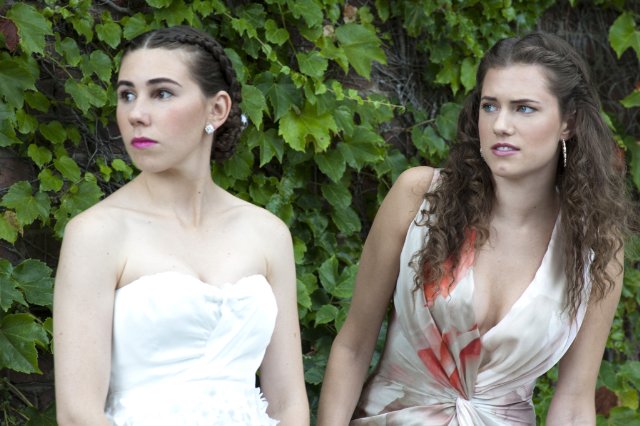
Did she ever—no matter which of the main she's on Girls you might mean. Marnie makes good on her end of her and Hannah's big fight in the last episode; uber-responsible (read: uber-controlling) to the last, she pays the rent up to the end of the month, and then she moves out, leaving Hannah to find a new roommate.

nullJessa also has a new roommate—her husband, Thomas John, a.k.a. the sad guy from the failed three-way. Apparently they went on a couple of dates; confused "new sexual partner, delirium caused by" with "lasting commitment, fitness for"; and invited all their friends to a party that's actually a surprise wedding. Everything about the event is quintessentially Jessa, from the idea that she'll mess with everyone's preconceived notions about free spirits to the "veil" that looks like she picked it out of the trash behind Beacon's Closet. Not only will the ensuing plots for Season Two write themselves (see: the months of material "Felicity" got out of this when Noel Crane married the Doritos girl), but a season-finale wedding is the perfect deus ex cake-ina for throwing characters together and stirring vigorously.

For example: Ray and Shoshanna. As predicted, Ray is really into Shoshanna; Shoshanna is really horrified that, not knowing that the party was a wedding, she dressed in white, and she's almost too preoccupied with that to overthink what she's agreeing to when Ray proposes taking her home that night. Later, in bed, Shoshanna's suffering from her usual logorrhea (observing that her aunt told her that losing her virginity felt like "scratching a sunburn" . . . wow, what?), but Ray is seemingly undeterred, and we're probably to assume that Shoshanna is relieved of her V card shortly thereafter.

Marnie, meanwhile, runs into Charlie at the wedding; he's sans new girlfriend—she's evidently live-blogging a tortilla-soup contest, or something?—and it seems like he and Marnie might go on a reunion tour together, but she isn't quite banged up enough on bubbly to go there . . . yet. The end of the night finds her draining yet another glass of champagne, eating cake with her hands, and making out with the Seth-Rogen-esque wedding emcee.

Even Elijah has moved on—to a new, older boyfriend named George, who's apparently hiding his relationship with Elijah from his homophobic teenage son. Elijah's having to live in an SRO until the kid graduates, which is the plot machination that allows Elijah to stay on the show: Hannah invites him to bunk with her, solving both their problems. (It doesn't hurt that he admits that he probably did give Hannah the HPV after all.)

But while it's a solution, it's also Hannah not moving forward, not growing up—staying stuck, facing backward. Marnie's moving out, without a plan, trying new things (or boys); Jessa's married, which is forward motion even if it's ill-considered; Shoshanna is dumping the virginity that keeps her a girl. Hannah is moving in with her gay ex-boyfriend from college, a known and safe quantity who won't challenge her. Adam has already suggested himself as the new roommate, pairing the proposition with a speech about moving on from toxic relationships without guilt, but Hannah just assumes he doesn't mean it, or that he just wanted to help. "Nobody does anything because they want to help; I did it because I love you!" he snaps.

Hannah doesn't know what to do with that information, and Adam doesn't sympathize at all, going off on her for following him "like [he's] the Beatles" for months and then giving him a "shrug" when he commits to her. The actor does a great job with a scene that, for Adam, is basically delivering an audience-proxy checklist of all the ways in which Hannah is an obnoxious, self-absorbed hypocrite: he yells that this is what Hannah wanted, and now she's not giving back. He bellows that she's pretty and a good writer and a good friend, but she doesn't believe those things about herself. Hannah tries to defend herself, to explain that she's scared, the most scared that anyone is, all the time, which I empathize with, and then Adam basically orders her to get over it, which I also empathize with. And then Adam gets clipped by a passing car, and he refuses to let her ride with him in the ambulance: "Don't let her in here. She's a monster."

The monster gets on the F train by herself.

Sarah: "Girlfriend is totally falling asleep and waking up in Coney Island with no purse, bet you a dollar."

Dirk: "No bet."

Sure enough, that's what happens—been there; walked home from that—and Hannah, who's lost her purse but managed to hold on to the slice of wedding cake, wanders out of the station and down onto the boardwalk as the light is coming up. Sunrise finds her on the beach, the Wonder Wheel behind her, sitting at the edge of the world eating cake. In a way, it's a reflection of her sitting in the bathtub eating a cupcake from the premiere—but everything's changed. But nothing has.

The finale showcases everything the show does well—which, I think, closely follows the list of reasons the show grates on people. Not everyone likes the girls of Girls, their self-absorption, their top-heavy ratio of theoretical to practical experience, their workshoppy ways of living, but Dunham and her co-writers have a perfect-pitch ear for how those people speak to and about each other. Not everyone wants to revisit the "thought we knew everything; actually knew fuck-all"-ness of their twenties, but Girls is a painstakingly researched document of that painful cluelessness.

The finale is also a great stage for the Adam character, who started out as a wince-inducingly accurate and familiar, but two-dimensional type of That Guy—dating around, waxing smug about wood craftsmanship while taking money from Grandma, not remembering where Hannah's from—and evolved into a nicely realized human being. He's also the embodiment of everything Hannah is afraid she'll never have, and at the same time that she will have—and then lose. She's still thinking like her high-school self. (And dressing like she doesn't own a mirror. I would love to know if this is intentional, because the problem is not Dunham's figure. It's that there is always always bunching. I'm just going to assume it's a character beat, because as such, it's quite effective.)

It's a strong end to the season; the writing feels confident, without the overworked or canned bits we got partway through. The show isn't for everyone, and it's about hardly anyone—and the niche appeal of/audience for what Dunham does is a legitimate reason not to watch the show or care about the characters. At the same time, though, you have to take the work for what it is. What's the expression—writing that tries to be for everyone ends up being for no one? Dunham's doing Dunham; she's doing it really well, and it's possible to hear some universals in it.

Sarah D. Bunting co-founded TelevisionWithoutPity.com, and has written for Seventeen, New York Magazine, MSNBC.com, Salon, Yahoo!, and others. She's the chief cook and bottle-washer at TomatoNation.com.

FALLING SKIES RECAP 1: WORLDS APART and SHALL WE GATHER AT THE RIVER

FALLING SKIES RECAP 1: WORLDS APART and SHALL WE GATHER AT THE RIVER

Falling Skies is back for its second season with a two-hour premiere that, as is so often the case with "special premiere events" these days, is actually two episodes shown back-to-back. So, Episodes 2.01 Worlds Apart and 2.02 Shall We Gather at the River constitute our relaunch into the post-invasion world of Tom Mason and the Second Massachusetts. It was not perfect, but definitely was tightly constructed and presented some solid science fiction in a watchable two hours..

nullIf you're just joining this series, it's not too terribly difficult to get caught up. Last season, aliens swooped in and attacked the Earth, winning the war in relatively short order through surprise and superior technology. Now resistance armies are fighting the occupation. Our hero is Tom Mason (Noah Wyle), a history professor whose knowledge of battles of the past proves useful (sometimes cloyingly so, when he rambles on about historical context) to the current situation. In tonight's Season 2 premiere, Tom's impromptu history lectures are mentioned with fond irony by people who've been irritated by them in the past, and maybe that's a sign the show will try to be a little less heavy-handed in that regard (although I really like the conceit that a history professor is useful here; history is, after all, one way to learn battle tactics). Tom has three sons, who are part of the 2nd Mass. Weaver (Bill Paxton) is the head of the division and a career soldier. Pope (Colin Cunningham) is a smart-ass gang leader who has joined forces with the division to the consternation of many, sometimes including the audience.

How the alien thing goes is this: There are nasty creatures we call "skitters" who look like giant reptilian spiders. There are big mechanical soldier types called "mechs." Teens are kidnapped by the aliens, who attach harnesses to the teens which appear to enthrall and change them. The 2nd Mass has been able to remove harnesses from two kids, both of whom experience residual effects, including enhanced physical abilities. One of the kids missed the aliens and rejoined them, the other, Tom's son Ben, hates them.

Late in Season 1, Dr. Glass (Moon Bloodgood) dissects a skitter, discovering a harness inside it. It was obvious to me at that moment that the harness is meant to turn people (and probably other beings) into skitters, but in the S2 premiere we hear two characters wondering how skitters reproduce, so perhaps it's not meant to be as clear as I think.

In addition to skitters and mechs, at the end of S1 we learn there are "overlords," essentially Roswell-style "grays." In the finale last year, Tom Mason boarded an alien vessel to negotiate with an overlord. Now you're all caught up. See? Not painful at all.

There are places where Falling Skies is not bad, specifically, but rather too corny. Tom returns to the 2nd Mass three months later, found, at random in a battle situation, by none other than his son Ben. Corny! Tom awakens from anesthesia at the exact moment that his flashbacks bring us up to the present moment. Corny! Reunions are a skosh too touching, and musical cues a skosh too moving. It's as if the writers don't quite trust that the inherent drama of the situation will entertain anyone. Which is ridiculous because: alien invasion! Earth destroyed! Children kidnapped! No hot running water!

It really is a shame because these situations do have drama, and they are largely well-played. The world of Falling Skies is a world where everyone has post-traumatic stress, and the heightened emotions of such a world do not need clichéd musical cues to deliver the goods.

Our first two hours this year are mercifully free of inspiring speeches, self-righteous prayer, and extended rumination on the Meaning of It All. Instead, there was some very strong television and exciting science fiction adventure, including some engineering trickery and Tom's journey through other parts of the U.S., which helped create real perspective on how far-reaching the war actually is, as well as a creepy alien parasite.

Creepy alien parasite! On the same day I saw Prometheus! UGH.

The creepy alien parasite (without spoiling anything) encapsulates much of what is excellent and also what is weak about Falling Skies. On the one hand: Creepy alien parasite! That is alarming. It's a shivery, oogy journey into science fiction that makes the world of the show as dark and "other" as it needs to be. On the weak side, it is simply not taken seriously enough. The 2nd Mass has both career soldiers and civilian survivors, but the civilians simply refuse to live as though, you know, there’s an alien invasion. There are always too few guards and too little fear.

Any post-apocalyptic entertainment works by showing us how much and how little we've changed, how hard the new life is and how traumatic the loss. It awakens us to what we have, stirs our fears of what we could lose, and plunges us into a fight for survival. This is true not just of Falling Skies but of The Walking Dead, Battlestar Galactica, or any number of others. When these shows succeed, they rouse all these intense feelings. When they fail, they make us feel like the end of the world is a lot like any other television show.

Deborah Lipp is the co-owner of Basket of Kisses, whose motto is "smart discussion about smart television." She is the author of six books, including "The Ultimate James Bond Fan Book."

TRUE BLOOD RECAP 2: AUTHORITY ALWAYS WINS

TRUE BLOOD RECAP 2: AUTHORITY ALWAYS WINS

You know the endlessly self-amused Nazi prick Christoph Waltz played in Inglourious Basterds? Well, someone over at True Blood casting found a prim-o Waltz-alike in the actor Christopher Heyerdahl.

nullHeyerdahl plays Dieter, a sociable sadist and Vampire Authority operative. His vampire theology monologue—shared while torturing Bill (Stephen Moyer), no less–finally gives Alan Ball, who's leaving the show this season, a chance to actually offend people.

Dieter asks Bill if he recalls what’s special about the Vampire Bible.

And we learn that what’s special about this Bible isn’t that it predates The Old and New Testament. Or that it’s the original Testament, telling how God created Adam and Eve as food for vampires and for God’s greatest creation—Lilith. 

No, what’s remarkable in this time of election year Fundamentalist fever is that God created Lilith in his image, as God is a vampire.

As Dieter editorializes, “Powerful stuff indeed!” (To view this scene, please click on the video above.)

If this episode is any indication, Season Five will indeed be powerful stuff. I’m just not even certain what genre it is anymore.

I mean, sure, there are vamps and shifters and werewolves. But Ball is also fusing the zero sum war between Fundamentalism and sanity inside large institutions, with allusions to splintering U.S. conservatism in an election year. And making no bones about it.

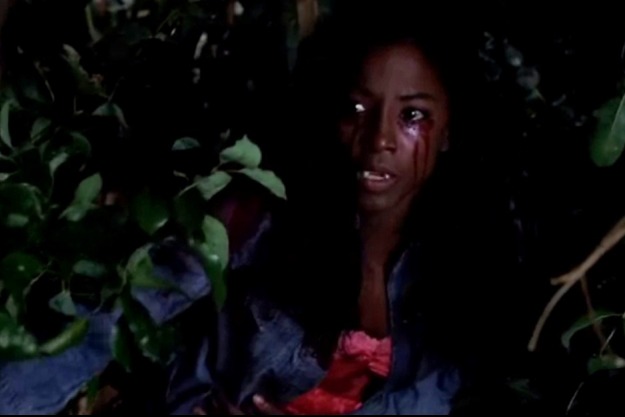
But there’s much more. There’s an ongoing, Andrew Sullivan-style "death of gay culture" subtext argument, an import of the main theme of Buffy’s Season Six necro-existential crankiness, courtesy the turning of Tara (Rutina Wesley) into a vampire—or as I’ll call her from now on, the Tarapire.

And at least half the show is finally showing us the Vampire Authority. Damned if their underground realm, all chrome, sleek curving plastics amid a mid-century futurism that never happened doesn’t evoke a Swingin’ 60s spy film, equal parts Phillipe Starck and Ken Adam (the master designer behind Thunderball, Dr. No, and The Ipcress File), 

At the center is Roman, the Authority himself, played by Christopher Meloni with the a brand of hyper-intense, top-dog, apocalyptic Type A times Pi machismo imported from an edgy production of Glengarry Glen Ross.

Roman, the ultimate sanguine super CEO, who loves to toss off non sequiturs like “Do you think that the whole concept of the common good is hopelessly naïve?”—which allows Eric the drollery of “I try to stay away from politics.”

But True Blood certainly doesn't.

But on to recapping. Much of this week is devoted to the Tarapire’s freak out, when she tears down down Sookie’s house.

Dying has been a really positive thing for the Tarapire—she’s very assertive (bam, there goes the fridge), has a killer deathly stare, and most of all, she doesn’t complain.

When she does snarl to Sook and Lafayette (Nelsan Ellis) that “I will neither forgive either of you,” there’s the delicious possibility that she’ll be promoted to full-blown bad guy. (To watch Tara in vampire form, please click on the video below.)

Things are going from bad to incredibly terrible for Bill and Eric (Alexander Skarsgård).

An Authority operative new to the show named Salome (Valentina Cervi) escorts them to the 60s design extravaganza I mentioned earlier, and jails them in a facility where they’re tortured with artificial sunlight and liquid silver and interrogated by sophisticated sociopaths like the aforementioned Dieter.

Over in our werewolf subplot, Alcide (Joe Manganiello) is refusing to join the pack in eating the corpse of ex-pack leader Marcus. Among the ritual diners is Marcus’s mom, Martha (Dale Dickey).

Clearly signed up for her gnarly, white thrash outlaw Sons of Anarchy appeal, and this impressively gross scene aside, Martha is a terrific addition to the cast, a gravel-voiced biker chick in her deep fifties with a worn regal vibe that fascinates.

Martha insists in several scenes that her daughter Emma, child of Marcus and Luna (Janina Gavankar), has more in common with her werewolf father than with her. This is a teaser for a scene that is astonishing, that demands you not drink fluids for you may gag or spit them up.

But right now, we’re talking Terry flashing back to Iraq and saying, “It’s coming for us.”

Will this show ever tire of crazed Iraq storylines? Can’t Terry get possessed by fairy lemurs or something, just once?

Then, a sweet cookie of a backstory is tossed to Pam (Kristin Bauer) fans. It’s a bawdy house in San Francisco, 1905. After a Campari, she hits the street. A creep tries to kill her, but in a flash Eric, in full Victorian eveningwear, kills the guy, licks the blood off his fingers and gives Pam his charm-face. There’s something oddly tentative about the show’s depiction of pre-vamp Pam, like Ball isn’t certain what he think of her quite yet. Still, that dress is a keeper. (Pam meets her maker, Eric, below.)

Sam (Sam Trammell), meanwhile, is recovering from his own wounds when Martha shows up, again insisting that Luna and Marcus’s toddler has supernatural canine blood in her veins. “She’s wolf—I can feel it!”

Are you sitting down? If not, do.

You’ll next see a scene where Jason goes to Hoyt’s mom’s, only to be rebuffed as by Hoyt (Jim Parrack) yet again as a girlfriend-fucker. And then we’re back at Luna’s house.

Suddenly, director Michael Lehmann cuts to a puppy in pajamas.

No CG, no make-up. Just a puppy in jammies. Only on True Blood.

There’s no way to follow that, but the show must go on. We end up deep in vampire Authority HQ, where Dieter is explicating that theology we started with, ending with what I assume will be the crux of this season’s drama:

That there are Vampire Bible fundamentalists who believe in a utopia where humans are farmed for food and human/vampire intimacy is blasphemy.

And there’s the Authority and Roman, who believe in “mainstreaming” and peaceful co-existence with humans.

In their secret chambers, the congress of the Authority lorded over by Meloni, dressed in the ultimate Hugo Boss-style pinstripe power suit.

Roman considers Bill and Eric, and says, “I’m in a real pickle here, boys.”

The pickle is—he needs to mete out justice to the killer of Authority member Nan Flanagan. Who Bill and Eric did kill.

Roman is the king of the mainstreaming cause, and he tells about it in detail, which is cool: I’ll listen to Meloni yell at me about a Google search for superior celery, he’s that violently entrancing.

Meloni wants to stake Eric and Bill. Bill has something to trade: the news that psycho-vamp Russell Edgington (Denis O'Hare) is alive.

Russell the anarchist psycho-vamp who would love nothing more than to destroy the Authority’s mainstreaming initiative for the sheer fun of it.  

As Meloni considers the import of this news, Lehmann cuts to Russell in a cart, his skin cracked into a thousand bloody fissures.

In true Edgington style, he licks his ruined lips. Gross! (Awesome.)

This week’s vestigial subplots:

Luna

She falls victim to Bon Temps’ most prevalent illness: unmotivated Sudden Character Reversal Syndrome. Last year, Sam became a murderous asshole for no apparent reason. Now Luna’s becoming a mean jerk, apropos of nothing.

Steve Nawlins

Steve Nawlins claims vampires for Christ. Will this dovetail with the Authority’s interests?

Jessica (Deborah Ann Woll)

Nawlins tries to buy Jason from her. Jessica says she does not sell her friends. Like, ever.

But mainly this week is owned by  Meloni’s Roman, the Tarapire, and the puppy. Good times.

Ian Grey has written, co-written or been a contributor to books on cinema, fine art, fashion, identity politics, music and tragedy. Magazines and newspapers that have his articles include Detroit Metro Times, gothic.net, Icon Magazine, International Musician and Recording World, Lacanian Ink, MusicFilmWeb, New York Post, The Perfect Sound, Salon, Smart Money Magazine, Teeth of the Divine, Venuszine, and Time Out/New York.