OSCARS DEATH RACE: WAR HORSE

OSCARS DEATH RACE: WAR HORSE

null[EDITOR'S NOTE: Fearless Sarah D. Bunting of Tomatonation.com is making it her mission to watch every single film nominated for an Oscar before the Academy Awards Ceremony on February 26, 2012. She is calling this journey her Oscars Death Race. For more on how the Oscars Death Race began, click here. And you can follow Sarah through this quixotic journey here.]

nullIn his review of War Horse for IFC.com, Matt Singer noted that "I did like one scene which is complete enough as its own unit of story and character that it could be pulled out of the film and played as its own short subject." The scene, of course, is the one in which said horse, Joey, makes a gallop for freedom but becomes hopelessly entangled in the barbed wire that separates the British and German lines. A soldier from each side comes out to aid Joey; for a moment, the Great War pauses to admit compassion — and Steven Spielberg pauses to work small.

I wish Spielberg had made a short subject, or even a trim feature, of that central moment, as it's free of everything that frustrated me about War Horse in its entirety: the insistent soundtrack that shoves us to and fro with plaintive piccolos and blatting-brass "hilarity"; the cartoonish attempts to show Joey (who is, after all, played…by a horse, and only expressive in certain ways) bonding with other horses and showing great heart and willing himself to escape and blah blah courage blah; the redundant exposition about Joey's many fine and remarkable qualities; the Saving Private Neighin' set pieces that strain to point up the horrors of war. The bit does contain continental characters speaking accented English instead of their native tongues, but that has a purpose here, at least, and isn't as Alcottsy and deadly dull as the Emilie sequence. (Or as poorly done. Top Secret! had better French accents.)

nullThe plot, in brief: Joey is bought at auction by drunk seldom-do-well Ted Narracott (Peter Mullan, too broad) to show up his rich landlord. Joey's not a plowhorse, he's a Thoroughbred, but Ted's son Albert (the promising Jeremy Irvine) bonds with Joey immediately, and swears he can break the colt to plow and get the rocky field tilled by the deadline. After this Rocky-of-the-shire moment, Joey is basically drafted into the British army — but by an officer who appreciates the special hoof-flake and promises Albert he'll get Joey home safe. Joey befriends another horse, Topthorne; escapes from various warlike tasks; gets caught in wire; and…cures the blind? Just go with it.

I rode horses as a girl, and worked as a stablehand in high school (the horse I had charge of was a goofy little blood bay named Indiana Jones, in fact) — I wanted to like War Horse, and I went into it prepared to write off the schmaltz and soaring strings that so often go with horse movies. But it's just too long, with too many breaks for Bazooka-Joe "humor" and sick-child moralizing. I gasped at the beauty of several of the shots or sequences, like the cavalry mounting up in the tall grass, and the expert editing of the cuts between the oncoming charge and the merciless gunners getting hurdled by riderless horses; that bit in particular would have gutted me in the fourth grade.

But this isn't the fourth grade; we know Spielberg can "do this." He does it here and he does it well, but the real accomplishment from the man at this point would be resisting the urge to hold our hands every minute, or setting himself the challenge of getting it in under 110 minutes on the first cut. Hell, re-cut this one — and boot that flatulent over-closed ending. I know many other reviews have mentioned the Gone with the Wind Technicolor skies, but: seriously! It's so over the top, you almost think he's joking! But it's Spielberg; he doesn't joke.

…Except in that barbed-wire sequence, which has a lightness to the banter, and gets at the message Spielberg is trying to send almost accidentally. The horror of war isn't always the barrage; sometimes it's the silences between, as in that scene with "enemies" working together and knowing the moment must end. The scene asks little of the horse except that he remain still, a symbol (which is how they work in our culture anyway, often), and subtracts the relationship with Albert, which starts out with a naïve sweetness but soon begins to seem rather weird. It doesn't show off. There isn't a cello. It's just a little story.

War Horse is handsome to look at; like Star Wars III, I'd have liked it more with my iPod in and some Handel playing. You want a real horse tearjerker, watch yourself some Phar Lap. You'll need IV fluids by the end.

This film's Oscar chances read to me as slim; the nominations may have been a gesture of respect, but it's not tapped for Best Director, so who knows. The score is diabetic and should not win; the cinematography could, and I would not hate that victory, but I wouldn't pick it.

Sarah D. Bunting co-founded Television Without Pity.com, and has written for Seventeen, New York Magazine, MSNBC.com, Salon, Yahoo!, and others. She's the chief cook and bottle-washer at TomatoNation.comFor more on how the Oscars Death Race began, click here.

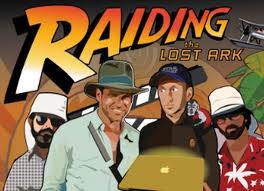
Raiding The Lost Ark: A Filmumentary By Jamie Benning

Raiding The Lost Ark: A Filmumentary By Jamie Benning

Raiding The Lost Ark: A Filmumentary By Jamie Benning from jambe davdar on Vimeo.

[EDITOR'S NOTE: In the tradition of Star Wars Begins, filmmaker Jamie Benning has stitched together the perfect informative tribute to this classic film. Don't miss it.]

OSCARS REVISITED, 1981: RAIDERS OF THE LOST ARK

OSCARS REVISITED, 1981: RAIDERS OF THE LOST ARK

[EDITOR'S NOTE: In a yearly feature titled "Oscars Revisited," Press Play takes a look back at the Academy Awards race from earlier eras. Our inaugural series focuses on the five Best Picture nominees from calendar year 1981: Reds, Atlantic City, On Golden Pond, Raiders of the Lost Ark and Chariots of Fire.]

For years after the release of his box-office breakthrough Jaws, Steven Spielberg fantasized about directing a James Bond picture. He got his chance, sort of, with Raiders of the Lost Ark, his first team-up with his longtime friend and fellow "movie brat" George Lucas. The two were on vacation in Hawaii in 1977 after the release of Lucas' own career-redefining blockbuster Star Wars, Episode IV: A New Hope but before the release of Spielberg's next movie Close Encounters of the Third Kind. Spielberg told Lucas of his desire to make a Bond film; Lucas replied that he had a better idea, and Spielberg instantly seized on it as "James Bond without the gadgets." It was about Indiana Smith, an archaeologist who travelled the world unearthing buried treasure, fighting bad guys and witnessing supernatural events; Lucas envisioned it as an homage to the World War II-era cliffhanger serials that he, Spielberg and other '50s kids used to watch in reruns on local TV, only in color and CinemaScope and in Dolby stereo. Spielberg liked the concept but suggested changing the hero's last name from Smith to Jones.

nullFour years and a $18 million worth of Paramount's money later, Spielberg and Lucas released Raiders of the Lost Ark, featuring up-and-coming action hero Harrison Ford — Han Solo in Lucas' Star Wars franchise — as the whip-cracking archaeology professor trying to keep the Lost Ark of the Covenant out of Hitler's hands. As scripted by Lawrence Kasdan, who rewrote the Star Wars sequel The Empire Strikes Back, Indy was a rumpled, unshaven, refreshingly human hero, surly but decent, less like a Bond-style sexy sociopath than a Gary Cooper character in a bad mood. The combination of Ford's casual fearlessness, Lucas' gee-whiz sensibility, Spielberg's kinetic precision and costar Karen Allen's tomboy sass made the film into the year's biggest hit, a sleeper that rolled into multiplexes opposite Superman II and the latest James Bond entry For Your Eyes Only and stole their box office thunder. Raiders grossed $209 million in North America and took the "So popular that we can't ignore it" spot in the following year's Best Picture lineup. It also inspired knockoffs, including the network TV series Tales of the Gold Monkey and Bring 'Em Back Alive and the movies High Road to China, Romancing the Stone and The Jewel of the Nile

nullSpielberg didn't stint on the violent action; this was probably one the first PG movies in which a lone hero singlehandedly and bloodily eliminated scores of foes, and definitely the first in which the power of God made Nazis' heads melt, implode and detonate, spewing meat chunks into the camera. Three summers later, the even more extreme violence of Indiana Jones and the Temple of Doom and the Spielberg-produced Gremlins inspired the creation of a new MPAA rating, PG-13. But the film's real draw was its mastery of pacing and tone. For a large production shot in several countries, Raiders was light on its feet, zipping through scenes without a wasted frame. And it managed the same neat trick as Spielberg and Lucas' earlier films in managing to seem at once self-aware and innocent. The duo plundered recent and past film history like kleptomaniacs on a prowl through Macy's. The deranged finale evoked Brian De Palma's Carrie and The Fury; Indy's wild escape beneath the carriage of a hijacked truck echoed a similar stunt in John Ford's Stagecoach; the final shot in which the Ark of the Covenant, recently recovered from Hitler's minions, is wheeled into a gigantic warehouse was filched from Citizen Kane. The transitional sequences depicting the global progress of Jones and company via cross-dissolved travel footage and maps festooned with animated red lines was so brazenly old-fashioned that it made the circa-1981 audiences that I saw it with laugh and applaud. (As I recounted in a piece about Raiders for The House Next Door, this was the first film that made me realize that movies could be expressions of a singular sensibility — that they were directed.)

nullRaiders was a career-redefining entry on the resumes of its major players. Ford stepped into the lead after CBS refused to release the filmmakers' first choice, Magnum, P.I. star Tom Selleck, from his TV contract, and proved he could sell tickets without a laser pistol in his hand; the film's success marked the start of a 20-year run as one of Hollywood's highest-paid actors. Ford's regular employer Lucas showed the studios that he wasn't just the Star Wars guy. The movie also revived Spielberg's career momentum after the box-office flop of 1941 (1979), an epically overscaled bit of period slapstick that in retrospect feels like a dry run for Raiders, an immense physical comedy that owed as much to Jacques Tati and Buster Keaton as it did to poverty row cliffhangers, with a stalwart hero taking on armies. The film and its sequels went on to comprise one of the most financially successful and stylistically influential series ever made. With their superficial awareness of the texture of certain periods and places, Jones' pre-World War II shenaningans felt like a precocious schoolboy's fantasy — flip books scrawled in the margins of a history text. Lucas, Spielberg, Ford and their collaborators pushed this sensibility further in the film's sequels, which saw Indy cheat death in pre-war Shanghai, British colonial India, Nazi-occupied Austria and Germany (where Indy ends up getting his father's Grail diary autographed by Hitler at a book burning!), and an atomic testing site in 1950s Roswell, New Mexico, (which gave prankish new meaning to the phrase "nuclear family"). Although mainstream critics and general audiences enjoyed the series (except for the long-delayed fourth film Indiana Jones and the Kingdom of the Crystal Skull, which some fans viewed as a personal affront) Indy's adventures had their detractors. The New Yorker's Pauline Kael complained that Raiders lacked the human touch of Spielberg's earlier hits and was lukewarm on The Last Crusade — although with typically Kaelian perversity, she adored The Temple of Doom. Alternative press critics pointed out — correctly, but without much impact — that Indy's adventures had an ahistorical and oddly pre-sexual vibe, and that Lucas and Spielberg's depiction of "foreign" cultures was cluless at best, racist at worst; for a long time, Indy's second adventure Indiana Jones and The Temple of Doom was banned in India. For a brief period in the late '80s and early '90s, Lucas brought Indy to TV. His youthful adventures were bracketed with segments narrated by a geriatric Indy, a craggy-faced, one-eyed icon whose appearance was inspired by documentary footage of the old John Ford.

The Indy films do have a personal sensibility, although it's admittedly obscured by gunshots, explosions and supernatural maimings. The films feel like daydreams, not product, and their fusion of spectacle, mayhem, slapstick, banter and miracles has no equivalent elsewhere in cinema. And the saga does have an implied narrative that's more knowing and gentle than Spielberg and Lucas' detractors care to admit. Over the course of four films, the arrested adolescent Indy grows up, taking responsibllity for a surrogate family in The Temple of Doom (a prequel that feels like a sequel), reconciling with his estranged dad in The Last Crusade, then coming to terms with mortality and reconnecting with Marion and the son he didn't know he had in Crystal Skull. There's something to be said for Indy's brand of resourcefulness; it's earthbound and useful, rooted in emotional reality and ultimately touching. He's a superheroic everyman, surly and self-effacing — James Bond as Yankee prole. "I'm going after that truck," Indy tells his buddy Sallah, before throwing himself into the movie's most raucous action setpiece. "How?" Sallah asks. "I don't know," Indy replies, pushing his hat down tight on his head. "I'm just making this up as I go."

A critic, journalist and filmmaker, Matt Zoller Seitz is the staff TV columnist for New York Magazine and the founder of Press Play.

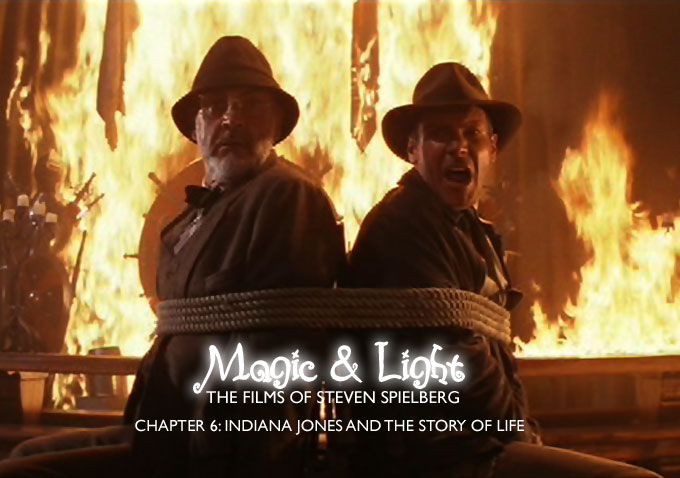
VIDEO ESSAY: MAGIC AND LIGHT: THE FILMS OF STEVEN SPIELBERG – Chapter 6: Indiana Jones and the Story of Life

VIDEO ESSAY: MAGIC AND LIGHT: THE FILMS OF STEVEN SPIELBERG – Chapter 6: Indiana Jones and the Story of Life

[Editor's Note: Press Play is proud to present Chapter 6 of our first video essay series in direct partnership with IndieWire: Magic and Light: The Films of Steven Spielberg.  This series examines facets of Spielberg's movie career, including his stylistic evolution as a director, his depiction of violence, his interest in communication and language, his portrayal of authority and evil, and the importance of father figures — both present and absent — throughout his work.

Magic and Light is produced by Press Play founder and Salon TV critic Matt Zoller Seitz and coproduced and narrated by Ali Arikan, chief film critic of Dipknot TV, Press Play contributor, and one of Roger Ebert's Far Flung Correspondents. The Spielberg series brings many of Press Play's writers and editors together on a single long-form project. Individual episodes were written by Seitz, Arikan, Simon Abrams and Aaron Aradillas, and cut by Steven Santos, Serena Bramble, Matt Zoller Seitz, Richard Seitz and Kevin B. Lee. To watch Chapter 1: Introduction, go here. To watch Chapter 2: Blood & Pulp, go here.  To watch Chapter 3: Communication, click here. To watch Chapter 4: Evil & Authority, click here. To watch Chapter 5: Father Figures, click here. ]

Narration:

What does it mean to be a father? What does it mean to come of age without a father? These questions have been at the center of many Steven Spielberg films. Both light entertainments and dark historical dramas have considered them.

The director’s evolving views on fathers and fatherhood are on surprisingly vivid display in the Indiana Jones series, which were produced by his longtime friend and Star Wars mogul George Lucas. Taken as a whole, the films feel like markers in Spielberg’s maturation.

Raiders of the Lost Ark introduces us to Indiana Jones, an archeologist who is more excited by grave-robbing and cheating death than by lecturing to Ivy League students. Indy holds a position of authority at the university, but were it not for the fact that he’s somewhat older than most of his charges and stands at the front of a classroom, he could be mistaken for a student.

There is no clear parental figure or even parental influence in the film. If anything, Indy is in his late thirties but has no visible entanglements. He even seems to treat his home merely as a crash pad, a base of operations.

When Indy decides to go looking for the Ark of the Covenant, he is cautioned by his older colleague of its power – the power of God, the ultimate father – and warned that maybe it shouldn’t be disturbed. Indy’s response is a blithe dismissal.

nullIn later films we will learn that Indy has taken on the vocation of his father as a way to impress, and then one-up, the old man, a stern and distant academic. In Raiders, Indy is presented as almost a runaway kid, a grown-up Bowery Boy who doesn’t give much thought to others. He possesses the shallowness of youth, complete with the clichéd woman in every port. He’s a heartbreaker, this one.

The most uncomfortably adult moment in the film might be the scene where he re-encounters his great love, Marion. We learn that he loved and left her cruelly, and that she was much younger than he was. Their affair ended badly enough to drive Marion to go tend bar in the Himalayas. There’s an unsavory hint of cradle-robbing.

Although chronologically it’s a prequel, the hard-edged Indiana Jones and the Temple of Doom is actually a direct continuation of Spielberg’s coming to terms with adulthood.

Made on the eve of his marriage to Amy Irving — a marriage that would eventually end in divorce, and a second marriage to Temple of Doom costar Kate Capshaw — Spielberg channels the hesitation that can paralyze some men when deciding to make the ultimate commitment. The entire movie positions Indy in relation to various configurations of family – good and evil, functional and dysfunctional. The film is dotted with images of fathers, from the Chinese gangster Indy barters with to the dignified general who protects the palace to the numerous guards in the Thugee cult. And the entire story is infused with a son’s primal fear that his father will fail him — and a father’s primal fear that he’ll let his wife and children down.

The movie finds the hero slowly forming his own bickering makeshift family, with Indiana Jones as reluctant, grouchy father, nightclub singer Willie Scott as mother, and orphaned pickpocket Short Round as their son. Early in the film we’re casually informed that Short Round’s parents were killed in a bombing. Willie could be a gold-digging female equivalent of Indy, an eternal teenager who’s mainly interested in having fun and acquiring nice things. Three people who are used to living alone and relying only on themselves are thrown together, and forced to depend on each other to survive. Their trivial concerns will be beaten and burned out of them, in the Indiana Jones film which for long stretches is essentially a horror movie.

nullWhen Indy, Willie, and Short Round come across a village, they discover all of the children have been kidnapped and forced into slave labor in the mines of the Thugee cult. In effect, the bad guys in this film have made the entire village childless, and turned all the kids into orphans by kidnapping them.

The image of the cult is like a child’s nightmare made real as it consists of nothing but horrible, evil fathers. When Indy is forced to drink a potion he comes under the spell of the cult and his behavior is that of an abusive alcoholic dad.

Temple of Doom, along with Gremlins – which Spielberg produced, and which was also released that same summer – represent Spielberg’s final hurrah as a pure pop storyteller. These are tonally very strange movies, by turns charming and vicious, buoyant and horrific. When he directed the movie in the summer of 1983, Spielberg was edging up on 40, star Harrison Ford was actually turning 40, and George Lucas was dealing with the fallout from a painful and costly divorce. There’s a sense of looking backward on innocence, and forward, toward something darker.

In the 5 years between Temple of Doom and Indiana Jones and The Last Crusade Spielberg had become a father himself. The film’s opening origin sequence shows Indy risking life and limb to get his father’s approval, only to be dismissed when he tries to show his dad his big discovery. His newfound understanding of what that means can be seen in the way that the film presents Indy’s relationship with his own father, a brilliant but rather distant man whom Indy instinctively calls “Sir.”

Like Roy Neary in Close Encounters, Indy’s father is obsessed with a vision, in this case the location of the Holy Grail – the cup from which Jesus Christ, perhaps theology’s most piteously suffering son, drank during the last supper.

nullWhile the elder Jones didn’t literally abandon his family to pursue his obsession, we have no doubt that a lot of the time when Indy was growing up, the old man was mentally or emotionally checked-out. You can see it in the way they communicate – or more accurately, don’t communicate.

Estranged from his father for years, the two are forced to work together when the Nazis attempt to also find the Grail.

Their rivalry is a constant source of father-son friction. It even plays out in Freudian ways as they sleep with the same woman.

In earlier films Spielberg might’ve been more inclined to empathize with Indy’s resentment towards his absentee dad. But in the scene in which Indy tries to lay a guilt trip on his dad, and his dad grows impatient with such childish complaints, Spielberg’s identification is with pretty clearly with the father.

For Spielberg, hanging onto resentment and anger over a parent’s failings is ultimately pointless, a sign that one has failed to evolve. At the same time, though, The Last Crusade acknowledges that a father is still capable of learning late in life, and that for good of both father and child, such evolution is desirable, and necessary.

When Indy is hanging on for dear life as he attempts to grab hold of the Grail, his father gives him one last order. The son puts his pride aside and listens. And it saves his life. It is the same lesson that the elder Jones had to learn – that the emotional reality of one’s family is more important than the abstract goal of pursuing one’s dream. Both father and son learn the value of letting go.

nullReleased almost twenty years after the last Indiana Jones film, Indiana Jones and the Kingdom of the Crystal Skull feels like a coda. Indy seems to be re-thinking his decisions, and having pangs of regret. Although the sixty-something Indy is still a snarling, leathery ass-kicker, and in what might be his surliest mood since the middle section of Temple of Doom, the movie’s overall tone is rueful and melancholy.

The whole story is suffused with feelings of displacement and regret. Indy is a man out of his element, and out of his time – perhaps out of time, period. Nobody who’s endured so much punishment should have lived this long. And emotionally, what has he got to show for it? Nothing. Or so he thinks….

Set in the 1950s – the decade of Spielberg’s childhood – Kingdom of the Crystal Skull shows Spielberg bringing everything full circle on both a story level and as his final musings on what he’s learned as a husband and father.

Kingdom of the Crystal Skull is about rejuvenation and the passing of knowledge. As a young man Indy thrilled to the globe-trotting search of artifacts of history without giving much thought to their historical significance. He sees them as prizes, showing little interest in context or for all that has come before him.

Indy’s discovery that he has a son forces him to realize that – in his own more physically fearless, two-fisted way – he’s as emotionally isolated as his father ever was. As he embarks on an adventure with Mutt, he doesn’t just become a father figure, he realizes he actually IS a father to the young man. He sees himself in Mutt, and tries to impart wisdom to the boy. Of course, coming out of Indiana Jones’ mouth, a lot of this sounds hilariously feeble. But he means well.

As father and son tentatively come together in order to rescue the boy’s mother – Marion, the relative baby that Indy robbed from her cradle in Raiders – their adventure becomes a meditation on a father’s legacy. It becomes

Indy’s last – and most important – adventure while simultaneously representing a son’s first step into true manhood. For Spielberg the gaining and passing of knowledge is the greatest legacy a father can give his son.

The changing of the guard – and the handing down of knowledge and wisdom – is symbolized in the film’s closing shot, which pairs Indy’s long-delayed marriage to Marion and Mutt’s final ascent into functional adulthood. There’s a gravitas to the young man’s swagger. His adventures with his mom and dad have seasoned him. For a moment we believe he might be ready to take possession of Indy’s iconic hat.

But the old man’s not done with it yet.

San Antonio-based film critic Aaron Aradillas is a contributor to The House Next Door, a contributor to Moving Image Source, and the host of “Back at Midnight,” an Internet radio program about film and television. Matt Zoller Seitz is publisher of Press Play. 

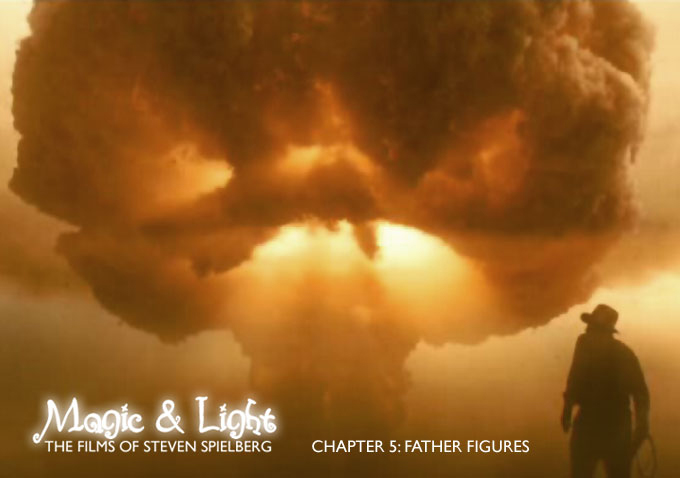
VIDEO ESSAY: MAGIC AND LIGHT: THE FILMS OF STEVEN SPIELBERG, Chapter 5: Father Figures

VIDEO ESSAY: MAGIC AND LIGHT: THE FILMS OF STEVEN SPIELBERG, Chapter 5: Father figures

[Editor's Note: Press Play is proud to present Chapter 5 of our first video essay series in direct partnership with IndieWire: Magic and Light: The Films of Steven Spielberg.  This series examines facets of Spielberg's movie career, including his stylistic evolution as a director, his depiction of violence, his interest in communication and language, his portrayal of authority and evil, and the importance of father figures — both present and absent — throughout his work.

Magic and Light is produced by Press Play founder and Salon TV critic Matt Zoller Seitz and coproduced and narrated by Ali Arikan, chief film critic of Dipknot TV, Press Play contributor, and one of Roger Ebert's Far Flung Correspondents. The Spielberg series brings many of Press Play's writers and editors together on a single long-form project. Individual episodes were written by Seitz, Arikan, Simon Abrams and Aaron Aradillas, and cut by Steven Santos, Serena Bramble, Matt Zoller Seitz, Richard Seitz and Kevin B. Lee. To watch Magic and Light: The Films of Steven Spielberg Chapter 1: Introduction, go here. To watch Magic and Light: The Films of Steven Spielberg Chapter 2: Blood & Pulp, go here.  To watch Magic and Light: The Films of Steven Spielberg, Chapter 3: Communication, click here. To watch Magic and Light: The Films of Steven Spielberg, Chapter 4: Evil & Authority, click here.]

Narration:

Steven Spielberg is the product of The Greatest Generation — a Baby Boomer raised on idealized images of the nuclear family, progress, and American might. He is also a child of divorce — a dreamer from a broken home. Spielberg’s attempt to reconcile these two biographical facts—the mythic ideal of the family, and the reality of its dismantling—has been at the heart of many of his films. Spielberg’s movies often focus on a real or makeshift family unit, banding together to fight an outside force that threatens to tear it apart. At the head of this makeshift family, there is often a father figure imparting wisdom to his charges, or being forced to confront his shortcomings as a protector. Often both.

nullIn Jaws Roy Scheider’s Chief Brody is the father figure to a tightly-knit summer community being terrorized by a Great White Shark. The scene where his son mimics his gestures tells us he’s a loving, good father who will do anything to keep his family – and his community – safe.

The film’s second half shows Brody becoming part of a makeshift family of shark hunters, with World War II veteran Quint taking over as protector of the landlubber police chief and the rich-kid, know-it-all oceanographer, Hooper.

The trio of Quint, Brody and Hooper  feels like a makeshift family unit: an impetuous, sarcastic younger brother, a tougher, wiser older brother, and their boozing, cantankerous, tinpot dictator dad.

At first, Brody and Hooper question Quint’s methods as well as his manner. The old sea captain is a gruff taskmaster. He’s slobblish, domineering and rude. He is also quite mad.

nullBut when the men sit around drinking and talking we learn the source of Quint’s insanity. He tells them of how he survived the sinking of the USS Indianapolis, the naval vessel that an atomic bomb that helped the United States defeat Japan in World War II. They were ultimately successful — but the mission is famous mainly for having its crew picked off by ravenous sharks.

Quint’s ordeal trumps anything Brody or Hooper will ever experience. And it seems to make a deep impression on them. Although they never stop resenting Quint’s sourness or fearing his craziness, they appreciate his toughness, and learn to work with him. They are members of the younger generation learning to respect a seasoned elder because they are, so to speak, all on the same boat.

And when the father dies horribly — leaving the boat adrift at sea, and the mission figuratively adrift – it is up to the sons to complete the mission.

In Saving Private Ryan, Captain Miller is an unofficial father figure to a mostly young group of Army Rangers. He’s given the public relations-burnishing task of finding and extracting the last surviving member of a group of brothers who were all killed fighting the Germans. Miller wonders if this mission is worth the price. For every man he’s lost in his command, Miller figures he’s saved maybe 10, 20. Now he’s been asked to put his entire platoon—his family—in harm’s way to save just one.

Miller hopes that Ryan is worth it – that he goes home and invents a longer-lasting light bulb or cures cancer. But he puts the thought aside for the same reason that parents try not to think about whether the incredible effort they’ve invested in their own, flesh-and-blood children will yield a saint, a felon, or something in between. One cannot know such things — and the end result of parenting isn’t the point of the exercise. You do it out of love. And duty. And you hope for the best.

When the men finally find Private Ryan he doesn’t want to go home. Why? Not out of some abstract sense of patriotism, but for immediate, personal reasons. Ryan doesn’t want to leave HIS surrogate family – his fellow soldiers.

Miller and the rest of the rescue team decide to stay and help Ryan secure a tower. It’s  practically a suicide mission. And it ends with Miller making the ultimate sacrifice.

nullThe Spielberg who made Saving Private Ryan in the late 1990s was a family man in his 50s. Detractors questioned Miller’s final admonition — asking, in effect, “Well, what if Private Ryan went home and DIDN’T accomplish anything special?” But that’s really not the point of that moment. It is a purely personal, human moment between Miller and Ryan that transcends war or even politics. In Spielberg’s films, every life is worth saving, provided that the saved person goes on to continue to be – or to BECOME — a decent person, and do the best he can with the gift he’s been given.

It’s probably worth pointing out that the Spielberg who directed “Saving Private Ryan” was a different person from the wunderkind of the 1970s. He was no longer the ambitious, single, childless twentysomething who directed Jaws, and who placed his sympathies with the brother figures that were caught between a bad father and a hungry shark.

The late’90s Spielberg is convinced that a son must earn his place in the world — and that it is the father’s responsibility to teach him that lesson. The weight of that conviction gives Saving Private Ryan a momentous quality, as well as a certain dour heaviness. It imparts a sense that a grave lesson was learned in World War II, and that this movie exists to teach it again — for the benefit of people who weren’t around to hear it the first time.

Whether in his serious movies or his pop fantasies, Spielberg often pivots the story on the father figure, be it real or surrogate. It’s not something as trite as Spielberg having Daddy Issues. More likely he is still uncovering something new about the nature of being a father.

For Spielberg, the presence and goodness of the mother is, with very few exceptions, a given. She will always protect and nurture. Fathers do that too. But they can also abandon the child, or be inexpressive when trying to impart knowledge. In Spielberg’s world, mothers are usually instinctive caregivers, healers, and teachers. They know what to do. Fathers are eternal students. They must learn, and keep learning.

null In Close Encounters of the Third Kind, Steven Spielberg shows a father driven to near madness in the pursuit of his dream. Roy Neary exhibits the behavior of a young artist who’ll stop at nothing to make the vision in his head a reality.  

The movie contrasts Roy Neary’s destructive obsession against the plight of Jillian Guiler, a single mom. Like Roy, she has been implanted with a vision of extraterrestrial contact. But her motive in going to Devil’s Tower is quite different. Where Roy wants to make his dreams come true – expressing the selfish drive of an artist — Jillian wants only to rescue her kidnapped son.

 The contrast between the two storylines is striking. We watch a mother desperately try to hold her family together. Meanwhile, a father abandons his own family to answer a higher calling.  Close Encounters is clearly the work of a young artist. Spielberg has said on several occasions that he made the movie today, he would not have had Roy Neary abandon his family to pursue his vision. Whether that’s indicative of deeper wisdom or a sort of creeping personal and artistic softness is impossible to say. But it’s definitely a change that came with age, and that is reflected in Spielberg’s attitude toward parents and their children – and grandchildren.

In any event, the film’s narrative momentum and sense of craft are so overwhelming that we do not judge Roy for what he does. Instead, we root for him – or at the very least, live vicariously through him, as he does something that most of us would not be brave enough – or obsessed enough – to do.

The image of Roy walking into the mothership to be a part of a new family could stand in for Spielberg in the mid-seventies: A young man leaving home to become a part of a filmmaking family, ascending from relative obscurity to become the most popular storyteller of his time.

But it’s a bittersweet moment, thanks to our awareness of what Roy has given up, and what his children have lost. He has chosen visionary fulfillment over personal responsibility.

nullSpielberg’s 1982 blockbuster E.T. feels like a continuation of Close Encounters – and not just because the story originated in Spielberg’s daydreaming about what might have happened if one of the aliens from Close Encounters got left behind. The film’s hero, Elliott, is the middle child in a bustling suburban home guided by a single mother. The absence of the father is conspicuous, and important. At time it feels as if we’re seeing what happened to the Neary family in Close Encounters after Roy lost his mind and ran off to Devil’s Tower.

In E.T. Spielberg uses the fanciful story of a boy and his friendship with an alien creature as his way of dealing directly with the trauma of divorce. The absence of Elliott’s father, the fact that his family will never be whole, permeates every scene of E.T. Elliott learns the hard lesson early that nothing can last forever.  

When Eliott befriends E.T., it’s as if he’s found an equal – a pet that reveals himself as a playmate. But really their friendship is compacted account of how all children will eventually be asked one day to look after those who nurtured and protected them. The relationship between the boy and his alien illustrates the phrase “the child is father to the man.” And as the tale unfolds, both E.T. and Elliott learn it.   E.T., like Elliott, feels abandoned by his family. But E.T. quickly assumes the role of friend of protector – and in some strange way, a mentor — of Elliott.

By the end of the story, the roles have switched. Elliott takes on the responsibility of reuniting E.T. with his family at the landing site. But at the same time, though, E.T. also reveals a depth of maturity and wisdom that we might not have suspected earlier. The crowd-pleasing shot of the rescued alien appearing in the back of the hijacked government van suggests an almost mythic power and wisdom. E.T.’s pose is vaguely Christlike. But the wrinkled visage and tattered robe suggest confident, loving grandfather who’s seen it all.

The final scene shows Elliott re-experiencing the heartbreak that comes when a family must separate. But he seems better able to handle it. It’s an intensely sad moment, but also resigned and mature.  Elliott seems tougher now. And wiser.

nullThroughout his films you can track Spielberg’s evolving feelings about the terrors, pleasures and responsibilities of fatherhood. In Empire of the Sun, based on J.G. Ballard’s novel, the preteen hero Jim is wrenched from his family as violently as any Spielberg hero, and must learn to survive on his own. He finds an unexpected ally – a sort of Humphrey Bogart-like, scoundrel-mentor – in Basie, an American steward stranded in Japanese-occupied Shanghai.

The film’s title is a bit of a pun: Son, S-U-N, is a reference to the sun on the flag of Imperial Japan. But it also describes the suddenly parentless hero’s empire – an immense, splendid, and very dangerous backyard for him to play in, and grow in. Empire of the son … S-O-N.

Even in Hook we are treated to the sight of the eternal child Peter Pan coming to grips with being a father, and learning to nurture the child within the man, but without neglecting his adult responsibilities.

Later films show Spielberg to be impatient, even resentful, at the sight of fathers neglecting their duties. You can sense his anger in wanting deadbeat dads to get a clue — a comeuppance.

In War of the Worlds divorced dad Ray Ferrier can hardly be bothered to look after his kids for a weekend.

When an alien invasion occurs, he is confronted for the first time in his life with the prospect of caring for others. Ray has never been reliable. Now, he must reunite his children with their mother. If he can do that then maybe he will earn the right to be a father.

In Minority Report Chief Anderton is a far cry from Chief Brody. This gifted cop watches over the people of D.C. not out of concern, but suspicion.

But there is a reason for his wanting to know the whereabouts of everyone under his authority. It stems from his failing as a protective father, which led to the kidnapping and murder of his only son.

Anderton was a good husband and dad, but a moment of distraction led to the loss of his family, and deep depression, and then to drug addiction.

In Jurassic Park, the childless hero’s discomfort with children is a running joke throughout the film’s first half. In an early scene of paleontologist Alan Grant lecturing about how dinosaurs evolved from birds, he even seems to take pleasure in terrifying the youngest members of his audience.

Alan is awkward and hesitant – fearful, even — when he suddenly finds himself the protector of two kids.

But by the end of the film, his parental instincts are in full bloom and he seems at peace with his responsibilities.

The film’s screenplay has an extremely conservative point-of-view on the matter. Parenting is depicted not just as an important job that perpetuates the species, but a symbol of evolution.

This is driven home in the film’s final shot, which shows the hero, his girlfriend and the two children being airlifted away from an island of primordial terror. The movie cuts from shots of this makeshift nuclear family, safe at last and relaxing, to shots of pelicans soaring through the sky. The meaning is clear: the willingness to take responsibility for a child, even one who’s not your own, is a marker of true maturity.  Alan Grant began the film as a dinosaur. By the end he has evolved into a bird.

Matt Zoller Seitz is the publisher of Press Play, the staff TV columnist for Salon.com and a finalist for the Pulitzer Prize in criticism. Ali Arikan is the chief film critic of Dipnot TV, a Turkish new portal and iPad magazine, and one of Roger Ebert's Far-Flung Correspondents. San Antonio-based film critic Aaron Aradillas is a contributor to The House Next Door, a contributor to Moving Image Source, and the host of “Back at Midnight,” an Internet radio program about film and television. Steven Santos is a freelance TV editor/filmmaker based in New York. He has cut docu-series for MTV, The Travel Channel, The Biography Channel, The Science Channel and Animal Planet. His work can be found at http://www.stevenedits.com. He also writes about films at his blog, The Fine Cut.


VIDEO ESSAY: MAGIC AND LIGHT: THE FILMS OF STEVEN SPIELBERG, Chapter 4: Evil and Authority

VIDEO ESSAY: MAGIC AND LIGHT: THE FILMS OF STEVEN SPIELBERG, Chapter 4: Evil and Authority


[Editor's Note: Press Play is proud to present Chapter 4 of our first video essay series in direct partnership with IndieWire: Magic and Light: The Films of Steven Spielberg.  This series examines facets of Spielberg's movie career, including his stylistic evolution as a director, his depiction of violence, his interest in communication and language, his portrayal of authority and evil, and the importance of father figures — both present and absent — throughout his work.

Magic and Light is produced by Press Play founder and Salon TV critic Matt Zoller Seitz and coproduced and narrated by Ali Arikan, chief film critic of Dipknot TV, Press Play contributor, and one of Roger Ebert's Far Flung Correspondents. The Spielberg series brings many of Press Play's writers and editors together on a single long-form project. Individual episodes were written by Seitz, Arikan, Simon Abrams and Aaron Aradillas, and cut by Steven Santos, Serena Bramble, Matt Zoller Seitz, Richard Seitz and Kevin B. Lee. To watch Magic and Light: The Films of Steven Spielberg Chapter 1: Introduction, go here. To watch Magic and Light: The Films of Steven Spielberg Chapter 2: Blood & Pulp, go here.  To watch Magic and Light: The Films of Steven Spielberg, Chapter 3: Communication, click here. To watch Chapter 5, Father Figures, click here. To watch Magic and Light: The Films of Steven Spielberg Chapter 6: Indiana Jones and the Story of Life, go here]

Narration:

The antagonist, in Steven Spielberg’s films, has many faces.  It can be government scientists involved in seemingly shady plots.

It can be unstoppable behemoths such as the shark in Jaws or the tanker truck in Duel. Warped ideologies, as in Schindler’s List.  Or the tangled and self-defeating allure of vengeance, as in Munich.

What’s essential is that none of these could truly be considered “evil” in the classical — or theological — mould. You can’t blame the T-Rex for being a T-Rex in Jurassic Park. You can’t blame a Martian for being a Martian in War of the Worlds. They are what they are. And even in the most menacing moments, even the most outwardly inhuman antagonists display qualities that could even be described as, well, almost human.
 
Evil, in Spielberg’s movies, is almost purely elemental. As strange as it might sound, it seems almost value-neutral — a menacing force that is simply there, like the terrifying, almost Biblical storms that gather in the skies of many of his films.

nullThe human version of this element is authority. In Spielberg’s movies, evil, such as it is, always comes back to the use or abuse of power. The relative good or evil of people in a Spielberg film can be discerned by looking at how they use whatever authority they have in a given situation – how they tap into, and apply, power.  This is how morality is measured. It is how good or evil is measured. In the words of WH Auden, “Evil is unspectacular and always human; And shares our bed and eats at our own table.”

Individual villains in Spielberg’s films are, if not totally guiltless, then definitely warped.  Indiana Jones’ French nemesis Belloq, in Raiders of the Lost Ark, is an overly-ambitious careerist, his reason for shacking up with the Nazis.  

The American billionaire Walter Donovan does the same in Indiana Jones and the Last Crusade for greed and glory: he is a cartoon villain in the mould of Montgomery Burns.

Even in The Color Purple or Schindler’s List, central villains have a certain complexity.  

Amon Goeth, hideous as he might be, is a deranged, damaged person, and clearly not wired right – a pathetic alcoholic with a bloated beer belly.  

Albert Johnson, a drunk and violent letch who goes by the nickname Mister, transfers his resentment of the old south and Jim Crow on his household. The casual viciousness of the system is an unseen force that seems to amplify his worst qualities, and Celie bears the brunt of his self-loathing.

nullBoth Goeth and Mister are monsters and emotionally twisted; and, evil does manifest itself — but only through characters that are morally and psychologically defeated.  They’re in with the power structure set out by society; even though they’re just individuals, in another sense they ARE authority.  

It is often society’s authority that is the true enemy in the Spielberg canon.  Many of Spielberg’s antagonists are but human extensions of it. The true evil in Munich is that the state of Israel feels entitled to do anything it feels is necessary to avenge the murder of its athletes by Palestinian terrorists. As the story unfolds, it turns into a classic case of what soldiers call “mission creep.” A mission with a clearly defined, and perhaps morally defensible objective keeps getting new and more questionable duties tacked onto it.

Over time it becomes harder and harder for the heroes to tell who they’re killing — and what (if anything) the targets had to do with the original Olympic massacre. And yet they’re expected to do what they’re told without question or doubt, because the government’s representatives tell them it has to be done, and to question authority would be an offense against the motherland.  It’s yet another example in Spielberg’s films of authority slowly clenching its iron fist around the individual. Nobody in Munich is evil – not the assassins, not their handlers, not the PLO targets they’re hunting. But they all are collectively responsible for evil acts.

In Raiders of the Lost Ark, Belloq is not Satan: Like Vichy France itself, he’s cowardly, weak, and opportunistic. And he has willingly let himself be corrupted by the system.  

Goeth is a sadistic son of a bitch, but he’s been given total power by the system — and, as such, by Nazi Germany itself.

nullSpielberg’s slave-era drama Amistad pointedly avoids giving us a single, cartoonish, Mandingo slave master that we can direct our righteous ire against. The villain is a corrupt, debased and complacent system that everyone has grown used to, and that treats humans as property – a system that must be recognized as such, and resisted.  Here, as in Schindler’s List, the representatives of corrupt authority are rather bland, even borderline faceless people. They embody Hannah Arendt’s notion of the banality of evil.

Even the hero’s fellow Africans are implicated in this. Without their greedy viciousness, the noble Cinque would never have ended up in chains.

We see the government operatives clandestinely eavesdropping on the little suburb in E.T.: The Extraterrestrial — a vision of terrors to come.  

Saving Private Ryan offers a different riff. Every single GI in the group searching for the titular soldier — including the leader of the outfit, Captain Miller — gets killed because of a PR exercise. They are literally dying for a symbol.

In Jaws, it is the mayor’s decision not to shut down the beaches after the first shark attack that leads to more tragedy.  Spielberg’s adaptation of Peter Benchley’s novel is like a high seas adventure version of Henrik Ibsen’s An Enemy of the People – a play in which the citizens of a small resort town discover that the runoff from a tannery is polluting the waters of the local baths, and collectively decide not to hurt their bottom line by doing something about it. There is one authority figure in the Spielberg canon who is particularly fascinating in this respect: John Hammond, the industrialist who created Jurassic Park.

Hammond is outwardly pleasant, but ultimately very dangerous.  The character comes across as a benevolent Santa Claus or old Walt Disney figure, but is actually a genial Dr. Frankenstein. And he is ultimately responsible for every maiming and killing that happens on his tropical islands.  

This sympathy for Hammond – unique to the film since the character is a right bastard in the original novel – seems to betray something of Spielberg.  Despite the filmmaker’s inherent distaste for authority, it is undeniable that he is one of the most powerful men in the film industry.  

Frankly, Steven Spielberg IS Hollywood.  Could it be that he sees himself not only his everyman heroes, but also as the figures of authority, even the seemingly malevolent or destructive ones? The ambiguity would be very much in character for Spielberg.

nullJohn Hammond, the creator of Jurassic Park, at first seems a charming old man who just wants to dazzle people and make them happy. But if you total up the body count of all the films in the series, he seems infinitely less adorable. Hammond is a cross between Dr. Frankenstein and Walt Disney, purveying spectacular wildlife attractions that end up killing the customers.

Yet the man behind this film series, director-producer Steven Spielberg, never condemns him outright. We get the sense that he understands him and even sympathizes with him – that he sees him as a kindred spirit.

Steven Spielberg is, of course, an authority figure himself, so it should not surprise anyone that he’d have sympathy for this particular devil. He is the most financially successful filmmaker in the history of motion pictures. Many of the top-grossing movies are ones he directed or produced. He is co-owner of his own studio, and has licensed his characters and situations to theme parks and toy manufacturers. He is not just a filmmaker but a mogul … a brand .. and a cultural force. As such, his portrait of authority figures always contains a certain amount of empathy and understanding, whether the character is kindly but destructively clueless impresario like John Hammond, or a more overtly repulsive and menacing character, like some of the ones presented in the first part of this essay. Even the mayor of Amity in Jaws seems more pathetic than purely evil – a man whose moral sense was suffocated by the almighty dollar.

Spielberg’s knowing and often mordantly funny depictions of commercialization and branding flow into this as well. The filmmaker consistently manages to have it both ways — imaginatively presenting some of the comical or oppressive aspects of commercialism, while showcasing actual products and corporate logos within his films. The richest and most contradictory example of this is the slow pan across the merchandise in the original Jurassic Park.

The logos are identical to those of the Jurassic Park franchise itself. The movie is advertising itself and critiquing itself at the same time. It is a pat on the back that doubles as a warning: Let the buyer beware.

Over time, Spielberg has maintained the mentality of an independent filmmaker — an auteur director standing apart from the very system that he of course embodies as a producer, a studio boss, a multiple Oscar winner, and all-around purveyor of stuff.

This manifests itself onscreen in Spielberg’s complex and often conflicted portrait of the individual’s relationship to authority: be it the government of a small town in Jaws; the Jim Crow south in The Color Purple; the blandly menacing futureworld societies of Minority Report and A.I.: Artificial Intelligence; and military and law enforcement agents in Close Encounters of the Third Kind, E.T., Saving Private Ryan and Catch Me If You Can, which impede, manipulate, control or pursue the film’s heroes.

Spielberg’s heroes survive, and sometimes triumph, by being tough, smart, and lucky.  Most of all lucky.  

But for the sympathetic characters to survive – for their narratives to have a personal tipping point – they also require the help of a sympathetic person in authority.  

This type of character is the flip side of the more menacing or corrupt authority figures we talked about earlier. He is a regular fixture in Spielberg’s films – a reliable type. He’s inside the power structure, such as it is. He draws a paycheck from the establishment and does its bidding. And yet he maintains an outsider’s mentality and responds — perhaps nostalgically, perhaps even a touch guiltily — to true victims, rebels, and heroes.  

This type of character cannot help but admire the pluck of a resourceful hero, fugitive or troublemaker – and feel sympathy for the beleaguered, the exploited, and the dispossessed.  

We can feel his empathy and understanding even when he’s acting in concert with the forces that make life hell for the good guys. And when the chips are down, when it really and truly matters, he does the right thing.

nullThe UFOlogist Lacombe in Close Encounters might be the first major character in a Spielberg film that fits this description – the ally within the establishment. It is Lacombe who spies the escaped UFO obsessives heading for the Devil’s Tower but refrains from tipping off the army.  It is because of Lacombe that Roy is able to don a red jumpsuit and join the other extraterrestrial pilgrims. It is because of Lacombe, a government agent, that Roy ultimately gets his wish, and walks up that ramp into the mothership.

In both Close Encounters and in E.T., the military and the government scientists initially seem sinister – and inasmuch as they impede the progress of our heroes, they are definitely forces to root against. But their faceless, threatening appearance early on eventually gives way to a more nuanced portrait. Once we’ve gotten a closer look at them, we can see that they’re just people — and that they’re as curious as anybody.

The fifth column, the inside man, is often critically important to the Spielberg hero’s success. During the finale of E.T., all that Keys needs to do to bring down the alien ship is to get on his walkie-talkie. He doesn’t. Instead, he watches the ship land and the alien depart. He is happy – privileged – just to be there. He’s a cleaned up, respectable version of Roy Neary – what Roy would have turned into if he’d stayed on earth and joined the government.

Indiana Jones should have been caught and killed on that steamship in Raiders of the Lost Ark. He survived only because the owner of an African freighter intervened — supposedly a no-good scoundrel who’s only in it for the money.

The mutineers in Amistad only get a shot at freedom because one of the most influential men in America — former president John Quincy Adams no less — decides to take up their cause.  

In Catch Me if You Can, the FBI agent Carl Hanratty offers a lifeline to Frank Abagnale JR, who seizes on the opportunity, thus saving himself from life-long imprisonment.

And in Minority Report, Spielberg turns the tables on an essential wheel in the machine, the supercop John Anderton — who realizes that a conspiracy is afoot, kidnaps the precog Agatha, and becomes a hounded fugitive, and an enemy of the state.

nullOskar Schindler deserves a special mention as the ultimate Fifth Column. He is a subversive infiltrator deep in the heart of the Nazi apparatus, fueled by the moral impetus to do the right thing, even though he is almost completely inscrutable, and justifies his goodness on mercenary grounds. Initially, Schindler is a cad and a dandy; an incorrigible womaniser; an exploiter of slave labour; a boorish bully; and a member of the Nazi party.  

Earlier in the film, Schindler is an opportunist, in cahoots with the National Socialists not out of ideological sympathy, but merely because they happen to be the ones in power.  He is a cut-throat capitalist, and his first act of rescue is for blood-curdlingly self-serving, business reasons.

Later, in 1942, Schindler witnesses the initial stages of Operation Reinhard in Krakow, the annihilation of the city's Jewish ghetto.  These visceral scenes of liquidation, degradation, and execution are haunting; and leave an indelible mark in Schindler.  This moment of truth is not met with angst-ridden introspection: Schindler proves himself, and changes, through his deeds.  Through bribery, collusion, and deception, he sabotages the Nazi war effort while saving 1100 Jews from the savagery of the Holocaust.

Of course, this sort of miracle could only be achieved by someone who was in with the overall authority of the powers-that-be.  That Schindler is a member of the Nazi party, that he is an insider, is necessary to the success of his plans.   Schindler mitigates the machine from the inside by using his own connections.  He is a businessman of fine-standing with the National Socialists, who hardly bat an eyelid as Schindler pulls the run under them in order to save his Jewish workers.  In the grand scheme of things, only a wanton, libidinous, money-grubbing and wholly-inscrutable industrialist – and dyed-in-the-wool authority figure — could have flown under the radar of the Nazi machine and pulled off that sort of a miracle.

Matt Zoller Seitz is the publisher of Press Play, the staff TV columnist for Salon.com and a finalist for the Pulitzer Prize in criticism. Ali Arikan is the chief film critic of Dipnot TV, a Turkish new portal and iPad magazine, and one of Roger Ebert's Far-Flung Correspondents. Kevin B. Lee is Editor in Chief of Fandor.

PETER TONGUETTE: Director Steven Spielberg and editor Michael Kahn: a life long partnership

PETER TONGUETTE: Director Steven Spielberg and editor Michael Kahn: a life long partnership

[Editor's Note: It's Steven Spielberg weekend here at Press Play. We are publishing our first video essay series in direct partnership with IndieWire called Magic and Light: The Films of Steven Spielberg.  This series examines facets of Spielberg's movie career, including his stylistic evolution as a director, his depiction of violence, his interest in communication and language, his portrayal of authority and evil, and the importance of father figures — both present and absent — throughout his work. A different version of the following article originally appeared in CinemaEditor magazine, Volume 61, Issue 1, First Quarter 2011, under the title, "Michael Kahn, A.C.E.: A Beginner's Mind, A Professional's Craft." If you would like to watch Magic and Light: The Films of Steven Spielberg Chapter 1: Introduction, go here. If you would like to view Magic and Light Chapter 2: Blood & Pulp, go here. To watch Magic and Light: The Films of Steven Spielberg Chapter 3, go here. ]

nullI was the sort of kid who paid attention to movie credits, even if I didn’t comprehend them, so from an early age I was familiar with the name of Michael Kahn. There it was, appearing again and again at the start of some of my favorite movies as a child: Close Encounters of the Third Kind, Raiders of the Lost Ark, Empire of the Sun. It was always preceded by words like “Film Editor” or “Edited By.”

Years later, I had the opportunity to write for CinemaEditor magazine, the official periodical of the American Cinema Editors (ACE), an honorary society. I wrote for the magazine for five years, diligently filing story after story about editor after editor, but all the while I dreamed of speaking with one editor in particular. The editor whose name I remembered from my childhood.

The day came when it was announced that Michael Kahn would receive the ACE Career Achievement Award in February 2011, and I was asked to profile him for CinemaEditor. I don’t know that I’ve ever been as excited about an interview.

But even his closest collaborator, Steven Spielberg, manages to still get excited about working with the man. When Spielberg accepted the American Film Institute’s Life Achievement Award in 1995, he singled out two of his longtime collaborators. Audiences watching the special at home that night would probably have seen the first one—John Williams—coming a mile away. But the second name Spielberg mentioned would be unfamiliar to many. “And, wherever you are, my lifelong editor, Michael Kahn, I wouldn’t be standing up here without you,” Spielberg said. (That video appears below)


“Wherever you are”? Michael Kahn really was elusive, but—as I was to discover—not in a Greta Garbo sort of way. He was so modest that when I called him up last November to ask him about the award, it was difficult to get him to talk very much about it. “I’ve gone to a lot of these events and I’ve seen all of these fellas get these awards,” he told me. “I never thought that it fit me to get one. I was delighted that my peers think me good enough to get the award. It was very surprising to me. I’m happy and thrilled that I belong in that category.”

Maybe Kahn was surprised that his career had taken him to this point. After all, it was a career that unfolded as if by accident. Born and raised in New York City, he told me he never had any thought of going into film or television in any capacity. “My parents didn’t encourage me to do this,” he said. “To tell you the truth, I got out of high school and I didn’t know what I wanted to do.”


nullThat isn’t to say that Kahn didn’t go to the movies a lot. It was a weekend ritual for him as a teenager. “I’d go Saturday, I’d go Sunday. I’d see anything that was playing,” he recalled. For an editor who would later make films like Poltergeist and Jurassic Park, Kahn’s youthful response to horror films is surprising: “If there was a scary picture on, I’d throw the coat over my head! Even today, I can edit a horror movie, but I can’t watch one! When I was a kid, I was very impressionable and it was extremely scary to me.”

He remembered going to double features. “So you went to see one and then you got the other one. I wanted to see a Western, so there was a Western, and then I got the other one. And if the other was too scary, I’d chew on my Hershey’s chocolate bar! I’d buy a big chocolate bar that had the little blocks of H-E-R-S-H-E-Y-S. I’d chew off a block and by the time the movie was over I’d finished the whole bar! I was probably as high as a kite by that time!”

Another accident: Kahn got a job at a New York ad agency that made commercials in California. “They had clients like Pepsi-Cola and Phillip Morris,” he said. “So they sent my boss out there. I was just a flunky, you know? They said, ‘Do you want to come?’ I said, ‘Sure.’ I came out to the coast. I didn’t know a thing. I didn’t even know what editing was, honest to God. They did a series of commercials and I said, ‘Gee, can I stay?’ They said, ‘Sure, if you want to.’”

nullKahn stayed and got a job at Desilu. It was there that he came into contact with Dann Cahn, Desilu’s editorial supervisor. “Danny was very nice to me,” Kahn said. “I was his assistant in the office. He said, ‘Listen, if you want to get ahead in this business, you’d better get into a union.’ So he got me into the editors union.”


Do you get the theme here? “And it was an accident that Danny liked me,” Kahn laughed. “He didn’t have to like me, but he did and there I was. He said, ‘I’m going to have to put you in the editing room.’ He put me in the editing room as an assistant to John Woodcock. I assisted him and I started learning about what an editor did.”

It was through osmosis that Kahn learned the art of editing. Besides Cahn and Woodcock, he absorbed the knowledge and expertise of such editors as Harry Harris (later an acclaimed director) and Bud Molin. It was Jerry London, another Desilu alum, who took Kahn from assistant editor to editor. London was editing Hogan’s Heroes when he decided to give directing a try. “We were friends, our wives were friends, we went out together,” Kahn remembered. “He said, ‘I’m starting a new show called Hogan’s Heroes for Bing Crosby Productions. If you come on as my assistant, the fifth or sixth show, I’ll make you an editor, so that I can go ahead and direct.’ Lo and behold, that’s exactly what happened….

“I learned how to edit on Hogan’s Heroes. I did it for five or six years. You had a lot of different directors. They all had different styles. I learned how to make things work. By the time I was through with him Hogan’s Heroes, I was a regular cowboy, you know?”

He graduated to features with George C. Scott’s Rage in 1972. In the five years between it and Close Encounters of the Third Kind (his first film with Steven Spielberg), Kahn edited twelve films. He found something to take away from each experience. “It wouldn’t matter what film it was,” he said. “Whatever came up, I did. I did a lot of low-budget pictures and had nothing but fun.” He had just done a film for Irvin Kershner—The Return of a Man Called Horse—when he was up for Close Encounters. “Kershner knew Steven, and so did [cinematographer] Owen Roizman, and Steven respected them,” Kahn said. “They recommended me. They gave him my name and I went in for an interview with Steven. It was a fast interview, but he told me to meet him in Devils Tower, Wyoming, and I met him there and we did Close Encounters. We got along well. It all went beautifully.”

nullTwenty-three films later, it is still going beautifully. “It just worked out that way,” Kahn said. “What did the old guy say? ‘It was meant to be!’… I’ve worked with Steven for so many years and I’m amazed at how he’s advanced. He wasn’t what he used to be. He’s better. You become a sidekick. You become a partner. I’m very comfortable with him. We spend a lot of time together in the editing room.”

Since Kahn edits as Spielberg is filming, a rough cut is usually ready in a week or less after production ends. “I edit right behind him,” he said. “I mount the show and I put it together. And at least he’s not going to be shocked when he sees the scenes because he’s seen them all. That saves a lot of time.”

During the filming of Saving Private Ryan, Spielberg repeatedly visited the editing room to look at the opening D-Day landing sequence, which had already been cut. As Kahn recalled, “I said, ‘How come you’re looking at it so much?’ He said, ‘Well, I don’t want the ending to be similar to the beginning. I want to keep it all fresh. And the beginning inspires me.’ He kept looking at it.” The scene couldn’t have provided Spielberg with inspiration had the film not been assembled according to Kahn’s method of cutting as shooting progresses.

Spielberg’s versatility has meant that Kahn has worked in virtually every genre, from science-fiction (Close Encounters) to adventure (Raiders of the Lost Ark), from historical drama (Empire of the Sun) to comedy (The Terminal). “There are some directors that do one genre,” he observed. “They stay with what they know. Steven is more adventurous. He’ll go and try different things. We were in Poland doing Schindler’s List and from ILM, in a big saucer, we’d be getting shots in from Jurassic Park. We’d be looking at them in Poland. I had my work print with me, so I would cut those shots in as they came in. We’re doing two shows at the same time, but it was fun.”

Even if he has worked in a particular genre before (as he has in the three Indiana Jones sequels), Kahn does his best to approach each film with a fresh set of eyes. “I try to forget what I have done in the past and drop it, so I’m not taking any baggage with me,” he said. “I don’t differentiate between one thing or another. The next thing I’m going to is like the first time I’m doing it. I find it fresh and new. There’s a phrase that I always use. It’s called ‘beginner’s mind.’ I come in with beginner’s mind, like it’s the first time I’ve done something and it’s brand new…. Each time I do a show, I try to forget everything that happened on the previous project. I come in with an open, free mind, like I haven’t edited before. I’m open to the director’s ideas because that’s the one you’re working with. With directors, I don’t talk too much. I listen. By listening and watching, that’s how I learn how to put it together and [understand] what the director had in mind.”

nullKahn didn’t mince words in explaining why his collaboration with Spielberg has been so successful: “After all, let’s be frank, I’m working with the best. There’s no doubt about it. I don’t say that because I’m with him. If I wasn’t with him, I’d say it. His memory is unbelievable. I feel I have a great memory, but he doesn’t forget. He likes me to put in temp music from other scores. He remembers the temps I put in years ago! It blows my mind. He’ll remember something. ‘Oh, you used that before!’ ‘Yeah, but it was ten years ago!’”

I got a scoop as my interview with Michael Kahn was coming to a close. Going in, I knew that all of the films he made with Spielberg had been cut on film, but then Kahn told me something as we were talking a bit about War Horse: “I’m doing a film with him now and it’s the first time that we’re working on the Avid. He decided that he’d like to try it. I was already experienced on the Avid.”

Spielberg is famous for cutting on film—“Steven likes the smell of it, the feel of it, the history of it,” Kahn told me—so this was a startling revelation, but in a way it made sense. It’s a testament to what Kahn called Spielberg’s adventurousness. He doesn’t stay settled in one genre or in one manner of working, even if he’s been working that way for a very long time.

This doesn’t daunt Kahn, though, who was similarly unflappable when talking about the challenges of editing The Adventures of Tintin: The Secret of the Unicorn, Spielberg’s first animated film and also his first in 3-D. “It’s all the same, no matter what they do technologically,” Kahn said. “What I do is the same. Being on the right angle at the right time and trying to help the story editorially. It doesn’t change, no matter if it’s 3-D, 4-D or 10-D!”

I could hear the enthusiasm in Michael Kahn’s voice as he talked to me about his craft. “When I was coming up as an editor,” he said, “editing was a transitory stage. [Editors] wanted to be directors. I was one of the few who was happy as an editor. I just wanted to be the best that I could be at it.” His suggestion to young editors who are just beginning? “I would say to see as many motion pictures as you can. How are you going to grow unless you see styles and see what people are doing?” In a way, it’s not unlike his own unwitting preparation for the job, watching all of those double features as a teenager in New York.

“To tell you the truth,” he laughed, “I can’t even find a big Hershey’s bar anymore!”

Peter Tonguette is the author of Orson Welles Remembered and The Films of James Bridges. He is currently writing a critical study of the films of Peter Bogdanovich for the University Press of Kentucky and editing a collection of interviews with Bogdanovich for the University Press of Mississippi. You can visit Peter's website here.
 

VIDEO ESSAY: MAGIC AND LIGHT: THE FILMS OF STEVEN SPIELBERG – Chapter 3: Communication

VIDEO ESSAY: MAGIC AND LIGHT: THE FILMS OF STEVEN SPIELBERG – Chapter 3: Communication

[Editor's Note: Press Play is proud to present Chapter 3 of our first video essay series in direct partnership with IndieWire: Magic and Light: The Films of Steven Spielberg.  This series examines facets of Spielberg's movie career, including his stylistic evolution as a director, his depiction of violence, his interest in communication and language, his portrayal of authority and evil, and the importance of father figures — both present and absent — throughout his work.

Magic and Light is produced by Press Play founder and Salon TV critic Matt Zoller Seitz and coproduced and narrated by Ali Arikan, chief film critic of Dipknot TV, Press Play contributor, and one of Roger Ebert's Far Flung Correspondents. The Spielberg series brings many of Press Play's writers and editors together on a single long-form project. Individual episodes were written by Seitz, Arikan, Simon Abrams and Aaron Aradillas, and cut by Steven Santos, Serena Bramble, Matt Zoller Seitz, Richard Seitz and Kevin B. Lee. To watch Magic and Light: The Films of Steven Spielberg Chapter 1: Introduction, go here. To watch Magic and Light: The Films of Steven Spielberg Chapter 2: Blood & Pulp, go here. To watch Magic and Light: The Films for Steven Spielberg Chapter 4: Evil and Authority, click here. To watch Magic and Light: The Films of Steven Spielberg, Chapter 5: Father Figures, click here]

Narration:

Steven Spielberg's movies are often described as hopeful, optimistic, sweet — or, pejoratively, as sentimental, naive, and "feel-good."

In some sense, all those adjectives are right. Many of his movies are transcendently cheerful. Even the bleakest offer a shred of hope for humanity, or else lament when it falls short of its potential. And all share an underlying belief: that misunderstandings could be fixed, problems solved, and disasters averted if we could all just learn to get along.

And before we can get along, we must communicate.

Close Encounters of the Third Kind is the first major Spielberg film to put this theme in the foreground.  But nearly all his movies touch on it: 1941 and the Indiana Jones films treat it lightheartedly, Close Encounters, E.T. and The Terminal with poignant warmth. In many of the historical dramas, we see both successful and failed attempts at communication depicted in an array of moods and modes. Ironic, hopeful, despairing — even coolly journalistic.

In scene after scene of film after film, Spielberg shows us characters struggling to speak unfamiliar languages in unfamiliar environments — often spiraling into depression until they meet some caring person, some fellow being, who will listen to them, and honestly try to communicate with them, and take the trouble to learn what they need and want, and help them get it. The films present verbal and nonverbal communication — and sometimes miscommunication — in a staggering variety of ways.

nullLanguage — and translation — are everything. In Close Encounters, for instance, Roy Neary tries to translate a dream vision into something he can feel and touch … and ultimately visit. Meanwhile, scientists use mathematics and puzzle logic to understand the nature of mysterious signals transmitted from space. In The Terminal, an international terminal becomes a microcosm of the world as a stranded traveler from an invented Balkan country learns to communicate with a sort of mini-United Nations of airport staff and airline employees, many of whom speak languages other than English. Spielberg’s other films feature smaller but no less significant moments of communication between individuals reaching out across gulfs of geography, language and culture. In a pivotal scene in Saving Private Ryan, a German prisoner's clumsy attempt to appeal to his Army Ranger captors' humanity saves his life.  It's ultimately not the words that persuade, but the man's all-too-human desperation.  

In Munich, Spielberg's film about the corrosive moral effect of vengeance, Israeli commandos accidentally end up sharing a safe house with commandos from the PLO — their sworn enemies — yet manage to negotiate a fragile, temporary truce. Here we see representatives of warring tribes viewing each other as individuals, sensing each other's humanity and transcending the walls that normally separate them from each other. Words, gestures and facial expressions break the ice. But what seals the deal — what makes true communication possible — is the greatest common language of all, music.  

nullIronically, the truth of their human connection can only surface because of a verbal un-truth. The Israelis have convinced the PLO fighters that they're non-Jewish members of international left-wing militant groups. One PLO fighter speaks blunt political truth to the film's German-raised Mossad agent hero because he believes he's a German gentile. The Mossad agent, shielded by his false facade, speaks from the heart as well. Throughout, Al Green's "Let's Stay Together" echoes in the background, gently satirizing the endless Israeli-PLO struggle — but also suggesting a deeper connection that both men consciously deny.

The more closely you study Spielberg's films, the more obvious it becomes that communication, translation and language are at the core of his personality as a director. What fans would call his optimism — and what detractors would call his naivete — are expressed most strongly in scenes where members of different races, cultures, even species transcend superficial differences, and do the hard work necessary to really listen to each other, and talk to each other.

This crystallizes in the climax of Close Encounters, which sees humankind speaking to extraterrestrials through a spontaneously composed musical-mathematical language. Not merely a triumph of direction and visual effects, the scene also lets Spielberg's regular composer, John Williams, step into the spotlight and take a solo. On an aesthetic level, this is just delightful. It means that Williams is, in effect, conducting — or directing — the film's most important sequence, on Spielberg's behalf. For a few minutes, Williams becomes Steven Spielberg's translator, and spokesman — a behind-the-scenes mirror of the UFO expert Lacombe's relationship with his own translator and spokesman, David Laughlin. Over time, the aliens, who initially seemed terrifying, seem merely inscrutable, then approachable. In the end, they're revealed as delicate, luminous beings, inviting us to join them among the stars.

A critic, journalist and filmmaker, Matt Zoller Seitz is the staff TV columnist for Salon.com and a finalist for the Pulitzer prize in criticism. He has worked as a movie critic for The New York Times, New York Press and New Times Newspapers and as a TV critic for The Star-Ledger of Newark. His video essays about Terrence Malick, Oliver Stone, Kathryn Bigelow, Budd Boetticher, Wes Anderson, Clint Eastwood, Michael Mann and other directors can be viewed at the The Museum of the Moving Image web site. Seitz is the founder of The House Next Door, a website devoted to critical writing about popular culture. His book-length conversation with Wes Anderson about his films, titled The Wes Anderson Collection, will be published in fall, 2012 by Abrams Books.

VIDEO ESSAY: MAGIC AND LIGHT THE FILMS OF STEVEN SPIELBERG Chapter 2: Blood & Pulp

VIDEO ESSAY: MAGIC AND LIGHT: THE FILMS OF STEVEN SPIELBERG, Chapter 2: Blood & Pulp

[Editor's Note: Press Play is proud to present Chapter 2 of our first video essay series in direct partnership with IndieWire: Magic and Light: The Films of Steven Spielberg.  This series examines facets of Spielberg's movie career, including his stylistic evolution as a director, his depiction of violence, his interest in communication and language, his portrayal of authority and evil, and the importance of father figures — both present and absent — throughout his work.

Magic and Light is produced by Press Play founder and Salon TV critic Matt Zoller Seitz and coproduced and narrated by Ali Arikan, chief film critic of Dipknot TV, Press Play contributor, and one of Roger Ebert's Far Flung Correspondents. The Spielberg series brings many of Press Play's writers and editors together on a single long-form project. Individual episodes were written by Seitz, Arikan, Simon Abrams and Aaron Aradillas, and cut by Steven Santos, Serena Bramble, Matt Zoller Seitz, Richard Seitz and Kevin B. Lee. To watch Chapter 1: Introduction, go hereTo watch Chapter 3: Communication, click here. To watch Chapter 4: Evil & Authority, click here. To watch Chapter 5: Father Figures, click here. To watch Chapter 6: Indiana Jones and the Story of Life, click here.]

When you think of the films of Steven Spielberg, violence may not be the first thing that comes to mind. But Spielberg’s films wouldn’t be Spielberg’s films if he didn’t show and imply violent actions. Violence is just another color on Spielberg’s palette and he’s not shy about using it, either to excess or with moderation. And the presentation of the violence reveals a lot about Spielberg’s sense of what the audience can handle, and how far he can go as a director.  

In fact, you can tell what kind of Spielberg film you’re watching based solely on the way he shows violence.
As a child, Spielberg used to worship the violent Grand Guignol violence of EC Comics – specifically such lurid titles as Shock Suspense Stories and Weird Science.   But he also gorged himself on 1950s network television and old Hollywood movies, which for the most part had a much more circumspect attitude toward violence.

Look over his filmography, and you’ll see the tension between those two tendencies – excess and moderation. But you’ll also notice that he lets one tendency take over when it shouldn’t. Spielberg modulates the tenor of the violence he employs to suit the content of his films.

There’s no explicit gore in the director’s early made-for-TV films Something Evil and Duel. Instead, it’s mostly about implication.

Three years after Duel came Jaws, which defined the term “blockbuster hit.” The film famously opens with a swim at dawn, and the shredding of a helpless bather. The scene strikes the perfect balance between evident agony and visible damage to the body. We don’t see the shark’s teeth digging into the girl, but we do sense the shark’s power. The level of brutality is shocking yet perfectly judged, and for this type of film, it’s necessary. For the mass hysteria and panic in Jaws to be immediately shared by characters and viewers alike, there has to be blood in the water. And boy, is there.

Note that the film amps up the violence incrementally as the story goes on, each death a bit more front-and-center than the last, in much the same way that Spielberg keeps the shark mostly off camera at first, gradually unveiling it in bits and pieces.

Contrast this with the sheer excess of some of the violence in the Indiana Jones films, which Spielberg made with his old friend, producer George Lucas.

The original Indy movie, Raiders of the Lost Ark, is filled with acts of violence both implicit and explicit.  Its finale is as over-the-top violent as the psychokinetic insanity of such films as The Fury and Scanners.

The heritage of pulp becomes even more apparent in Indiana Jones and the Temple of Doom, which is almost certainly the pulpiest of the four Indy movies.

In scenes such as the opening – in which Indy uses a shish kebab skewer in a unique and uncomfortable way – Spielberg shows us he’s ready and willing to serve up cartoonish and wildly exaggerated mayhem.
The Temple of Doom is adorned with skulls and skeletons in various stages of decomposition, reminding the viewer of the dated but effectively excessive tone that Spielberg is adopting here.

The banquet scene in Pankot Palace is particularly grisly and over-the-top. At one point Kate Capshaw’s squeamish American is served a bowl of soup that suggests the palace’s kitchen is being run by the Crypt Keeper from EC Comics’ Tales from the Crypt.

And yet the Hitchcockian subtlety of Jaws and the gleefully boyish excess of the Indy films are but two of Spielberg’s violent modes. He finds other ones in his historical dramas – especially the ones that deal with war.

Empire of the Sun – an adaptation of J.G. Ballard’s uses violence in a very different way than Saving Private Ryan because, where Saving Private Ryan is about the chaos of being in war – the actual EXPERIENCE of combat – Empire of the Sun is about the disappearance of life as the film’s young protagonist once knew it.  It’s a subtle distinction, and this is – for all its scope – a subtle movie, as evidenced by the power that Spielberg wrings from a single, relatively minor act of violence that doesn’t even draw blood.

In Empire of the Sun, James Graham, the film’s young British protagonist, soon realizes that the sanctity and the familiarity of his home have disappeared. His maid, whom he used to boss around, slaps him when he catches her stealing furniture. He can’t process what this action means. He just stands there stunned and lets the maid walk away, averting her eyes so that they don’t meet with his as she steals his furniture.

A similarly direct and gritty approach can be seen in the combat and atrocity scenes of Spielberg’s violent historical dramas.The D-Day sequence in Saving Private Ryan is the apex of the de-humanizing nightmare that its characters endure. The entire point is to put you in the middle of it and show you everything, even things no person should see. Spielberg goes so far as to make the bullets whizzing through the air and water visible. That more than can be said for the individual faces of the American soldiers, who for the most part are depicted as cannon fodder – bodies hurled up on a German-held beach to die by the thousands.  The selective shakiness of Spielberg’s camera adds another layer of surrealism to the experience of watching this volatile scene.

This is a far cry from the gun battles in the Indiana Jones pictures, which take place in roughly the same era and have similar firearms, some of them wielded by Nazi Germans.

Even if you were to compare two of Spielberg’s strictly fantasy-based films, Jurassic Park and A.I.: Artificial Intelligence, you’d find that you’re seriously different territory just by looking at the way he depicts violence.

By the time Spielberg made Jurassic Park, the MPAA had created the PG-13 rating thanks to films like Joe Dante's Gremlins, which Spielberg executive produced, and Spielberg's own Temple of Doom. These films and others shepherded by Spielberg wrap fundamentally lurid material in family-friendly package. But the science fiction films – like the Indy films, for the most part – are very careful not to go too far, too soon.  They’re a bit like Jaws in that respect – a comparison made official by the opening kill in Jurassic Park, which is staged in a manner very similar to the bather’s death that opens Jaws.

Spielberg is so adept at balancing gore against human distress that in his films, as in Hitchcock’s, you often think you’re seeing more than you actually are. For example, it’s hard not to misremember that, during the scene in which Wayne Knight's opportunistic programmer gets spat on by a dinosaur, nothing that grisly is explicitly shown. He's screaming loudly though, and there's gunk on his face and his shirt, and John Williams's score is blaring. But in terms of what’s actually shown it’s a pretty restrained scene. The whole movie is more restrained than we may remember. In fact, the most horrendous violence in the film is not shown at all. The scene in which an unseen pack of raptors massacres a living cow happens off-screen, and is more unnerving because of it.

When Sam Neill describes to a snot-nosed kid how raptors used to gut their prey and ate them alive, the full brunt of the horror is conveyed verbally, without any images to assist it.

Artificial Intelligence is also set in a pulpy, theme-park-ride-friendly fantasy setting, but the film is decidedly darker than the Jurassic Park films, or almost any Spielberg films for that matter. And as a result, the violence here is pointedly less rambunctious. During the Flesh Fair scene, David the boy robot watches as outmoded robots get torn apart, shot through hoops of fire and dismantled in various different grisly ways. The Flesh Fair is supposed to be a carnival: a three-ring circus and so-called "celebration of life" that requires the death of inorganic robots to thrive.

On some level we may be aware that if the violence inflicted on these robots were inflicted on actual humans, we would probably turn away from it onscreen.  That subliminal awareness plays into the movie’s central preoccupation: at what point should a biologically non-human person be considered, for all intents and purposes, human? If it feels synthesized feelings, are they not still feelings?  Shouldn’t simulated pain still be considered pain?

The most upsetting scene in Artificial Intelligence might be the one in which David is abandoned by the side of the road by his distraught foster mother. The moment when he realizes what she's doing is heart-breaking. David's squeals of panic are so tortured that you're afraid that something bad is about to happen – something that will hurt both him and his mother. The juxtaposition of this scene with the Flesh Fair sequence is a good reminder of how good Spielberg is at juggling his role as both carnival barker and humanist. His movies are often dominated by trauma and violence: to appreciate his work, you just need to know when sit back and revel in an unreal, bloodthirsty spectacle, and when to avert your eyes.

Simon Abrams is a New York-based freelance arts critic. His film reviews and features have been featured in the Village Voice, Time Out New York, Slant Magazine, The L Magazine, New York Press and Time Out Chicago. He currently writes TV criticism for The Onion AV Club and is a contributing writer at the Comics Journal. His writings on film are collected at the blog, The Extended Cut. Video editor Richard Seitz has worked for 20 years as a sound designer, audio engineer, composer, and dialogue editor for video games, television, short films and theatrical trailers. Game titles include The Hulk 2, Battlestar Galactica, Van Helsing, The Hobbit, Predator and Diablo 2.

AARON ARADILLAS: JAWS: the film and the director that changed everything

AARON ARADILLAS: JAWS: the film and the director that changed everything

null


[Editor's Note: It's Steven Spielberg weekend here at Press Play. We are publishing our first video essay series in direct partnership with IndieWire: Magic and Light: The Films of Steven Spielberg.  This series examines facets of Spielberg's movie career, including his stylistic evolution as a director, his depiction of violence, his interest in communication and language, his portrayal of authority and evil, and the importance of father figures — both present and absent — throughout his work. If you would like to watch Magic and Light: The Films of Steven Spielberg Chapter 1: Introduction, go here ]

It is often said that Steven Spielberg’s Jaws, his excitingly directed adaptation of Peter Benchley’s disposable beach read about a summer community being terrorized by a great white shark, ushered in what we now know as the modern blockbuster. It, along with George Lucas’ Star Wars, brought about what we now accept as the Summer Movie Season. Up until Jaws, studios had considered the summer a vast wasteland where they could offload their grade-z programmers. Just like the town of Amity in the film (really Martha’s Vineyard), where a successful summer tourist season could carry the town through the rest of the year, Hollywood studios would forever rely on summer blockbusters to carry them throughout the rest of the year. This is all true, but Jaws is something else. Look closely and you’ll see it is actually the last old-fashioned adventure, a kind of farewell to a rickety yet sturdy style of Hollywood filmmaking – and values.

The first half of Jaws plays like one of those ‘50s monster movies where a town is under attack by a man-eating creature, but instead of it being mutated ants or Godzilla, it is a shark. The opening shark attack put the audience on notice that this wasn’t your run-of-the-mill horror film. The shooting of the movie was plagued by a constantly malfunctioning mechanical shark. This setback forced Spielberg to be creative by creating suspense by withholding the sight of the shark. This also lined up beautifully with future audiences’ anticipation of the summer movie season. You didn’t know what was coming your way.


There are really only two points of view in the film; the shark’s or Spielberg’s, and at times they’re one and the same. The opening of the film is a P.O.V. shot of the shark in motion, but it could easily be Spielberg, the hot young director who had wowed TV audiences with the compact road thriller Duel and impressed critics with the mature romantic chase picture The Sugarland Express, looking to announce himself to the world. Not yet 30, Spielberg was a product of the first generation to grow up with television. He had an encyclopedic understanding of film and film history. He loved Hollywood spectacles like Around the World in 80 Days and B movies by William Whitney equally. He clearly respected the movies and stars that came before him, but he also knew things had to change. He wanted to tell stories faster and on the appropriate scale. He wanted to make a monster movie where you actually believed the characters were in danger.

Like Hitchcock and Welles, Spielberg refused to be restricted by the rules of realistic perspectives. For Spielberg, the camera could be where it was needed to be in order to tell the story. The only point of view that mattered was his; all others were secondary. You can see this in the sequence where Chief Brody (Roy Scheider) is with his family on the beach, keeping watch on everyone to make sure they’re safe. He’s been told by the mayor to consider a shark attack an isolated incident. Brody isn’t comfortable with this. As he watches people swimming and playing, Spielberg uses a series of wipes to get our senses heightened to the possibility of another shark attack. Then, John Williams’ two-note score begins and we’re plunged into the water as the shark zeros in on the splashing legs of a boy. When the boy is attacked Spielberg cuts to Brody and uses the famous zoom in/pullback shot from Vertigo to make us aware of Brody’s worst fears coming true. The entire sequence isn’t shot to make us feel like one of the tourists on the beach. It is told from the perspective of a filmmaker wanting to play us like a piano. (That scene appears below.)


The second half of the film has Brody and college rich kid oceanographer Hooper (Richard Dreyfuss) accompanying veteran shark hunter Quint (Robert Shaw) as they set out to kill the shark. When their boat leaves the dock it’s as if the movie is leaving behind traditional filmmaking and entering uncharted territory. The camera is rarely, if ever, locked down. It bobs up and down, circles the characters, swoops around Quint’s leaky boat looking for the best angle. (One of my favorite unexplained shots is when Quint stands out on the ship’s pulpit, readying to shoot a barrel into the shark, and the camera moves up and down as he takes aim.) It is the second half of the film that we finally see the shark, but Spielberg purposely catches us off guard. It’s a throwaway gag designed to make you scream, then laugh. (Spielberg also cheats by not using the shark’s theme music to warn us it’s nearby.) Later, Spielberg displays a playful sense of motion as the men seem to be chasing the shark. Williams’ score along with the camera gliding alongside the boat and the sight of barrels moving in the water give us a real sense of momentum.

nullThe centerpiece of the movie is when the men sit around the table, drinking and talking. There’s an unspoken rivalry between the crusty old seaman Quint and the young smart-ass Hooper. They start to compare scars they’ve gotten while observing sharks. (Brody, a former big-city cop who has rarely fired his gun, has no scars.) Hooper is amused by Quint, humoring his macho posturings. Quint knows this. But Quint puts Hooper in his place when he begins to tell him how he survived the Indianapolis, the World War II vessel that delivered the Hiroshima bomb. The Indianapolis is most famous for being attacked and its crew being picked off by sharks. There are a couple of things going on in this sequence. Quint’s monologue stops the film cold and gives it a sense of drama that had been mostly absent up until that point. His story is real and is scarier than anything in the movie. That’s probably why some critics (particularly Pauline Kael) raised concerns about its inclusion in otherwise escapist entertainment. Some felt the movie was crossing a line by using a real-life tragedy in the service of an adventure story. It would seem to be exploiting the real pain of the families of those who perished or survived the Indianapolis. But for Spielberg and his contemporaries (Scorsese, Coppola, De Palma), nothing was off limits. Nothing was sacred if it made for a better story. Quint’s monologue transforms the movie from an old-fashioned monster movie into something haunting. It’s why the movie has endured all these years.


The sequence also represents the changing of the guard as an older generation relinquishes power to a younger, cockier one; it’s the passing of Hollywood’s old guard to a generation of new filmmakers itching to make their mark. Shaw’s Quint stands in for a generation of men of few words who rarely allowed themselves to show their emotions, men full of stories – and to a certain degree, full of shit. Quint’s tale of survival trumps anything that Hooper will ever experience. Hooper knows this. Earlier, he had mocked Quint’s crumbling of a beer can by crumbling his Styrofoam cup. Now he has a newfound respect for him and quietly accepts his wisdom. But Hooper is also clearly Spielberg’s stand-in, a smart-ass who employs the latest in technology to do his job. Brody’s our stand-in as he takes in all he can from the old and the new in an attempt to keep up with what is going on around him. And when the shark finally leaps onto the boat (and at the audience) and bites down on poor Quint, we are seeing the devouring of an outdated Hollywood value system. The shark is the unknown variable that continues to surprise audiences. From the shark in Jaws to the Millennium Falcon going into hyperspace to Superman taking flight to the runaway boulder in Raiders of the Lost Ark to the Stay Puft Marshmallow Man to seeing the Batmobile to the T-1000 to the dinosaurs in Jurassic Park to the long shadow of the flying saucers in Independence Day to Jar Jar Binks to the birth of Darth Vader, we’ve been conditioned to expect the unexpected during the summer. Jaws was the first movie roller coaster. At the time, who would’ve predicted that we wouldn’t want the ride to end?

San Antonio-based film critic Aaron Aradillas is a contributor to The House Next Door, a contributor to Moving Image Source, and the host of “Back at Midnight,” an Internet radio program about film and television.