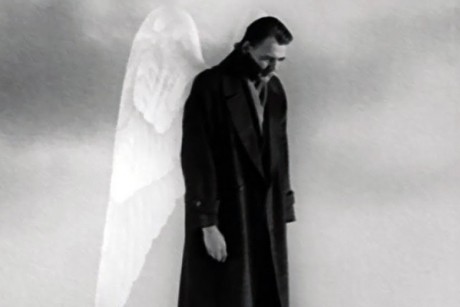
SLIDE SHOW: Movies for a desert island

SLIDE SHOW: Movies for a desert island

null

You don’t need much of a setup for this one: It’s a Desert Island List of visual media that I’d like to have with me if I were shipwrecked.

Here are the rules:

1. This list is composed solely of motion pictures and TV shows. Music, books, paintings and other media are not included. It is assumed that you’ll have an indestructible DVD player with a solar-recharging power source, so let’s not get bogged down in refrigerator logic, mm’kay?

2. You can list 10 feature films, one short and a single, self-contained season of a TV series.

3. NO CHEATING. Every slot on the list must be claimed by a self-contained unit of media. You can put all 15 hours of Berlin Alexanderplatz on the list because it’s considered one long film (or if you saw it in Germany, a TV miniseries), but you can’t put The Godfather and The Godfather, Part II in the same slot because “it counts as one long film” (it doesn’t!). You can’t put 10 seasons of I Love Lucy on their, either, or "Twin Peaks up through the part in Season 2 where we finally find out who killed Laura Palmer.” Part of the fun of this exercise is figuring out what you think you can watch over and over, and what you can live without. Stick to the parameters, otherwise we’ll have human sacrifice, dogs and cats living together, and mass hysteria.

I’ve listed my short film pick and my TV season first, followed by a list of 10 theatrical features in alphabetical order. Please add your own picks to the Letters section; I want to see what you’d put in your suitcase.

You can view Matt's final slide show here at Salon.

A critic, journalist and filmmaker, Matt Zoller Seitz is the staff TV columnist for New York Magazine and the founder of Press Play.

SLIDE SHOW: The best TV shows of the year

SLIDE SHOW: The best TV shows of the year

nullWe’re living in some kind of new Golden Age of scripted TV, and this year’s best offerings were amazing. I decided to be rigorous and restrict myself to just 10 entries. It wasn’t easy.

These 10 picks represent what I think were the most creative and consistently satisfying scripted comedies and dramas that aired on American TV during 2011. If I’d expanded the list to account for shows that were somewhat more erratic but that produced terrific individual episodes, this list would have had 30 or maybe even 40 titles on it. If anybody’s curious, I may post the expanded list in the comments section.

You may see some of the runners-up cited next week, when I will present a slide show honoring the best individual episodes of scripted series. There might be an article listing the best nonfiction programs as well.

You can view Matt's slide show here at Salon.

Matt Zoller Seitz is the publisher of Press Play and TV critic for Salon.

SLIDE SHOW: Secret agenda: 20 classic spy movies

SLIDE SHOW: Secret agenda: 20 classic spy movies

null

There’s one big problem with compiling a list of great spy movies: How exactly do you define a “spy movie”? Do the spies have to be employed by a government agency? Does the action have to be international, or can it be domestic, even local? Do the characters have to engage in deception and/or information-gathering, or can they mainly be assassins, like James Bond or Jason Bourne? Is the “assassin film” its own separate genre? If movie characters have nothing to do with international politics but engage in surveillance and deception and other classic spy activities, can their story be grouped within the “spy movie” category?

James Bond wouldn’t spend five seconds contemplating any of that. He’d be too busy quaffing martinis with a diplomat’s wife and telling a dealer to pass the shoe. He’s represented on this list of great spy movies, along with grittier, more mundane depictions of espionage, deceit and international mayhem. I included a couple of TV programs as well as movies, because the genre’s emphasis on character and atmosphere makes it especially well-suited to the small screen.

Since these lists always seem to be compiled according to some mysterious private criteria, I’ll disclose mine upfront: If a film depicts characters navigating the treacherous labyrinth of the military-industrial complex, in their own country or abroad, and engaging in deception or impersonation or codebreaking or defection or assassination or other tried-and-true espionage mainstays, I considered it. But if too many of those aspects were missing, I ruled it out. That’s why you’ll see The Ipcress File but not, say, The Conversation. I’ve also arranged the list in pairs, or double features, because some of the films just seemed to fit together nicely. Let’s argue about it in the Letters section, where I hope you’ll volunteer your own list of great spy films, and your own definition of the category. Be sure to use a pseudonym and file from a secure location. You can’t be too careful.

You can view Matt's slide show here at Salon.

Matt Zoller Seitz is publisher of Press Play and TV critic for Salon.

SLIDE SHOW: Martin Scorsese’s greatest movies

SLIDE SHOW: Martin Scorsese’s greatest movies

null

This has been quite a year for 60-something American filmmakers. Terrence Malick, who started directing in 1973, created the year’s most divisive conversation piece with The Tree of Life.  Woody Allen, who started directing in 1966, had his biggest financial success with Midnight in Paris. Steven Spielberg, who directed his first feature-length movie 40 years ago, has two blockbusters coming out this month, The Adventures of Tintin and War Horse. And Martin Scorsese, who made his directorial debut in 1966, has had another success with Hugo, a film history-conscious 3-D art film for kids that finished second to The Muppets at the box office during its opening weekend and was just named film of the year by the National Board of Review. It’s as good a time as any for a Best of Scorsese list — as if I really need an excuse!

What you see here is my own personal list of Scorsese’s 10 (actually 11; I cheated on one slide) greatest films. I’ve tried to cast a wide net here and include both fiction and nonfiction; he works regularly in both modes, and the latter tends to get neglected. This list was in some ways harder to compile than the Woody Allen list from a couple of weeks back, because although Scorsese hasn’t made a film that totally satisfied me in a while, his films are nearly always brilliant in places — sometimes for very long stretches. Even The Aviator, Bringing Out the Dead and Gangs of New York — which I think are sorely hampered by miscasting — are often breathtaking. If you’re wondering where Cape Fear, The King of Comedy, After Hours, The Last Waltz, The Last Temptation of Christ and The Color of Money are, I don’t hate them. I just think these films are ultimately richer.

You can view Matt's slide show here at Salon.

Matt Zoller Seitz is publisher of Press Play and TV critic for Salon.com.