

 This weekend is Chinese Lunar New Year, a cultural landmark that even some of my Chinese friends needed to be reminded is almost upon us. One way you can tell that the holiday is impending is to look for Chinese films at your local movie theater. In the same way that a crop of big budget Bollywood premieres are perennially released in time for autumn’s Diwali festivities, so too are a number of studio-produced would-be Chinese blockbusters released in time for the new year. But blink and you'll miss ‘em: there are only two Chinese films being released at AMC theater chains.
But hey, that's more than you knew were being released last year, right?
China Lion, a relatively new company dedicated to releasing mostly mainland Chinese (and some Hong Kong) films to American multiplexes, will release All's Well, Ends Well 2012 (unrelated to the Shakespeare play, though it is the seventh film in the romantic comedy series that began in 1992 with a film starring the likes of Stephen Chow and the lamentably deceased Leslie Cheung) next Friday and The Viral Factor this Friday. That may not sound like a three-car pile-up but considering that China Lion has heretofore staggered their releases over a matter of weeks (sometimes even a couple months), it's a sign that the Lunar New Year is here.
More importantly, it's a good time to take stock and see what China Lion has released over the last year. Sadly, while the idea behind the new company is great—introducing both established and new fans of popular Chinese/H.K. films to the latest pop cinema—the results have been mostly underwhelming. Don't expect China Lion to bring you prime-grade films from Wilson Yip, a guy that went from making films with titles like Bio Zombie and Daze Raper to Ip Man and Dragon Tiger Gate. Don't get me wrong, Ip Man and Dragon Tiger Gate are both enjoyable in their own ways, but Magic to Win, Yip's latest and most flavorless film in a while, is totally underwhelming.
If last year's worth of releases is any indication, China Lion films are, at best, immediately likable but largely disposable melodramas. My vote for their most, ahem, outstanding title would be 3D Sex and Zen: Extreme Ecstasy, a funky little softcore comedy that was a hit in Hong Kong last year thanks to its endearingly unsound use of 3D technology.
Sadly, more often than not, China Lion puts out movies like The Viral Factor, a frenetic but totally shallow and mostly inert action movie starring milquetoast stars Nicolas Tse and Jay Chou. Directed by Dante Lam (Fire of Conscience, Beast Stalker), The Viral Factor is a cop drama high on bathos and lackluster action scenes; Lam and co-writers Candy Leung and Wai Lun Ng haven’t met a cliché that they didn’t like. Two estranged brothers, one an amoral thief (Tse) and one a righteous cop (Chou), reunite in order to fight an evil cartel of corrupt policemen-cum-terrorists. Tse and Chou run around and struggle to remind each other of their similarities.
Between lame plot points, Lam delivers typically frenetic but unpolished action scenes that are distinguished largely by their hints of preposterousness. Early on, Chou’s cop gets shot in the brain, and the bullet is still lodged there throughout the film. Still, he persists in running around and fighting bad guys—with an actual bullet lodged in his brainpan. This is impressive even when you compare it to the scene where Tse stumbles out of a hospital after jumping several stories and landing gracelessly on a car below him. If there were more crazy stuff like this throughout The Viral Factor, it’d be worth the price of admission. Unfortunately, such insanity only serves as garnish for Lam’s otherwise flavorless film.
Thankfully, China Lion hasn’t just released disappointing piffle like The Viral Factor. They’ve also released charming piffle like Love in Space, a romantic comedy about three self-centered sisters that struggle to fall in love, and Aftershock, an epic family drama about two siblings that were separated during the 1976 Tangshan earthquake. 
Aftershock is probably the more durable of the two aforementioned titles. Its pseudo-progressive depiction of Chinese history is fairly compelling, if only for the light touch that director Xiaogang Feng (The Banquet, If You Are the One) brings to his film’s series of minor domestic crises. Love in Space does have one of the most charismatic ensemble casts of any of China Lion’s films to date, but, like The Viral Factor, it’s mostly worthwhile for its quirks. (Love in Space is just as cliché-ridden as The Viral Factor, but it’s mostly amiably cheesy.) Aftershock is at least compelling, if sappy, for its core story, which is taken from a novel by Ling Zhang.
So if you want to celebrate the Lunar New Year with a new Chinese flick, fire up your Netflix account and check out Aftershock, now available on Instant Streaming. It’s not a must-see film, but it is as good of a representative of the China Lion brand as you can currently get. Unless, that is, titillating comedies about libidinal enhancement (i.e., donkey penises) are more your thing, in which case you’ll probably want to check out 3D Sex and Zen: Extreme Ecstasy. Either way, come for the shrill melodrama, stay for the sincere cheese.
Simon Abrams is a New York-based freelance arts critic. His film reviews and features have been featured in the Village Voice< andTime Out Chicago. He currently writes TV criticism for The Onion AV Club and is a contributing writer at the Comic Journal. His writings on film are collected at the blog, The Extended Cut. Simon reviewed 3D Sex and Zen: Extreme Ecstacy here for Press Play.


 Like Frontier(s) before it, The Divide is a grungy pastiche of a classic horror film; it is to Night of the Living Dead what Frontier(s) is to The Texas Chain Saw Massacre. In The Divide, the sudden impact of a nuclear explosion in Manhattan forces a group of survivors to pile into a subterranean shelter where they bicker shrilly, form cliques and devolve into monsters. In the film, Gens tries to prove that he can be even more cynical than his predecessors were, if that’s imaginable. So instead of the black guy getting shot and killed at the very end, the black guy gets shot and killed about midway through the film while his murderer’s silhouette is hidden behind an American flag; take that, Romero!
 For people that just can’t stand gore: Them (2006). This spare, based-on-a-true-story house invasion film is so gripping that people still maintain that, even though its plot is pretty much pure formula storytelling, The Strangers is somehow a rip-off of Them. Them’s just that good.
 According to
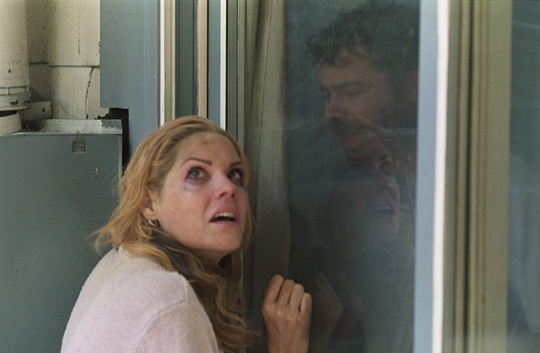

 As in Romero’s The Crazies, Right at Your Door evokes a world where authority figures are visibly shown to be unreliable. This is extraordinary in Right at Your Door because authority figures are only physically represented by armed grunts clad in gas masks and biohazard jumpsuits. These monsters are just following orders when they don’t answer Brad’s questions. For example, one can't help but notice the way one soldier hesitates and even trembles while puffing out his chest and defensively telling Brad, “We’re not trying to cause more panic than there already is.” Compare that with the way the similarly dressed soldiers in The Crazies are defined by their actions. They don’t use verbal prompts that might even tentatively reveal their humanity. By contrast, Gorak's army men reveal their humanity while they’re doing the most cruelly impersonal things.

 You’d have to work pretty hard to cover up that kind of wear, but that’s kind of the point of Ghost Protocol: Cruise’s Hunt is not in denial. He’s in great shape – did you not see him clean up the world’s tallest building in Dubai? Or, on foot in a sand storm, running around like a madman? Or crashing several BMW luxury sedans? Just think of Tom Cruise’s face as the portrait of Dorian Gray, which I guess makes his body Dorian Gray…except in Ghost Protocol, Dorian Gray is galloping around the world with his portrait on display. Which is…odd, to say the least.
 But in all seriousness, Ghost Protocol needs Cruise’s over-seriousness and his tendency of making himself look that much more focused, that much more determined and that much more capable than everyone around him. Even newcomer Jeremy Renner looks like a girly man compared to Cruise, like in the scene where Renner is floating around (literally, floating around) in an overheated subterranean tunnel while wearing a chain mail suit that levitates his whole body.
 This is it, folks: David Gordon Green isn’t the guy that made George Washington and All the Real Girls anymore. Now, he’s the guy that made Pineapple Express and Your Highness. Which is a transition that doesn’t really deserve an award or a hearty handshake or even much praise really. But for the sake of needlessly giving credit where credit is due, I have to say: this new David Gordon Green is ok.
 Because, let’s face it, the plot of The Sitter is exhausting and not always comically so. Even screenwriter Brian Gatewood and Alessandro Tanaka eventually throw up their hands and accept that they have to get semi-serious about their lazy, potty-mouthed pastiche after a point, which puts a serious damper on Green’s genital-fixated style of humor (I’d say the point where the film stops being generously funny is probably the point where Noah tells Slater that he’s gay…).


 At the same time, Shame could be remade in any other city because any faceless city could be the setting for McQueen and co-writer Abi Morgan’s facile and altogether trite observations about being stuck in a bad spiral of shame. That glancing shot of the memorial and all the other specific references to the city, from Madison Square Garden to the way Brandon conspicuously shuttles from 28th Street to Fulton on his way to work, make Shame, as it exists now, very much a film whose meaning comes from McQueen’s surface-deep view of the city. Then again, why should he value the character of the city he’s shooting in when he shows us that he doesn’t want to cut any deeper into his human protagonists’ personalities either?
 McQueen tries so hard to make Brandon’s problems seem more than just dramatic but rather momentous to the point that Shame doesn’t look operatic but rather self-satisfied and over-cautious. Every emotion is writ in impersonally large letters, such as the way that Sissy, the bright-eyed and unfettered bohemian who still thinks of New York as a playground for her amusement, stands right at the edge of the R train’s platform while Brandon, the morose and self-loathing sex addict, stands at least a meter away from the edge. By trying to keep Brandon as physically far back as possible from his sister and any oncoming cars, McQueen rubs in our face just how literally he can represent the carnal abyss that Brandon’s trying to avoid.
 Press Play Video Blog