SIMON SAYS: White Men Can’t Ninja

SIMON SAYS: White Men Can’t Ninja

null

In the ‘60s and ‘70s, ninjas proliferated in Japanese movies. Movies like The Daimyo Spy (1964) and Castle of Owls (1964) helped to establish ninjas as the sneaky but honorable warriors that we now know them as. In 1981, an Israeli filmmaker with too much money and not enough talent started a wave of ninja-sploitation films. Producer-cum-director Menahem Golan was supposed to direct Charles Bronson in Death Wish 2. But, as the apocryphal story goes, Bronson didn't want Golan at the helm. So Golan directed Enter the Ninja—a movie which, oddly enough, has remote ties to the spaghetti western genre.

Enter the Ninja is the first film in a trilogy of schizoid films that Carlson, my amiably ornery Bad Idea Podcast co-host, has wisely characterized as "copy-and-paste cinema." Like spaghetti westerns and Manchurian action films before them, ninja-splotation films depend on cinematic revisionism. But instead of post-dubbed Italians shooting each other in Monument Valley, ninja cheapies like Enter the Ninja feature non-Italian Europeans throwing ninja stars and colored smoke bombs at Asian guys (plenty of whom were not even Japanese-American) in colorful outfits.

Ironically enough, Franco Nero, the star of Sergio Corbucci's blood-soaked spaghetti Western classic Django (1966), also starred in Enter the Ninja. Nero's face changed in the 15 years between the two films: the formerly glass-jawed B-grade star is notably puffier and has a different mustache in the later film. But the jowly, bleary-eyed, Chevron-mustache-clad look Nero perfected here would influence a couple of other ninja-splotation heroes, including Richard Harrison, star of such films as Ninja Terminator (1985) and Project Ninja Daredevils (1986). Harrison may have started his film career auspiciously in the 50s, as the co-pilot in the film version of South Pacific (1958), but after starring in such spaghetti westerns as Rojo (1967) and $100,000 for Ringo (1966), Harrison went even farther West: to Japan. 

The connection between spaghetti westerns and the '80s cycle of white-washed ninja films doesn’t run very deep. The narrative coherence found in spaghetti westerns can’t be found in ninja movies. For example, in Enter the Ninja, Golan arbitrarily transplants a western stock plot in the Philippines, presumably because it was famously very cheap to shoot there. But once we are in the Philippines, we see that nothing makes sense. Case in point: the film's villain is an evil, union-busting plantation owner with a bizarre love for synchronized swimming. He's hired a sadistic one-eyed German fellow as his head lackey. Similarly, the titular machine in Ninja Terminator is a small toy robot that delivers its irate masters' death threats for them. Regardless of budget constraints, these movies make no sense.

But ultimately, such a salient lack of sense is part of the appeal of the ninja-sploitation film. These blustery and nonsensical films follow murderous but chivalric white guys with lethal squints as they fight badly dubbed villains who laugh maniacally and use the telephone too much. What kind of ninja uses a phone? These are ninjas! They live by a code of honor, protect their women and beat each other up with exotic weapons. Who said anything about Ma Bell?!

In summation: no, I can't tell you why one film would include a toy robot, or another a sadistic, eye-patch-wearing gnome. But I'd have an equally hard time explaining why Nero's Django hid his signature Gatling gun in a coffin. The average ninja-splotation film makes its own rules, unwittingly going further than most spaghetti westerns did to feature as much exploitable ninja-related violence as possible on a tiny budget. Schlockmeisters like Golan and Godfrey Ho (Ninja Destroyer, Rage of Ninja), inept filmmakers though they were, carved out a surreally burgeoning niche for themselves.

***Enter the Ninja will be the first movie playing in a double bill that Steve Carlson and I will present next Saturday, 6/9 at 92YTribeca. That night, we will also be screening a 35mm print of Ninja III: The Domination.***

CANNES 2012: And the Winners Should Be…

CANNES 2012: And the Winners Should Be…

null

Read our critics' personal predictions of who SHOULD win the awards, and who WILL win the awards, at Cannes 2012:

Glenn's Predictions:

With the last Cannes competition screening in the books, let the award prognostications begin. Since Cannes 2012 has been the year of non-consensus, trying to pick the award winners is like playing a game of musical chairs.  But here goes:

Best Actor:

If there’s any justice in this world, Denis Lavant will carry the day for his breathtaking, transformative performance in Holy Motors. There’s no male performance in competition that compares. Aniello Arena of Reality has an outside chance of pulling an upset here, as does Jean-Louis Trintignant of Amour, but I see the latter and his co-star Emmanuelle Riva getting a special mention award instead.

Will and Should Win: Denis Lavant, Holy Motors

Best Actress:

This category is more of a crapshoot, with Margarete Tiesel (Paradise: Love), Marion Cotillard (Rust and Bone) and Emmanuelle Riva (Amour) all serious competitors. Cotillard should take it as the local favorite, especially since Paradise: Love is an incredibly divisive film and the performances in Amour should get their own award.

Should Win: Margarete Tiesel, Paradise: Love

Will Win: Marion Cotillard, Rust and Bone

Jury Prize:

Sergei Loznita’s In the Fog has an outside chance at the Palme, but I see him getting either the Jury Prize (his great War film would be my choice) or Best Director for his brilliantly dire work. But my prediction for third place is Cristian Mungui’s stark indictment of religious ideology, Beyond the Hills, a resounding technical achievement hindered by taxing hysterics and a blunt “fish-in-a-barrel” ending.

Should Win: In the Fog

Will Win: Beyond the Hills

Best Screenplay:

Andrew Dominik’s talky gangster film Killing Them Softly deserves this one for its amazingly dense dialogue sequences and interesting subplots. But I see David Cronenberg’s talky satire Cosmopolis pulling this one out. If Resnais doesn’t get the Palme, he might get a Screenplay win in return.

Should Win: Killing Them Softly

Will Win: Cosmopolis

Best Director:

It would be wonderful if Wes Anderson were honored with Best Director for Moonrise Kingdom, the one American film in Competition that grows more complex and enjoyable by the day. But he seems like a long shot despite the overall warm reception. If Holy Motors doesn’t win any other award, Carax has a shot at director as well. But the aforementioned Loznitsa will walk away with the prize.

Should Win: Wes Anderson, Moonrise Kingdom

Will Win: Sergei Loznitsa, In the Fog

Grand Prix:

Michael Haneke’s stunning Amour has been the one film most festivalgoers agree on, gaining both critical acclaim and audience praise. But since the Danish director won for his last film (The White Ribbon), look for it to receive the runner-up prize.

Will and Should Win: Amour

Palme d’Or:

Four films have a viable shot at winning the Palme d’Or (Amour, You Ain’t Seen Nothing Yet, Like Someone in Love, and Holy Motors), but directors of two (Haneke and Kiarostami) have already won the top prize. Kiarostami’s brilliant Like Someone in Love deserves the award for its audacity, complexity, and sheer thematic force, but it’s hard to imagine the jury giving this divisive a film the big prize.  I’m going with Resnais, mostly because he’s never won the award and this is reportedly his last film. The master of the French New Wave will undoubtedly be jury president Nanni Moretti’s sentimental choice. But don’t count out Leos Carax’s loony Holy Motors, the one film in competition with the most impassioned momentum.

Should Win: Like Someone in Love

Will Win: You Ain’t Seen Nothing Yet

SIMON'S PREDICTIONS:

I’m usually pretty bad at prognosticating anything, so please do take that in mind when reading these predictions. I’ve tried to keep in mind the warm reception some of these films have gotten from colleagues, audience members and myself as well as what a jury (any jury, really) might be inclined to reward. But really, this is a tough year to predict. There have been a number of exceptional films in competition and also a bunch of awful ones, too. Choose wisely, Nanni and co.

Best Actor:

Who Will Win: Denis Lavant, Holy Motors. Lavant plays an actor that transforms from one scene to the next in Leos Carax’s astounding ode to film (the rise of digital cinema weights heavily on him). I tend to think this will win because Lavant’s not only typically versatile but he also has a very physical and demanding role. It’s an impossible-to-miss performance.

Who Should Win: Denis Lavant, Holy Motors. He really is that good, you guys.

Best Actress:

Who Will Win: Emanuelle Riva, Amour. Admittedly, there’s a look-at-me quality to the role that Riva plays in Michael Haneke’s suffocating and disturbing (but in a rewarding way!). How could an award’s body ignore the actress that plays an elderly woman losing her memory? At the same time, Riva really is excellent so this seems like an easy pick.

Who Should Win: Anne Consigny, You Ain’t Seen Nothin’ Yet! Alain Resnais’s newest (and possibly last) film is characteristically rich. He gathers a bunch of actors and has them perform the same roles as each other for the sake of a meta-textual and meta-physical commentary on, well, life, death and performance. Of the three actresses that play Eurydice in the film, Consigny stands out the most, however. This is saying something, considering that she’s playing the same part as the equally impressive Sabine Azema.

Jury Prize:

Who Will Win: Like Someone in Love. I’m not even sure what this award is for. What’s this award for? In any case, Nanni Moretti, the competition jury’s president, apparently made a push for Like Somone in Love director Abbas Kiarostami’s The Taste of Cherry to win a prize. And Kiarostami’s “due,” as they say. Oh, and the movie’s good, too.

Who Should Win: Holy Motors. I seriously don’t know what this prize is. And Carax’s new film is kind of amazing but I don’t think it will win the Palme. Still, I think it will win…something, certainly. This prize could just as easily go to Moonrise Kingdom though.

Best Screenplay:

Who Will Win: After the Battle. Again, being the jaded ass that I am, I don’t think jury members can resist this film’s blunt, dialectical discussion of the recent and highly publicized Egyptian coup. I mean, they should try to resist it, but I think it’ll be a difficult resistance.

Who Should Win: Cosmopolis. David Cronenberg’s adaptation of Don Delillo’s novel is seriously impressive. The changes he’s made to Delillo’s narrative are small but significant, as they only serve to bolster Delillo’s complex and fascinating story. Cronenberg’s script is the backbone for a very well-paced and canny bit of speculative fiction (ie: scifi). So it won’t win but it should.

Best Director:

Will Win: Reality. I rather like Matteo Garrone and am okay with the assured but subtle creative decisions he made for this film. But honestly, the real reason I chose this one is because Garrone's apparently stuck around. So, hey: the prize goes to the guy that directed First Love. Noiiiiice.
 
Should Win: Killing Them Softly. You can say what you want about the film's obnoxious politics but Dominik is one assured filmmaker. The way he juggles the acidic irony of certain lines of dialogue with relatively playful song cues and then, you know, a serious heist plot–really impressive, even if the rest of the film isn't as good as his previous efforts.
 

Grand Prix:

Who Will Win: Holy Motors. Leos Carax’s deeply felt passion project has understandably impressed almost everyone I’ve talked to at Cannes. It’s a great film and a complex one, so I tend to think it has something for everyone. Plus, it’s about cinema. So the guys that thought The Artist would tickle the 2011 Cannes jury’s fannies, I mean fancies might have just been off by a year.

Who Should Win: Cosmopolis. I dunno, guys, it takes a lot of skill to pull off an adaptation of Delillo’s knotty source novel that’s as great as Cronenberg’s is. And this sure as hell won’t win the Palme. Plus, the subject’s contemporary, it’s hip, it’s happening. I dunno, I think this movie should win a major award and as long as I’m being both hopeful and realistic, this is probably the prize it should win.

Palme D’Or:

Who Will Win: You Ain’t Seen Nothin’ Yet! Alain Resnais is considered to be the favorite for the Palme by everyone and their mother because, well, he’s old, probably dying and a great fucking filmmaker. So he’s “overdue,” as they say. Oh, and his new movie is really good, too.

Who Should Win: The Paperboy. Make no mistake: Lee Daniels’ new movie is not good by any stretch of the imagination. He confuses sleazy mugging with meeting tawdry material at its own level and trite notions of sex and race as if they were deep sentiments to live by. But holy guacamole, if this movie won, Cannes would be burned to the ground overnight. The prize would be stolen, along with viewers' hearts (?!), by the guy that directed such faux-works of holier-than-thou kitsch as Shadowboxer and Precious: Based on the Novel ‘Push’ by Sapphire. How awesome would that be, right?!

Glenn Heath Jr. is a film critic for Slant Magazine, Not Coming to a Theater Near You, The L Magazine,andThe House Next Door. Glenn is also a full-time Lecturer of Film Studies at Platt College and National University in San Diego, CA.

Simon Abrams is a New York-based freelance arts critic. His film reviews and features have been featured in The Village Voice, Time Out New York, Slant Magazine, The L Magazine, The New York Press and Time Out Chicago.He currently writes TV criticism for The Onion AV Cluband is a contributing writer at the Comics Journal.His writings on film are collected at the blog, Extended Cut.

Cannes 2012: Sang-soo Im’s THE TASTE OF MONEY

Cannes 2012: Sang-soo Im’s THE TASTE OF MONEY

null

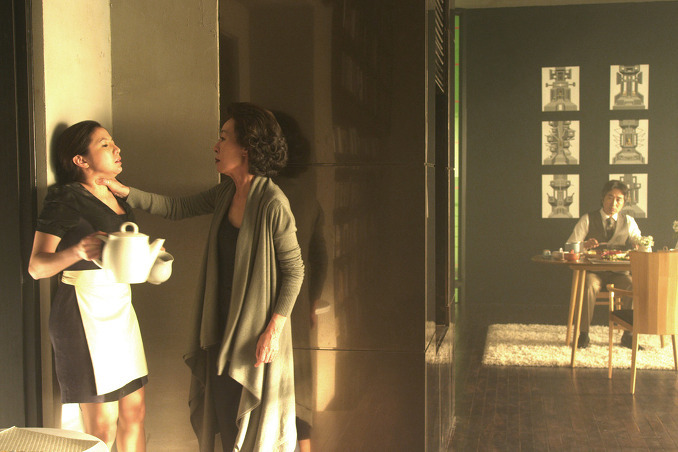
You have to really want to say “F*** you” to anyone watching your work to make a black comedy as rancid as The Taste of Money. Money is a needlessly self-parodizing, feature-length supplement to South Korean Sang-soo Im’s (The President’s Last Bang) recent remake of Ki-Young Kim’s The Housemaid. In fact, Im rubs that connection in viewers’ faces by alluding to The Housemaid three times in Money, even going so far as to have his hatefully stupid protagonists watch both versions of The Housemaid.

For comparison’s sake: both versions of The Housemaid focus on a working-class domestic who suffers a hilarious psychotic breakdown on refusing to be bought off by her corrupt bosses, who naturally come from old money. The Taste of Money's two hirelings reluctantly climb the corporate ladder and look on in mute disdain while their screwy bosses literally screw each other over, acting like rejected antagonists from Passions. Im actively encourages laughter at hysterical, one-dimensional protagonists. This aggressively broad satire is designed to needle everybody and satisfy no one.

Young-jak (Kang-woo Kim) is a factotum-cum-personal assistant for Chairman Yoon (Yoon-sik Baek), a wealthy owner of a multi-billion dollar international conglomerate. Yoon has Young-jak do almost everything for him. And, as is explicitly spelled out in the film’s first scene, in which Young-jak is told to “taste” (ie: pocket) some money for himself, he’s being groomed for a higher position.

But Young-jak doesn’t know if he wants to climb the corporate ladder in the weird, unexpected ways required in this film. He’s awkwardly caught between Geum-ok Baek (Yeo-jong Yoon), Yoon’s wife, and Yoon, who is having an affair with his Filipina maid Eva (Maui Taylor). And to keep everything copacetic between everyone in the Yoon clan, he also has to schtup Na-mi (Hyo-jin Kim), Yoon’s attractive daughter, too. Despite his reluctance to admit it, there is a line that even a would-be sell-out like Young-Jak isn’t prepared to cross. And he’s made to cross it several times over.

The Taste of Money’s smugly shrill sense of humor delights in ridiculing its soft target protagonists. The film is punishing-ly surreal in that way, being insanely melodramatic, but it also never reaches a Mel Brooks-level of farce. If anything, Im is just so in love with his jokes that he reaches a new strata of semi-self-aware camp. Topless women, too many gimmicky POV shots, and the random presence of a white CEO named Robert Altman (played by the respected real-life Korean film critic Darcy Paquet) are not even the most bewildering things about the film. It’s an utterly baffling film: not because it’s hard to understand what Im’s doing (money corrupts, apparently!) so much as why he won’t stop doing it.

Unfortunately, The Taste of Money isn’t even batshit on an inspired level, like the ending of his The Housemaid remake (One word: SELF-IMMOLATION). It’s just a noxiously tedious bit of fuckwittery and a big waste of time. If the ending of Im’s The Housemaid was his way of exhaling sharply and letting his gut out, then The Taste of Money is his way of keeping his beer belly out and playing The Green Hornet theme song with his navel, over and over and over again. 

Simon Abrams is a New York-based freelance arts critic. His film reviews and features have been featured in The Village Voice, Time Out New York, Slant Magazine, The L Magazine, The New York Press and Time Out Chicago. He currently writes TV criticism for The Onion AV Club and is a contributing writer at the Comics Journal. His writings on film are collected at the blog, Extended Cut.

CANNES 2012: Koji Wakamatsu’s 11/25: THE DAY HE CHOSE HIS OWN FATE

CANNES 2012: 11/25: Koji Wakamatsu’s THE DAY HE CHOSE HIS OWN FATE

null

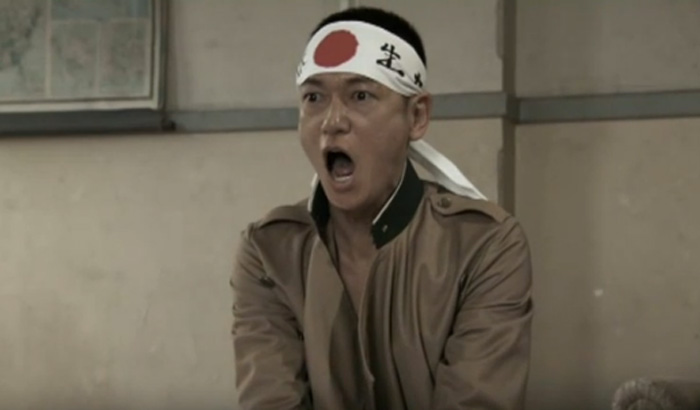
Legacy is the thing in 11/25: The Day He Chose His Own Fate, Japanese guerilla filmmaker Koji Wakamatsu’s remarkable drama about the death of militant poet/novelist Yukio Mishima. Wakamatsu (United Red Army, Angelic Orgasm) knows that Mishima, a jingoist who committed seppuku at Tokyo’s Ministry of Defense, was obsessed with political action and what future generations would take away from his work. This is why Wakamatsu’s film, whose docudrama realism contrasts sharply with Paul Schrader’s oneiric depiction of Mishima in Mishima: A Life in Four Chapters, is so concerned with Mishima’s ritual suicide. Wakamatsu’s ambiguous but sometimes-fawning representation of this enigmatic event's aftermath is problematic but just as vital a work of revisionist cinema as his essential United Red Army.

Wakamatsu’s character arc for Mishima (superbly rendered by Arata) in The Day He Chose His Own Fate tellingly revolves around his death. Variations on the question, “When is the day you will die,” mark the frustration and broad beats of Mishima’s pre-suicide activities. But this myopic focus also makes Masakatsu Morita (Shinnosuke Mitsuhima), Mishima’s most ardent acolyte and the only other follower who committed suicide with him, a crucial supporting character in Mishima’s story.

Wakamatsu examines Morita’s pre-seppuku activities with similar fascination for the most part, as in a scene in which a fisherman reminds Morita and a student colleague of the potential consequences of their pseudo-revolutionary actions. But the fact that Wakamatsu consistently lavishes Morita’s activities with almost as much attention as Mishima’s, from Morita's expulsion from college to his reunion with Mishima, is a clear sign of Wakamatsu’s admiration for Mishima’s drive towards death.

After all, we don’t really know much about Mochimaru, Mishima’s original second-in-command before Morita’s promotion. Morita wouldn’t be as close to Mishima if Mochimaru hadn't departed. But Mochimaru’s most important moment in the film is a scene in which he tells Mishima he has to get a job and marry, rejecting Mishima’s counter-offer of a salary for his Society activities. “Should passion be submerged by absurdity,” Mishima murmurs in response, making it seem as if Mochimaru is only really important to Mishima’s story for leaving it.

More importantly, Wakamatsu’s depiction of the speech Mishima delivers before killing himself is equally problematic. Mishima’s speech is filmed from just below the balcony where he speaks. It’s therefore impossible to see the crowd he’s addressing, or the lack thereof. The sounds of yelling and the drone of a nearby helicopter periodically increase, and grainy images of what or may not be footage of police and onlookers are interspersed with Mishima’s speech. But all this does is ground this crucial scene in Mishima’s tortured headspace. Wakamatsu doesn't quite indulge Mishima’s romanticism at this moment or elsewhere in the film, instead ineffectually complicating it.

However, Wakamatsu’s portrait of the artist as an obsessed, self-fashioned martyr is periodically gripping for the way it develops its concern with legacy. Scenes like the one where a journalist looks over a glossy photo of the Shield Society members, with each member identified on the back, achieve the thoughtfulness Wakamatsu is known for. Also, Arata’s performance is so nuanced, giving Wakamatsu’s Mishima an air of troubled grace. I’m especially impressed with the sequences where Mishima descends his home’s staircase for the last time, passing each step with a surreal detachment. 11/25: The Day He Chose His Own Fate is not as rigorous a work as it should be, but it is a complex and absorbing re-interpretation of the Mishima legend.

Simon Abrams is a New York-based freelance arts critic. His film reviews and features have been featured in The Village Voice, Time Out New York, Slant Magazine, The L Magazine, The New York Press and Time Out Chicago. He currently writes TV criticism for The Onion AV Club and is a contributing writer at the Comics Journal. His writings on film are collected at the blog, Extended Cut.

CANNES 2012: Lee Daniels’ THE PAPERBOY

CANNES 2012: Lee Daniels’ THE PAPERBOY

null

In Precious: Based on the Novel 'Push' by Sapphire, Lee Daniels deplorably used sizzling pigs' hooves, mommy issues, and incestuous rape to shed light (ineptly) on the difficulties of growing up black in a broken home. In The Paperboy, he alternatively sends up and embraces hick stereotypes while also mootly insisting that issues of race and sex are, like, complicated. So, when not switching between mocking and then sympathizing with his execrably two-tone characters, Daniels makes pat statements about passion and prejudice. Based on Peter Dexter’s novel by the same name, The Paperboy is so trite and rabidly campy that you often have to wonder what you should and shouldn't be laughing at.

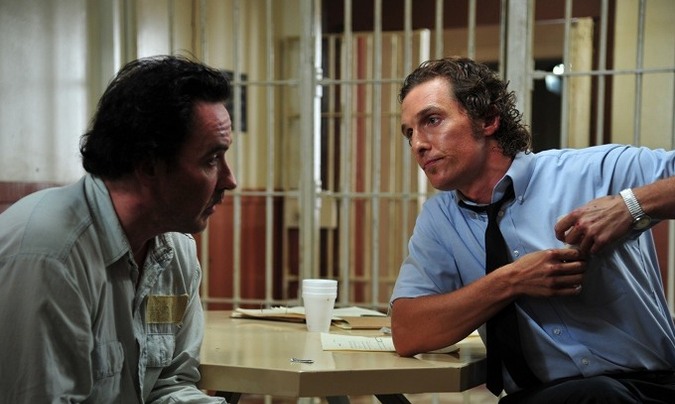
Daniels loves to pick on and then half-assedly elevate soft targets as martyrs. High School Musical's Zac Efron plays Jack, a former collegiate swimmer and part-time journalist. Jack is also the subject of a true story Anita (Macy Gray) recounts, decades after the film's events have taken place. The time is 1965, and the place is Moat County, Florida, where the white folks are mostly racist and clueless. As newspaperman Jack joins his brother Ward (Matthew McConaughey), their nymphomaniacal collaborator Charlotte (a self-debasing Nicole Kidman), and Yardley (David Oyelowo), a black writer from London, to investigate the case of convicted death row prisoner Hillary (a deliriously on-point John Cusack), they inadvertently uncover just how obnoxious a Lee Daniels movie can get in the name of ostensibly self-aware humor and indefensibly trite humanism.

That’s right, Daniels tries to be funny sometimes, a concept that totally undermines scenes in whixh he's trying to show sympathy for his characters. The scene of Charlotte and Hillary's first meeting is one such moment, in which Daniels mercilessly pokes fun at both characters for being uncouth, rednecks, and in heat. Hillary ignores the other men in the conjugal cell where he first meets Charlotte, demanding that Charlotte show him her panties and make an obscene face. She consents, and something more than the desired result is achieved. Daniels further mocks Charlotte later on by having her urinate on Jack after he’s stung by a flock of jellyfish—she even goes as far as to ward off other girls who try to whizz on him by screeching, “If anyone’s going to piss on him, it’s going to be me!”

But later, Charlotte’s character is given what she thinks she wants most: a chance to love Hillary. This predictably turns out to be not only not what she wants but also one of many crucial moments where Daniels self-seriously asserts that his film isn’t just, ahem, taking a piss with its characters. Late in the film, Charlotte reluctantly allows herself to be abused by Hillary, suggesting that Daniels thinks he’s meeting his film’s source material at its low-brow level, hence appropriately sending it up whenever necessary.

However, Daniels isn't Paul Verhoeven, and The Paperboy isn't high kitsch, just pompous, condescending trash. Even Verhoeven wouldn’t be brazen enough to ask his viewers to take seriously the unrequited romance between Anita and Jack, a tepid inter-racial romance that never becomes much more than a bathetic subplot. The two actors have no chemistry, fitting for a charmless, schizoid film like this. The best that can be said of The Paperboy is that it’s sometimes intentionally awful. More often than not, however, it’s just awful.

Simon Abrams is a New York-based freelance arts critic. His film reviews and features have been featured in The Village Voice, Time Out New York, Slant Magazine, The L Magazine, The New York Press and Time Out Chicago. He currently writes TV criticism for The Onion AV Club and is a contributing writer at the Comics Journal. His writings on film are collected at the blog, Extended Cut.

CANNES 2012: Walter Salles’ ON THE ROAD

CANNES 2012: Walter Salles’ ON THE ROAD

null

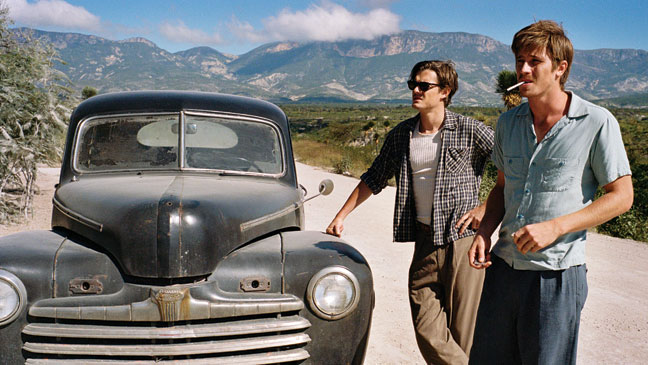
Walter Salles’s painfully literal-minded On the Road is a chore to watch. Unlike its source material, Jack Kerouac’s sui generis, fictional beatnik opus, Salles’s adaptation is flat-footed and monotonous. Salles and screenwriter Jose Rivera counter-intuitively eschew Kerouac’s anecdotal and dizzyingly nimble style of stream-of-consciousness prose to attempt a straightforward, narrative-bound film of it.

The film's narrative is at its best when it veers into impressionistic territory showing us isolated images of an itinerant Sal Paradise’s (Sam Riley) feet or the symbolic road whizzing past him, echoing Kerouac’s immortal bohemian poetry. Unfortunately, Salles and Rivera rarely allow viewers to think for themselves or to appreciate the agony and ecstasy of the nomadic romantic lifestyle. Instead, they superimpose voice-over narration, often taken verbatim from Kerouac’s book, onto these beautifully spare images. Everything in Salles and Rivera’s On the Road is explicitly spelled out, nothing is left to the viewers’ imagination, and no one scene ever feels as alive as Kerouac’s novel.

Sal’s narrative begins and ends with his friendship with Dean Moriarty (Garrett Hedlund), the leader of a pack of vagabond writers. In Salles’s film, Dean is more of an emblematic personality than anyone else. While Dean’s mistreatment of his wife Camille (Kirsten Dunst) is ostensibly addressed at the film’s end, Salles and Rivera are ultimately more interested in making viewers pity Dean. By film’s end, Dean’s disillusionment speaks louder than anyone else’s feelings, making Salles and Rivera’s On the Road more of an artistic manifesto than a turbulent account of artistic self-fashioning. According to Salles and Rivera, the end of Sal and Dean’s story is the end of a boho dream.

Sal and Dean travel the country several times over with a couple of friends and lovers, stealing food, doing drugs, and having sex with each other whenever they can. These characters are in the process of creating a new life for themselves, ignoring the mandates of a square society that isn’t, as Sal puts it, as “mad” as Sal and Dean are for experiential pleasure. This makes squares like Galatea Dunkel (Mad Men’s Elizabeth Moss), the wife of the dowdy and largely absent-minded Ed Dunkel (Danny Morgan), semi-sympathetic obstructions to Sal and Dean’s free-wheeling good times.

But Kerouac’s story should feel like a long and alternately wonderful and alienating trip, not a joy ride whose cheap thrills are sometimes hampered by the periodic jettisoning of human baggage. Therein lies the main problem with On the Road: Salles and Rivera indulge their protagonists, and then sometimes acknowledge the consequences of their actions, when in fact the book was less programmatic.

The weakest aspect of On The Road is the thoughtless way Sal and Dean are immortalized. Kerouac’s protagonists were never heroes, but rather people who experienced things that radically changed their points of view. Just because these characters periodically say that they want to do exactly what they wound up doing doesn’t necessarily make their actions good, valorous, or un-problematically romantic. Salles and Rivera love On the Road’s characters and world too much to know how to properly represent them.

Simon Abrams is a New York-based freelance arts critic. His film reviews and features have been featured in The Village Voice, Time Out New York, Slant Magazine, The L Magazine, The New York Press and Time Out Chicago.He currently writes TV criticism for The Onion AV Cluband is a contributing writer at the Comics Journal.His writings on film are collected at the blog, Extended Cut.

CANNES 2012: Andrew Dominik’s KILLING THEM SOFTLY

CANNES 2012: Andrew Dominik’s KILLING THEM SOFTLY

null

It’s a testament to Australian director Andrew Dominik’s considerable story-telling abilities that a movie as nakedly cynical and aggressively repellent in its philosophy as Killing Them Softly is as satisfying as it is. Dominik adapted Killing Them Softly’s screenplay himself, from George V. Higgins’s novel of the same name, and it shows. The ambiguous, larger-than-life macho men in Dominik’s Chopper, The Assassination of Jesse James by the Coward Robert Ford and now Killing Them Softly are all of a piece. They all have one foot in their own self-mythologizing headspaces and the other in the future they believe is just around the corner. But unlike those two earlier films, the macho-est man of all in Killing Them Softly knows exactly what the future holds—but he just doesn’t care.

The present of Dominik’s latest film is a dystopian version of contemporary America. Chest-thumping tough guys and hand-wringing power brokers abound, none as tough as they’d like others to think. This is especially true of Jackie Cogan (Brad Pitt), a hitman hired to knock off two bottom-feeding hoods who rob a group of well-connected gangsters at an illegal poker game. Since this is the second time the games have been robbed, confidence in these illegal card games is at an all-time low. Business needs to pick up and fast. Enter Cogan, introduced with a tongue-in-cheek song cue of Johnny Cash’s “When the Man Comes Around.” Yes, Brad Pitt is God and the Economic Apocalypse is upon Obamerica. Heavy-handed, sure, but consistently self-serious? Not so much.

That having been said, Killing Them Softly can just as easily be characterized as a plaintive howl of disaffection with, according to Dominik, President Obama’s failure to deliver on his 2008 campaign’s promise of “change” and bipartisan unity. This brazen and largely idiotic lament drones in the background of Killing Them Softly’s loud and hearty heist-and-doomed-getaway narrative until the film’s last scene. Throughout, Dominik inserts snippets from televised and radio addresses where both George W. Bush and Obama, still a senator at the time, talk rhetorically about what needs to be done to fix America’s ailing economy. At the end, Dominik effectively slaps his viewers in the face (back-handed!) and dares them to like it. But until then, Dominik masterfully develops his film’s ultimately untenable thesis.

For example, the film’s song cues and fetishistically detailed slow-motion scenes of violence (they’re not really action scenes) lend an air of ambivalence to the film’s otherwise dour proceedings. Cues from Depression-era standards like “Life is Just a Bowl of Cherries” and “It’s Only a Paper Moon” are sandwiched between songs like “Heroin” and “Windmills of Your Mind,” creating a weird ahistorical context in which every confrontation seems simultaneously over-dramatic and self-deflating.

Thankfully, Dominik is a great meat-and-potatoes visual story-teller. He paces scenes composed entirely of conversations, framing them with ostentatious care and dyspeptic whimsy: Killing Them Softly ultimately suggests Zodiac as directed by Paolo Sorrentino.

Dominik also fleshes out his characters effectively, making them the human context for his film’s polemical and largely vague political posturing. The director draws striking parallels between Cogan’s character and his friend Mickey (James Gandolfini), a fellow hitman who’s gone to seed in just two years’ time, as well as with the two-bit robbers that Cogan is hired to kill. Killing Them Softly does fall apart completely in its last scene, in which Cogan venomously explains that America is “not a country: it’s a business,” smugly using the fact that Thomas Jefferson, the great unifier, owned and had sex with his slaves as proof. But until then, Dominik does a fantastic good job of selling curdled milk.

Simon Abrams is a New York-based freelance arts critic. His film reviews and features have been featured in The Village Voice, Time Out New York, Slant Magazine, The L Magazine, The New York Press and Time Out Chicago.He currently writes TV criticism for The Onion AV Cluband is a contributing writer at the Comics Journal.His writings on film are collected at the blog, Extended Cut.

CANNES 2012: Brandon Cronenberg’s ANTIVIRAL

CANNES 2012: Brandon Cronenberg’s ANTIVIRAL

null

Antiviral, Brandon Cronenberg’s directorial debut, proves the apple really doesn’t fall far from the tree. Like his father David Cronenberg’s early features, Antiviral is more of a collection of inspired, perverse ideas than a cogent piece de provocation. To be fair, Antiviral’s vision of the soon-to-be corrupt future is derivative, which would be a moot point if it didn’t evoke David Cronenberg films like Crash and Videodrome. But at the same time, Antiviral is more than sufficiently novel to be entertaining, even if Brandon Cronenberg’s script and direction are not as sufficiently assured.

Brandon Cronenberg imagines a world where people’s celebumania has mutated into an obsession with contracting famous people’s exotic diseases, which will literally consume their flesh. His debut has promise, though it lacks the conviction that we’ve come to associate with his father’s movies, over time.

Syd (Caleb Landry Jones) is a salesman at a clinic dedicated to infecting plebs who want to contract various diseases, including herpes, from their favorite celebrities. Syd is also a viral mule, inoculating himself and smuggling bugs out of the clinic to sell on the black market. Unfortunately for Syd, the latest bug he’s contracted, this time directly from “perfect” celeb Hannah Geist (Sarah Gadon), is of unknown origin and probably lethal.

While Syd looks for a cure, both for himself and for Hannah, he navigates between two predictably similar different worlds. The clean world of radical new cosmetic technology and antiseptic clinics is necessarily similar to the black market world of stem cell muscle steaks grown from human tissue samples. The representatives of both sides are equally morally bankrupt and practically cutthroat, from Arvid (Joe Pingue), the butcher who buys viruses and sells human meat, to Syd’s boss, Edward Porris (Douglas Smith), the CEO who publicly denies the ethical dubiousness of his practice to a reporter. 

Syd’s character arc is thus defined by his struggle to neither identify with nor distance himself from either side. The result of this class-based tug-of-war is not hard to guess. (Spoilers ahead, though not really!) Since he’s caught between two stations and has an unidentified sickness gnawing at his guts, Syd inevitably grows to accept that he wants to buy what Arvid and Edward are both selling. In one scene, Syd looks on with awe at an interactive TV console in a seedy club that allows customers to dominate a helpless celebrity, virtually. After the celebrity mewls and begs him, still an anonymous, un-committed voyeur, to tell her how she should hurt herself, Syd starts to become convinced.

In the end, Syd doesn’t wind up anywhere unexpected. He’s not a obsessed cipher like Videodrome’s Max Renn, or a free-wheeling pervert like Crash’s James Ballard, but rather an embroiled collaborator. His fate is too neat to be really transgressive, an effect which is, ironically enough, one of the most salient ways Brandon Cronenberg’s first work differs from most of his father’s work. On some level, David always knew how to push buttons, even if he did get better at it as he went along. Brandon’s a better scenarist and idea man than he is as a button-pusher though. One can only hope his follow-up is a little more distinct, or, barring that, a lot more confident.

Simon Abrams is a New York-based freelance arts critic. His film reviews and features have been featured in The Village Voice, Time Out New York, Slant Magazine, The L Magazine, The New York Press and Time Out Chicago. He currently writes TV criticism for The Onion AV Club and is a contributing writer at the Comics Journal. His writings on film are collected at the blog, Extended Cut.
CANNES 2012: Michael Haneke’s AMOUR (Glenn Heath Jr.’s Take)

CANNES 2012: Michael Haneke’s AMOUR (Glenn Heath Jr.’s Take)

"Amour"

Sometimes the aged body revolts, leaving a once vibrant human life facing the inevitably slow process of physical decay. Old age can become a metaphorical tomb, welded shut by fading memories and unspoken emotions, a place where the outside world fades from consciousness and leaves only the opportunity for personal reflection behind. One lingering question persists: can lasting devotion and intimate love exist within such a suffocating process? Michael Haneke’s Amour dares to answer yes, addressing the possibility that nightmares and hopeful dreams can co-exist in the same closed-off cinematic space. By encasing the viewer in the expansive apartment of an elderly couple experiencing the grim reality of impending death, Haneke examines a nearly impossible scenario with brilliant restraint and complexity.

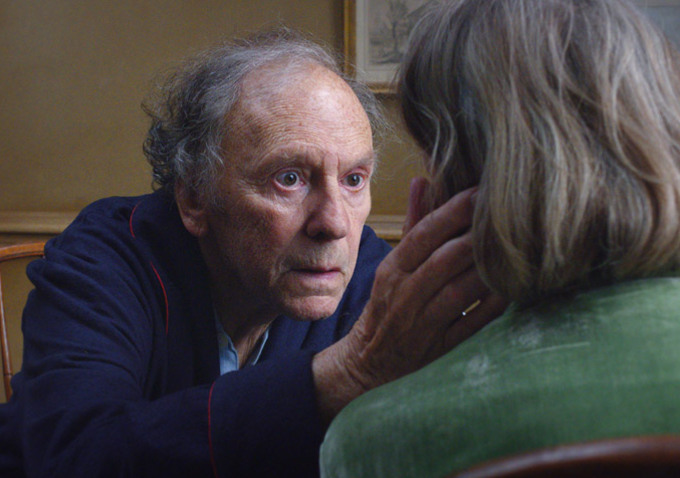
The opening moments of Amour find Georges (Jean-Louis Trintignant) and Anne (Emmanuelle Riva) attending a piano concert held by one of Anne’s former students. In a great straight-on shot of the crowd that holds for over a minute, we can barely glimpse the elderly couple in the middle of the frame, staring at the stage, waiting calmly and quietly together for the music to start. They’ve probably attended hundreds of such events over the course of their relationship, but this will be their last. A few cuts later, the couple returns to their upper-class domicile, bantering about family matters over a quaint breakfast. When Anne suddenly stops speaking and looks stricken, failing to respond to one of Georges' questions, it’s clear some kind of terrible shift has occurred. Haneke spends the rest of the film documenting Anne’s brutally frank deterioration and Georges' fracturing mental state.

Despite the grave subject matter, Haneke avoids turning the couple’s suffering into a grotesque sideshow. We feel their pain in every striking composition, especially when Darius Khondji’s stunning medium shots hover above Anne lying in bed, her darkly tinted eyes in haunting contrast with her increasingly jaundiced skin. But the recurring presence of found memory provides a constant reminder that there’s still emotion to mine beneath this cold façade. When Georges loads Anne into her wheelchair, he tries to remember a story from his youth about a film-going experience that changed his life. He states, “I can’t remember the film’s title, but I remember the emotions.” In this instance and many more, we get the sense his sheer attempt at remembrance offers warm comfort despite the fact that he is mired in an ongoing personal hell.

Like most of Haneke’s oeuvre, Amour strips down set design and audio cues to suit the film's stark material. Darius Khondji’s precise camera is at its best when slowly moving through the apartment foyer, or momentarily out into the hallway for a brilliantly realized dream sequence involving wet feet and an errant hand. But Haneke only delves into the surreal a few times, instead letting the ambient noises of Anne’s cries echo like a requiem in the cramped space. In many ways, the sounds of Amour are most essential, markers of disappearing time and waves of emotion slowly fading to black.

Finally, Haneke’s layered mise-en-scene would be somewhat hollow without the two devastating performances at the film’s center.  Trintignant and Riva entrench themselves completely in the experience, their main form of communication often coming in the form of striking facial contortions and long distance eye contact. This instinctual sense of togetherness between two long-time companions gives Amour its heart and soul, permanently instilling in us the thought that love is never truly fulfilled until that final fade to black.

Glenn Heath Jr. is a film critic for Slant Magazine, Not Coming to a Theater Near You, The L Magazine, and The House Next Door. Glenn is also a full-time Lecturer of Film Studies at Platt College and National University in San Diego, CA.

Welcome to the Cannes Film Festival 2012!

Welcome to the Cannes Film Festival!

null

Editor's Note: Press Play has two critics covering the Cannes Film Festival this year. Simon Abrams and Glenn Heath Jr. are tag-teaming their way through the most anticipated collection of screenings in the film industry. This is your ticket to Cannes. Enjoy!

nullGlenn Heath Jr.

`

nullSimon Abrams

Glenn Heath Jr. and Simon Abrams pick the winners at Cannes 2012.