
[EDITOR'S NOTE: Press Play presents "Should Win," a series of video essays advocating winners in seven Academy Awards categories: supporting actor and actress, best actor and actress, best director and best picture. These are consensus choices hashed out by a pool of Press Play contributors. Follow along HERE as Press Play decides the rest of the major categories including Best Director, Best Actor, Best Actress, Best Supporting Actress, Best Supporting Actor and Best Documentary. Important notice: Press Play is aware that our videos can not be played on Apple mobile devices. We are, therefore, making this and every video in this series available on Vimeo for these Press Play readers. If you own an Apple mobile device, click here.]
Narration:
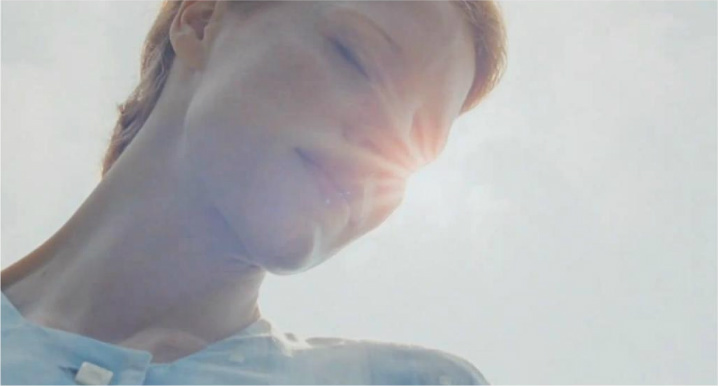
All of the 2011 Best Picture nominees have their merits, but one towers above the rest: The Tree of Life, writer/director Terrence Malick's film about…well what is The Tree of Life about, anyway? For a free-associative non-linear movie that skips back and forth through time and space, and that includes a lengthy early section recounting the creation of the universe, the movie was a surprising commercial success, dominating discussion among cinephiles throughout a summer moviegoing season that is usually overshadowed by much louder, dumber movies. And at the center of the discussion were very basic questions about writing and direction – about storytelling generally – that cut to the heart of what movies are and what they can be.
 It's impossible to discuss the movie without posing a number of questions. Whose story are we seeing here? Is it the story of the middle-aged Jack, played by Sean Penn, and his younger self? That point of view would not account for the voiceovers and subjective sequences told from the point of view of the father, played by Brad Pitt, and the mother, played by Jessica Chastain. Is the creation sequence an integral part of the movie's vision or an unnecessary and indulgent side-trip? In the scene between the wounded dinosaur and the predator down by that prehistoric river, why does the predator seem as though he's going to crush his skull, and then suddenly back off? Are we seeing the first stirrings of the schism that is discussed and visualized in different sections of the film – the way of nature versus the way of grace? Or is there some other explanation? Is there a God in Terrence Malick's universe? The repeated shots of trees, water, clouds, sky and figures haloed or backlit by intense, almost heavenly light would seem to indicate that, yes, there is a God, but uncertainty permeates the entire story, if indeed there is a story – and this, too, was the subject of debate.
No other major American release provoked so many questions about the meaning of its images and situations, the agenda of its writer/director and the validity of its methods. And no other American release provoked such intense, personal reactions – such deep reflection – among people who saw it. Even those who didn't particularly care for Tree of Life or who had serious problems with its structure or tone seemed to respect what it was doing or trying to do. And the unusual rhythms of the filmmaking, at once fractured yet graceful, seemed to mimic the structure of thought itself. The mind races forward, the mind races backward; past becomes present, present becomes past. This is what it means to be conscious, to be alive. This is what it means to be aware of one's own mortality. These are the sensations that movies should provoke. This is the sort of reflection that movies should inspire. This is the achievement of Tree of Life. It is an original, beautiful, unique movie by a defiantly individual director, and Press Play's choice for Best Picture.
Serena Bramble is a rookie film editor and publisher of the blog Brief Encounters of the Cinematic Kind. Matt Zoller Seitz is the staff TV columnist for Salon.com and the founder of Press Play.

 Yet, the most striking of this year's nominees is the underdog sports film Undefeated. Following what at first seems to be a hopeless season with the Manassas High School varsity football team in Memphis, Tennessee; Undefeated emerges as one of the more impressive examples of cinema verite, otherwise known as "direct cinema." Nearly every shot is handheld; in fact much of the film seems to be unfurling in real time, in front of our very eyes. The camera is free flowing and reacts to the reality of every situation. Like other great examples of direct cinema, from Don't Look Back to the thematically similar Hoop Dreams, Undefeated breathes with an immediacy that is void of headline political agenda, broad-stroke narrative fallacies and any sort of forced sentiment. This is observant, go-for-the-throat filmmaking.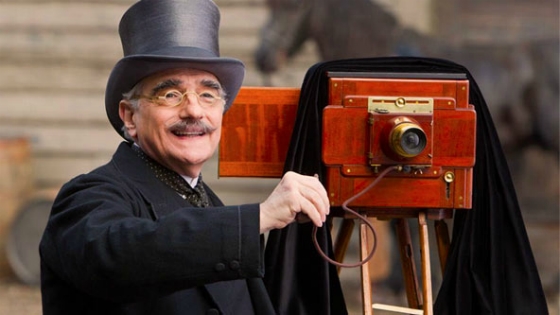
 Woody Allen's Midnight in Paris is not a love letter to nostalgia or a trite piece of idol worship. Instead, it's a mature artist realizing his own folly. It's a melancholy film, yet Allen's direction is full of hope, with the final choice of the hero underlining the pointlessness of living in the past and the necessity of having to trudge on. Michel Hazanavicius' supreme achievement in The Artist is making people talk about the silent era again and argue about whether the film accurately represents it. Terrence Malick's canvas is as wide as they come in The Tree of Life, where he explores life, death, the universe and everything in a spasmodic stream-of-consciousness narrative. He finds the personal in the expansive. The theme of loss permeates the film. Malick arranges the beautiful movements with grandeur. The Descendants is perhaps Alexander Payne's most conventional movie to date. Loss, once again, is prominent in this family drama deftly directed by Payne with a loving eye for the minute details in the grand scheme of life.
 Brad Pitt’s performance is an almost old-fashioned, movie star one. In another universe, one could imagine Jimmy Stewart or Cary Grant taking the part. He brings to the role an assured quality on overzealous, yet understated, lust for ultimate success that was forged in the fires of years and years of failure. He's charming and cheeky and funny, and very good looking (despite the hideous early naughties’ haircut and lumbering fashion sense). Pitt brings a subtle comedic take to what could have been a rather boring central role; his various dealings with other managers, his scouts and players, betray genius-level timing and mimicry.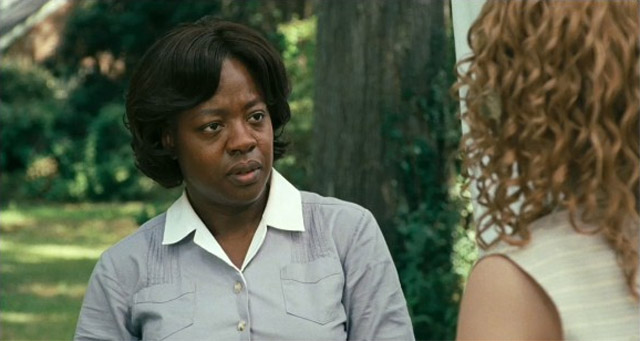
 The power of the performance is in Davis’ eyes. They take in everything – tossed-off racist remarks, a child’s need to be comforted. And her voice, which never rises above a formal submissiveness, quivers with a boiling anger that stands for generations of women whose hard work goes unnoticed. It’s a voice that needs to be heard.
 [EDITOR'S NOTE: Press Play presents "Should Win," a series of video essays advocating winners in seven Academy Awards categories: supporting actor and actress, best actor and actress, best director and best picture. These are consensus choices hashed out by a pool of Press Play contributors.]
 Press Play Video Blog