Why AMC’s HELL ON WHEELS Is a Hot Mess

Why AMC’s HELL ON WHEELS Is a Hot Mess

null

Television
connoisseurs have long considered American Movie Classics (AMC) the Pixar of
the small screen: Everything the nearly twenty year-old network touches turns
to gold. But much like Pixar, AMC has recently revealed itself to be only an
imperfect vehicle for screenwriting genius. For Pixar, the first evidence of
decline was the trifling Cars (2006), though the company’s four
subsequent masterpieces (Ratatouille, WALL-E, Up, and Toy
Story 3
) were nearly enough for fans of big-screen animation to forgive
Pixar its latest and most underwhelming efforts: Cars 2 (2011), Brave
(2012), and Monsters University (2013). AMC hasn’t yet experienced quite
the downturn Pixar has, though it’s worth noting, despite the current
popularity of The Walking Dead, that no one would ever confuse either
its writing or its plotting for that of network standouts Mad Men and Breaking
Bad
. And that’s why when Hell on Wheels came along in 2011, it
suddenly began to seem like the middling scripts and occasional hammy acting of
AMC’s zombie-apocalypse thriller were something less than coincidental. Hell
on Wheels
, whose third season premiered just two weeks ago, is widely and
justifiably regarded as the worst offering on AMC to date. The reason? Bad
acting, bad scripts, a bad concept, and a long line of small- and big-screen
Westerns that have done everything Hell on Wheels aims to do, but
exponentially better.

Hell on Wheels centers around Cullen Bohannon
(Anson Mount), a former Confederate officer who’s predictably mysterious and
charismatic, though he also has—of course—the heart of a gentleman. Bohannon
leaves his Mississippi home to work on the railroad, an inauspicious life
decision that shortly takes him to Hell on Wheels, the tent city that follows
the leading edge of the Union Pacific railroad. The landowning Southerner
Bohannon released all his slaves prior to the onset of the Civil War; this is
hammered home repeatedly in the show’s early episodes, lest viewers begin
questioning the likability of a man whose sole occupation at present is
murdering former Union soldiers he has a grudge against. Of course, even
Bohannon’s half-secret homicidal agenda is entirely in keeping with the ground
rules for a television anti-hero: he’s trying to track down the men who
assaulted and killed his wife. However, the fact that he doesn’t know his wife
was murdered when he begins his rampage (incredibly and inexplicably, he
believes her to have committed suicide after being raped) undercuts his steely
determination somewhat.

It’s
not entirely clear what there is about Cullen Bohannon to draw admiration or
even interest. Like thousands of others of his era, he’s a reasonably
good-looking former soldier who occasionally led men in battle capably, who in
the postwar era soon discovered that the homeland he’d once fought for no
longer existed. If it weren’t for the focus of AMC’s cameras, one would expect
such a man to live and die anonymously doing hard labor somewhere in the
American West, or drinking himself to a stupor in Dixie. Given even the
dull-witted viewer’s near-certainty that Bohannon will find and ultimately
execute his wife’s murderers—coincidentally, he’s only got one man left to kill
by the third episode of the series—it’s not at all clear where the character’s
story should go, and there’s no particularly compelling reason for a viewer to
stick around and find out. Anson Mount may be an attractive and suitably
understated leading man, but even a likely suspect for the role can do little
with such thin gruel.

null

The
show’s supporting cast is equally uninspiring. Tom Noonan plays Reverend Cole,
the obligatory fish-out-of-water evangelist tasked with converting sinners
obviously beyond his reach; as in his appearances elsewhere (ranging from the
great Manhunter to the criminally
underrated films What Happened Was
and Synecdoche, New York), Noonan plays “creepy” exceedingly
well but “ethereal” and “wise” with a glaring ineptitude.
You’d hardly let the man babysit your children, let alone shepherd you to
eternity. Colm Meaney plays a vaguely Irish heavy the way he always has: By
raising his voice and indulging in a series of facial tics that would make
Elmer Fudd blush. Common—a rapper, not an actor—does his level best as recently
freed slave Elam Ferguson, but his every utterance is so charged with
bitterness and dormant rage that it’s a wonder anyone in 1865 would hire him in
the first place, let alone make him de facto spokesman for Union Pacific’s
overworked and underpaid black linemen. Dominique McElligott, clearly slated to
be Bohannon’s love interest from the moment she appears on screen—her bookish
land surveyor husband is predictably written out of the script almost
immediately—is a talented enough actress, but the presence of a British lady in
the midst of Cheyenne territory in 1865 is so contrived as to offend even the
most credulous of viewers. The less said about the show’s heavily-accented
comic relief the better: Ben Esler and Phil Burke do yeoman’s work bringing
outrageous Irish stereotypes back into vogue, as two entrepreneurs whose
unlikely business plan involves a “magic lantern” and blurry slides of Irish
vistas. As AMC has a long history of airing the best ensemble shows on American
television, it’s not exactly clear what’s happened here. Of the ten to fifteen
regulars on Hell on Wheels, it seems all but two or three were chosen by
a ear-plugged and blindfolded talent scout who’d never seen any of their
previous work nor watched even a single specimen of the Western genre.

One
exception to the above is Christopher Heyerdahl, who plays Thor Gundersen, a
ex-Union quartermaster from Norway whose experiences as a POW in Andersonville
prepared him well for his new life as a Union Pacific enforcer. Appropriately
spectral and menacing, Heyerdahl’s performance is undercut by the fact that he
hasn’t actually been given much to do except illegally skim from the company
and shadow Bohannon as he moves about the camp. It’s bad enough that Gundersen,
known in Hell on Wheels as “The Swede,” suspects Bohannon of killing
a company hack on little evidence, as it undercuts viewers’ confidence in his
(strongly implied) intelligence. Far worse are his repeated and coyly cryptic
intimations, to anyone who’ll listen, that “there’s something strange”
about Bohannon. In fact, what supposedly makes the show’s leading man unusual is
the same hackneyed revenge plotline we’ve seen in everything from Django
Unchained
to Gladiator.

null

What’s
most surprising about Hell on Wheels is how poorly written it is.
Meaney’s Thomas Durant is so hamfistedly villainous that he actually slanders
the just-murdered husband of Lily Bell (McElligott) and tries to
ingratiate himself with her romantically during the same horribly contrived
dinner-date. The racial animus between Elam Ferguson and several white Union
Pacific men, much like the cross-racial sexual attraction between Ferguson and
Eva (Robin McLeavy), a former white slave turned prostitute, is so awkwardly
handled and woodenly written it makes the scriptwriters of Glory seem
screenwriting prodigies by comparison. Even Bohannon, who’s been given some of
the show’s better lines, turns in such a desultory performance as a railroad
foreman and selfless do-gooder that he receives from even credulous viewers
only slim credit for either role. One suspects the show’s writers simply had
too much confidence in their creations to realize they’d given them nothing
actually interesting to do or say–a circumstance made all the more surprising
by the fact that watching any previous Western would have offered
sufficient guidance on what mustn’t be done yet again. Instead, there’s hardly
any Western trope that Hell on Wheels fails to not only exploit but
wallow in: a hero of few words; a helpless lady; hapless immigrant sidekicks; a
cunning and humorless adversary; a greedy and unscrupulous businessman; a
“converted savage” (Eddie Spears as Joe Moon, a baptized Cheyenne
whose soul-searching is tiresome and trite); a preacher out of his depth; a
dark secret that leads to many deaths; and so on. Deadwood this is not;
that show, the best small-screen Western this side of Lonesome Dove,
gave us fully-realized characters whose eccentricities and complex moral codes
were entirely novel, and whose alternately dastardly and heroic deeds were, in
consequence, entirely astonishing.

Yet
the real culprit behind the lackluster presentation of Hell on Wheels
is the show’s central conceit: A mobile city of tents that follows the Union
Pacific railroad as it makes its way slowly West. The show makes virtually no
use whatsoever of the transient and ephemeral nature of Hell on Wheels, as not
only does the cast remain fairly static, there are also no major plotlines
associated with having to strike camp and move the entire town every few days.
Nor can the show do much with its 1865 setting, as the fallout from the Civil
War was—at that early point in the Reconstruction process—more or less
predictable, presaged as it was by similarly sudden cessations of military
hostilities in other nations throughout the eighteenth and seventeenth
centuries. 1865 is simply too early for America to have done much
soul-searching with respect to its recent near-dissolution, and consequently
the former soldiers of Hell on Wheels are left asking one another easy
questions like “Who did you fight for?”, “Did you own
slaves?”, and (worst of all) “Did you have sex with any?”
Meanwhile, Durant’s ambition to squeeze as much money as he can out of Union
Pacific’s manifest destiny-driven enterprise is little different from that of
any other war profiteer or shifty-eyed businessman. That the expansion of the
nation’s railroads to California represented for war-torn America a chance to
self-realize its grand ambitions has been so thoroughly investigated in all
forms of media that Hell on Wheels would need to go to extraordinary
lengths to add to that narrative, and it doesn’t.

AMC
has, by now, earned enough trust from its viewership, including this author,
that one finds oneself searching for some complicated explanation for the noxious
badness of Hell on Wheels–rather than simply accepting that AMC
greenlighted a project it should not have. Did the network, one wonders, worry
that it hadn’t yet ventured into Westerns, and was it thus predisposed to pull
the trigger on Joe and Tony Gayton’s flimsy script? Was it hoping to stand on
the coattails of the nation’s abiding interest in Southern culture, as
epitomized by present ratings king Duck Dynasty? Did it see, in the
moderate success of A&E’s Longmire, a possible opening for yet another
cowboy hero? Were the lush settings promised by a Western like Hell on
Wheels
simply too much for a cash-flush operation like AMC to resist? Were
AMC executives seduced by writer Tony Gayton’s pedigree, a pedigree that
includes a film-school diploma from USC and an apprenticeship to John Milius, who
was, among other things, the creator of HBO’s excellent but equally
expensive Rome? Certainly, the network must have seen something in
the Gaytons, Tony particularly, yet it’s not at all clear what: Tony’s previous
television work was limited to a single made-for-TV movie in 2006, and he’s
been credited on only five feature films, none of which were notable (the only
exception being 2010’s Faster, which starred Dwayne “The Rock”
Johnson yet grossed only $35 million worldwide).


Critics have been predictably unkind to Hell on Wheels. The
Huffington Post
called
it “tedious,” TV Guide
“heavy-handed,”
USA Today
“as
subtle as a sledgehammer,”
The San Francisco Chronicle
“cartoonish,” The Philadelphia
Daily News
“meandering,”
and Variety
“diluted
and herky-jerky.”
Slate, The New York Times, and The Los
Angeles Times
said much the same. Two glowing reviews from The
Washington Post
and The Boston Globe notwithstanding, even the
positive write-ups in Newsday, The Chicago Sun-Times, The
New York Post
, The Miami Herald, and The Wall Street Journal
seemed to conclude that the show was solid if unspectacular, a significant
come-down for a network accustomed to scooping up Emmys by the handful. 

The
final nail in the coffin for Hell on Wheels is that scourge of all
television programs that begin slowly: Most viewers simply won’t have the
patience to find out if the show’s writers ultimately find their footing. And
given that the aggregate reviews for the second and third seasons of Hell on
Wheels
are not so different from those for the first–Metacritic lists
Season 2 as a middling 60, and (with only four reviews thus far) Season 3 as a
possibly promising 74–it’s not certain that Hell on Wheels can offer
viewers much payoff, even with the long runway it’s been given. If you
absolutely love Westerns; if you’re an AMC completist; if you’re willing to
laugh out loud at dialogue you know isn’t intended to be funny; if you find
either Anson Mount or Dominique McElligott eye-catching enough to warrant
squandering much of your down-time, by all means see if you can muster the
energy to make it to Season 3 of Hell on Wheels. The rest of us will
just have to be satisfied with the final episodes of Mad Men and Breaking
Bad
, and remembering fondly the network’s other triumphs: an episode here
and there of The Walking Dead; the first season of The Killing;
and much if not all of the single-season run of Rubicon. As
cable-network track records go, that’s still a pretty good one.

Seth Abramson is the author of three collections of poetry, most recently Thievery (University of Akron Press, 2013). He has published work in numerous magazines and anthologies, including Best New Poets, American Poetry Review, Boston Review, New American Writing, Colorado Review, Denver Quarterly, and The Southern Review.
A graduate of Dartmouth College, Harvard Law School, and the Iowa
Writers’ Workshop, he was a public defender from 2001 to 2007 and is
presently a doctoral candidate in English Literature at University of
Wisconsin-Madison. He runs a contemporary poetry review series for
The Huffington Post and has covered graduate creative writing programs for Poets & Writers magazine since 2008.

John Luther and the New Face of Evil

John Luther and the New Face of Evil

Those
with only a passing interest in the BBC detective drama Luther, or
who’ve watched the program only half-heartedly, will wrongly say that this is a
show about a dirty cop. In fact, what it is is a program about a man trying to
be heroic in all the wrong ways. The show’s title character, John Luther (Idris
Elba), is a Detective Chief Inspector working for London’s Serious Crime Unit;
while Luther has a set of skills that come in handy in homicide investigations,
this by no means confirms his career choice as a wise one. The show seems to
intimate that this is often the way with heroes: They misidentify the optimal
utilities of their skill-sets, blinded by the clarity of their ambitions. As a
former cop turned murderous flunky says of Luther at one point, “He’s not
a dirty cop. He’s a man over a barrel. There’s a difference.” 

While
I’ve never myself been a police officer, I have been a public defender, and
public defenders are known for having an even more complex and self-destructive
Jesus Complex than do patrolmen and detectives. For the seven years I defended
children and adults in criminal cases ranging from marijuana possession to
first-degree murder, I had nightmares almost every night. But they weren’t
nightmares about my clients, or about the things my clients may or may not have
done—as 99.8% of alleged crimes are of the most banal sort—they were nightmares
about failure. About letting down those I’d sworn to protect. And those
nightmares made me work even harder during my waking hours, or, when too
exhausted to work harder, caused me the worst sort of guilt about not being at
my best. That sort of internal struggle is slowly but surely destructive, which
is why I ultimately left the law, and why it’s particularly wrenching for me to
see John Luther so tied to a job that’s slowly killing him. Indeed, it’s not too
much to say that Luther is a documentary of suicide-by-profession.
The lead is always intimating he’s about to leave the force—a strange conceit,
for a detective drama—but the viewer never quite believes it. Luther without a
badge is merely a broken man without a purpose, not because his skills aren’t
transferable but because he lacks the imagination to conceive of such a
transference.

In
the second season of Luther, a teenage porn actress who claims to
enjoy her job—a job that entails being gang-raped while unconscious—is
admonished by Luther to call her mother. Her response: “It’s not my voice
she wants to hear. She’s no different from the freaks who get off on these
films. It’s not who I actually am that matters, it’s who they wish I was.”
Throughout the three seasons of Luther that have aired on the BBC
so far, the show’s lead is constantly being given hints like these—by porn
stars, actresses, even sociopaths he’d once hoped to arrest and prosecute—that
he himself is the one most in need of self-knowledge and salvation. Indeed, even
those who’ve never worked in the public service sector can see in Luther a
series of traits readily recognizable to anyone who’s ever wanted to be a hero,
or who’s ever relied overmuch on someone else who wanted to be a hero, or who’s
ever had the misfortune of being the spouse or child of someone who wants to be
a hero. In short, Luther sacrifices his mental health to be very, very good at
what he does, and he does so because he places a higher premium on the well-being
of others than on his own. The readily predictable result: Those he loves get
hurt, and he himself begins a slow descent into despair.

For
all its quirks, Luther does have many of the usual trappings of a
detective show: a smart and strangely charismatic leading man whose weaknesses
undermine his professional life and ensure persistent chaos in his personal
life; a cast of loyal compatriots, sprinkled with the occasional two-faced
villain in policeman’s gear; a series of brutal crimes that can only be solved
by a man nearly as troubled as the perpetrators themselves. What’s unusual
about Luther, apart from the stunning brutality of some of the
crimes it depicts—viewer discretion ought be repeatedly and urgently advised—is
the sense it provokes that it’s always mere seconds from going off the rails
completely. It’s not that John Luther is unpredictable, though he is; or that
he’s perpetually surrounded by intrigues of the most scandalous and destructive
sort, though that’s also true; it’s that Luther is a psychological drama
disguised as a detective show, not, like Monk
or another recent BBC hit, Sherlock
Holmes
, a detective show masquerading as a character portrait. So the
inherent instability of Luther’s circumstances indeed cuts at the very structure
of the series itself.

null

Rarely
have I been so repeatedly surprised by a television program. Issues which seem
likely to linger for several episodes are neatly resolved in minutes, only to
reappear much later as significantly more complicated destructive mechanisms.
Wise decisions made by characters are shortly reversed, with disastrous
consequences. Natural allies, including most of Luther’s administrative
superiors, become enemies under circumstances in which neither party is truly
to blame. Minor characters who’ve been minor for some time suddenly receive
promotions to “major” status. Killers are not always caught; in fact,
they don’t always remain villains, as one of the show’s primary characters, Alice
Morgan, is a known killer Luther now uses as a clandestine advisor on other
investigations. The genre of the show oscillates between police procedural and
horror flick, as undoubtedly the crimes portrayed on Luther are
some of the most heinous ever to appear on television. The show’s habitually
tight shots, particularly of victims at crime scenes, create a sense of
claustrophobia mediated only by an occasional wide shot of sterling beauty.
Ultimately the very structure of the show, as to both its plot and its
cinematography, is every bit as chaotic as the life and times of Luther
himself. As Luther unravels, so do (and so must) our expectations for what his
world should and will look like.

What’s
superlative about Luther is that it draws no attention whatsoever
to its oddities. The show’s lead plays Russian roulette with himself while
sitting alone in a room, but it’s merely one scene among many with more bells
and whistles; he assaults a suspect while in disguise to capture a DNA sample,
and it seems strangely apropos rather than creepy and illicit; Alice Morgan turns from a villain into Luther’s ally by a process of osmosis so slow it’s
almost imperceptible; the basis for a shifting allegiance five
episodes down the line is put repeatedly under your nose, only you don’t
realize it until you’re trying to put together the pieces later on. One can
only conclude, from all this, that Luther is seeking to normalize
that which cannot be normalized, in much the same way that Luther himself—who
wants very much to be a hero, however understated his body language is—must
normalize his psychic degeneration in order to keep doing the job he loves so
much.

Luther
poses for the attentive viewer an important question about the daily
manifestations of evil, and our own complicity in their devastations. How many
of us make erroneous assessments of what we do or don’t need in our lives? Or
of what we are or are not called upon to do, or who we are or are not capable
of being good to, or of what we can or cannot withstand? Luther is
a show about the crime of having both too much and too little self-knowledge,
not the harrowing and intricate gorefests staged by the show’s murderous
rogues’ gallery. It’s a show worth watching because it’s a cautionary tale, not
because we feel the vindication of justice served or heroic instincts validated
by merely watching it. Such instincts aren’t validated; in fact, they’re
revealed as poisonous, and in time we see them cause as much injustice to the
innocent as to the guilty. 

Luther—the
man as much as the show—is an emotional train-wreck it’s impossible to look
away from. The series is so cunningly disguised as entertainment that we can almost
(but not quite) forget how many of our own errors in judgment it reflects back
at us. Evil at its most pure, as Luther says in Season 2, quoting verbatim
(ironically) an unrepentant murderer, is a “black hole”—anything that
“drags you in and crushes you to nothing.” Earlier, another
unrepentant murderer is heard distinguishing between the banality of evil,
which he considers rightly taken for granted, and the much less feared but
considerably more insidious “evil of banality.” Detective work is a
civic function—a workaday banality—John Luther feels compelled to
execute, but which he cannot participate in without self-harm;
it’s just the sort of black hole that slowly and almost invisibly crushes
a man into nothingness. Like many detective shows, Luther is
finally about the insidious mechanisms of evil: it’s just not the sort of evil
you’d ever expect, nor the sort of self-destruction you’d ever see coming.

Seth Abramson is the author of three collections of poetry, most recently Thievery (University of Akron Press, 2013). He has published work in numerous magazines and anthologies, including Best New Poets, American Poetry Review, Boston Review, New American Writing, Colorado Review, Denver Quarterly, and The Southern Review.
A graduate of Dartmouth College, Harvard Law School, and the Iowa
Writers’ Workshop, he was a public defender from 2001 to 2007 and is
presently a doctoral candidate in English Literature at University of
Wisconsin-Madison. He runs a contemporary poetry review series for
The Huffington Post and has covered graduate creative writing programs for Poets & Writers magazine since 2008.

Is Reggie Watts the Most Important Artist of the Century So Far?

Is Reggie Watts the Most Important Artist of the Century So Far?

null

The
only thing you need to know about “postmodernism” is that it’s over.
Several decades of academics goading us to dig deeper into the roots of all
language, the better to see that we don’t define words or understand others’
speech consistently, have come to a close. That’s largely because the
generation of literary and performance artists coming up now has—without
realizing it—eaten this “postmodernism” for breakfast every day and
grown tired of it long before formal exposure to it in college and grad
school. 

The
harsh reality that language is imperfect is simply old hat. Instead of
dissecting the realities of language, what today’s youngest and most innovative
artists are doing is speaking in the language of reality. They’ve leaped over
both the hundred thousand tomes of boring European literary theory that defined
academic art for decades, as well as the much-discussed sincerity-irony
spectrum that was so important to Gen-X art in the eighties and nineties—think
Bret Easton Ellis and “Reality Bites”—to come to a place in which
what really matters is achieving in art what we all already experience in life:
A sense that we move through so many online and real-time identities in our
lives, and are exposed to so many different types of discussions, and are so
unsure anymore about what is real and what is fiction and what the difference
between the two is, that the only recourse is to live life and make art as if
those identities, discussions, and realities were actually interchangeable.
This, then, is really all you need to know about “metamodernism,” the
place America’s most experimental young artists have taken us in music,
literature, film, and television.

Reggie
Watts, a New York City-based musician, comedian, and slam poet whose routine is
heavy on improvisation and stream-of-consciousness association, is just the
sort of multidimensional artist you need to be watching if you want to know
what experimentation in the literary and performance arts looks like right now.
Instead of academics like Kenneth Goldsmith or Rachel Blau DuPlessis performing
high-concept ideas in art based on European theories about the mind and
language, or young emo boys and girls painting over the gaps in their sincerity
with irony, we’ve now got artists like Watts. His way of making art is much
closer to the way we actually function day-to-day in America—something which,
not that you’d know it, has been a goal of experimental art for at least a
century. 

Back
in the early twentieth century, a number of European literary movements,
including Dadaism, Futurism, and Surrealism, bred young radicals who used
wild-eyed manifestos and ultra-challenging experimental literature to force
workaday men and women to more carefully consider the pitfalls of modern
living. While sometimes this form of social protest included an element of
performance, more commonly it was found in texts that—ironically—only the
Continental intelligentsia were likely to ever come across. The aim of all these
movements was nevertheless an admirable one: To make the conditions under which
art is created and performed every bit as dramatic and complex as the conditions
under which those who don’t make art
are forced to live. Unfortunately, somewhere along the way this ambitious aim
got sidetracked and stifled in the offices and classrooms of
university-dwelling English scholars. Metamodernistic artists like Watts offer
our best hope, now, of once again seeing America’s artist class making art directly
relevant to how we live today.

Perhaps
it’s not surprising, then, that metamodernists like Watts don’t go in for
reductive titles like “filmmaker” or “poet” or “novelist”
or “musician”; today’s most innovative work not only crosses all
boundaries of genre but in fact ignores such boundaries altogether. We see it
as much in poetry as in songwriting, as much in fiction as in comedy. This
metamodernist approach weaves together different planes of reality and modes of
communication to build the sort of uneasy coherence that allows us to survive
them intact. In other words, while it may often seem, in the Internet Age, that
a stable self-identity is a luxury few of us can access or afford, what
metamodernism offers us—all of us—is a way to locate an authentic self even
in the midst of contemporary America’s chaotic, social media-driven culture.

Watts’s
tenth multimedia production, the short film “Why Shit So Crazy?”, is now
available for streaming download from Netflix. It’s cobbled together from
various clips of the performer’s bizarre stage routine, a fact which itself
suggests more than one level of reality: the reality experienced by the people
who attended the shows we see excerpted in the video, and the new reality Watts
creates by foregrounding his short film as a highly-manipulated sequencing of
things that actually happened. Some of the effects in the video are
“merely” stylistic—for instance, psychedelic visual echoes, or
inexplicable slow-motion shots, all of which remind us we’re not in Kansas
anymore. But most, including countless conspicuous jump-cuts, are deliberate
and force us to consider the things we do and don’t count as “real”
in both art and life.

More
commonly, Watts is engaging in several manipulations of language that reveal
the metamodernistic life we now live. Sometimes, what Watts is doing is making
activities we’d normally consider secondary to a live performance the primary
focus of his act, much like tooling around on the Internet has become a way of
life for America’s youth rather than merely something to pass the time. Watts
at one point spends two minutes adjusting his microphone; later, he takes that
same microphone off-stage to have a brief yet convincing argument with his
girlfriend. On other occasions, common verbal tics become the entire substance
of Watts’s routine. And in one particularly memorable bit, Watts performs a
masterful and detailed mimicry of the whispered conversations of audience
members disrupting his performance. 

Often,
Watts leaves his audience wondering what the baseline of his act is—in other
words, who Watts himself really “is”—by switching without warning
between different accents, foreign languages, timbres, and volumes. He
sometimes even speaks in gibberish, though it’s gibberish so convincing in its
rhythm and timbre that it seems merely a reasonable continuation of the
monologue that preceded it. Many of Watts’s thoughts go unfinished, but in a
way that mimics ADD or ADHD rather than seeming coy or ironic. Other remarks
seem wise but also empty of content, like this one: “I’ve learned
throughout the years, living here in New York, that unless you keep realistic,
there’s no way you can survive. You have to make sure that things make sense every
day
.” Okay, that seems clear enough; wait a minute, what?

These
purposeful eccentricities emphasize just how much of the language we come
into contact with daily is noise that nevertheless feels essential and true.
For instance, sometimes Watts will sing his lyrics
“incorrectly”—offering a word that’s other than the one we might
have expected—though as the entire routine is improvised, it’s up for grabs in
this type of performance what’s “correct” or in error. Elsewhere
Watts seems to bare his heart with a searing sincerity, though as it’s in the
context of an improvised Jamaican pop-song scat, who knows: “I’ve been in
love so many times before, it’s hard to count. And when I fall in love again, I
won’t know if it’s really love because I can’t remember what it was the first
time I fell in love. Because it’s a construct of your memory. But it’s a
feeling nonetheless, and I’ve got to respect that in the process. And everyone
knows, everyone feels inside: that’s Life.” Some, all, or none of
this may be autobiographical, but it’s undeniably catchy as a sung lyric. It’s
also wise, yet it’s presented in just the sort of frivolous package we’d expect
to find nonsense in. That’s how the Internet Age feels sometimes, and Watts
knows it. The same can be said of his use of “call-and-response”
techniques. Usually, the sound that echoes back to him on stage is quite
different from the sound he requested from the audience, demonstrating for us
that even when we want to be in concert with one another, it’s impossible.

Watts
also goes into sudden diversions of thought and manipulations of fact that
frustrate even our most modest expectations. For instance, he tells a story
about his Montana childhood, and then he casually mentions an incident that
happened to him as a youth in the 1950s (which is impossible; Watts just turned
forty last year). Later, he details the history of the venue he’s performing in
with great authority, then subtly changes major facts the second time he
repeats them. More broadly, “Why Shit So Crazy?” slides seamlessly
from one topic or genre of performance to another, as when Watts moves from
miming to narrative to scat to hip-hop without pausing, or fills his improvised
songs with “plain speech” no one would ever set to music.

Yet
even Watts’s “plain speech” is quite a bit more—that is to say,
quite a bit less—than it at first
appears. At one point Watts speaks of how men and women “are” without
ever completing a thought or making a coherent observation. Women think and do
things, Watts explains, speaking as if he’s exposing a fundamental truth of
great import, and men also sometimes do and say things. And this, Watts
concludes, “explains” the situation in Palestine as well as the on-again,
off-again military conflict in Kashmir. It doesn’t, of course, explain either
of these things, but Watts nevertheless ends each sentence of his mini-lecture
with the words, “know what I mean?” Another of Watts’s songs is
comprised entirely of gorgeously sung profanities coupled with a recitation of
the parts of speech in English (e.g., noun, adjective, adverb). Still
another reproduces the compelling non-narratives of everyday gossip using a
string of sung pronouns: “I’ve got you, and you’ve got him, and he’s got
her, and she’s got she; he’s got he and we got them. We is them too when we go
there–well, no, I don’t know.”

It
helps that Watts is an excellent singer, lays down some of the best beats
you’ll ever hear, has impeccable comic timing, and can improvise narrative better
than even the most talented slam poet. Which is exactly what this new mode of
art calls for: Excellence in multiple types of language—and in the realities
those languages create for us—rather than specializing in obscure theories
about how individual parcels of language sometimes operate. It’s like today’s
young innovators are looking upward, toward the many different realities
layered atop our everyday one, whereas yesterday’s aging innovators are forever
looking down, trying to see how many angels (or European scholars) they can fit
on the head of a pin (or in scholarly treatises no one reads). 

We’re
seeing this same sort of emphasis on “super-consciousness”—that is,
on how realities collide and accumulate in the lives of real Americans—not only
in stage performances like Watts’s, but on the page, too, in the poetry and
fiction of young literary artists who live and write in multi-genre
communities. Increasingly, these literary artists are found in graduate fine
arts programs across the nation, even as they experience social networking
phenomena on a daily basis like the rest of us. If the previous generation of
artistic experimenters was fascinated by basic Internet-Age technology like
search engines and “uncreative writing” (the idea that you can take a
text that already exists and pretend it’s “poetry”), the younger
generation Watts is a member of is more interested in having fifty tabs open in
a web browser all at once and moving seamlessly between them as through a
single “reality.” Sure, it was interesting and instructive when John
Cage recorded his “4’33″” in 1952—a “song” that’s
simply four minutes and thirty-three seconds of silence—and Kenneth Goldsmith
intrigued many younger artists when he typed up an edition of The New York Times in 2003 and called it
a book of poetry (Day), but neither
teaching us to appreciate background noise nor challenging what sorts of
material can be used to make a poem resonate in 2013 the way they once did. If
anything, today’s young people are so suffused in noise and so bored at the way
language is constantly being thrown at them in tiny, marketing-savvy packets
that what they’re looking for is something entirely different: A way out of the
nation’s gummed-up language matrix that makes them feel more human rather than less.

We’ve
become accustomed to thinking that America’s poets and novelists don’t write
much if anything of relevance to today’s youth. But with more and more young
artists sticking with their artistic ambitions through college and graduate
school, we’re more commonly seeing young American creators who are eccentric
but not, importantly, separated out from their peers like the solitary geniuses
of America’s literary past. The result is a generation comprised of young poets
and novelists—and musicians, comedians, and genre-bending performers of all
types—who seem like the sort of people you’d want to get a beer with, and who,
however strange and distinct their performances or modes of writing, are
somehow capturing what it means to be in your twenties or thirties or even
forties in the Internet Age. The list of such artists includes poets like
Donald Dunbar, Chelsey Minnis, and Sampson Starkweather; musicians like Lady
Gaga and Bo Burnham; filmmakers like Joss Whedon, Shane Carruth, and Terrence
Malick; and multi-genre performers like Sarah Silverman and, of course, Reggie Watts.
Ultimately, these men and women are among the most successful experimental
artists in the United States not because they’re boring and obscure, but
because they’re exhilarating and only obscure in the way modern living
sometimes feels obscure. It’s all right to be confused and frustrated by the
simultaneous identities and realities our technologies force on us, but Watts
and other young artists in the metamodernistic mold teach us that it’s okay to
laugh at and embrace and combine these conflicting realities, too.

Seth Abramson is the author of three collections of poetry, most recently Thievery (University of Akron Press, 2013). He has published work in numerous magazines and anthologies, including Best New Poets, American Poetry Review, Boston Review, New American Writing, Colorado Review, Denver Quarterly, and The Southern Review.
A graduate of Dartmouth College, Harvard Law School, and the Iowa
Writers’ Workshop, he was a public defender from 2001 to 2007 and is
presently a doctoral candidate in English Literature at University of
Wisconsin-Madison. He runs a contemporary poetry review series for
The Huffington Post and has covered graduate creative writing programs for Poets & Writers magazine since 2008.

Are the Belchers of BOB’S BURGERS the New All-American Family?

Are the Belchers of BOB’S BURGERS the New All-American Family?

null

The conceit that made The Simpsons the
longest-running animated series and sitcom in U.S. television history was
simple enough: Focus attention on a working-class family whose members are all
of above-average intelligence relative to their age—with the notable exception
of the breadwinner—and let hilarity ensue. Most of the resultant humor
focused, in the early seasons, on Bart’s ready ability to outsmart his elders;
in later seasons, Homer’s tendency to win the day without any know-how or even really
trying stole the show. Here and there, toddler Maggie’s age-inappropriate
intelligence, Lisa’s nerdy maturity, and Marge’s throwback do-gooderism offered
a spoonful of additional comic relief.
 

The premise behind Bob’s Burgers is altogether
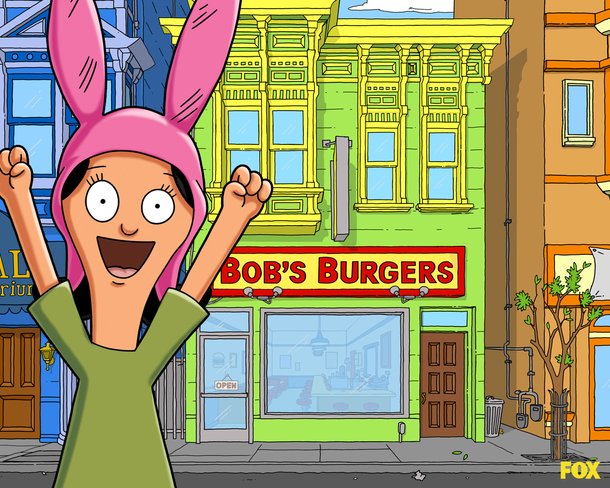
different. Instead of being across-the-board shrewder and more insightful than
their peers, the Belcher kids are defined by the type of their intellects rather than their magnitudes: Louise is
strategic, Tina self-conscious, and Gene unpredictable. More broadly, and far
more importantly, all three seem to suffer from significant mental and
emotional disabilities. Louise, the youngest Belcher, wears bunny ears at all
times, relishes violence and conflict, and only rarely shows even a hint of
emotional attachment to her parents and siblings; Tina, the eldest, is a
depressed and anxious pre-teen whose creepy obsession with sex is made all the
more unsettling by the fact that she speaks in a boyish monotone; Gene, the
only son and middle child, alternates between making insightful observations
and farting uncontrollably, between an attention span measured in seconds and
being willing to eat or say or do absolutely anything if asked. The upshot of
all this is that viewers can smell the dysfunction a mile away—even if they
lack the clinical terminology to diagnose it.
 

nullBy comparison, Bob and Linda Belcher, the show’s Baby Boomer
parents, are refreshingly normal-seeming. Linda is on occasion overbearing and
melodramatic, and her voice and physical mannerisms undoubtedly grating, but
she’s reasonably intelligent and loves her children ferociously. Bob’s not a
particularly good father, in part owing to his fixation on an ailing small
business and in part due to his garden-variety egotism—which has, over the
years, made him less attentive to his offspring. Viewers therefore get to
witness all at once two common fears about Baby Boomers: either that they’ve
grown up to become squares like their parents (as with Linda), or that their
narcissism and baseline immaturity has doomed them and their families to a
diminished quality of life (as with Bob). Meanwhile, their kids stand in for
not one but two generations of overdiagnosed and overtreated younger Americans,
though in Bob’s Burgers there’s a notable twist on even that (somewhat
tired) form of social satire: The Belcher kids’ presumptive diagnoses would probably turn out
to be perfectly well-founded.
 

A few of the show’s peripheral characters are interesting as
well—there’s erstwhile burger-joint patron Teddy, a middle-aged bachelor who’s
chatty, “local,” and unsophisticated; the mysterious Calvin
Fischoeder, Bob’s landlord and a likely grifter; and Mort, a white-bread
funeral home director with no social circle—but most of the show’s extras are
simply foils for its ingeniously zany plotlines. More important is that, unlike
Bob and Linda, who have at least a dollop of parental instinct, the Belcher
children live in a borderless world, one in which kids are free to give vocal
and dramatic expression to their every neurosis.

nullAs middle-school-aged children on the cusp of young
adulthood, the looming question for the Belcher brood is, “Will they stay
like this into adulthood? Is this what the next generation of Americans looks
like, in crude caricature?” Of course this has been the chief fear of
red-blooded middle-class Americans for years: That soft, upper middle-class
living, marked by self-indulgent lawlessness, will become standard in the
United States. Thus Louise’s instinctive unwillingness to be feminized by her
father, mother, or school; Tina’s androgyny and repressed sexual deviance; and
Gene’s perpetual infancy. These same phenomena likewise encapsulate two fears
long endemic to the nation’s eldest two generations: That women will refuse to
or forget how to “act like women,” and that boys will never evolve
into “real men” capable of fighting and winning wars and running the
economy. Implied in all of this is that Bob, and perhaps America, would meet
with greater economic success if a lid were finally put on such first-world
eccentricities as the Belcher children display.

And yet, never has an animated show exhibited such
light-hearted contempt for average men, women, and children. To call Louise,
Tina, and Gene’s middle-school classmates drooling idiots is to merely describe
their appearance, demeanor, and intelligence with precision. Some of them
actually do drool, and all are imbeciles for whom two-dimensionality would be
an improvement on their characters. What few neighborhood adults populate the
Belchers’ highly-circumscribed little world are conspicuously underwhelming.
All of which encourages the view that, while the Belcher kids are indeed
suffering from emotional and (as to Tina and Gene, if not Louise) intellectual
degeneration, at least they’re not flatliners like everyone else. This celebration
of eccentricity would be a tad
unsettling if it wasn’t also so uniquely American. What others abroad might
term antisocialism is, in the United States, individualism at the level of the
individual and patriotism at the level of the nation. 

Ultimately, what makes Bob’s Burgers perhaps the funniest
animated series ever aired on U.S. television—and adorably escapist, rather
than arch-conservatively dystopic–is the sitcom format, which ensures that
borderlessness does not, ultimately, lead to chaos. True, the humor of the
series is often predicated on every joke or snippet of dialogue going two or
three steps farther than one normally might be comfortable with, but the
emphasis is finally not on American family life permanently jumping the rails
but on the ways modern living lets families ride their own nonsense to its farthest
waystations. So it is that when Tina threatens to punch a female classmate if
she ever gossips about her, the violent threat is issued not merely once or
twice but ten times. In the same episode, Gene confronts mild, harmless,
intermittent bullying at school with severe, persistent, physically threatening
bullying of his own. Louise, meanwhile, makes manifest her anger at her
father’s shifting affections by literally attacking a gift her father gets for
her brother with a sharp object. In other words, the overstimulated Belcher
kids habitually pass on their over-stimulation in the form of overreaction, or
else honor the ways they’re emotionally and intellectually underdeveloped with
gross under-reaction—much like, many would say, American culture tends
to do. These days, any crank will tell you, no public nuisance fails to produce
a public outcry, no private slight fails to become an occasion for a public
meltdown, and no grotesque facet of American culture is so harrowing that the
nation’s children can’t gradually become desensitized to it.

nullThe Belchers’ five-booth diner may require a re-opening
after its initial opening (and a re-re-opening after that, and a
re-re-re-opening after that; ephemeral disasters seem to follow this family),
but open for good it finally does, and if it makes virtually no money at all—a
fact uncomfortably remarked upon by Bob in most episodes—it also never quite
goes bankrupt, either. The message is implicit: With a younger generation like
this, and with parents like these, America’s middle class may never prosper,
but it’ll somehow eke by. If this throughline seems identical to the one
popularized by The Simpsons in the 1990s, it’s because, while the
Belchers are certainly not the Simpsons, they’re still, at base, an
all-American family whose members are perfect avatars for an empire in decline.
Only in a nation unmoved by its own excesses and turgid economy can simply
treading water as small businesses come and go—the opening of each episode of Bob’s Burgers features at least one
local storefront that won’t make it to the next episode—be considered good
enough.

It’s nearly impossible to find an animated television family
designed to be lifelike, so it’s not reasonable to expect animated art to
mirror actual life. But for all that, there’s a sense in which—at the level of
metaphor, and with an eye towards an entire nation rather than just one nuclear
family—the Belchers are as representative an American family as we’ve seen on
TV in a very, very long time.

Seth Abramson is the author of three collections of poetry, most recently Thievery (University of Akron Press, 2013). He has published work in numerous magazines and anthologies, including Best New Poets, American Poetry Review, Boston Review, New American Writing, Colorado Review, Denver Quarterly, and The Southern Review.
A graduate of Dartmouth College, Harvard Law School, and the Iowa
Writers’ Workshop, he was a public defender from 2001 to 2007 and is
presently a doctoral candidate in English Literature at University of
Wisconsin-Madison. He runs a contemporary poetry review series for
The Huffington Post and has covered graduate creative writing programs for Poets & Writers magazine since 2008.
An Open Letter to Richard Linklater: Let Jesse and Celine Separate. Preserve Cinéma Vérité.

An Open Letter to Richard Linklater: Let Jesse and Celine Separate. Preserve Cinéma Vérité.

null

[Warning: The essay below contains spoilers for the Richard Linklater films Before Sunrise, Before Sunset, and Before
Midnight.]

Increasingly,
members of my and succeeding
generations have come to understand that marriage might not be the
sacrosanct institution we once believed. It’s not unusual, of course, for
an individual to decide that their plans for their future—for their own
self-development emotionally, professionally, and spiritually—are not
conducive to the sorts of sacrifices a marriage calls for. But recent
generations seem to have put enough thought into this possibility that,
for the first time, the very institution of marriage is in doubt. We know from history, experience, and the Richard
Linklater film Before Midnight that the
ambitions of women can be particularly imperiled by marriage, because our culture still considers
the lion’s share of marital sacrifices to be feminine. One not only hopes
but expects this circumstance to end in the near
future; until it does, it will be the responsibility of each man and
woman considering marriage to ask of themselves this question: Have I
developed in my youth and young adulthood the inner resources to war
with myself over the competing demands of self-realization and marital
compromise without permitting this war to
permanently scar
myself, my mate, our prospective children, and other bystanders? This
is not the same as
treating marriage as a series of silent sacrifices: couples can, do,
and should communicate to whatever degree is necessary to navigate shared
and separate hopes and ambitions. But when dialogue invariably escalates
into irreparable verbal aggression, as happens in the denouement of
Linklater’s Before Midnighta
documentation of several hours of small, unanswered provocations that
predictably explode into a relationship-threatening tilt—the question
becomes not whether a marriage can survive, but whether it should survive.
To this moviegoer, it seemed that Jesse and Celine could, at the conclusion of Before Midnight,
continue in their common-law marriage only if
they developed complex and abiding strategies to turn frustrated
self-realization into productive dialogue. I know from hard experience
that arguments punctuated by “I don’t love you” can happen only a few
times in a relationship—perhaps
not more than once—before cataclysmic damage has been done to the
relationship jointly and to both parties individually. There’s no
evidence either of the partners depicted in Before Midnight
has developed an appropriate strategy for coping with noxious feelings
of entrapment, unless we’re to count the implied infidelity of each
partner as a solution, which of course it isn’t. It’s hard to conclude,
then, from the evidence of the final scenes of
Before Midnight,
that Jesse and Celine’s marriage will continue. One expects, though, that
in nine years of Hollywood and actual time we will discover (in a film
called Before Dying or some such)
that in fact either the well-being of their children, inertia,
couples’ counseling, or a deus ex machina has saved Jesse and Celine from
the dissolution of their union.
nullThe harder question to ask, of course, is whether a relationship such
as the one we witness in the Linklater trilogy should continue. For his part, Jesse makes clear in Before Midnight that he decided, years earlier, that his happiness lay with Celine, for
better or worse, in bad times and good. Celine appears to have drawn no
such conclusion. If nine years of common-law marriage, two
children, and countless shared sacrifices and joys have not
convinced her to either a) choose what happiness she can find with
Jesse, or b) take whatever steps might make such a feeling possible on her part (be it individual and/or couples’ counseling,
substantially more generative dialogues with her partner, or some adjustment of her own or Jesse’s ambitions), there is no particular
reason to think her relationship with Jesse can, will, or should sustain
many more direct hits to its bow. These hits are equally damaging to
Celine and to Jesse, and each year that passes in which Celine believes
her marriage the terminus of all her ambitions is another year those
ambitions are not being realized and she and her mate are suffering the
calamity of being slowly but violently pulled apart.
Relevant to this discussion is a 2012 article in The Guardian,
which featured the reminiscences of a hospice nurse regarding the five
most
common regrets of her dying charges.
The most curious entry to the list—in the nurse’s view, and perhaps in
the minds of many of her readers—was the fact that many of those whose
deaths had been witnessed and memorialized had not realized before
dying that happiness is a choice. The words themselves (“happiness is a
choice”) sound trite, but in fact if there is a significant cinematic
achievement to be found in Before Midnight,
and there is, it is that the movie exhibits better than any before it that happiness is indeed something we either learn to choose during
our lifetimes or do not. 
Of
course, “choosing happiness” is no guarantee of actual
happiness, nor does it prevent isolation, depression, or
self-destruction. What it is, however, is an attitudinal alignment that
says each choice one makes will be made, to the best of one’s ability,
with sufficient self-knowledge to make happiness a marginally more
likely outcome than would have been the case were the decision made
blindly. In other words, to choose happiness, we must
first work diligently at self-knowledge, as those who cannot
or will not know themselves (the good, the bad, the ugly, all of it)
are those who cannot intelligently determine their future likelihood to
produce happiness in themselves or in others. Such individuals only harm
themselves and others in their meanderings, and while we do well to
care deeply about such individuals and to help them on their way, we
also do well to give them wide berth when the time comes to choose a
lifelong partner–at least until they find themselves differently
situated. This is not because such people can’t be vigorously happy, as
they can be; or because they cannot bring joy to others, as depending
upon their circumstances they often will; or because they’re
ill-intentioned, as far more often than not they’re not; but rather
because, of all the institutions human civilization has devised,
marriage most requires as an antecedent the inner
resources to wage productively rather than destructively the war we all,
to some
degree or another,
perpetually wage within ourselves over when and how to sacrifice for
those we love. It is no crime to know oneself an
ill match for the institution of marriage; it is no crime
to not know oneself well enough to protect oneself and another from
an ill-made and ill-fated match; it is, however, a tragedy
to so conjoin and to be so conjoined, and an even worse tragedy to
remain so past the point a change is still possible. And it’s a tragedy
that’s avoidable from the start.
Like
many of my generation, I have both dated individuals facing the same
tough questions as Celine and Jesse and
also wondered about my own suitability for a lifelong commitment. And
like many of my generation, I have suffered at the hands of those
who believed themselves prepared for the sort of long-term union that
was not, in the event, what they really wanted. It will be a poor result
of the remarkable act of filmmaking that is Before Midnight
if the consequent conversations between partners who’ve seen the
movie hinge primarily on whether one or another of the two central characters could have done this or that or avoided doing this
or that to make all well between the film’s two leads. It will be a poor
result because the sort of conflict depicted in the movie, at least in
the lines of dialogue we hear onscreen, is not navigable, and believing
it so only brings more pain and suffering to its participants. 
nullThe conflict between Jesse and Celine is, indeed, impassable, as it was seeded in the identities of both partners when
they first met
eighteen years ago (in Before
Sunrise
) and then reunited nine years later (in Before Sunset).
Both parties made a decision, on those dates, to continue a liaison
with someone whose ambitions and temperament and self-identity were not
compatible with their own; Jesse and Celine, in short, confused lively
conversation with a future. But abiding relationships delve much deeper
into the psyche than mere repartee does, a fact Linklater’s first two
films displayed little enough awareness of to be disconcerting.  
No
blame for any of the above lies at the feet of either Jesse or Celine,
though we could certainly wish that, as a couple, the two had either
seen their initial meetings for what they were—something glorious but
fleeting—or else, in deciding otherwise, developed more resources to
work through what (by the time of the events of Before Midnight) has
clearly become a hardened
disconnect. Anyone who can watch the hotel scene in Before Midnight and not
see a relationship in which this sort of aggression has played out many
times before has never been in a relationship in which this sort of war
of words occurs in the first instance. The accusations and insults
hurled in anger—I hate making love to you; I ruined my life for you;
you’re mentally disturbed; your selfishness makes my happiness a
perpetual impossibility; I cheated on you; I also cheated on you; I
don’t love you anymore—are harrowing and more often than not
relationship-ending. Those who say the movie depicts a couple who’ve
just “grown a bit weary,” or are merely “a little bitter” were clearly watching the movie they’d hoped to see, not the movie they were given by the film’s writers and director.
The central conflict of Before Midnight—the film we actually see, not the film we might wish to see—is one for which an earnestly romanticist
sensibility (as opposed to one of gloomy pragmatism)
can offer only one solution: separation of the parties. It
will hurt their children, likely irreparably, but as Before Midnight takes
great pains to establish with respect to Jesse’s son Henry, such a
wound is survivable. It is, moreover, preferable to a childhood spent
listening to one’s parents arguing (or brooding silently) over acts of
verbal aggression, infidelities, or even (at the extreme terminus of
such a destructive downward spiral) physical aggression waged by one or
both
of the parties against the person or property of the other. It is no gift to seal two characters moviegoers love so much into a coffin of
shared fate neither truly wishes for themselves. It is, in fact, our own
selfishness in wishing for life to be different in the movies than it
is in our own bedrooms and backyards. 
And
so, with the foregoing in mind, I ask—even beseech—Richard Linklater
to divorce these two characters and let each live the life they were
meant to be living. If you want to make a movie that reflects the times
we live in, Mr. Linklater, make a movie in which marriage is not, in
fact, for everyone, and in which no one is forced to spend a lifetime
with someone they see as an obstacle or an albatross rather than a
partner. One wonderful day in Vienna, and another wonderful day in
Paris, do not a lifetime make. Like many my age, I have had such days, I
have even been lucky enough to have many months of such days, and I
know as well as you do, Mr. Linklater,
that
they simply aren’t enough. The day Celine chooses
happiness is the day she leaves Jesse, and the day Jesse chooses
happiness is the day he accepts it and moves on. I don’t want it to be
so, but I know it to be so. I
recognize the bind you’re in—your commitment to cinema verite is at
odds with your own (and Ethan Hawke’s and Julie Delpy’s) abiding
attachment to Jesse and Celine—but the obligation you owe to love,
life, and art takes precedent over the obligations you owe to the box
office, the media, and even your audience.

Seth Abramson is the author of three collections of poetry, most recently Thievery (University of Akron Press, 2013). He has published work in numerous magazines and anthologies, including Best New Poets, American Poetry Review, Boston Review, New American Writing, Colorado Review, Denver Quarterly, and The Southern Review.
A graduate of Dartmouth College, Harvard Law School, and the Iowa
Writers’ Workshop, he was a public defender from 2001 to 2007 and is
presently a doctoral candidate in English Literature at University of
Wisconsin-Madison. He runs a contemporary poetry review series for
The Huffington Post and has covered graduate creative writing programs for Poets & Writers magazine since 2008.

You Are What You Play With: How SESAME STREET and Legos Generated a Generation

You Are What You Play With: How Sesame Street and Legos Generated a Generation

null

For a man or woman of a certain age, it’s hard to imagine a
single commercial or non-profit venture having had more of an impact on one’s
psychological maturation than Legos or Sesame
Street
. Yet even today’s youth might say the same thing: In 2013, we have
Lego-based television shows (Ninjago: Masters of Spinjitzu and Legends
of Chima, 
both on the Cartoon Network), Lego-based video games (more
than forty-six so far, including sequences based on Lego Star Wars, Harry
Potter
, and Indiana Jones sets), and even a forthcoming
feature-length film (The Lego Movie, due out in 2014 and starring the
voice-acting talents of Will Ferrell, Liam Neeson, Morgan Freeman, and Will Arnett).
Meanwhile, Sesame Street, now in its forty-fifth year of broadcasting,
remains ubiquitous in the lives of millions of American children. In short, it
would be difficult to name two cultural touchstones more worthy of being
written about by pop-culture critics, yet less often discussed in the
mainstream media. I’m thirty-six, and like many my age I spent much of my
childhood amongst the friendly monsters of Sesame Street, and another
significant percentage of my child’s play amongst store-bought and self-modeled
creations from Lego’s City, Space, and Castle lines of building bricks. So when
The Lego Group, now in its sixty-fourth year of operation, suddenly sat front
and center in the news last week due to a new report on design changes to its
building blocks, I paid closer attention than I would have anticipated. 

A recent study urges
parents to consider, when purchasing toys for their children, the indisputable
fact that Lego minifigures are substantially more likely today than twenty
years ago to feature angry or otherwise non-smiling plastic faces. Meanwhile,
anxious parents continue fretting publicly today, as they have for decades,
about the entertainment options available for their kids on television and at
the movies, meaning Sesame Street remains ever at the border of
conversations about American child-rearing, just as The Lego Group is right
now. And certainly there’s good reason for parents to worry about both toys and
television: Children are sponges, often noticing stimuli adults don’t. In
internalizing certain stimuli and ignoring others, they decide, by themselves,
the sort of adults they’ll become. The question, then, is a simple one for many
of today’s most anxious parental units: Does the anger painted on the face of a
toy make it more difficult for a child to access happiness? Would the gradual
loss of children’s programming of the caliber of Sesame Street—which is
increasingly likely, as each year it seems a greater and greater percentage of
children’s entertainment is provided by the Disney Channel rather than Jim Henson’s
heirs and successors—contribute to a generation incapable of growing up? And a
larger question: Isn’t one of American culture’s most unsettling blind spots
that it takes us longer to mature emotionally than seems to be the case in
other cultures? And isn’t this at least partially attributable to how we spend
our playtime as children and young adults?

nullThe answer to the above questions may well be
“yes,” but it may also be that these are the wrong questions. When I
was a Lego-obsessed child, the thing about every Lego minifigure featuring the
same smiling, yellow-plastic face—and they did; it wasn’t until 1989 that
additional facial features got added to Lego minifigures, and it took until
2003 for Lego to introduce lifelike skin tones—was that you quickly learned to
ignore your Lego minifigures’ facial expressions in imagining your own
Lego-based melodramas. Children instinctively (and from hard experience) know
that not every moment is a happy one. If their toys seem to be selling a
different story, they opt for empiricism over marketing and ignore the false
positives in their midst. If, however, as is now the case, Lego minifigures are
carefully painted to represent a series of distinct ethnicities, facial
expressions, and emotional attitudes, it’s much more difficult for a child to
impose their imaginative will upon their playthings. The same is true for the
feature of modern-day Legos most children and AFOLs (Adult Fans of Lego)
complain about, which is that increasingly Lego sets feature stickers to
portray complicated bits like engines or headlights or chassis details. This means
that once again children are denied the authority (and discouraged from
exercising their capacity) to imagine these features on their own.

If store-bought Lego sets represent, more and more, a
predetermined endpoint rather than a beginning, it says much for the
opportunities today’s kids do or don’t have to engage in imaginative play. That
said, the fact that Lego now regularly uses flesh-toned hues for its
minifigures rather than stock yellow headpieces is a far more significant
development than the one that made the news last week, at least from the
standpoint of child psychology. What happens when the cartoonishly fantastical
World of Lego begins to look significantly more lifelike, with minifigures that
are (variously) white, black, Latino, pale, tanned, young, old, et cetera? The
study states that what happens—as I’d suggest has been the case with Sesame
Street
from the very beginning—is that children begin to make decisions
about which faces and temperaments are most relatable to their own experiences,
and it’s in those decisions that juvenile psychologies may well get formed, or
so instinct and common sense tell us. It’s all to the good that children can
now play with toys featuring faces that don’t look like their own, and perhaps
it’s even to the good that children can now play with toys whose facial expressions
better match the range of expressions present in kids’ real-time environs; the
question is whether it would be even better if Lego minifigures were configured
abstractly enough to encourage children toward entirely-homespun playtime
narratives.

When Sesame Street was testing its pilot episodes
before audiences in 1969, social scientists told Henson and his collaborators
that children would be confused if puppets and human beings appeared on-screen
together. Yet the juxtaposition of Henson’s friendly puppet
“monsters,” who individually represented dramatically different
emotional and intellectual archetypes, and human beings, who generally
exhibited the full range of homo sapiens’ complexity, scored much better
among young test audiences and so—just like that—the social scientists’
objections were pushed aside. The result, of course, is one of the most
celebrated television programs in American history. It’s also a cultural
phenomenon that tells us much about how Generations X and Y learned to understand
themselves.

Each of the “Muppets” featured on early episodes
of Sesame Street could credibly be said to have represented a discrete
set of emotional and intellectual characteristics; some of these were
“positive” traits, some “negative,” though of course this
is a gross over-simplification (one popular theory
holds
that it’s more useful to think in terms of “Chaos Muppets” versus
“Order Muppets”). In the broadest terms, however, each of the
“major” Muppets of the early years of Sesame Street
represented a personality portfolio a child could instinctively choose to
relate to or be repelled by. Because these bundled archetypes were commingled
on-screen with human actors, it seemed reasonable for children to see Henson’s
friendly monsters as worthy not only of sympathy but empathy. Sesame Street
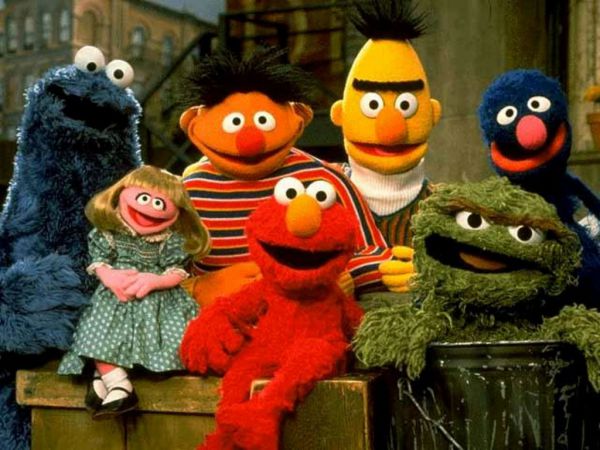
thus featured a pantheon of Muppetry ranging from the generally admirable
(e.g., Big Bird, Elmo, Kermit, and Grover) to the generally undesirable (e.g.,
Oscar, Bert, and Cookie Monster). Yet each Muppet was just three-dimensional
enough for any child to find them at least partially relatable.
 

nullGiven all this, we might posit here a personality test, in
the mold of the Meyers-Briggs assessment, that uses Muppets instead of
readily-definable character traits as its primary touchstones. It seems a
worthwhile hypothesis, given that so many of the Muppets of the 1970s and 1980s
simultaneously exhibited positive and negative characteristics that were
essentially symmetrical. That is, each “positive” trait had a
“negative” corollary, and vice versa. For instance, Big Bird, and
later Elmo, were both naive and oversensitive, but also—on the other side of
the same coin—friendly and empathetic. Perennial fan-favorite Grover was unwise
and impetuous, but also courageous and self-confident. Telly was neurotic and
anxious, but also kind-hearted and sympathetic. Ernie was irresponsible and
flippant, but also jovial and extroverted. Cookie Monster, like The Count,
could equally be seen as harrowingly obsessive and admirably passionate. Bert
was often tense, irritable, and impatient, but he was also intelligent,
motivated, and a self-starter. Oscar the Grouch, like Kermit the Frog, sat more
steadfastly at one of the spectrum than the other: If Oscar was generally
undesirable for his ill temper, pessimism, and reclusiveness, the Kermit of Sesame
Street
was consistently admirable for his intelligence, wisdom, and
emotional acumen. Other high-visibility monsters on Sesame Street also contained
important dichotomies, albeit more subtle ones: Herry Monster, for instance,
was, like so many of our fathers, equal parts imposing/unapproachable and
powerful/comforting.

As a child I most admired Ernie, Grover, and Cookie Monster,
which sounds suspiciously like my own psychological profile. I imagine some readers
will likewise be able to see themselves in some triangulation of Reagan-era
Muppetry. Are you a BCE (Big Bird, Cookie Monster, Ernie)? A COG (Cookie
Monster, Oscar, Grover)? Whatever one’s predilections, the point is that we can
understand, now, why parenting advocates are constantly mindful of what their
children are watching, and why social scientists are so skeptical of Legos’
recent evolution. Still, the question for both parents and social scientists
remains the same: Are we really considering, in our activism and our science,
how children consume entertainment, or do our anxieties merely underscore what
building blocks and puppets mean to us now, as adults? When I consider my own
history with Legos, for instance, I’m reminded that up until the age of
fourteen I wanted to be an architect, as it was somehow kept from me until that
time that architects have to do a lot of math; likewise, up until my
mid-twenties I carried with me the sort of childlike naivety about the ways of
the world that would be familiar to anyone who’s spent any time on Sesame
Street. It wasn’t, in either case, that either my toys or my television were
too constricting, but rather that just enough imaginative freedom was provided
me by them to make my playtime either a danger or, depending on my luck and my
instincts, a boon.

Seth Abramson is the author of three collections of poetry, most recently Thievery (University of Akron Press, 2013). He has published work in numerous magazines and anthologies, including Best New Poets, American Poetry Review, Boston Review, New American Writing, Colorado Review, Denver Quarterly, and The Southern Review.
A graduate of Dartmouth College, Harvard Law School, and the Iowa
Writers’ Workshop, he was a public defender from 2001 to 2007 and is
presently a doctoral candidate in English Literature at University of
Wisconsin-Madison. He runs a contemporary poetry review series for
The Huffington Post and has covered graduate creative writing programs for Poets & Writers magazine since 2008.

Attention Red Wedding Crashers: Get a Grip, Sit Back, and Enjoy a Best-in-Genre Moment

Attention Red Wedding Crashers: Get a Grip, Sit Back, and Enjoy a Best-in-Genre Moment

null**Warning: This piece contains spoilers. Read at your own risk.**

If one struggles to name any fantasy-genre
standout on the small screen or silver screen that isn’t a book adaptation, an
animation, or a mawkish cult classic like David Bowie’s Labyrinth, the reason’s simple: American audiences consider
the entire genre frivolous and flippant, and won’t embrace it in new
media unless book-lovers, kids, or hipsters have already given it their stamp
of approval. In other words, outside the context of video games, Americans need
an excuse to love a fantasy-genre production; either it borrows its gravitas
from the fact of it having sold well in bookstores first, it needs no gravitas
because it’s essentially kiddie-candy, or it operates beyond the reach of
gravitas because it’s pure kitsch. The end result is that no one takes the
genre seriously and, beyond a few hundred thousand mass-market paperbacks sold
annually at brick-and-mortar bookstores, no one really cares much about it.
It’s tangential to American life; it’s a first-world curiosity. The reason?
Fantasy authors, animators, and directors have never found a way to make
readers or audiences feel in their gut the grotesque moral savagery around
which the genre is built, or to see in fantastical morality plays lessons with
timely relevance for modern living, and in consequence no story rendered as a
fantasy ever properly lands with American audiences. It’s simply too removed
from anything that really matters.

The Red Wedding scene from the HBO series
“Game of Thrones” may not have reinvigorated a genre—one could argue that the entire series, which
lights up Twitter and Facebook weekly like few other cultural artifacts do, has
done that—but it may well have reinvented it. Martin’s controversial killing off of
three major characters in the middle of the series’ seasons-long story arc, and
his unceremonious ending of the two-family feud at the center of that arc
seemingly seasons too early, is a best-of-genre moment that has roused much
anger among television-watchers precisely because it changed the ground rules
of an entire genre in mid-stride.

Many Americans, this author included, go to
television generally, and fantasy or fantastical shows specifically, as a means
of escaping time—that is, to watch consequence-free melodrama in a space that
feels entirely removed from anything we really care about. Horror films don’t
meet that standard because they frighten; contemporary dramas, because they make
use cry; comedies, because they make us laugh (and sometimes, when done right,
cry while laughing); and romances because they make us swoon. Fantasy shows and
movies are supposed to be more like documentaries that entertain us in the
absence of any informational content; if they refresh our spirit, they do so
quietly and only with our implicit preapproval.

Enter “The Rains of Castamere,” an
episode of “Game of Thrones” that led fans of the series to take to
Twitter and Facebook to issue death threats to the series creator, George R.R.
Martin; many others announced they’d no longer watch the show. Fans of the book
had a similar reaction when the now-infamous Red Wedding scene appeared in the
book on which Season 3 of “Game of Thrones” is based, A Storm of Swords.

In the scene immediately preceding the Red
Wedding in the Robb Stark/Catelyn Stark storyline, the King of the North’s
mother urges him to let his mortal enemies, the Lannisters, know what it feels
like to lose something they love. It’s considered, by both Stark scions, to be
just about the only thing that will awaken the callous Lannisters from their
complacent wealth and endless political victories (also, a string of de facto
military victories brought on not by their own military prowess but the
weakness and disorder of their enemies). In the very same way, Martin’s killing
off of the two senior Starks has affected a complacent, wealthy, victory-rich
nation—America—by taking from it two characters it loves and admires, and doing
so without any of the advance warning first-world countries implicitly demand
before they’re handed a major defeat. That’s what really gets our goat about
the Red Wedding: It was a sneak attack against our affections and our courage,
launched from a platform (the fantasy genre) which has long been free of
such audience-rattling excursions. It’s no wonder the most successful
fantasy-film franchise in the history of Hollywood, the Lord of the Rings trilogy, was based on a book Britons once voted
the best of the twentieth century and which, consequently, both the English and
their American cousins already know the ending to. The Red Wedding was
something different; it was a nasty surprise that stole from us something we
actually value and made us actually hurt, thereby breaching the contract
fantasy readers and filmgoers have implicitly always had with the genre.

But George R.R. Martin has taken this particular
best-in-genre moment even further, and in doing so has returned fantasy to
real-time cultural consequence for the first time in, well, forever. Fans
mourning the deaths of Robb Stark, Catelyn Stark, and Talisa Stark fail to see
that these are precisely the characters who needed to die. They needed to die
immediately and they needed to die in precisely this way, for what has always
made the fantasy genre the most underrated of all the genres is not only that
(as with the Red Wedding) it carries the capacity to move us as deeply as any
other form of entertainment, but also that it teaches us better than any other
genre about the moral savagery that still endangers us daily. Whatever we may say
of their deaths, the now-deceased Stark trio each had it better than almost
anyone in Westeros, which left viewers with little to learn from them except
the falsehood that in an unpredictable world the emotionally rich are rarely in
peril. 

Robb Stark had a father who not only loved him
but inspired him, a mother who loved him and modeled for him every strength a
man or woman of any time-period could need, a wife with whom he shared true love, a home for which he felt genuine fondness and with which he shared a
genuine spiritual attachment, brothers and bannermen and vassals who he loved
and who loved him in return. He knew himself, he knew his cause to be just, and
he knew himself to be capable of generative moral audacity and abiding
political courage. The same could be said of his wife and his mother, excepting
that his mother also enjoyed the most loving marriage in Westerosi history for
several decades and was perhaps the first mother in Westerosi history to be
sincerely and justifiably proud of every one of her children (even Sansa). The
tragedy of her last year of life, like the tragedies of Robb’s and Talisa’s
last months together, in no way erases the permanent mark of a life well lived.

In a fantasy book or film, we expect emotional
removal and cultural irrelevance, and so we expect a life well lived to end happily,
as in our own reality they so often do not. In our reality, children are killed
by cluster bombs dropped pursuant to military squabbles they have nothing to do
with; loving mothers are killed in childbirth or by drunk drivers or from
breast cancer; good men are ruined by men with fewer scruples, baser instincts,
and a larger quantity of money. Sometimes, but with precious rarity, what is
true in life is also true in fantasy: We learn from goodness, when we learn
from it at all, only from its downfall. That that’s a lesson we rarely get from
artifacts of the fantasy genre is something we’ve come to live with, in fact
it’s become something that (ironically) makes fantasy palatable to American
audiences.

We call George R.R. Martin a cretin for killing
off the three most noble Starks this side of Arya—Ned, Robb, and Catelyn—but
look for a moment at the miserable lives of his tale’s supposed
“victors.” Cersei is still alive; she’s a beautiful and intelligent
woman who’s never felt romantic love for anyone but her brother, is afforded a
tenth of the respect her intellect deserves, was married off like a parcel of
property (and is about to be so married again) to a man she doesn’t love or
respect, has no mother and fears rather than loves her father, has no friends,
parented a sociopath into a reign of unfettered derangement, and will never
achieve even a fraction of her life’s ambitions. Her brother and lover Jamie
Lannister has led a life of such self-loathing that the first consequential
interpersonal encounter of his thirty-something years is with a six-foot-tall
virginal pariah who’s charged with his prisoner’s transport; it’s not clear that
he’s ever had sex with anyone but his sister or been loved by anyone but her
and his near-universally-despised little brother. Petyr Baelish has spent his
entire life pining after a woman who doesn’t love him and compensating for a
childhood spent getting the snot beat out of him by stronger, taller,
better-looking, better-armored men. He has not a single friend. Lord Varys is a
castrato who endured years of penury, torture, forcible rape, and public
humiliation just so he could work harder than anyone in his immediate vicinity
on behalf of a kingdom that does not appear to deserve (or in any sense
appreciate) his efforts to counter Baelish’s Chaos with Order. Let’s put aside
that no one loves him, either, that he loves no one, and that his only
“friend” is Tyrion Lannister—who doesn’t trust him. All of these
people, and the many other Lannisters and assorted baddies who survived the Red
Wedding, are miserable wretches whose lives and loves we do not admire or envy.
The few days and weeks and months we’re permitted to watch their lives
notwithstanding, they’ve suffered substantially more, and lived substantially less
well, than those they have killed or have just heard about being killed at the
Red Wedding.

The lesson of the Red Wedding, then, isn’t just
that well-written fantasy takes from us things that are precious to us in a way
that actually hurts us, but that we learn more from the suffering of the bad
than the clean living of the good. This isn’t a lesson we normally associate
with fantasy–in fantasy, or so the casual fantasy-watcher thinks, the evil
ultimately perish and the good ultimately prosper—but it’s a lesson many of us
have been associating with the very best exemplars of the genre for a very long
time. If you’re a Ned Stark-like father-figure who happens to live in a
war-torn Middle Eastern country, all your hard lessons about righteousness and
many years of dedicated love may not keep your children or wife safe; if
you’re a homosexual in the wrong place on Earth, your true love for another may
someday lead to your brutal murder; if the way you live and love is an
inspiration to others, you may have your entire life toppled someday by someone
lacking your stringent codes of honor and various self-restrictions. The only
way to encourage a nation to fight the worst human instincts—whether they arise
from within the nation or without it—is to engender in that nation an abiding
understanding of what it means to lose what one loves and what it means to
watch the devious succeed. By the same token, the only way to encourage a
nation to honor the best human instincts—whether they arise from within the
nation or without it—is to enforce an understanding that goodness sometimes
leads to happiness before it leads to tragedy, and that savagery often leads to
misery before (and even while) it leads to perpetual skin-of-one’s-teeth
survival.

One of the worst things about human history is that
we have often learned the above lessons, when we’ve learned them at all, from
violence and loss of life; one of the best things about human history is its
continual production and reproduction of art, and one of the best things about art is that it teaches us what we need to learn about ourselves and language
and the nature of attachment without any accompanying need for bloodshed.

Don’t hate George R.R. Martin for taking from
you what you love, “Game of Thrones” viewers, thank him. Don’t hate “Game
of Thrones” for bending the conventions of fantasy to make you feel
something real in real-time, be grateful for it. And don’t underestimate the
beauty of something good—whether a life or a love—because it’s ended, nor
overestimate the comforts of something false and miserable because it persists.
Most of all, don’t treat the death of a pregnant woman, her husband, and his
mother as the end of an era for a television program; treat it as what it is:
the rebirth of an entire genre, and a regeneration of the belief all
well-intentioned persons share, which is that living justly and kindly is its
own reward and earns back any subsequent cost a thousand times over.

Seth Abramson is the author of three collections of poetry, most recently Thievery (University of Akron Press, 2013). He has published work in numerous magazines and anthologies, including Best New Poets, American Poetry Review, Boston Review, New American Writing, Colorado Review, Denver Quarterly, and The Southern Review.
A graduate of Dartmouth College, Harvard Law School, and the Iowa
Writers’ Workshop, he was a public defender from 2001 to 2007 and is
presently a doctoral candidate in English Literature at University of
Wisconsin-Madison. He runs a contemporary poetry review series for
The Huffington Post and has covered graduate creative writing programs for Poets & Writers magazine since 2008.

The Dangers of An Empty Suit: Marvel Comics’ War on War Continues

The Dangers of An Empty Suit: Marvel Comics’ War on War Continues

null(Warning: This article contains spoilers for the film Iron Man 3.)

The implicit argument of every comic book and
comic book-inspired movie is that the world outside comic books is a better
place for having no superheroes in it, and a far worse place for having so many
warmongers. Iron Man 3 is Marvel
Comics’ strongest argument yet on both scores. True, the Iron Man films have always been conspicuously anti-war—Stark
removes his privately-funded R&D enterprise from U.S. Defense Department
involvement in the first entry in the now-trilogy—but Iron Man 3 is a uniquely instructive exemplar of Marvel’s war on
war by way of Hollywood.  

In Iron
Man 3
, the United States, in the person of billionaire playboy and
self-described “mechanic” Tony Stark (Robert Downey Jr.), has perfected the
drone as a weapon of mass destruction. Whereas Stark actually had to be in his specially-designed metal-alloy
suit to become “Iron Man” in both Iron
Man
and Iron Man 2, the man is
now superfluous to the machine: Downey’s titular character has a veritable army
of man-shaped drones (a metaphor that ought not be lost on us) ready to do his
bidding at a moment’s notice.

In one particularly charged scene toward the
end of the film, Stark says to his nemesis, of girlfriend Pepper Potts, “she’s
perfect as she is.” As action-flick dialogue goes, this is pretty insignificant
stuff, yet it’s also a good summary of the chief theme of Iron Man 3, which ultimately pits men who believe they’ve perfected
machines against men who believe they’ve perfected humans. It’s no spoiler to
say that neither pipe dream is realized in the end; the question is just how
lifelike both the dream and its perpetual deferral really are.

Stark’s technological breakthroughs don’t fall
very far from our own reality, given that just a couple weeks ago the real-life
United States Navy launched a drone from a nuclear-capable aircraft carrier for
the first time. This means that American drones can now officially drop
cluster-bombs on anyone, anywhere, at any time, as if that weren’t already the
case in practice. Meanwhile, the Obama Administration recently launched an
initiative to map the human brain—in the same way scientists mapped the human
genome several years ago—and in this well-intentioned effort there’s an eerie
reminiscence of the baddies of Iron Man 3,
who believe they’ve perfected the human body by (you guessed it) mapping the
human brain to create an army of super-soldiers. In short, Iron Man 3 asks us to ponder the question: Is the perfect man any
less dangerous than the perfect machine, and isn’t Pepper Potts (Gwyneth
Paltrow) actually perfect just the way she is?

But Marvel Comics’ increasingly cerebral and
interconnected film productions are wont to do much more, now, than simply
throw mud at all corners of the global military-industrial complex. The
presidential administration portrayed in Iron
Man 3
, which appears to be vaguely Republican (much is made of the White
House doing nothing to investigate a major oil spill, an oversight an oilman
president, say, might be wont to make) dresses up its Don Cheadle-cum-War
Machine drone in patriotic colors, redubbing it The Iron Patriot, and it’s this
obsession with re-marketing drones as a nationalistic imperative that nearly
gets Marvel’s imaginary President Ellis blown to Kingdom Come. The message is
clear: The more attractive-looking the drone, the more likely it can be used as
a Trojan Horse for dangerous geopolitical initiatives and even more dangerous
first principles.

Likewise, the villain of Iron Man 3 is not, as it turns out, a gnarly Ben Kingsley—whose
primary job in the film is to look dirty, foreign, asexual, and (worst of all)
old—but rather a blond, perfectly-coiffed Lothario who (as it happens) can
literally breathe fire. Here, too, the message is clear enough: Dress up a
villain in something like the clothes we’d expect a “winner” to wear, and it’s
not much different from dressing up a nation’s foreign policy in those
metaphoric clothes we expect “winner” nations (that means us Americans) to
favor. Each of these premises is equally alluring; each is even—at the risk of
taking the analogy too far—equally sexually intoxicating. Yet both are a threat.
The upshot is that we don’t need or want perfect men or women, any more than
we’d want perfect war machines. This isn’t to say we shouldn’t map the human
brain, or strive to perfect certain strains of military-industrial innovation (recent
advances in non-lethal weaponry come to mind), but rather that it’s the perpetual
search for perfection and self-perfection that often leads us to destruction. This
theory can be applied with equal force to men and women who judge others
primarily by their physical appearance and voters who judge elected officials
by how good a game they talk on anti-terrorism and national defense.

What Tony Stark ultimately learns in Iron Man 3—we’ll see if the lesson
sticks in Iron Man 4—is that he needs
to be more fully human, not more fully superhuman. He finally has the metal
shards lodged in his heart removed so that he can once again function without
the aid of blood-pumping machinery; he turns aside from his “mechanic” identity
by destroying the fruits of his labors in spectacular fashion; he re-dedicates
himself to his relationship with the already-perfect Pepper Potts by increasing
their face-time and decreasing his log-times (after first paying for surgery to
reverse artificial “perfections” performed upon Pepper by the villainous
Mandarin); and he concludes, in a final voiceover, that he’s the “Iron Man”
even if all his high-tech toys are taken away—something many a Marvel fanboy
would dispute. In other words, Stark discovers that it’s not enough to turn
aside from direct complicity with warmongers, what’s required of a strong and
capable human is the ability to turn aside from the fallacy of perfectibility,
too. 

This message is one particularly at odds with contemporary
American culture, which convinces us more easily than we’d like to admit that
there isn’t a single facet of our physical or emotional well-being we can’t
perfect with a crash diet or a brain-boosting iPad app. Likewise, Marvel seems
to take a dim view of the current penchant for political panaceas: The idea
that a single political solution exists (whether in the form of a politician or
a policy) for the complex problems of the nation and the world is one with
little backing in any of the recent Marvel films. Indeed, it’s not too much to
say that Marvel Comics is reminding us anew, with each successive film in the Avengers network of storylines, that
the worst sort of war is the war we wage daily against our own fears of
fallibility and failure, as it’s this sort of windmill-tilting that ultimately
leads us down the path to ruin. Tony Stark’s realization that his desire to
protect Pepper from alien invaders is fueling the destruction of both their
relationship and his psyche—in the same way the fictional United States of Iron Man 3 fuels its own demise by
up-jumping its fear of terrorism to ever more frenzied levels—is just the sort
of thing Yoda always warned us about (“Fear leads to anger, anger leads to
hate, hate to suffering”).

Ironically, it’s a yearning after perfection that
sells untold millions of comic books to young male and female consumers the
world over, so we ought to read Marvel’s Avengers
films as a particularly ingenious bit of reverse psychology. If we actually
took the lesson of Iron Man 3 and its
ilk to heart, we too would blow up our personal anxieties, demand real rather
than Hollywood courage from ourselves and the many empty suits in political
office, and plant a long, lingering kiss on the already-perfect lips of
whichever Gwyneth Paltrow is presently brightening our days.

Seth Abramson is the author of three collections of poetry, most recently Thievery (University of Akron Press, 2013). He has published work in numerous magazines and anthologies, including Best New Poets, American Poetry Review, Boston Review, New American Writing, Colorado Review, Denver Quarterly, and The Southern Review.
A graduate of Dartmouth College, Harvard Law School, and the Iowa
Writers’ Workshop, he was a public defender from 2001 to 2007 and is
presently a doctoral candidate in English Literature at University of
Wisconsin-Madison. He runs a contemporary poetry review series for
The Huffington Post and has covered graduate creative writing programs for Poets & Writers magazine since 2008.

The Fuzzy Logic of WILFRED: How FX Turned a Dog Suit Inside Out

The Fuzzy Logic of WILFRED: How FX Turned a Dog Suit Inside Out

null

While as viewers we tend to focus on the exceptions rather than the rule, many television programs do, in fact, get precisely the level of attention and admiration they deserve. Now and again a promising young program may be prematurely scrapped because it costs too much to produce or garners a devout but too-narrow viewership—Rome is a good example of the former phenomenon, Firefly the latter—and certainly there are many programs more beloved than lovable (e.g., How I Met Your Mother), but these days it’s rare for a program of sterling imagination and craftsmanship to disappear into the ether before its time. Finely-calibrated shows like Mad Men, Breaking Bad, and Sons of Anarchy are enjoying long and well-deserved runs on American television sets, and Americans are the better for it.

At first blush, Wilfred seems another success story of this sort: It has generally impressed critics; viewers like it (Season 1 was a top-ten cable program); the show stars the lead actor of one of the highest-grossing film series in history (Elijah Wood); it airs on FX, a channel whose programming is considered among the best this side of HBO; it’s based on a foreign series that won three AFI awards between 2007 and 2011 (AFI being the Australian equivalent of the Emmys); it features the sort of irreverent humor preferred by American advertisers’ most-coveted demographic, the 18-to-49 set; and not for nothing, it’s presently the preeminent high-concept program on American television, doing more per minute to subvert viewer expectations than Lost ever did. Yet despite being so intellectually and emotionally challenging, Wilfred has gotten not even a fraction of the buzz afforded Mad Men, Breaking Bad, and Sons of Anarchy. Why?

nullOn closer examination, chinks in the armor are evident: Wilfred is a program without a genre, as it’s nominally a sitcom but offers no laugh-tracks, studio audience, or stable points of reference (think of the reassuring, character-based through-lines of a sitcom like Friends or Seinfeld). Its titular character, the show’s costar, never appears outside a man-sized dog-suit, just the sort of visual quirk likely to squelch speculation of serious artist intent. It’s neither properly episodic nor properly serialized, as individual episodes both do and don’t depend upon episodes preceding and following. Wood, the show’s most conspicuous setpiece, plays the straight man to Jason Gann’s Wilfred so convincingly, it’s maddening. Certain scenes (such as one in which Ryan is forced to prostitute himself to eliminate a debt, or one in which Wilfred attempts to kill Ryan’s sister while under the influence of demonic possession) are among the most psychologically upsetting accessible on cable; there are entire sequences of episodes in both the first and second season of Wilfred that are gripping but almost entirely devoid of humor. And the series as a whole lacks a plot—unless you count as plot a man’s psyche slowly circling the drain.

For all that, Wilfred proves to America’s TV-watching audience something innovative fiction-writers (e.g., Robert Coover and John Barth) and poets (e.g., the Russian Metarealists of the 1970s and 1980s) have known for some time: Metarealism offers a more rigorous and exhilarating brand of social commentary than realism ever has or will. We can enjoy watching the decline and fall of anti-heroes like Don Draper (Mad Men), Walter White (Breaking Bad), or Jax Teller (Sons of Anarchy), but ultimately we learn more about ourselves and our sometimes maddening environs when the environs we see on our television screens are fabricated entirely from whole cloth.

*

At its best, television improves our emotional intelligence. Bearing witness to the psychic detritus of fictonalized characters, be it a drunken cop-prodigy (Jimmy McNulty of The Wire) or a salty space-captain (Malcom Reynolds of Firefly) or a shifty saloon troll (Al Swearengen of Deadwood), helps us understand why and how the vagaries of the human condition often lead to conflict and tragedy. But we’d hardly call most of our favorite television shows mimetic—they don’t remind us, in intimate and exacting ways, of our own lives and shortcomings. Their focus is usually on the social sphere, or, at best, on how social spaces help shape psychic spaces. The result is that they’re far more likely to educate us about how to be happy social animals than how to socialize the animal within us all.

Wilfred is undoubtedly this second sort of animal, a television show with little interest in depicting civil society and heavily invested in overturning rocks most of us habitually leave undisturbed. It pushes, with each episode, not only the boundaries of good taste, not only the boundaries of which questions television can ever ask or seek answers to, but of whether, far from being merely imitative, television must acknowledge any relationship with reality at all. In short, Wilfred stakes its claim upon two audacious premises that could affect the future of television programming in America: One, that metarealism has become a more relevant critical mechanism through which to view American culture than realism has been or can be; two, that if we wish to minimize Americans’ penchant for escapism—and the use of television as a fetish for doing so—it’ll take, paradoxically, just the sort of high-concept Art Wilfred offers.

Wilfred is, depending on your view of the “reality” (if any) it depicts, either a show about a living man, or a dead man; a show about one living man and one dead man, or a show about one living man and one ghost; a show about one living man and one living dog, or a show about one living man and one dead dog; or a show in which none of the actors are presently living. Somewhere in the mix is an insufferable sister, a mentally-ill mother, a chipper girl next door, Chris Klein of American Pie, endless bags of weed, two stuffed animals that may or may not be sentient and/or sexually insatiable, and an entire dog culture invisible to human eyes and ears. 

By pushing to the margins most of the setpieces we’d expect to find in a primetime sitcom, Season 1 of Wilfred finally seems more like a play—a morality play—than anything else on television. If the brief description of the show provided above seems coy, it’s only because Wilfred is one of the first shows ever to appear on American television screens (Lost is another) in which nothing that occurs on-screen may “actually” be happening, and the central mystery of the series is the presence or absence of a stable reality. This isn’t to say Wilfred takes place in a perpetual dream state, though portions of certain episodes definitely do, but rather that Wilfred offers viewers several layers of reality, or metareality, to choose from, and individual scenes—indeed, individual shots within scenes and individual lines within dialogues—cycle so rapidly between these layers of reality it’s often impossible to pin down what’s actually happening, or when, or why.

*

The first level of reality: Ryan Newman is an attorney who retires from the legal profession in his late twenties. The reasons for this retirement are unclear, though there’s much in the air implying a dark secret surrounding the decision.

The second level of reality: Ryan kills himself in the first scene of the series. The fact that the series doesn’t stop after the pilot implies Ryan survives the attempt. However, by beginning with an attempted self-expurgation, Wilfred throws the reliability of everything we see thereafter into a state of perpetual turmoil. Is Ryan dead? Is the series merely an allegorical post-mortem?

nullThe third level of reality: Wilfred appears on Ryan’s doorstep with his “owner,” Jenna. As the series progresses, all options remain equally possible and equally unpalatable as to who or what Wilfred is. A dog, a man, a ghost, God, Satan, Ryan’s id, Ryan’s ego?

The fourth level of reality: Ryan and Wilfred smoke pot incessantly in Ryan’s basement; Ryan’s high for most of each day. How much does he see through the haze of THC? Is Wilfred (is Ryan’s life) a drug-induced hallucination?

The fifth level of reality: Ryan has a family history of schizophrenia—an ailment that began to manifest in his mother when she was exactly the age Ryan is at the start of Season 1 of Wilfred. Ryan’s also been the victim of several childhood traumas. The entire series is symptomatic of schizophrenia, and each episode appears to reenact a trauma Ryan has previously experienced.

The sixth level of reality: Wilfred often moves in social ecosystems separate and distinct from Ryan’s, begging the question of how these systems are constructed and who’s constructing them. Ultimately, Gann offers American audiences the best depiction of dog logic—in human terms—in the history of film or television. Were it nothing else, Wilfred would function as a startling exposé of the cruelties endemic to the animal brain: Cruelties to which the human brain is, of course, heir.

The seventh level of reality: After-school-special-ready platitudes precede each episode of Wilfred, offering a thematic framework for each scenario and suggesting that the plotlines of Wilfred are merely moral allegories with no greater affiliation to reality than, say, the Bible.

*

We all do things we’re not proud of—and when we’ve harmed ourselves or others with sufficient gusto, we usually don’t just repent, we wish to undo. Yet sometimes our errata permanently transform us in a way we can neither alleviate nor avoid, and it’s out of these sorts of tensions Great Art is made. It’s in such moments that we ask ourselves, “Am I man or animal? What sort of man would persist in this course of action? What sort of impulse drives these thoughts, what sort of thoughts these actions, what sort of actions this life?”

Invariably, we answer these questions in a vacuum: The vacuum of our own sum-totality. Whereas shows like Mad Men and Breaking Bad and Sons of Anarchy allow relational logic to resolve questions of cause and effect, Wilfred puts the most dire human struggles and initiatives into an abstract framework that permits neither escape nor the comfort of familiarity. It puts questions of perspective and first principles in play, and in doing so makes navigation of the Big Questions—the nature of evil; the circularity of reason; the degradation of the human spirit over time and trials; the impossibility of replicating or representing individual experience—next to impossible. In other words, it’s unrelentingly lifelike. On its face, it’s the least plausible thing on television; at its core, it’s at once the most essential and most mimetic.

Seth Abramson is the author of three collections of poetry, most recently Thievery (University of Akron Press, 2013). He has published work in numerous magazines and anthologies, including Best New Poets, American Poetry Review, Boston Review, New American Writing, Colorado Review, Denver Quarterly, and The Southern Review. A graduate of Dartmouth College, Harvard Law School, and the Iowa Writers’ Workshop, he was a public defender from 2001 to 2007 and is presently a doctoral candidate in English Literature at University of Wisconsin-Madison. He runs a contemporary poetry review series for The Huffington Post and has covered graduate creative writing programs for Poets & Writers magazine since 2008.