METAMERICANA: RICK & MORTY: The Ballad of Abradolf Lincler

METAMERICANA: RICK & MORTY: The Ballad of Abradolf Lincler

null

The Back to the Future films gave us Doc and Marty, the former a catchphrase-spouting, drunk-seeming, AARP-eligible scientist who was equal parts madman and genius, and the latter a high-voiced square with an alternately plucky and anxious disposition. Rick & Morty,
Dan Harmon’s and Justin Roiland’s new animated series on the Cartoon Network, deviates from
that formula by giving us Rick and
Morty: the former a catchphrase-spouting, drunk-seeming, AARP-eligible
scientist who’s equal parts madman and genius, and the latter
a high-voiced square with an alternately plucky and anxious disposition.
If there’s another similarity between Bob Zemeckis’ 80s cult-classic
film series and Harmon’s latest instant classic, it’s that both share
an interest in exploring the vagaries of transdimensional travel. That,
and physical comedy.

Apart from its resemblance to the Back to the Future franchise, Rick & Morty seems deliberately calibrated to defy analogy. Is it Futurama meets Harmon’s earlier hit, Community? Men in Black
meets Picket Fences? The X-Files meets Brazil? While Rick & Morty
is certainly another entry in a long line of genre- and reality-bending
TV programs, none of these analogies will finally do, largely
because the creators’ interest in Rick & Morty
is not in creating an identifiably parodic mish-mash of styles, but
juxtaposing opposing principles to the point of irresolvable paradox.
It’s not merely that most episodes of Rick & Morty
take place in the fifth and sixth dimensions—in the fifth dimension,
humans are able to perceive all possible futures stemming from their
present timeline; in the sixth dimension, we perceive alternate
timelines entirely
divorced from our own past, present, and future—it’s that even within
these dimensions the plot and characters oscillate between sense and
nonsense, unidirectional and spiraling narratives, optimism and cynicism
for humankind’s ability to create order from chaos.

In short,
Harmon and Roiland want to deny us all of our comfortable psychosocial
poles—excessive sentimentality and excessive cynicism, for instance—by
forcing us to reside, as viewers, in the same sort of ambiguous
head-space the Internet and popular culture forces us to reside in
anyway. If Rick at one point describes the transdimensional
Intergalactic Council of Ricks (it’s a long
story) as a "who’s who of who’s you and me," he could equally be
describing our own space-time continuum, in which we retain our sanity
not by establishing stable selves ever willing to betray their own prime
directives, but by
embracing plural selves who
exhibit an abiding fidelity to certain core principles. You and I are
always you and I, the transdimensional adventures of Rick & Morty imply, but surviving the Internet Age intact means knowing exactly which you and I we are at all times.

Rick & Morty
so defies generalization that one must resort to anecdotes and clips
from the show to even approach an understanding of the program’s
particulars. So, first, an anecdote: In the eighth episode of the first
season of Rick & Morty, Rick
chastises his daughter, son-in-law, and granddaughter for obsessing
over a pair of goggles that shows them their lives in alternate
dimensions rather than
watching Ball Fondlers, a
sixth-dimensional television program that has nothing to do with either
balls or fondling because those words mean something entirely different
in the sixth dimension. Seeing how miserable his relatives have been
made by visualizing how much better their lives would be in an alternate
reality, Rick says, "I don’t want to rub it in or anything, but you
guys clearly backed the wrong conceptual horse." What Rick means is
that, in the context of a workaday reality so nonsensically
contradictory that it requires highly conceptualized forms of resistance
to survive, the choice between fetishizing stable selves and a stable
reality and accepting the intertextuality (juxtaposition of
data-streams) and intersubjectivity (juxtaposition of consciousnesses)
of our daily experiences should be an easy one. If we treat realities as
multiple and elective instead of stable and imposed from
without, it enables us to better navigate an online cultural sphere in
which multiple and elective realities are already the order of the day.
Every day, in fact.

This, in a nutshell, is why Rick & Morty is like no other television program before it, and why even comparing it to alternate-reality cult hits like The X-Files or Brazil
is inadequate. In simple terms, the program’s plot and characters move
so seamlessly between opposing poles of thought and feeling that calling
it "sci-fi" does it a disservice. Instead of "sci-fi," Rick & Morty
is more appropriately termed "nonfi-fi": a subgenre in which the
boundaries between the things we can readily understand and those we
cannot possibly relate to our own experience is crossed so rapidly and
with such regularity that we enter an entirely new space (indeed an
entirely new dimension) simply by consuming it. We see this tendency in Nathan for You, a Comedy Central program which is ambiguously either an actual documentary or a mockumentary; in IFC’s Comedy Bang! Bang!,
which is ambiguously either an actual late night interview program or a
parody of a late night interview program; and–well, you get the
picture. These programs never give viewers the comfort of either earnest
immersion in a genre or ironic distance from any genre; instead,
viewers subsist in a central space between all possible received
expectations–a place in which the
normal rules of physics, individual morality, and collective culture
are intermittently suspended.

Yet Ricky & Morty
somehow takes even "nonfi-fi" to another level by being at once
meticulously written from a conceptual standpoint—its perspective on
the necessary flexibility of reality is unmistakable—and also
improvisational in its writing. Harmon’s and Roiland’s point, as seen in the episode "Rixty Minutes," seems to be that while we can
conceptualize approaches to reality, whatever our approach may be,
reality is simultaneously being improvised and solidified at every
moment. This, then, is the reason for its daily absurdity: we’re all
winging it all the time, but we all have to accept the aggregation of
all our improvisations to survive. As Morty observes when Rick upgrades the family’s cable package with programming from
every
conceivable reality, "Seems like TV from other dimensions has a
somewhat looser feel to it" (to which observation Rick responds, "Yeah,
it’s got an almost improvisational tone").

If there’s an iconic figure on Rick & Morty,
one whose composition best summarizes Harmon’s social and metaphysical
critique, it’s "Abradolf Lincler," a genetically engineered creation of
Rick’s who’s half Adolf Hitler and half Abraham Lincoln. Rick describes
him as "a crazed maniac—just a misguided effort of mine to create
a morally neutral super-leader . . . turns out it just adds up to a lame,
weird loser." Of course, that "lame, weird loser" is simply us—what
Lincler himself describes (in speaking of himself) as "an abomination,
tortured by the duality of its being"—and as much as the show may use
Lincler for comic relief, in fact his dilemma is our own. How do we
resolve our opposing inclinations without lapsing into a moral
neutrality that’s both uninteresting, perverse, and doomed to
self-destruction? In another several-minute stretch of Rick & Morty, its creators model for us how the fifth and sixth dimensions permit a
reconsideration of both the relationships between things and the
relationships between our selves and one another. In just a few minutes
of on-screen montage, we see all of the following
vignettes: (1) Two pizzas ordering humans on cell phones while sitting
on couches; (2) two cell phones
ordering couches on humans while sitting on pizzas; and (3) two couches
ordering cell phones on pizzas while sitting on humans.

In the
examples above, the point is not to create random permutations of
reality, but to render as equivalent all nouns (including pizzas,
humans, cell phones, and couches) in the fifth and sixth dimensions,
where the term "possible" is not limited by normative science or
psychology. Rick & Morty
doesn’t, however, contend that science is irrelevant, nor social
convention, nor human scruples—merely that all of these things are both
wholly integral and wholly context-dependent.

In parodies—a
postmodern art-form entirely divorced from Hamon’s twenty-first century
vision—we’re repeatedly reminded that certain social conventions are
integral to our lives by virtue of the fact that our lives
can’t function without them. In a show like Rick & Morty,
the takeaway is a very different one: that everything is always
integral within its own context. It’s for this reason that Rick’s
catchphrase in Season One of Rick & Morty
is a comically nonsensical string of syllables that’s only in the
season finale translated as "I am in great pain, please help me"; and
it’s for this reason that, at almost the same moment we discover this
translation, Rick switches his catchphrase to "I don’t give a f**k!" Of
course, Rick’s earlier pain is no less real because it’s completely
unintelligible to his family, nor is his subsequent happy-go-lucky
nihilism any less real because we find it sophomoric and banally
expressed.

By taking his "everyman" grandson Morty along on his
transdimensional adventures, Rick shows him
that anything which presently seems unreal or unintelligible either
can’t yet be translated or simply is not yet aligned with its proper
context. The lesson is an important one for all of us living in
twenty-first century America, where our reaction to online phenomena
that seem unreal or unintelligible is either to rail against them
ineffectually or to deconstruct them into tiny but largely irrelevant
parcels that briefly make sense to us but nevertheless leave us unhappy. The show’s creators would have us make neither of these mistakes: by forcing us to
watch the alternating harmony and disharmony of paradox, they ask us to
consider that paradox is our present state, and that our only remaining
action-step is to determine how we react to it. Perhaps the time for
microanalyzing the senselessness of popular culture is over, and the
time for somehow exploiting that senselessness to live better and richer
lives has begun. Rick and Morty are doing
it—and (spoiler alert) Abradolf Lincler dies doing it—so why can’t we?

Seth Abramson is the author of three collections of poetry, most recently Thievery (University of Akron Press, 2013). He has published work in numerous magazines and anthologies, including Best New Poets, American Poetry Review, Boston Review, New American Writing, Colorado Review, Denver Quarterly, and The Southern Review.
A graduate of Dartmouth College, Harvard Law School, and the Iowa
Writers’ Workshop, he was a public defender from 2001 to 2007 and is
presently a doctoral candidate in English Literature at University of
Wisconsin-Madison. He runs a contemporary poetry review series for
The Huffington Post and has covered graduate creative writing programs for Poets & Writers magazine since 2008.
METAMERICANA: Outlaw Country Goes Psychedelic: An Interview with Sturgill Simpson on His Music Videos

Outlaw Country Goes Psychedelic: An Interview with Sturgill Simpson on His Music Videos

null

If any album of 2014 can be said to have received
“universal acclaim,” it’s Metamodern
Sounds in Country Music
, released in May by country artist Sturgill
Simpson. A mesmerizing and sometimes bewildering mix of traditional country
sounds, contemporary philosophy, and psychedelic recording-studio wizardry, the
album’s appeal appears to cross all boundaries of age and genre. Pitchfork called it “a
surprisingly tender….vehicle for big, unwieldy ideas about human
consciousness and the nature of life”, while no less an old-media stalwart than
The New York Times called it “a triumph of exhaustion, one of the most jolting
country albums in recent memory.” NPR wrote that Simpson had “perfected the trick of distilling
classic country from many eras and moving away from it at the same time . . . [a]
trick that takes skill and affection for the history of the genre, as well as a
willingness to stand alone”; meanwhile, a television channel built to capture
the hearts of the Heartland, Country Music Television, credits Simpson with “a voice that recalls Merle Haggard,
and guitar licks that bring Buck Owens to mind.”

Other glowing reviews of Metamodern Sounds by Rolling
Stone
(“equal parts haunted, tender, and trippy”), The Austin Chronicle (“the rising rural talent….uses the genre’s classic
narratives to obscure right and wrong in the search for higher truths
”), and Record Collector (“Simpson truly scores in the ease with which he
ponders life’s bigger questions while couching them in familiar country
language and sounds
”) have helped seal the album’s reputation as one of the
year’s most acclaimed releases. And now the album has earned its author an Emerging
Act of the Year nomination from The Americana Honors & Awards, and popular
Americana blog Twang Nation calls Metamodern Sounds a “dark horse
candidate
” to win a Grammy Award for Americana Album of the
Year—a claim that’s now been echoed on the personal websites of countless fans
of Americana.

The music charts love Simpson, too. Metamodern Sounds has thus far spent
nine weeks in the Billboard Top 200, peaking at #59, and just
as long on the Country Music chart, peaking just outside the top ten. And to
top it off, Simpson just appeared on The Late
Show with David Letterman
.

What hasn’t yet been much discussed are the three
oddball music videos Simpson has thus far released: the first two, “Turtles All
the Way Down” and “The Promise,” from  Metamodern Sounds, and the third, “Railroad
of Sin,” from his 2013 debut album High
Top Mountain.
Simpson has been interviewed countless times this year—by
everyone from Rolling Stone to The Wall
Street Journal
, National
Public Radio
to Billboard—but
never once asked to discuss in detail the multimedia rollout that accompanied
the release of Metamodern Sounds (let
alone the sole video release from Simpson’s first album, which is every bit as
strangely juxtapositive as his videos for Metamodern
Sounds
). This oversight may be attributable to the fact that the lyrics and
music of Metamodern Sounds require so
much careful attention and discussion; or, it may be that even the media
outlets now praising Simpson underestimate the scope and ambition of his
project. Certainly, on the evidence below—the videos themselves—it seems clear
that the visuals accompanying Metamodern
Sounds
are as critical to the project as are the album’s ten songs.

Last week I caught up with Simpson to ask him some
pointed questions about these three videos, as well as the artistic vision
behind them. Below are links to each of the three, followed by Simpson’s
discussion of them with Press Play.

“Turtles
All the Way Down,” Metamodern Sounds in Country Music (2014)

“The
Promise,” Metamodern Sounds in Country Music (2014)

“Railroad
of Sin,” High Top Mountain (2013)

Press Play (PP): In filming videos for a country album that’s in
many ways unconventional, what are your influences? Any favorite videos by
musicians in other genres?

Sturgill Simpson (SS): I’m a movie buff/indie film whore. Lots of
foreign [films]…lots of 60’s westerns. I someday hope to find the time and coin
to invest more of my creative energy towards the visual media side of releasing
music. I’d love to make short film videos pushing the conventional standards of
what a country music video can be.

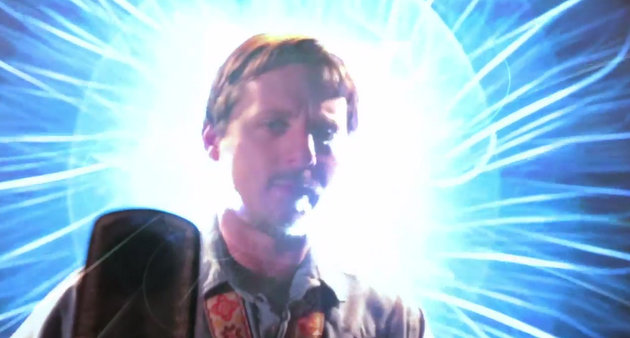
PP: The video for “Turtles All the Way Down” features
psychedelic CGI and gorgeously styled shots of the band, but it also gives
viewers a first-person look at a virtual wormhole during the lyrics’
denouement. Do you see this idea of a short-cut between two far-flung positions
as being important to the work you’re doing on Metamodern Sounds in
Country Music
? If so, what’s on either end of the wormhole?

SS: More than anything, I believe the themes, content, and sonic palette
of the album created the wormholes and sort of formed the juxtaposition on
their own. I’m not sure how much of it was intentional, looking back now. Even
with most finite planning you never know what the final result will reveal
itself to be until it’s staring back at you. I think the album just really
shows where my head was at that moment in time.

PP: The videos for
“Turtles All the Way Down” and “The Promise” juxtapose an almost DIY ethic
(e.g., close-up tracking shots of you and other members of the band)
and a real commitment to using technology (e.g., computer-generated visual
effects) to mesmerize. Can you talk about the process of filming these videos?
How much of the concepts were drawn from your own sense of Metamodern
Sounds in Country Music
, and how much was a multimedia collaboration with
other artists?

SS: Well that’s another story in itself. My buddy Graham Uhelski directed
and edited everything. I gave him a mental outline of what I was after and
wanted to see on both songs and he filtered that through his interpretation to
get what you see. For “The Promise” we decided a single simple tracking shot
filmed inside a bleeding heart was all it needed. I knew the video for “Turtles”
had to employ inter-dimensional/thematic elements. Really I just wanted to
make it look like a live performance at the Omega Point. Our budget was next to
nothing. We put together a small team of highly talented, dedicated players and
turned an empty warehouse into a soundstage. I was introduced to a generative
software artist in New York named Scott (Spot) Draves through Dr. Rick
Strassman and his colleague Andrew Stone. Scott created an interface
A.I./synthetic consciousness software called Electric Sheep. I sent him the
album and explained the message I was trying to get across with the project. He
was sympathetic to the cause and my budget and very graciously offered his
assistance.

PP: The video for “Turtles”
definitely achieved that “inter-dimensional” ambition—it’s a wild mix of
religious lighting, pharmaceutical-friendly animation, “infinite regress”
cosmological theory, and lyrics that run the gamut from Jesus to Buddha, fairy
tales to aliens. How concerned were you about trying to tie everything together
visually?

SS: That was the challenge and for me, simultaneously the source of the
excitement in tackling it.

PP: It’d be impossible
to watch these three videos without thinking about the use of color in each;
not many live-action videos are more spectacularly colored than these are, and
in each case the use of color feels not just aesthetic but rhetorical. Was
featuring transformative, blurred, and technicolor displays a particular
emphasis in putting together these videos, and if so, how do you see that
emphasis interacting with Metamodern Sounds in Country Music (and/or
earlier work from High Top Mountain) lyrically and thematically?

SS: Everybody is on drugs . . . just give ’em what they want.

PP: In addition to the
references to various drugs in “Turtles,” a lot of people have homed in on your
album’s use of the word “metamodern.” Do you think of these as metamodern music
videos?

SS: Now that’s a question I’d really much rather hear your thoughts on.

PP: The second release
from Metamodern Sounds, “The
Promise,” uses vignetting to leave us with the uncanny feeling we’re literally looking through someone’s
heart. It’s a song with a clear narrative bent, so I wondered if you could talk
about the role (if any) of narrative in that video. Did you and your team
imagine the moment you’ve captured on film as a contextualized one, or was the
concept primarily aesthetic?

SS: Nailed it. We wanted it to look like you were staring directly into a
bleeding heart or a very vulnerable love light.

PP: “Promise” also
superimposes black-and-white film-reel visual effects over a static,
“real-world” shot of you sitting on a stool; the reel effects are later
replaced by an over-saturated color palette and the same “ink” effect we
briefly saw in “Turtles All the Way Down.” Is foregrounding the different ways
reality can be framed—music, writing, cinema, photography, et cetera—important
to your “metamodern” approach to songwriting, and if so, how do you see it
playing out in the work?

SS: I believe framing reality is one of the only ways we can ever be
sure it actually exists. In that regard, I feel as though I’m still learning
who I am as an artist.

PP: Switching to the
2013 video for “Railroad of Sin”—it makes Tokyo subways and business districts
the setting for a classic rockabilly sound. It’s not a combination many would
come to organically, but it really works, so I wanted to ask you how you conceived
of it? And also the video’s epigraph—“a single dream is more powerful than a
thousand realities”—feels critical to what you’re up to. What can you tell us
about that video?

SS: I lived in Japan when I was younger for about two years. I spent my
time equally between religiously studying Aikido in Shinjuku by day and hard
partying in Shibuya and Roppongi by night. On more than a few nights, those
subways were my own personal stage coach to hell. I thought it would be fun to
return and work with some friends to capture the techno advanced world of Tokyo
against the backdrop of a high octane country song about a reckless life of
abandonment and personal disregard represented as a speeding train.

PP: A side note about
all three of these videos: the distribution channels for music videos today are
obviously a world apart from what they were in the 1980s, when you and I were
more or less coming online culturally; did the new potential for “virality”—a
strange word—play any role in the design and execution of these videos?

SS: Of course. As you pointed out, there was no such thing as “viral”
in the 80’s and 90’s video world. I knew before making these videos the only
place people would ever see them would be on YouTube. With that said, CMT
actually picked up the “Turtles” video for rotation, so go figure. That in and
of itself is a win in my book.

PP: Looking ahead, are
there plans for any additional videos for Metamodern Sounds in Country
Music
? If so, any details?

SS: Yes. Eventually, I want to have a video or visual representation for
every song on the album so you can watch the album in order of its track
listing. This may take a year or more.

Seth Abramson is the author of three collections of poetry, most recently Thievery (University of Akron Press, 2013). He has published work in numerous magazines and anthologies, including Best New Poets, American Poetry Review, Boston Review, New American Writing, Colorado Review, Denver Quarterly, and The Southern Review.
A graduate of Dartmouth College, Harvard Law School, and the Iowa
Writers’ Workshop, he was a public defender from 2001 to 2007 and is
presently a doctoral candidate in English Literature at University of
Wisconsin-Madison. He runs a contemporary poetry review series for
The Huffington Post and has covered graduate creative writing programs for Poets & Writers magazine since 2008.
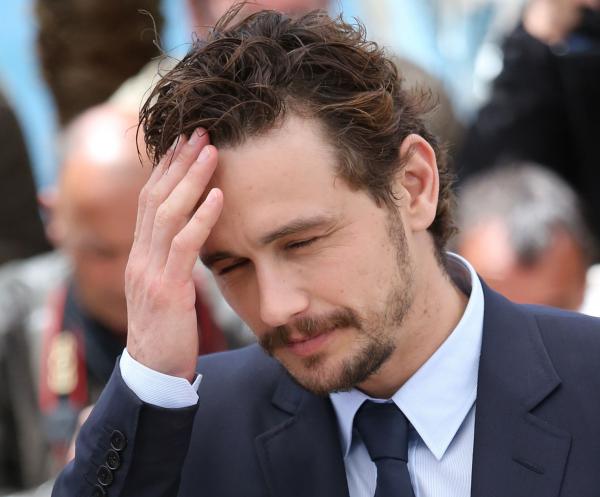
METAMERICANA: Is James Franco a Creep? Thank God We’ll Never Know

METAMERICANA: Is James Franco a Creep? Thank God We’ll Never Know

nullThis
past week, James Franco was “caught” propositioning a seventeen
year-old Scottish tourist via Instagram and text message. The
Internet subsequently exploded with speculation that the scandal was a cynical
concoction, just a clever bit of performance art-cum-free publicity for
Franco’s forthcoming film Palo Alto, whose plot (based on a Franco short
story from the collection of the same name) details
a high school soccer coach’s illicit
affair
with one of his female players. If you have a lot of time and even more
patience, you can read the intricate conspiracy theories alleging that we’re all being played
for fools, or (alternately) that the whole brouhaha merely proves that Franco
is celebrity swine. You can also find subtle variations
on these two themes, for instance in an article on Slate that begs Franco
to “just” be a creep rather than that far more odious manifestation
of eerie eccentricity, a performance artist.

In
keeping with the theme of this column, however, I’ll offer a third hypothesis:
That the real question is, why should we care whether James Franco’s a creep?

I
don’t say this as a moral observation, since the fact that Scottish teen Lucy
Clode (if any such person exists) is above the age of consent certainly doesn’t
clear Franco of the taint of impropriety. This is a high-schooler on holiday
with her mom, after all, and the celebrities we most admire refrain from cynically
exploiting their positions for sexual advantage. Nor am I offering up some
holier-than-thou nonsense about how we shouldn’t hold celebrities to a higher
standard than anyone else, or shouldn’t care about their personal lives at all.
It’s no more unreasonable to titter about what Brad and Angelina are doing than
it is to marvel at Michelle Obama’s latest dress; it’s natural to be interested
by those we believe have more interesting lives than we do, even if,
admittedly, that sort of interest saps our energies for more productive,
ennobling, and (not for nothing) interesting endeavors. 

In
any case, if we’re to be enthralled by the lives of the young and famous, James
Franco isn’t a bad place to start. Whatever else he may be, he’s undoubtedly an
interesting man. In addition to pursuing four graduate degrees simultaneously
and requesting public financing for
his film projects despite his enormous wealth, Franco has also made some of the
most interesting meta-art of this century and done yeoman’s work as a
philanthropist, not just including work on behalf of young filmmakers but also
the fight to cure AIDS and eradicate illiteracy.

So
the reason to set aside the question of whether James Franco is a creep has
nothing to do with whether the man himself is of natural interest to
self-anointed celebrity-watchers; no, the main reason not to care whether
Franco is or is not a creep is that it’s far more interesting not to know than
to know. Whatever your opinion of fellow budding auteur Shia LaBeouf—who Franco
infamously defended in the New York Times after
the former plagiarized several individuals and then plagiarized his apologies
for those plagiarisms—he’s
certainly a more compelling figure now that he appears to have become an icon
of American metamodernism
than he was when running away from
explosions in slow-motion with Megan Fox in the dismal Transformers: Revenge
of the Fallen
. Some may quibble here and say that the only thing worse than
being a self-indulgent artist is being a self-indulgent wannabe artiste—as
LaBeouf would indeed be, were his stunts not partly inspired by an entirely
serious artistic philosophy originating in the most respected salons of Western
Europe—but
the argument here isn’t that LaBeouf is interesting because he’s
(alternately) the genuine article or a phony, but that he’s interesting because
in the Age of Information, the only mysteries left are those no amount of
information can dispel. 

It’s
widely known among metamodernists that Shia LaBeouf did not, in fact, write the
“Metamodernist Manifesto” that now bears his name, which was in fact written three
years ago
by British photographer Luke Turner;
likewise, it’s widely known to committed metamodernists that metamodernism
isn’t particularly interested in plagiarism like LaBeouf’s, nor are the
“metamodern” influences LaBeouf has publicly cited (like postmodern
poet Kenneth Goldsmith) actually metamodernists themselves. But when does it
stop mattering what someone intends, or knows or doesn’t know, or (in the case
of Franco) is or is not—when the ambiguities they leave in their wake are not
only intellectually provocative and ethically instructive but also pretty damn
entertaining? Which was more interesting to you: Joaquin Phoenix’s bizarre
appearance on David Letterman at a time when we believed the Academy
Award-nominated actor had retired from acting and inexplicably taken up rap, or the movie it turned out he was
putting on that act for, 2010’s I’m Still Here, which managed
even a middling 54% on Rotten Tomatoes only because, at the time it was
released, the jury was still out on whether it was a documentary or performance
art
?

The
ambiguities that lie behind these actors’ behaviors suggest not that ignorance
is sublime, but rather that the particular breed of ignorance born when either
of two diametrically opposed possibilities is equally possible is, in fact, one
of the only avenues of transcendence left for us. Whether it’s trying to determine
if Alison Gold’s now-infamous song “Chinese Food” was sincere or a parody, or trying to
make the same determination regarding this song, we increasingly find the most
rigorous challenges to the status quo to be, rather than those that entrench
long-abandoned principles or deconstruct still-conventional structures, those
that remind us that the phrase “Information Age” is and always will
be a misnomer. The idea of the  Information Age is perpetually dangerous, not
because it permits us to act lousily both anonymously and with impunity—though
it does—but because it deludes us into believing we know much more than we
actually do.

For
all the social media hoopla surrounding James Franco and Shia LaBeouf, and all
the “news articles” detailing the latest escapades of both actors,
the newsflash the Information Age denies us is this one: We don’t know the first damn thing about either James Franco or Shia
LaBeouf.
All we even think we know is the fraction of what
James and Shia choose to let us see which media filters then permit us to
discover online. This distillation is then further filtered through our own
ability to comprehend lives and contexts entirely foreign to our own. And
because what James and Shia choose to let us see is undoubtedly dictated by
inscrutable personality traits and obscure eccentricities inherent to both men,
the sincerity or insincerity of any data relating to Franco or LaBeouf is not
only unknown to us but also (to quote Donald Rumsfeld) unknowable. 

We
can watch films in which either Franco or LaBeouf is featured and know whether
we’ve enjoyed each actor’s performance; we can decide for ourselves whether we
find either man attractive or charismatic; we can choose to be titillated or
bored by either one’s shenanigans; but ultimately, “James Franco” and
“Shia LaBeouf” are merely constellations of data that make us feel
things we do or don’t like to feel. James Franco is not a realizable human
being to me, nor is Shia LaBeouf, nor could they ever be until I had met them several
times and observed first-hand all those human quirks the “Information
Age” makes it harder rather than easier to access: body language;
intonation; treatment of strangers in real-time; split-second reactions to
unexpected stimuli; the ability to listen; general temperament; private
fidelities and infidelities; and so on. The biggest lie of the Information Age
is that it’s the age of actionable and reliable information. Our need to know
whether James Franco is respectful to women and capable of distinguishing
between a child and an age-appropriate peer is merely our need to cash in on
the promises implicitly made to us by the Age. We think that we ought to
be able to know things, so we insist that we do—even when we manifestly don’t.
Or else, as in the “Lucy Clode” imbroglio, we chase the rabbit down the
rabbit-hole in a vain attempt to locate “truth.”

When
I consider how misinformation (or merely information that’s impossible to
confirm or deny) can empower me by denying me access to ready conclusions—that
is, by keeping me in a state of suspended intellectual and emotional
titillation—I realize that, unless I get to know James Franco or Shia
LaBeouf personally, the value of the terms “James Franco” and
“Shia LaBeouf” is really no more and no less than the quality of the
ambiguities they leave in their wake. To observe the same phenomenon in another
public sphere, I can, for instance, dislike U.S. Senator Ted Cruz (R-TX)
because he’s an obvious fraud—which he undoubtedly is, even according to
members of his own party—but
I can also dislike him for being an uninteresting compendium of data in a world
in which parcels of data constantly compete for my attention. The fact that Ted
Cruz doesn’t really require my attention is attributable not only to his
political rhetoric being conspicuously unjust and destructive, but also to the
fact that it’s all too easy to slot him into my mental diagram of the American
superstructure. 

We
are, all of us, powerless in the face of so much data. We can’t distinguish its
value, and pretending otherwise diminishes us. The best course of action for
those of us hoping to weather or even transcend this generation of
unaccountable hot air is to watch, when we have time, astrophysicist Neil
deGrasse Tyson on “Cosmos” (a television program that deals only in data that’s been
subjected to the scientific method), and then, whenever we don’t have time, let
the generative ambiguities of data-dumps like “James Franco” and
“Shia LaBeouf” power-wash us clean of all our false ambitions.

Seth Abramson is the author of three collections of poetry, most recently Thievery (University of Akron Press, 2013). He has published work in numerous magazines and anthologies, including Best New Poets, American Poetry Review, Boston Review, New American Writing, Colorado Review, Denver Quarterly, and The Southern Review.
A graduate of Dartmouth College, Harvard Law School, and the Iowa
Writers’ Workshop, he was a public defender from 2001 to 2007 and is
presently a doctoral candidate in English Literature at University of
Wisconsin-Madison. He runs a contemporary poetry review series for
The Huffington Post and has covered graduate creative writing programs for Poets & Writers magazine since 2008.

What’s Behind the Puzzling Bum Rap TRUE DETECTIVE Has Gotten?

What’s Behind the Puzzling Bum Rap TRUE DETECTIVE Has Gotten?

null

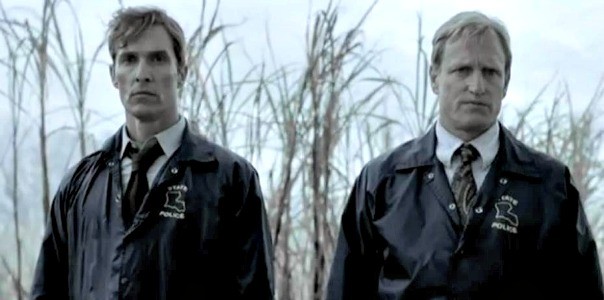
There’s something about the recently concluded first season of the HBO program True Detective that’s driven certain normally cogent television critics batty. Usually one can follow, at least generally,
naysayers’ objections to a program’s narrative arc or episode-to-episode execution, but in the case of True Detective
almost nothing the critics are saying adds up. The result is that a
beautifully written and elegantly produced drama about existential
despair on the Louisiana Bayou has become the latest pariah for hipsters
and self-anointed cultural critics alike.
True Detective
is a show with only three well-drawn characters–in fact only three
characters the show has any interest in developing at all–and one of
them is female, two male. Critics
of the show conclude that True Detective had no interest in the feminine.
It
is, too, a show that hints at a vast, murderous conspiracy of rich
white men, but finally gives viewers the satisfaction of seeing only a
single member of that ring brought to justice. In a television industry
where the conventional thing to do would have been to ensure that all
wrongdoers ever shown or hinted at on-screen were apprehended, True Detective
takes the unusual tack of conceding that sometimes even the most
dedicated detectives can only solve a small piece of the larger puzzle.
It’s a fact foreshadowed repeatedly in the show’s first season via
repeated reference to the cavernous blindspots even
talented detectives must endure. Critics of the show opine in
response–inexplicably–that True Detective
wasn’t, in fact, bucking a decades-long trend in the true crime genre,
but merely not trying hard enough. In other words, a more conventional
plot would have satisfied critics by convincing them, in a conventional
way, that the show wanted more than anything to meet their expectations.
Except that it didn’t, so they howled.
True Detective is
a program so long on abstract philosophical rumination that critics say
they couldn’t bear to hear a minute more of the existential conjectures
of
disgraced police detective Rustin “Rust” Cohle (Matthew McConaughey); those same critics warn potential new viewers of True Detective
that the show is merely a standard police procedural–even though that
genre is known to be (to put it charitably) a little light on anything
approaching abstraction generally or philosophy specifically.
True Detective is a show that’s been panned by some major media outlets–The New
Yorker
, most notably–even as
everyone more or less agrees that the acting is great, the
cinematography is great, the writing is great, and the pacing is
sufficient to tie even the most skeptical viewer to their television set
every week.
If all this sounds rather strange–as though True Detective
is getting the sort of treatment reserved for cultural setpieces that
somehow destroy our sense of ourselves, placing us immediately in a
defensive stance–that’s because the whole melodrama surrounding True Detective is indeed incredibly strange. And, too, it has an
undercurrent of nastiness that’s merely underlined by the above
paradoxes. Maybe critics got sick of praising shows produced by HBO;
maybe they resented the growing tendency (see House of Cards)
for Hollywood film stars to take turns on the small screen; maybe they
tire of the arrogant, self-aggrandizing digi-hipster buzz that seems to
surround every new cable series with half a pulse; maybe decades of
egregiously turgid Law & Order spinoffs have soured the media on anything that looks even vaguely like a police procedural.
Here’s
what we know: Watching your television is not an exercise in seeing how
close a program can come to emulating your archetype of the genre you
think you’re watching. Nor is appreciating art merely a game of
deduction in which the starting point is how you think that art should
look, and the endpoint is your grave disappointment at what it actually
turns out to be and (as importantly) want to
be. If a television program features one man so traumatized by the loss
of his two year-old daughter and the subsequent disintegration of his
marriage that he no longer believes in love nor yearns for sex; if it
features another man so self-conflicted about his own soul he ping-pongs
blindly between a loving wife and psychologically immature mistresses
without seeing any of them more clearly than he sees himself; if the
villainous mob at the heart of the program
feeds off the poisonous legacy of “good ol’ boy” Southern cultural
practices like “rural Mardi Gras”; if the milieu of the show’s
protagonists–the seedy criminal underbelly of impoverished coastal
Louisiana–is one in which women are marginalized and most of the chief
actors (that is to say, most of the appalling archetypes dotting the
landscape) are male; if all these things are true, I probably won’t
recommend to friends and family that they watch such a program to find
sterling depictions of complex feminine psyches. But that doesn’t mean I
won’t recommend the show; it simply means that I’ll judge (and
recommend) the program on its own terms, adjudicating its value based
upon the story the program wishes to tell and the fidelity to that
purpose that it shows in telling it. I certainly won’t insist that any
one television program, in a nation with hundreds of them, be all things
to all people.
Matthew McConaughey’s Rustin
Cohle is an iconic television figure. Neither a hero nor an anti-hero,
he’s a man whose belief in his own perseverance is so wispy he moves
through every scene like a ghost. If you think you’ve seen Rustin Cohle
on your television screen before, you probably weren’t paying undue
attention to the show’s subtly eloquent dialogue, which
sees McConaughey ruminating on such yawn-inducing, overplayed TV topics
like how hypothetical beings inhabiting the fourth dimension would
perceive the lifespans of two- and three-dimensional beings; whether
consciousness generally and fatherhood and motherhood specifically
are in fact the original, purge-proof sins of our species; whether love
is merely a delusion of sentience subsumed beneath the broader
fallacies of free will and linear time; you know, run-of-the-mill police
procedural shit like that. If Woody Harrelson’s Marty Hart is slightly
more conventional a small-screen figure–a philandering, hard-drinking
alpha male cop who becomes equally enraged at any woman he can’t control
and any man who mistreats a woman–he’s also played to perfection by
Harrelson, in fact so convincingly that when Hart’s wife says that the
foundational tragedy of her husband’s life is that he has no idea who he
is (despite seeming to play entirely to type), we believe her. It’s a
cutting critique of masculinity that those counting, instead, the number
of lines of dialogue doled out to male and female actors in the series
may have missed. In no uncertain terms, True Detective
concludes that
our nation’s founding archetype for the male body and psyche is so
hollow that the destruction it generates is merely terror and aggression
predictably filling an existential vacuum. Critics of the show respond
that it’s a procession of buddy-cop tropes. I don’t have any idea what show they were watching.
It’s true that True Detective
leaves some loose ends, and equally true that in the age of cable
television programs so expensive to produce that one never knows if
they’ll have a second season, that’s par for the course. Still, some
of the loose ends the critics complain about seem paltry by comparison
to, say, the trail of questions left behind by Lost, or Firefly, or even now long-forgotten near-classics like Rome.
Sure, we never find out why Marty’s daughter was drawing men and women
having sex on sketchpads at her elementary school, but who cares,
finally? We never found out the precise mechanism by which that prison
rat killed himself in his cell; so? And it’s unclear whether that
cowardly parish Sheriff in fact goes on to seek revenge against Rust
after the latter has credibly threatened him with execution and
professional ruin if he does, but can’t we just use our imagination to
resolve that trifling canard? And while it’s undoubtedly a much bigger
deal that True Detective
ultimately uncovers the key to only a few
murders on the Bayou, rather than the hundreds it alludes to, for those
taking the show on its own terms Marty’s explanation in the series
finale–that sometimes having good intentions and fortitude means doing
whatever one can, not everything one conceives of–seems not just
plausible but, based upon Hart’s background and motivations, earned.
Likewise, a brilliantly written final monologue by the philosophical
pessimist Cohle (portrayed by critics as “merely” a nihilist, as that’s a
pejorative term most readers will understand) is perfectly consistent with
his complicated personal ethos: one governed by deeply considered views
on consciousness and time, not (as would be the case with the
conventional nihilist) “meaning” and ethics. A key difference between
Cohle and a workaday nihilist is that the latter doesn’t believe in any
of those pesky meta-realities Rust eerily obsesses over–a fact that
makes Rust’s gradual conversion to a sort of spirituality
cleverly unsurprising rather than stupidly epiphanic.
No one will accuse True Detective
of offering many groundbreaking roles for actresses–of the three women
who get the most minutes on-screen, one is a housewife who roughly
conforms to the archetypal spouse locked in a loveless,
infidelity-riddled marriage; one is a courthouse steno who slums with
Marty as she looks for a husband; and one is a former prostitute turned
mentally ill cellphone store employee–but at some point it must be
allowed that there will be programs, albeit thankfully not too many of
them, in which the primary
relationship considered by the script is between two men. I love Cormac
McCarthy’s The Road; I certainly
wouldn’t want every film, or even a notable fraction of them,
to put two males in an existential wrestling match and see who loses and
how. True Detective at least has
the good grace to offer only the slightest relational arc between Rust
and Marty; those who say the series’ first season ends with the two as
lifelong friends are confusing the empathy of co-survivors with genuine
affection. If Rust and Marty seem likely to stay in touch after the
final credits roll, that’s because they have nothing else to do with
themselves and too little direction to orient themselves otherwise. It’s
hardly a ringing endorsement of platonic love between men. Indeed, the
more likely follow-through after the final shot of True Detective
is
that Rust kills himself shortly thereafter, and Marty continues on in
the dreary and directionless life we saw him living when Rust rolled
back into town to close out the Dora Lange case once and
for all. Those who see resolution or reunion in the mere fact that
Marty’s children and ex-wife visit him as he lays half-dead in the
hospital–or that Hart begins sobbing uncontrollably during their visit
(quite obviously tears of abject misery, not joy)–are grasping at
straws. There’s no happy ending for Harrelson’s Marty, nor does the show
allude to one.
Nor, it appears, is there any
happy ending for True Detective. Its detractors have resorted, now, to merely contending that Top of the Lake was a better program and got less attention. Okay; is this somehow proof positive that True Detective is unwatchable or (less grandly) undeserving of praise? Does the fact that The Wire is still far better than either of these two shows mean Top of the Lake is unwatchable too? Someday we’ll find out what was behind the bum rap given to True Detective; or, alternately, we won’t–and be left instead with The New Yorker claiming that one of the best-written programs of the last few years is in fact no more memorable dialogically than, if you can
believe it, Family Matters. Steve Urkel used to go on and on about fourth-dimensional metaphysical overlords, didn’t he?

METAMERICANA: SOUTH PARK: THE STICK OF TRUTH Is a Fantasy RPG That’s All Too Real

METAMERICANA: SOUTH PARK: THE STICK OF TRUTH Is a Fantasy RPG That’s All Too Real

null
I
haven’t been an avid videogamer since my mid-twenties, and I’ve never been more
than a casual observer of the South Park television and film franchise,
so I was an unlikely pick to be the guy driving from Madison, Wisconsin to the
Illinois border at 2AM to purchase the new South Park role-playing
videogame, South Park: The Stick of Truth. The reason I made the nearly
hour-long drive from the Wisconsin capital down to Beloit was partly because I
couldn’t sleep, and partly because I’d heard two things about the new South
Park
game that piqued my interest. First, it’s one of the only RPG
videogames licensed from a television or film franchise ever to receive
near-universal critical acclaim in the console era. Second, it is, for all
intents and purposes, a “meta-RPG,” that is, a role-playing game about
role-playing games. Given my recent insomnia and the stated theme of this column
(“art about art”) I just couldn’t resist checking it out. What I found was a
gaming experience equal parts poignant and hilarious, familiar and
unpredictable, self-referential and transgressive—exactly the sort of art we
look for, demand, and deserve in the age of metamodernism.


I’ve
watched maybe thirty South Park
episodes start-to-finish during the seventeen-year run of the television show,
a number which, I’ll concede to the legions of fanatical South Park devotees,
is embarrassingly low. But it’s a show I’ve always admired from afar, and not
merely because I know that, despite being one of the most gleefully offensive
franchises in television and (with the 1999 feature-length film South Park:
Bigger, Longer, and Uncut
) film history, it’s also one of the most
decorated artifacts of the Age of Television. Time Magazine deemed
it one of the 100 best TV shows of all-time; Rolling Stone called it the
funniest show of this century’s first decade; Entertainment Weekly rates
it a Top 25 television program over the last quarter-century; it received a
Peabody Award in 2006; and it’s been nominated for ten Emmy Awards (winning
four times). For all the protests and boycotts it’s provoked, it somehow
manages to win over, in time, even its fiercest critics—or most of them. It
does this by revealing its long game to be an astutely political rather than
merely asinine one. I admire South Park not only for its persistent
intelligence, but also its dogged cultural relevance. Both Gen X and Gen Y
Americans—and soon enough, the elementary school kids of Gen Z—understand what
it’s like to be simultaneously mystified and victimized by the adults of the
generation preceding; the corrosiveness of our intergenerational inheritance is
a timeless theme that South Park
addresses fearlessly and, beneath a veneer of flippancy, with surprising
subtlety.

South
Park
has gotten the
videogame treatment five times in the past, and in all cases (to hear
professional videogame critics tell it) forgettably: South Park (1998)
was said to be “one of those games that is bound to come up when you start
thinking about the worst game you’ve ever played” by industry leader GameSpot; South
Park: Chef’s Luv Shack
(1999) received an aggregate score of 50% (out of
100%) from ratings tallier GameRankings; South Park Rally (2000) fared
even poorer than its predecessor, at 47%; after nine years spent regrouping,
the franchise returned to consoles in 2009 for South Park: Let’s Go Tower
Defense Play
, which failed to achieve critical acclaim but nevertheless boasted
the series’ best showing to date (7.5 out of 10 from GameSpot, which noted,
with only muted sarcasm, that it was at that point “easily the best South
Park
game”); and then 2012 saw a relapse for series creators Trey Parker
and Matt Stone, as South Park: Tenorman’s Revenge again reached
only about the halfway point (52 out of 100) on ratings aggregator Metacritic.

So
why does a television program with so much critical acclaim have such
difficulty succeeding when translated from its native medium to another?
Besides the obvious answer—that licensed videogames are almost always
hastily-arranged cash-grabs that pay zero attention to plot or gameplay—one
possibility is that the allure of South Park is altogether more
complicated than videogame designers have ever considered.

South
Park
, which takes
place largely in the titular (fictional) town in Colorado, is first
and foremost an epic about how American children are forced to inhabit social,
cultural, and political spheres governed by adults who are idiots at best and
cretins at worst. The franchise traces the ways different children respond to
this passive, systemic, large-scale form of child abuse. Some kids, such as
series star Cartman, adopt the worst behaviors of their elders, and do so
effectively enough that many of those they’re emulating give them carte blanche
for their bad behavior; others, like Stan and Kyle, are savvy enough to realize
the impossibility of finding role models, but also pragmatic enough to realize
that navigating the madness of the adult world means from time to time
indulging madness oneself; and still others, like mute latchkey-kid Kenny,
become a sad amalgamation of the two preceding types—suffused with the
callousness of their culture but unable to accede to it entirely because they
are, after all, benignly naive and instinctively optimistic children. To watch
these kids weather the storm of American culture and its many subcultures—now indulging
racist biases because they’ve seen them performed so often and so
energetically; now getting in trouble because the depth of local adults’
depravity is beyond their understanding—is alternately hilarious and
heartbreaking. If I don’t watch the show more often, it’s because I find the
world it depicts a depressing one. And, unfortunately, one I all too often
recognize as my own.

Living
in rural Massachusetts in the 1980s, I had the same sort of middle-class
upbringing I suspect Parker and Stone did: one in which a kid has a lot of
leisure time, enjoys a Gen X sort of relationship with his parents (one marked
by distance rather than, as with Gen Y, an eerie sort of friendship), and is
therefore mostly left to fend for himself in understanding how the world works
and why. Like many kids who grew up in the mid-1980s, I was calling classmates
“faggots” for many years before I had any idea what the word meant; was a
little shy (which is not to say hostile) around any child who seemed different,
whether that child was handicapped or black or a girl or somehow physically
notable (due to height, weight, facial features, or otherwise); and, generally
speaking, learned the conventional biases of my culture via the osmosis of
television and film. It’s remarkable how odiously bias-entrenching much
eighties television and film seems in retrospect, and unfortunately eighties
children bore the brunt of it with only minimal guidance from their
elders. 

When
I see the basically good-hearted kids of South Park, Colorado—Eric Cartman, the
nominal villain, excepted—struggling to understand the cultural mores and
presuppositions they’re exposed to daily, it makes me uncomfortable because I
know that the humor of the kids in South Park is really just that: the
humor of eighties-style elementary school children who don’t know any better
than to reflexively mimic how speech-impaired children speak, or to exoticize
Asian-Americans, or to discount by 50% or more the masculinity of anyone they
identify as gay. I don’t at all mean to excuse these kids (or my child self)
any past misconduct; I merely know what it’s like to be a thirty-something
progressive looking back at his life as a South Park-age kid in the
1980s and feeling ashamed for how natural such misconduct felt at the time. South
Park
is not, to me, a comedy program that fetishizes the most radical brand
of adult humor, it’s a program that dramatizes—sometimes realistically,
sometimes via absurdist metaphor—a very banal and common juvenile
experience. 

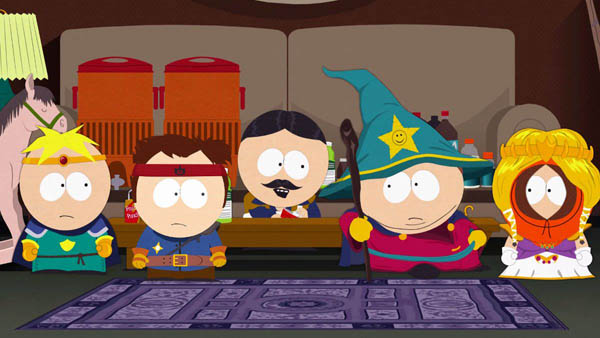
In
South Park: The Stick of Truth, the children revolt, which is probably
why I like it so much. The game’s frenetic plot follows the children of South
Park as they turn their occasional LARPing (“Live-Action Role Playing”) into a
perpetual form of escapism, with a gang of “Humans” led by Cartman vying with a
tribe of “Elves” led by Kyle to gain possession of the vaunted “Stick of Truth”
(just a stick, really). The game successfully turns an entire universe of
confusing mundanity into rosters of weapons (e.g., a basketball, a Super Ball,
a broken bottle, a hammer), equipment (e.g., medical scrubs, a marching band
uniform, SWAT gear), and various costumes (e.g., hundreds of makeup kits,
eyewear, wigs, and gloves), all ordered by their supposed effectiveness as
offensive or defensive military equipment. The designations are entirely
imaginary, of course. For instance, the South Parkers refer to Twitter as “a
carrier raven,” their backyards as castles and keeps, and their styles of
dress, personal ethics, and self-mythologies as “classes” consistent with those
found in the Dungeons & Dragons universe (e.g., Mage, Thief, Paladin,
Ranger, and Bard; the game’s one addition is the “Jew” class, inspired by Kyle’s
religion and Cartman’s unsettlingly entrenched anti-Semitism). Because the
whole affair is ripped straight from J.R.R. Tolkien (Lord of the Rings)
and Gary Gygax (creator of Dungeons & Dragons), playing South Park: The
Stick of Truth
is the equivalent of being a role-playing kid who’s role-playing
a role-playing game. But as with so much meta-art, these several levels of
remove from the “real” thing feel as or more real than the “originals,” in part
because being several times removed from anything “real” is more or less the
human condition in 2014.

But
South Park: The Stick of Truth removes its player still further from its
source material, because the game is as much an homage to—and a satire of—the
entire “role-playing” enterprise as it is a gamer’s translation of the
endeavor. Certain set pieces of 1990s video-gaming
(particularly RPG gaming) are here put under the microscope for criticism or
admiration: for instance, the hero of the game (a newcomer to South Park
variously called “The New Kid,” “Douchebag,” “Sir Douchebag,” or “Commander
Douchebag”) is one of RPG gaming’s much-maligned “silent protagonists,” a fact
repeatedly remarked upon and derided during the seventeen-hour run-time of The
Stick of Truth
. The game’s battle sequences are turn-based, a style of play
so long ago abandoned by top videogame developers that it becomes a running
in-game joke here, as your fighting partners will sarcastically remark upon
your slowness if you take any time whatsoever planning your next move in
battle. Even Jamie Dunlap’s score—which is actually very, very good—is merely a
tongue-in-cheek medley of vaguely Tolkienesque sonic doodles. 

Certain
moments in the game are so pricelessly “meta” that I’d be hard-pressed to think
of any game this side of Final Fantasy VII so willing to acknowledge its
own artifice; and in terms of explicit rather than implicit acknowledgment of
artifice, I’m not sure we’ve even seen anything on this scale. At one point
Cartman tells the game’s hero not to speak to Mrs. Cartman (his mother) because
“she’s not part of the game”—leaving unsaid whether the “game” he’s speaking of
is the South Parkers’ LARPing or South Park: The Stick of Truth. In the
same way, a group of toughs at one point informs both The New Kid and the
videogamer playing him that fighting them “at this point in the game is really
just a waste of time.” Who are they speaking to, really, and does it matter?
One of the beautiful ironies of this type of art is that each layer of reality
shares sufficient commonalities with the others that what applies conspicuously
to one level usually applies as much or more to all the others. The more
furious the layering of realities, the more bewildering and also hilarious the
gameplay of The Stick of Truth. At
one point, Mr. Mackey, South Park Elementary’s guidance counselor and detention
overseer, warns the South Parkers against breaking one of their number out of
detention by referencing every layer of reality in the game: the source
material for the kids’ LARPing; the “game” they’ve created to LARP in; and the
videogame in which real-world humans role-play the LARPers. From one sentence
to the next you have no idea which layer of reality Mr. Mackey is inhabiting,
and that sort of sublime ambiguity is, at times, spectacular.

Of
course, South Park wouldn’t be the cultural phenomenon it is if it
merely satirized fringe practices like LARPing and tabletop role-playing games,
or even if it merely commented implicitly on the ignorance and fecklessness of
American adults. The show—and this most recent videogame based on the franchise—is
much more pointedly political than this, and much more maniacally traumatizing
psychologically. Recurring sociopolitical themes in The Stick of Truth
include mistrust of centralized government, derision for political rhetoric,
antagonism toward overdetermined sociocultural discourses, and a frank
appraisal of the way individual citizens shirk their responsibilities to one
another and (even more poignantly) themselves. Of course, all of these
commentaries are packaged in the most visually and aurally noxious plot-points
and cut-scenes imaginable—for instance, a “boss battle” in which the recently
miniaturized hero fights on the very bed his parents are having wild sex upon.
Not only are the hero’s mother’s breasts visible throughout the fight, but dodging
the hero’s father’s testicles is actually part of the in-game challenge.
Failure to do so leads to instant death.

Parker
and Stone likely became such infamous provocateurs because they know that in a
culture incapable of genuine shock, the only way to grab and hold anyone’s
attention is to cross what few boundaries of taste remain. South Park: The
Stick of Truth
certainly does that, offering players everything from a
sodomy minigame aboard an alien spaceship to an abortion minigame in which you’re
asked to perform an “abortion” on a man in drag; from the playing of Nazi
propaganda sound-clips over many routine battles (owing to a “Nazi zombie”
plotline) to a quest in which you beat up homeless people at the request of
South Park’s Mayor (her reasoning: only by violently driving the homeless from
South Park can the town’s callous indifference to their existence be obscured).
Throughout, one finds religious, national, and ethnic stereotypes so
outrageous they can only credibly be received as satire; one also encounters
characters so unthinkably grotesque they can only serve as Parker and Stone’s
own winking self-satire (for instance, talking feces, giant aborted fetuses
wearing Nazi armbands, and gay leather fetishists who aid the hero by anally
consuming minor enemies). There are also dozens of lesser sight-gags, for
instance one involving the television industry: in the sewers of South Park,
regular “finds” include both feces nuggets and Emmy Awards. There’s also an
easily missed but clearly derisive reference to the Entertainment Software
Rating Board, an entity that understandably issued its sternest parental
warning (“M for Mature”) for The Stick of Truth. All of the above
suggests that the game is fully aware of exactly what it’s doing and why.
Much of it is horrifying—I cringed as frequently as I laughed—but I’d be
hard-pressed to call any of it unintelligent or undirected.

For
me, the most moving moment in The Stick of Truth came in the sewers
below the city, as the New Kid moved from caches filled with human feces, used
syringes, dirty bindles, tufts of pubic hair, and Emmy Awards to protracted
battles with drug-addled homeless men. As disgusting as the visuals of this
“level” of the game are, the music being played throughout it is—oddly—deeply
enchanting. Dunlap’s score is gentle, soothing, and vaguely mysterious. The
point here, and one I might not have gotten until I was twelve hours into the
game, is that the music of South Park: The Stick of Truth isn’t “for”
the gamer, or “for” the world of South Park adults whose reaction to their kids’
LARPing is rarely less than hostile. The music reflects, instead, the layer of
reality Parker and Stone are most invested in as kids who grew up largely in
the eighties (Parker was born in 1969, Stone in 1971) and wished to imagine
their world as something rather more beautiful than the one they saw in school
and on the news. In other words, however disgusting the sewers beneath South
Park may be, they’re still a place of some wonder for the pint-size Rangers,
Bards, and Paladins who traipse through them pretending to be questing nobly.
The game doesn’t talk down to these kids—however coarse they themselves may
sometimes be—but rather ennobles their fantasies by treating them as not just
reasonable but superlative. It was a pleasure to inhabit these kids’ fantasies
for seventeen hours, even if they reminded me not just of how beautiful
childhood can be if we let it, but also of how cruel and uncompromising it can
be when we adults do our damnedest, as we usually do, to make it that way.

Seth Abramson is the author of three collections of poetry, most recently Thievery (University of Akron Press, 2013). He has published work in numerous magazines and anthologies, including Best New Poets, American Poetry Review, Boston Review, New American Writing, Colorado Review, Denver Quarterly, and The Southern Review.
A graduate of Dartmouth College, Harvard Law School, and the Iowa
Writers’ Workshop, he was a public defender from 2001 to 2007 and is
presently a doctoral candidate in English Literature at University of
Wisconsin-Madison. He runs a contemporary poetry review series for
The Huffington Post and has covered graduate creative writing programs for Poets & Writers magazine since 2008.

METAMERICANA: Paolo Sorrentino’s THE GREAT BEAUTY Is Exactly That

METAMERICANA: Paolo Sorrentino’s THE GREAT BEAUTY Is Exactly That

null

This biweekly column
looks at instances of film, television, drama, and comedy that
are in some way self-referential—”art about art.” Also discussed is metamodernism, a cultural paradigm that uses both fragmentary
and contradictory data to produce new forms of coherence.

The first scene of The Great Beauty
documents an interminably long outdoor rave on a scenic balcony owned
by Italian novelist-turned-journalist Jep Gambardella. It takes some
time for the camera to locate the film’s star, as for many minutes it
rests its gaze instead on a cacophony of delirious partygoers, many of
whom are so enmeshed in riotous frivolity they seem creepily
otherworldly–entirely removed from the space-time continuum the rest of
us live in. As we soon
learn, that’s exactly the point: Gambardella, who decades earlier gave
up a once-promising literary career after his first love inexplicably
abandoned him, has spent most of his life living in Rome amid precisely
this sort of rootless inanity. In one early voiceover, he tells us that
the aim of his life so far has been not merely to be the life of every
party, but to be so central to Rome’s dissolute nightlife that he can,
by word or deed, single-handedly ruin
any party he attends. This destructive instinct presages the thematic
arc of the film, which sees Gambardella vainly seeking meaning in the
meaninglessness of his milieu. It seems a paradox, but the resultant act
of witnessing the film permits is as meaning-laden an existential
adventure as I’ve
had the pleasure to experience in a very long time.

As
the theme of this essay series has thus far been metamodernism in the
arts–that is, the rapid oscillation between (and ultimately the
transcendence of) conventional poles of affect like sincerity and irony,
optimism and cynicism, knowledge and doubt–it’ll seem convenient for
me to say now that The Great Beauty is preoccupied, first and foremost, with exactly this sort of oscillation. But it’s true; Gambardella lives in one of the
world’s most venerable cultures, yet traipses voluntarily through
its dankest ephemera; his amorality mandates that he live in the
present, but his mind turns relentlessly to a tragedy in his past; he
repeatedly encounters objects and scenes of obvious moment, yet he
always slips off, thereafter, into a cesspool of artifice, as if by
rote. All in all, it’s impossible to tell what portion of Gambardella’s
life is real and what portion is fantasy, a state of affairs nearly all
of us can relate to in the Digital Age.
What’s most remarkable about The Great Beauty isn’t the concept behind the work, however, but director Sorrentino’s uncanny visualizations of its particulars. The Great Beauty is
not only one of the most visually arresting films in years,
but also one of its most eclectic: each scene develops a distinct
internal atmosphere through the auteur’s selection of color palette,
stage direction, and (most notably) musical score, giving the moviegoer
everything from a sprightly neo-Surrealist scene of couples dancing at
an outdoor wedding to an almost apocalyptic encounter
between Gambardella, a lost child, and a sewer-grate in a crypt. The
film, in other words, follows in its form the pattern of its hero’s
thoughts: it doesn’t cohere so much as wend through marvels of every
mood and description. The poles of reality and unreality, profundity and
banality, sincerity and artifice alternate so rapidly between
prominence and disappearance that the result is a state of suspended
sublimity. If we define the sublime as anything that inspires awe in us
because of its supernaturally elevated quality, The Great Beauty is exactly that.
Several scenes in The Great Beauty encapsulate this sense that it’s possible to occupy the space between realities—that place where all is neither entirely real nor entirely unreal. In one such scene, the sixty-five year-old Gambardella has
just slept with Ramona, the 42-year-old daughter of an old
friend, and the two have awakened the next morning with plans of taking a
day trip to the ocean. The scene begins with a shot of Ramona’s arm
hanging limply over the side of a bed; the way her arm hangs, one
suspects that the body to which it
attaches is now deceased. But then we hear Gambardella lazily coaxing
Ramona to wake, and we realize that she’s merely sleeping. Yet she
doesn’t stir, so Gambardella calls her name a second time, now with a
note of worry, causing us (once again) to suspect Ramona is dead.
But after several pregnant moments—during which the camera
explores Ramona’s entirely still face and upper body—the
forty-something beauty opens her eyes. We relax; she’s alive. But in the
next scene Ramona’s father is being consoled by a male customer at the
strip-club he manages; “I’m so sorry about your daughter,” says the
customer. So is Ramona dead or alive? We never find out: she’s not seen
or spoken of on-screen again.
A
second such scene is the funeral of a socialite’s son. Prior to the
funeral, Jep and Ramona (still alive) are seen preparing for the event
at a local dress shop. Jep patiently, and not a little conceitedly,
explains to Ramona that there’s an art to acting properly at a funeral.
The art, he says, demands two things above all: That the mourner not
cry, and that he position himself in such a way as to be seen mourning
(but not to seem to want to be seen mourning) by all those in attendance. He finishes his lecture by quoting for Ramona the sort of empty but seemingly meaning-laden platitude one might whisper in the ear of a
bereaved mother. 
Later,
during a silent moment in the church where the funeral is being held,
Jep suddenly stands up among the assembled crowd of mourners. His decision
to
stand at such an inopportune moment suggests that the entire scene is a
fantasy, much like the fugue state Jep experiences when he looks up at
the ceiling of his bedroom to see, instead of white plaster, the very
waters in which he nearly lost his life as a teen. But when the much
older Gambardella begins to walk toward the front of the church, we
change our assumption: all right, we think, he must have been asked to
give a eulogy. But when Jep arrives at the front of the crowd, his
silence, and then his awkward statements about the deceased, are so
surreal that we suspect, once again, that the entire event is imagined.
Yet the way the deceased’s mother arises, walks toward Gambardella, and
kisses him normalizes the moment so quickly that we return, once again,
to an acceptance of “reality.” That Gambardella
then whispers in the woman’s ear exactly the absurd
phrase he’d earlier, half-jokingly, told Ramona one might say to a
bereaved family member; that these ingratiating words are accepted by
their recipient as authentic; that Jep then agrees (with some others) to
carry the casket out the front doors of the church; that Jep weeps
uncontrollably as he’s
carrying the casket—all of these subsequent reversals generate the
same sort of reality-to-unreality whiplash of the moments preceding.
There
are other instances of such ambiguity in the film—for instance, an
unforgettable scene in which a giraffe may or may not be present, made
all the more “meta” by the fact that the scene’s dialogue relates to the
difference between trickery and genuine magic—but hopefully the above
elaborations suffice to make the point.
It is often said, of the very best lyric poetry, that much of it is not
factually true, but nearly all of it is emotionally true.
This notion that there are different breeds of truth, and therefore
different planes of reality that are equally true, is endemic to verse
but less well-known in other circles. Certainly, it takes a mind
uncannily willing to juxtapose Art and Life to see no qualitative
difference between the two. Since the nineteenth century, poets have
called this sort of willingness “negative capability”—a suspension not
of disbelief but of belief, a state in which a man or woman exposed to a
sufficiently complex artwork can permit the ignorance of awe to be an
inspiring rather than debilitating experience. Few can achieve this
state of suspended belief, for much the
same reason that few people have ever been exposed to a moment they
could honestly describe as sublime: It’s frightening not to be anchored
by the poles of thought and emotion we know so well, whether they be
reality and unreality, beauty and ugliness, or hope and despair. 
The great beauty to be found in The Great Beauty
is the acknowledgment that in fact most of our lives are
lived in this middle (in ancient Greek,
“meta”) state, and that much of the pain and doubt we experience is
caused not by inhabiting such a space but by insisting we don’t. We’re
comfortable saying that we know something, or that we don’t; we’re less
comfortable saying that we do not know what we know. We’re comfortable
being able to ascribe simple adjectives to our mood—words like
“optimistic” or “pessimistic”—but feel dangerously unanchored when we
cannot honestly say exactly how or even what we feel, or what that
should or shouldn’t mean to us, or what it does or doesn’t say about who
and what we are.
Metamodernists
(not coincidentally, much like Buddhists) know that the middle space
between certainties is not a place of weakness and self-destruction, but
of the kind of transcendence no other abstracted space can offer. Nor
is ceasing to tell the story of oneself in terms of polar extremes
disempowering; just as Jep begins his second novel after he realizes he
can no more understand his own mortality as understand why his
now-deceased first love abandoned him, one imagines The Great Beauty to be a screenwriter and director’s acceptance of this
same sublime ignorance. If, several days after seeing it, I still don’t
know exactly what I think The Great Beauty has
done to or for me—except to know that seeing it was an experience I’ll
never forget—that’s due not to ambivalence on my part, or to any
infirmity in the film, but to my recognition that the film delivered on
what at first had seemed like an undeliverable promise: to provide a
glimpse of genuine and permanent transcendence.
The final shot of The Great Beauty is
its most
striking; oddly, or perhaps not so oddly, it’s also its most
understated. The camera, placed on the bow of a small riverboat, tracks
what a person sitting in that spot might see—and might choose to look
at—during a continuous, ten-minute slice of life that’s at once almost
entirely silent and almost inconceivably profound. What Paolo Sorrentino
shows us here is how dramatically his film has changed its viewer;
having experienced first-hand Gambardella’s transformation from amoral
playboy to spiritually awakened artist, we’re now able to calmly see the
world the way it was meant to be seen. My girlfriend and I sat
transfixed as the closing credits rolled over this final shot, and I suspect many reading this essay will do the same if and when they see The Great Beauty.
The sublimity
of unknowing as a pathway to internal quiet and a form of transcendence
may sound like New Age nonsense, but as I’m neither a religious person
nor a devout spiritualist of any kind, I certainly hope it isn’t. What I
know for certain is that the 142 minutes I sat watching The Great Beauty were the most Real—capital-r “Real”—moments I’ve enjoyed in a movie theater. And that’s good enough for me.

Seth Abramson is the author of three collections of poetry, most recently Thievery (University of Akron Press, 2013). He has published work in numerous magazines and anthologies, including Best New Poets, American Poetry Review, Boston Review, New American Writing, Colorado Review, Denver Quarterly, and The Southern Review.
A graduate of Dartmouth College, Harvard Law School, and the Iowa
Writers’ Workshop, he was a public defender from 2001 to 2007 and is
presently a doctoral candidate in English Literature at University of
Wisconsin-Madison. He runs a contemporary poetry review series for
The Huffington Post and has covered graduate creative writing programs for Poets & Writers magazine since 2008.

A NEW PRESS PLAY COLUMN: Seth Abramson’s “Metamericana”: Is Martin Scorsese’s Latest Offering Unbelievable On Purpose?

A NEW PRESS PLAY COLUMN: Seth Abramson’s “Metamericana”

null

This biweekly column
looks at instances of American film, television, drama, and comedy that
are in some way self-referential—”art about art.” Also discussed is
American metamodernism, a cultural paradigm that uses both fragmentary
and contradictory data to produce new forms of coherence.

Greed, Martin
Scorsese suggests in his new film The
Wolf of Wall Street
, is now executed in U.S. financial markets on such a
colossal and audacious scale that it no longer has the capacity to scandalize
us. That’s why The Wolf of
Wall Street
may well be the most unbelievable film Hollywood has
produced in more than a decade, a claim that seems extraordinary given the
film’s grounding in the memoirs of the real-life “Wolf of Wall
Street,” Jordan Belfort. There’s a difference, however, between a biopic—something The
Wolf of Wall Street
exhibits little interest in being—and a movie that
intends, instead, to enter the historical record as High Art. The foremost ambitions
of High Art are to illuminate the unknown and frustrate the conventional;
entertainment value is a secondary consideration, indeed sometimes not even a
consideration at all. Which is why it’s little surprise that not only does
nearly everything that happens on-screen in Martin Scorsese’s new film strain
credulity, there’s little evidence that either Scorsese or his actors (among
them Leonardo DiCaprio, Jonah Hill, Matthew McConaughey, Rob Reiner, Jon
Favreau, and Bo Dietl) intended it to be otherwise. Even the movie’s run-time—an
arguably bloated three hours—seems calculated to emphasize the excess this
movie not only revels in but elevates to the level of conceptual spectacle. And
sometimes America needs a spectacle that outrages rather than delights; in
fact, often it is the outrage of unmet expectations that inspires America to
take dramatic action in its own self-interest. Given that, where malfeasance in
the American marketplace is concerned, America has yet to act decisively to
punish individual and institutional wrongdoers, dramatic remedial action is
long overdue.

To read major-media reviews of The Wolf of Wall Street, you would suspect
that many of the nation’s most esteemed film critics have missed the point of
the film entirely. Focused on the exploits of a gaggle of crooked stockbrokers
who sell near-worthless penny stocks to wealthy investors, Scorsese’s epic is
indeed, as Joe Morgenstern grumped disapprovingly in The Wall Street Journal,
a “hollow spectacle” (let’s ignore for a moment the jaw-dropping
irony of that publication in particular issuing such a declamation). But those
who opine that Leonardo DiCaprio, who plays stockbroker kingpin Jordan Belfort,
doesn’t seem “terribly comfortable” in the role (Christian Science
Monitor
), or that the film is, in sum, “about getting your own” (The
Detroit News
), or that DiCaprio’s and Hill’s on-screen antics are intended
as “slapstick” (National Public Radio) saw in Scorsese’s grand
vision only reflections of their own unwarranted disappointment. These critics
wanted a relatable human drama with an unambiguous moral; what they got was a
piece of High Art deliberately inaccessible by Hollywood standards.

To quote Belfort’s father Max upon seeing a credit card statement detailing
outrageous payments to prostitutes, “Crazy? This is obscene.”
Indeed it is. The Wolf of Wall Street is an aestheticized
obscenity—that is to say, one whose scope is intended to provoke awe, not
understanding—and unlike obvious predecessors such as Oliver Stone’s Wall
Street
, it comes to American movie-goers with no canned message whatsoever.
That’s right: Scorsese doesn’t deliver a Wall Street morality play so much as
offer his audience a spectacle of meaninglessness that’s intended to be exactly
that. The Wolf of Wall Street isn’t
seedy realism; it’s garish fantasy. Scorsese knows, and The Wolf Of Wall Street confirms, that misbehavior in the American
market has risen to the level of the sublime. The nation’s class of
moneymakers—whose sole exports are bullshit and nonsense—are the abstract
expressionist painters of contemporary America, the only difference being that
their canvas is the nation itself rather than a legion of
gallery wall-spaces.

It’s impossible to overstate the three-ring circus of absurdity on display in The
Wolf of Wall Street
. Donnie Azoff (Hill), upon seeing a gorgeous woman at a
crowded party, removes his penis from his pants and begins to masturbate;
Belfort (DiCaprio) snorts coke out of a prostitute’s asshole, sexually assaults
airline stewardesses, demands someone fetch him a bag of cocaine just moments
before drowning at sea, tapes thousands of dollars to a naked woman to smuggle
ill-gotten funds into Switzerland, and invites into his large-scale boiler-room
“office” a veritable parade of outrageous guests: everything from a
half-naked high school marching band to dancing prostitutes and begoggled,
velcro suit-wearing little people. In the film’s most audacious scene, Azoff
and Belfort take so many Quaaludes that the latter ends up crawling across a
country club parking lot, while the former falls through a glass table and
nearly chokes on a piece of ham. None of it, taken in its totality, is the
least bit plausible—no more than is Azoff urinating on a federal subpoena to
the applause of his officemates, or Belfort having sex with his wife atop a
giant pool of neatly-stacked hundred-dollar bills. But why do we expect that it
should be? And even if it’s all ripped straight from the pages of an
autobiography—mind you, the autobiography of a self-admitted drug-addict,
felon, and confidence man whose profit motive in selling his life story is
self-evident—ought we not credit Scorsese with sufficient artistic vision to
know when the truth is not just stranger than fiction but veritably
indecipherable?

If the characters and scenarios of The Wolf of Wall Street seem plastic
and deliriously unchanging, it’s because, Scorsese submits, the scope of American
greed is likewise far past the point of plausible melodrama. The 2001 Enron
scandal cost that company’s shareholders, many of whom were mid-level employees
with retirement accounts comprising exclusively Enron stock, more than $74
billion dollars; the collapse of Lehman Brothers and other global financial
services firms in 2008 cost American taxpayers $700 billion in bailouts. What
these and other recent financial scandals of similar scope have in common is
that they were preventable before the fact and only lightly redressed (in terms
of criminal penalties) after the fact. In short, even after years of DC-led tough-on-crime
initiatives emphasizing reductions in street crime, America had insufficient
stomach to punish the patrons of a different sort of “street” when their criminal
conduct cost the nation untold anguish and financial distress. That’s why
DiCaprio’s Belfort routinely breaks the fourth wall—not, as you might expect,
to educate the audience on why his character is doing what he’s doing, but
rather to remind the audience that whether they understand what’s happening or
not is beside the point, because the movie’s obscene spectacle continues
regardless. Never before has a film so baldly lectured its paying customers on
the irrelevance of their credulousness and comprehension. If Michael Douglas’
Gordon Gecko (Wall Street) monologued with sufficient gusto to encourage
(in some moviegoers) an understanding and even admiration of the reasoning
behind his avarice, DiCaprio’s Belfort is a villain more suited to the often
amoral twenty-first century. When he tells his lackeys, “I want you to
deal with your problems by being rich,” it’s immaterial whether he
believes his own bullshit, or whether you do, or whether you believe he
loves his wife or feels kinship with his friends, because the scope of what
he’s doing is beyond your small understanding in any case. Which is exactly how
America’s worst villains want things to be, and exactly why they’ve become
nearly impossible for the rest of us to stop.

Seth Abramson is the author of three collections of poetry, most recently Thievery (University of Akron Press, 2013). He has published work in numerous magazines and anthologies, including Best New Poets, American Poetry Review, Boston Review, New American Writing, Colorado Review, Denver Quarterly, and The Southern Review.
A graduate of Dartmouth College, Harvard Law School, and the Iowa
Writers’ Workshop, he was a public defender from 2001 to 2007 and is
presently a doctoral candidate in English Literature at University of
Wisconsin-Madison. He runs a contemporary poetry review series for
The Huffington Post and has covered graduate creative writing programs for Poets & Writers magazine since 2008.

Shia LaBeouf: Plagiarist or Genius?

Shia LaBeouf: Plagiarist or Genius?

null

By now, most movie
buffs have stumbled across the imbroglio involving Hollywood megastar Shia
LaBeouf, whose short film “HowardCantour.com” was allegedly rife with
plagiarism of cartoonist and screenwriter Daniel Clowes. The brouhaha has
recently expanded to include allegations that LaBeouf’s mini-comic Stale
N Mate
 was in substantial part a plagiarism of Benoit Duteurtre’s
novel The Little Girl and the Cigarette. Both Clowes and Melville
House, Duteurtre’s publisher, are considering legal action against the
twenty-seven year-old star of the “Transformers” film series and the
forthcoming Lars von Trier film Nymphomaniac.
Meanwhile, LaBeouf has flooded his Twitter account with statements of
contrition—all of which are apparently plagiarized from infamous apologies by
the likes of Alec Baldwin, Russell Crowe, former New York governor Eliot
Spitzer, Tiger Woods, and the con-man who gate-crashed Nelson Mandela’s funeral
as a sign-language “interpreter.” You’d think someone in the arts
community—
perhaps even someone
at Melville House, whose list is full of literary performances with which
LaBeouf’s present schtick is sympatico (e.g., Melville House’s Tao Lin
populated his novel Richard Yates
with “characters” including real-life celebrities Dakota Fanning and Haley Joel
Osment)—would have noticed that LaBeouf’s playing a game that has less to do
with appropriating others’ work than with a new and controversial form of
artistic expression called “metamodernism.”

“Metamodernism”
was a term coined by two European cultural theorists in 2010, and since its
birth the idea, a fairly simple one, has taken the Continent by storm. In
America, it’s still an emerging artistic philosophy—one that has infiltrated
venues far more public than its European originators likely imagined was
possible. The only text to be found on the primary website devoted to the idea is a somewhat
obtuse manifesto that nevertheless threatens to permanently change the way we
look at the performing, visual, material, and literary arts. The basic premise is
one LaBeouf and many others in Hollywood appear to have taken to heart: oscillating
rapidly between contrary poles of thought and emotion—for instance, truth and
falsehood, sincerity and irony, reality and fantasy, optimism and
cynicism—allows those who do it the best chance yet of transcending these
conventional spectrums entirely. Moreover, proponents of the term claim that
it’s the Internet, with its myriad forms of social media and dubious level of
accountability, that has forced upon us this new-fangled way of interpreting
contradictory data.

All this would be no
more than fodder for scholars if it weren’t so en vogue in American cinema. If
you’ve seen Leos Carax’s Holy Motors,
in which an actor painstakingly plays several “roles” in the absence of any
cameras—thereby challenging his (and our) capacity to distinguish between reality
and artifice—you’ll know what I mean. Even outside Hollywood, examples of
metamodernism in the American art world abound, such as Kyle Lambert’s
photorealistic iPad “portraits”
of celebrities like Morgan Freeman. In other words, metamodernism is no longer
limited to those genres, like poetry, to which only the effetely academic still
pay attention. Sampson Starkweather may publish a book of poems entitled The
First Four Books of Sampson Starkweather
; thirty-three year-old poet Noah
Cicero may cheekily publish The Collected Works of Noah Cicero, Vol. 1;
and poet Adam Robinson may publish a collection entitled Adam Robison
and Other Poems
 (mispelling intended), but Americans have not yet returned
en masse to poetry as a cultural bellwether. More’s the pity; by framing their
collections with titles that earnestly point to the vanity of publishing one’s
Art but also the ironies inherent in that vanity (Starkweather’s boast of “four
books” comprises only one book, for instance; likewise, Cicero can’t actually publish
a compendium of his life’s work in his early thirties, or Adam Robinson access
the gravitas of self-titling a collection when his readers suspect the cover
sports a typo), these poems are challenging us to reconsider what’s real and
what’s not, what’s sincere and what’s ironic. That these books have only a few
hundred readers apiece limits the effectiveness of the statement, however. But few
Americans could miss the insinuation into Hollywood of modes of
expression that call the very nature of reality into question. In the recent
film This Is the End, James Franco and several equally famous buds
delivered a wildly fantastical tale in which they played only slightly tweaked
versions of themselves. In Anchorman 2, Will Ferrell’s Ron Burgundy
reveals his recent suicide attempt to a stranger in a tone that suggests he’s
lying about each and every detail–when in fact he’s doing no more than
delivering the honest truth. And now we find aspiring auteur Shia LaBeouf
seemingly plagiarizing entire scenes from other artists, and then, when caught,
plagiarizing each apology in a way he surely knew would be registered
immediately by self-appointed cultural critics like Perez Hilton.

Hilton’s
mystification at
LaBeouf’s serialized (and possibly plagiarized) apologies is telling.
“This is just really weird,” Hilton wrote on his
self-titled website. “Plagiarism should not be treated
like a joke.” Maybe not, but what we’re learning is that plagiarism, much
like comedy, can most certainly be elevated to the status of Art. Most
recently, we’ve seen Netflix air (via its online streaming service) specials by
Bo Burnham (“What.”) and Reggie Watts (“Why S*** So
Crazy?”) that consistently discomfort audiences by willfully warping
reality. Watts’s largely improvised routine 
sees him shifting between
languages in the middle of sentences, telling obvious lies seemingly without
self-awareness, and using video editing techniques to comment on the
artificiality of his medium. Burnham’s “What.” takes this mind-bending
zaniness to previously unimagined heights, as the young comic repeatedly
engages in conversation prerecorded robotic voices whose scripts Burnham wrote
himself. For audience members to be offended when, for instance, one of these
voices calls the Caucasian Burnham a “nigger,” they must do a sort of
mental gymnastics, reminding themselves that the animatronic voice they’re
hearing is not, in fact, an unaccountable robot, but Burnham’s own script
filtered through an off-stage editing booth. And Burnham’s repeated, subtly
complex maxim—“Art is a lie; nothing
is real” (emphasis added)—is the same sort of point young poets like
Starkweather, Cicero, and Robinson are making, but it finds a far larger
audience on Netflix than it ever could in your local bookstore.

Burnham, like Watts,
routinely points to the divergent realities of the Internet Age—the way our
many on- and off-line personas are mere approximations of the truth—by
undercutting his comedy with a running commentary on his own performance. But
what elevates the work to the level of Art is its additional and simultaneous
dimensions: a secondary commentary that comments on the primary commentary, and
even, sometimes, a commentary on the commentary on the commentary. These
techniques call to mind LaBeouf’s implicit skewering of America’s massive and
growing celebrity-shaming apparatus, of which Hilton is a primary proprietor.
What better way to expose the complexities of influence and inspiration, or the
silliness of celebrity worship, or the culture of gutter journalism America has
lately developed, than to turn each stage of a needless media circus—rather
than just the first few—into a cacophony of absurdity and manufactured
outrage?

However abstract all
these performances of the way contemporary technology warps our sense of time
and space, they’re not just intellectually provocative but also—audiences are
more and more commonly reporting—wildly entertaining. The idea that the
world’s most important emerging art philosophy should not only be devoutly theory-driven
but also consistently engaging is a cultural shift of significant proportions,
even if we saw the roots of this phenomenon in cultural touchstones like Steve
Martin’s 1970s stand-up routines and the 1980s satire-pop of “Weird
Al” Yankovic. What this new and much larger generation of metamodern
artists promise, in the near-term, are many more confused responses on the
order of Perez Hilton’s; in the long term, this new mode of music, cinema,
comedy, and literary art could open up a vital conversation about how we all
think–and live–amidst the vagaries of our digitized realities.

Seth Abramson is the author of three collections of poetry, most recently Thievery (University of Akron Press, 2013). He has published work in numerous magazines and anthologies, including Best New Poets, American Poetry Review, Boston Review, New American Writing, Colorado Review, Denver Quarterly, and The Southern Review.
A graduate of Dartmouth College, Harvard Law School, and the Iowa
Writers’ Workshop, he was a public defender from 2001 to 2007 and is
presently a doctoral candidate in English Literature at University of
Wisconsin-Madison. He runs a contemporary poetry review series for
The Huffington Post and has covered graduate creative writing programs for Poets & Writers magazine since 2008.

Joseph Gordon-Levitt Dons the Jerk Gear for DON JON

Joseph Gordon-Levitt Dons the Jerk Gear for DON JON

null

Recently, Buzzfeed published a widely read listicle entitled, “40 Things Every Self-Respecting Man Over 30 Should Own”. Reaction online was mixed. Some men and women considered the list—which included head-scratchers like duct tape, a wine key, a chef’s knife, a flask, playing cards, sunglasses, heavy liquor, a bar set, and a French press—a reasonable tally of objects prerequisite to being a man. Others, largely men, considered the list patronizing at best and destructive at worst. One commenter wrote, “I had twenty out of forty [of these items], and was more proud of the twenty I didn’t have than the twenty I did.” The Buzzfeed list was light on objects indicating any interest in civil society: computers, newspapers, and magazines were deemed inessential. It also lacked objects encouraging men to be interested in their own emotional development. Tools for self-reflection were mysteriously absent, unless you count “a book collection” which, the list’s author noted, didn’t need to have been read, or a record player which, as the list’s author noted, was primarily useful for playing records that make their owner look good. One suspects that a thirty-something male who owns all or nearly all of the items on the Buzzfeed list is more likely smug than admirable—or adult. Enter Jon Martello, the character played by Joseph Gordon-Levitt in the porn-addiction dramedy Don Jon. Martello is just the sort of man for whom the Buzzfeed list functions as an essential guidebook, and if Don Jon is successful in its satire of contemporary living, it is primarily in reminding us—as if any reminder were needed—just how invasive and insidious gender typecasting is in America.

Martello is called
“Don Jon” by his friends because he has a long, unbroken streak of
post-clubbing sexual conquests. As with everything in Martello’s life, sex is a
mathematical function; a night out ends with intercourse just as surely as
Mondays are abs, Tuesdays are back, Wednesdays are legs, Thursdays are chest,
and Fridays are shoulders. Don Jon is the sort of borderline sociopath who,
with pathological self-consciousness, aims at and hits all the markers on the Buzzfeed shopping
list: a decent car (#38), black dress shoes (#2), cologne (#7), proper bedding
(#9), a grooming kit (#14), an ironing board (#22), multiple sheet sets (#35),
and so on.

Needless to say, a number
of these items could indeed be considered useful to both men and women of any
age past twenty-one. The problem is with counting them obsessively, as Buzzfeed
and Martello do, as though the only way to get through life is to regularly
award oneself gold stars for meeting the presumed requirements of adulthood.
Despite these daily self-assessments, Martello is forced to endure his boorish
father’s persistent insistence that he’s not yet a man. This likely explains
the fact that the first half of Don Jon is one of the most depressing
movie-going experiences you’ll ever encounter. Never has a young man’s life
seemed so grasping yet emptily routine. Martello surrounds himself with the
trappings of adulthood, but receives none of its satisfactions in return. Would
picking up a newspaper help? Writing in a journal? Reading a favorite literary
classic? Who knows.

Certainly, Martello doesn’t
own any such items, and even if he did it’s not clear that he’d know what to do
with them. In fact, he has so little imagination that he can’t masturbate
without a visual aid; so little patience behind the wheel of a car that he’s a
road-rage homicide waiting to happen; so little self-knowledge that he reacts
with instinctive anger when his closest friend engages him in conversation of a
personal nature; so little soul he can’t look women in the eye when he speaks
to them; so little emotional support that he never speaks to his parents
without arguing with them (and never speaks to his largely mute sister at all);
and so little self-possession that he falls madly in love with a woman
(Scarlett Johansson) simply because she’s a “dime” (a
“ten”) physically.

On the bright side, he does
seem to own a French press (#31).

null

Of course, being an adult
isn’t a matter of either/or; it’s possible to both own a French press and also
have a rich inner life. The problem, as Don Jon sees it, is that men and
women alike have so routinized their lives and their identities that these days,
lists like the one on Buzzfeed really do, for many, resemble exhaustive
how-to manuals for adulthood. Perhaps this is why the first half of Don Jon
seems at once harrowingly true-to-life but also dizzyingly pornographic in its
broad brushstrokes and general moral shabbiness. Viewers have no idea why
Martello and his two friends (he appears to have no others) continue to spend
time together, as they do nothing but club and criticize one another; Jon even
gets visibly upset when one of the two deigns to knock on his apartment door
unannounced. Viewers likewise have no sense of Jon’s professional life, as his
unsatisfying bartending job is only alluded to twice and seen on-screen (in a
two-second jump-cut) just once. Jon’s family and church life are little more
than a pastiche of uncomfortable Italian and Catholic stereotypes. His
relationship with the seductive, romantic comedy-loving Barbara Sugarman (Johansson)
is miles wide and inches deep, so much so that it’s difficult to say whether
either of the two says an honest word to the other during the film’s
ninety-minute run-time.

This, then, is what romantic
comedies and pornography alike promise their consumers: a world in which
expectations are obvious and always met, deviations from the norm are both
predictable and harmless, and bean-counting one’s own successes is the only way
to escape one’s suppressed misery. A list of essential man-objects from Buzzfeed
serves much the same function, as it sets easily-attainable expectations for
men while avoiding even the implication that idiosyncrasies are
permissible. Years of being an adult male have taught me that the only
essential objects in a man’s life are those that help him authentically
distinguish himself from his demographic. Equating masculinity with conformity
calls to mind Barbara’s final rebuke of Jon (“I thought you were
different!”)—
which is notable primarily because
no viewer of Don Jon could ever have made that mistake in judgment.

Two moments in Don Jon
are particularly revelatory of the movie’s implicit critique of contemporary
masculinity. In the first, Jon patronizingly tells a friend that “if you
do things right,” you end up with a great girl, having the best sex of
your life. It’s a fraught moment because Jon—an under-employed porn addict with
an anger management problem who also (horrors!) loves vacuuming and dusting—has
no more sense of how a man “does things right” than does Buzzfeed.
His sense of a man’s moral obligation begins and ends with confession-eligible
sins, destructive but obligatory family dinners, misogynistic male bonding
exercises, and favoring weightlifting to cardio.

He even misuses the items
on the Buzzfeed list. He drives his souped-up car like an ass, he uses
his dressing and grooming and apartment-cleaning skills to no purpose other
than casual sex with women whose names he doesn’t know, and he deploys his
ostentatious masculinity (one imagines him owning #27, a Leatherman) to
intimidate classmates at night school, belittle his peers, and perpetuate an
emotionally abusive relationship with his father.

In a second great moment of
gender critique, Jon interrogates a priest who’s given him the same penance for
two sins: affectionate premarital sex with a woman he respects, and emotionally
empty premarital sex with multiple women he doesn’t. Having been assigned ten
Hail Marys for each, he asks, “How did you arrive at that number?”
It’s a poignant question, one that could be directed to Justin Abarca, author
of the Buzzfeed list.

How did “40
Things Every Self-Respecting Man Over 30 Should Own” end up including a
flask and not a magazine subscription? Or “good socks” (#32) and not a
pet you have to care for? Or “brown dress shoes” (#3)  and not some area of interest you might have actually
read up on, rather than merely (as Abarca condones) appearing to have done so?
Why forty items, rather than twenty or sixty? Why only items you can buy, and not
abstractions you can access for free? What magical fairy-dust alights on a
man’s shoulder at thirty, making him need undershirts (#24) afterwards, but not
before that age? And who is our hypothetical “self-respecting man”
doing this all for, anyway? Himself? A woman who thinks “jumper
cables” (#23) are more essential to a self-respecting thirty-something
than, say, integrity, courage, articulateness, and generosity?

null

Reasonable people can
disagree as to whether rom-com cliches are as destructive to a woman’s sense of
self and her romantic expectations as pornography is to the same things in
men’s lives. Reasonable people can disagree as to whether hair gel (absent from
Abarca’s list) is a worthy addition to a man’s grooming kit, or—as Martello’s
eventual savior, middle-aged pothead Esther (Julianne Moore), says—entirely
superfluous. But what seems beyond contention or debate is the noxious first
principle proposed by Buzzfeed: that self-respect arises from
a short roster of material goods, rather than strength of character, a sense of
humor, and self-possession. As well to say that a woman may be judged (to
borrow from one Martello voice-over) by whether her breasts are fake, her butt
perfect, her willingness to give oral sex and receive a facial unambiguous, and
her facility with ten or more sexual positions incontrovertible. 

The second half of Don
Jon
is remarkable—and surprisingly affecting—because in it we see Martello
indulging what are, to him, eccentricities: playing basketball, drinking
coffee, listening to and making eye contact with women when they speak, styling
his hair without product, treating his friends decently, subduing his perpetually
creepy and aggressive body language, and judging a woman by the way she makes
him feel, not by the boxes she ticks on some teenager-ready jerk-off checklist.
Maybe all those who lauded a thirty-something’s version of that checklist—”40
Things Every Self-Respecting Man Over 30 Should Own”—should steal a page
from Martello’s revised playbook and close their eyes, imagine a man or woman
whose presentation and lifestyle hasn’t been pre-approved by American media,
and see whether they can still find physical and emotional delight in the
unsupervised oddities of a real-life man.

Seth Abramson is the author of three collections of poetry, most recently Thievery (University of Akron Press, 2013). He has published work in numerous magazines and anthologies, including Best New Poets, American Poetry Review, Boston Review, New American Writing, Colorado Review, Denver Quarterly, and The Southern Review.
A graduate of Dartmouth College, Harvard Law School, and the Iowa
Writers’ Workshop, he was a public defender from 2001 to 2007 and is
presently a doctoral candidate in English Literature at University of
Wisconsin-Madison. He runs a contemporary poetry review series for
The Huffington Post and has covered graduate creative writing programs for Poets & Writers magazine since 2008.

You Got the Miley You Paid For, America

You Got the Miley You Paid For, America

Just days after Miley Cyrus’
bizarre, off-putting performance at the 2013 MTV Video Music Awards—which saw
the twenty year-old performer rubbing herself provocatively with a foam finger,
“twerking” against the genitals of thirty-six year-old singer Robin Thicke, and
gleefully slapping the buttocks of her backup dancers—Camille Paglia wrote a
piece for Time decrying Cyrus’
decidedly unsexy three-ring circus primarily on artistic grounds. Miley has
never been given “the time or space to develop emotional depth or creative
skills,” and therefore lacks “professional focus,” wrote Paglia. Paglia ended
her essay with an impassioned exhortation: “Miley, go back to school!” Instead,
Miley went to New York City, where she hosted Saturday Night Live and
announced to a cheering studio audience that her reasonably well-behaved Disney
Channel alter ego, teenage schoolgirl Hannah Montana, had been “murdered.”
Played for laughs, the gag was funny in part because it was true: the Disney
Corporation, with a subtle but equally reckless assist by Miley’s
fans, killed Miley’s childhood dead, and neither wishes nor revisionism
will ever bring it back. It’s a cycle we’ve seen played out with
nausea-inducing regularity: America, its legions of consumers just as much as
its faceless institutions, siphons away any sense of normalcy its artist-heroes
might ever have enjoyed, then stands in mock outrage above the debris field
that invariably results.

The idea that performing artists need time and space—perhaps
even the time and space afforded by a school-like setting—to learn something
about the history of their art and thereby develop so-called “professional
focus” makes a certain sense in the music industry. Because touring brings in
as much or more revenue than album sales do, there’s a strong incentive for
recording artists to stay perpetually in the limelight. The utility of time,
space, focus, and professionalism is less clear in other art-making genres.
It’s easy to see why singers ought to sometimes flee the glare of the national
spotlight and the equally searing heat of their record companies’
profit-margin assessments, but what about poets, sculptors, painters, potters,
and the millions of other artists working daily in unprofitable and rarely
acknowledged sectors of America’s art culture? What (and when and how) should they
be fleeing?

One possible answer: the ravages of a culture that annually
finds ever more ingenious ways to screw up the lives of profit-driven and
profit-blind artists alike. The means of such systemic destruction may be
different in different genres, but the end result is all too frequently the
same—whether it’s for Miley Cyrus or Lindsay Lohan, Justin Bieber or Britney
Spears, Corey Feldman or Danny Bonaduce. Whenever an artistic sensibility is
given too much or too little leash, the risk of a public or private disaster
resulting is high. A young singer with little proper schooling (Miley was home-,
set-, and tour-schooled following middle school), a perpetually abnormal social
life, only sporadic parenting, and too much expendable income to use
responsibly will often enough end up—using Miley as just one example—twerking
on the privates of someone almost twice her age for a screaming national
audience. Likewise, a writer with no job, no health insurance, no stable and
affordable housing, no reliably encouraging community, a spotty sense of
history, and a virtual rogues’ gallery of indifferent role models is equally
likely to end up in an emergency room as making Great Art. When
individuals as emotionally and psychologically temperamental as artists
habitually are lack access to high-quality healthcare, employment, and support
networks, they all too often under-medicate, 
under-insure, under-employ, and over-isolate themselves into episodes of
financial and spiritual despair.

Because often it’s lack, not surfeit, that’s most conducive
to artistic greatness, we can’t really say that instability is always unhealthy
for budding artists in the short term. What we can say is that the Muse
of suffering ought not be foisted upon all artists indiscriminately, as even
those who benefit from it often don’t benefit from it for long, and even when
and where suffering inspires an artist one can’t know whether a different
medium might have worked as well or better as a conduit for genius. In any
case, at no point in the process of watching artists’ lives play out do
audiences earn the right to expect more from their artists than the
pitfall-riddled lives to which they’ve been left. You (that is to say, we) get
the Miley we overpaid for, just as we invariably get the poets, sculptors, painters, and potters we’ve habitually refused to pay for at
all. While formal schooling only lends focus to those artists already inclined
to be focused or to benefit from a particular emphasis on skill-development and
historical awareness, the time, space, depth of seriousness, and range of
skills Camille Paglia wished for Miley in her Time essay should be
wished for for all our nation’s artists—and so we shouldn’t be
surprised when the lack of any of these leads an artist to a public or private
meltdown. 

This isn’t to say that denying artists time and space for
the development of serious ambitions and a versatile skill-set invariably leads
to disaster, merely to note that the fact that it may is
foreseeable and therefore unworthy of public shamings in Time or
elsewhere. Likewise, none of this is to say that artists should face no
censure for poor behavior; they can be, they should be, and they frequently are held
to account (often unfairly) for bucking the norms our culture so
authoritatively insists upon. A media outlet like TMZ, for instance, exists for
no other reason than to shame artists for their ill-considered antics; the vicissitudes
of the academic and corporate job markets do similar work in ensuring that
literary and visual artists never stray too far from the behavior employers
expect from their investments.

Yet even if we account for all of this, it’s still the case
that public criticism of artists should not be willfully ignorant of the
personal and professional milieu of working artists generally. Those
criticizing Miley Cyrus should somewhere in their critiques give some
indication that they know they’re criticizing a socially maladjusted
teen-equivalent who’s been surrounded by uncaring, selfish, morally incompetent
adults her entire life. Should Miley’s mother be managing her daughter’s most
important professional decisions, thereby confusing two roles with entirely
different expectations, responsibilities, and prerequisites? Should someone
have stopped a fifteen year-old Miley from granting what appeared to be a
topless photo-shoot to Annie Leibovitz? Should the bosses at the Disney Channel
have granted the then-thirteen year-old Miley a shooting schedule that
permitted her to be schooled amongst her peers rather than hurriedly and
on-set? Could Miley’s father, the one-hit wonder country singer Billy Ray
Cyrus—who recently said that Hannah
Montana
“destroyed my family . . . I’d take [Miley being on the show] back in a
second”—have resuscitated his own fading career via something other than a co-starring role alongside
his teenage daughter? Absolutely. A bevy of poor decisions—personal,
professional, educational, and otherwise—led Miley to where she is now, and
only a few of those decisions were solely Miley’s to make.

Miley’s decision to appropriate black culture for financial
gain was certainly an elective act—but it shouldn’t be deconstructed in the
same way one academic takes another to task. Rather,  critics should in some way acknowledge that
however foolish and race/gender-insensitive Miley’s shtick may be, she’s still
a young woman with little education who’s had no reasonable limits on her
spending since she was a child, who’s grown up in full view of the nation’s
hundred million living rooms, and who hasn’t lived the sort of life that
induces more temperate conduct since, well, never. Miley gets paid an
exorbitant amount of money to have no sense whatsoever of musical history or
even the barest standards of professionalism, and she gets paid that money by
the very same culture that subsequently derides her misbehavior as though it
were evidence of a system failure rather than a young person’s temperamental
decision-making. In other words, Miley’s been exploited by corporations,
unscrupulous charlatans, and blindly adoring fans her whole life, and almost certainly
hasn’t enjoyed a truly “normal” moment in more than a decade. Under the same
circumstances, you’d be twerking, too.

*

That an artist’s life is a relatively easy one is as much an
invisible presumption of American culture as is the idea that no culture can
long survive without Art. You’d think that decades of celebrity mug-shots, Behind
the Music
episodes, and checkout-aisle gossip rags would have convinced us
that the last thing you’d want your son or daughter to become is an artist of
any kind. Yet somehow America still encourages its children to pursue their
artistic inclinations, and celebrates their ambitions and successes as unambiguously
healthy and just. What’s the harm, after all? Sure, we know from mountains of
academic and pop-culture biographies that an alarming number of the literary,
musical, dramatic, and material artists whose work we most enjoy have died
penniless in ditches, or by their own hand, or with their hands on a bottle, or
choking on their own vomit following a drug overdose, but wasn’t that song
sublime? That poem? That novel? That sculpture? We know making Art often takes
a terrible toll on the psyche, on one’s mental health and physical well-being,
and on one’s finances—think Sylvia Plath, Kurt Cobain, Gary Coleman, or any one
of a thousand other young, much-heralded artists. But nothing can stop American
culture from consuming the energies of its artists so voraciously that hardly
any time or space is left them to catch their breath.

No one but Miley Cyrus’ doctor
and closest family and friends know her mental health status specifically or
her current medical condition generally, and no one outside that circle should
deign to speculate authoritatively on either. But here’s what we do know: Miley
has been in the public eye since she was eleven. When I was eleven, I was still
alone in my room trying to figure out how to masturbate properly. So to
converse about Miley Cyrus as though she were a normally socialized twenty
year-old defies both the evidence and common sense.

This isn’t a matter of crying
“Leave Britney alone!”, it’s a question of knowing the cost and value of the
throes of American culture. In other words, with Miley, as with all artists,
you get what you pay for, America: If you offer your artists no jobs, no
patronage, no supportive communities, and no means for coexisting with any
measure of comfort alongside their fellow citizens, you end up with artists
whose lives are unstable, uncertain, and in at least some identifiable
percentage of instances, psychologically and/or physically unhealthy. Moreover,
you end up with artists who begin to falsely associate infelicities with
predestination, who believe that being at loose ends emotionally and
financially is the only way to make Art that they and—on occasion, perhaps—other
Americans will respect. On the other end of the spectrum, if you throw millions
of dollars at children before they’ve reached puberty, if you pull them from
their local middle school to “help” them avoid paparazzi they shouldn’t have to
deal with in the first instance, if you juxtapose the roles of parent and
manager, if you reward ethical misbehavior or profligate spending or shoddy
songwriting with ever larger and larger royalty checks, you are ruining a
childhood and you’ll undoubtedly see that ruination play out on your television
set in a few short years. The conversation about Miley Cyrus isn’t dull because
we’ve done it before—it isn’t dull because it’s hard to see much daylight
between Paris Hilton, Amy Winehouse, Justin Bieber, Lindsay Lohan, et cetera—but
because it’s so cynically and insidiously hypocritical it’s nauseating. Miley
isn’t shocking; in fact, she’s so predictably derivative of the way our culture
condones the abuse of young artists across all genres that it’s painful to see
all our self-servingly unreasonable expectations unfolding in real time.

Those who take Miley to task for appropriating black
culture, or for undercutting responsible notions of femininity—as Sinead
O’Connor infamously did recently—are willfully missing the point. The time for
cultural critics to have intervened in the fiasco Miley’s life has become was
when she was a corporate wunderkind on the Disney Channel. Time and time again
we’ve seen children ruined by early success go on to harrowing tribulations as
adults—for every resurgent Christina Aguilera or Justin Timberlake, there’s a
whole dollar-bin of Britneys—yet we speak of an unsocialized teen’s predictable
nervous breakdown (or, the apparent non-clinical equivalent) as though it takes
a gaggle of scholars to sort it all out. Though the analogy is by no means a
perfect one, I for one am no more surprised by Miley appropriating black culture
or undercutting third-wave feminism’s political gains than I would be by an
abused child re-enacting the horrors once visited upon her by insidious
elders. 

If indeed Miley has offended or done damage with her
straight-from-the-playbook youth rebellion, I’m more insulted by those who are
insulted than by the one purportedly doing the insulting. If you don’t want
your consumer dollars going directly to the abuse of children whose antics
you’ll later find repugnant and comment-worthy, don’t watch the MTV Video Music
Awards, don’t watch Miley’s YouTube videos or follow her on Twitter, don’t buy
her albums or attend her concerts, and most of all don’t participate in
farcical remonstrations over Miley’s antisocial displays. Not because Miley
does or doesn’t deserve your patronage, but because America’s moral degradation
is long past the point you’ve any right left to ignore it. After all, this is a
country that establishes national campaigns to protect urban youth from the
ravages of drugs—on the theory that many such youth have few or no responsible
adults available to help them avoid drug addiction—and then pounces on them
when they turn sixteen, as the nation’s anti-drug campaign, having failed to
save any of those it was charged to save, turns on a dime into a nationwide,
incarceration-happy flash-mob. Miley bears a good deal of responsibility for
Miley, certainly, but the responsibility of a child to raise herself in a nest
of vipers is by no means limitless. America helped raise Miley in a very real
way—indeed, it did so carefully, consciously, and conscientiously over
more than a decade—so it has little right now to decry its own failure to
protect a vulnerable, impressionable, and naive young artist. To Camille Paglia
I would say, Miley doesn’t need a better school; what she’s long needed, and
what she never got nor will ever get, is a better country to grow up in.

Seth Abramson is the author of three collections of poetry, most recently Thievery (University of Akron Press, 2013). He has published work in numerous magazines and anthologies, including Best New Poets, American Poetry Review, Boston Review, New American Writing, Colorado Review, Denver Quarterly, and The Southern Review.
A graduate of Dartmouth College, Harvard Law School, and the Iowa
Writers’ Workshop, he was a public defender from 2001 to 2007 and is
presently a doctoral candidate in English Literature at University of
Wisconsin-Madison. He runs a contemporary poetry review series for
The Huffington Post and has covered graduate creative writing programs for Poets & Writers magazine since 2008.