VIDEO ESSAY: BEAVER’S LODGE: THE BAD AND THE BEAUTIFUL (1952)

VIDEO ESSAY: BEAVER’S LODGE: THE BAD AND THE BEAUTIFUL (1952)

This is the sixth installment of BEAVER'S LODGE, a series of video essays narrated by actor Jim Beaver which will offer critical takes on some of Beaver's favorite films. Jim Beaver is an actor, playwright, and film historian. Best known as Ellsworth on HBO’s Emmy-award winning series DEADWOOD and as Bobby Singer on SUPERNATURAL, he has also starred in such series as HARPER'S ISLAND, JOHN FROM CINCINNATI, and THUNDER ALLEY and appeared in nearly forty motion pictures. You can follow Jim on Twitter.

Reckoned by many to be one of the best films about Hollywood, The Bad and the Beautiful is pungent and occasionally acidic, and at the time of its release a clear sign that things were changing in the movie capital. Even one or two years previously it would have been unimaginable for a major studio to release a film quite as disparaging of the people at the top of the heap in movie making.

Of course, sixty years have passed since this film, and much, much more biting and bitter films have been made about the way movies are created. But within the context of its time, and for the quality of its writing and much of its acting, The Bad and the Beautiful is a notable film. I don't find it as compelling as some do, but it's a very entertaining film. In many details it does not match how films are made (at least today), but in essence, in spirit, much of what is at play in this film is still a ripe part of Hollywood today.

Kirk Douglas is Jonathan Shields, a charismatic but unscrupulous producer who has burned every bridge he ever crossed. He asks three former colleagues/friends to put aside their spite for him and help him launch a new film. As the three consider the proposition, we are presented the stories of their individual pasts with Douglas's character. Barry Sullivan is a writer-director whose dream project was taken away from him by his friend Shields. Lana Turner is the alcoholic daughter of a famed actor (read Diana Barrymore and John Barrymore), who is romanced by Shields only in order to get from her what he wants to advance his career. Dick Powell is a novelist whom Shields drags to Hollywood and tragedy. Douglas and Powell, in particular, are good, giving broad and quiet performances, respectively, that are quite true to the types they embody. Gloria Grahame, an actress I like a lot, won an Oscar as Powell's southern-belle wife, though this is scarcely her best performance and her "southern" accent is almost more bull than belle.

Director Vincent Minnelli and Oscar-winning screenwriter Charles Schnee do a very good job with this drama, and the score and photography are rich. The Bad and the Beautiful has lost some of its steel over the years, but it's a very good movie that suggests that there are a lot of people in Hollywood who are either bad or beautiful, or both. That's an over-simple generalization, but it makes for an effective movie.
 

VIDEO ESSAY: From Mr. Chips to Scarface: The Evolution of Walter White

VIDEO ESSAY: From Mr. Chips to Scarface: The Evolution of Walter White

"Walter's a shithead!"

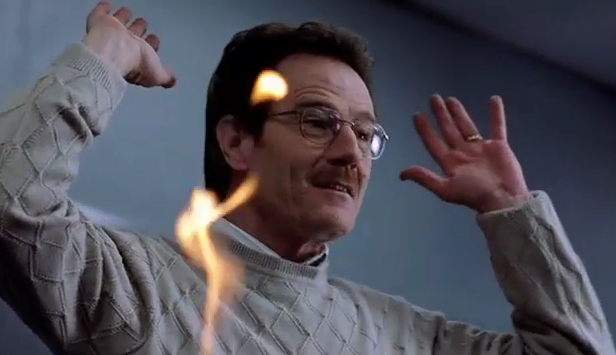
I had just walked in the door to the family home in Forestville, California. My dad had just finished the second season of Breaking Bad, specifically the episode "Phoenix," in which Walter (Bryan Cranston) passively allows Jesse's heroin-addicted blackmailing girlfriend Jane (Krysten Ritter) to choke to death on her own vomit. "I mean, he just stood there and let her die. He cried at the end, but still," my dad recounted, disgusted and amazed at the same time. Now, understand that my father is a pacifist hippie who would rather laugh than cry and much prefers Californication over Mad Men (which I give him slack for every minute I can—including while I’m writing this), but I'm sure other viewers have had a similar reaction to Walt's progression from a bumbling schoolteacher who doesn’t know where the safety tab on a gun is located to a meth kingpin, and the collateral damage in between.

Personally, I had an opposite reaction to my father’s: I feel that the show is at its strongest when it exposes the moral gray matter of Walt's decisions. Like AMC's other headliner show Mad Men, Breaking Bad doesn't excuse its protagonist's behavior like so many other shows do ad nauseum, as it reinforces and even underlines his vulnerabilities, and it boldly forgoes the safety net of having a sex symbol as a leading man. Gone are the excuses that he needs money for chemotherapy and his family. Walt has worked his way up, from Mr. Chips to Scarface, as Vince Gilligan likes to say, but now more than ever, there's nowhere to go but down. All we can do is look at him with some amount of disgust at his actions—and with amazement at how far the show has come.

Serena Bramble is a rookie film editor whose montage skills are an end result of accumulated years of movie-watching and loving. Serena is currently pursuing a Bachelor's degree in Teledramatic Arts and Technology from Cal State Monterey Bay. In addition to editing, she also writes on her blog Brief Encounters of the Cinematic Kind.

VIDEO ESSAY: A Drop of BLOOD Through the Heart – A TRUE BLOOD Tribute

VIDEO ESSAY: A Drop of BLOOD Through the Heart

It's perhaps either a fitting coincidence or a realization of my own 20-something existential crisis that the making of this True Blood montage came shortly after I completed my video contemplation of the world of Mad Men's Don Draper. The similarities might not be obvious, but they are there: While Don Draper struggles to conceal his true identity as Dick Whitman as others around him try in vain to scratch beneath the surface, Sookie Stackhouse is still on a journey to reconcile her supernatural fairy blood with her human existence.

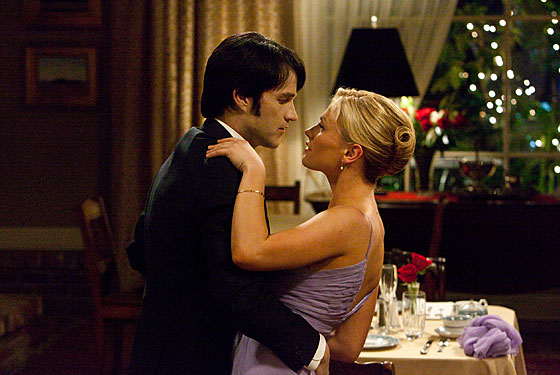
The essays contrast the question "Who is Don Draper?" with "What are you?" At its heart, True Blood is exactly about how we cope when we realize our constant, our humanity, is taken from us—new vampire Jessica's relationship with human Hoyt, shapeshifter Sam's investigation into the lives of his birth parents, and Bill's flashbacks to his first few decades as a vampire with Lorena are all examples. As the dearly departed Queen Sophie-Anne reminds Bill, "we started out [as humans] too." And when we left off in the Season 4 finale, mortality had never been more pressing than when Debbie and Tara had seemingly died—and perhaps even more shocking was Sookie's pulling of the trigger on Debbie in cold blood. I have a feeling that humanity, in addition to Tara's mortal life and Sookie's redemption, will be a huge theme in Season 5. And wild werewolves couldn't drag me away from seeing what happens next.

Serena Bramble is a rookie film editor whose montage skills are an end result of accumulated years of movie-watching and loving. Serena is currently pursuing a Bachelor's degree in Teledramatic Arts and Technology from Cal State Monterey Bay. In addition to editing, she also writes on her blog Brief Encounters of the Cinematic Kind.

‘SHOULD WIN’ VIDEO ESSAY SERIES: Best Picture TREE OF LIFE

‘SHOULD WIN’ VIDEO ESSAY SERIES: Best Picture TREE OF LIFE

[EDITOR'S NOTE: Press Play presents "Should Win," a series of video essays advocating winners in seven Academy Awards categories: supporting actor and actress, best actor and actress, best director and best picture. These are consensus choices hashed out by a pool of Press Play contributors. Follow along HERE as Press Play decides the rest of the major categories including Best Director, Best Actor, Best Actress, Best Supporting ActressBest Supporting Actor and Best Documentary. Important notice: Press Play is aware that our videos can not be played on Apple mobile devices. We are, therefore, making this and every video in this series available on Vimeo for these Press Play readers. If you own an Apple mobile device, click here.]

Narration:

All of the 2011 Best Picture nominees have their merits, but one towers above the rest: The Tree of Life, writer/director Terrence Malick's film about…well what is The Tree of Life about, anyway? For a free-associative non-linear movie that skips back and forth through time and space, and that includes a lengthy early section recounting the creation of the universe, the movie was a surprising commercial success, dominating discussion among cinephiles throughout a summer moviegoing season that is usually overshadowed by much louder, dumber movies. And at the center of the discussion were very basic questions about writing and direction – about storytelling generally – that cut to the heart of what movies are and what they can be.

nullIt's impossible to discuss the movie without posing a number of questions. Whose story are we seeing here? Is it the story of the middle-aged Jack, played by Sean Penn, and his younger self? That point of view would not account for the voiceovers and subjective sequences told from the point of view of the father, played by Brad Pitt, and the mother, played by Jessica Chastain. Is the creation sequence an integral part of the movie's vision or an unnecessary and indulgent side-trip? In the scene between the wounded dinosaur and the predator down by that prehistoric river, why does the predator seem as though he's going to crush his skull, and then suddenly back off? Are we seeing the first stirrings of the schism that is discussed and visualized in different sections of the film – the way of nature versus the way of grace? Or is there some other explanation? Is there a God in Terrence Malick's universe? The repeated shots of trees, water, clouds, sky and figures haloed or backlit by intense, almost heavenly light would seem to indicate that, yes, there is a God, but uncertainty permeates the entire story, if indeed there is a story – and this, too, was the subject of debate.

No other major American release provoked so many questions about the meaning of its images and situations, the agenda of its writer/director and the validity of its methods. And no other American release provoked such intense, personal reactions – such deep reflection – among people who saw it. Even those who didn't particularly care for Tree of Life or who had serious problems with its structure or tone seemed to respect what it was doing or trying to do. And the unusual rhythms of the filmmaking, at once fractured yet graceful, seemed to mimic the structure of thought itself. The mind races forward, the mind races backward; past becomes present, present becomes past. This is what it means to be conscious, to be alive. This is what it means to be aware of one's own mortality. These are the sensations that movies should provoke. This is the sort of reflection that movies should inspire. This is the achievement of Tree of Life. It is an original, beautiful, unique movie by a defiantly individual director, and Press Play's choice for Best Picture.

Serena Bramble is a rookie film editor and publisher of the blog Brief Encounters of the Cinematic Kind. Matt Zoller Seitz is the staff TV columnist for Salon.com and the founder of Press Play.

MAGIC AND LIGHT: THE FILMS OF STEVEN SPIELBERG: Chapter 1: Introduction

VIDEO ESSAY: MAGIC AND LIGHT: THE FILMS OF STEVEN SPIELBERG: Chapter 1: Introduction

[Editor's Note: Press Play is proud to present Chapter 1 of our first video essay series in direct partnership with IndieWire: Magic and Light: The Films of Steven Spielberg.  This series examines facets of Spielberg's movie career, including his stylistic evolution as a director, his depiction of violence, his interest in communication and language, his portrayal of authority and evil, and the importance of father figures — both present and absent — throughout his work.

Magic and Light is produced by Press Play founder and Salon TV critic Matt Zoller Seitz and coproduced and narrated by Ali Arikan, chief film critic of Dipknot TV, Press Play contributor, and one of Roger Ebert's Far Flung Correspondents. The Spielberg series brings many of Press Play's writers and editors together on a single long-form project. Individual episodes were written by Seitz, Arikan, Simon Abrams and Aaron Aradillas, and cut by Steven Santos, Serena Bramble, Matt Zoller Seitz, Richard Seitz and Kevin B. Lee To watch Chapter 2, "Blood and Pulp," about the presentation of violence in Spieberg's movies, click here. To watch Chapter 3, "Communication," click here. To watch Chapter 4, "Evil & Authority," click here. To watch Chapter 5, "Father Figures," click here. To watch Chapter 6, "Indiana Jones and the Story of Life," click here.]

Narration:

Steven Spielberg is one of the most popular storytellers of all time. Based solely on box-office receipts, that’s an inarguable fact.

It's been true since 1975, when the box office take of his breakthrough Jaws redefined the the word "blockbuster."

Look at the top grossing movies of all time, and you'll see that a startling number were produced or directed by Spielberg. And yet this almost forty-year streak hasn't been enough to insulate him against charges that he's a frivolous director – or that, at the very least, his success is an example of style, or more accurately technique, over substance. That he does not persuade or even seduce viewers, but that he overwhelms them. With sound. With light. With music. And special effects.

But a closer look at the Spielberg canon betrays a remarkable depth of feeling and consistency of vision; a recurring set of interests, expressed with increasing subtlety and dexterity over time; a distinctive moral sense; a philosophy of life.

The sheer inescapability of Spielberg makes it tempting to ignore all this; to deny it and refute it; to write him off as an essentially juvenile showman, unworthy of serious consideration, even when he's dealing in quote-unquote serious subject matter.

nullThese complaints have persisted well into Spielberg's fourth decade as a pop culture force, and it's not hard to see why. He is not a confrontational or particularly edgy filmmaker, nor for the most part does he try to be. Even his most stylistically or thematically daring films are conceived in populist terms, to reach the widest audience – the widest MARKET – possible.

The raps against Spielberg are legion, and many are hard, even impossible, to refute.

That his sensibility is fuelled primarily by movies and television and other 20th century media, rather than novels or opera or painting or other, older art forms. 

That his populism, his sentimentality, and his love of neat endings with clearly stated lessons mark him as a mainstream, perhaps even middlebrow, storyteller.

That he is the Peter Pan of cinema: The boy who refused to grow up.

And there is something so overwhelming about Spielberg, even at his subtlest, that some may be inclined to resist as a matter of course. His is a cinema of apocalyptic finales and miraculous visions. A cinema of eye-filling, eardrum-shattering immensity.

Think about Spielberg's signature images for a moment. What do you picture? The sun. The moon. Shooting stars. Menacing skies filled with biblically awesome storm clouds.

You know how students love to talk about the idea of the storyteller, or the director, as God? Well, Steven Spielberg turns that subtext into text. He makes it official. Here is a director who inscribes his signature on the elements… on the cosmos. A director, who literally or figuratively raises entire historical periods, civilizations, even SPECIES from the dead.

The fact that Spielberg is perfectly attuned to the commercial aspects of cinema does not preclude the idea that he is a master artist, who's worthy of appreciation and study. J.G. Ballard, whose memoir-novel Empire of the Sun was adapted by Spielberg back in 1987, once wrote:

"The qualities that the cineastes see as weaknesses, I see as Spielberg's strengths, and as the reason why he is one of today's most important film-makers – the producer-director who single-handedly saved the Hollywood film when it threatened to founder in the Seventies. Besides, sentimentality and spectacle have a valuable place in the arts, as in the operas of Puccini – though there are puritans who feel slightly queasy at the thought of Tosca and Madama Butterfly. In many ways Spielberg is the Puccini of cinema, one of the highest compliments I can pay. He may be a little too sweet for some tastes, but what melodies, what orchestrations, what cathedrals of emotion.""

nullIn recent decades, the notion that Spielberg is somehow trying to prove himself, or re-brand himself, or be quote-unquote serious when he moves away from action-adventure or fantasy, has come to seem increasingly quaint, shorthand for a truism that's not true anymore. It's a critical relic from a long-gone era, akin to marvelling at the notion that, say, Woody Allen or Pedro Almodovar has directed a bleak drama. Indeed, hardly anyone under the age of 40 expresses even mild surprise that Spielberg would make a film such as Schindler's List, Munich, or A.I.

The longer Spielberg directs movies, the more apparent it becomes that his is a chameleonic talent, more versatile in some ways than the talents of two of his most profound cinematic influences, Alfred Hitchcock and Walt Disney.

The phrase "A Steven Spielberg Film" no longer refers to a certain genre, or even a particular mood or mode. Over the decades it has become more elusive, mysterious and much harder to pin down. And that visible evolution – that muddying and deepening – has had a retroactive effect on his movies. Just as the so-called "serious" films reveal themselves as undeniably, obviously, overwhelmingly Spielbergian, in the late 1970s and early 1980s sense, so too do Spielberg's earlier, supposedly "lighter" films reveal their own kind of seriousness. Spielberg’s idea of personal growth is a crucial aspect of all his films. He puts his characters through almost Biblical tests that would have made Job say, "Well, that's a bit much, isn't it?" They come out of the other side as better, more mature, more sensitive people, but at terrible cost.

Simply put, Steven Spielberg was always a serious filmmaker, just as Disney and Hitchcock, and John Ford and Howard Hawks, and Sam Peckinpah and Martin Scorsese, were always serious. Spielberg is, and always was, an auteur by any measure. A reliable purveyor of richly imagined, thoughtfully constructed entertainment and art.

nullThis series will examine just a few of Spielberg's key obsessions and motifs, as expressed over a wide range of films, released over four decades. We'll look at the influence of pulp fiction, serials and comic books on Spielberg's skillful depiction of violence – and how he learned to modulate it over time, in ever more varied ways. We'll look at the importance of communication and translation in Spielberg's films: the director's evident conviction that curiosity and goodwill can overcome superstition, bigotry and fear. We'll examine Spielberg's multifaceted portrait of evil and authority, and how the two intertwine, and express themselves in some of his most important characters. And we'll look at the director's sometimes warm, sometimes harrowing portrait of family life, with its negotiations and compromises, disappointments and tragedies — and the pivotal role played by father figures. Cold and loving. Present and absent.

As we shall see, Spielberg is in some ways a more complex and multifaceted filmmaker than even his fans give him credit for.  Beneath the explosions and effects; the slapstick and thrills; the emotion and wonder; lies an acute sense of right and wrong.  An appreciation of human weakness. An awareness that we are capable of great cowardice and cruelty. And that, even under the worst of circumstances, we can do great things. He is an exuberant showman. A stealthy artist. And a master of magic and light.

A critic, journalist and filmmaker, Matt Zoller Seitz is the publisher of Press Play, the staff TV columnist for Salon.com and a finalist for the Pulitzer prize in criticism. Ali Arikan is the chief film critic of Dipnot TV, a Turkish news portal and iPad magazine, and one of Roger Ebert’s Far-Flung Correspondents. Ali is also a regular contributor to The House Next Door, Slant Magazine’s official blog. Occasionally, he updates his personal blog Cerebral Mastication. In addition, his writing appears on various film and pop-culture sites on the blogosphere. You can follow his updates on twitter at twitter.com/aliarikan. Serena Bramble is a rookie film editor whose montage skills are an end result of accumulated years of movie-watching and loving. Serena is currently pursuing a Bachelor's degree in Teledramatic Arts and Technology from Cal State Monterey Bay. In addition to editing, she also writes on her blog Brief Encounters of the Cinematic Kind.

CHAPTER ART: MAGIC AND LIGHT: THE FILMS OF STEVEN SPIELBERG debuted Dec. 15

CHAPTER ART: MAGIC AND LIGHT: THE FILMS OF STEVEN SPIELBERG debuts tommorow

nullnullnullnull

null

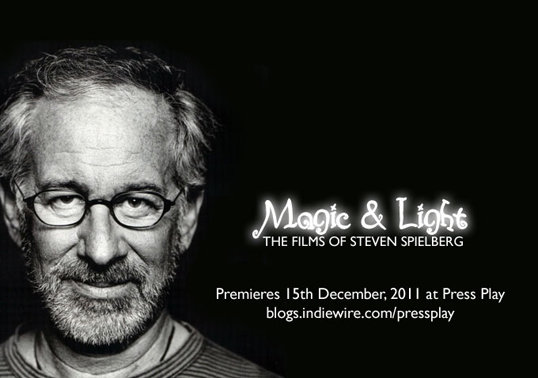
Press Play's first video essay series in direct partnership with IndieWire: Magic and Light: The Films of Steven Spielberg.  Beginning Dec. 15, 2011 at Press Play, this series examines facets of Spielberg's movie career, including his stylistic evolution as a director, his depiction of violence, his interest in communication and language, his portrayal of authority and evil, and the importance of father figures — both present and absent — throughout his work.

Magic and Light is produced by Press Play founder and Salon TV critic Matt Zoller Seitz and coproduced and narrated by Ali Arikan, chief film critic of Dipknot TV, Press Play contributor, and one of Roger Ebert's Far Flung Correspondents. The Spielberg series brings many of Press Play's writers and editors together on a single long-form project. Individual episodes were written by Seitz, Arikan, Simon Abrams and Aaron Aradillas, and cut by Steven Santos, Serena Bramble, Matt Zoller Seitz, Richard Seitz and Kevin B. Lee. For a taste of Magic and Light, check out the chapters above. The trailer for this series is here. Chapter 1 of the series is here. — Editors

The Art of MAGIC & LIGHT: THE FILMS OF STEVEN SPIELBERG

The Art of MAGIC & LIGHT: THE FILMS OF STEVEN SPIELBERG

nullnullnullnullnullnullnull

null

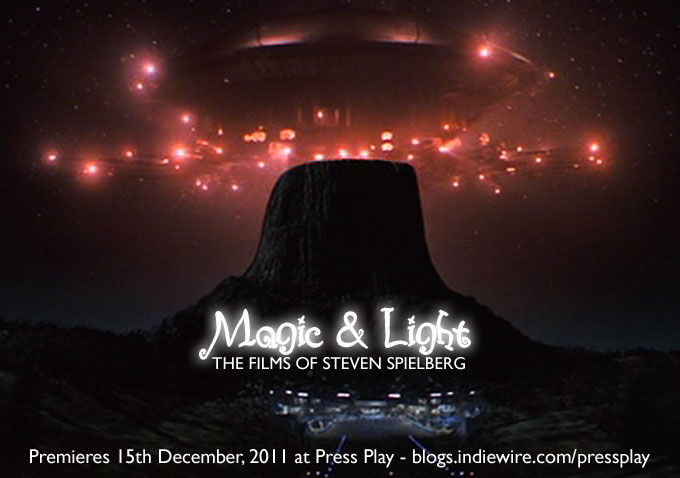
MAGIC & LIGHT: THE FILMS OF STEVEN SPIELBERG premieres Dec. 15 at Press Play. Check out these eye-popping title cards. As they used to say of CLOSE ENCOUNTERS trading cards back in the '70s, collect them all!

[Editor's note: These are graphics designed by Boke Yuzgen to promote the Press Play original video essay series Magic and Light: The Films of Steven Spielberg, which will premiere Dec. 15 on this site. The series is produced by Matt Zoller Seitz and Ali Arikan and narrated by Arikan. It brings the talents of many Press Play contributors together on a single project.  The individual chapters are written by Seitz, Arikan, Simon Abrams and Aaron Aradillas, and edited by Steven Santos, Matt Zoller Seitz, Richard Seitz, Kevin B. Lee and Serena Bramble.]

Press Play video series MAGIC AND LIGHT: THE FILMS OF STEVEN SPIELBERG to debut Dec. 15, 2011

Press Play video series MAGIC AND LIGHT: THE FILMS OF STEVEN SPIELBERG to debut Dec. 15, 2010

Magic and Light: The Films of Steven Spielberg (HQ) from Serena Bramble on Vimeo.

Press Play is proud to announce our first video essay series in direct partnership with IndieWire: Magic and Light: The Films of Steven Spielberg.  Set to premiere Dec. 15, 2011 on this blog, this series will examine facets of Spielberg's movie career, including his stylistic evolution as a director, his depiction of violence, his interest in communication and language, his portrayal of authority and evil, and the importance of father figures — both present and absent — throughout his work.

Magic and Light is produced by Press Play founder and Salon TV critic Matt Zoller Seitz and coproduced and narrated by Ali Arikan, chief film critic of Dipknot TV, Press Play contributor, and one of Roger Ebert's Far Flung Correspondents. The Spielberg series brings many of Press Play's writers and editors together on a single long-form project. Individual episodes were written by Seitz, Arikan, Simon Abrams and Aaron Aradillas, and cut by Steven Santos, Serena Bramble, Matt Zoller Seitz, Richard Seitz and Jose Salvador Gallegos. For a taste of Magic and Light, check out the embeddable trailer above, which was edited by Serena Bramble. — Editors

LIFE’S WORK: THE FILMS OF ROMAN POLANSKI – Chapter 1: Polanski’s God

LIFE’S WORK: THE FILMS OF ROMAN POLANSKI – Chapter 1: Polanski’s God

Polanski's God from Serena Bramble on Vimeo.

[EDITOR'S NOTE: Press Play is devoting much of its content this week to a study of the films of Roman Polanski, whose new movie Carnage opens the New York Film Festival this Friday, September 30. We will count down to the event by running a new video essay every day this week under the title Life's Work: The Films of Roman Polanski. We're kicking off the series with "Polanski's God," about the pessimistic, bleakly funny world view expressed in the majority of Polanski's films. This video essay is a collaboration by two Press Play contributors. Simon Abrams contributed the narration; Serena Bramble edited.]

By Serena Bramble and Simon Abrams
Press Play Contributors

TRANSCRIPT: "Polanski's God," narrated by Simon Abrams; edited by Serena Bramble

I think people who go to see [Roman Polanski's films] for escapism are not going to be necessarily disappointed, but they're going to have to tweak their understanding of what entertainment is. When you watch a Polanski film, you're watching this sense of abundance in them. They have very cheerful settings — deceptively cheerful. You get the sense that you're watching the seasons change from this brightness to this inner gray that takes over.

Violence in Polanski's film is psychological. It's largely implied and it's rarely explicit, and when it is explicit, it's for comedy's sake. When Jake gets his nostril slit in Chinatown, he looks ridiculous for the rest of the film, with the bandage on his nose.

[Clip from Chinatown]

Jake: But. Mrs. Mulwray, I goddamned near lost my nose. And I like it. I like breathing through it. And I still think that you are hiding something.

The aftermath of [the attack on Jake] is constantly rubbed in your face as very this silly thing to look at — whereas the lingering type of violence in [Polanski's] films is always something that's creeping and slow and under the skin that his characters have to deal with, with greater understanding of things. It's like the way that certain (H.P.) Lovecraft stories work. You get the biggest scares out of knowing things you didn't before. Well, that necessarily means that you have to build in stages to an ultimate sense of understanding, an ultimate sense of knowledge that will really destroy you, that will really violently upend you.

[Clip from Chinatown]

Evelyn Mulwray: She's my sister. She's my daughter. My sister. My daughter.

Jake: I said I want the truth.

Evelyn Mulwray: She's my sister and my daughter.

And that's why it's necessarily a creeping kind of violence. It's a kind of series of reversals, and really, implied actions.

Jake: He raped you?

With films like The Ghost Writer and The Tenant, you get the sense that these characters are dealing with their trauma as they're figuring out that it's happening to them. And that's fascinating.

There are no traditional good guys and bad guys in Polanski's films. They're typically much more ambiguous. But obviously there are exceptions that prove the rule. They're just people you don't want to spent time with. But, after a point, you just recognize that you're watching their lives disintegrate, and that's as close as you get to identifying with them, because you're watching them. You're sutured into the degradations of disintegration, and you can help but feel for them. But you don't like them after a point.

I don't think evil, in a traditional theological sense, exists in Polanski's films. I think you've got characters like John Huston's character in Chinatown. They are deeply self-interested. They are deeply self-involved. They are not necessarily out for anyone else's interest but [their own]. But, after a point, that [describes] everyone. The problem is that certain characters have more of an advantage than others, and those are usually the bad guys. Those usually the ones that are able to be more manipulative and exploitative than the little guys that Polanski's film follow with the understand that you want these characters to succeed very badly, even though they almost never can.

[Clip from Chinatown]

Jake: How much you worth?

Noah Cross: I have no idea. How much do you want?

Jake: I just want to know what you're worth? Over ten million?

Noah Cross: Oh my, yes.

Jake: Why are you doing it? How much better can you eat. What can you buy that you can't already afford?

Noah Cross: The future, Mr. Gittes! The future!

[Clip from The Ghost Writer]

Former Prime Minister Adam Lang: I've never taken orders from anyone. Whatever I did. I did because I believed it was right.

The Ghost: Even supporting illegal kidnapping for torture?

Adam Lang: Oh for God's sakes! Spare me the bleeding heart bullshit!

[The Ghost Writer] is a Polanski thriller through and through. It may be very similar in content to [Robert] Harris' novel — like the plot beats and everything. But the tone, and the way it moves, and the way the characters are essentially motivated and governed by the powers that be in that film, that's Polanski. Totally.

I think Polanski is not quite an atheist. But, I think that agnosticism is a lot closer to his belief system in many of his movies. You get this idea that [there] is something going on, there is some higher power or powers out there, and they're manipulating the characters in his films. But they're not always following a set plan, beyond the fact that they're gonna screw with these main protagonists. In that sense, for the longest time you can get the sense that there is no one up there, like in the beginning. And then, and then you get the idea that there is [someone up there] — and he hates you.

[The end of ] The Ghostwriter is the perfect example. The Ewan McGregor character gets hit by a car. We don't see it. There is not explicit violence. All the work that he did in the film doesn't matter. All the research, all the knowledge that he's accrued doesn't matter. It's all gone to pot, and he's dead.

Chinatown is another great example because it has that ending where the Jake character's totally resigned. He hasn't quite lost, but he knows he can't win. He has this absolute sense of certainly now that there is no viable way to continue with his investigation. He's not quite ready to throw in the towel, but it's so out of his hands that — that's it. That's the epitaph of his investigation. And beyond that, he just has to accept it. He just has to take it.

[Clip from Chinatown]

Walsh: Forget it, Jake. It's Chinatown.

The interesting thing about The Pianist is that [it's about] a character that just wants to play his piano and be well off, to continue doing it on a steady basis. And he's not allowed that because of the historical context of the times. As Polanski had the impact of losing his wife to the Manson clan, that obviously informs this bleak, agnostic opinion, and that's why when you see The Pianist, survival is enough. Survival is its own victory, and I think [The Pianist has] one of most optimistic endings of any of his films, because you get the sense that [the hero] has won because he made it, as opposed to all the other films of his — especially Knife in the Water, where surviving is that much more hellish because all of these characters have been through a gauntlet and [gained] a greater sense of understanding is that there is no one up there, no entity that they can identify with.

There is something up there. But it's not understandable. You can't discern the motives of God, or of a deity like that. You just have to go with the fact that something's happening, wheels are in motion, and it's just like a giant Rube Goldberg machine, and you get out of it at the end. That's great. It never gets better. It just keeps going. That's life for Polanski.

Serena Bramble is a rookie film editor whose montage skills are the result of accumulated years of movie-watching and loving. Serena is currently pursuing a bachelor's degree in Teledramatic Arts and Technology from Cal State Monterey Bay. In addition to editing, she also writes on her blog Brief Encounters of the Cinematic Kind.Simon Abrams is a New York-based freelance arts critic. His film reviews and features have been featured in the Village Voice, Time Out New York, Slant Magazine, The L Magazine, New York Press and Time Out Chicago. He currently writes TV criticism for The Onion AV Club and is a contributing writer at the Comics Journal. His writings on film are collected at the blog, The Extended Cut.