OSCARS DEATH RACE: WAR HORSE

OSCARS DEATH RACE: WAR HORSE

null[EDITOR'S NOTE: Fearless Sarah D. Bunting of Tomatonation.com is making it her mission to watch every single film nominated for an Oscar before the Academy Awards Ceremony on February 26, 2012. She is calling this journey her Oscars Death Race. For more on how the Oscars Death Race began, click here. And you can follow Sarah through this quixotic journey here.]

nullIn his review of War Horse for IFC.com, Matt Singer noted that "I did like one scene which is complete enough as its own unit of story and character that it could be pulled out of the film and played as its own short subject." The scene, of course, is the one in which said horse, Joey, makes a gallop for freedom but becomes hopelessly entangled in the barbed wire that separates the British and German lines. A soldier from each side comes out to aid Joey; for a moment, the Great War pauses to admit compassion — and Steven Spielberg pauses to work small.

I wish Spielberg had made a short subject, or even a trim feature, of that central moment, as it's free of everything that frustrated me about War Horse in its entirety: the insistent soundtrack that shoves us to and fro with plaintive piccolos and blatting-brass "hilarity"; the cartoonish attempts to show Joey (who is, after all, played…by a horse, and only expressive in certain ways) bonding with other horses and showing great heart and willing himself to escape and blah blah courage blah; the redundant exposition about Joey's many fine and remarkable qualities; the Saving Private Neighin' set pieces that strain to point up the horrors of war. The bit does contain continental characters speaking accented English instead of their native tongues, but that has a purpose here, at least, and isn't as Alcottsy and deadly dull as the Emilie sequence. (Or as poorly done. Top Secret! had better French accents.)

nullThe plot, in brief: Joey is bought at auction by drunk seldom-do-well Ted Narracott (Peter Mullan, too broad) to show up his rich landlord. Joey's not a plowhorse, he's a Thoroughbred, but Ted's son Albert (the promising Jeremy Irvine) bonds with Joey immediately, and swears he can break the colt to plow and get the rocky field tilled by the deadline. After this Rocky-of-the-shire moment, Joey is basically drafted into the British army — but by an officer who appreciates the special hoof-flake and promises Albert he'll get Joey home safe. Joey befriends another horse, Topthorne; escapes from various warlike tasks; gets caught in wire; and…cures the blind? Just go with it.

I rode horses as a girl, and worked as a stablehand in high school (the horse I had charge of was a goofy little blood bay named Indiana Jones, in fact) — I wanted to like War Horse, and I went into it prepared to write off the schmaltz and soaring strings that so often go with horse movies. But it's just too long, with too many breaks for Bazooka-Joe "humor" and sick-child moralizing. I gasped at the beauty of several of the shots or sequences, like the cavalry mounting up in the tall grass, and the expert editing of the cuts between the oncoming charge and the merciless gunners getting hurdled by riderless horses; that bit in particular would have gutted me in the fourth grade.

But this isn't the fourth grade; we know Spielberg can "do this." He does it here and he does it well, but the real accomplishment from the man at this point would be resisting the urge to hold our hands every minute, or setting himself the challenge of getting it in under 110 minutes on the first cut. Hell, re-cut this one — and boot that flatulent over-closed ending. I know many other reviews have mentioned the Gone with the Wind Technicolor skies, but: seriously! It's so over the top, you almost think he's joking! But it's Spielberg; he doesn't joke.

…Except in that barbed-wire sequence, which has a lightness to the banter, and gets at the message Spielberg is trying to send almost accidentally. The horror of war isn't always the barrage; sometimes it's the silences between, as in that scene with "enemies" working together and knowing the moment must end. The scene asks little of the horse except that he remain still, a symbol (which is how they work in our culture anyway, often), and subtracts the relationship with Albert, which starts out with a naïve sweetness but soon begins to seem rather weird. It doesn't show off. There isn't a cello. It's just a little story.

War Horse is handsome to look at; like Star Wars III, I'd have liked it more with my iPod in and some Handel playing. You want a real horse tearjerker, watch yourself some Phar Lap. You'll need IV fluids by the end.

This film's Oscar chances read to me as slim; the nominations may have been a gesture of respect, but it's not tapped for Best Director, so who knows. The score is diabetic and should not win; the cinematography could, and I would not hate that victory, but I wouldn't pick it.

Sarah D. Bunting co-founded Television Without Pity.com, and has written for Seventeen, New York Magazine, MSNBC.com, Salon, Yahoo!, and others. She's the chief cook and bottle-washer at TomatoNation.comFor more on how the Oscars Death Race began, click here.

OSCARS DEATH RACE: EXTREMELY LOUD AND INCREDIBLY CLOSE

OSCARS DEATH RACE: EXTREMELY LOUD AND INCREDIBLY CLOSE

null

Oskar Schell (Thomas Horn) lost his father, Thomas (Tom Hanks), on 9/11. About a year later, Oskar finds what he thinks is a message meant for himself in his father's closet: an envelope with the word "Black" written on it, and a key inside. Inspired by the memory of the myth-burnished scavenger hunts his father used to devise for him — both as a bonding agent between them and a way for Oskar to confront his phobias — Oskar decides that "Black" is the name of someone who knew Thomas, and sets out to find that someone. No matter that there are 472 of them in the New York City phone book, or that this won't change anything; he thinks it's what his father meant him to do.

nullIt's the type of Rube Goldberg plot I usually dig, and would have really dug at Oskar's age; at Oskar's age, I also cherished a number of compulsions and superstitions about deaths in the family and how they might be warded off or, after the fact, solved for X. Extremely Loud and Incredibly Close has the tools to become a movie I would love.

I did not love it. I did not love that the so-called revelation about Schell Sr.'s farewell answering-machine messages "revealed" nothing and hinged on an idiot plot — that Oskar's mother Linda (Sandra Bullock) wouldn't run straight to the machine, or check it after asking whether Thomas called, or notice that the answering machine had disappeared, is ridiculous. I did not love Horn's performance; it is a difficult role, I realize, but what is meant as realistic "spectrum behavior" seems mostly like an inexperienced actor tasked with a gamut of emotions and nuances he's not ready for. (His scenes with Viola Davis emphasize this.) I did not love the tics substituted for traits, or how the film idealizes Thomas to an unrelatable degree while really telling us nothing about him.

The film is a smug, twee gallery audio tour of a family's and a city's grief. Put on the headphones provided; proceed to the first image; listen to the facts we have selected for you. When you hear the ping, move to the next dot on the floor. At the conclusion of the tour, which will linger fetishistically on some things and rush past others that fail to resolve neatly, you will receive a complimentary tote bag. We ask that guests avert their eyes from the loose ends. Thank you for visiting the Closure Museum.

nullIt's not the pimping of 9/11 that makes EL&IC so off-putting. It's the tying of the handmade-art-project bow around Oskar's mourning — there's another bereft son out there! Mommy understands me! All better now! As overused and itchy a term as closure has become, it is the entire purpose of fictional narrative to impose order on chaos, and to bestow closure or peace on a child when perhaps we can't in life is of course enormously appealing. But the film doesn't trust its own hero. It has to tell us constantly how special and determined and pitiable Oskar is, cut in footage of him ranting uncontrollably (or another variation on Linda, hand clasped over her mouth, weeping silently through the twinkle of her engagement setting), team him up with a "mysterious" boarder at his grandma's house who speaks in notes and YES/NO tattoos on its hands, or, failing all of that, another shot of the Towers going down, like, for the love of beer and skittles! If you want me to cry, pluck one of my eyelashes and save yourself some time, but if you want an Oscar for the privilege, how about you not act like we're all too goddamn stupid to comprehend, or scale, a tragedy without the aid of a jingling tambourine? It's manipulative and condescending, and whether it's the book or the script, I resent it. Not every boy on a journey is Odysseus, or even Luke Skywalker, but Oskar only has to be the boy the story cares about, and he isn't. He's a tool for drawing parallels and jerking tears. Contempt for my perception duly noted, and returned in kind.

Max von Sydow does a wonderful job pretending that his character isn't a gimmick — if it's not the face he pulls in response to "Are you a stranger, technically?" that got him the nomination, it's the one he makes when he's awakened by a juice-box straw — but the man played chess with Death, for God's sake. Write the part with half an inch of depth.

Sarah D. Bunting co-founded Television Without Pity.com, and has written for Seventeen, New York Magazine, MSNBC.com, Salon, Yahoo!, and others. She's the chief cook and bottle-washer at TomatoNation.comFor more on how the Oscars Death Race began, click here.

OSCARS DEATH RACE: PUSS IN BOOTS

OSCARS DEATH RACE: PUSS IN BOOTS

null

[EDITOR'S NOTE: Fearless Sarah D. Bunting of Tomatonation.com is making it her mission to watch every single film nominated for an Oscar before the Academy Awards Ceremony on February 26, 2012. She is calling this journey her Oscars Death Race. For more on how the Oscars Death Race began, click here. And you can follow Sarah through this quixotic journey here.]

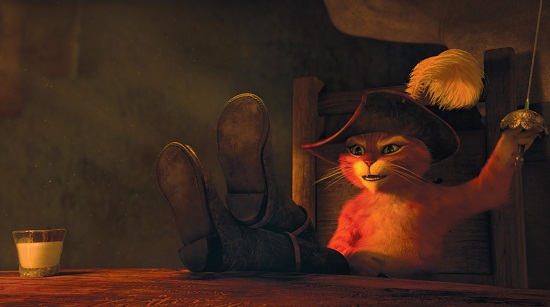
I bailed on the Shrek franchise after the first movie; I didn't really like it and I didn't need any more of it. So, either I forgot or never knew that the titular puss in Puss In Boots is a character from the second Shrek installment, which probably let me enjoy the story and the jokes without any expectations to live up (or down) to.

nullAnd for the first hour, I did enjoy said story. It's a similar fairytale/Zelig kind of a thing, with Puss (Antonio Banderas) teamed with Kitty Softpaws (Salma Hayek) and Humpty Dumpty (Zach Galifianakis), his former bestie and current nemesis, for one-last-heist/clearing-of-good-name fun times. The animation has an uncanny-valley issue or two vis-à-vis the felines having human teeth etc., but for the first half-hour, things move too fast for that to register, and the humor is rimshotty (Puss's thunderous "the egg betrayed me!" punctuated by Kitty snoring; the talking-to-plants crack that sets off the giant beanstalk) but enjoyable. Humpty is very funny, not least in his heel turn towards the end, and that "I was always there" montage cracked me up (as did his outfits, and I would like to thank the animation team, or whomever, for understand that, if you anthromorphize an object, you must then put some pants on it/him).

But the clever asides about catnip (Puss is using it "for his glaucoma") and the exciting free fall with the leaf parachutes go off the boil about halfway through. It's like the writers — and there are six credited, so go figure — didn't know how to end it. The result feels like each of the six wrote a climactic scene; all of those scenes stayed in; and then, after the last one, the story just kind of bah-dum-bummed offstage all, "Okay, my ride's here, so…see you guys at the sequel, 'kay?" Well, you killed off the best character in it, so: pass.

I giggled several times. It's fine. It won't win its category.

Sarah D. Bunting co-founded Television Without Pity.com, and has written for Seventeen, New York Magazine, MSNBC.com, Salon, Yahoo!, and others. She's the chief cook and bottle-washer at TomatoNation.comFor more on how the Oscars Death Race began, click here.

OSCARS DEATH RACE: Surveying the race for Best Documentary

OSCARS DEATH RACE: Surveying the race for Best Documentary

null

[EDITOR'S NOTE: Sarah D. Bunting of Tomatonation.com is watching every single film nominated for an Oscar before the Academy Awards Ceremony on February 26, 2012. She is calling this journey her Oscars Death Race. She has completed the category for Best Documentary and now surveys the competition. For more on how the Oscars Death Race began, click here. And you can follow Sarah through this quixotic journey here.]

nullAh, Best Doc — where the short list gets the finger-pointing and pearl-clutching underway early. I like to imagine Steve James watching the Oscars at home with a bottle of Goldschlager and a Krazy Straw, wearing PJs with basketballs on them, because as you probably heard, he didn't get nominated. (Again.) Let's look at what did.

The nominees

Hell and Back Again: Compelling traditional-structure doc with a likeable subject whose sound-editing tricksiness could work either for or against it. Topicality of subject matter may give it a slight edge.

If a Tree Falls: A Story of the Earth Liberation Front: Also compelling and topical, also straight-ahead in structure; very well done and informative

Paradise Lost 3: Purgatory: I think very highly of the filmmakers' previous two works on the subject of the West Memphis 3, whose release I supported. Attending a New York premiere of the film with the WM3 present was a thrill. With that said, the film qua film is rushed and collage-y, and I'm not sure viewers not familiar with the case and/or the other films would get much from it. The ending changed on the filmmakers, and they did well with that circumstance, but in theory, the Oscar rewards the best in the category, not the happiest ending. In practice…this probably wins.

Pina: …Unless this wins. I think it's between PL3 and Pina; the latter has the edge in its use of technology, and it pushes the form harder. It may also push the audience…into a nap? It won me over, but this may not be a film Academy voters will force themselves to see.

Undefeated: Entertaining enough for an hour and a half, and another charismatic subject, but may seem somewhat familiar or not "issues-y" enough to voters.

Who shouldn't be here: May not be the right question. It's more of an apples-and-oranges issue, and we have three apples (the more traditional docs) and an orange (a doc that's more of a recap, tied to a news event) and…a kiwi, in a way (dance experiment/elegy), so it's not that the apples in question don't rate; it's which fruit the Academy is in the mood for. See below.

Who should be here, but isn't: Like the apples metaphor? …Too bad, we're stuck with it. So: as apples go, I think The Interrupters (airing this week on Frontline, I believe) and Project Nim are a little tastier than Undefeated. Conan O'Brien Can't Stop did some interesting things, in spite of pacing issues and O'Brien presenting as rather off-putting.

Who should win: Pina.

Who will win: The WM3 is a tough arc to resist, but I'm calling it for Wenders and Ringel.

Sarah D. Bunting co-founded Television Without Pity.com, and has written for Seventeen, New York Magazine, MSNBC.com, Salon, Yahoo!, and others. She's the chief cook and bottle-washer at TomatoNation.comFor more on how the Oscars Death Race began, click here.

OSCARS DEATH RACE: Pina

OSCARS DEATH RACE: Pina

null

[EDITOR'S NOTE: Fearless Sarah D. Bunting of Tomatonation.com is making it her mission to watch every single film nominated for an Oscar before the Academy Awards Ceremony on February 26, 2012. She is calling this journey her Oscars Death Race. For more on how the Oscars Death Race began, click here. And you can follow Sarah through this quixotic journey here.]

Pina made me impatient for at least an hour. A small part of it is seeing the film at BAM, where arriving at the specified showtime is considered entirely optional and in fact rather bourgeois, but whispering knowingly throughout the film is considered mandatory. A much larger part of it is the medium of dance; I respect it, and especially its physical demands, but it's…not my way, I guess. My response to "some situations have no words" is not "express the situation via the body." It's "get a thesaurus and try again."

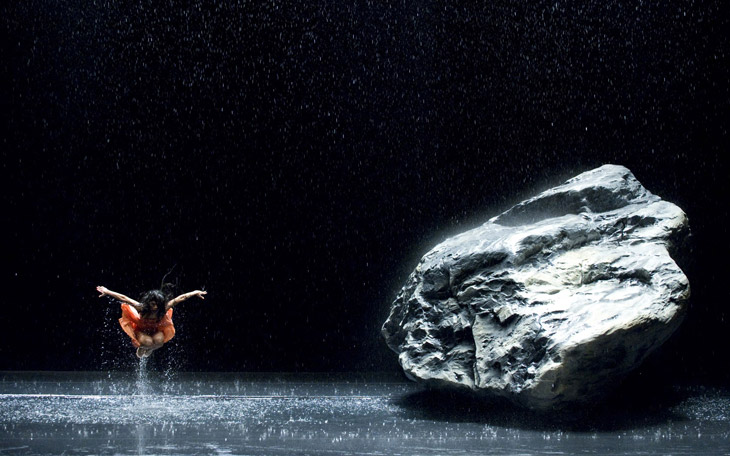
nullAnd another large part of it is co-director Wim Wenders, who, in my experience, is more than happy to wait out the whiny-squirmy "get to the point, just tell me what's important, this is boring" viewer — which is my way — and let the images and moments accumulate. You don't so much get to the point as realize that it's surrounded you since the beginning. I don't know Wenders's work all that well, actually; this is just my impression, and it's certainly the case with Pina, a 3D documentary that's a dance concert movie, and an experiment with re-setting dance out into the world, and a working-through of loss by a dance company whose forceful and incisive leader has died. (Pina is Pina Bausch, artistic director of Tanztheater Wuppertal Pina Bausch; she passed away just days before principal shooting was to begin.)

The decision to shoot in 3D is understandable, but I don't know that it's necessary to the film's power. Some of the choreography is, in my opinion, overly obvious and earnest, and the grand plié denoting childbirth or the "I am floppy with grief" sequences aren't any fresher for seeming to happen in your lap. But the depth of field in the staging brings out a lot of cool visuals: dancers flashing through the foreground, water spinning outwards, men appearing as if from nowhere or out of a giant rock.

Still, the recurring themes of compulsion, inspection, the rearranging of the self don't require the eyes in order to have their effect. The pain and joy of the reverent interstitials, then reflected in dances on trams and in intersections and along hilltops, don't require glasses. The moment where a man curls up, sad, relieved, drained, at rest, on a woman's flat back as she walks is the moment where I realized I'd been there all along.

Absolutely not for everyone, Pina, but it's one of those movies I thank the Death Race for each year because it's knocked me a couple degrees to one side.

Sarah D. Bunting co-founded Television Without Pity.com, and has written for Seventeen, New York Magazine, MSNBC.com, Salon, Yahoo!, and others. She's the chief cook and bottle-washer at TomatoNation.comFor more on how the Oscars Death Race began, click here.

OSCARS DEATH RACE: THE MUPPETS

OSCARS DEATH RACE: THE MUPPETS

null

[EDITOR'S NOTE: Fearless Sarah D. Bunting of Tomatonation.com is making it her mission to watch every single film nominated for an Oscar before the Academy Awards Ceremony on February 26, 2012. She is calling this journey her Oscars Death Race. For more on how the Oscars Death Race began, click here. And you can follow Sarah through this quixotic journey here.]

I loved the Muppets as a kid — The Muppet Show is one of the few programs my parents' ambitious first-child rules about TV would allow — and I remember them fondly. But I had misgivings about The Muppets going in, for two reasons. The first is that, while I like Jason Segel, he works better for me as a seasoning and not the main course.

nullThe second reason, which I admit knowing full well that this is the internet equivalent of climbing Wolf Mountain wearing a steak suit, is that I don't like Miss Piggy, at all. I never did. The "hiiiii-YA!", the "moi," the Scarlett-O'Hara-class come-here-go-away nonsense with Kermit: no thanks. If it was always intended as a meta commentary on high-strung actresses or something, well, my bad, but I don't care for it.

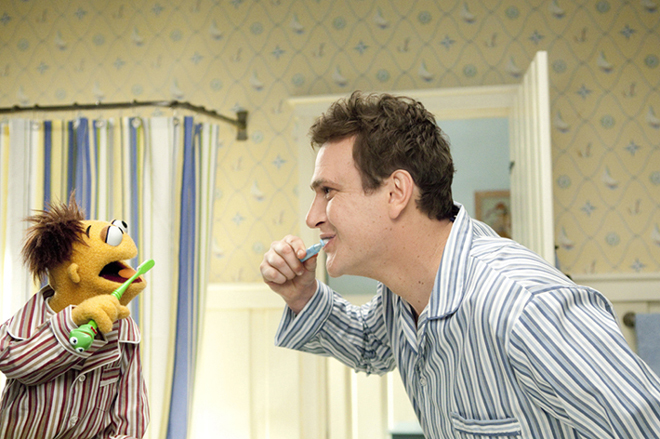
I didn't care for The Muppets either, and Miss Piggy is kind of a bitch in it but it isn't her fault (or Segel's; he fully commits to Gary and his various soppy subplots). It's the storyline about Walter, Gary's Muppet brother and world's biggest Muppets fan, finding his place in the world and believing in himself and whatnot — a perfectly functional concept whose execution here is problematic. Again, Gary (a human) and Walter (a Muppet) grew up together. Gary is apparently around 30, which would put Walter in his late 20s, probably, and yes, it's a kids' movie, but what's up with their still sharing a twin-beds Bert-and-Ernie domicile? If that's the house they grew up in, what became of their parents? This isn't even getting into the arrested-development issues Gary's having: son, you don't keep a girlfriend played by Amy Adams waiting ten years for a ring. She teaches a car-repair class, in a circle skirt and pumps! Also, she's Amy Adams. I know that's the point, but the problem here…is that it's Amy Adams. (She's charming in the film, in spite of the "it's me or the dog" bit she has to play.)

And then you find yourself troubled with all these larger existential questions about Muppet aging — they split up how long ago? Which makes them how old now? Are they…old old? The Eighties-Robot gag is okay (I enjoyed visiting with vintage soda-can fonts), but then you can't stop wondering how we're meant to understand "Muppet years" and whether they can die or they just get unstuffed or what.

And then you down a half-inch of bourbon and wander back to your point, and here it is: the movie treats Walter like he's still a child. That doesn't really line up timing-wise, and Walter is just kind of a wet end in the second place. It's great that he finds his people (well, "people"), and he's a hell of a whistler, but that subplot draaaaags. The main plot, in which the Muppets must reunite to save their theater from an evil land developer (Chris Cooper, who tries heroically, but I hope he fired his agent after he had to rap), is also a foregone conclusion, but between the meta jokes from Waldorf and Statler about how they're announcing plot points; the Scandinavian diacritical marks on the Chef's subtitles; the Chiba-esque credits sequence for kidnapping Jack Black; and sundry cameos, that story is more spritely. The Walter stuff that felt shoehorned in for children/people unfamiliar with the franchise felt damp and simplistic.

The nominated song, "Man or Muppet," is why we're all here. It's not good, and not just because forces Walter to sing that he's "a very manly Muppet." Blech. Still, expect to see Mr. The Frog up at the podium on Oscar night.

Sarah D. Bunting co-founded Television Without Pity.com, and has written for Seventeen, New York Magazine, MSNBC.com, Salon, Yahoo!, and others. She's the chief cook and bottle-washer at TomatoNation.comFor more on how the Oscars Death Race began, click here.

OSCARS DEATH RACE: Anonymous

OSCARS DEATH RACE: Anonymous

null

[EDITOR'S NOTE: Fearless Sarah D. Bunting of Tomatonation.com is making it her mission to watch every single film nominated for an Oscar before the Academy Awards Ceremony on February 26, 2012. She is calling this journey her Oscars Death Race. For more on how the Oscars Death Race began, click here. And you can follow Sarah through this quixotic journey here.]

I'd rather have seen a Noises Off-style story about what's going on backstage at the modern-day framing-device production that opens Anonymous — actors rushing to their places; the stage manager lighting torches with one of those little lighters chefs use to fire a crème brulee — than the film I got. Of course, I'd rather have seen a root canal than what I got; I recoiled physically from the trailer all "ohhhh no no no no no," because if a buddy/heist movie is Buntnip, a costume drama concerning Shakespeare and the dirty-haired era in which he worked is…whatever the opposite of that is. Red Byptonite?

nullDoesn't matter. A costume drama/conspiracy pic that attempts to argue for historical William Shakespeare (the enthusiastic Rafe Spalls) as an illiterate creeper, whom the Earl of Oxford (Rhys Ifans, one of the only compelling things in the film) uses as a writing beard via some pimping help from Ben Jonson (Sebastian Armesto, one of the…things in the film), is just not for me — at least, not one that takes itself and its theory this seriously. One scene in particular came to illustrate this problem: the young Earl of Oxford (Jamie Campbell Bower) has just boned Queen Elizabeth (Joely Richardson in the flashbacks). He offends her somehow, so she squalls at him to get out, but undaunted and barely clothed in a dingy damask something-or-other, he starts sonneting at her, and she's so ensorcelled that he's getting a beej by the closing quatrain. And…look, real talk? This is why a lot of dudes start writing poetry to begin with — God knows it ain't the big bucks — and often enough, it works. Fine. Just play it that way and make the joke, instead of positioning the moment, and all the others, as a portentous slo-mo high-five between political stagecraft and the literal version. That's the issue with Anonymous. It's not that the subject isn't my thing, or that the Shakespearean quotations selected aren't imaginative, or that some of the players aren't quite up to their tasks, although those things don't help. It's that Roland Emmerich is known for, and fairly good at, ripping yarns, and he unwisely treats Anonymous like a middle-school educational-theater field trip. And that's exactly how it feels.

…Most of the time. Whenever Xavier Samuel is onscreen, it feels like a time machine back to Jersey in the '80s. "The Earl of Southampton"? Try "the Earl of South Amboy" — I haven't seen a perm that crunchy since Hunka Bunka.

The film isn't awful. Ifans is great, and the movie seems to grab its gears better whenever he's onscreen; the stunt-casting of Richardson as the younger QE and Vanessa Redgrave as the older version actually works, although Richardson is often backed by the script into corners she has to screech her way out of. (The "shocking" plot twist in the third act is probably given to Ifans to play for a reason, and he's fantastic in the scene even though the twist itself is risible.) But it's often dull, and too dour for its own good.

The nomination is for Best Costumes, and while I will give extra credit for Robert Cecil's specialty breastplate that is fitted for his spinal disability, I will take the points back again just as quickly for the Bon Jovi extensions on Samuel.

Sarah D. Bunting co-founded Television Without Pity.com, and has written for Seventeen, New York Magazine, MSNBC.com, Salon, Yahoo!, and others. She's the chief cook and bottle-washer at TomatoNation.comFor more on how the Oscars Death Race began, click here.

OSCARS DEATH RACE: FOOTNOTE

OSCARS DEATH RACE: FOOTNOTE

null

[EDITOR'S NOTE: Fearless Sarah D. Bunting of Tomatonation.com is making it her mission to watch every single film nominated for an Oscar before the Academy Awards Ceremony on February 26, 2012. She is calling this journey her Oscars Death Race. For more on how the Oscars Death Race began, click here. And you can follow Sarah through this quixotic journey here.]

In the press notes I received at the screening of Footnote, writer/director Joseph Cedar comments that his film "qualifies as a tragedy, as most father-son stories do." It's a big statement; what's interesting about Footnote — if not entirely successful — is how Cedar presents that tragedy.

nullDescribing the plot without spoiling its central elements is difficult, but basically, Eliezer Shkolnik (Shlomo Bar Aba) is a professor at the Hebrew University, a Talmudic scholar whose micro-focused research has gone largely unappreciated thanks to bad timing, academic backbiting, and Eliezer's immutably sour personality. His son, Uriel (Lior Ashkenazi), is a professor in the same department; his focus is broader, more civilian-friendly. Naturally, there is competition between father and son, although it isn't spoken of between them…until the precipitating event, it isn't spoken of at all, and even that event and its ensuing complications across the family doesn't force that conversation out in the open. It takes place through articles, footnotes, and the ways father and son read and write them.

Cedar often plays this silent tension for laughs, using list chyrons and cueing melodramatic chords on the score. The sound design amps up some effects and drops out others to parallel the selective understandings of the characters; when Uriel gives a speech accepting an award, the camera stays steady on Eliezer's unkempt eyebrows and bilious stare into the middle distance while the sound of his irritated breathing slowly crescendos. Later, as Eliezer and his strangely impassive wife, Uriel's mother Yehudit (Alisa Rosen), proceed into an auditorium, footsteps and airplane-y white noise dominate.

Cedar's decision not to include a confrontation between Eliezer and Uriel — or a discussion between Eliezer and Yehudit, or much reaction from Yehudit at all — is both maddening and refreshing. The "closure" we may have unconsciously come to expect in chapters of filial pain and disappointment is something most of us have to live without in real life; more to the point, it's true to these characters, emotionally bleak but truthful.

The execution doesn't always work. One scene featuring the university's most decorated minds crammed into a meeting "room" the size of a toaster oven is a deft visual gag, but the dialogue should move faster and include more over-talking (tip of the hat to Ashkenazi for the elegance of his straight-to-camera exposition-dumping here, though). And Yehudit's blankness might be too tough to read. Not knowing how she feels is one thing, but I'm not sure I know that she feels. Not that that couldn't work too, in context, but I needed a little more from that character.

But it does a handful of nifty things — the set design of an academic's teetering-book-pile-hole of an office is dead on, for one — and I feel confident in declaring "cookie recipes in the Babylonian Diaspora" the Oscars Death Race Subtitle of the Week.

Sarah D. Bunting co-founded Television Without Pity.com, and has written for Seventeen, New York Magazine, MSNBC.com, Salon, Yahoo!, and others. She's the chief cook and bottle-washer at TomatoNation.comFor more on how the Oscars Death Race began, click here.

OSCARS DEATH RACE: DRIVE

OSCARS DEATH RACE: DRIVE

null

[EDITOR'S NOTE: Fearless Sarah D. Bunting of Tomatonation.com is making it her mission to watch every single film nominated for an Oscar before the Academy Awards Ceremony on February 26, 2012. She is calling this journey her Oscars Death Race. For more on how the Oscars Death Race began, click here. And you can follow Sarah through this quixotic journey here.]

The IMDb's plot summary of Drive is hilariously understated: "A mysterious Hollywood stuntman, mechanic and getaway driver lands himself in trouble when he helps out his neighbour." Well…yeah. If by "mysterious," you mean "communicates primarily in stares and vicious, bloody attacks and is never given a name," and if by "trouble," you mean "a zero-degrees-Kelvin-cold set-up that will beat a path of shattered skulls to his door." But: yeah.

nullFor all that, and all the horrible crunching and squelching that accompanies the ultra-violence (which the film is basically nominated for in Sound Editing), and the Red Shoe Diaries credits font and the Sonny-Crockett-esque brooding by the dashboard light and various other hat-tips to '80s culture, it's a compelling 100 minutes. If you don't find gazing at Ryan Gosling a worthwhile pursuit for its own sake, your mileage may vary (sorry about that pun), but whenever I started to make a snarky note about B-side Tangerine Dream videos mated with a Chevy commercials, something twisted or capital-M Mythic would happen and yank the movie back onto the right side of lazy collage: Bernie (Albert Brooks) killing a dude in an unnecessarily messy way, then soothing him in a bedside tone as he dies; the lights going out in the elevator and turning a kiss between the driver and Irene (Carey Mulligan) into a dream sequence.

Several sequences stretch out too far without much apparent rationale, and the matching of soundtrack lyrics to onscreen emotional narrative is probably intended as another homage to the '80s, but that's not a film formula in need of honoring. Drive can get a little referential and self-indulgent for what is, in the end, a splattery heist-gone-wrong flick, and it oversold the scorpion/frog thing. But it's a world you don't usually see, in a story that doesn't use the usual toolkit or timing cues, and I liked it for that. It respects an ellipsis.

After the driver, Irene, and her son Benicio (Kaden Leos, exactly cute enough) spend an afternoon driving around, Irene breaks a gaze-tastic silence to say, "That was good." I really liked that line, how it was broad and specific at the same time.

Sarah D. Bunting co-founded Television Without Pity.com, and has written for Seventeen, New York Magazine, MSNBC.com, Salon, Yahoo!, and others. She's the chief cook and bottle-washer at TomatoNation.comFor more on how the Oscars Death Race began, click here.


OSCARS DEATH RACE: KUNG FU PANDA 2

OSCARS DEATH RACE: KUNG FU PANDA 2

null

[EDITOR'S NOTE: Fearless Sarah D. Bunting of Tomatonation.com is making it her mission to watch every single film nominated for an Oscar before the Academy Awards Ceremony on February 26, 2012. She is calling this journey her Oscars Death Race. For more on how the Oscars Death Race began, click here. And you can follow Sarah through this quixotic journey here.]

nullIt feels a little too long, and leans a little too hard on the "what happened to you is not who you are" messaging, but Kung Fu Panda 2 is pretty fun, even for people like me for whom a little Jack Black goes a very long way. The opening origami-style animation sequence is lovely; the fight scenes pop along; and I watched the kung-fu radish in the dream sequence three times. So cute!

KFP2 is a pro effort, and I can't draw a stick figure so it's hard for me to assess the logistical complexities of the category — but if this is some kind of achievement in animation, it's not terribly memorable. I liked it, I laughed a few times, but I don't know that I'd have remembered even the images I mentioned above if I hadn't written them down. "A pleasant enough hour and a half" doesn't seem like Oscar territory. Then again, as I keep reminding myself, Wolfman has one, so what the hell do I know. NEXT!

Sarah D. Bunting co-founded Television Without Pity.com, and has written for Seventeen, New York Magazine, MSNBC.com, Salon, Yahoo!, and others. She's the chief cook and bottle-washer at TomatoNation.comFor more on how the Oscars Death Race began, click here.