Lukas Moodysson, Teacher of Women’s Stories: WE ARE THE BEST! Indeed

Lukas Moodysson, Teacher of Women’s Stories: WE ARE THE BEST! Indeed

null

There’s a scene near the end of Show Me Love, Swedish director Lukas Moodysson’s first film, that tells everything about
the director’s sense of humanity in one short burst, showing that he is a good teacher as
well as a swift storyteller, and that what he is teaching is how being human feels (in case we’d forgotten, as well we might have). In the scene, Agnes, one
of the film’s lovelorn centerpieces, has just thrown a birthday party, and Viktoria, who
is wheelchair-bound, is the only one to show up. Because Agnes is a teenager,
and troubled, and angry no one showed up to her party, especially not the girl
she is in love with, she makes vicious fun of Viktoria, saying cruel things, as
bluntly as only someone her age could say them. Viktoria finally leaves the house, crying.
Rather than filming her departure dramatically, Moodysson simply shows us her back,
as she wheels along all alone, up a quiet, dark street. One gets the sense that
Moodysson knows exactly what it feels like to be Viktoria, in that wheelchair,
moving slowly through the dark, cast out, misunderstood. Moodysson understands what
it feels like to be hurt. But also how it feels to rise out of that pain: Show Me Love, Together, Lilya-4-Ever and We Are the Best!, within his filmography, all teach what sadness
feels like, and show characters’ development as a sort of rumbling around inside that sadness, sometimes escaping, sometimes not.
Above and beyond that, though, Moodysson is a skillful teller of women’s tales: Show Me Love is a juvenile lesbian love story, Together the tale of a
woman’s seeking of refuge within a chaotic commune, and the subsequent Lilya 4-Ever
a blisteringly educational journey into the world of sex trafficking. While the
reviews of the current film have praised it as “upbeat,” “adorable,” and other
such adjectives, for the undeniable cuteness of its three juvenile leads, it is
easy to overlook that this filmmaker quickly and effectively takes viewers
inside the female experience in a male-centered society, telling how it feels
in numerous ways–and has done so throughout his career. We Are the Best!
addresses issues timelessly relevant to women with great power and directness—even
if the film’s leads are in their preteens. In fact, the youth of these characters
makes Moodysson’s points all the more poignant, demonstrating that issues of
acceptance and adaptation may start at a very early age.

Let’s start with their looks: the female leads in this film
look like boys, and they suffer for it, however indirectly. The film’s spiritual
center. Bobo (Mira Barkhammar), has short-cropped hair and often carries herself blockily; when
she walks around in her tights, you might easily think she was a boy wearing
pajamas around the house. She’s the best actor of the three; Moodysson’s
trademark close-ups reveal a thoughtfulness and reflectiveness in her gaze, a
silence before she speaks, that’s striking in a film about three schoolmates
forming a punk band. Her bandmate, Klara (Mira Grosin), is similarly boyish in appearance,
with a cocky mohawk and a raffish aggression that reminds one of the male
characters in the film; her emotions are fairly simple ones—happy, sad,
confused, without much nuance. The two friends gradually adopt Hedwig (Liv LeMoyne), a
Christian who also plays classical guitar proficiently, as part of their
band—though more classically “pretty,” with long blondish hair, she too has a
vaguely blunted quality to her, a sub-verbal affect expected more from a sullen teenage
boy than a rocker in a girl band. When the trio interacts with the other girls in their school, all wearing
heavy make-up, we realize that the bandmates are foils for the other characters’ more
stereotypically “feminine” affectations, and that the film’s sympathies are
obvious—the more “popular” girls here seem callous beside the rebellious, more alive
protagonists. Ultimately, other children’s ridiculing of the bandmates comes
across here as the beating down of the less-attractive by the more-attractive. Male
treatment of these girls can be brutal at times; more than once, they are called
“ugly,” reinforcing their status as social outcasts—and reinforcing the idea, all
too common,  of a “typical” female appearance,
which doesn’t include cropped hair, boyish features, or mohawks. (At least not in Sweden.) When the girls
cut Hedwig’s long blond hair short, the act reads a little bit like an
initiation into a post-archaic vision of womanhood.

Moodysson, given his intense sensitivity to
female concerns, doesn’t really present male characters comfortably. Here, as in his other
films, either they’re brutes or they’re overly gentle—there’s never an excess
of subtlety in the characterization. In this film, the receding quality of many of the male characters
brings the band members’ attitudes into the foreground. When the girls meet up
with another punk-ish band, all male, the boys in the other band, shoegazers par excellence when they’re not playing
their instruments, seem like dull knives beside the more fiery protagonists of
this film—they make poor conversation, and they’re hopeless as flirts. Whether
faking her indifference or not, Bobo dismisses the boys in the band as boring,
and her dismissal makes good sociological sense, in this context; in a
community not entirely ready to accept the idea of a girl band, what could be
more conventional than a group of young boys playing punk, and oafishly? Likewise,
male authority figures, like the bumbling supervisors in the rec center where
the girls practice, or even Bobo’s father, often seem passive. Bobo’s father
is gone a lot of the time; Bobo’s mother sleeps around quite often; his is a
sham of fatherhood. Unable to fully command others, or take a stand, the male
characters in this film ultimately leave the female characters, regardless of
their age, to make their own way, and their own rules, successfully. The film
becomes a parody of male dominance.

Near the end of We Are
the Best!,
as if to top things off, the girls even have to cope with what
we would call “mansplaining,” or whatever the Swedish version of it would be,
as one of the rec center directors insists on showing off his guitar skills, as a demonstration of proper playing,
only to watch Hedwig, who is adept at classical guitar, play circles around
him. The scene is not overplayed, and yet, like everything else in the film, it
is set up for a highly deliberate purpose. The older men in the rec center
don’t have a chance; any disciplinary or authoritative gesture they make can
only show their incompetence. It’s to the film’s credit that, despite the
simple, straightforward way it develops, it manages to arrive at an ending that
shows the girls as successful on their own terms, even if they get a stormy
reception, complete with food-throwing. The film, beyond being a girls’
hero-saga, indicates that these characters, these women can live for each other—and
in so doing, teaches a little bit, or perhaps a mouthful, about human survival.

Max Winter is the Editor of Press Play.
On GORE VIDAL: THE UNITED STATES OF AMNESIA: The Current State of the “Public Intellectual”

On GORE VIDAL: THE UNITED STATES OF AMNESIA: The Current State of the “Public Intellectual”

null

What does it mean to be a “public intellectual” in 21st
century America? To answer this question properly, you have to answer two smaller
questions: what does it mean to be public? And what does mean to be an
intellectual? The answer to the first is simple. If you have a computer and an
understanding of passwords, you can establish both a Twitter and a Facebook
account in a matter of minutes. Voila! You’re public. Any thoughts you might
have will be shared with anyone who cares to seek them out. The second question
is more thorny. Education has changed. The country has changed. America remains
only a smidgen above third world nations in its educational quality, and has
occupied that spot for many years. So the answer to the question becomes: being
an “intellectual” means being smart enough to make people listen to you, and believe you. (No mean feat.) So
what of the whole label? Can a blogger be seen as a public intellectual? Are
the pundits we read at Salon, Slate, and the Huffington Post the seers we look
to for stimulation of thought and dialogue? Or, to take it farther, when a
Tweeter with nearly a million followers writes a glib 140-character statement that provokes dialogue, can we consider this an act of
public intellectualism? Are the fomenters in comment boxes on Facebook, blogs, news sites, to be seen as public intellectuals, themselves, for the command
of a virtual and potential audience? Think about these questions too hard, and
you might just throw up in your mouth. Seeing Gore Vidal: The United States of
Amnesia
might shed some light on the matter, or at least suggest what the strange term “public intellectual” used to mean. 

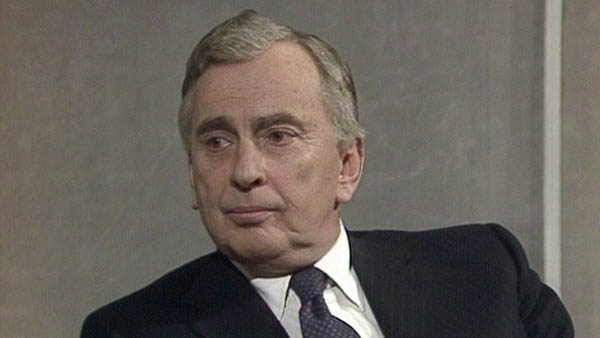
There was very little that Vidal, who died in 2012, didn’t
do, and the documentary shows us his working life in loving detail. He was a
novelist, throughout his life; his frankly homoerotic 1954 novel The City and the Pillar gave him great
notoriety on its publication, and in fact it guaranteed that the New York Times
would not review his books for many years afterwards. Finding that he needed to
make a living, he turned to plays and teleplays, one of the most successful of these
being the stage play The Best Man, a sharp social drama that saw a revival in 2000 and 2012. Much later in life, he would write the—again—scandalous Myra Breckinridge, about a transsexual,
for which he also wrote a screenplay, which was made into what some think was
one of the worst films ever made. He also ran for public office twice: for the
House of Representatives in 1960, and for the Senate in 1982. His chief
function in American life, though, and that for which he is perhaps most widely
remembered, was as an essayist (for the Partisan Review, the New York Review of
Books
, and elsewhere), a brilliant commentator, an eminently witty pundit—a public intellectual of the
grandest type. Despite the fact that he himself came from a very wealthy
background, he was unabashedly liberal. The most hair-raising moments in a
documentary jammed with Vidal’s controversial but wise statements come first
from footage of a famous series of televised debates he had with William F.
Buckley in 1968. As police clashed violently with protesters at the Democratic
Convention in Chicago, Vidal and Buckley talked quite heatedly about, put simply,
ideas. Asked to comment on the riots, Buckley expressed the hardline view that
they were anarchistic, to which Vidal responded that Buckley was a
“proto-Nazi,” to which Buckley responded that Vidal was a “queer” who should
take himself away from his “pornography”—and the conversation went on from
there, verging on violence. This wouldn’t be the only such rodeo for Vidal: in
a similarly famous debate with the notoriously pugnacious and masculinist but
highly articulate Norman Mailer, the two men nearly came to violence. The
topic? Feminism. Vidal was in favor, Mailer a skeptic, natch. There are nits to
pick, here, as virtuous and intelligent as Vidal might seem. When Vidal and
Buckley debate, they often seem here to be competing to see who can do the best
moneyed drawl, the best James Mason imitation, or both. It might also be argued
that, from a position of wealth and privilege, Vidal was not in a position to
change anyone’s mind about anything—as he knew not whereof he spoke, at least
as far as his views on the life of the poor were concerned. (Rarely in the present-day sections of the film do we see Vidal outside of his mansion overlooking the sea, in Italy.) Nevertheless, what he
and his quasi-contemporaries (Susan Sontag, Joan Didion, and yes, William F. Buckley, and yes, Norman Mailer)
stood for was the value of the written word, of clarity, of beauty and succinctness of expression.
Along with, of course, superior education and background. These intellectuals
were celebrities because of the way they spoke, not because of financial status
or their ability to dodge flying cars. (Or, for that
matter, because of their legs.) It would be hard, in other words, to imagine Jimmy Fallon,
comically gifted as he might be, sitting down with Vidal and Buckley and
hosting a chat of the sort they had in the 1960s; talk shows, at present, cater to celebrities of an entirely different caste. Christopher Hitchens, of recent thinkers, might come closest to this older standard, in terms of his public presence and his acceptability beside celebrities of other types; indeed, he flickers
in and out of the documentary, once named by Vidal as his unofficial “heir” or “dauphin”
and then rejected when he wrote essays in favor of the Iraq War.

And so, where have we landed? All we can say with any
certainty is that, in some senses, it is easier to command public attention
with words than it used to be. The rise of blogs, personal websites, and other
such publications as sources of commentary and outlets for expression has
elevated the importance of the first-person perspective and given a broader
swath of individuals a mass audience, through the Internet, that they wouldn’t
necessarily have had before. Who’s to say that’s a bad thing? However, perhaps
the general level of our commentary has decreased, with time. Can we say that
Patton Oswalt, who live-Tweets Downton Abbey, or famously race-baited Fox News
through a series of cleverly worded Tweets, or Louis C.K., whose invective
against smartphones spawned a wide range of commentary, or whose recent Tweets against the Common Core aroused attention from many different quarters, represent the 21st
century’s version of a public intellectual? I’m not complaining, if so, because I love
both comics dearly. But then, on the other hand…

Max Winter is the Editor of Press Play.

Truth, Based on a Story: Disney’s MILLION DOLLAR ARM

Truth, Based on a Story: Disney’s MILLION DOLLAR ARM

nullSport is blessed with narrative. In no sport is this more
apparent than in baseball. Through an affection for and addiction to
statistics, one can draw lines between a century of stories. The game, unlike
most others, has barely changed since Abner Doubleday claimed to have invented
it. There’s wooden bats, leather gloves, nine innings, and at any point,
anything can happen. Its exposition is what writers dream of having the talent
to divine. Which makes Hollywood’s penchant for altering its history so
confounding, as displayed once again in Disney’s Million Dollar Arm. In altering the truth the film unnecessarily
takes a compelling story and makes it a contrived and derivative Hollywood tale
of the American Dream.


Million
Dollar Arm
is based on a true story born for the silver screen, the
tale of two poor Indians who through luck, happenstance, and determined will found
themselves pitching for a chance at major league contracts. It was quite
literally a rags to riches story. Unfortunately, the film has Disney-fied the
story, corrupting its narrative, and producing a feature that is a victim of
its own attempts to be successful. Cursory investigation of the real story
behind Million Dollar Arm suggests
the filmmakers left a better movie somewhere in the ether of truth.

This has been done before with baseball films. Recently, Bennett
Miller’s Moneyball, the story of
baseball’s statistical analysis revolution,
altered timelines in order to suit Steven Zaillian and Aaron Sorkin’s
script’s desires. Oakland A’s first baseman Carlos Peña is a star on the rise in
the film, which was not the case in reality. Philip Seymour Hoffman’s brilliant
portrayal of A’s manager Art Howe is an interpretation of the real man, and not
at all what Howe or other A’s of that era claim him to be. And Jeremy Giambi is
presented as a player added to the Oakland A’s roster before the season upon
which the film is based, when in fact he was on the team the year before, and
was involved in one of baseball’s most notorious plays, New York Yankees’ Derek
Jeter’s “flip play” in the 2001 American League Division Series. The
changes were not major, leaving one to wonder: Why make the changes at all?

In a sport whose fans are manic and devout in their faith
in statistics and lore, why rewrite an already compelling story? Million Dollar Arm falls victim to the
Hollywood treatment in its attempt to make the story a contrived fantasy about
the American Dream. Sports agent J.B. Bernstein (Jon Hamm) and his partner Ash
Vasudevan (Aasif Mandvi) are struggling to make their agency thrive in an era
of greed and opulence. Times may be hard indeed: how else might Bernstein be
about to lose his Porsche and palatial L.A. home? In the film, Bernstein comes
up with the idea (while watching cricket and Britain’s Got Talent, no less) to search India for the next great
baseball talent. In reality, Vasudevan was a venture capitalist whose partner
Will Chang came up with the scheme. Would the truth have made a less compelling
film? Not at all.

The true failure in Million
Dollar Arm
is not in its reworking of history but in its choice of the lens
through which history is filtered. Disney chose Hamm’s Bernstein, so that a pretty
man with pretty things could get more pretty things, including a pretty wife,
and somewhere along the way have an epiphanical father figure transition moment
all within a 2-hour run time. A more interesting, compelling, and logical
choice would have been to tell the story through the eyes of the aspiring
Indian ball players Rinku Singh (Suraj Sharma) and Dinesh Patel (Madhur Mittal).
The two youngsters came from nothing and, in real life, ended up far from home
with their one billion countrymen watching as they attempt to do the
impossible. The film touches on their story, obviously, but addresses them as noble
savages, insulting the audience and illustrating the simplicity of the
Hollywood film factory.

Even if the filmmakers had been afraid of non-white males
as leads, another option would’ve been to explore the story through Tom House
(Bill Paxton), the exiled former Major League pitcher and coach, among the
first major leaguers to use steroids, whose coaching techniques were
controversial, using research and technology to assess training needs, and
frowned upon by the traditions of the sport, not unlike the statheads at the
core of Moneyball. There is a natural
redemption story in House’s tale as he attempts to take two boys who know
nothing about a complicated game, who have never held a baseball, and make them
legitimate prospects. But, Tom House is not pretty, and perhaps already had
enough pretty things from a major league baseball career that the filmmakers
figured his story was not one that audience would want to be spoon-fed.

The preposterous misguided swagger of Hollywoodism is
confounding. A producer of last year’s 42
might well have suggested in a meeting to make Jackie Robinson Asian in order
to appeal to the lucrative foreign market. Perhaps in a remake The Pride of the Yankees, Lou Gehrig
could discover a cure for ALS, and rejoin the Yankees as manager, leading them
to a dynasty in the ‘80s. ESPN’s The
Bronx Is Burning
, the story of the 1977 Yankees set against the backdrop of
a tortuous summer for New York: blackouts, looting, finanical peril, and the
NYPD’s hunt for the Son of Sam, would have been a far better film had John
Turturro’s Billy Martin caught David Berkowitz, kicked his drinking problem,
found a cure for the energy crisis, and single-handedly put out out the fires
that raged through the Bronx in the summer of 1977.

There are other odd discrepancies in Million Dollar Arm. Patel’s subplot of wanting to buy his father a
new delivery truck is all Disney. Brenda Fenwick (Lake Bell), Bernstein’s love
interest (because you need a love interest) was not a doctor, as she is in the
film. And Patel and Singh were actually from East St. Louis, and not Lucknow,
India. Okay, that last part isn’t true, but: Hollywood indulges in changes to
stories because they don’t trust in the audience’s ability to consume truth.
But baseball is rooted in truth, truth that can be traced back and forward
through generations. That truth is the sport’s lifeblood, its essence, and to alter
it is folly. Million Dollar Arm is
not a horrible film, but in its wake we’re left to wonder if a better film
existed in the truth they chose not to tell.

Mike Spry is a writer, editor, and columnist who has written for The
Toronto Star, Maisonneuve, and The Smoking Jacket, among
others, and contributes to MTV’s
 PLAY
with AJ
. He is the author of the poetry collection JACK (Snare
Books, 2008) and
Bourbon & Eventide (Invisible Publoshing, 2014), the short story collection Distillery Songs (Insomniac Press,
2011), and the co-author of
Cheap Throat: The Diary of a Locked-Out
Hockey Player
(Found Press,
2013).
Follow him on Twitter @mdspry.

The Curious Appeal of Griffin Dunne

The Curious Appeal of Griffin Dunne

null

I don’t like hubris in any form; when I see it on screen, my
dislike is amplified. Hence, I tend not to be a huge fan of Lead Actors. Joaquin
Phoenix is a Method-fueled blur, Cate Blanchett a scenery chewer, Leonardo
DiCaprio too young, even at his age. I tend to be drawn towards character
actors, or at least those who have built their careers on secondary roles: the Brad Dourifs, the Tom Noonans, the Marcia Gay Hardens, the
non-mega-stars. I tend, also, to be a fan of Griffin Dunne, wherever he appears.
Dunne is an interesting case: he gave early star turns in An American Werewolf in London and After Hours, but has since then been primarily a supporting player, albeit a consistent one.
He formed a standard Griffin Dunne expression in the early films, one which
combines three stages of rage: the initial outburst, the growing anger, and the
acknowledgment that there is nothing to be done, settling into a fixed glower
that never entirely leaves his face. This vulnerability, and his frustration
with it, is too ingrained in him for him to ever be a leading man—he seems to
feel his pains the way the rest of us feel them. He wants to hide them, but he
can’t. Insecurities, fears, and anxieties in the Lead Actor, by contrast, must occur like the
psychological equivalents of exploding cars; they must be huge, expansive, intimidating,
screen-filling. Dunne doesn’t fill the screen, and yet he does occupy it. In
his current film, The Discoverers, he
occupies the screen much like a human grounding plug—his presence never allows
other characters’ histrionics to go too far. Any rage of his own is, likewise, contained.

Granted, The
Discoverers
had stiff competition, given that it opened on the same day as
Godzilla; if faced with the choice of
seeing a film about the career struggles of a poorly shaven history professor
or a movie about a gigantic lizard from the bottom of the ocean, the decision might, for many viewers, be fairly simple. This is regrettable, because any flaws the
film contains (and there are a few) are small in contrast with the strength of
its different elements. The story has a shaggy-dog quality to it, one part road movie, one part self-realization saga: divorced
history professor Lewis Birch (Dunne) is traveling to Portland for a professional conference
with his two children, here beautifully deadpanned by Madeleine Martin and Devon Graye; he has
also just sent his 6,000-plus-page history text on a minor figure in the Lewis
and Clark Expedition to a diminutive, obscure academic publisher. Neither of
these attempts are destined to be successful; Birch broadcasts their impending
failure with his entire bearing: the stubble on his chin, his poor posture, his
messy apartment, even his dirty car, suggest things won’t work out so well for
him. The fact that he moonlights as a security guard indicates, in tandem with
all of the other clues, that the trip is a bit of a Hail Mary pass. What
distinguishes Dunne’s performance from those of other actors who have “gone
sloppy” for the sake of a role (see Michael Douglas in Wonder Boys, for a famous example) is that it hurts more. In a
swerve that shapes the story, Birch is forced to make a detour en route to the
conference to see his estranged parents, one receding into dementia, the other
fatally ill. The lack of love communicated between Birch and his father, played
beautifully by Stuart Margolin, is palpable; what radiates here is less alienation
than profound dislike. It comes out in small ways, such as their inability to
look fully at each other for long, or the vaguely deadened, aggravated sound in
Dunne’s voice when he speaks to his father. The two are left alone because Birch’s mother dies suddenly, before she speaks a line of dialogue; her absence
hangs over the rest of the film as if it might be the only thing that would
cement their relationship.

In After Hours and American Werewolf, as with subsequent roles, Dunne seemed more
rational than any of the players surrounding him. After Hours found his modest office worker wandering through the
streets of Soho at night, being toyed with and pursued by a host of brilliantly
portrayed characters, including a be-beehived Teri Garr, a sad, brooding,
obsessive John Heard, and a vengeful Catherine O’Hara. In American Werewolf, he still offered the voice of reason, even from
beyond death, as his soon-to-be-lupine friend couldn’t control the changes
occurring in his body and mind and Dunne’s gorily maimed corpse had to explain things
to him, in a sarcastic, do-I-really-have-to-explain-this tone. Here, similarly, Dunne’s grounding-plug instincts are put to the test
as he must follow his father into the woods, where he has gone with a group of
re-enactors of the Lewis and Clark expedition. Predictably, the re-enactors all
speak in period language, eschew modern convenience, act somewhat
freakishly—and predictably, hijinks ensue. But these hijinks don’t reach nearly
the pitch they could have—the film’s strength lies in the fact that neither
their absurdity nor Dunne’s sad state are entirely laughable. The director
chooses, instead, to come close to embracing them—we learn a lot about the
expedition through Birch and through his father’s band of cohorts, as the film
looks openly at the re-enactors, considering why they might have arrived at
this point. Perhaps the most touching of these performances comes from Cara
Buono, playing a potentially damaged soul-seeker, a million miles from her more strident recent role as Faye on Mad Men. Similarly, we come to
see Birch as less a middle-aged, down-at-heels academic than a confused son of
confused parents, striving to be more than marginally better at parenting
himself.

Dunne is the leading man of this film, and yet he is not the
leading man. The film offers too much competition, in every way, even beyond
the strengths of its other actors. The script, while it has its moments of pat
indie-com humor, is admirably restrained and intimate; even Birch’s daughter’s
indication of a stray pube on a bathroom floor, as she and Birch are both sitting there, turns into a
moment of closeness. The film’s visuals, as well, rise beyond the story: the
blue of a mountain range or the immensity of a fog-filled morning write their
own kind of script here, across the film’s plot, and they operate in a gorgeous
counterpoint with it. Dunne can’t compete with these elements, nor does he try
to. The strength of actors like this, those who operate on a fainter register than others,
is that they remind us of what we are like, rather than what we are told we might
be like, if we tried. The strength of Dunne’s performance here is that, despite the fact
that he’s arguably the center of the film, you’d never know it to look at him.

Max Winter is the Editor of Press Play.
Vivian Maier, Mystery Woman and Master Photographer

Vivian Maier, Mystery Woman and Master Photographer

null

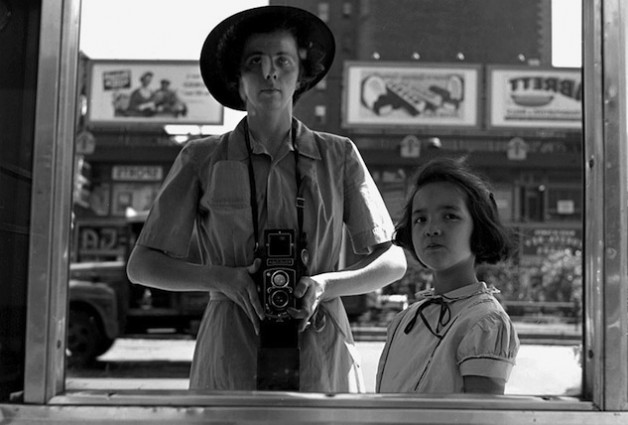
“I am the mystery woman,” Vivian Maier
says when asked her name by a child in one of her home movies, and she remains a
mystery to us today. Little is known about the specific details of Maier’s life,
despite her great photographic talent and tremendous physical presence, described
(albeit with exaggeration) as masculine, seven-feet in height, and walking with
a commandeering stride. Born in New York in 1926, Maier spent much of her youth
in France, and then later, after working in New York City sweatshops, she moved
to Chicago, where she worked as a nanny for nearly forty years. Other than this
skeletal history, the details are scattered and sparse. To one acquaintance she
described herself as being “sort of a spy,” and to businesses she patronized
she would give permutations of her name as identification. And yet paradoxically,
given this intensely private woman’s attempt to conceal the details of her
personal life, the incredible body of photographic work she left behind is now
receiving international recognition.

Is this the legacy that Maier would
have wanted? Likely not, given the way she guarded her privacy when she was
alive. This photographic evidence would have been dispersed and forever escaped
our notice if not for John Maloof’s good eye and brilliant luck in purchasing a
case of her photographic negatives at auction, or his tenacity in both
gathering physical evidence and, like a detective, meticulously piecing together
a story from the items that she collected. And so, with the release of Maloof’s
film, Finding Vivian Maier, come
looming questions—would Maier have wanted this? And, how self-serving is
Maloof’s ambition? The former was asked of the subjects who knew Maier best
(which still was not very well) and their response was unequivocally “no,” she
would have loathed the attention. The answer to the latter question is more
ambiguous. The film is a paean to Maier’s work, but it’s also a documentation
of the director’s own quest to reconstruct her identity and retroactively
position her work alongside that of photographic giants like Arbus and Avedon.
Uncovering Maier’s work has become Maloof’s obsession, and for now, it’s also become
his life’s work.

Maloof is on a quest to uncover an
identity that explains Maier’s enigmatic practice, but in so doing, he seems a
bit enigmatic himself: “You always want to know who is behind the work,” he states,
as if this is the only justification he needs to publicly reveal and make sense
of the traces Maier left behind. He’s made it his mission to “find” Maier, to
make sure that her estate is preserved the “right” way, and he says that he has
been “pushed” into this role of curator of her work. While this at first sounds
believable, and Maier’s body of work is arresting, deserving of attention, it
is hard to believe that Maloof has merely been “pushed”: he also seems terribly
ambitious. Even though he questions what Maier would have wanted, the answers
he’s given—that she would not have wanted the personally directed public
attention—don’t seem to weigh heavily on him. All for art’s sake might be Maloof’s motto. But of course, there remains
the looming question of what Maloof stands to gain from this: it seems like a
great deal. On the one hand, Maloof’s enthusiasm is seemingly borne of good
intentions. On the other, his posthumous discovery of Maier’s work, combined
with her lack of descendants and close friends to vie for control of it, means
he stumbled upon a treasure with no strings attached. And so, there are really two
stories being told in Finding Vivian
Maier
: that of Maier the enigma, of reveling in her art while constructing
a narrative to stand beside it; and that of Maloof’s curatorial pursuit to
preserve Maier’s work, to sell her work, and to establish her relevance within
the art world—and through her relevance, his own significance.

Vivian Maier walked through the
world with a camera around her neck. As a nanny she took long strolls with her
charges, and they accompanied her on adventures through rundown areas of town—the
stockyards, abandoned lots, city streets. She falls in to the category of photographer
as flâneur,
as Susan Sontag identifies in On
Photography
: “an armed version of the solitary walker, reconnoitering,
stalking, cruising the urban inferno, the voyeuristic stroller who discovers
the city as a landscape of voluptuous extremes.” It seems Maier developed her
practice on the street, too. She had no formal schooling, and yet she had developed
a brilliant eye for composition and lighting, a sense of humor, and a capacity
for the grotesque, as well as a flare for capturing intimate gazes on film. Her
eye for the eccentric and offbeat, framed exquisitely, made for an arresting
image. As a person, Maier was eccentric, opinionated, didn’t trust men, followed
the news and politics, and was quite brave despite her reserve, traveling the
world on her own. But as a poor woman—“too poor to die,” she claimed—working as
a live-in nanny meant that shelter and amenities were built into her job, and
this, along with her vast solitude, gave her freedom and autonomy to pursue her
photographic work, and this work comprised her life.

She left behind her over 100,000
negatives, nearly 1,000 undeveloped rolls of film, as well as cassette recordings
and short films. She also had tendencies toward hoarding, such as saving
towering stacks of newspapers for articles she wanted to read and accumulating
piles of insignificant receipts (then placing them all in storage). It’s as if
Maier’s connection to material objects in some way compensated for her lack of
intimacy with any other people besides the children she tended. The intimacy
and humor in her photographs is undeniable. And yet it seems as if Maier never
had any intention of showing these images publicly, or even sharing them with
the families she lived with. In our hyperconnected state, with Instagram and myriad
forms of social media, this is an unthinkable idea. So, we’re told that Maier
sold herself short, that something was wrong with her.

Perhaps. Perhaps Maier would’ve
been acknowledged as one of the greats if she had sought to show her work.
Maloof gets caught up with this question of why Maier was so prolific and yet so
private. And while it’s a conundrum, it’s also disconcerting to think that something
was wrong, in that Maier had an extensive practice that she didn’t try to
profit from. Maier’s lack of wealth and status may have made it difficult to show
work and have it taken seriously. And also, given that she was an eccentric woman
without connections who made work starting in the ‘50s—would she really have been
embraced by the commercial art world? It seems that she didn’t lust after this
recognition, and she didn’t think it an option, either. Maier acknowledges in a
letter she wrote to a French photo developer that she was difficult to deal
with. But there’s also the possibility that, for Maier, the work was enough.

As we look at the images—filled
with soft gazes, drunks passed out on stoops, knowing glances, so many faces,
some disfigured, some dazzling—it becomes apparent that photography was one of
the few ways Maier truly engaged with the world.  It’s almost as if she found comfort in the
distance that comes with standing behind the lens. This allowed for the brief
intimate exchanges she had in her pictures. She was endowed with the power of
the gaze while not having to give any of herself up. In this space, even an
outsider and eccentric could discover moments of intimacy.

Susan Sontag discusses the distance
and voyeurism inherent to photography: “The whole point of photographing people
is that you are not intervening in their lives, only visiting them. The
photographer is a supertourist, an extension of the anthropologist, visiting
natives and bringing back news of their exotic doings and strange gear. The
photographer is always trying to colonize new experiences or find new ways to
look at subjects.” Sontag is talking about Diane Arbus’ work, but it’s just as
relevant to Maier’s here. Photography provided Maier with a form of intimacy
and experience gathered vicariously, through watching others. These others “are
to remain exotic, hence ‘terrific.’ Her view is always from the outside.” And
that’s just it: Maier was always on the outside looking in. And she always took
photos—even when it seemed callous, such as when one of the children we tended
was hit by a car: she turned the camera on him and kept filming.  It seems to be a way she mitigated the chaos
of the external world.  And as an
impoverished, eccentric woman Maier perhaps saw herself within the people she
captured, too. She captured many images of herself: often refracted, at oblique
angles, always solitary except when accompanied by a child, or as a shadow lurking
over the scene.

This inability to enter the world
is not unique to Maier—but she was closed off in such an extreme way, and made so
much work, that it is remarkable that her incredible talent remained so
well-hidden. Poet Mary Ruefle identifies this inability as inherent to the
poet, too: “There is a world that poets cannot seem to enter. It is the world
everybody else lives in. And the only thing poets have in common is their
desire to enter this world.” In this sense, Maier is a true poet, and by poet I
mean artist, photographer, woman with a singular vision. Perhaps her extreme
need for privacy created the very tension that drove Maier to document so much.
And yet, here I am falling prey to hypotheses and opinions, attached to my own idea
of Vivian Maier, reconstructing her narrative in a different light than Maloof,
but still just as much a fabrication.

Maloof is a curator—and with his
meticulous sense of detail, his strong inclination toward achievement and
connection, and his eye for the market, he’s also extremely shrewd. But he’s
something of a conquistador, too, claiming Maier’s work, in a sense, and making
the recognition of her work his mission, when perhaps it’s just enough that her
work is seen. Maier herself would probably recoil from her growing celebrity. Her
philosophy of life is, surprisingly, rather communal, as she said on tape: “It’s
a wheel—you get on, you go to the end, and someone else has the same
opportunity to go to the end, and so on, and somebody takes their place.
There’s nothing new under the sun.” The wheel of fortune spins around, Maier’s went
down, and in her descent brought Maloof up with it again. There’s nothing new
in that either.

 “The new creativity is pointing, not making,”
claims poet Kenneth Goldsmith. “Likewise, in the future, the best writers will
be the best information managers.” And following his logic, the best artists
will be the best curators. In this sense, Maier’s extensive body of work is the
perfect discovery for Maloof, who now identifies as a filmmaker and
photographer—Maier was a prolific artist whose life is a mystery, whose posthumously
discovered work echoes that of other great photographers of her era, and whose
prints can be multiplied and distributed. We can read into her what we want,
and with Finding Vivian Maier’s
widespread release, this seems to be just the beginning of the making of
Maier’s personal mythology. But perhaps we’ve already found all we need by
looking at her photographs.

Anne K. Yoder’s fiction and nonfiction have
appeared in
The Millions, Fence, Bomb, and Tin House, among other publications. She
has received fellowships from The School of the Art Institute of Chicago
and the Summer Literary Seminars. She currently lives in Chicago.

In the Future We Will Have Less of Everything: On HOW I LIVE NOW and Its Predecessors

In the Future We Will Have Less of Everything: On HOW I LIVE NOW and Its Predecessors

null

Has there ever been a film about the future that advocated in favor of progress, rather than against it? Metropolis, A Clockwork Orange, Blade Runner, the Mad Max series, AI, and then onwards to such recent films as Never Let Me Go, The Hunger Games, and, most recently, How I Live Now, do not offer a bright outlook for the results of our ostensible progress, in technology, government, or in any form of broader social structure. The days of the Buck Rogers or Flash Gordon visions of the future, in which everything is easier, happier, better, or faster, are long over–increasingly, films purporting to be about our society’s future either involve an apocalypse which has left devastation behind it or predict one which may well occur during the film itself. If there is no apocalypse, then something else has been taken away: consider Children of Men, in which even women’s fertility has been taken away. The theme, then, seems to continually be one of deprivation, or a sense that something has been removed which was once present. This could occur for a number of reasons, ranging from the sense, on a given director’s part, that to predict the future carries with it a moral imperative, to the more basic sense, frightening as it might sound, that a happy future is a weak basis for a story, that unless something bad is coming, characters have nothing against which to gird themselves.

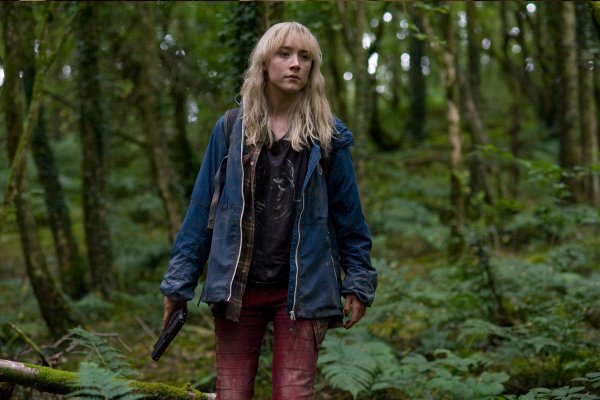
How I Live Now, the latest film in this trend, starts interestingly, suggesting that it might just be a film about the future in which the future itself doesn’t play a lead role—and, despite odds, it is successful in this attempt. Saoirse Ronan’s Daisy, resplendent in dark eyeshadow, dyed hair, and a host of voices whispering encouragements and admonishments in her head, charges through an airport, punk-ish music blasting on her headphones, to meet her cousin; she will be staying with her aunt in the English countryside because, as she views it, her father (her mother is deceased) would rather not have her around. From the beginning, relationships are foregrounded, even as little visual cues that we are in the future (such as retina identification devices at the airport) continue to pop up. This continues as the movie progresses; Daisy can’t stand her cousins, dismissing them as naive and vaguely obnoxious. There is even a love interest: Eddie, portrayed with silent charm here by George MacKay. Eddie talks to animals and seems to have a knack for accessing Daisy; he wins her over when he’s able to make an entire herd of cows and bulls move out of her way. Daisy gradually loses her punk/goth affectations, relaxes, begins to enjoy herself, make conversation: the film shows signs of being a heartwarming tale of an angry girl’s growing-up, with a winning mood of immediacy.

Then, the future enters in more aggressively. London is bombed, an attack claimed by 15 different terrorist groups. Daisy’s aunt, played briefly but memorably by Anna Chancellor, is away on a business trip when it happens; she is always away, in fact, leaving the children on their own, and at the very most she is around late in the evening and early in the morning. This core loneliness at the heart of the childrens’ lives—Eddie, being the oldest, serves as a surrogate parent, but he is, after all, only a child himself, and so he can’t provide much nurture for his younger siblings—is only the tip of the iceberg. The London bombing serves as a harbinger of what the rest of the film sets out to prove, and what many films that attempt to forecast what lies ahead tell us, as well: that the future we have to look forward to, as a race, is dark, and that self-reliance will be important because, to put it simply, there will be less of everything. Fewer people, less food, fewer landforms (after bombing has destroyed them), fewer cities, fewer options; as daily processes become more efficient, this simplification itself will come to resemble a form of deprivation. 

Slight statement though this might be, How I Live Now ends on a more optimistic note than it could have ended on, which is significant; after Daisy and her very young cousin Piper (Harley Bird) take a Homeric-cum-Arthurian-cum-Grimm’s Fairy Tale-esque march through deep woods in search of the others, from whom they have been separated (by rough, aggressive soldiers, seemingly separating them for their own good, as there is an invasion in progress), there is a homecoming, of sorts, but it isn’t without substantial loss along the way. Ultimately, the title says it all. In the film’s last moments, we see a very simple tableau: humans, caring for each other, taking care of themselves. And what are they surrounded by? A forest in the film, but nothingness, in another sense. So the future is a metaphor? Not entirely: the message of the film, and the films that have come before it, might well be more literal than this, a suggestion that more and more may be taken away from us as the decades pass, in obvious and not-so-obvious ways, until we are left, finally, staring at ourselves. There may well be any number of slap-happy movies about our future in the depths of film history–Brazil, for example, was gleeful, but in a highly mordant way, or one could always, in a pinch, try Woody Allen’s Sleeper, overcast as it was by its director’s inherent neurosis–but the films which have made the most cultural impact have, at their heart, substantial melancholy: one part regret, one part fear, one part uninventiveness , one part guilt. How I Live Now, in its own quiet way, works beautifully and admirably against this trend, pervasive as its gloom might be, in suggesting that the sanctity of human relationships can create a barrier between the self and the crumbling world.

Max Winter is the Editor of Press Play.

The Good Struggle: ILYA AND EMILIA KABAKOV: ENTER HERE

The Good Struggle: ILYA AND EMILIA KABAKOV: ENTER HERE

null

What do we do when things get worse than we can stand? Or better yet, what do we do when things have been worse than we could stand? Some of us crumple. Some of us lash out, and in so doing, may make things more horrific for ourselves. Many of us, though, choose a much more complicated response: we create, we do things, we act. The creation of art as a sublimation of pain or suffering is not a new concept, but it comes close to being made new in the work of Russian artist Ilya Kabakov, born and raised in Soviet Russia, an American expatriate for nearly 25 years. In one of his sculptures, a pair of booted legs descends from the ceiling, soles firmly planted on the ground. The work’s title is “What Is Our Place?” In one of his installations, we see a room papered with all kinds of wild, colorful posters; the ceiling of the room contains a gaping hole, plaster from the ceiling hanging down, along with peeling paint. The work’s title? “The Man Who Flew Into Space from His Apartment.” Amei Wallach’s Ilya and Emilia Kabakov: Enter Here is less a documentary than a study of the ways we react to tragedy, to trauma, to past suffering–in Kabakov’s case, the trauma was the time he spent living under Soviet rule, from 1933 to 1987. And yet, miraculously, these works never seem overburdened by the past behind them: they are always guided by the urge to narrate, to tell a story. You might feel, bumping up against one of his installations, that you’ve been dropped into the middle of a surreal novel. The works suggest that for Kabakov, the telling of a story provides the means for one to leave suffering, to fly into space.

It is significant, then, that the documentary concerns itself with a trip Ilya and Emilia Kabakov took in 2008, back to Moscow, which they had not visited in 20 years (they currently live in Long Island, outside New York City), for a vast retrospective of Kabakov’s work–well-deserved, given that Ilya is one of the most widely-known Russian artists now living. The film shows little of Moscow itself, but the little it does show, along with the references made to it in the film, are enough to communicate the essence: raw, oppressive, intense, unhappy, dark. The artist’s acquaintances–fellow artists, patrons, scholars–establish that Ilya’s time in Soviet Russia, illustrating children’s books for survival while also secretly making work which would certainly have earned him punishment by the government, was quite difficult, even soul-destroying. 

Kabakov’s work itself displays this same sort of truculence, only in a quieter, more inventive manner. The exhibition described in the film occurred in three different locations; the most elaborate and eccentric of these exhibits was staged in a former bus garage–in fact, the site of Dziga Vertov’s famous 1929 film, Man with a Movie Camera–now the Garage Center for Contemporary Culture. One part of the exhibit was called the “museum”; in this museum hung rows and rows of paintings, meant to emulate the Soviet-approved artwork that permeated Kabakov’s youth, filled with false happiness: happy workers returning home from their (dreary) jobs; cheerful, rosy-cheeked families eating dinner together; delighted children playing in the snow. As we watch Kabakov setting up this exhibition, we notice things one might not normally notice in a documentary about an artist who has worked his way, literally, out of years of oppression: his masterful walk, the strangely humble expression on his face, his grace when instructing workers about where to place parts of the display. He resembles nothing less than a little Prospero, exercising magical powers when necessary to keep the island of his sensibility in order. His wife is a presence here too; a frequent collaborator with Kabakov, she most resembles a guide for her extremely intense husband.

My own first experience with Kabokov’s work was in 1993, at the Whitney Biennial. Young as I was, I harbored incredibly jaded, cynical feelings as I walked through much of the exhibition. The works I saw, with their loud colors, their video loops, their larger-than-life signage, were more than I could digest at one time, or perhaps more than I could stomach. Only two artists paused my arrogant 23-year-old’s wandering eye–Ida Applebroog, with her storied, direct approach to her subject, seemingly antiquated in this context, and Kabakov. The work on display was an installation, a small crowded, cluttered room, with numerous tiny, human figures arranged on the floor. My immediate response was wonder: how did these figures get here? What was I to think? And it is this same sense of wonder that drives Enter Here. One wonders out of what recesses in his imagination Ilya Kabakov is able to pull the concept for his works–and beyond that, how he is able to keep producing them. In the presence of his work, we all become like those small figures, dropped down into alien territory, trying to make sense of it all, and yet feeling, at the same time, as if the scenarios we witness are strangely familiar.           

Max Winter is the Editor of Press Play.

The Tragic Absorption of THE MOTEL LIFE

The Tragic Absorption of THE MOTEL LIFE

null

There are times, during THE MOTEL LIFE, when it seems as if the film is sustaining itself on pure mood. Directors Alan and Gabriel Polsky have put substantial energy, in their delivery of this story of two brothers with flawed judgment but unfailing commitment to each other, into its darkness, into drenching us in the dim light of motel rooms or the darkness of city streets at night, so that when the film moves into a brighter location, such as a hospital room or a casino (the film is set in Reno), the shift comes as a shock, as if someone were shining bright lights on the story, asking us to look it in the face, possible interpretations of it being as various as the viewers themselves.

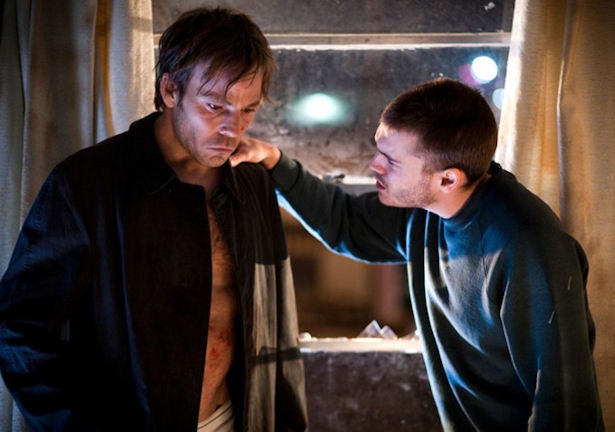
The story is a sad one, without much room for light. The two brothers, Jerry Lee and Frank, ran away from home as children after their mother’s death from cancer. In an accident which occurred while they were train-hopping, Jerry Lee lost half of one leg–and as it is, the lost half-limb comes to serve as an outer manifestation of his personality; as Stephen Dorff plays him, he seems only half-present for much of the film, as if he were talking to others while also having another conversation with himself. By contrast, his brother, played here with depressed immediacy by Emile Hirsch, seems more grounded, carrying the burden of the brothers’ perpetual rootlessness along that of his brother’s needs. After Jerry Lee kills a young boy in a hit and run accident, what was a dour story becomes much more dour–the brothers have to run from the police, and what was previously a seemingly hand-to-mouth existence becomes rife with traditional images of desperation and outsiderhood. All the motels look the same. All the meals are take-out. Frank carries a bottle of whiskey around with him like a holy chalice.

What is amazing, in the body of the film, is how much texture and soul the directors manage to reap from such a bleak story. The Nevada landscape is sublime, in the truest sense of the word, its grand, uncrossable mountains a comment on the impossibility of the brothers’ situation. Kris Kristofferson shines here in a minimal part, as an old boss of Frank’s who tries, beautifully un-invasively, to counsel Frank on how to lead a responsible, or at least a forward-looking life. Dakota Fanning is mature, and sad, and memorable as a girlfriend of Frank’s, left and then found again, living in the tiny, poetically barren town of Elko. And then there are the oddballs: one sadsack who we first meet after he’s been hospitalized following a liquid-acid binge, and another old friend of Frank, a generally unlucky gambling addict who persuades Frank to go in with him on an implausible-seeming bet.

True to itself, the progress of the movie is both sad and upbeat. As options decrease for the brothers, their trajectory becomes more wild and stealthy. They sustain themselves, as they have since childhood, through story-telling; Frank tells Jerry Lee possible anecdotes from possible lives he hasn’t lived—and the directors take a risk by animating these stories in the style of Jerry Lee’s own cartoonish drawings, a touch which doesn’t necessarily work in all movies (such as Howl, which was at its most successful when most simple, its animated sequences a distraction from James Franco’s responsible performance) but which gives a pleasant sense of release, of taking off, to this work.

As we’ve learned from Breaking Bad, from Cormac McCarthy, from Sam Shepard, from Badlands, and even from the recent COG, the land west of the Mississippi can be a fecund setting for stories having to do with loss, or restlessness, or despair, or hopelessness. The Motel Life, while it operates on a quiet enough register that it might not reach all viewers, brings home a meaningful story without significant compromise, a promising debut feature from two very skilled filmmakers.

Kubrick in Reverse: The Earthly Pull of GRAVITY

Kubrick in Reverse: The Earthly Pull of GRAVITY

null

Since its premiere at the Venice Film Festival, Gravity has generated a tremendous
amount of reverential hype, but with its general release the inevitable
critical backlash is beginning to roll—or rather troll—its way across the
web.  Where once critics compared Cuarón’s
film favorably with the work it most resembles, Stanley Kubrick’s 2001: A Space Odyssey, it is now being
criticized for falling short of that earlier film’s ambition.  While Gravity’s
special effects are sufficiently stunning to distract, potentially, from
the film’s intellectual and emotional impact, it is a much smarter film than it
is generally given credit for being.  Far
from being mere imitation or homage, Gravity
offers an ingenious and moving revision and critique of its predecessor, one
that begins in the stars but returns us to our own earthly soil. Cuarón’s
achievement is to make our own planet and the fragile lives it sustains seem as
miraculous as the cosmos that surrounds it.

Both films concern space travel, yet while 2001 reflects the sense of wonder inspired
by the golden era of space travel, Gravity
shows a space program in which the optimism of its early years has been gutted,
along with its budget. Much of the film
takes place in abandoned space stations, interiors clogged with the trash
and cast-off tchotchkes of departed astronauts. The opening scene shows a technical crew repairing
the Hubble telescope above a jaw-dropping view of the Earth, but they seem
almost bored, or, like Dr. Ryan Stone (Sandra Bullock), nauseous, as she
attempts to fight off the effects of zero-g by concentrating on her work, evidently
as dull to her as the scenery might be grand to a novice.

But dullness and nausea quickly give way to terror as the
hurtling debris from an exploded Russian satellite strikes the repair crew, and
it is telling that the film’s greatest threat comes from, essentially,
garbage.  Stone is sent spinning out of
control into space, in a scene clearly derived from that harrowing moment in 2001 when Frank Poole hurtles into the
darkness when his oxygen hose is severed. Yet it is at this early point that Cuarón begins to reverse the direction
of Kubrick’s odyssey: whereas the one surviving astronaut of 2001’s Jupiter crew will set out on a
journey “Beyond the Infinite,” Cuarón will take us into the finite, as Ryan
Stone confronts her own mortality.

Throughout Gravity we
are reminded of how fragile human beings are, how vulnerable our bodies, as we
witness Stone being thrown and pummeled through a series of deadly and dazzling
physics lessons. As in Children of Men, Cuarón’s elaborately
choreographed camera work is used to place us in almost unbearably intimate
proximity to the fear and suffering of his characters. We hear and see Stone’s breathing until it
becomes almost an extension of our own. The awkward bulkiness of her suit only serves to
emphasize the frailty of a body it cannot hope to protect. 

While some of these elements are also present in Kubrick’s 2001, human frailty and the technologies which sustain it are emphasized only to underscore the film’s final
movement towards transcendence. Though
there are a wide range of possible interpretations of 2001’s final image of a gigantic fetus floating in space, it
is clearly meant to represent some kind of rebirth, one in which David Bowman,
and by extension the human race, has moved on to its next, possibly final,
evolutionary stage, a journey that began long ago, when a giant black monolith
taught early hominids how to use tools.  Ryan
Stone, on the other hand, will journey in the opposite direction, towards a
humanness that is less cosmic, more earthly.

Cuarón explicitly references Kubrick’s final image when
Stone finally makes it to the shelter of the International Space Station. There, she frees herself from her burdensome
suit and floats, fetus-like, in the oxygenated atmosphere. The image is mesmerizing, and Kubrick-like in
its use of one-point perspective; yet Cuarón’s fetus image is radically
different in its thematic implications. Whereas Dave Bowman’s transformation signals another, clearly
post-human, phase of evolution, Cuarón emphasizes Stone’s humanity, her
corporeal, embodied self. Cuarón
replaces Kubrick’s image of transcendence with one of vulnerability.

Given the fact that most of Gravity is spent free of the earth’s pull, the title might seem
ironic, at least until we learn more about Stone’s personal history. The absorption in work that marked her first
appearance in the film is in large part an escape from the painful memory of the
death of her young daughter, who fell while playing on the schoolyard. The randomness of this tragic event serves to
underscore the film’s preoccupation with human frailty, as both mother and
daughter find themselves pulled by natural forces beyond their control. Rather than transcend these merely physical
forces, however, Cuarón asks us to accept, and even embrace, them.

In what is, to me, the film’s most powerful scene, Stone,
alone in an abandoned space station and desperate for the sound of another
voice, searches the airwaves for some signal from Earth. At last, out of the static, there emerges a
foreign male voice, apparently drunk, and laughing. Stone seems a little disappointed, until she
hears a dog in the background. Attempting to transcend the language barrier, she makes dog sounds, at
first in the hopes of engaging her human counterpart, but eventually engaging the
nonhuman.  We are pulled into an intimate
close-up as Stone begins to howl, mournfully, along with the dog, shedding
tears that float into the oxygenated air, forming globules like tiny
planets. She has found a place in herself prior to speech, allowing her to give vent to sorrows deeper than human
language.  Like the dog, she is an
embodied, vulnerable creature, and in evolutionary terms they share a common
ancestry, and a common planet.

The film’s final scene will make this evolutionary narrative
even more explicit, but I don’t want to give anything away, since this is a thriller
after all, isn’t it? While the film’s
action sequences have been justly praised as some of the most gripping and
technically accomplished ever filmed, I would argue that they are there
primarily to serve the central human narrative. This narrative is told through minimal dialogue and maximal images, yet
it is as clear and direct as fairy tale or myth. If we compare Cuarón’s space
sequences with Kubrick’s, a clear difference emerges: though the space-ships of
2001 might dance to the rhythms of a
Strauss waltz, they are cold and inhuman, whereas in Gravity the human form is at the center of nearly every shot.  One might compare the presence of CGI technology
in Gravity to that of the HAL
computer in 2001: each might guide
our journey, but after a certain point we need to cut them loose to discover
how our story will turn out.

Jed Mayer is an Associate Professor of English at the State University of New York, New Paltz.

INSIDIOUS, CHAPTER 2: The Haunting of the American Male

INSIDIOUS, CHAPTER 2: The Haunting of the American Male

null

Warning: This review contains the mildest of spoilers, probably nothing you couldn’t guess for yourself.

The Insidious
films take place in an America haunted by faded dreams of a prosperity provided
by a loved and respected father.  In
James Wan’s vision this patriarchal figure has been replaced by a maniacal
presence brooding in the dark corners of a house where women are the strongest
presence and men have become peripheral. Wan’s latest film (his second this
summer) is too filled with tiresome exposition and brazen shock tactics to be
haunting, but like many horror films, good, bad, or indifferent, it is
certainly haunted.  Set in starkly
isolated locations, where it is always dusk or nighttime, with characters
slouching towards doom at dream-like pace, horror films speak as much through
their conventions as through the stories they tell.  Like its predecessor, this second chapter of
the Insidious franchise tells the
story of a father and son who have the ability to project their sleeping selves
into a ghostly realm called “The Further.” 
While this imaginatively-realized plane of the undead has its
fascinations, the world in which the Dalton family leads its waking life seems
no less lifeless and every bit as haunted as the spirit world they fear.

Like many American popular discourses, the film is
preoccupied with anxieties about masculinity. 
The story is haunted by the rise of women as chief breadwinners in the
household, a demographic shift that has somehow surprised and disturbed cable
news pundits from across the political spectrum.  At times male anxieties seem so pronounced in
the film as to suggest a horror film adaptation of Susan Faludi’s Stiffed: The Betrayal of the American Male,
which addresses the rise of “Angry White Male” politics in the face of rising
unemployment and perceived male disenfranchisement.  James Patrick Wilson turns out to be an ideal
actor to convey this brooding male anger, barely hidden behind his unnaturally
frozen, deceptively boyish good looks. 
One of the chief pleasures in watching the first Insidious film was trying to decide whether Josh Lambert’s behavior
was the result of unknown forces or simply run-of-the-mill dickishness.  As he grows increasingly unconcerned about
the plight of his family, he spends more and more time at work; it is only
later in that film that we discover he is haunted by a secret.

Chapter 2 begins
by delving further into the secret of Josh’s behavior, as we revisit his
haunted childhood.  In one especially
striking scene, an old videotape filmed by a paranormal investigator when Josh
was a child shows a brooding presence hovering over the boy’s shoulder, a
presence which turns out, on closer scrutiny, to be his adult self.  The therapeutic solution to his disturbed
childhood is a novel one for a culture otherwise obsessed with recovering and
publicly airing repressed traumas: Josh is hypnotized into forgetting.  While repression is not generally encouraged
by therapists, it is certainly a common way of dealing with complex emotional
problems, particularly among men. 

Not surprisingly, Josh’s repressed trauma does what every
psychologist from Freud onward has warned us it would do: it returns, and with
a vengeance.  While the previous film
focused primarily on Josh’s son Dalton, who shares his father’s ability to
travel between the lands of the living and the dead, Chapter 2 centers on the father, a figure who has become a haunted
simulacrum of the American male.  We soon
learn that Josh is haunted, not just by his past traumas, but also by a
maniacal, sexually ambiguous presence. 
While the plot of the film centers on the problem of how to get the real
Dad back, the most frightening scenes, and those that linger longest in the
mind, are those where Josh is both frightening and fatherly, paternal and
possessed.  The story becomes a kind of male
version of The Stepford Wives, in
which lifeless replacements can be substituted for actual people because their
behavior is only a slight but disturbing exaggeration of the gender characteristics
of their originals.  Like many American
fathers, Josh doesn’t listen to his wife, gives meaningless orders he expects
everyone to follow, and stares blankly at his children. He hides his lack of
feeling behind a fixed grin.  It seems a
surprisingly short step from this sadly familiar behavior to the more
disturbing mayhem of the film’s latter half.

So what’s wrong with Dad, exactly?  In a revealing moment, the film cuts suddenly
from the story of the attempted self-castration and suicide of a patient
overseen by Josh’s mother to a shot of Josh pulling a healthy tooth out of the
back of his own mouth, itself a kind of symbolic self-castration.  Masculinity is deeply suspect in Wan’s world,
as men become increasingly peripheral, fading away before the stronger presence
of women.  In the first film, Dalton is
saved as much through the efforts of medium Elise Rainier (Lyn Shae) as by his
devoted father.  That film ended with her
mysterious death, possibly at the hands of Josh himself.  In Chapter
2
he is under suspicion for the crime, the motive for which is obscure, but
which seems related to his increasingly misogynistic behavior, suggesting
resentment over a woman taking control. 
In both films the other psychic investigators are a pair of inept male
nerds, whose uncertain masculinity is marked by a rather tasteless moment of
homophobia in the sequel.  An older
psychic investigator misreads the signs he receives from the beyond, completing
the picture of a world where men are largely at the periphery.

Taking up the slack are Josh’s wife and mother.  As in the first film, Rose Byrne’s
performance as suspicious and frightened wife Renai is utterly persuasive. While
she is often made to succumb to stereotypically female screaming fits, her best
moments occur when she scrutinizes her husband’s appearance and behavior,
trying to figure out what’s happened to the man she thought she knew. Barbara
Hershey transforms the taciturn mother-figure she played in the first film into
a more confident and assured character who helps her daughter-in-law reclaim
her family.  When the male psychic
investigators prove too weak for the challenges thrown out by “The Further,”
the ghostly presence of Elise Rainier emerges to save their skins.  This is a woman’s world in which the presence
of men is annoying at best, insidious at worst.

The least believable yet most compelling quality in Wan’s
films is a sense of haunted isolation from the living world.  The characters live in impossibly large
houses that are completely detached, both socially and physically, from their
communities. The characters are rarely seen engaging in conventional domestic
activities, like eating together or playing board games.  They just wander around their sumptuous homes,
waiting for the next intrusion from the beyond. 
Their world is a ghostly remnant of the American dream, one grown
insubstantial as much through economic recession as through demographic
shift.   Insidious, Chapter 2 ends like its predecessor, with a hypnosis
session in which Josh is made to forget the horrors he experienced, ensuring
that there will be another sequel, and that Dad will remain as cold and empty
as his enormous house.

Jed Mayer is an Associate Professor of English at the State University of New York, New Paltz.