

 If you take enough writing classes, you will eventually hear the expression "following the poem." When used in relation to reading, it simply means tracing the visible path a writer has taken from the beginning to the end of a piece; when used in relation to writing, though, it means that the writer has followed the work’s inspiring impulse to its natural end, rather than trying to steer it, and that that following is recognizable in the structure of the poem. Alex Ross Perry’s most recent film, ‘Queen of Earth,’ can be said to "follow the film" as it makes an excellent portrait of a woman having a nervous breakdown that often tips into being a cross-section of a character’s mind, and does so in a way that seems effortless and seamless and wholly natural.
The reason the film might interest us and hold our attention from its outset is that its characters are, for lack of a better word, real: the rarified parts of their personalities are laid bare next to the less interesting aspects, with no narrative preference. Every trait is fair game for the filmmaker, and the story evolves from these traits, rather than from an overarching plot. Catherine has come to the country house of Virginia’s parents, following two traumatic events: her father’s suicide and breaking up with her boyfriend; while she stays in the house, she unravels. And that’s pretty much it. Watching is the sport here, and because virtually every actor in the film gives an equally strong performance, regardless of screen time, watching a natural course of events unfold is a pleasure. If I say Elizabeth Moss, as Catherine, is a "revelation," I might actually mean just that: her descent in the film, complete with snot, running make-up, some horrifyingly depressed facial turns, shows us, in a way entirely new, how far one might go into the self’s abyss. Moss’s typically straightforward delivery, each sentence announced as much as it is said, is perfect for a character in a film which seeks, eventually, to expose her. Moss seems open to us, the viewers, at first, and then only becomes more open. Katherine Waterston brings a familiar kind of negativity to her performance as Virginia; there’s a pout behind every statement she makes. It’s easy to see that she’s the more stable of the two friends, and yet her stability seems somewhat joyless. Perry includes several shots here of Waterston simply jogging, seemingly pointless but telling at the same time: she runs with the mood of someone determined to bring discipline into her life; somehow her downcast eyes tell us the exercise isn’t the point. Patrick Fugit has a brief but very memorable appearance here as Virginia’s semi-boyfriend. You’ve seen this person before. He’s the kind of gadabout male who enters a social milieu, takes advantage of it for a while, and then leaves–but not before telling Catherine off, calling her a "spoiled rich brat." His movements are sluggish, cool, and mildly creepy. We can’t be certain what his relationship to Virginia is, and this seems as if it might be because of an allergy to commitment. These characters are thrown together, and not; at times it seems as if Perry is playing alchemist here, tossing a collection of characters together in a beaker and seeing what new element arises from their combination.
Throughout the film, characters beat each other up, verbally, even in their offhand remarks. When one of Virginia’s neighbors meets Catherine near the house, he calls Virginia’s parents "terrible people." How often does such a plain statement of dislike occur in a film? During an intimate conversation, at a time when Catherine’s unraveling strands are plainly visible, Virginia remarks that this must have been what Catherine was really like, all along, even before her break-up or her father’s demise. The insensitivity is startling. And yet Perry doesn’t necessarily swing empathy in Catherine’s favor, or Virginia’s, or anyone else’s. These people’s relentless sniping at each other has an important function, or perhaps two functions. It entertains: few filmmakers do "mean" as well as Perry does. But it also stabilizes. The nastiness seems effortless, part of the film’s highly natural motion, its following of itself. This is only true to a certain extent, of course; the razor-sharp editing of the film–the close-ups, the cuts, the vaguely hallucinatory light refractions–is highly deliberate. Everything is deliberate: such a closely observed portrait of an individual, which in turn gives portraits-in-relief of other characters, must be worked out ever-so-carefully. But the driving impulse of the film is to work from within, to let lives fall where they may, with all their cruelties, sufferings, and deteriorations on full display.
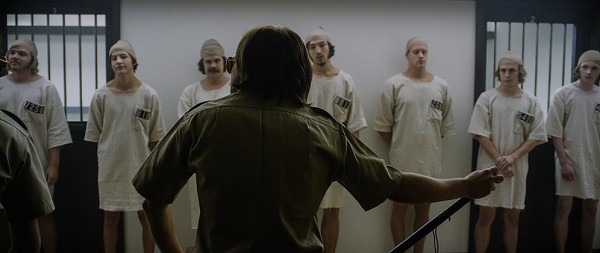
 ‘The Stanford Prison Experiment,’ Kyle Patrick Alvarez’s beautifully and intensely executed new film, is a hard film to say you “like.” Who wants, after all, to have humans’ latent inhumanity shoved in their face? Many viewers like the security of knowing that the expression of evil is contained within a carefully constructed plot, rather than within an account of actual events, as is the case with this film. That being said, the movie’s tale of a 6-day Stanford 1971 psychological group experiment gone wrong could be shown to visitors from outer space as an example of what debased behavior we people are capable of; within the limits of this film we witness violence, sexual aggression, and verbal abuse among people who don’t know each other, under the guise of role-playing: playacting at being prisoners and prison guards. In showing these interactions between individuals in a controlled circumstance, the film not only teaches us about human nature but about what it means, in a number of senses, to perform.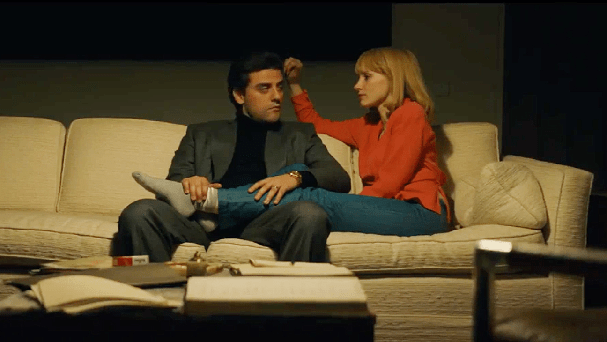
 The places where we live shape us, and we shape the places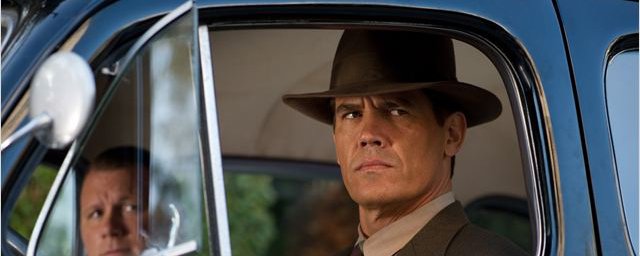

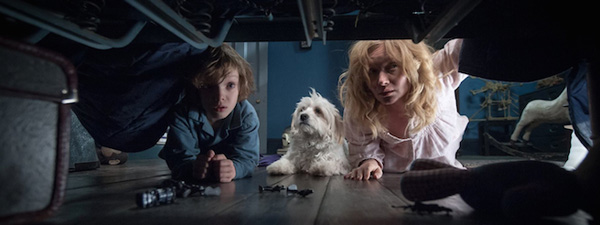
 The Babadook opens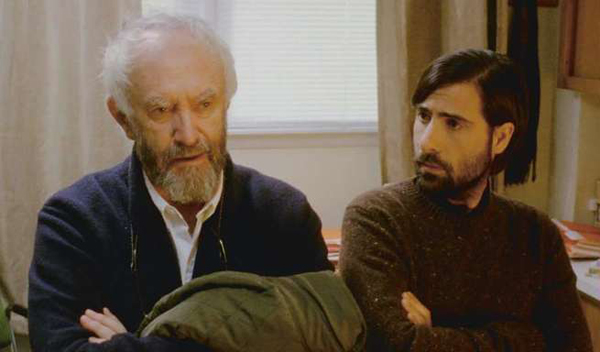
 Alex Ross Perry’s LISTEN UP PHILIP, besides featuring Jason Schwartzman’s best acting job and wrestling remarkable turns from Jonathan Pryce and Elizabeth Moss, performs an act of kindness for its viewers. This tale of an abusive, alienated, successful novelist’s spiral into loneliness lays out, in excruciating detail, the relationship between cause and effect that can govern the shape a human life takes. In showing us, painfully clearly, the results of novelist Philip Lewis Friedman’s poor behavior, both within his own life and in the reactions of those around him, Perry advocates strongly against such behavior, making his film the equivalent of watching a Biblical punishment unfold on film. The critical reception has focused almost entirely on Philip’s meanness, and the entertainment value therein, and not on why such a story might be told. Philip’s behavior is not, in fact, the most interesting part of the film–there is no novelty in the idea of a cruel, clever writer. That story’s been told, many times, and without such a shaky camera. There is, however, a great deal of novelty and originality in holding that cruel clever writer accountable, at length, and in so doing, prodding at viewers’ consciences. The play’s the thing, after all.
 What do you consider offensive? The dictionary definition of


 A large part of writing a review is telling what experiencing the work in question is like—the feeling one gets when reading, or watching, or listening,
 I almost didn’t write this review. This was not because I didn’t
 Press Play Video Blog