


Growing up in the 1980's with the slave name Boone, I was delighted to hear the joke song my older brother brought home from school one day. He sang it to the tune of the Daniel Boone TV theme song in his best middle-school baritone, holding one arm out and extending his slight baby-fat belly like Burl Ives: "Daniel Boone was a man/He was a biiiiig maaan… But the bear was bigger/so he chased that nigga/up a treee…." This would thereafter cause me to choke with laughter whenever it was sung within my earshot. First off, there was the use of the word nigger as nigga, the way kids in my neighborhood used it, as a subversively goofy synonym for man. Second, the song turned a straightforward 1960's adventure show into an F-Troop-style lampoon, sending the kind of barrel-built frontiersman you'd expect to fight a bear one-handed scrambling up a tree instead.
 The absurdity of the word nigger, and of the American empire that counted it as currency, inspire Quentin Tarantino nearly as much as Uma Thurman's toes. He marvels at a society that creates, perpetuates and forever fears a nigger class. In Django Unchained, we get to witness the entire nigger creation/perpetuation/demonization assembly line, and it looks like the most jackleg Rube Goldberg contraption you can imagine. It starts by showing slaves dragged along in neck and ankle chains; it proceeds to detail the auctioning, trading, policing and torturing of niggers. Greasy rednecks and pretentious Southern gennuhmen fumble at the levers of this ungainly contraption all the way along, spitting tobacco and ducking its blast of dirty locomotive exhaust.
We know, thanks to a voluminous amount of reporting, that Tarantino has filtered this view of American capitalism through his film critic lens, referencing Sergio Corbucci Spaghetti Westerns and blaxploitation, and, less frequently noted, Blazing Saddles and The Skin Game. I also spied the kind of anachronistic postures and quips that made Wild Wild West, Hogan's Heroes and, yes, F-Troop dietary staples of Tarantino's (and my) generation.
Now, there is a certain type of African-American intellectual whose grasp of the brute facts of history is firm but whose funny bone goes dead numb at the sound of the word nigger; whose measure of artistry in any film approaching the vast subject of "us" is whether it uplifts or insults us. These are the niggas that would stare sourly at my brother's rendition of the Daniel Boone theme song and at Django Unchained's approximately 115 utterances of nigga.
Spike Lee is one of those niggas. A talented filmmaker and brilliant businessman, his imagination often seems atrophied when he tries to build up his ability to choose topical, incendiary subject matter. In Malcolm X, he staged one of the most vivid, vigorous passages in X's autobiography, the Roseland ballroom dance, as a stagy, choreographed number with canned music—PBS Black History Month stuff. Later in that film, he recreated Malcolm's magical realist encounter with the specter of Elijah Muhammad as an interview with a glowing Yoda in his prison cell. The lowest point in the history of Spike's imagination was the scene in Summer of Sam where serial killer David Berkowitz's dog Sam, sounding like Jon Lovitz and moving his lips with the help of Purina-commercial CGI, ordered his master to "Kill, Kill, KILL!!!"
Spike brought that kind of imagination to a recent Tweet-review of Django Unchained, written without having seen the movie: "American Slavery Was Not A Sergio Leone Spaghetti Western. It Was A Holocaust. My Ancestors Are Slaves. Stolen From Africa. I Will Honor Them."
Not to say that Django is an exceptionally subtle piece of work. Both Spike and Quentin have a Sam Fuller tendency to go all-caps, tabloid large when staging bits of provocation that would be juicy all on their own. But let's just lay it on the table: Tarantino is the better filmmaker, by many miles. His ability to organize screen time and space is more assured and rhythmic than Spike's generally antsy, grab-bag approach. Certain sublime stretches of Do the Right Thing, Clockers, 25th Hour and his lovely documentaries nothwithstanding, it's hard to imagine Spike sitting still for the carefully timed and detonated jokes built around Django's initiation into the bounty-hunting business. Both filmmakers are terrible actors who have trouble getting out of their own way, but Tarantino, more often than Spike, redeems his indulgences with scene-making that simply rewards close, patient attention. Both filmmakers quote the films and pop culture totems that inspire them; Tarantino just tends to do it more elegantly and purposefully (Radio Raheem's lyrical Night of the Hunter quotation in Do the Right Thing and Kill Bill's sometimes ungainly kung fu Orientalism notwithstanding).
 What Spike had over Quentin, up until Inglourious Basterds and Django Unchained, was a political passion that made headlines. Tarantino, who had once criticized Oliver Stone for turning his nihilistic crime script Natural Born Killers into a bludgeoningly political "Oliver Stone Film," seems to have emerged as a junior Stone, speaking out with a strong liberal voice about how today's prison industrial complex is essentially "modern day slavery." His two most recent films are complicated reflections on American evil. The massacre of mostly civilian moviegoers in Basterds was uncomfortable even before the Colorado Dark Knight shootings; we could recognize ourselves in those doomed Nazi sympathizers and appeasers. We are the good citizens who sit by when our government and corporate elite commit crimes that we believe won't touch us, up until the moment the chickens come home to roost. The insurgent heroes in Basterds and Django don't discriminate much between active combatants and their abettors—a quality that resonates in all directions, at modern-day terrorists, soldiers, CIA torturers, tribal warlords and regional militia. A scene where freed slave Django argues with his bounty hunter mentor, King Schultz (Christoph Waltz), over the prospect of sniping a wanted man in front of that man's son, might as well be between two Defense Department employees pondering the morality of extrajudicial killings by aerial drone. Their view of the man pushing a plow on his quiet farm even resembles the kind of perspective drones and attack helicopters get on their Eastern prey.
Through Basterds and Django, Tarantino states that all power that dehumanizes an Other is bloody and treacherous, and that when it's performed in our name, we should know exactly what it looks like and anticipate tasting similar treachery in retaliation. A certain non-violent, ingratiating character in Django Unchained gets swept away in a cartoon-like gun blast. She flies back like a rag, as weightless as her convictions. At both screenings I attended, the audience roared with laughter in that moment—but it was an uneasy laugh.
So Tarantino has more interesting things on the Django plate than the ugliness or savage beauty of the word nigger, but they all orbit around the global condition for which that word is merely a place card. Daniel Boone was a big man, as 60's television taught us, but he also owned slaves, as I learned when I was a teen, digging for some link between my family name and a glorious American past. In history, the niggers are the ones you have to do some digging to find, typically under rubble or unmarked graves. To do this kind of digging as a filmmaker, a really fine-tuned sense of humor helps a heap.
Spike Lee showed that kind of raw but humanistic wit on Do the Right Thing and in great documentaries like Jim Brown: All-American. That guy would enjoy Django Unchained, I'll bet. The other Spike Lee, the one who Tweeted a psychic review of a movie he hadn't seen, has already spoken, inanely. Yet another Spike Lee, the one who has shown, in films like She Hate Me and the shallower portions of Bamboozled, a sense of humor every bit as trivial and callous as he claims Django to be, reminds me of that Lucille Clifton poem about Eddie Murphy and Richard Pryor:
eddie, he a young blood
he see something funny
in everythin ol rich
been around a long time
he know ain't nothing
really funny
Steven Boone is a film critic and video essayist for Fandor and Roger Ebert's Far Flung Correspondents. He writes a column on street life for Capital New York and blogs at Big Media Vandalism.


 In a way, this problem with dramatic situations in his work is a necessary consequence of the formal predilections that launched Tarantino’s career. When the most salient feature of your debut is that its characters spend a significant portion of the running time sitting around talking about pop culture, there’s a good chance that emotional depth is off the table altogether. The irony is that while Reservoir Dogs and Pulp Fiction were being hailed for their “slice of life” sensibility, they were really just trading one kind of artifice for another, less recognizably “cinematic” one. So while characters in a Tarantino film might just sit around talking about cheeseburgers or instant coffee, as real people are indeed wont to do, they were affirming themselves as fundamentally frivolous, which ultimately made it hard to care about their fates. Characters who resembled real people wound up feeling less fully realized than more conventional ones might have, which is the opposite of the intended effect. There’s no doubt that Pulp Fiction is a hugely enjoyable and inexhaustibly quotable film. But it’s not exactly emotionally rich or psychologically complex, either.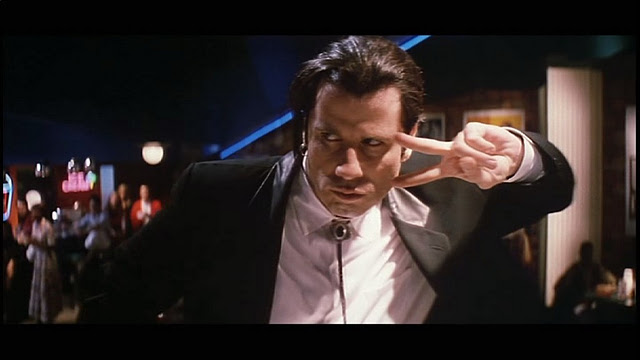
 Tarantino has been doing this from the start of his career, from the moment in Reservoir Dogs when the doomed Mr. Brown (played by Tarantino himself) waxed profane about the supposed true meaning of Madonna’s “Like a Virgin,” then promptly died of gunshot wounds behind the wheel of a getaway car. His second film, Pulp Fiction, moves this tendency into the foreground. Nearly all of the movie’s 150-minute running time features characters talking, talking, talking, about their personalities, their values, their world views, and about other characters, some of whom we don’t get to know—or even meet—for an hour or more. All the film’s major characters are modern, workaday cousins of the Great and Powerful Oz; the film builds them up by having others repeat their (often self-created) legends until they loom in our minds like phantoms, then tears away the curtain to reveal panicked little people desperately yanking levers. “Come on,” Jules tells Vincent in the film’s opening section, “let’s get into character.”
 Tarantino does this over and over again in Pulp Fiction. Mia Wallace is introduced as a sex goddess monitoring her date, Vincent, via surveillance cameras while mood-setting music (“Son of a Preacher Man”) thrums on the soundtrack, and then speaking to him through a microphone. Until Vincent’s car pulls into the parking lot of Jackrabbit Slims, she’s just a pair of lips and two bare feet, intriguing by virtue of her remoteness and sense of control. She seems a more strange and special person than the woman described earlier by Jules: a failed wannabe-star turned gangster’s trophy. “Some pilots get picked and become television programs,” Jules says. “Some don't, become nothing. She starred in one of the ones that became nothing.” But the date proves to be a complete disaster, as Mia mistakes Vincent’s heroin for cocaine while he’s in the bathroom and nearly dies of an overdose. And about that needle scene: Vincent and his drug dealer Lance’s terrified babbling about the right way to administer a heart injection refutes an earlier conversation in which they tried to make themselves seem like world-weary bad-asses. (Lance on his smack: “I'll take the Pepsi challenge with that Amsterdam shit, any day of the fuckin' week.” Vincent: “That’s a bold statement.”)
 “There's this passage I got memorized,” Jules tells Pumpkin, the would-be diner robber who has dared to steal his “Bad Motherfucker” wallet. “Ezekiel 25:17. ‘The path of the righteous man is beset on all sides by the iniquities of the selfish and the tyranny of evil men. Blessed is he who, in the name of charity and good will, shepherds the weak through the valley of darkness, for he is truly his brother's keeper and the finder of lost children. And I will strike down upon thee with great vengeance and furious anger those who attempt to poison and destroy my brothers. And you will know my name is the Lord when I lay my vengeance upon thee.’ I been saying that shit for years. And if you heard it, that meant your ass. I never gave much thought to what it meant. I just thought it was some cold-blooded shit to say to a motherfucker before I popped a cap in his ass. But I saw some shit this morning made me think twice. See, now I'm thinking, maybe it means you're the evil man, and I'm the righteous man, and Mr. 9 millimeter here, he's the shepherd protecting my righteous ass in the valley of darkness. Or it could mean you're the righteous man and I'm the shepherd, and it's the world that's evil and selfish. I'd like that. But that shit ain't the truth. The truth is, you're the weak, and I'm the tyranny of evil men. But I'm trying, Ringo. I'm trying real hard to be the shepherd.” – Matt Zoller Seitz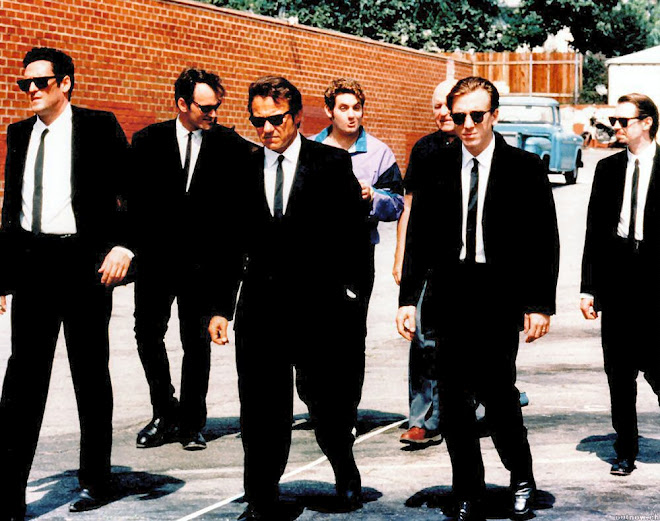
 Press Play Video Blog