

EDITOR'S NOTE: We are proud to present an unusual and personal series of articles by critic Peter Tonguette about grief and mourning on film, and how certain moviegoing experiences affected him in the aftermath of his father's death. Peter's series includes pieces on Hereafter, The Darjeeling Limited, Running on Empty, Men Don't Leave and A Soldier's Daughter Never Cries. If you would like to read the introduction to this series, click here. If you would like to read Pictures of Loss: The Darjeeling Limited, click here. If you would like to read Pictures of Loss: Running On Empty, click here. If you would like to read Pictures of Loss: Men Don't Leave, click here. If you would like to read Pictures of Loss: A Soldier's Daughter Never Cries, click here.— — Matt Zoller Seitz
Joan Didion says, “We tell ourselves stories in order to live.” In the months after my father died, the story I told myself was that I could write as I always had, about movies and movie directors, and that this would, in fact, serve as a useful distraction from my grief. I was certain that my professionalism would see me through this terrible time.
Most would call it denial.
Soon enough, I found that I couldn’t sit for most movies, and the last thing I wanted to do was write about them. The only words that mattered now—that my father haddied—were the words I could not bring myself to write. I suspect the same is true in the aftermath of any catastrophic event. To write of anything else feels trivial; what could possibly take precedence over the catastrophe? Yet to write about the catastrophe itself is just too difficult.
I managed to do a few interviews for the book I was finishing and a handful of magazine assignments, which I eagerly accepted before finding that my usual dedication and focus had forsaken me. I tried everything, including reminding myself that my father would want me to proceed apace with my career. In hindsight, my putting the matter that way—which I did on more than one occasion—seems telling. If I was so certain about continuing to write about movies, why would I even raise the possibility of stopping?
Eventually, I was nudged back to work by the prospect of collaborating with a friend on a small editing project. The friendship was more helpful to me than the work, which was not particularly creative, but it was a start. Since I hadn’t worked on a consistent basis in months, I regarded the project as a challenge and was eager to do well. Because I had a
partner in crime, and because she was a friend, I had no choice but to hold up my end of the bargain.
The exercise was a turning point. I began to write again in earnest, but ever so slowly, and only gradually did it dawn on me that I had a book to finish, that there were people in this world who actually wanted me to write for them. But what allowed me to see it through to completion, I realize now, was not the professionalism I imagined I possessed or the pressure of not wanting to disappoint a good friend.
My book was about the late filmmaker James Bridges, whose films were often about the heartache of losing a loved one. This is certainly the theme of his best film, September 30, 1955, which stars Richard Thomas as a college student in Arkansas who is bereft at the death of his idol James Dean. Long before my father’s death, I had made voluminous notes about the film, but as I marshaled them into a manuscript, I found that I was obsessed by it. “Death is never far in Bridges’s films,” I wrote, and it wasn’t far from my mind as I typed those words. At first, I did not know why I dwelt so intensely on September 30, 1955. I’m sure I was convinced I did so because it was “among the very greatest of American films of the 1970s.”
But something else was afoot.
I found myself relating to the grief of the Richard Thomas character in a very personal way. I understood his sorrow—and I bickered with it, too. He lost a movie star, not a parent or a family member or a friend. He should know better, though I myself hadn’t always known better. As a teenager, I was always very affected by the death of a public figure I admired, like Stanley Kubrick. Yet when J.D. Salinger died several weeks after I lost my father, I was very sorry, but not devastated.
I watched and re-watched September 30, 1955, and the words poured forth, but I was still unaware of the reason why. So I didn’t seek out other films that gave me the jolt it had.
Instead, they seemed to find me.
One night, I was working in my room when someone decided to put in a DVD of Clint Eastwood’s Hereafter. I used to love Eastwood’s films. I was the sort of person who considered Bronco Billy to be a masterpiece. I saw Mystic River three times when it was first released in theatres. In my present state, however, keeping up with Eastwood was low on my list of priorities. I’m sure I thought, “Why bother? What difference does it make if it’s any good or not?” But as the film started, I caught myself turning to watch every few minutes. A snippet of dialogue would intrigue me. An overheard moment would pull me in. I glimpsed a scene here, a scene there, and I found it harder and harder to turn away. I soon left my work and moved to a chair closer to the TV. The film did more than command my attention. I was—literally—being drawn in by it.
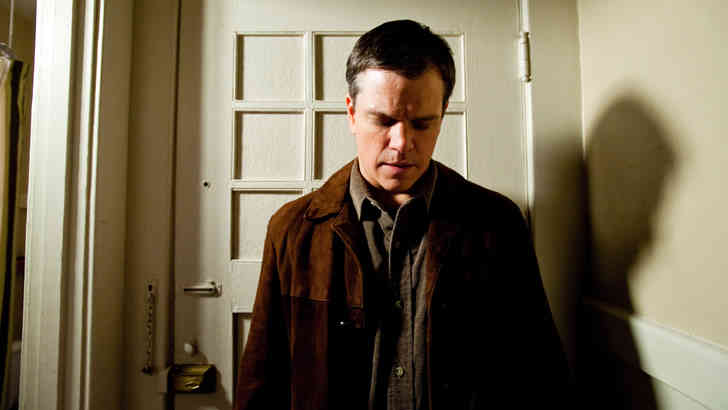
In Hereafter, Matt Damon plays George Lonegan, a psychic who does not wish do be a psychic. It is one of Damon’s best performances. Even though he declines to help many sad, desperate people who feel they can benefit from his gift, he always retains sympathy for the grief-stricken amongst us, a reflection of Eastwood’s own compassionate perspective.
Has the director ever filmed a moment as heartrending as when a British youngster named Marcus (whose twin brother Jason has died in an accident) looks to his sibling’s empty bed and says, “Goodnight, Jas”?
Obsessed with communicating with his brother, Marcus learns of George and tracks him
down when George serendipitously makes a trip to London. Marcus wants him to do a reading, but the answer is—predictably—no. “I don’t do that anymore,” he insists in a huff. But Marcus will not give up that easily and proceeds to stake himself outside of George’s hotel room all day. George’s basic decency finally gets the better of him, as he invites Marcus inside. He begins by asking Marcus a stream of questions, with Marcus either answering or nodding his head yes to each. “Someone close to you has passed away… A male… He was young when he died… Is this person your brother? Older brother? But not by much, he says. Only by a few minutes… I’m sorry, kid.”
Because we have seen Marcus and Jason’s story unfold, we know that everything George says is true. Because George has only just met Marcus, we also know that his psychic abilities are therefore real.
It turns out that Eastwood’s attitude toward the supernatural is as matter-of-fact as his screen persona. He seems to have followed the suggestion of the poet and novelist Robert Graves, who once wrote that “one should accept ghosts very much as one accepts fire—a more common but equally mysterious phenomenon.” In Hereafter, Eastwood accepts George’s abilities much as Graves accepted ghosts and fire: at face value. For example, when George is pestered into doing a reading by a young woman he has a romanticinterest in (played by Bryce Dallas Howard), he relays a message from her deceased father that is greatly upsetting to her, thus ending their nascent relationship. Why would George do this unless he really was psychic? After all, from his perspective, would it not have made more sense to tell the woman something she wanted to hear?
Rilke wrote the line “Who says that all must vanish?” in a different context, but it is easy to imagine Eastwood and screenwriter Peter Morgan asking it of us, as they confidently but casually assert that loved ones are still here, somehow, even after they seem gone. My favorite moment in Hereafter comes when George tours the London home of Charles Dickens (his favorite author). He pauses to admire the painting “Dickens’s Dream,” which, it is explained by a tour guide, shows a dozing Dickens surrounded by “characters from his novels floating in the air around him.” The description beautifully anticipates the way George says Jason describes the afterlife to him: “The weightlessness. He says that’s cool.”
Not since Evelyn Waugh’s A Handful of Dust has the work of Charles Dickens been referenced to such powerful effect.
Even though Hereafter is about death and near-death, I didn’t find it grim. Just the opposite. I remembered the strange truth of what Stanley Kubrick told Stephen King when he was about to make The Shining into a movie: “Well, the concept of the ghost presupposes life after death. That’s a cheerful concept, isn’t it?” There isn’t a single character in Hereafter who I would call cheerful, yet Marcus walks away from his session with George with the reassurance he has been seeking. “If you’re worried about being on your own, don’t be,” his brother communicates to him, through George. “You’re not. Because he is you and you are him. One cell. One person. Always.”
If we must suspend disbelief to fully share in Marcus’s solace at hearing those words, let us remind ourselves that we are in good company. At the end of his final film, Family Plot, Hitchcock allows a fake psychic (Barbara Harris) to demonstrate authentic telepathic abilities. “Blanche, you did it! You are psychic!” her husband (Bruce Dern) exclaims, as if imitating Hitchcock’s own incredulousness. But it’s true—she is!
Of course I loved Hereafter: here was a film that expressed not only my pain but also to my most basic, private wish, the same wish expressed by the son who loses his father in Paul Brickman’s Men Don’t Leave (discussed later this week): “I want to see him again. One more time.”
Peter Tonguette is the author of Orson Welles Remembered and The Films of James Bridges. He is currently writing a critical study of the films of Peter Bogdanovich for the University Press of Kentucky and editing a collection of interviews with Bogdanovich for the University Press of Mississippi. You can visit Peter's website here.


 Press Play Video Blog