


A plantation in the antebellum South is a perfect setting for a Quentin Tarantino film. His movies flip expectations, revealing gangsters as mundane chatterboxes and assassins as loving parents, transforming the would-be victims of murderous stalkers and World War II Nazis into forces of vengeance. So with Django Unchained, Tarantino takes aim at the mythology of the southern plantation through his genre-colliding structure to bathe the culture in his excessive style. The film is intermittently thrilling fun—the director is in complete control of his camera—yet for all its surface pleasures, it feels oddly unfocused. It rarely displays Tarantino’s ability to undermine or reinvent the familiar. Too often it feels like a film by one of his poor imitators.
In many ways, the structure of Django Unchained recalls Inglorious Basterds. It’s a mix of spaghetti western and blaxploitation that takes its title from the Sergio Corbucci film Django, and even features a cameo by its star, Franco Nero. The film begins with a shot of whip scars on the back of the titular Django, played by a quietly soulful Jamie Foxx, as he’s led across the landscape as part of a chain gang. Dr. King Schultz, a dentist played by Christoph Waltz, approaches the slave masters in the middle of a forest, using words such as parley and malarkey to intimidate them with his control of the English language. It turns out the good doctor is actually a bounty hunter who needs Django to identify his next targets. When Django’s owners turn down Schultz’s request, he turns this nighttime encounter into a bloody mess, sending our heroes on their way, and planting the seeds of black revenge.
In terms of sets and locations, Django Unchained is Tarantino’s most expansive film, but it features his most straightforward story. Django and Schultz first team up as bounty hunters across the South before deciding to rescue Django’s wife, Broomhilda (Kerry Washington). She’s being held captive by the vicious, maniacal slave owner Calvin Candie (Leonardo DiCaprio, miscast) and Samuel L. Jackson as Candie’s loyal servant Stephen, an Uncle Tom to the nth degree. Schultz and Django must perform in order to deceive their captors, hiding their shock at the violence and pain of slavery around them. Playacting in service of the job is a Tarantino signature (see Reservoir Dogs’s undercover cop posing as the bank robber Mr. Orange, the Pulp Fiction assassin Jules bellowing Biblical passages as a prelude to murder, and the various role-players in Inglorious Basterds). Django doesn’t come at this theme with nearly as much originality or verve, nor does it present its bloodshed in a way that comments upon the moviegoer’s attraction-repulsion to violence. The characters obsessively discuss the savagery onscreen and the way violence is commodified, but their observations never add up to a critique.
Tarantino’s initial concept is promising; one would think that if anyone could re-imagine the clichés of Spaghetti westerns and slavery exploitation pictures, he could. But because the outcome of this tale feels inevitable and telegraphed, there’s little at stake, and the characterizations are disappointingly one note, and don’t defy our expectations as thrillingly as some of his other creations. Although Foxx plays Django with a cool and calculated depth, the hero never seems more than an archetype at the center of a myth, and Washington, another excellent performer, is given even less to do as Django’s mate Broomhilda. As much fun as DiCaprio looks like he’s having shouting epithets, his character is still a bombastic cartoon—stylish and fun but rarely complex. Only Waltz and Jackson give their characters more complicated, dynamic shadings. The plot machinations eventually lead to violent battle at the plantation, but it takes so long that when it arrives, it seems more a peak of excess than a satisfying climax, and throughout, the film lacks most of the other elements that make his earlier work more than just flashy entertainment. The hero slays all those who perpetuate the culture of slavery, but after the apocalyptic finale of Basterds, the bloodbath feels rote.
Tarantino, the Man Who Loves Movies, is still a virtuoso with the camera, taking inspiration from his idols to craft thrilling and exciting scenes. Sergio Leone’s tight closeups, Corbucci’s zooms, John Ford’s vistas and Howard Hawks’ editing patterns are all in play throughout Django, and there are echoes of blaxploitation films, too, particularly Shaft and Superfly. His camera movements are bold, taking you right into the action, and with Robert Richardson as director of photography, Western iconography hasn’t looked as good since The Assassination of Jesse James by the Coward Robert Ford. The film also boasts some of Tarantino’s most violent action, which for him is saying a lot, and its point-of-view is squarely with the oppressed rather than the oppressors. Scenes of violence toward blacks have an intense visceral quality and are often shot in tortuous close-ups with a grainy, oversaturated texture; violence against whites often plays in long shots, which lend these scenes over-the-top comical quality.
Unfortunately, Tarantino’s proficiency stops with the visuals. He seems more interested in its surface pleasures than actually engaging with his text. The movie’s most subversive moment—a comical set piece involving a very game Don Johnson and the Ku Klux Klan—feels less like Tarantino than a deleted scene from Blazing Saddles, and the deliberately anachronistic use of rap and soul artists, including 2Pac, Rick Ross, and John Legend, feels more intrusive than organic. (None of the songs feel as strangely right as David Bowie’s “Cat People” did in Basterds.)
More puzzlingly, the verbal tangents, a Tarantino hallmark, fall flat. Those elongated discussions usually serve one of two purposes: They contribute to the creation of unique character moments later, as in the TV pilot discussion in Pulp Fiction or the lap dance narrative in Death Proof; or they suggest what is not being said in a scene and build tension, as in the German pub sequence in Inglorious Basterds. Django’s talk lacks such richness. Much of the dialogue in the film’s second half centers on discussions of how slaves’ strength is rated; it should cut to the heart of the film’s subject, but it only underlines how much Tarantino loves his own phrasing. By the time Candie gives us an anatomy lecture with a human skull, the film seems as if it’s trying to be bold for boldness’ sake, without giving much thought to its ultimate goal. What, if anything, is the filmmaker trying to say about race, racism and slavery throughout Django Unchained? It’s not clear. The film plays out the fantasy of African-American revenge to an appropriately bloody conclusion, but it all seems more passé than inventive, clever but never revolutionary.
The movie’s failures are all the more depressing when one considers how many great films Tarantino has made, and how his talent has evolved over time. Twenty years ago, he revived commercial cinema with an adrenaline shot to the heart, but any complexity or surprise Django Unchained might have had gets asphyxiated under Tarantino’s love of his own craft. The movie is technically impressive but never emotional, its flourishes are witty yet superficial, and over time it becomes tedious. A film involving this many sticks of dynamite should have been more powerful.
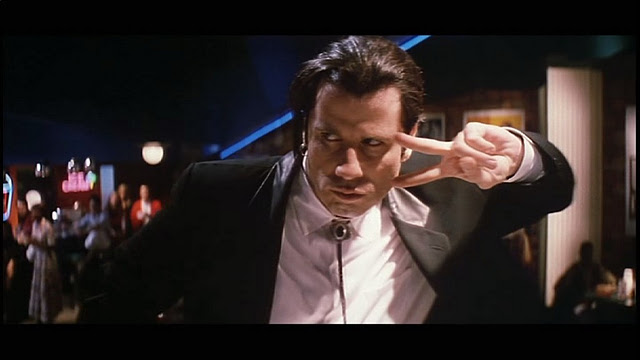
 Tarantino has been doing this from the start of his career, from the moment in Reservoir Dogs when the doomed Mr. Brown (played by Tarantino himself) waxed profane about the supposed true meaning of Madonna’s “Like a Virgin,” then promptly died of gunshot wounds behind the wheel of a getaway car. His second film, Pulp Fiction, moves this tendency into the foreground. Nearly all of the movie’s 150-minute running time features characters talking, talking, talking, about their personalities, their values, their world views, and about other characters, some of whom we don’t get to know—or even meet—for an hour or more. All the film’s major characters are modern, workaday cousins of the Great and Powerful Oz; the film builds them up by having others repeat their (often self-created) legends until they loom in our minds like phantoms, then tears away the curtain to reveal panicked little people desperately yanking levers. “Come on,” Jules tells Vincent in the film’s opening section, “let’s get into character.”
 Tarantino does this over and over again in Pulp Fiction. Mia Wallace is introduced as a sex goddess monitoring her date, Vincent, via surveillance cameras while mood-setting music (“Son of a Preacher Man”) thrums on the soundtrack, and then speaking to him through a microphone. Until Vincent’s car pulls into the parking lot of Jackrabbit Slims, she’s just a pair of lips and two bare feet, intriguing by virtue of her remoteness and sense of control. She seems a more strange and special person than the woman described earlier by Jules: a failed wannabe-star turned gangster’s trophy. “Some pilots get picked and become television programs,” Jules says. “Some don't, become nothing. She starred in one of the ones that became nothing.” But the date proves to be a complete disaster, as Mia mistakes Vincent’s heroin for cocaine while he’s in the bathroom and nearly dies of an overdose. And about that needle scene: Vincent and his drug dealer Lance’s terrified babbling about the right way to administer a heart injection refutes an earlier conversation in which they tried to make themselves seem like world-weary bad-asses. (Lance on his smack: “I'll take the Pepsi challenge with that Amsterdam shit, any day of the fuckin' week.” Vincent: “That’s a bold statement.”)
 “There's this passage I got memorized,” Jules tells Pumpkin, the would-be diner robber who has dared to steal his “Bad Motherfucker” wallet. “Ezekiel 25:17. ‘The path of the righteous man is beset on all sides by the iniquities of the selfish and the tyranny of evil men. Blessed is he who, in the name of charity and good will, shepherds the weak through the valley of darkness, for he is truly his brother's keeper and the finder of lost children. And I will strike down upon thee with great vengeance and furious anger those who attempt to poison and destroy my brothers. And you will know my name is the Lord when I lay my vengeance upon thee.’ I been saying that shit for years. And if you heard it, that meant your ass. I never gave much thought to what it meant. I just thought it was some cold-blooded shit to say to a motherfucker before I popped a cap in his ass. But I saw some shit this morning made me think twice. See, now I'm thinking, maybe it means you're the evil man, and I'm the righteous man, and Mr. 9 millimeter here, he's the shepherd protecting my righteous ass in the valley of darkness. Or it could mean you're the righteous man and I'm the shepherd, and it's the world that's evil and selfish. I'd like that. But that shit ain't the truth. The truth is, you're the weak, and I'm the tyranny of evil men. But I'm trying, Ringo. I'm trying real hard to be the shepherd.” – Matt Zoller Seitz

 Press Play Video Blog