


Jeff Nichols’ film Mud was just added to Netflix streaming in what I hope will be the film’s second chance at earning the attention and acclaim it deserves. For me, Mud was one of the finest films of 2013 but it was somehow overlooked during its theatrical release. It is difficult to know whether it was a marketing problem, a timing issue, or a matter of the film’s understated artistry that caused it to miss hitting critical mass in theaters. But this soft box office performance does not reflect the fine quality of storytelling in Mud: after my first viewing, I left the theater with the distinct feeling that I had just experienced an American classic.
What was so powerful about this film? And what elements had come to bear on the idea of a “classic” for me? To begin, there is something fundamental in the storytelling—something close to nature. One of the very first scenes of the film is captured from a moving boat so that the pace of the film truly aligns with the rhythm of the Mississippi River, where the tale takes place. Going forward, we see that Mud continues to move like the river, the story unfolding with the same smooth, slow-rolling tension.
This river scene introduces two boys, Ellis (Tye Sheridan) and Neckbone (Jacob Lofland), who are setting out on an adventure in the secret hours of the early morning. The distinctly American spirit of exploration is palpable, and as the boys navigate the foggy river, we recognize the archetype of a great adventure tale beginning. They boys are searching for the island where a recent storm has supposedly landed a boat high in the branches of a tree. The image recalls mythological floods and a sense of folklore, imbuing Mud with that quality of classic storytelling from the start.
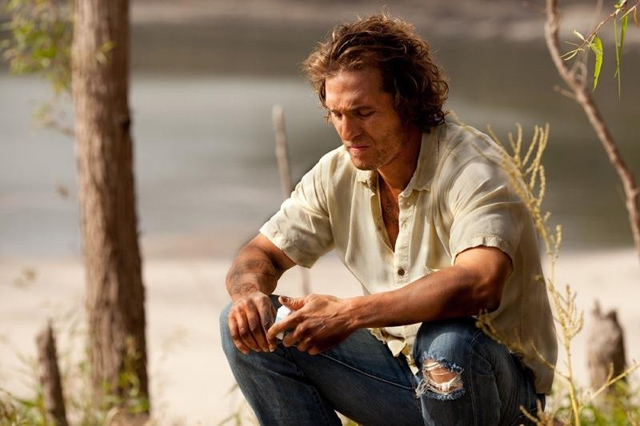
What begins as an innocent adventure takes a serious turn when the kids realize that someone is living in the fabled tree-boat. This turns out to be a mysterious fugitive who calls himself Mud (Matthew McConaughey). As the boys begin a friendship with an outlaw on the banks of the Mississippi River, the influences of another classic American tale become clear: writer-director Jeff Nichols has certainly rooted Mud in the mood of The Adventures of Huckleberry Finn. He even had the two young actors study Mark Twain’s novel on set, and the influence is beautifully apparent in the film’s deep sense of adventure and wonder.
Another striking Huck Finn influence—and to me, one that lends Mud that quality of a classic—is the way the story highlights the genius of youthful intuition. The character of Ellis celebrates the intuitive wisdom of the American kid. He is adventurous, perceptive, and resourceful, having grown up steering boats and catching fish. In addition to these good old Southern attributes, Ellis values loyalty and love with such intensity that the adults in his life cannot meet his standards. That is, until he meets Mud, whose fierce devotion to his first love has landed him on the wrong side of the law. And so where Ellis might be “The Great American Kid,” Mud is “The Great American Rebel.” Both characters possess a particular kind of intelligence—the wisdom of the outliers and the outlaws, the children who see more clearly than the adults, the shrewd wit of those raised close to nature. Their characters reflect a value system that fits into the old Southern classics, the tradition of Huck Finn and Tom Sawyer coming of age and evading the law on the Mississippi River.
The film takes place in contemporary Arkansas, but it is easy to lose track of the era while watching Mud. Its raw and natural imagery evokes a timeless spirit, rather than identifying a particular moment. The cinematography engages with the rich textures of the terrain – close-ups of mud and sand, writhing snakes and creaking houseboats. This intimacy with the landscape enhances the old fabled quality of life on the river. Even the acting reflects this natural style. The cast of Mud puts forth refreshingly honest performances. Indeed, six months before his Academy success in Dallas Buyers Club, McConaughey proved himself as a seriously nuanced actor with a neatly restrained performance in this film. Surely his young co-stars encouraged this organic acting style; their intuitive performances—something of that childish genius—seemed to draw a more natural tone of acting from McConaughey and the rest of the adult cast.
And so the acting, too, feels close to nature, in a sense. It fits with the raw and uncontrived essence of Mud‘s story, closer to Southern folklore than a Hollywood performance. In many ways, Mud is a throwback to good old-fashioned storytelling. It takes us back to Mark Twain, back to childhood, back to the rhythms of nature. Now, looking forward, this modern classic gets a second life through Netflix streaming. If you missed it the first time around, Mud is well worth another look.
Kayleigh Butera is
a writer from Philadephia, PA. She is a recent graduate of Brown University,
where she studied American Studies and French language. She worked as the
programming coordinator of Brown’s Ivy Film Festival, the world’s largest
student-run film fest. Kayleigh is currently living in Brooklyn. She can be reached at kayleigh.butera@gmail.com.

 Press Play Video Blog