

[EDITOR'S NOTE: Press Play presents "Should Win," a series of video essays advocating winners in seven Academy Awards categories: supporting actor and actress, best actor and actress, best director and best picture. These are consensus choices hashed out by a pool of Press Play contributors. We'll roll out the rest of the series between now and Friday. Follow along HERE as Press Play picks the rest of the categories including Best Picture, Best Director, Best Actress, Best Supporting Actress, Best Supporting Actor and Best Documentary. Important notice: Press Play is aware that our videos can not be played on Apple mobile devices. We are, therefore, making this and every video in this series available on Vimeo for these Press Play readers. If you own an Apple mobile device, click here.]
Narration:
Brad Pitt is one of the biggest movie stars in the world. But he is also a fantastic actor. His phenomenal range has allowed him to play delirious and zany, as in Twelve Monkeys, but also understated and restrained, as in The Curious Case of Benjamin Button. Those films brought Pitt a Best supporting actor and a best leading actor Oscar nomination respectively, but both times, he went back home empty-handed. This year, Pitt is once again nominated as best actor in a leading role Academy Award for his performance in Bennett Miller’s Moneyball. Press Play believes that he deserves the Oscar, and, in this video essay, we will tell you why.
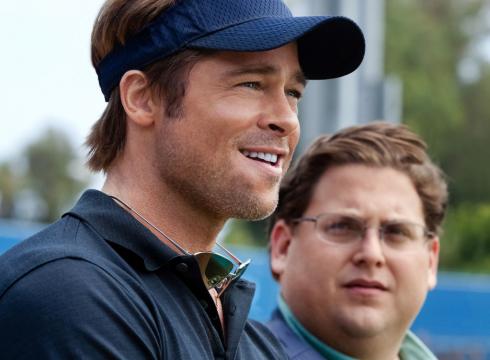
In Moneyball, Brad Pitt plays Billy Beane, the legendary general manager of the Oakland A’s, who reinvented the way baseball players were hired during the 2002 season. There is real mystery to Pitt's take on Billy Beane. He loves the game, but knows the game is changing. He knows he has to get wins in order to keep his job, and is more than willing to modernize for that reason. But he also knows there is something you can't calculate about the game of baseball. The scenes of Pitt driving to work or sitting in the locker room show a man who is constantly trying to figure out the odds and knowing deep down that there are some things you can't figure out.
 Brad Pitt’s performance is an almost old-fashioned, movie star one. In another universe, one could imagine Jimmy Stewart or Cary Grant taking the part. He brings to the role an assured quality on overzealous, yet understated, lust for ultimate success that was forged in the fires of years and years of failure. He's charming and cheeky and funny, and very good looking (despite the hideous early naughties’ haircut and lumbering fashion sense). Pitt brings a subtle comedic take to what could have been a rather boring central role; his various dealings with other managers, his scouts and players, betray genius-level timing and mimicry.
Pitt plays him as a nexus of frustration: he never made the big time, so he tries to make up for that lost opportunity. He is clever, though: he knows that he is unable to see the forest for the trees as evidenced in the final conversation with Peter Brand, a composite character played by Jonah Hill; as well as the earlier exchange with his precocious daughter, but that's what obsessive-compulsive people are like. They know what they're doing is irrational, but they have to keep doing it.
Ali Arikan is the chief film critic of Dipnot TV, a Turkish news portal and iPad magazine, and one of Roger Ebert’s Far-Flung Correspondents. Ali is also a regular contributor to The House Next Door, Slant Magazine’s official blog. Ken Cancelosi is writer/photographer living in Dallas, Texas.
 I can't speak to what baseball atheists got out of it. I can name maybe two other people who got the same frisson of hilarity out of the casting of Chad Kreuter as Rick Peterson as I did. I know for a fact that nobody else snickered at "No bunting whatsoever," but I of course collect comments like that. But I'm pretty sure "Who's Fabio?" "He's that shortstop from Seattle"; the "I'm just saying, his girlfriend is a six, at best" sequence; and Billy Beane's ex-wife's new husband and his man-dals got laughs from other people, because I'm pretty sure Moneyball is a good movie qua movie, sharply observed and well acted across the board.
 Press Play Video Blog