
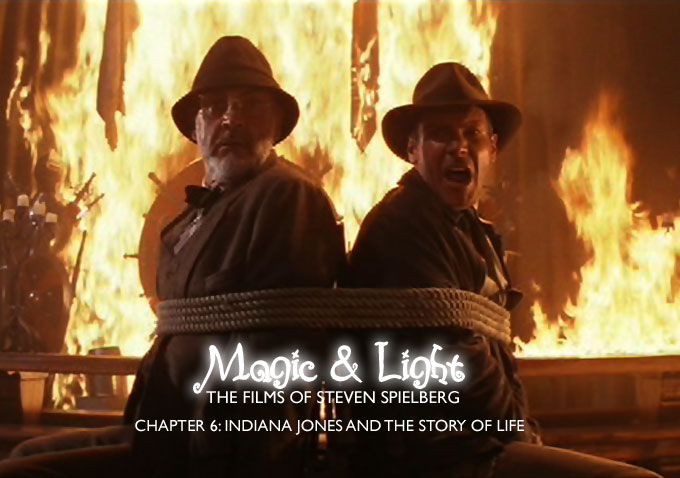
[Editor's Note: Press Play is proud to present Chapter 6 of our first video essay series in direct partnership with IndieWire: Magic and Light: The Films of Steven Spielberg. This series examines facets of Spielberg's movie career, including his stylistic evolution as a director, his depiction of violence, his interest in communication and language, his portrayal of authority and evil, and the importance of father figures — both present and absent — throughout his work.
Magic and Light is produced by Press Play founder and Salon TV critic Matt Zoller Seitz and coproduced and narrated by Ali Arikan, chief film critic of Dipknot TV, Press Play contributor, and one of Roger Ebert's Far Flung Correspondents. The Spielberg series brings many of Press Play's writers and editors together on a single long-form project. Individual episodes were written by Seitz, Arikan, Simon Abrams and Aaron Aradillas, and cut by Steven Santos, Serena Bramble, Matt Zoller Seitz, Richard Seitz and Kevin B. Lee. To watch Chapter 1: Introduction, go here. To watch Chapter 2: Blood & Pulp, go here. To watch Chapter 3: Communication, click here. To watch Chapter 4: Evil & Authority, click here. To watch Chapter 5: Father Figures, click here. ]
Narration:
What does it mean to be a father? What does it mean to come of age without a father? These questions have been at the center of many Steven Spielberg films. Both light entertainments and dark historical dramas have considered them.
The director’s evolving views on fathers and fatherhood are on surprisingly vivid display in the Indiana Jones series, which were produced by his longtime friend and Star Wars mogul George Lucas. Taken as a whole, the films feel like markers in Spielberg’s maturation.
Raiders of the Lost Ark introduces us to Indiana Jones, an archeologist who is more excited by grave-robbing and cheating death than by lecturing to Ivy League students. Indy holds a position of authority at the university, but were it not for the fact that he’s somewhat older than most of his charges and stands at the front of a classroom, he could be mistaken for a student.
There is no clear parental figure or even parental influence in the film. If anything, Indy is in his late thirties but has no visible entanglements. He even seems to treat his home merely as a crash pad, a base of operations.
When Indy decides to go looking for the Ark of the Covenant, he is cautioned by his older colleague of its power – the power of God, the ultimate father – and warned that maybe it shouldn’t be disturbed. Indy’s response is a blithe dismissal.
 In later films we will learn that Indy has taken on the vocation of his father as a way to impress, and then one-up, the old man, a stern and distant academic. In Raiders, Indy is presented as almost a runaway kid, a grown-up Bowery Boy who doesn’t give much thought to others. He possesses the shallowness of youth, complete with the clichéd woman in every port. He’s a heartbreaker, this one.
The most uncomfortably adult moment in the film might be the scene where he re-encounters his great love, Marion. We learn that he loved and left her cruelly, and that she was much younger than he was. Their affair ended badly enough to drive Marion to go tend bar in the Himalayas. There’s an unsavory hint of cradle-robbing.
Although chronologically it’s a prequel, the hard-edged Indiana Jones and the Temple of Doom is actually a direct continuation of Spielberg’s coming to terms with adulthood.
Made on the eve of his marriage to Amy Irving — a marriage that would eventually end in divorce, and a second marriage to Temple of Doom costar Kate Capshaw — Spielberg channels the hesitation that can paralyze some men when deciding to make the ultimate commitment. The entire movie positions Indy in relation to various configurations of family – good and evil, functional and dysfunctional. The film is dotted with images of fathers, from the Chinese gangster Indy barters with to the dignified general who protects the palace to the numerous guards in the Thugee cult. And the entire story is infused with a son’s primal fear that his father will fail him — and a father’s primal fear that he’ll let his wife and children down.
The movie finds the hero slowly forming his own bickering makeshift family, with Indiana Jones as reluctant, grouchy father, nightclub singer Willie Scott as mother, and orphaned pickpocket Short Round as their son. Early in the film we’re casually informed that Short Round’s parents were killed in a bombing. Willie could be a gold-digging female equivalent of Indy, an eternal teenager who’s mainly interested in having fun and acquiring nice things. Three people who are used to living alone and relying only on themselves are thrown together, and forced to depend on each other to survive. Their trivial concerns will be beaten and burned out of them, in the Indiana Jones film which for long stretches is essentially a horror movie.
 When Indy, Willie, and Short Round come across a village, they discover all of the children have been kidnapped and forced into slave labor in the mines of the Thugee cult. In effect, the bad guys in this film have made the entire village childless, and turned all the kids into orphans by kidnapping them.
The image of the cult is like a child’s nightmare made real as it consists of nothing but horrible, evil fathers. When Indy is forced to drink a potion he comes under the spell of the cult and his behavior is that of an abusive alcoholic dad.
Temple of Doom, along with Gremlins – which Spielberg produced, and which was also released that same summer – represent Spielberg’s final hurrah as a pure pop storyteller. These are tonally very strange movies, by turns charming and vicious, buoyant and horrific. When he directed the movie in the summer of 1983, Spielberg was edging up on 40, star Harrison Ford was actually turning 40, and George Lucas was dealing with the fallout from a painful and costly divorce. There’s a sense of looking backward on innocence, and forward, toward something darker.
In the 5 years between Temple of Doom and Indiana Jones and The Last Crusade Spielberg had become a father himself. The film’s opening origin sequence shows Indy risking life and limb to get his father’s approval, only to be dismissed when he tries to show his dad his big discovery. His newfound understanding of what that means can be seen in the way that the film presents Indy’s relationship with his own father, a brilliant but rather distant man whom Indy instinctively calls “Sir.”
Like Roy Neary in Close Encounters, Indy’s father is obsessed with a vision, in this case the location of the Holy Grail – the cup from which Jesus Christ, perhaps theology’s most piteously suffering son, drank during the last supper.
 While the elder Jones didn’t literally abandon his family to pursue his obsession, we have no doubt that a lot of the time when Indy was growing up, the old man was mentally or emotionally checked-out. You can see it in the way they communicate – or more accurately, don’t communicate.
Estranged from his father for years, the two are forced to work together when the Nazis attempt to also find the Grail.
Their rivalry is a constant source of father-son friction. It even plays out in Freudian ways as they sleep with the same woman.
In earlier films Spielberg might’ve been more inclined to empathize with Indy’s resentment towards his absentee dad. But in the scene in which Indy tries to lay a guilt trip on his dad, and his dad grows impatient with such childish complaints, Spielberg’s identification is with pretty clearly with the father.
For Spielberg, hanging onto resentment and anger over a parent’s failings is ultimately pointless, a sign that one has failed to evolve. At the same time, though, The Last Crusade acknowledges that a father is still capable of learning late in life, and that for good of both father and child, such evolution is desirable, and necessary.
When Indy is hanging on for dear life as he attempts to grab hold of the Grail, his father gives him one last order. The son puts his pride aside and listens. And it saves his life. It is the same lesson that the elder Jones had to learn – that the emotional reality of one’s family is more important than the abstract goal of pursuing one’s dream. Both father and son learn the value of letting go.
 Released almost twenty years after the last Indiana Jones film, Indiana Jones and the Kingdom of the Crystal Skull feels like a coda. Indy seems to be re-thinking his decisions, and having pangs of regret. Although the sixty-something Indy is still a snarling, leathery ass-kicker, and in what might be his surliest mood since the middle section of Temple of Doom, the movie’s overall tone is rueful and melancholy.
The whole story is suffused with feelings of displacement and regret. Indy is a man out of his element, and out of his time – perhaps out of time, period. Nobody who’s endured so much punishment should have lived this long. And emotionally, what has he got to show for it? Nothing. Or so he thinks….
Set in the 1950s – the decade of Spielberg’s childhood – Kingdom of the Crystal Skull shows Spielberg bringing everything full circle on both a story level and as his final musings on what he’s learned as a husband and father.
Kingdom of the Crystal Skull is about rejuvenation and the passing of knowledge. As a young man Indy thrilled to the globe-trotting search of artifacts of history without giving much thought to their historical significance. He sees them as prizes, showing little interest in context or for all that has come before him.
Indy’s discovery that he has a son forces him to realize that – in his own more physically fearless, two-fisted way – he’s as emotionally isolated as his father ever was. As he embarks on an adventure with Mutt, he doesn’t just become a father figure, he realizes he actually IS a father to the young man. He sees himself in Mutt, and tries to impart wisdom to the boy. Of course, coming out of Indiana Jones’ mouth, a lot of this sounds hilariously feeble. But he means well.
As father and son tentatively come together in order to rescue the boy’s mother – Marion, the relative baby that Indy robbed from her cradle in Raiders – their adventure becomes a meditation on a father’s legacy. It becomes
Indy’s last – and most important – adventure while simultaneously representing a son’s first step into true manhood. For Spielberg the gaining and passing of knowledge is the greatest legacy a father can give his son.
The changing of the guard – and the handing down of knowledge and wisdom – is symbolized in the film’s closing shot, which pairs Indy’s long-delayed marriage to Marion and Mutt’s final ascent into functional adulthood. There’s a gravitas to the young man’s swagger. His adventures with his mom and dad have seasoned him. For a moment we believe he might be ready to take possession of Indy’s iconic hat.
But the old man’s not done with it yet.
San Antonio-based film critic Aaron Aradillas is a contributor to The House Next Door, a contributor to Moving Image Source, and the host of “Back at Midnight,” an Internet radio program about film and television. Matt Zoller Seitz is publisher of Press Play.
 In Jaws Roy Scheider’s Chief Brody is the father figure to a tightly-knit summer community being terrorized by a Great White Shark. The scene where his son mimics his gestures tells us he’s a loving, good father who will do anything to keep his family – and his community – safe.
  But when the men sit around drinking and talking we learn the source of Quint’s insanity. He tells them of how he survived the sinking of the USS Indianapolis, the naval vessel that an atomic bomb that helped the United States defeat Japan in World War II. They were ultimately successful — but the mission is famous mainly for having its crew picked off by ravenous sharks.
  The Spielberg who made Saving Private Ryan in the late 1990s was a family man in his 50s. Detractors questioned Miller’s final admonition — asking, in effect, “Well, what if Private Ryan went home and DIDN’T accomplish anything special?” But that’s really not the point of that moment. It is a purely personal, human moment between Miller and Ryan that transcends war or even politics. In Spielberg’s films, every life is worth saving, provided that the saved person goes on to continue to be – or to BECOME — a decent person, and do the best he can with the gift he’s been given.
  In Close Encounters of the Third Kind, Steven Spielberg shows a father driven to near madness in the pursuit of his dream. Roy Neary exhibits the behavior of a young artist who’ll stop at nothing to make the vision in his head a reality.
  Spielberg’s 1982 blockbuster E.T. feels like a continuation of Close Encounters – and not just because the story originated in Spielberg’s daydreaming about what might have happened if one of the aliens from Close Encounters got left behind. The film’s hero, Elliott, is the middle child in a bustling suburban home guided by a single mother. The absence of the father is conspicuous, and important. At time it feels as if we’re seeing what happened to the Neary family in Close Encounters after Roy lost his mind and ran off to Devil’s Tower.
  Throughout his films you can track Spielberg’s evolving feelings about the terrors, pleasures and responsibilities of fatherhood. In Empire of the Sun, based on J.G. Ballard’s novel, the preteen hero Jim is wrenched from his family as violently as any Spielberg hero, and must learn to survive on his own. He finds an unexpected ally – a sort of Humphrey Bogart-like, scoundrel-mentor – in Basie, an American steward stranded in Japanese-occupied Shanghai.
 The human version of this element is authority. In Spielberg’s movies, evil, such as it is, always comes back to the use or abuse of power. The relative good or evil of people in a Spielberg film can be discerned by looking at how they use whatever authority they have in a given situation – how they tap into, and apply, power. This is how morality is measured. It is how good or evil is measured. In the words of WH Auden, “Evil is unspectacular and always human; And shares our bed and eats at our own table.”
 Both Goeth and Mister are monsters and emotionally twisted; and, evil does manifest itself — but only through characters that are morally and psychologically defeated. They’re in with the power structure set out by society; even though they’re just individuals, in another sense they ARE authority.
  Spielberg’s slave-era drama Amistad pointedly avoids giving us a single, cartoonish, Mandingo slave master that we can direct our righteous ire against. The villain is a corrupt, debased and complacent system that everyone has grown used to, and that treats humans as property – a system that must be recognized as such, and resisted. Here, as in Schindler’s List, the representatives of corrupt authority are rather bland, even borderline faceless people. They embody Hannah Arendt’s notion of the banality of evil.
 John Hammond, the creator of Jurassic Park, at first seems a charming old man who just wants to dazzle people and make them happy. But if you total up the body count of all the films in the series, he seems infinitely less adorable. Hammond is a cross between Dr. Frankenstein and Walt Disney, purveying spectacular wildlife attractions that end up killing the customers.
 The UFOlogist Lacombe in Close Encounters might be the first major character in a Spielberg film that fits this description – the ally within the establishment. It is Lacombe who spies the escaped UFO obsessives heading for the Devil’s Tower but refrains from tipping off the army. It is because of Lacombe that Roy is able to don a red jumpsuit and join the other extraterrestrial pilgrims. It is because of Lacombe, a government agent, that Roy ultimately gets his wish, and walks up that ramp into the mothership.
 Oskar Schindler deserves a special mention as the ultimate Fifth Column. He is a subversive infiltrator deep in the heart of the Nazi apparatus, fueled by the moral impetus to do the right thing, even though he is almost completely inscrutable, and justifies his goodness on mercenary grounds. Initially, Schindler is a cad and a dandy; an incorrigible womaniser; an exploiter of slave labour; a boorish bully; and a member of the Nazi party.
 Language — and translation — are everything. In Close Encounters, for instance, Roy Neary tries to translate a dream vision into something he can feel and touch … and ultimately visit. Meanwhile, scientists use mathematics and puzzle logic to understand the nature of mysterious signals transmitted from space. In The Terminal, an international terminal becomes a microcosm of the world as a stranded traveler from an invented Balkan country learns to communicate with a sort of mini-United Nations of airport staff and airline employees, many of whom speak languages other than English. Spielberg’s other films feature smaller but no less significant moments of communication between individuals reaching out across gulfs of geography, language and culture. In a pivotal scene in Saving Private Ryan, a German prisoner's clumsy attempt to appeal to his Army Ranger captors' humanity saves his life. It's ultimately not the words that persuade, but the man's all-too-human desperation.
  Ironically, the truth of their human connection can only surface because of a verbal un-truth. The Israelis have convinced the PLO fighters that they're non-Jewish members of international left-wing militant groups. One PLO fighter speaks blunt political truth to the film's German-raised Mossad agent hero because he believes he's a German gentile. The Mossad agent, shielded by his false facade, speaks from the heart as well. Throughout, Al Green's "Let's Stay Together" echoes in the background, gently satirizing the endless Israeli-PLO struggle — but also suggesting a deeper connection that both men consciously deny.

 We’re living in some kind of new Golden Age of scripted TV, and this year’s best offerings were amazing. I decided to be rigorous and restrict myself to just 10 entries. It wasn’t easy.
 These complaints have persisted well into Spielberg's fourth decade as a pop culture force, and it's not hard to see why. He is not a confrontational or particularly edgy filmmaker, nor for the most part does he try to be. Even his most stylistically or thematically daring films are conceived in populist terms, to reach the widest audience – the widest MARKET – possible.
 In recent decades, the notion that Spielberg is somehow trying to prove himself, or re-brand himself, or be quote-unquote serious when he moves away from action-adventure or fantasy, has come to seem increasingly quaint, shorthand for a truism that's not true anymore. It's a critical relic from a long-gone era, akin to marvelling at the notion that, say, Woody Allen or Pedro Almodovar has directed a bleak drama. Indeed, hardly anyone under the age of 40 expresses even mild surprise that Spielberg would make a film such as Schindler's List, Munich, or A.I.
 This series will examine just a few of Spielberg's key obsessions and motifs, as expressed over a wide range of films, released over four decades. We'll look at the influence of pulp fiction, serials and comic books on Spielberg's skillful depiction of violence – and how he learned to modulate it over time, in ever more varied ways. We'll look at the importance of communication and translation in Spielberg's films: the director's evident conviction that curiosity and goodwill can overcome superstition, bigotry and fear. We'll examine Spielberg's multifaceted portrait of evil and authority, and how the two intertwine, and express themselves in some of his most important characters. And we'll look at the director's sometimes warm, sometimes harrowing portrait of family life, with its negotiations and compromises, disappointments and tragedies — and the pivotal role played by father figures. Cold and loving. Present and absent.


 All together now, readers: If you hate Glee so much, Matt, why do you keep watching it? I don’t know, folks. At the risk of sounding like a masochistic romantic who’s stuck in a tortuous relationship — Dear diary, I can’t TAKE this anymore, it’s horrible and it’s KILLING me … but OH MY GOD IF YOU COULD HAVE SEEN THE GIFT SHE BOUGHT ME! — I have to go on the record about last night’s Glee Christmas special. It was brilliant.

 Press Play Video Blog