
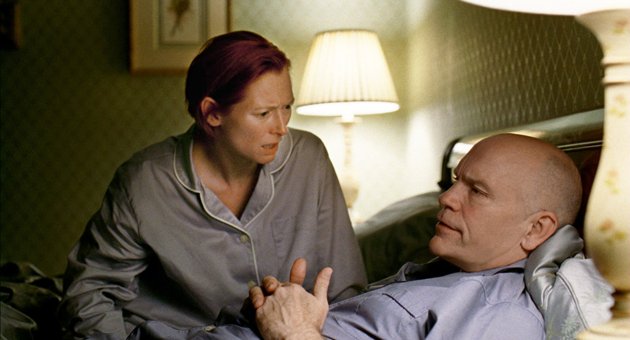

When Katie Cox (Tilda Swinton) descends into her husband’s basement office and copies financial records off of his computer, we get a glimpse of a book on the desk, a book that looks to be George F. Kennan and the Origins of Containment: 1944-1946: The Kennan-Lukacs Correspondence. This should not surprise us. We have previously heard Osborne Cox (John Malkovich), while struggling to dictate his memoirs, declare: “The principles of George Kennan—a personal hero of mine—were what animated us. In fact they were what had originally inspired me to enter government service.”
Burn After Reading is a film about containment and knowledge, or, to put it another way, a tale of wars against chaos. Necessarily, it is a farce.
The Coen brothers’ films are sometimes criticized as nihilistic. They are only nihilistic, though, in the sense that Buddhism is nihilistic. The films are full of characters who quest for meaning and purpose, but they quest badly. They seek eternal verities in a universe that only provides constant change, shifting perspectives, cultural relativisms, random sets, infinite fractals, and distant enlightenment. These are not nothing. Knowledge, meaning, and even, perhaps, purpose can be found in them. In A Serious Man, the movie the Coens made directly after Burn After Reading, and which serves as a kind of cousin to it in many ways, Rabbi Marshak is the wisest of all the characters because he knows enough to pay attention to a pop song: “When the truth is found. To be lies. And all the hope. Within you dies. Then what?” One command: “Be a good boy.” And, left unspoken but vividly present: “Find somebody to love.”
 Spy thrillers appeal to the pleasures of secret knowledge, the idea of knowledge as power. God is Truth, and Truth is always hidden, available only to the worthy, jealously protected and obfuscated by the clerics. Conspiracy theories are theologies, but they are also power fantasies. One legacy of J. Edgar Hoover, who successfully petitioned (or bullied) Hollywood into taking the side of his knowledge-seeking G-men, is that the most common representation of government agents in American films is of technically skilled poobahs of the panopticon. This is especially true of conspiracy thrillers, whose verneer of subversive or cynical intent is usually itself subverted, because there is nothing more flattering to government agencies than to portray them as dangerously powerful. (It is better to be feared than loved.) Popular chronicles of conspiracy, whether tales of heroes or martyrs, give us lone wolves hunted by all-seeing feds or monolithic, hyper-competent corporations. Such stories leave no room for the everyday mess of bureaucracy, for institutionalized incompetence, for the slips and serendipities of inevitable human error, for technical glitches, for stupidity, for ignorance, for chaos. Power-flattering representations serve the acronymed agencies well, providing them with an aura of omniscience, authority, infallibility.
Burn After Reading counters this with a portrayal of bureaucracies that possess extraordinary powers of surveillance, but not knowledge. Outside the bureaucracy, in the random chaos of the world (and the precisely-structured chaos of the film’s narrative), we see individuals whose confidence in their own knowledge is misplaced. The smartest people in any room turn out to be the CIA bureaucrats who know what they don’t know, and are perfectly capable of working with that. Their goal is simply containment. But Harry (George Clooney), Linda (Frances McDormand), and Chad (Brad Pitt)—and to a certain extent Osborne and Katie—suffer epistemological hubris. Again and again, they call each other stupid, or morons, or idiots, as they vie for position in the hierarchy of, in every sense of the word, intelligence. But intelligence is overrated. Bureaucracy teaches the pragmatic lesson that containment doesn’t require omniscience. In Burn After Reading, it’s a lesson most of the individuals outside the bureaucracy don’t learn in time to save themselves.
 Their yearning for complex explanations and Hollywood thrills blinds the characters to the unexciting, unflattering truths in front of them. We see this right from the beginning: Osborne protests his demotion and scorns the idea that he has a drinking problem, insisting, “This is political! Don’t tell me it’s not!” He storms out of the office and we cut to him at home, making a drink. Again and again, the film will show us that Osborne is a man with a violent temper who drinks a lot. The reason the CIA decided to demote him may be, in fact, exactly what they said. Osborne Cox believes that a man of his stature could not be relieved of
his duties for mundane reasons, but must have been felled by the hand of
nefarious conspirators. Osborne wants for his life to have been important in some way, as do we all—to have been more than just the life of a run-of-the-mill man, an ordinary guy. Like so many people who think their lives will achieve immortality by being printed and bound into narrative, he decides to write his memoirs (and even to gild the word with a fine French twist, memwaaa).
But the only people who care about his memoirs are Linda and Chad, who assume Osborne is important—and so, though he can’t see it, he has found the ideal audience for his life’s story. (Their only competition being Osborne’s catatonic father, who may, for all we know, think his son is as unimportant and annoying as everybody else does.) Osborne, Linda, and Chad are ideologically matched: they believe in the legends of the CIA, the Hollywood stories of derring-do and secrets that must be preserved at all costs. The CIA itself does not believe this—Osborne Cox had a security clearance level of 3, which elicits barely a shrug when the agency superiors learn there has been a leak. The Russians, once they look at the memoir material, deem it to be drivel. The only people in the world who think Oswald’s work was so important as to be worth lots of money, major conspiracies, and maybe a Hollywood deal are Linda and Chad.
 A superficial interpretation of the film would propose that the Coens think all these characters are stupid and that we should laugh at their follies—that we should, in fact, revel in our superiority to these schmucks. Hence the occasional (or more than occasional, depending on where you look) criticism of the Coens for mocking their characters, for holding them in contempt. I cannot speak for the Coens, who may, in fact, be sneering smartypants bathed in fumes of schadenfreude, but the feelings ultimately produced in my experience of their movies are not ones of superiority for the characters so much as sympathetic solidarity. Not for all the characters, of course. Inevitably, there are bullies and tyrants whose sufferings are sweetly just deserts, but look, for instance, at a character like Linda. We (or I, at least) start out laughing at her, at her oblivious self-absorption, her bumptiousness. Ohhh, look at this silly woman getting all marked up by the plastic surgeon, this woman who thinks her health insurance company will pay for her expensive nips and tucks. Ha ha ha, isn’t she hilarious, isn’t she ridiculous, isn’t she just—
But for me this contempt doesn’t last. And this is one of the great powers of the Coens’ films, and part of those films’ great artistry and value. In the Coens’ world, people who begin as caricatures become, somehow, more human than characters in even the grittiest of verité social realism.
In Burn After Reading, I can mark the precise moment where this happens for me: a POV shot twenty-one minutes into the film, a shot through the windows in the office of Linda’s boss, Ted (Richard Jenkins), as Ted watches Linda hold her head and weep after the conversation with the agent at the health insurance company. The effect stems from Frances McDormand’s performance, the terror in her eyes while she talks on the phone, the terror that lurks behind her mask of determination, and the moment where she can’t keep the mask from slipping. Having seen that, we don’t need to see her from the front right away. We know what she feels, we know why she weeps, and if we have any tinge of decency in our hearts, we feel chagrin. Because earlier, we saw her just as her plastic surgeon saw her: as silly meat. We judged her just as she judged the men whose profiles she so quickly flipped through on the dating website: “Loser, loser, loser.” We know now that this is her own fear, the fear she hopes, however realistically or unrealistically, to conquer by reinventing her physical self.
Loser, loser, loser. Haven’t you ever shared that fear? Haven’t you ever—foolishly, humanly—invested all your hopes in one path, and had that path shattered in an instant? (By a bureaucrat, perhaps, an agent . . .) Ted certainly has. His puppydog kindness toward Linda is a kindness I think we’re encouraged to share at that moment. Ted is the most decent guy in the film, a man who has come to accept life as it is, even to find pleasure in it. Once, he was a man of God, but it didn’t really work out. Now, he helps people get stronger, to get in better shape. Linda can’t see what Ted has to offer, his loving ordinariness, because her mask and her expectations blind her to Ted’s obvious infatuation. It’s too bad for Ted, but we’ve been him, too: a bit too puppydog, a bit too ordinary. For all his differences from Linda and from Osborne Cox, his fears are the same. All the main characters’ fears are the same. They don’t want to be a loser like the other losers. There’s contempt there, sure, but it’s not raw contempt so much as it’s a contempt masking fear. It’s a contempt we’re complicit in, but the Coens show us that we can escape our complicity by escaping our fears and embracing, accepting, and even delighting in our loserdom. Linda is one of the few characters to survive in the end, and the only character to truly get what she wanted from the beginning. Her triumph is one I celebrate, and I cherish the experience of starting from contempt for her when she first appears and evolving to cheer on her success at the end. The surgeries serve as the film’s primary MacGuffin, but as MacGuffins go it’s a complex one, because the gift of the movie is the gift of reinvention: for Linda and for us.
None of the other main characters find the same success. Most of them end up killed off by the chaos. Perhaps their failures are random, but that means some success will be random too, and that’s okay. We can live with that. Linda’s greed and vanity get her into the mess she gets into, but at least her greed is not the sort of dishonest, dissembling, gluttonous greed of George Clooney’s Harry. Linda just wants to find somebody to love. Like her, Harry is full of vanity, particularly as it relates to his gun (which he and everybody else always knows is a penis substitute), and he, too, is seeking love. But he’s a bad boy and his fate is to end up in a paranoid vortex of his own construction. His final scene with Linda in the park is a masterpiece of comic set-up, because various separate bits of information, precisely placed throughout the film, all converge to convince him that everybody is out to get him. The truth is exactly the opposite, but the effect of his delusion is congenial to everyone: he escapes to Venezuela. Just because you’re paranoid doesn’t mean everybody doesn’t really want you to go away.
More, of course, could be said about all the connections and coincidences, the incorrect assumptions, misheard remarks, mistaken identities: the beautiful structures and balances of the film. But saying much more is too much like explaining a great joke. Jokes and movies shouldn’t mean, but be.
Nonetheless, I feel obliged at least to note one other level on which the film is working: that of metafiction. This is a movie that knows it’s a movie, and is all the better for it. First, it relishes our genre knowledge, the knowledge that produces expectations, those things that lead us astray. The title credit sequence could be that of a spy thriller: we zoom in from space as if from a surveillance satellite (topic for another time: compare the CIA in Burn After Reading to God in A Serious Man), the music is determinedly dramatic, the credits splay across the screen accompanied by the techno-tinkle sound associated (why?) with computer text, and we cut to serious feet walking seriously through the serious, antiseptic corridors of CIA headquarters. The music will be the key to the seriousness throughout—it cues big revelations, moments of drama, rising tensions. The comedy comes from the music’s misjudgment: the relevations are, more often than not, mundane, the drama banal, the tension easily diffused. (It’s music more appropriate to, for instance, the previous movie George Clooney and Tilda Swinton made, Michael Clayton.) The film has been scored to meet the characters’ expectations for the kind of story they want to be in. Little do they know that they’re in an entirely different film from the one they desire.
 And then there’s Coming Up Daisy, the Claire Danes and Dermot Mulroney movie-within-the-movie that Linda always takes her dates to. It is, apparently, a fluffy romance, a sappy fantasy of eternal love and perfect happiness and beautiful people. (The sort of fantasy that makes a woman like Linda hate herself and her life, the sort of fantasy that keeps many cosmetic surgeons in business.) Linda goes to the movie twice, once on a bad date (with Alan) and once on a date that seems to come out of just such a movie (with Harry). This is not the end of this reference, though. When Harry’s wife, Sandy, goes on a TV show in Seattle, one of the later guests is Dermot Mulroney. Harry is oblivious to his wife’s faithlessness, her ability to deceive him even more effectively than he thinks he is deceiving her—oblivious, in other words, to her agency. After Harry shoots Chad, he tries to make a salad for Katie, but only ends up chopping an enormous pile of carrots. In Seattle, though, Sandy kisses her boyfriend in the dressing room of the TV show while a segment about the “Sultan of Salad” plays above them. Sandy, it turns out, is the one character who lives in a world where fantasies of perfection are not quite so fantastical.
The casting of Burn After Reading also contributes to some of its metamovie touches: not just with the reuniting of Clooney and Swinton, but also, more slyly, with the appearance of David Rasche as a serious CIA man. Rasche is probably best known, at least to connoisseurs, for his starring role in the mid-’80s TV comedy Sledge Hammer!, a spoof of the Dirty Harry films in which Sledge’s solution to every problem is to shoot it with his giant gun. Sledge Hammer! makes even the broadest comedy in Burn After Reading look like a marvel of subtlety, but I know I can’t be the only viewer who, upon first seeing Rasche, immediately thought of his earlier character’s motto: “Trust me, I know what I’m doing.” Many of the characters in Burn After Reading think the same thing, with similar results.
(Tangentially, I expect I’m also not the only viewer who, on seeing the name of the gym where Linda, Chad, and Ted work, thought of Susan Jeffords’ brilliant book Hard Bodies: Hollywood Masculinity in the Reagan Era. Of Harry Callahan, Jeffords writes: “Harry’s heroism has a nihilistic edge to it that cannot reassure audiences that any of his actions have mattered or have changed the social order in any way.”)
Burn After Reading ends with The Fugs’ song “CIA Man,” and so the ending is, like everything else in the movie, perfect in its multiplicities of meaning:
Who’s the agency well-known to God?
The one that copped his staff and copped his rod?
Fucking-a man! CIA Man!
Matthew Cheney’s work has been published by English Journal, One Story, Web Conjunctions, Strange Horizons, Failbetter.com, Ideomancer, Pindeldyboz, Rain Taxi, Locus, The Internet Review of Science Fiction and SF Site, among other places, and he is the former series editor for Best American Fantasy. He teaches English, Women’s Studies, and Communications & Media Studies at Plymouth State University.

 Thus, it wasn’t until Gran Torino that I could say I really watched an Eastwood movie. The ones I’d seen before were films I looked at as the films I’d expected them to be. But Gran Torino shocked me into seeing it. I’d seen reviews belittling the movie, and I expected it to be a not-quite-vaguely racist heap of claptrap. I don’t remember even when I decided to watch it, or why. But I did.
  We need to pay close attention to the conclusions of Eastwood’s movies, particularly the ones he directs and stars in, because these films allow him to configure and reconfigure his iconicity. From Play Misty for Me to Gran Torino, he has played jazz riffs on the idea of “Clint Eastwood,” repeating and revising the figure he embodies. Nowhere are the riffs more poignantly played than in The Outlaw Josey Wales (the subject of
 Press Play Video Blog