METAMERICANA: Hawkeye, Normcore Avenger: A (Mellow) Revolution from Marvel Comics’ Matt Fraction and David Aja

METAMERICANA: Hawkeye, Normcore Avenger: A (Mellow) Revolution from Marvel Comics

nullSo-called “normcore fashion,” a bizarre combination of countercultural
radicalism and bourgeois complacency, is the only way anyone has found thus far
to re-envision mainstream culture as avant-garde. In normcore culture,
twenty-something hipsters who have already established their countercultural
bona fides by dressing in the uniform of their kind for years (think
thick-rimmed glasses, skinny jeans, sportcoats, bow ties, and brogues) turn
these customs on their head by returning to the white, upper-middle class clothing
stores of their youth. Thus, a herd of excruciatingly self-aware young people seems
to dress like either their parents or their suburban peers, and outside
observers are none the wiser about their intentions. Normcore is ironic to
those who know it when they see it, and painfully earnest to those who see
someone wearing clothes from The Gap or Abercrombie & Fitch and assume it’s
the result of thoughtlessness rather than design. Of course, the more generous
view of normcore suggests that those who subscribe to its fashion wing simply
no longer wish to be distinguished from others on the basis of their attire.
Better, then, to say that the wearing of jeans and tee shirts by normcore
aficionados is merely a “detached and knowing” decision, and not necessarily an
“ironic” one. But what happens to our hipster calculus when normcore culture
goes supernatural?

Superheroes are the hipsters of English-language graphic novels: discernible
almost immediately by their accoutrements, superheros may want to be like you
and me (hence, secret identities) but before long are sure to do something—lift
a car, shoot an eye-beam—that places them outside mainstream culture. They can’t
help themselves. And millions of us read about their exploits in comic books
because we, too, can’t help ourselves. Following the adventures of costumed
counter-culturists is the nerdy equivalent of sitting on a park bench
people-watching in the Williamsburg section of Brooklyn. Which is why, when
comic book writer Matt Fraction and artist David Aja decided to portray the
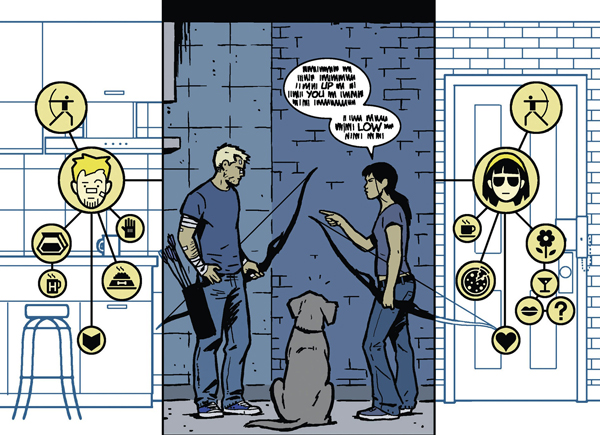
least-popular Avenger, Hawkeye, not as a bow-wielding badass but an
unremarkable, hoodie-wearing bro hanging around his apartment, it felt—to those
of us who enjoy comic books but are tired of their poor writing, cinema-ready
plotlines, and cutout characters—like something of a revolution.

Fraction and Aja’s Hawkeye depicts its titular character in his
traditional (at least since the Avengers movie) purple and black get-up on the
cover of its first two paperback collected editions. In both cases, “Hawkeye”/Clint
Barton—Iowan; former carnie; superpower-less master archer—is carrying his
trademark bow. It’s an intentional misdirection, as in the pages of My Life
As a Weapon
(collecting Hawkeye #1-5 and Young Avengers Presents
#6) and Little Hits (collecting Hawkeye #6-11) Hawkeye rarely
uses his bow and is almost never in his Avengers uniform. Instead, he putters
about his Bed-Stuy apartment and does, well, not very much. A breakdown of the
early issues:

Hawkeye #1: Hawkeye recuperates in a hospital, adopts a dog, attends a
neighborhood barbecue, helps a single mom avoid eviction, and buys his
apartment building so he can become its landlord.

Hawkeye #2: Hawkeye practices shooting his bow, attends a gala event,
stops a gang of petty thieves (but in a tux), and has a long phone call with a
young female protégé who has a crush on him.

Hawkeye #3: Hawkeye organizes his arrows, buys a new car, sleeps with a
stranger, and fights off some heavies hired by a slumlord who wants Clint’s
apartment building back.

Hawkeye #4: Hawkeye attends a neighborhood barbecue, gets interviewed by
the Avengers, travels to the Middle East, has his wallet stolen in a taxi, and
attempts to buy at auction an item that could destroy his reputation if it
falls into the wrong hands.

And so on. Clint virtually never gets into uniform, virtually never faces a
super-villain, never uses any superpowers, and views any excitement he
experiences as a distraction from what he really wants to be doing: hanging out
with his neighbors at rooftop barbecues and petting his adopted dog (“Pizza
Dog,” so named because this iteration of Clint Barton isn’t very witty, either,
so he simply names his dog after the mutt’s favorite food). In Little Hits,
the second Hawkeye paperback collected, the low-key vibe continues, and
if anything is doubled down upon by Fraction and Aja:

Hawkeye #6: Hawkeye sets up his stereo system, saves the world from a
terrorist organization (presented, however, via just a two-page pictorial
summary), argues with the maintenance man at his apartment building, attends a
neighborhood barbecue, fights off some slumlord heavies, watches TV, and
considers going on vacation.

Hawkeye #7: Hawkeye helps a neighbor move during a hurricane, and later
rescues him from drowning in his new basement. Hawkeye’s protégé Kate Bishop
attends a wedding, goes to a pharmacy, and stops a robbery in progress.

Hawkeye #8: Hawkeye deals with a new (and crappy) romantic relationship,
tries to fight slumlord heavies but ends up in jail, and complains about his
new girlfriend messing up his comic book collection.

While the news recently came down that the Fraction/Aja Hawkeye series
will come to a close with issue #22, the fact remains that this writer-artist
duo has given us an entirely new way of thinking about not just comic books but
ourselves. There are a number of things Hawkeye does in this series that no one
without superlative archery skills could do. However, these acts of heroism are
overwhelmed in both number and vividness by the roster of things Clint Barton
does in Bed-Stuy that nearly any of us could do: make an effort to meet
and befriend our neighbors; help someone move or avoid eviction; finally unpack
our boxes and set up our new apartment; adopt a stray; or make a property
investment with an eye toward making the lives of others a little less bleak.
There’s nothing preachy about Hawkeye, however—it can’t be said that
Fraction and Aja have any evident interest in making us all better people. What
they want, I think, is no more than what Barton himself wants, and what, if we
go back into the annals of Western literature, David Copperfield once wanted:
to be the hero of our own life stories, whatever banalities and unremarkable
tribulations those stories will so often, inevitably, entail.
 

In other
words, Fraction and Aja have somehow captured the temperament of our Age:
neither naively fixated on the possibility of heroism nor (anymore) captivated
by anti-heroes. The earnestness of the conventional superhero has begun to irk
us, but so too, however slowly, has an unwilling and unlikely hero like
Deadpool, a mercenary whose running commentary on his own antics—droll,
fourth-wall-breaking—is steeped in petulant cynicism. In an ongoing tug-of-war
that mirrors what’s happening now in video games (cf. “#gamergate”), there’s a
divide between those who want a comic book that simply “plays well”—meaning, it
touches all the usual plot, tight-pant, and monologing-baddie bases—and one
that is reflexive enough about its aesthetics and ambitious enough about its
aims to qualify as Art. Fraction and Aja have given us a comic book series that’s
decidedly in the middle in all particulars—even its interior art is somehow,
despite its stylishness, understated—and in doing so find a sweet spot that’s
exactly where most of us already live. This new Clint Barton is neither a hero
nor an anti-hero, he’s simply . . . unremarkable. Which makes him as
remarkable a superhero as we’ve seen in a very, very long time.

Seth Abramson is the author of three collections of poetry, most recently Thievery (University of Akron Press, 2013). He has published work in numerous magazines and anthologies, including Best New Poets, American Poetry Review, Boston Review, New American Writing, Colorado Review, Denver Quarterly, and The Southern Review.
A graduate of Dartmouth College, Harvard Law School, and the Iowa
Writers’ Workshop, he was a public defender from 2001 to 2007 and is
presently a doctoral candidate in English Literature at University of
Wisconsin-Madison. He runs a contemporary poetry review series for
The Huffington Post and has covered graduate creative writing programs for Poets & Writers magazine since 2008.

The Dangers of An Empty Suit: Marvel Comics’ War on War Continues

The Dangers of An Empty Suit: Marvel Comics’ War on War Continues

null(Warning: This article contains spoilers for the film Iron Man 3.)

The implicit argument of every comic book and
comic book-inspired movie is that the world outside comic books is a better
place for having no superheroes in it, and a far worse place for having so many
warmongers. Iron Man 3 is Marvel
Comics’ strongest argument yet on both scores. True, the Iron Man films have always been conspicuously anti-war—Stark
removes his privately-funded R&D enterprise from U.S. Defense Department
involvement in the first entry in the now-trilogy—but Iron Man 3 is a uniquely instructive exemplar of Marvel’s war on
war by way of Hollywood.  

In Iron
Man 3
, the United States, in the person of billionaire playboy and
self-described “mechanic” Tony Stark (Robert Downey Jr.), has perfected the
drone as a weapon of mass destruction. Whereas Stark actually had to be in his specially-designed metal-alloy
suit to become “Iron Man” in both Iron
Man
and Iron Man 2, the man is
now superfluous to the machine: Downey’s titular character has a veritable army
of man-shaped drones (a metaphor that ought not be lost on us) ready to do his
bidding at a moment’s notice.

In one particularly charged scene toward the
end of the film, Stark says to his nemesis, of girlfriend Pepper Potts, “she’s
perfect as she is.” As action-flick dialogue goes, this is pretty insignificant
stuff, yet it’s also a good summary of the chief theme of Iron Man 3, which ultimately pits men who believe they’ve perfected
machines against men who believe they’ve perfected humans. It’s no spoiler to
say that neither pipe dream is realized in the end; the question is just how
lifelike both the dream and its perpetual deferral really are.

Stark’s technological breakthroughs don’t fall
very far from our own reality, given that just a couple weeks ago the real-life
United States Navy launched a drone from a nuclear-capable aircraft carrier for
the first time. This means that American drones can now officially drop
cluster-bombs on anyone, anywhere, at any time, as if that weren’t already the
case in practice. Meanwhile, the Obama Administration recently launched an
initiative to map the human brain—in the same way scientists mapped the human
genome several years ago—and in this well-intentioned effort there’s an eerie
reminiscence of the baddies of Iron Man 3,
who believe they’ve perfected the human body by (you guessed it) mapping the
human brain to create an army of super-soldiers. In short, Iron Man 3 asks us to ponder the question: Is the perfect man any
less dangerous than the perfect machine, and isn’t Pepper Potts (Gwyneth
Paltrow) actually perfect just the way she is?

But Marvel Comics’ increasingly cerebral and
interconnected film productions are wont to do much more, now, than simply
throw mud at all corners of the global military-industrial complex. The
presidential administration portrayed in Iron
Man 3
, which appears to be vaguely Republican (much is made of the White
House doing nothing to investigate a major oil spill, an oversight an oilman
president, say, might be wont to make) dresses up its Don Cheadle-cum-War
Machine drone in patriotic colors, redubbing it The Iron Patriot, and it’s this
obsession with re-marketing drones as a nationalistic imperative that nearly
gets Marvel’s imaginary President Ellis blown to Kingdom Come. The message is
clear: The more attractive-looking the drone, the more likely it can be used as
a Trojan Horse for dangerous geopolitical initiatives and even more dangerous
first principles.

Likewise, the villain of Iron Man 3 is not, as it turns out, a gnarly Ben Kingsley—whose
primary job in the film is to look dirty, foreign, asexual, and (worst of all)
old—but rather a blond, perfectly-coiffed Lothario who (as it happens) can
literally breathe fire. Here, too, the message is clear enough: Dress up a
villain in something like the clothes we’d expect a “winner” to wear, and it’s
not much different from dressing up a nation’s foreign policy in those
metaphoric clothes we expect “winner” nations (that means us Americans) to
favor. Each of these premises is equally alluring; each is even—at the risk of
taking the analogy too far—equally sexually intoxicating. Yet both are a threat.
The upshot is that we don’t need or want perfect men or women, any more than
we’d want perfect war machines. This isn’t to say we shouldn’t map the human
brain, or strive to perfect certain strains of military-industrial innovation (recent
advances in non-lethal weaponry come to mind), but rather that it’s the perpetual
search for perfection and self-perfection that often leads us to destruction. This
theory can be applied with equal force to men and women who judge others
primarily by their physical appearance and voters who judge elected officials
by how good a game they talk on anti-terrorism and national defense.

What Tony Stark ultimately learns in Iron Man 3—we’ll see if the lesson
sticks in Iron Man 4—is that he needs
to be more fully human, not more fully superhuman. He finally has the metal
shards lodged in his heart removed so that he can once again function without
the aid of blood-pumping machinery; he turns aside from his “mechanic” identity
by destroying the fruits of his labors in spectacular fashion; he re-dedicates
himself to his relationship with the already-perfect Pepper Potts by increasing
their face-time and decreasing his log-times (after first paying for surgery to
reverse artificial “perfections” performed upon Pepper by the villainous
Mandarin); and he concludes, in a final voiceover, that he’s the “Iron Man”
even if all his high-tech toys are taken away—something many a Marvel fanboy
would dispute. In other words, Stark discovers that it’s not enough to turn
aside from direct complicity with warmongers, what’s required of a strong and
capable human is the ability to turn aside from the fallacy of perfectibility,
too. 

This message is one particularly at odds with contemporary
American culture, which convinces us more easily than we’d like to admit that
there isn’t a single facet of our physical or emotional well-being we can’t
perfect with a crash diet or a brain-boosting iPad app. Likewise, Marvel seems
to take a dim view of the current penchant for political panaceas: The idea
that a single political solution exists (whether in the form of a politician or
a policy) for the complex problems of the nation and the world is one with
little backing in any of the recent Marvel films. Indeed, it’s not too much to
say that Marvel Comics is reminding us anew, with each successive film in the Avengers network of storylines, that
the worst sort of war is the war we wage daily against our own fears of
fallibility and failure, as it’s this sort of windmill-tilting that ultimately
leads us down the path to ruin. Tony Stark’s realization that his desire to
protect Pepper from alien invaders is fueling the destruction of both their
relationship and his psyche—in the same way the fictional United States of Iron Man 3 fuels its own demise by
up-jumping its fear of terrorism to ever more frenzied levels—is just the sort
of thing Yoda always warned us about (“Fear leads to anger, anger leads to
hate, hate to suffering”).

Ironically, it’s a yearning after perfection that
sells untold millions of comic books to young male and female consumers the
world over, so we ought to read Marvel’s Avengers
films as a particularly ingenious bit of reverse psychology. If we actually
took the lesson of Iron Man 3 and its
ilk to heart, we too would blow up our personal anxieties, demand real rather
than Hollywood courage from ourselves and the many empty suits in political
office, and plant a long, lingering kiss on the already-perfect lips of
whichever Gwyneth Paltrow is presently brightening our days.

Seth Abramson is the author of three collections of poetry, most recently Thievery (University of Akron Press, 2013). He has published work in numerous magazines and anthologies, including Best New Poets, American Poetry Review, Boston Review, New American Writing, Colorado Review, Denver Quarterly, and The Southern Review.
A graduate of Dartmouth College, Harvard Law School, and the Iowa
Writers’ Workshop, he was a public defender from 2001 to 2007 and is
presently a doctoral candidate in English Literature at University of
Wisconsin-Madison. He runs a contemporary poetry review series for
The Huffington Post and has covered graduate creative writing programs for Poets & Writers magazine since 2008.

VIDEO ESSAY: THE AVENGERS: Marvel’s Redemption?

THE AVENGERS: Marvel’s Redemption?

Amazingly, the Marvel movie brand has been able to survive with an enthusiastic audience—even in the midst of artistic failure. To explain: Marvel’s track record at the box office is basically critic-proof. No matter how bad or silly a Marvel movie may be (e.g. Thor), the bottom line box office numbers speak to a broader truth (e.g. Thor eventually grossed $449 million in ticket sales). And now with The Avengers, the already highly successful Marvel economic phenomenon should increase exponentially. Regardless of whether or not you’re sick to death of superhero movies, this upcoming release of The Avengers deserves some close examination—if not optimistic thinking. You see, unlike the cavalcade of superhero movies that preceded it, Avengers is attempting to do something that no feature film has ever done; it will cinematically bring to life all of Marvel Comic’s core superheroes in one movie, a feat that should excite a wide spectrum of fan boys. The top tier cast is unmatched: Robert Downey Jr. (Iron Man), Mark Ruffalo (Hulk), Scarlett Johansson (Black Widow), Chris Hemsworth (Thor), Jeremy Renner (Hawkeye) and Chris Evans (Captain America). So the real question is this: Is The Avengers the light at the end of the tunnel for a nation of loyal Marvel fans?

Perhaps the best way to tackle this question is to go back to what captured fans’ hearts in the first place—the Marvel comic books. Consider: The heroes that were created under the Marvel umbrella transcended the quick-fix throwaway ethos found in traditional comic strips (e.g. brief standalone scenes) by maturing through long prose narratives. For example, a comic book hero like “Captain America,” birthed onto ink and paper at the start of World War II, sprouted brimming nationalism. On the other hand, the “X-Men” comic books (1963) took their crucial twist, the existence of mutant heroes, and illustrated a parallel narrative evoking the anxieties of the African-American Civil Rights Movement. Each of these Marvel superheroes was able to tell a never-ending American saga in comic book form. His or her iconic superhero outfits could always be updated, but the heart of each hero was linked to its cultural reference in the national timeline.

Underlying their messages, of course, was the immediate draw of the Marvel comics: pure unadulterated escapism. A billionaire who builds his own iron suit to fight world terror! A brilliant scientist who can morph into a giant green beast when he’s angry! A demigod who wields a hammer with the force of thunder! They’re all sky-reaching wonders. On top of all this, the syntax of a comic book—with its varying panel sizes and meshing of word balloons against vibrant images—projected these flights of fancy onto the imaginations of generations of readers.

So what went wrong with the Marvel movies?

To be fair, using the phrase “lost in translation” would be unjust. After all, the motion picture medium works with different gears (sight and sound); plus the Hollywood system was never one to choose artistic purity over dollar signs. Yes, these Marvel movies are telling the literal comic book stories of each superhero—but not without diluting the purity of each hero with laughable screen dialogue (as when the titular hero of Captain America asks if he has time to pee before undergoing his explosive transformation) and distracting product placement (Robert Downey Jr. sure does love his Burger King in Iron Man). In fact, nothing is really “lost” in the translation from page to screen: it’s as if the filmmakers mistook the comic book ads as pages to the main narrative. These Marvel movies are super sized to please the most aloof of moviegoers; throw in some A-list movie stars, an innumerable amount of CGI explosions and you got yourself a box office hit.

Which brings us back to The Avengers. Over the last few years, Marvel has been hinting at an eventual all-barrels-blazing motion picture adaptation: The comic book character of Nick Fury (aptly embodied by Samuel L. Jackson) appears after the end credits of recent Marvel movies, recruiting each titular superhero to join the Avengers team. Now we are literally days away from seeing this cinematic event hit screens across the nation. The sheer anticipation from hordes of loyal fans will surely churn out staggering box office figures come opening weekend (possibly giving the film legs to ride out the early summer). Though, the real challenge for The Avengers won’t be to save the world onscreen or to etch its place in box office history. The real challenge will be in the film’s ability—or inability—to redeem the historical iconography of its heroes, which would in turn reaffirm Marvel as a vital cultural phenomenon (and not just an economic phenomenon). Fortunately, writer-director Joss Whedon reveres the mythology behind the characters he brings to the screen (look no further than his highly-celebrated Buffy The Vampire Slayer TV series). Couple that with his knack for gleefully deconstructing cliché movie vehicles (like his witty and ingenious screenplay for the horror-comedy The Cabin In The Woods) and The Avengers seems destined to be that one-in-a-million blockbuster that actually has the brains to match its box office brawn. It just might be the miracle fan boys, as well as commercial moviegoers, have been waiting for.

Nelson Carvajal is an independent digital filmmaker, writer and content creator based out of Chicago, Illinois. His digital short films usually contain appropriated content and have screened at such venues as the London Underground Film Festival. Carvajal runs a blog called FREE CINEMA NOW which boasts the tagline: "Liberating Independent Film And Video From A Prehistoric Value System."
You can follow Nelson on Twitter here.