

This biweekly column
looks at instances of American film, television, drama, and comedy that
are in some way self-referential—”art about art.” Also discussed is
American metamodernism, a cultural paradigm that uses both fragmentary
and contradictory data to produce new forms of coherence.
Greed, Martin
Scorsese suggests in his new film The
Wolf of Wall Street, is now executed in U.S. financial markets on such a
colossal and audacious scale that it no longer has the capacity to scandalize
us. That’s why The Wolf of
Wall Street may well be the most unbelievable film Hollywood has
produced in more than a decade, a claim that seems extraordinary given the
film’s grounding in the memoirs of the real-life “Wolf of Wall
Street,” Jordan Belfort. There’s a difference, however, between a biopic—something The
Wolf of Wall Street exhibits little interest in being—and a movie that
intends, instead, to enter the historical record as High Art. The foremost ambitions
of High Art are to illuminate the unknown and frustrate the conventional;
entertainment value is a secondary consideration, indeed sometimes not even a
consideration at all. Which is why it’s little surprise that not only does
nearly everything that happens on-screen in Martin Scorsese’s new film strain
credulity, there’s little evidence that either Scorsese or his actors (among
them Leonardo DiCaprio, Jonah Hill, Matthew McConaughey, Rob Reiner, Jon
Favreau, and Bo Dietl) intended it to be otherwise. Even the movie’s run-time—an
arguably bloated three hours—seems calculated to emphasize the excess this
movie not only revels in but elevates to the level of conceptual spectacle. And
sometimes America needs a spectacle that outrages rather than delights; in
fact, often it is the outrage of unmet expectations that inspires America to
take dramatic action in its own self-interest. Given that, where malfeasance in
the American marketplace is concerned, America has yet to act decisively to
punish individual and institutional wrongdoers, dramatic remedial action is
long overdue.
To read major-media reviews of The Wolf of Wall Street, you would suspect
that many of the nation’s most esteemed film critics have missed the point of
the film entirely. Focused on the exploits of a gaggle of crooked stockbrokers
who sell near-worthless penny stocks to wealthy investors, Scorsese’s epic is
indeed, as Joe Morgenstern grumped disapprovingly in The Wall Street Journal,
a “hollow spectacle” (let’s ignore for a moment the jaw-dropping
irony of that publication in particular issuing such a declamation). But those
who opine that Leonardo DiCaprio, who plays stockbroker kingpin Jordan Belfort,
doesn’t seem “terribly comfortable” in the role (Christian Science
Monitor), or that the film is, in sum, “about getting your own” (The
Detroit News), or that DiCaprio’s and Hill’s on-screen antics are intended
as “slapstick” (National Public Radio) saw in Scorsese’s grand
vision only reflections of their own unwarranted disappointment. These critics
wanted a relatable human drama with an unambiguous moral; what they got was a
piece of High Art deliberately inaccessible by Hollywood standards.
To quote Belfort’s father Max upon seeing a credit card statement detailing
outrageous payments to prostitutes, “Crazy? This is obscene.”
Indeed it is. The Wolf of Wall Street is an aestheticized
obscenity—that is to say, one whose scope is intended to provoke awe, not
understanding—and unlike obvious predecessors such as Oliver Stone’s Wall
Street, it comes to American movie-goers with no canned message whatsoever.
That’s right: Scorsese doesn’t deliver a Wall Street morality play so much as
offer his audience a spectacle of meaninglessness that’s intended to be exactly
that. The Wolf of Wall Street isn’t
seedy realism; it’s garish fantasy. Scorsese knows, and The Wolf Of Wall Street confirms, that misbehavior in the American
market has risen to the level of the sublime. The nation’s class of
moneymakers—whose sole exports are bullshit and nonsense—are the abstract
expressionist painters of contemporary America, the only difference being that
their canvas is the nation itself rather than a legion of
gallery wall-spaces.
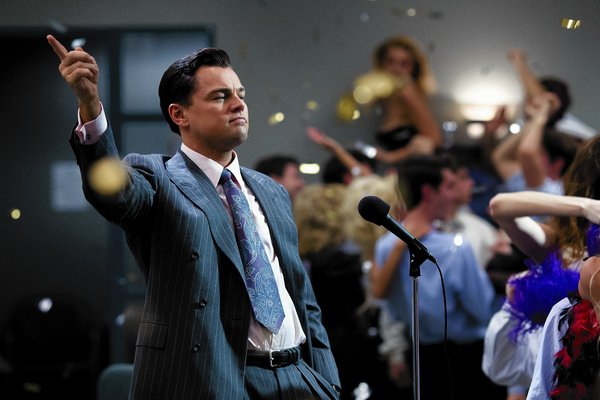
It’s impossible to overstate the three-ring circus of absurdity on display in The
Wolf of Wall Street. Donnie Azoff (Hill), upon seeing a gorgeous woman at a
crowded party, removes his penis from his pants and begins to masturbate;
Belfort (DiCaprio) snorts coke out of a prostitute’s asshole, sexually assaults
airline stewardesses, demands someone fetch him a bag of cocaine just moments
before drowning at sea, tapes thousands of dollars to a naked woman to smuggle
ill-gotten funds into Switzerland, and invites into his large-scale boiler-room
“office” a veritable parade of outrageous guests: everything from a
half-naked high school marching band to dancing prostitutes and begoggled,
velcro suit-wearing little people. In the film’s most audacious scene, Azoff
and Belfort take so many Quaaludes that the latter ends up crawling across a
country club parking lot, while the former falls through a glass table and
nearly chokes on a piece of ham. None of it, taken in its totality, is the
least bit plausible—no more than is Azoff urinating on a federal subpoena to
the applause of his officemates, or Belfort having sex with his wife atop a
giant pool of neatly-stacked hundred-dollar bills. But why do we expect that it
should be? And even if it’s all ripped straight from the pages of an
autobiography—mind you, the autobiography of a self-admitted drug-addict,
felon, and confidence man whose profit motive in selling his life story is
self-evident—ought we not credit Scorsese with sufficient artistic vision to
know when the truth is not just stranger than fiction but veritably
indecipherable?
If the characters and scenarios of The Wolf of Wall Street seem plastic
and deliriously unchanging, it’s because, Scorsese submits, the scope of American
greed is likewise far past the point of plausible melodrama. The 2001 Enron
scandal cost that company’s shareholders, many of whom were mid-level employees
with retirement accounts comprising exclusively Enron stock, more than $74
billion dollars; the collapse of Lehman Brothers and other global financial
services firms in 2008 cost American taxpayers $700 billion in bailouts. What
these and other recent financial scandals of similar scope have in common is
that they were preventable before the fact and only lightly redressed (in terms
of criminal penalties) after the fact. In short, even after years of DC-led tough-on-crime
initiatives emphasizing reductions in street crime, America had insufficient
stomach to punish the patrons of a different sort of “street” when their criminal
conduct cost the nation untold anguish and financial distress. That’s why
DiCaprio’s Belfort routinely breaks the fourth wall—not, as you might expect,
to educate the audience on why his character is doing what he’s doing, but
rather to remind the audience that whether they understand what’s happening or
not is beside the point, because the movie’s obscene spectacle continues
regardless. Never before has a film so baldly lectured its paying customers on
the irrelevance of their credulousness and comprehension. If Michael Douglas’
Gordon Gecko (Wall Street) monologued with sufficient gusto to encourage
(in some moviegoers) an understanding and even admiration of the reasoning
behind his avarice, DiCaprio’s Belfort is a villain more suited to the often
amoral twenty-first century. When he tells his lackeys, “I want you to
deal with your problems by being rich,” it’s immaterial whether he
believes his own bullshit, or whether you do, or whether you believe he
loves his wife or feels kinship with his friends, because the scope of what
he’s doing is beyond your small understanding in any case. Which is exactly how
America’s worst villains want things to be, and exactly why they’ve become
nearly impossible for the rest of us to stop.
Seth Abramson is the author of three collections of poetry, most recently Thievery (University of Akron Press, 2013). He has published work in numerous magazines and anthologies, including Best New Poets, American Poetry Review, Boston Review, New American Writing, Colorado Review, Denver Quarterly, and The Southern Review.
A graduate of Dartmouth College, Harvard Law School, and the Iowa
Writers’ Workshop, he was a public defender from 2001 to 2007 and is
presently a doctoral candidate in English Literature at University of
Wisconsin-Madison. He runs a contemporary poetry review series for The Huffington Post and has covered graduate creative writing programs for Poets & Writers magazine since 2008.


 Woody Allen's Midnight in Paris is not a love letter to nostalgia or a trite piece of idol worship. Instead, it's a mature artist realizing his own folly. It's a melancholy film, yet Allen's direction is full of hope, with the final choice of the hero underlining the pointlessness of living in the past and the necessity of having to trudge on. Michel Hazanavicius' supreme achievement in The Artist is making people talk about the silent era again and argue about whether the film accurately represents it. Terrence Malick's canvas is as wide as they come in The Tree of Life, where he explores life, death, the universe and everything in a spasmodic stream-of-consciousness narrative. He finds the personal in the expansive. The theme of loss permeates the film. Malick arranges the beautiful movements with grandeur. The Descendants is perhaps Alexander Payne's most conventional movie to date. Loss, once again, is prominent in this family drama deftly directed by Payne with a loving eye for the minute details in the grand scheme of life.

 But Hugo is unsupervised because his parents have both died. (…I believe? I'm not entirely clear on what has become of his mother; his father, played by Jude Law, is consumed by a fiery backdraft in flashback, and this is not explained either.) Hugo's druncle Claude (Ray Winstone) takes custody of the boy, sticks around long enough for Hugo to learn the station-clock trade, then goes on walkabout, and Hugo is left to fend for himself. Fortunately, he's gifted at fixing things, so he keeps the clocks running in the hopes that nobody will notice Claude has gone missing, and dodges the station inspector (Sacha Baron Cohen), an orphan-phobe with a mechanical leg and an equally hostile Doberman. Hugo nicks pastries from bakeries, and spare parts from Georges, the sour proprietor of a toy stall (Ben Kingsley), because on top of keeping the time and staying out of the boys' home, Hugo has a third job: trying to fix an old automaton repatriated by his father from a museum, in the hope that the machine will send him one last message from beyond the grave. And it does, in more ways than one.
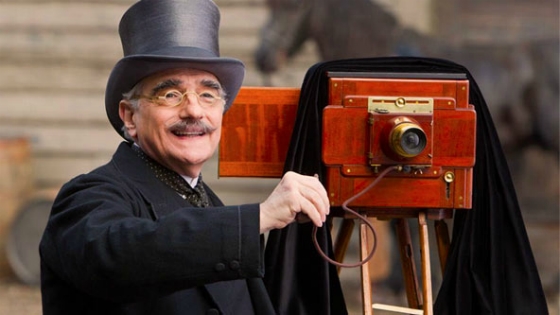
 The mythological story — the labors to earn back the notebook, the redemption of the warrior of the past who now toils in heartbroken obscurity — might not seem like an intuitive choice for Martin Scorsese. But the story is a love letter to film, and to the "indoorsy kids" through the ages who, confined to quarters, learned the world through the stories of others. That sort of elegy could pall quickly, and the speeches about the magic of cinema are…just that, but they're also relatively short, utterly sincere, and backed by Scorsese's voluminous knowledge. I liked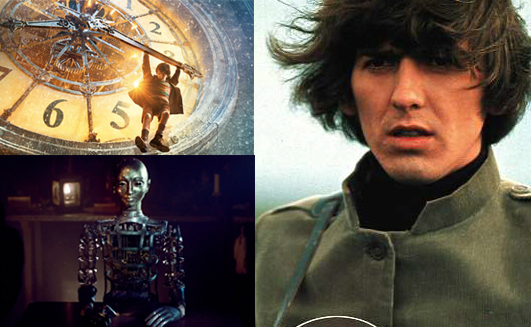

 But in
  As you’ve probably heard, the film’s talking heads – among them Ringo and McCartney – are sometimes identified and sometimes not. About fifteen years of Harrison’s life are simply omitted, one assumes, because, like that racing bit, they just don’t fit Marty’s thesis: quiet guy becomes mystic. (You could say this lacks dimension.) The tales we’ve heard of George as a compulsive, somewhat cruel womanizer are whimsically hinted at by his wife Olivia, and then dropped. The epic coke binges occupy a fascinating single string of video that suggests the great film this could have been – I’ll return to that topic.
 Hugo’s redemption comes in the form of Isabelle (Chloë Moretz), a young girl who’s never seen a film, and who’s the foster granddaughter of Papa Georges (Ben Kingsley), a cranky man with a toy shop in the station, and who is on the run from the slow reveal of being
  I get the temptation to rewrite George as spiritually ahead-of-the-curve, as an enigma tucked inside a mystery. Problem is, in order to do this properly, you have to commit all kinds of misdemeanors against the artist, the arts and history. Scorsese ends up so busy whitewashing alone, he has to, for example, mostly play down the matter of George’s, well, guitar playing.
 Scorsese, literally, could not care less. Instead of this tale of self and spiritual discovery through music, Scorsese fritters away precious time with Eric Clapton, who shares tales of his cockmanship, of his creation of Scorsese’s favorite
  It’s an amazing legacy that Scorsese omits, and it doesn’t end there. There’s George creating “world music” decades before the likes of Peter Gabriel, Sting or Björk via the 1968 Beatles track “The Inner Light” and its pulsing dress of sitar, harmonium, flute, table and santoor. (That Scorsese used world-music-style music by Gabriel for the soundtrack for

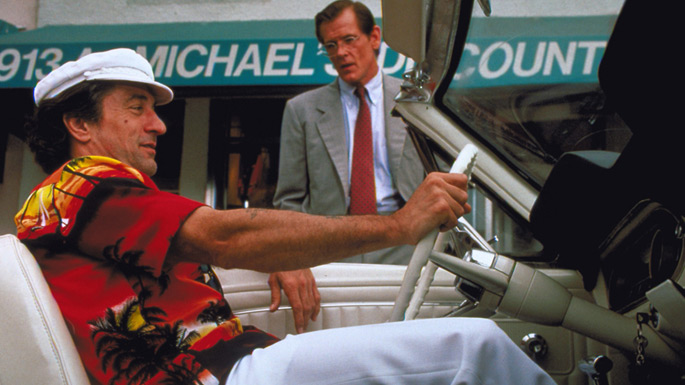
 For some critics, Cape Fear was seen as a placeholder, an attempt by Scorsese to earn some financial security so he could make his more “personal” stories. (The film was produced by Steven Spielberg’s Amblin Entertainment, with Spielberg wanting to produce his friend’s most financially successful film. Cape Fear remained Scorsese’s top grosser until Gangs of New York.) Like The King of Comedy in 1983, Cape Fear was the follow-up to an artistic triumph for Scorsese. King came after Raging Bull; Cape Fear came after
  And that’s where Max Cady (Robert De Niro) enters the scene. His rage at Sam is not only palpable, it is justified. It’s revealed that Sam defended Cady for rape and battery 14 years ago, and in the process of preparing a defense, he buried a report that said the girl Cady raped was promiscuous. For Scorsese, Sam’s “moral” choice to protect the community by violating his oath has rendered him a fallen man who has forsaken his rights to protection from the law – and God. Cady, who was illiterate at the time of his conviction, has become a self-taught man and intends for Sam to “learn about loss.”


 Press Play Video Blog