BREAKING BAD’s Greatest Scene

BREAKING BAD’s Greatest Scene

If longtime fans of Breaking Bad were asked to identify the show’s most memorable scene, many would probably point out gems like Walt and Jesse’s standoff with Tuco in the Mexican desert in early Season 3, Hank’s shoot-out with the cousins in mid-Season 3, or Gus’s spectacular demise in last season’s finale. Each is among the great show’s most iconic segments. 

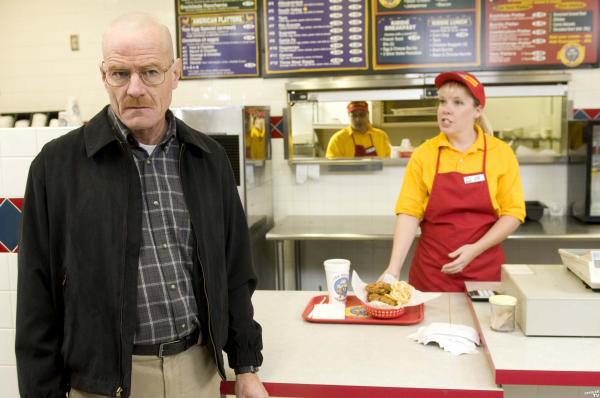
My pick would not be nearly as blood-pumping or blood-spattering.  I would choose the fantastic beginning of Season 3’s ninth episode, a mock commercial for Los Pollos Hermanos that slowly melds into a wordless tour of the massive methamphetamine center lying beneath Gus’s fast food empire. While a seemingly anonymous throwaway with no character dialogue and barely any appearance by Breaking Bad’s stars, the opening is a mesmerizing sequence which captures in one swoop the show’s brilliance, beauty, character debasement, and tension as well as any single scene in the show’s four seasons.

Creator Vince Gilligan takes a unique approach to each episode’s opener, often implementing unexplained teasers, as well as small asides that hold far greater significance than viewers may first surmise.  The Los Pollos opening is a prime example of this style and grows out of Gilligan’s dark sense of humor.  The ad sounds and feels incredibly authentic, making the audience feel as if the commercial break is still in progress; it isn’t entirely clear that the episode has even begun until the smooth-voiced announcer intones the historic lineage of the fictional restaurant. 

Though the commercial’s impressive quality seems like the brain child of some slick Madison Avenue agency, it is instead another clever trick by Gilligan, who loves to toy with his characters—see Walt’s befuddlement at removing the pizza off the roof of his house or his extortion at the hands of Saul Goodman’s vengeful receptionist—as well as his audience, best shown in Gus’s death scene, with the kingpin emerging seemingly indestructible in a neat homage to The Bridge on the River Kwai, and with Gus fixing his tie before keeling over, much as Alec Guinness dusted off his fallen cap before falling dead onto the dynamite plunger.

Beyond merely playing with the audience, the Los Pollos opening is a good expression of the show’s thesis that things are often not as they appear; indeed, the premise of the entire series, that a harmless, nerdy teacher who harbors a boiling rage of resentment, jealously, and cruelty becomes an irredeemable criminal—Mr. Chips becoming Scarface, in Gilligan’s description—revolves around this larger theme.

We quickly see the Los Pollos commercial is not what it purports to be. The sequence then goes one step further by immediately showing how the advertised chicken joint is an elaborate front for the biggest meth distributor in the Southwest. The fairy tale story of the “chicken brothers” and their “zesty chicken . . . slow cooked to perfection”—with delectable-looking brown wings and legs floating in the air—melds into a sprinkling, tinkling rain of turquoise bits of Walt’s blue crystal, as the narcotic is processed by an a small army of drug handlers in surgical garb, hidden in hundreds of tubs of thick gooey fry batter, and packed into trucks headed across the region. The chicken product has, in seconds, become something entirely different and far more deadly than any artery-clogging fat, as the sequence strips away the lies of Gus, just as the longer show methodically reveals more and more of Walt’s underlying callousness. 

The Los Pollos opening gives us our best view yet on the show of the startling, almost comic commoditization of the drug trade that is literally coming off an assembly line like cars from Detroit. In this case, the drug trade has melded figuratively and literally with fast food, and is not much different from greasy grub in its scale of mass production and its ultimately unhealthy after-effects.  If Breaking Bad is in part about the narcotics industry itself, it articulates this exploration no better anywhere in the show’s forty-six episodes than in this sequence.

The scenes also demonstrates the show’s attention to detail as Walt weighs and loads his fresh drug batch onto a dolly where it is wheeled out to numerous destinations. Walt looks tired, half-hearted, and almost bored by the monotony of his job—the drug trade is hardly as exciting as it might appear, or as he naively believed.

This theme recalls two other superb similar sequences from earlier in Season 3, the first where Walt excitedly prepares his brown bag lunch for his first day at the super lab, and the next the extended sequence where he and Gale enjoy their first day “at work” together, making meth, enjoying coffee, playing chess, and discussing poetry to breezy music reminiscent of a Charlie Brown movie.   

These scenes portray the initial fun, exciting side of meth-making, which will be dryly stripped away episodes later in the Los Pollos commercial.  And importantly, the dark side of the trade, the constant threat of extreme violence, lurks in the background as Gus’s henchman Victor opens the meth shipments and menacingly prowls behind the workers—not to mention in the numerous shootings and murders throughout the series.

Furthermore, the opening displays Gilligan’s love of piercing colors and sharp sound effects; here, the glowing red brightness of the sizzling chicken and accompanying spices, the wet clopping cuts of the succulent peppers, the dazzling phosphorescence of the blue meth, the metallic shininess of the super lab, and most of all, the funky, bouncy, strangely compelling music of the scene all remind viewers vividly of Gilligan’s reliance on visually and audibly arresting mediums to catch and hold viewers’ attention in place.

More broadly, the Los Pollos sequence is a textbook example of good filmmaking: a fast, wordless sequence which neatly establishes in minutes an intricate, complex storyline that could be delineated over an entire episode or season. Just as Walt’s bag lunch scene perfectly establishes his professional delusions and personal devolution, the Episode Nine opening explains Gus Fring’s entire organization in around a minute and a half.

At the opening’s finish, as the endless procession of trucks carrying meth across the country moves towards the highway, Gus stands alone, his face hidden by shadow, but his identity clear by his crisp, tucked-in shirt, gleaming rimless eyeglasses, and good posture, He watches in obvious wonderment at the size of his operation, then turns slightly in clear pride at his burgeoning empire. Gus is ultimately a stand-in for Vince Gilligan himself, who crafted this tight sequence which stands as a brilliant summary of his classic show.  He deserves to take that bow too.

Mark Greenbaum's work has appeared in The New York Times, Salon, The LA Times, The New Republic, and other publications.
A CONFEDERACY OF DUNCES Finds Its Star In Zachary Galifianakis

A CONFEDERACY OF DUNCES Finds Its Star In Zachary Galifianakis

null

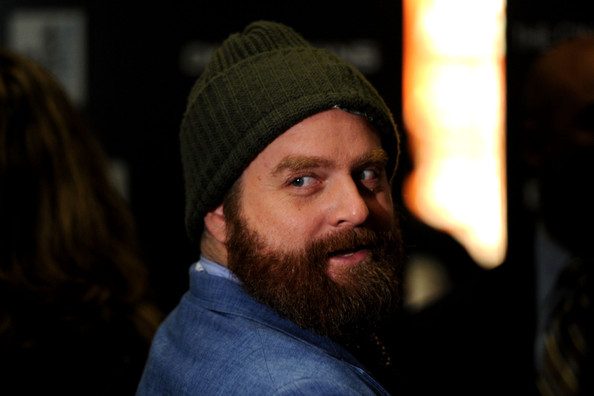
Among its army of cult followers, A Confederacy of Dunces is the funniest American novel ever written. Little surprise, then, that the recent leaked news of yet another attempt to adapt it to the big screen after thirty years of failure—with Zachary Galifianakis in the lead role—was greeted ecstatically by the book’s fans. But enormous obstacles remain in translating the unusual book to screen, including, most of all, whether Galifianakis has the ability to capture its one-of-a-kind antihero, Ignatius J. Reilly, in a way no one has ever done.

The story of the book’s path to publication is extraordinary. A gifted young New Orleans writer named John Kennedy Toole wrote A Confederacy of Dunces in the early 1960s. Toole couldn’t get it published, and, falling into deep depression from his general lack of success, killed himself in 1969 at age 32.

Several years after his death, his mother discovered the only remaining copy of the Confederacy manuscript in a box in his room. Determined to prove her son’s brilliance, she submitted the book to several publishers, meeting with rejection until she approached the great southern writer Walker Percy in 1976. Showing up unannounced at his office at Loyola University, she dumped the massive, barely legible draft in his hands and demanded he read it. Percy, who describes the incident in the book’s foreword, astonishingly not only read it but loved it. With his prodding, Louisiana State University Press published it in 1980 with a small print run, not expecting a profit. The rest is history: Confederacy earned national critical attention, won the Pulitzer Prize, and has sold millions of copies.,

The book’s path to Hollywood has not had a similar ending . . . yet. After Confederacy’s release, Scott Kramer, a young executive at 20th Century Fox, immediately bought its rights and set out to get the movie made. In 1982, he nearly signed John Belushi to star—after several amusing face-to-face meetings where the prickly star repeatedly forgot who Kramer was—but Belushi died shortly before a deal could be consummated.  Since then, such luminaries as Kramer, Johnny Carson, and John Langdon have tried to get the project made, with stars attached including John Candy, Chris Farley, John Goodman, and Will Farrell, as well as directors Harold Ramis and Steven Soderbergh, but none of the productions have ever gotten off the ground.

Of Confederacy, Will Farrell has said, “It’s a movie everyone in Hollywood wants to make, but no one wants to finance.” He may be right, but that’s only a small piece of the story. Other challenges relate to the book’s structure, specifically its language (which is unique to blue collar New Orleans), time period (ostensibly set in the early 1960s), and unusual plot layout (or really, its lack thereof). A big part of the book’s charm, indeed, lies in its language, which many Louisianans have long praised for its accuracy in capturing the region’s accents, something Toole seemingly acknowledged to his future readers in the beginning of the book: “’Oh, Miss Inez,’ Mrs. Reilly called in that accent that occurs south of New Jersey only in New Orleans, that Hoboken near the Gulf of Mexico.”  (This was also observed by Percy in a letter to Toole’s mother: “[Confederacy has] an uncanny ear for New Orleans speech and a sharp eye for place (I don’t know of any novel which has captured the peculiar flavor of New Orleans’ neighborhoods as well).”). First-time readers may take some time to get used to this language, but it’s hardly unintelligible: it’s an integral ingredient in creating the strange world of the novel, and it wouldn’t have to be changed to be understood or be funny. Take, for example, the main character’s description to his mother of an altercation at work: “I had a rather apocalyptic battle with a starving prostitute,” Ignatius belched. “Had it not been for my superior brawn, she would have sacked my wagon. Finally she limped away from the fray, her glad rags askew.”

Time period is also a potential challenge, but one that can be fairly neatly addressed. For the most part, the book makes almost no direct reference to its time, with the only clues revealing it based on the movies Ignatius goes to throughout the book (“When Fortuna spins you downward, go out to a movie and get more out of life”). When the adaptation actually takes place, then, is potentially flexible; a good film could take place in 1962 or 2012 and still capture the book’s spirit. In fact, it seems likely, both because of cost considerations and Ignatius’s loathing of the modern world, that the adaption would be set in the present, to make Ignatius’s pathology more timely and relatable.

Implementing Confederacy’s plot would be harder. For all of its gifts, the book is a highly unconventional narrative with no real plot. Not that there's anything wrong with that, but this why Toole had such a tough time finding a publisher in the 1960s, and why any adaptation would be a challenge.  

This problem was recognized by Simon & Schuster’s Robert Gottlieb. Gottlieb, who would go on to become the Editor-in-Chief at The New Yorker and the top editor at Knopf, corresponded with Toole over two years in the mid-1960s. He admired the book but repeatedly observed its lack of plot, something he noted in his first letter to Toole: “[Confederacy] must be strong and meaningful all the way through—not merely episodic . . . . In other words, there must be a point to everything in the book, a real point, and not just amusingness that’s forced to figure itself out.”

Considering its level of success, Gottlieb clearly underestimated Confederacy’s broader appeal, but his criticism remains apt. Despite Ignatius’s epic misadventures and squabbles, his personal story doesn’t follow a regular arc. This lack of direction is even more pronounced with the other characters: Ignatius’s antagonist, Myrna Minkoff, who isn’t actually seen until the novel’s final scene, the sardonic Burma Jones, the nasty bar owner Lana Lee and her dopey aspiring stripper Darlene, Patrolman Mancuso and his aimless “quest” to make an arrest, the pitiful denizens of Levy Pants, Claude Robichaux and his hatred of “communisses,” and others have no realizable goals—they’re all just drifting through the story. Make no mistake: their exploits are fantastic, but they lack real depth or meaning and would thus largely have to be filled out in a film—where, unlike in a novel, a character's actions must be seen and not just surmised.

Still, no book adapted to film is retained in its entirety, and writers must cut, amend, or remake entire scenes or segments. While in Confederacy’s case, the plot work to be done will be more immense – creating an individual drive for virtually each of the characters—and has likely been a factor in the repeated adaption failures, it’s not unreasonable to expect from a crack writer. Furthermore, as there is no single framework for a movie, Confederacy could come out as more episodic and less plot-driven; though many details would need to be creatively crafted from scratch.

Instead, the biggest difficulty in adapting Confederacy comes from the unparalleled main character. It is not hyperbole to describe Ignatius Reilly, the massive, flatulent, obese, obscene, delusional, curmudgeonly, masturbatory, habitually unemployed, and unemployable medieval philosopher layabout as a character with few parallels anywhere in American letters. He is Toole’s most magnificent creation, the novel's center and its most appealing part.

Every reader knows Ignatius is a fool, as does every character with whom he crosses paths; the only person who doesn’t realize this is Ignatius himself, which is what would make any portrayal of him so complicated.  Just beneath Ignatius’s hapless appearance, questionable sanity, and miserable tenure as a hot dog vendor is an unshakable dignity: we may see him as a clownish pariah, but Ignatius believes, no, knows he is a genius and a revolutionary, and it is the rest of the world—businessmen, police officers, gays, Protestants, beatniks—that ignores his wisdom at its own peril.  Preserving this dignity while at the same time capturing Ignatius’s rants and pratfalls would require a tough balancing act.

To portray him as simply a bumbling fat-ass who lives with his mother might earn some cheap yucks, but it would ignore Ignatius’s true greatness. This approach marks the fate Confederacy fans should fear most given the substandard comedies being churned out in recent years; I can just see a preview ad with a mustached, bloated Ignatius falling over and farting in a coarse resemblance to the tired slapstick of the recent ghastly-looking Three Stooges flop.

The newest adaptation attempt is at least in good hands.  The helming producer, Scott Rudin, is one of the most respected and intelligent men in Hollywood today (The Social Network, There Will Be Blood, The Girl With the Dragon Tattoo), with a reputation for taking on tough projects (including, for example, plans to adapt some of the most complex novels of William Faulkner and Cormac McCarthy).  Rudin’s selection of Zach Galifianakis to play Ignatius is evidence that the filmmaker is on the right track.  Confederacy with Will Farrell would have been a painful disaster: besides lacking the all-important physical look, Farrell’s one character, the Ricky Bobby-Ron Burgundy-Frank the Tank-George W. Bush idiot may lack self-awareness, a deficit which would be key to portraying Ignatius, but it’s a tired, one-dimensional act which couldn’t capture Toole’s subtlety.  John Candy, who thrived in kindly roles in Uncle Buck and Planes, Trains and Automobiles would have been too soft-edged, and the great Chris Farley, most clearly in Tommy Boy and defining roles like SNL motivational speaker Matt Foley, too loud and purely physical to pull it off. 

Less comedically narrow, Galifianakis is a better fit for the role.  Besides sharing Ignatius’s girth, tangled facial hair, swarthy visage, and panting physique, Galifianakis can also be funny in a mild manner, something he exhibited well in The Hangover as Alan, a pathetic, creepy weirdo who nonetheless doesn’t realize his eccentricity or others’ disgust for him.  Galifianakis also acts with a disguised but pointed bitterness, conveying an anger at the world which doesn’t come off as so biting and hostile that it overwhelms his comic effectiveness, and which would be a critical component to capturing Ignatius’s crusade against the world.  Galifianakis’s acting resume is thinner than those other top comic actors, but with Belushi and Oliver Hardy long gone, he seems by far the best man to balance Toole’s story with Ignatius’s misplaced dignity and soft, harmless fury.

If Confederacy finally gets made, fans everywhere will be hoping he can do it.
 

Mark Greenbaum's work has appeared in The New York Times, Salon, The LA Times, The New Republic, and other publications.

In Defense of UNFORGIVEN’s Little Bill Daggett

In Defense of UNFORGIVEN’s Little Bill Daggett

Unforgiven, Clint Eastwood’s final western, offers a stirring rebuke to the genre he has done more to popularize than perhaps any actor or director, laying bare the senseless, ugly violence of the Wild West and its depictions.  This argument is made most clearly by Eastwood’s main character, William Munny, a retired assassin whose attempt at a final score descends into a murderous odyssey in which almost everyone but Munny is ultimately beaten to death, maimed, or gunned down.  It is a grim verdict, but one that remains immensely popular, due in part to a ubiquity on cable that has won it many new fans over the years.

Certainly, the film’s most charismatic, if not memorable, character remains Munny’s antagonist, Sheriff Little Bill Daggett.  While appreciated by audiences – and certainly critically, with Gene Hackman deservedly winning his second Oscar for the role – Daggett is generally misunderstood, unfairly branded as the film’s sadistic villain whose final punishment is well deserved.  While Daggett is not softly sympathetic – in a film with no sympathetic characters, only brutes, victims, and cowards – he does attempt to create law and order in a region that has previously only seen unrequited violence.  Munny’s presence, and the specters of other assassins arriving to claim the bounty of whores, are antithetical to Daggett’s vision for the town and the new house he is building, and thus justify his rough countermeasures.

We first meet Little Bill moments into the movie, after the hooker Delilah Fitzgerald is attacked by a cowboy.  Coming into Greeley’s out of the dead of night, Daggett decides to horsewhip the offender and his friend until they agree to repay Skinny, the brothel owner, with several of their horses.  When Strawberry Alice (played by Eastwood’s then-wife Frances Fisher) furiously protests the leniency, Daggett angrily asks her, “Ain’t you seen enough blood for one night?”  Alice and her prostitutorial brethren thereafter decide to offer a bounty through their johns to entice an assassin to Big Whiskey to kill the cowboys in retribution for Fitzgerald’s disfigurement.

The opening portrays Little Bill as a cold-hearted sheriff disdainful of women and inexplicably unwilling to mete out frontier justice to the two men who slashed a woman’s face without provocation.  The whores’ thirst for blood may seem morally justifiable to viewers who grew up on Eastwood films, like his revenge bonanza The Outlaw Josie Wales, but it runs counter to Daggett’s wish for law and order and his aversion to violence solely for its own purpose.  While Daggett will resort to violence in ensuing scenes, this precept forms the core of the sheriff’s own code. 

Soon after the attack, Skinny alerts Daggett to the hookers’ plan, visiting Little Bill where he is building a house.  Even as Skinny smirks at the shoddy construction, Little Bill brags at his work, pridefully looking forward to sitting on his porch with a pipe and coffee.  The symbolism of the house as Little Bill's new place in the community is obvious and provides a glimpse of Little Bill's background, suggesting he hasn’t been in Big Whiskey long but intends to plant some roots in the community and help grow it out.   Daggett grimaces at Skinny's news, presuming aloud that a swarm of vicious men from as far as Texas will make their way to Big Whiskey to collect on the contract.

When the first such assassin, English Bob, arrives in town, we learn a bit more about Little Bill, getting valuable context for his approach.  As Daggett’s inexperienced deputies arm up to arrest English Bob (played with nice understated pluck by Richard Harris, in one of his final roles), two deputies question aloud whether Little Bill might be scared of Bob, a frightening type of killer whose caliber none have ever encountered before in Big Whiskey.  The one-armed deputy Clyde scoffs, “Little Bill?  Him scared?  Little Bill come out of Kansas and Texas boys.  He worked them tough towns.” 

This is the extent of what we learn about Little Bill’s background, but it says much about his perspective.  Coming from the 1870s West, Daggett clearly experienced pervasive wanton violence in such places as Shackleford County, Texas, where bands of roving criminals often ran frontier towns.  Cormac McCarthy’s description of a saloon in 1878 Ft. Griffin, Texas in the great Blood Meridian evokes this sort of society: “A dimly seething rabble had coagulated within… he was among every kind of man, herder and bullwhacker and drover and freighter and miner and hunter and soldier and pedlar and gambler and drifter and drunkard and thief and he was among the dregs of the earth in beggary…”  Ft. Griffin was located in what was then one of the most lawless parts of America, and the type of town Little Bill had come from, if not that place exactly, and help explain his leadership style.

Little Bill’s first encounters with English Bob and William Munny starkly display this leadership.  In two confrontations similar in their origins and outcomes, Little Bill badly beats first the suave English Bob and then Munny for entering town and not surrendering their firearms pursuant to the advertised county ordinance.  The scenes further cement Little Bill’s status as the film’s heavy, but they also demonstrate his sympathetic motivations.

Little Bill and the audience already know of English Bob’s deadly nature, revealed from the fear of his fellow train passengers who comment on his penchant of gunning down Chinese immigrants; Munny’s reputation as a murderer is established early by the Schofield Kid’s awe, and while Daggett does not know it initially, he correctly surmises that Munny too has arrived in town for blood.  As Daggett separately pummels the two assassins, he revealingly bellows that their ilk may be tolerated down in Wichita and Cheyenne, but not in Big Whiskey.  He later delineates his philosophy to the simpering W.W. Beauchamp (played in a terrific send-up of Hollywood itself by Saul Rubinek): “I do not like assassins or men of low character, like your friend English Bob,” who Daggett explains once gunned down a disarmed man over a woman (ironically only to fabricate the tale through Beauchamp).  Little Bill believes that the only way to deal with assassins who embody the carnage of the west is through opposing brute force, and he uses that force to run a black-and-blue Bob out of town.

Little Bill’s past in post-Civil War Texas and Kansas informs his rule in Big Whiskey, which up to this point in 1881 has not yet been torn down by the violence so common back east.  His ruthlessness and dictatorial laws, while stark, are his way of keeping the peace to create a place to put down his new house.

Of course, it is Little Bill’s violent enforcement that costs him his life in the final shootout.  Facing the end of Munny’s shotgun, Daggett calls the avenging dark angel Eastwood “a cowardly son of a bitch” for killing an unarmed man (much as English Bob had once done) and for “kill[ing] women and children” before Munny guns him down, along with Skinny and most of the overmatched deputies.  With Munny standing over him, Little Bill croaks, “I don’t deserve this – to die like this!  I was building a house.” 

When the kill shot rings out and past Eastwood’s shadowed face, the audience – myself sometimes included – cheers at the baddie getting his comeuppance, but the moral picture is far hazier.  Little Bill’s last words encapsulate his sense of frontier nobility as he sought to build a community and protect it from the bloody rigors of the age.  In an interview on his film, Eastwood has acknowledged this perspective: “He was a sheriff, who had noble ideas.  He had a small town, and he ran it with a lot of strength… He had dreams…”

Little Bill’s tough enforcement is likely the only way to meet the challenge of the time and place, but its effectiveness inspires the same dangerous people he fights to pursue him and seek brutal revenge.  Indeed, it is Daggett’s ruthless killing of Munny’s partner Ned Logan (Morgan Freeman) to get information on Munny that leads Munny to kill Little Bill and ravage his town to a point from which the Wyoming backwater will probably never recover.  Daggett was building a house, of shoddy construction maybe, but it was well-intentioned and just.

In the end, though, Little Bill is ultimately incapable of taming the world of Big Whiskey.

Mark Greenbaum's work has appeared in The New York Times, Salon, The LA Times, The New Republic, and other publications. This is his first piece for Press Play.