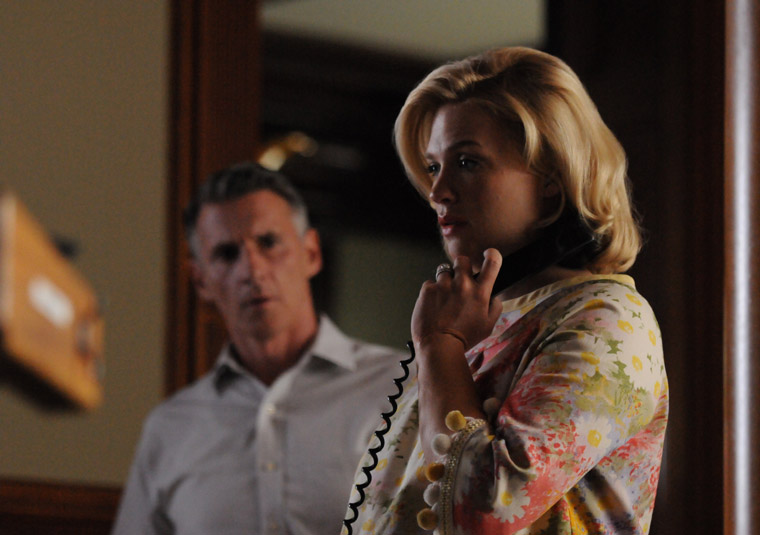
MAD MEN RECAP 2: TEA LEAVES

MAD MEN RECAP TWO: Tea Leaves

Watch a clip from Mad Men Season Five, Episode Two: "Tea Leaves."

"When is everything going to get back to normal?"

null

In recent interviews, Matt Weiner has been sharing this quote, uttered by Roger at the end of Tea Leaves, as a kind of capsule of the entire season. There is no normal to get back to, and as Don said in episode 105, 5G, "I have a life, and it only goes in one direction. Forward." At the moment (late June and early July 1966), forward is a very strange direction indeed, for Don, for Betty, for Roger, for SCDP, and for the United States as a whole.

When forward gets strange, backward looks pretty good. Betty reached out to Don because she knew what she would get: "Say what you always say," she begs, and Don knows exactly what she means. There was a time she hated when he said that; "You don't know that," she answered, but now she reaches out to Don, not because she's in love with him, or threatening his marriage or her own, but because he is familiar, and she knows what he'll say, and she can use that to calm herself. Betty's parents are both dead, the only past that Betty can touch is Don, and it works, she calms down enough to breathe.

The title Tea Leaves suggests the future, and a fortune teller arrives a little before the halfway point to remind us that attempts to predict the future are a fool's game. Mad Men has treated tarot reading quite respectfully in the past, and even uses a tarot card as a production logo. The tea leaf lady doesn't represent a condemnation of the whole idea of divination so much as a demonstration that the belief in a controllable and containable future just doesn't withstand scrutiny.

"Time is on My Side" is the Rolling Stones song everyone’s talking about, and not because it was a big hit in 1966. In fact, the Stones recorded it in '64; if Mad Men simply wanted to reference a current song, why not "Paint It Black,"  which was released in May of 1966 and was huge. No, the song was selected for its title. Is time on Betty's side? On Roger's? On Megan's? Betty might not have cancer, but there's a kind of awakening to the future, to tea leaves, to the choice to reach forward or back.

It's also not a coincidence that the doctor refers to Betty as "middle-aged." Man, that's got to hurt. Betty is now all of 34, which we wouldn't call middle-aged now, but was not an unreasonable label in 1966. Still, I can't imagine she likes it. She's seething that Megan is 20 (she's 26 but hey, what's six years between enemies?). Youth culture has arrived. Our closing song, "Sixteen Going on Seventeen" (from The Sound of Music), Harry lusting clumsily after young girls, even Megan calling Don "square": it's all about the passage of time. Don's inability to communicate with his mother-in-law (he doesn't speak much French) seems symbolic of the gulf between Megan's youth and Don's age. These old squares can't even tell whether or not they've met the Rolling Stones! (I don't know how much scrutiny a closing song gets, but Hammerstein died of cancer shortly after The Sound of Music opened on Broadway, before it was made an Academy Award-winning film in 1965; that bit of musical trivia sure fits with the contrast of youth and death, which is one a theme of this episode.)

Naturally everyone will want to talk about Betty's weight gain, and naturally, the storyline was written to accommodate January Jones's pregnancy. It's strange that in Season 1, Peggy's story was that she looked fat but was actually pregnant, and now January Jones is pregnant, and Betty looks pregnant but is actually fat. The fourth wall kind of melted for me when I saw Betty, and I had a hard time understanding, for a few minutes, that this was a tale about Betty Francis becoming fat, because instead I was thinking, "Oh, that's how they are dealing with January's pregnancy." I was wondering if Betty was pregnant, instead of seeing the evidence on-screen: From the moment we saw Betty struggling to get into her dress, we saw a story about a woman who had gained unwanted weight. Thinking otherwise comes entirely from reading gossip columns and knowing what's going on behind the scenes. We really undermine ourselves when we suck up all that backstage stuff, because it prevents us from seeing the drama on its own terms.

Anyway. Betty got fat. Again, in interviews following Season 1, Matt Weiner expressed a lot of interest in the way that fat women are treated in our world, and he got to tell some of that story by having Peggy gain weight. In Season 2, we met Betty's friend Sarah Beth, who couldn't string three sentences together without including one about how awful it was that her daughter was fat. The oppressiveness of that ongoing monologue was palpable.

As is Betty's self-hatred. It's one thing to get fat, it's another to decide that your husband can no longer see you naked, and you can no longer go to fancy events unless you fit into your old, glamorous clothes, and you can no longer have an active sex life. One thing I've always loved about Betty is her libido: she may be prim and judgmental, but in the sack she is desirous, playful, and rarin' to go. Betty is denying herself things she loves: going out, showing off her beautiful clothes, making love, being admired. She's doing this because fatness is hateful to her.

I am not a doctor, but it seems to me that even a benign tumor sitting on the thyroid could cause weight gain, so it surprised me that the show played, at the end, with the notion that Betty is fat because she's eating extra ice cream. Maybe that's true, or maybe she's giving herself permission to indulge because she's unable to lose weight even when she starves herself (which is exactly what happens with a thyroid problem). Betty watches every bite she eats, even during pregnancy ("Jesus, Bets, have some oatmeal. That baby’s gonna weigh a pound," Don said in episode 3.09). This is why her silent, private indulgence in a chicken leg (episode 2.13) was so moving and so sensual. If there's a loss of control it's more than just "letting herself go;" Betty is control.

The other major theme of Tea Leaves is appearances. Betty is not just fat, she is deeply concerned with being seen as fat, and she is sure that Henry is incapable of seeing her accurately. Megan is concerned with how she appears to the Heinz people, and awkwardly makes sure they know she didn't sleep with a married man. Harry wants to look cool in front of, well, he's not sure…the girls backstage? Don? The security guard? If only someone would think he's cool, he'd feel better. Meanwhile, he's hiding his eating, which seems like a nod at Betty. Michael Ginsberg is a talented nebbish who wants to appear so obnoxious that he'll be mistaken for bold and exciting. And Peter, as ever, wants everyone to know how important he is. (Note Peter in a black suit, when he usually wears blue or green; he's dressed as the Head of Accounts and he doesn't want anyone to miss it.) Part of what Tea Leaves is about is the show we're all putting on for each other so much of the time.

Some additional thoughts:

In Season 1, Harry advised Pete that looking and flirting were the kinds of pleasures a married man can have. His one infidelity left him remorseful and quick to confess. I don't know if Harry is cheating, but what he's doing is worse, in a way. He's longing. Jennifer can't know what's hit her.

Henry is working for John Lindsay, who was Mayor of New York from 1966 through 1973. He doesn't want the mayor seen with (George) Romney because "Romney's a clown." Ha! I'm allowed to enjoy the cheap shots, aren't I? Mitt's father, George, was governor of Michigan at the time, but I'm sure the writer's room had a nice laugh sticking that in the script.

"Romney's a clown" would be the quote of the week if it weren't for "Someone with a penis."/"I'll work on that." My son came home from work just as Peggy said that, and I was laughing so hard he thought something was wrong.

I think we can give Jon Hamm's directorial debut a thumbs up, don't you?

Deborah Lipp is the co-owner of Basket of Kisses, whose motto is "smart discussion about smart television." She is the author of six books, including "The Ultimate James Bond Fan Book."

Watch Mad Men Moments, a series of videos on Mad Men, produced by Indiewire Press Play.

MAD MEN RECAP 1: A LITTLE KISS

MAD MEN RECAP 1: A LITTLE KISS

Megan knows about Dick Whitman.

Say what you will about this episode, discuss the meaning and the symbolism and the complexity and whatever else you like, but it all boils down to just one thing.

Megan knows about Dick Whitman.

nullLeaping into Mad Men after a long delay is a thrill, and I'm as eager to gobble down this episode as anyone. It's been agony, but all is forgiven after these two amazing hours. At the end of Season 4, the Surprise Marriage Proposal prompted an awful lot of people to say that Don would never have married Faye, because Faye knew his secret. I may be the only writer on Mad Men in all of cyberspace who didn't say, when Don revealed Dick-in-a-Box to Faye, “Well, that's over.” Honestly, I felt kind of stupid, like all the other writers had more insight than me. But I still couldn't bring myself to say it. It felt too simple, too much of an equation: This, then that, and therefore… That's not Matt Weiner's style.

So just a wee little bit, I feel vindicated. (A wee bit? Like Pete looking out a big window!) 

In Episode 4.10, Don said to Faye, “I'm tired of running,” and told her his secret. Then he said, “Now I think that’s over.” And now? Now he's decided it was a good idea. He really was tired of running, really was relieved when he thought it was all over, and despite his terror that day, despite his hand being forced, it seems it has become a decision. Eight months later we see him living the results.

For those of you keeping score, A Little Kiss* takes place May 30 through June 6, 1966, seven months after the Season 4 finale, Tomorrowland.

About Megan, Don says to Peggy, “You don't know her at all.” It almost doesn't matter why he says it; what matters is that he really does know his second wife, as he never knew Betty. And Megan knows Dick Whitman. She has a lot to learn about her husband, and she made a real miscalculation with the party, but he's given her the means to know more: something he never gave to Betty until she forced his hand.

Looking at the broader themes of this episode, let's start with babies. There are an awful lot of babies in this episode: Tammy Campbell is just off-screen, Kevin Harris gets passed around, Gene Draper is with his siblings (I guess now that Don has a wife, he's not afraid of having the baby along with the older kids), and there's a hint that Megan is next (Joan says it outright, plus Megan feels inexplicably sick—maybe it's morning sickness, maybe it's foreshadowing, maybe it's just a hangover—we'll have to wait and see). Does it symbolize renewal? Rebirth? Is it Matt Weiner winking at the audience since his series is "reborn"? We'll have to wait and see, but the motif is plain enough.

Thematically, we're looking at the interplay of work and domesticity. Consider: The Drapers come to work together, leave together, and finally, the show ends with a discussion of that intersection. Joan, coming to work with a baby, also provides a clear illustration of home and work intermixed. The visual references (couples at work, babies at work) open the door for a wide-ranging exploration. Joan misses work, and she doesn't even have the language to express that. She tells her mother she wants to go back to work because “I don't want to break my promise.” Like Peggy, I'm inclined to say “bullshit.” She wants to go back to work because it's interesting, and diaper rash just isn't. I've been there, honey.

Don is happy at home and nice to clients, while Pete is frustrated at home and surly at work, even in response to success. Lane and Rebecca are unhappy at home, and Lane is lost at work, missing Joan (who is something like his “work wife,” in the most positive sense of that phrase), fantasizing about having something, or someone, different. He refuses to allow money to be spent on pranks at work (but is overruled) and refuses to allow his wife to write checks (and isn't). Roger is miserable at home and increasingly meaningless at work. He's trying to buy his way out of emptiness. (He should try actually working and see if that's satisfying, but I may be asking too much.)

Two quotes encapsulate this theme: Trudy says to Pete, “This becomes a home the minute you walk through that door.” Later, Lane says to Joan, “It's home but it's not everything.” In truth, both work and home need to be satisfying, and when one is broken, it drags down the other.

Matt Weiner likes to start us in the middle, and teasing the audience into catching up. By making the party the centerpiece of everything, the episode accomplishes so much. It plays on the theme, as coworkers interact in a home environment. It sets a lot of the conflicts of the era: It's 1966, Megan is in a mini-dress. Look around the party and you can see the beginning of the “Generation Gap;” more than in past decades, people are dividing into age-specific groups (“key demographics,” Harry might say), and you can see it in the clothes, makeup, and dance styles. And it re-introduces most of the key players and their current situations. We hit the ground running, which is fun, without the structural tedium a re-introduction could have in weaker hands.

Rebecca: “Don't forget to get the name of Megan's real estate agent.”
Lane: “Yes dear.”

Rebecca: “And her decorator.”

Because that's what makes a happy home. Rebecca wants a piece of that happy marriage and that exciting life, and she's hoping the surfaces will somehow provide it. Lane is going for the surface too, falling for a picture in a wallet. Do you think we ever meet Dolores? I bet we don't, but that Lane has an affair with someone else. Dolores is like the mechanic that Betty encounters at the beginning of Season 2; the beginning of a sexual experiment, not its culmination. (Infidelity of a different magnitude than what Lane did while his wife was out of the country and when he believed his marriage was over.)

I haven't even talked about Pete. He is an inflamed cyst of dissatisfaction right now, and is also Don Draper minus ten years (and a lot of charm). He doesn't like the suburbs, he doesn't like the way Trudy has changed post-baby, and nothing satisfies, not even winning. Pete gets the client, he gets the bigger office, he even gets to successfully prank Roger, but none of it is the same as feeling good.

By the end of Season 3, it was hard to remember that Pete was very much the villain of Season 1, but after A Little Kiss, I feel confident that Pete Campbell's Bitchface will have plenty of material. My goodness, what a petulant little brat. Talk about "love to hate"!

There are a lot more subjects worth exploring in these two hours. In a little over a thousand words, I feel like I've just scratched the surface, and I'll be writing a lot more about this episode on my own site.

The racial subplot is going to become very important. I predict a new cast member, hired as a result of this improbable prank. Tanner Colby wrote a recent article in Slate about race, Mad Men, and Madison Avenue. He got the year wrong, but I think he got the trajectory right. Predictions?

Speaking of getting the year wrong, most people did. I've been saying since Season 2 that things won't continue to skip too far ahead, because Matt Weiner loves the sixties and doesn't want to see their end too soon.

A lot of money changed hands in a lot of different ways, and serves as a secondary motif, after babies and domestic life.

At this moment, I have no idea what the title means. Thoughts?

Don Draper is so sexually complex. I can't even.

No Betty this week. Don't forget they were working around January Jones's pregnancy.

*For the sake of cohesiveness, I'm treating A Little Kiss Part 1 and A Little Kiss Part 2 as a single episode.

Deborah Lipp is the co-owner, with her sister Roberta, of Basket of Kisses, home of "Smart Discussion About Smart Television," and the premiere Mad Men blog. Deborah has written six books, including The Ultimate James Bond Fan Book. She lives in Rockland County, New York with her son, two cats, and an assortment of unfinished projects.

VIDEO SERIES – MAD MEN Moments

VIDEO SERIES – MAD MEN Moments

nullWith the long-awaited premiere to Season Five imminent, Mad Men is on many a person's mind. For the next thirteen weeks, some may revel in a neverland of glamorous mid-60s living fraught with social strife; others may wonder what jaw-dropping, life-changing events await their favorite characters. But for us here at Press Play, it's about the moments. Moments that have us instantly rewinding our DVRs as soon as an episode is over, or poring over blog recaps all Monday long while real work lies unattended. Mad Men has yielded four seasons stuffed with such moments. We decided to produce a series of videos dedicated to spotlighting some of the best.
This was no easy task and involved a fair amount of deliberation in selecting four iconic moments to produce the video essays that are our specialty here at Press Play. We decided to pick just one moment from each of the previous four seasons that lent itself best to video essay treatment. What surprised us was how each selected moment organically led to distinctly different approaches in our analysis. Watch each video and see what we mean. If anything they will have you salivating for more from Matt Weiner, Jon Hamm & company.

Press Play is especially fortunate to have as co-producer of the series Deborah Lipp of the popular Mad Men blog Basket of Kisses. Deborah co-runs the blog with her sister Roberta Lipp (who lent her estimable voice talents to three of these videos) and was an invaluable presence in bringing this series to fruition. Not only are we proud to co-present these videos with Basket of Kisses, we are doubly excited to announce that Deborah will serve as Press Play's very own Mad Men specialist, writing episode recaps throughout the season. Look for her first recap this Sunday IMMEDIATELY following the end of the two-hour season premiere, which starts at 9PM on AMC. For the next thirteen weeks, Press Play will be an essential destination for replaying another season's worth of Mad moments.

Index of "Mad Men Moments" Video Essays:

It's a Mad World: A video essay by Serena Bramble, essay by David Ehrenstein

Season One: The Carousel by Tommaso Tocci and Kevin B. Lee

Season Two: The Sad Clown Dress by Deborah Lipp, Roberta Lipp and Kevin B. Lee

Season Three: The Lawnmower by Amanda Marcotte, Roberta Lipp and Kevin B. Lee

Season Four: The Fight by Serena Bramble, Deborah Lipp, Roberta Lipp and Kevin B. Lee

Top Five Mad Men Moments, selected by the Mad Men blog Basket of Kisses

Deborah Lipp is the co-owner of Basket of Kisses, whose motto is "smart discussion about smart television." She is the author of six books, including "The Ultimate James Bond Fan Book."

Kevin B. Lee is Editor in Chief of IndieWire’s PressPlay Video Blog and contributor to Roger Ebert.com. Follow him on Twitter.

VIDEO ESSAY: It’s a MAD World – a MAD MEN Video Tribute

VIDEO ESSAY: It’s a MAD World – a MAD MEN Video Tribute

Part of the Mad Men Moments Video Essay Series

Serena Bramble, who has already created several dazzling montage tributes to film noir, Powell and Pressburger, and Steven Spielberg, among others, unveils her latest work, weaving dozens upon dozens of clips into a jazz-like succession of motifs, mapping out the resplendent world of Mad Men

Bramble's video includes an excerpt of Don Draper reading Frank O'Hara's poem "Mayakovsky" from the premiere episode of Season Two. Writer David Ehrenstein takes that scene as the starting point for the following meditation on the poem, its author the poet Frank O'Hara, and their significance to the series:

Don Draper reading Frank O’Hara’s poem "Mayakovsky" was one of the most startling yet oddly right cultural cross-references in all of Mad Men. Don is of course extremely intelligent and very much aware of the arts — but hardly what anyone would call an intellectual. His romantic exploits have brought him in passing contact with late 50’s /early 60’s New York bohemia (jazz clubs, loft parties) but he’s never evidenced a desire to be part of them. His chance encounter with an O’Hara poem is part and parcel of his magpie-like instinct to gather up information for possible future use. Had Don actually run into Frank O’Hara it’s doubtful he’d have anything to say to him. O’Hara, of course, would have been sure to put the make on a Total Babe like John Hamm.

Frank O’Hara (1926-1966) lived a life that in some ways mirrors that of the Mad Men characters. He went to Harvard (Edward Gorey was his roommate) studied music, but became profoundly interested in poetry — especially avant-garde French and Russian poets Stephane Mallarme, Arthur Rimbaud, Pierre Reverdy, Boris Pasternak and Vladimir Mayakovsky. He got a job working in the card shop at the Museum of Modern Art and in a very short space of time worked his way up to being one of the Museum’s most important curators. This Peggy-like rise was aided by the fact that he became personal friends with the Abstract Expressionists the Museum was collecting. His essays reveal him to be one of their most vocal and direct champions. It wasn’t lofty and “theoretical” with O’Hara at all. A prodigious imbiber, the fact that he could drink any abstract expressionist in the house under the table was why this very openly gay man with — in his words — “the voice of as sissy truck driver” doubtless impressed this decidedly straight and very macho crew. Here’s the greatest love poem ever written (IMO).

O’Hara wrote constantly. His powers of inspiration never waned. The poem he reads above is about Vincent Warren — a dancer in the chorus of the New York City Ballet. O’Hara had been invited by John Ashbery to accompany him on a State Department sponsored Cultural Tour of Europe (hence the cities listed in the poem). The minute he said “Yes” to the trip was the same minute he discovered that he was in love with Vincent Warren. O’Hara’s open celebration of joy in his sexual and romantic self is something Mad Men’s Sal couldn’t possibly bring himself to so much as dream of. 

Frank O’Hara died in 1966 as a result of injursies sustained when he was hit by a slow-moving dune buggy on Fire Island coming back in the wee smalls from a party. He was in mid-conversation with Babe du Jour J.J. Mitchell, when J.J. suddenly realized Frank had stopped talking. He looked back and there Frank was on the sand. He was flown back by helicopter to New York where he died in hospital while trying to comfort his distraught friends. His last words were to Willem de Kooning. “Oh Bill, you’ve come by. How nice.”

It would be nice if Mad Men makes mention of it when the time comes in the story arc.

Serena Bramble is a film editor currently pursuing a Bachelor's degree in Teledramatic Arts and Technology from Cal State Monterey Bay. In addition to editing, she also writes on her blog Brief Encounters of the Cinematic Kind.

David Ehrenstein is a film critic and writer whose books include Open Secret: Gay Hollywood 1928-2000 and The Scorsese Picture: The Art and Life of Martin Scorsese. He lives in Los Angeles.

VIDEO ESSAY – MAD MEN Moments: The Carousel

VIDEO ESSAY – MAD MEN Moments: The Carousel

Part of the Mad Men Moments Video Essay Series

Click here to watch this video on your mobile device.

This video is inspired by the famous "Carousel" presentation in the finale of season one of Mad Men. In this scene, Don Draper uses idyllic images of his family to sell Kodak's new slide projector as a "time machine" taking us from one perfect moment of our life to the next.  This video re-imagines the scene as a time machine journey through the life of Don Draper, with moments that are anything but picture-perfect. It asks the question that has run through the entire series: "Who Is Don Draper?" and explores the gaping chasm between the man he has been and the man he wishes to be.

The original sequence is embedded below, and is further explored by Tommaso Tocci in the following essay.

The 'carousel scene' was one of the moments that helped define the first season of Mad Men. The series had made a strong first impression on its 2007 debut and had consistently built on that over the course of the twelve episodes before 'The Wheel'. Many of the seasonal arcs had already reached their conclusion in the penultimate episode, 'Nixon vs. Kennedy', leaving this one as a sort of offbeat climax covering emotional grounds.

nullThe season finale finds creative director Don Draper in charge of a pitch to Kodak executives for the marketing of their new projector. The client request is to work the technology angle, emphasizing the automated capabilities of the device.

Except that Don Draper doesn't really trust technology, or even the future. Earlier in the season (ep. 1.2), he dismissed a space-themed campaign because 'some people think of the future and it upsets them'. As much as he doesn’t like thinking of himself – and his agency – as 'traditional' (ep. 1.6), he always goes searching for his ideas in the past, because that’s where the emotions he’s drawn to really are.

'Technology is a glittering lure, but there’s the rare occasion when the public can be engaged on a level beyond flash, if they have a sentimental bond with the product'.

When we met him in the pilot, we took his boyish smile at face value. We could believe his free-spirited nature, his philosophy that what we call love was invented by guys like him – to sell nylons. He lives like there’s no tomorrow because there isn’t one. It’s only at the end of the episode that we learn how heavily Don had invested on an idealized, prefabricated version of tomorrow (and love). We discover that there's very little we can take at face value in this show. After thirteen episodes spent trying to stabilize this fracture, it's clear that something has gone wrong in the process. By the time he gets to work on the Kodak pitch, Mr. Draper is no longer a happy customer.

The carefully crafted ‘love-doesn’t-exist’ fiction is consistent with the way he approached his first challenge of the series: the creation of a new slogan for Lucky Strike. Claiming that advertising is only based on 'happiness' ('a billboard screaming with reassurance that whatever you’re doing, it’s okay. You are okay' – it’s worth noting that Jon Hamm was instructed to say the line as if he was telling that to himself), in a fit of genius he abandons any thoughts of complexity and just focuses on immediate pleasure: 'It’s toasted'. Don’s discomfort throughout the episode is mirrored by the setting of the scene when he walks into the meeting. He sits alongside Roger in a fully lit, unforgiving room, desperately scrambling for inspiration. He’s just scratching the surface of himself, like a patient on the first session with his therapist.

null

Thirteen episodes later, with an extremely messier but more acute self-awareness, he owns the Kodak pitch. He's the man behind the curtain, now. He's getting closer to the darkness that's being eating at him while simultaneously distancing himself from it by literally projecting it on the wall. Look how he disappears in the dark background of the room, firmly in charge of the narrative. Confident, composed, assured while he exposes himself. He is a man with a plan, and his plan is so effective because it feeds off everything that’s happened to him in 13 episodes.

Over the course of the season, we’ve seen flashbacks of a forgotten childhood emerge through the cracks of a crumbling conscience. As in a twisted psychoanalytical process, Don refuses to acknowledge his past on a conscious level, but he allows it to re-surface in his work. Indeed, it’s the only place he ever goes to – his secret emotional goldmine.

'A deeper bond with the product. Nostalgia. It's delicate, but potent'.

The story he tells about his first job, 'in-house at a fur company' with 'this old pro copywriter' Teddy, is a convenient half-truth (we’ll find out only in episode 4.6), just like the Greek etymology of 'nostalgia' that he uses as a gateway for his carousel allegory: 'nostalgia' is not 'the pain from an old wound'; it’s actually the pain caused by the desire to return home. But for Don Draper, the thought of returning home IS an old wound, and a very painful one.

As the plastic of the projector rotates, echoing each of Don’s increasingly assertive statements, we go back and forth between full-frame family pictures and Don’s face. It’s almost shot-reverse-shot. Note how the pictures are kept in motion and in contact with the scene by the cigarette smoke blowing in front of the projector ('Smoke gets in your eyes') and how Don’s dark, austere frame is dynamically countered by the abstract painting in the background.

nullThe first slide with Don and Betty – playfully biting the same hot dog – is a recreation of an actual photo of series-creator Matthew Weiner’s parents on their first date. Beyond the autobiographical detail, this also reinforces the notion of Mad Men as a ‘time machine’ for the people who are now 40-to-50 years old. A way for that generation to come to terms with their parents’ time. This is interesting because every major character can be examined through the lens of its child issues (Don, Betty, who’s always been a child, Peggy, who must fight to no longer be considered one). Mad Men is full of irresolvable controversies and contradictions – simultaneously stigmatizing and fetishizing the customs of the 60s, hating and loving its anti-hero protagonist, believing in his emotions or regarding his whole identity as a ploy, and ultimately being in itself a meta-meta play on the ambivalence of advertising. It's epic turned parody turned irony turned postmodern epic. A rational centrifuge of polar opposites spinning faster and faster until you need a different set of eyes to make sense of it. Reconciling such opposites is the way in which we make peace with our parents, with their world. It’s how we put them to rest. It’s probably the only point of view from which Mad Men can be experienced as a whole – rather than as an eternal duality.

That’s why the carousel scene has made such an impression – it encapsulates not only the themes and storylines of every character in the first season, but also the different layers that the series has taught us to look out for. People ‘buy’ the scene for its straightforward, raw emotional power, or they choose to see it as the ultimate manipulation. It can be a psychoanalytic struggle or an historical rollercoaster. It can be earnest or cynical, cathartic or parodic.

The 'place where we ache to go again' also complements another etymological quirk that appears earlier in the season (1.6), when Rachel explains to Don that ‘Utopia’ means both ‘the good place’ and ‘the place that cannot be’. Another double definition perfectly fitting Don’s search for his past AND the time of Mad Men in its entirety. A magical Babylon. Has it ever really existed? Or did we collectively imagine it? Is it just some good memories of a child mixed with the rational judgment of a man? 'It was good, but it cannot be' would make a great caption for the show’s attitude towards the values and customs it depicts.

Tommaso Tocci is a freelance writer and translator currently based in Italy. Follow him on Twitter.

Kevin B. Lee is Editor in Chief of IndieWire’s PressPlay Video Blog and contributor to Roger Ebert.com. Follow him on Twitter.

VIDEO ESSAY – MAD MEN Moments: The Sad Clown Dress

VIDEO ESSAY – MAD MEN Moments: The Sad Clown Dress

Part of the Mad Men Moments Video Essay Series

Click here to watch this on your mobile device.

In selecting an iconic moment for Season Two of Mad Men, we wanted to shift the focus away from the storied office shenanigans of Sterling Cooper and spend time unpacking the domestic storyline that, while less sexy, imbues the world of Mad Men with added dimension and depth. By focusing on the idyllic domestic world of Betty Draper and how it all falls apart within a 24-hour span, this video serves as a complement to the Season One video portrait of Don Draper in "The Carousel." 

The script for this video essay is written by Deborah Lipp, narrated by Roberta Lipp, and edited by Kevin B. Lee.

TRANSCRIPT

Mad Men's Betty Draper is a master of surfaces.

A former model who is happiest when praised for her beauty.

She lives the life expected of her, but the suburbs bore her and she has no real interest in motherhood.

Her husband is a mystery…and a philanderer.

In episode 2.08, A Night to Remember, it all comes apart.

Betty intends to prove herself the perfect hostess and wife, throwing the perfect party.

She then discovers she's a pawn.

She spirals into a rage. Don has broken the pact to maintain a perfect surface. Now there is nothing for Betty to hide, and so much to expose. 

Betty spends the night with her daughter instead of Don, as if to seek solace in a childlike state.

Over the course of the next day , her flawless party look–which costume designer Janie Bryant calls her “Sad Clown Dress”– falls to ruin.

She no longer bothers putting on a show of perfection. It no longer exists.

And she won’t move beyond this moment, until she finds the proof she seeks: that this man, and the idyllic life they’ve created are built on a lie.

But she’s unable to expose Don. She can only hurt herself.

And yet, she knows what she knows. She can no longer trust appearances, since that’s all her husband has to offer. Don stays in the shadows, denying everything.

Betty’s hair is held back in a band so that we see the full effect of emotion on her face.

The surface of perfection is gone. She’s exposed and looks broken. But underneath is a new found conviction about herself.

Finally, she faces Don without makeup, without a hairdo, without even a color. The white robe accentuates the starkness of this moment.

Now it is Don who’s afraid of losing everything. And it’s his expression of fear that brings her back.

The next day, the house is filled with warm, renewing light. Betty is back to being an immaculate housewife, as if nothing happened.

But a TV commercial brings it all back.

It has all crumbled. Her perfect home, her handsome husband, they are empty surfaces that have all been sold to her.

Betty is no longer buying.

Deborah Lipp is the co-owner of Basket of Kisses, whose motto is "smart discussion about smart television." She is the author of six books, including "The Ultimate James Bond Fan Book."

Roberta Lipp is the co-owner of Basket of Kisses and is or has been a voiceover artist, improvisor, actor, singer/songwriter, blogger and Mad Men aficionado. She plans to produce a one-woman show.

Kevin B. Lee is Editor in Chief of IndieWire’s PressPlay Video Blog and contributor to Roger Ebert.com. Follow him on Twitter.

VIDEO ESSAY – MAD MEN Moments: The Lawnmower

VIDEO ESSAY – MAD MEN Moments: The Lawnmower

Part of the Mad Men Moments Video Essay Series

Click here to watch this on your mobile device.

Our iconic moment of Mad Men season three easily ranks as one of the most shocking of the entire series to date. To explore it in depth, we adapted one of the best pieces we could find about the episode, written by Amanda Marcotte of Pandagon. This video is narrated by Roberta Lipp of Basket of Kisses and edited by Kevin B. Lee.
 

Amanda Marcotte is a Brooklyn writer who likes indie rock, quality television, and political blogging. She blogs at Pandagon. Follow her to Twitter

Kevin B. Lee is Editor in Chief of IndieWire’s PressPlay Video Blog and contributor to Roger Ebert.com. Follow him on Twitter.

VIDEO ESSAY – MAD MEN Moments: The Fight

VIDEO ESSAY – MAD MEN Moments: The Fight

Part of the Mad Men Moments Video Essay Series

Click here to watch this video on your mobile device.

There is near unanimous consensus that 4.07: "The Suitcase" is the standout episode of Season Four of Mad Men, so we knew that our video essay on a singular moment from that season had to come from that episode. But there are so many great moments in "The Suitcase:" Peggy's telephone breakup with her boyfriend (and her family), the scenes between Don and Peggy in the diner and the bar (where they express their mutual attraction as far as they allow themselves to); the confrontation with Duck Phillips back in the office; the early morning phone call; and of course the hand-holding. But for this video, we decided on the fight that erupts between Don and Peggy after she decides to devote her evening in the office with him on the Samsonite ad campaign. There is just so much to unpack in this swift, three minute scene, four seasons' worth of narrative and character subtext that has built up and finally explodes between them. What's also remarkable is how much of this is conveyed through subtle but effective choices in staging and direction, as we hope this video illustrates.

The script for this video essay is written by Serena Bramble, Deborah Lipp and Kevin B. Lee, based on "a kernel" of an idea by Serena Bramble. The video is edited by Kevin B. Lee and narrated by Roberta Lipp and Kevin B. Lee.

TRANSCRIPT

Don has received an ominous phone message about his dying friend Anna.

Telephone at his side, he is trying to bring himself to call.

Don is staged front and center, conveying a sense of isolation and confrontation with himself.

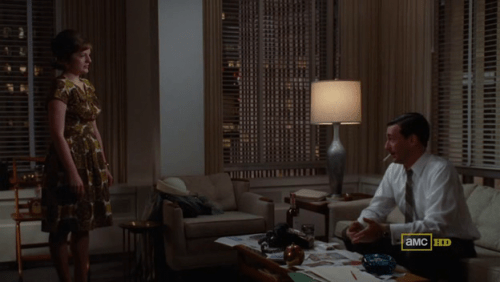
The framing of this wide shot emphasizes the distance between Don and Peggy.

The rest of scene goes back and forth between these two shots of Don seated on the couch and Peggy standing as if above him.

The staging highlights Peggy's newfound aggressiveness towards Don in this scene. She is emboldened by her breakup. He is weakened by Anna's imminent death.

The following dialogue plays like an exchange of blows that resonates with the episode's boxing subplot. It even lasts about the 3 minute length of a boxing round.

Don's response doesn't invite further conversation or empathy. It is action-based, in line with his past advice to Peggy.

Don’s smile betrays relief that he won’t be alone. He can put aside the call. But he conceals this by acting as if Peggy could easily have left.

The framing of Don on the couch has shifted left. A space has opened.

Peggy wants to finish the fight she started with Mark by taking on the man at the opposite end of what’s expected of her. Her insult of Don's personal life is as much towards herself as to him. The remark doesn't faze Don in the least.

Peggy's body now occupies the space to Don's left, further establishing her imposing presence.

Now it is Don who insults Peggy's personal life, patronizing her for being girlish. But Peggy, too, is unfazed. She jabs directly at what really bothers her.

Unlike with Peggy's insult of his personal life, Don takes this insult of his professional life as "personal" Don is ready to fight, if only to drown out the more painful feelings of grief. He can do it best where he feels most at home: the office.

The scene moves into tighter closeups of Don and Peggy as they exchange jabs with increased intensity

Like Cassius Clay in the prize fight going on that night, Peggy fights with sharp, rapid flurries. Like Clay’s opponent, Sonny Liston, Don is slower, methodical, and forceful.

Don's face is intensely red. He needs the emotional release of this fight as much as Peggy.

Peggy again seeks recognition, but now it’s not professional. It’s emotional. But showing emotions is unprofessional. She’s been caught with her gloves down. Don finally unleashes.

The knockout blow: one last insult encapsulating the conflicts running through the scene.

Serena Bramble is a film editor currently pursuing a Bachelor's degree in Teledramatic Arts and Technology from Cal State Monterey Bay. In addition to editing, she also writes on her blog Brief Encounters of the Cinematic Kind.

Deborah Lipp is the co-owner of Basket of Kisses, whose motto is "smart discussion about smart television." She is the author of six books, including "The Ultimate James Bond Fan Book."

Roberta Lipp is the co-owner of Basket of Kisses and is or has been a voiceover artist, improvisor, actor, singer/songwriter, blogger and Mad Men aficionado. She plans to produce a one-woman show.

Kevin B. Lee is Editor in Chief of IndieWire’s PressPlay Video Blog and contributor to Roger Ebert.com. Follow him on Twitter.

VIDEO – The Top Five Mad Men Moments

VIDEO – The Top Five Mad Men Moments

Part of the Mad Men Moments Video Essay Series

Click here to watch this video on your mobile device.

The Mad Men Moments video essay series is co-produced by Deborah Lipp, co-owner with Roberta Lipp of the popular Mad Men website Basket of Kisses. The site features a robust community of Mad Men fans, so we thought to poll them on their expert opinion on what the best moments of the series have been after four seasons.  Here are the results, with the selected scenes featured in the video above. Below are brief accounts of each scene written by several members of the Basket of Kisses community.
 

5. Peggy and Joan, (4.13: Tomorrowland)
This scene, full of small pleasures, takes off when Joan becomes Peggy's safe place on a bad day. “Whatever could be on your mind,” she purrs. – Anne B

4. Don and Peggy hold hands (4.07: The Suitcase)
If actions speak louder than words…if three years of previous build-up lead to one glorious culmination…that is the pinnacle of this episode's (and for that matter, this season's) denouement: never was a simple gesture so fraught with dimensionality of meaning as when Dick Whitman places his hand on top of Peggy Olson's. – Peg4Prez

3. "Open the drawer" (3.11: The Gypsy and the Hobo)
The Don/Betty game changer. Just when you think Don's about to run away with Suzanne, the woman of his dreams, Betty makes it crystal clear that he'll never outrun his past. It's shocking — in a good way — to see Don suddenly so helpless and small. – Andee Joyce, aka Meowser

2. "I Wanted Other Things" (2.13: Meditations in an Emergency) 
The writers’ words often carry several shades of meaning on Mad Men, and this is one instance. "Well, one day you're there, and then all of a sudden, there's less of you, and you wonder where that part went, if it's living somewhere outside of you, and you keep thinking maybe you'll get it back, and then you realize it's just gone." At first, we wonder if Peggy is talking about the baby, coming as it does on the heels of her confession. Then we understand she’s referring to her own feelings for Pete—she “wanted something different”. And then, a deeper echo of truth—there is a cost to moving forward, and it’s not just giving up a piece of the past. The weight of her words is crushing, almost cruelly made lighter by the tenderness of her touch across Pete’s shoulder as she leaves. – Mitch Virchick

1. Carousel (1.13: The Wheel)
Everybody loves this scene. Don’s pitch leaves the men from Kodak speechless. The scene serves the show, tapping into the right plot points, but what really makes it work isn’t on the screen. It’s our own set of life-shots, inserted into the projector’s circular slide tray, in our mind’s-eye. Brilliant! – SmilerG

Deborah Lipp is the co-owner of Basket of Kisses (hyperlink), whose motto is "smart discussion about smart television." She is the author of six books, including "The Ultimate James Bond Fan Book."

MATT ZOLLER SEITZ: What makes MAD MEN great?

MATT ZOLLER SEITZ: What makes MAD MEN great?

nullWe head into Mad Men’s" fifth season knowing nothing about it. The on-air promos recycle moments from past seasons, and the teaser art has been cryptic even by this show’s standards: an opening-credits-styled image of a falling man that could be hawking any season, and a photo of hero Don Draper staring at two mannequins — a clothed male and a naked female* — through a dress-shop window. Matthew Weiner, who banned advance screeners after a New York Times review revealed innocuous details from the season-four premiere, has dropped a cone of silence over the production. We have no idea if Don went through with plans to wed his young secretary, Megan; if Joan had Roger’s baby; or if the new agency is still in business. We don’t even know the year in which this season takes place, which at least would prepare us for the wingspan of Roger’s lapels.

On first glance, the black-ops secrecy seems insane. This isn’t a plot-twisty series like Breaking Bad or Homeland; it’s a low-key drama consisting largely of men and women in vintage clothes bantering on the same eight or nine sets. And yet the cloak-and-dagger shtick is of a piece with what’s onscreen. It’s a rare show that can vanish for seventeen months, make a tight-lipped and rather self-satisfied return, and presume we’ll give it a prodigal son’s welcome and be right. Mad Men has earned that level of blind trust because it’s serenely sure of what it’s doing.

You can read the rest of Matt's piece here at New York Magazine.

Matt Zoller Seitz is founder and publisher of Press Play and TV critic for New York Magazine