
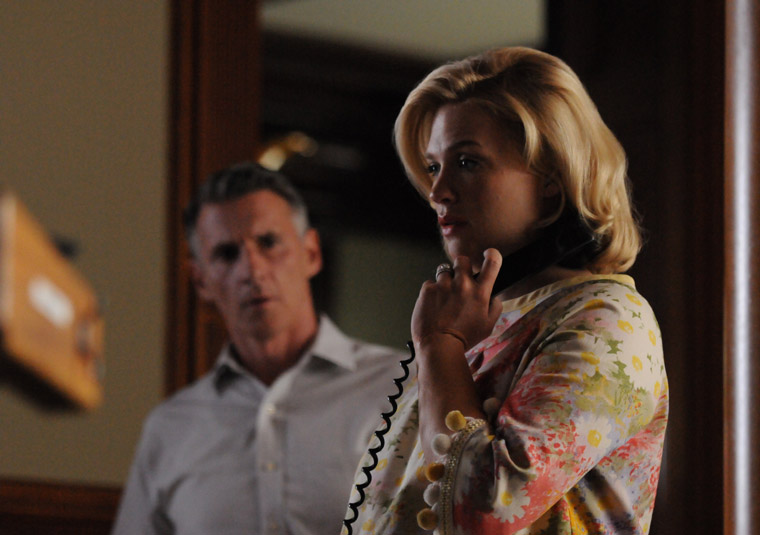
Watch a clip from Mad Men Season Five, Episode Two: "Tea Leaves."
"When is everything going to get back to normal?"

In recent interviews, Matt Weiner has been sharing this quote, uttered by Roger at the end of Tea Leaves, as a kind of capsule of the entire season. There is no normal to get back to, and as Don said in episode 105, 5G, "I have a life, and it only goes in one direction. Forward." At the moment (late June and early July 1966), forward is a very strange direction indeed, for Don, for Betty, for Roger, for SCDP, and for the United States as a whole.
When forward gets strange, backward looks pretty good. Betty reached out to Don because she knew what she would get: "Say what you always say," she begs, and Don knows exactly what she means. There was a time she hated when he said that; "You don't know that," she answered, but now she reaches out to Don, not because she's in love with him, or threatening his marriage or her own, but because he is familiar, and she knows what he'll say, and she can use that to calm herself. Betty's parents are both dead, the only past that Betty can touch is Don, and it works, she calms down enough to breathe.
The title Tea Leaves suggests the future, and a fortune teller arrives a little before the halfway point to remind us that attempts to predict the future are a fool's game. Mad Men has treated tarot reading quite respectfully in the past, and even uses a tarot card as a production logo. The tea leaf lady doesn't represent a condemnation of the whole idea of divination so much as a demonstration that the belief in a controllable and containable future just doesn't withstand scrutiny.
"Time is on My Side" is the Rolling Stones song everyone’s talking about, and not because it was a big hit in 1966. In fact, the Stones recorded it in '64; if Mad Men simply wanted to reference a current song, why not "Paint It Black," which was released in May of 1966 and was huge. No, the song was selected for its title. Is time on Betty's side? On Roger's? On Megan's? Betty might not have cancer, but there's a kind of awakening to the future, to tea leaves, to the choice to reach forward or back.
It's also not a coincidence that the doctor refers to Betty as "middle-aged." Man, that's got to hurt. Betty is now all of 34, which we wouldn't call middle-aged now, but was not an unreasonable label in 1966. Still, I can't imagine she likes it. She's seething that Megan is 20 (she's 26 but hey, what's six years between enemies?). Youth culture has arrived. Our closing song, "Sixteen Going on Seventeen" (from The Sound of Music), Harry lusting clumsily after young girls, even Megan calling Don "square": it's all about the passage of time. Don's inability to communicate with his mother-in-law (he doesn't speak much French) seems symbolic of the gulf between Megan's youth and Don's age. These old squares can't even tell whether or not they've met the Rolling Stones! (I don't know how much scrutiny a closing song gets, but Hammerstein died of cancer shortly after The Sound of Music opened on Broadway, before it was made an Academy Award-winning film in 1965; that bit of musical trivia sure fits with the contrast of youth and death, which is one a theme of this episode.)
Naturally everyone will want to talk about Betty's weight gain, and naturally, the storyline was written to accommodate January Jones's pregnancy. It's strange that in Season 1, Peggy's story was that she looked fat but was actually pregnant, and now January Jones is pregnant, and Betty looks pregnant but is actually fat. The fourth wall kind of melted for me when I saw Betty, and I had a hard time understanding, for a few minutes, that this was a tale about Betty Francis becoming fat, because instead I was thinking, "Oh, that's how they are dealing with January's pregnancy." I was wondering if Betty was pregnant, instead of seeing the evidence on-screen: From the moment we saw Betty struggling to get into her dress, we saw a story about a woman who had gained unwanted weight. Thinking otherwise comes entirely from reading gossip columns and knowing what's going on behind the scenes. We really undermine ourselves when we suck up all that backstage stuff, because it prevents us from seeing the drama on its own terms.
Anyway. Betty got fat. Again, in interviews following Season 1, Matt Weiner expressed a lot of interest in the way that fat women are treated in our world, and he got to tell some of that story by having Peggy gain weight. In Season 2, we met Betty's friend Sarah Beth, who couldn't string three sentences together without including one about how awful it was that her daughter was fat. The oppressiveness of that ongoing monologue was palpable.
As is Betty's self-hatred. It's one thing to get fat, it's another to decide that your husband can no longer see you naked, and you can no longer go to fancy events unless you fit into your old, glamorous clothes, and you can no longer have an active sex life. One thing I've always loved about Betty is her libido: she may be prim and judgmental, but in the sack she is desirous, playful, and rarin' to go. Betty is denying herself things she loves: going out, showing off her beautiful clothes, making love, being admired. She's doing this because fatness is hateful to her.
I am not a doctor, but it seems to me that even a benign tumor sitting on the thyroid could cause weight gain, so it surprised me that the show played, at the end, with the notion that Betty is fat because she's eating extra ice cream. Maybe that's true, or maybe she's giving herself permission to indulge because she's unable to lose weight even when she starves herself (which is exactly what happens with a thyroid problem). Betty watches every bite she eats, even during pregnancy ("Jesus, Bets, have some oatmeal. That baby’s gonna weigh a pound," Don said in episode 3.09). This is why her silent, private indulgence in a chicken leg (episode 2.13) was so moving and so sensual. If there's a loss of control it's more than just "letting herself go;" Betty is control.
The other major theme of Tea Leaves is appearances. Betty is not just fat, she is deeply concerned with being seen as fat, and she is sure that Henry is incapable of seeing her accurately. Megan is concerned with how she appears to the Heinz people, and awkwardly makes sure they know she didn't sleep with a married man. Harry wants to look cool in front of, well, he's not sure…the girls backstage? Don? The security guard? If only someone would think he's cool, he'd feel better. Meanwhile, he's hiding his eating, which seems like a nod at Betty. Michael Ginsberg is a talented nebbish who wants to appear so obnoxious that he'll be mistaken for bold and exciting. And Peter, as ever, wants everyone to know how important he is. (Note Peter in a black suit, when he usually wears blue or green; he's dressed as the Head of Accounts and he doesn't want anyone to miss it.) Part of what Tea Leaves is about is the show we're all putting on for each other so much of the time.
Some additional thoughts:
In Season 1, Harry advised Pete that looking and flirting were the kinds of pleasures a married man can have. His one infidelity left him remorseful and quick to confess. I don't know if Harry is cheating, but what he's doing is worse, in a way. He's longing. Jennifer can't know what's hit her.
Henry is working for John Lindsay, who was Mayor of New York from 1966 through 1973. He doesn't want the mayor seen with (George) Romney because "Romney's a clown." Ha! I'm allowed to enjoy the cheap shots, aren't I? Mitt's father, George, was governor of Michigan at the time, but I'm sure the writer's room had a nice laugh sticking that in the script.
"Romney's a clown" would be the quote of the week if it weren't for "Someone with a penis."/"I'll work on that." My son came home from work just as Peggy said that, and I was laughing so hard he thought something was wrong.
I think we can give Jon Hamm's directorial debut a thumbs up, don't you?
Deborah Lipp is the co-owner of Basket of Kisses, whose motto is "smart discussion about smart television." She is the author of six books, including "The Ultimate James Bond Fan Book."
Watch Mad Men Moments, a series of videos on Mad Men, produced by Indiewire Press Play.

 Press Play Video Blog