VIDEO ESSAY: AN AMERICAN WEREWOLF IN HOLLYWOOD: HORROR, MAKEUP AND THE OSCARS
Editor's Note: Press Play is aware that our videos can not be played on Apple mobile devices. We are, therefore, making this and every video in this series available on Vimeo for these Press Play readers. If you own an Apple mobile device, click here.]
Narration:
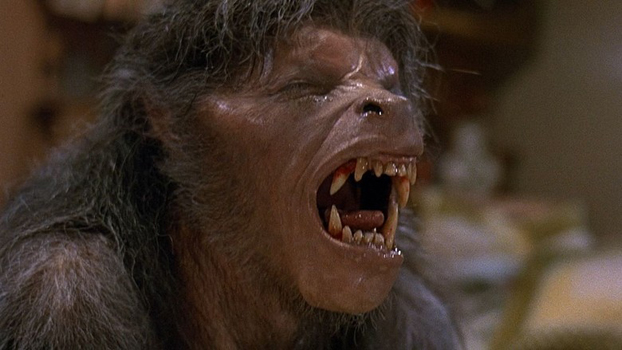
The practitioners of visual effects have a favorite phrase for what they do: the Invisible Art – effects that are imaginative, even astonishing, but that are ultimately there to sell a world, a character or a moment. Special makeup might be the best illustration of this principle. One of makeup's greatest triumphs is An American Werewolf in London, which in 1982 became the first film to win an Oscar for makeup in regular competition. Overseen by Rick Baker, who supervised all of the film's makeup effects, it shows a man changing into a werewolf in real time…right in front of your eyes. This sequence was the culmination of eight decades of movie makeup. And the film's Oscar represented a coming-out for a once-neglected aspect of filmmaking.
Makeup effects were always a key component of the movies. Greasepaint, wigs, putty, latex appliances and other items in the makeup master's toolkit helped make the improbable, and the impossible, seem vividly real. Boris Karloff could make us believe that he was a tormented, tragic creature built from pieces of dead men in Universal's Frankenstein films – with makeup by the great Jack Pierce. Pierce's work on The Wolfman made an ordinary man become a werewolf when the wolfbane bloomed and the moon was full and bright. A 25-year-old Orson Welles played the title character of Citizen Kane at a dazzling array of ages, thanks to inventive, at times highly theatrical effects by Maurice Seiderman.
Yet despite these and other examples of the makeup master's art, the Academy refused to acknowledge the contribution of makeup artists. Prior to the 1980s, just two Special Achievement awards were given for makeup effects. Both were handed out in the 1960s. One was for 1964’s 7 Faces of Dr. Lao, which sported effects by William Tuttle. The other was for 1968’s Planet of the Apes –makeup by John Chambers. The latter citation is fascinating because, while the Academy was right to recognize the extraordinary achievement of Apes, it ignored a film from that same year whose ape makeup was even more impressive. The ape makeup in the Dawn of Man sequence of 2001: A Space Odyssey was so good that many people assumed that director Stanley Kubrick used actual, trained apes. This uptake in visual sophistication was par for the course in that period of American film.
The 1960s through the 1980s were the high point of traditional, analog filmmaking techniques. Some of the most memorable films from this era showed transformation, decay and violence with unprecedented realism. Some of the most striking makeup effects of this period were the work of one man, Dick Smith, who finally received a special Oscar from the Academy in 2012 after decades of groundbreaking work. Nobody spilled blood with more panache.
And nobody has ever done more convincing old-age makeup. For The Exorcist, Dick Smith helped turn preteen actress Linda Blair into a rotting, puking, devil-possessed monstrosity so profoundly revolting that it haunted the dreams of millions. But the film also contains a much subtler triumph: Max von Sydow's transformation into the title character. Von Sydow was just 43 when he played the role. But Dick Smith's wrinkles and liver spots were so believable that for years afterward, casting agents kept offering him old man parts. Just as viewers thought that the costumed actors in 2001 were real apes, casting agents unfamiliar with von Sydow's work for director Ingmar Bergman thought he was some doddering European character actor. For makeup artists, such misperceptions are the highest possible praise.
The late 1970s saw makeup effects moving away from realistic applications and moving toward the extremes of fantasy. Christopher Tucker's remarkable makeup for David Lynch's 1980 drama The Elephant Man may have pushed the Academy to start handing out a Best Makeup award the following year. After eight decades' worth of movie makeup effects, and 20 years of rapid technical innovations, to continue ignoring the makeup artist's craft would have seemed perverse. And speaking of perverse….
When Rick Baker received the first Best Makeup Oscar ever given in regular competition for 1981's An American Werewolf in London, it was sweet vindication, not just for makeup artists, but for fans of genre movies. The creation of a makeup category was not just a means of acknowledging a branch of the industry that had been glossed over in the past. It was also a sneaky way to let Academy voters bestow awards on horror, science fiction, fantasy, action and other genres that were, and maybe still are, considered un-serious, or low-class. With its still-unique mix of slapstick, romance and gore, American Werewolf never could have gotten Oscar nominations in the major categories. In retrospect, the makeup award seems not just a prize for the movie's sophisticated use of latex, air bladders and audio-animatronic puppets, but for the originality of writer-director John Landis' vision. The technical categories let Academy voters honor offbeat fare – including genre films that tend not to get nominated in the picture, director, screenplay or acting categories.
The 1970s and '80s were the age of the makeup artist as cult figure. Magazines aimed at genre buffs and wannabe-gore wizards turned the giants of the field into heroes: Jack Pierce; Dick Smith; John Chambers; Tom Savini, George Romero's go-to guy for zombie makeup; Rob Bottin, who created similarly dazzling lycanthropes a year before American Werewolf in Joe Dante's The Howling and still-unmatched alien transformation effects in John Carpenter's The Thing.
The Oscar for American Werewolf signaled that the 1980s – the decade of high-concept blockbusters – would be the golden age of analog makeup effects. When you look back over genre movies from the period – small and big, sensitive and crass, clichéd and innovative – the special effects often hold up surprisingly well. In some cases they're the main reason that people still talk about the movies. Modern makeup effects are slicker and more consistent from scene to scene and shot to shot for reasons that we'll get to in a minute. But, given the mechanical limitations of the pre-digital era, their achievements are still impressive. Even when the storytelling falters, or when the film itself seems less an artistic statement than the end result of a studio deal memo, you can still see the behind-the-scenes craftspeople working at the peak of their powers, always striving to innovate and impress.
But as it turned out, this golden age also represented a final flowering. The industry was about to change in ways that transformed every aspect of production, including makeup. With few exceptions, the '80s heyday of makeup focused on the fantastic – the spectacular. For every film like The Elephant Man or Mask, which integrated extraordinary makeup into a realistic drama, there were a dozen more films in which the makeup was the real show. But the thing is, on some fundamental level, even in the very best makeup-driven movies of that period, you were still aware of the makeup. The effects looked, at times, a little too wet – too painted-on. This was always true, even in earlier periods, when the abstracting effect of black-and-white film gave makeup people another layer of artifice to work with. In the early '90s, right around the time that Bram Stoker's Dracula was winning an Oscar for its state-of-the-art yet old-school makeup effects, new technological advances were making it harder to tell the difference between the real and the virtual. Starting in the late 1980s, advancements in computer generated imagery had begun to offer a level of detail that wasn't possible when done practically. It reached a point where you couldn’t tell where the makeup ended and the computer imagery began.
By the time of The Dark Knight and The Curious Case of Benjamin Button, viewers started to assume that makeup effects were achieved not with putty, powder, latex or other physical materials, but with computer generated effects. And increasingly, they were right. Movies were always driven by the mandate to make the implausible plausible. But this became an even more urgent mission in the '90s and aughts. Entertainment became centered on TVs, then computers, then ultimately phones. Hollywood strove to give viewers reasons to go to theaters and experience movies on a big screen. That increasingly meant spotlighting the unreal. The ostentatious. The overwhelming. All these qualities were more achievable with CGI. Special makeup effects have gradually become less apparent, and ultimately almost invisible, thanks to CGI. The work of makeup artists and visual effects wizards became intertwined – blended together after-the-fact by digital manipulation. The new tools blend acting, photography and visual effects with makeup. CGI is like a finishing coat of paint, applied to everything. For makeup artists, and indeed for all special effects people, this is the ultimate irony. The invisible art has finally earned its nickname.
San Antonio-based film critic Aaron Aradillas is a contributor to The House Next Door, a contributor to Moving Image Source, and the host of “Back at Midnight,” an Internet radio program about film and television. A critic, journalist and filmmaker, Matt Zoller Seitz is the staff TV columnist for New York Magazine and the founder of Press Play. Ken Cancelosi is the co-founder of Press Play and photographer living in Dallas, Texas
‘SHOULD WIN’ VIDEO ESSAY SERIES: Best Actor Brad Pitt, MONEYBALL
[EDITOR'S NOTE: Press Play presents "Should Win," a series of video essays advocating winners in seven Academy Awards categories: supporting actor and actress, best actor and actress, best director and best picture. These are consensus choices hashed out by a pool of Press Play contributors. We'll roll out the rest of the series between now and Friday. Follow along HERE as Press Play picks the rest of the categories including Best Picture, Best Director, Best Actress, Best Supporting Actress, Best Supporting Actor and Best Documentary. Important notice:Press Play is aware that our videos can not be played on Apple mobile devices. We are, therefore, making this and every video in this series available on Vimeo for these Press Play readers. If you own an Apple mobile device, click here.]
Narration:
Brad Pitt is one of the biggest movie stars in the world. But he is also a fantastic actor. His phenomenal range has allowed him to play delirious and zany, as in Twelve Monkeys, but also understated and restrained, as in The Curious Case of Benjamin Button. Those films brought Pitt a Best supporting actor and a best leading actor Oscar nomination respectively, but both times, he went back home empty-handed. This year, Pitt is once again nominated as best actor in a leading role Academy Award for his performance in Bennett Miller’s Moneyball. Press Play believes that he deserves the Oscar, and, in this video essay, we will tell you why.
In Moneyball, Brad Pitt plays Billy Beane, the legendary general manager of the Oakland A’s, who reinvented the way baseball players were hired during the 2002 season. There is real mystery to Pitt's take on Billy Beane. He loves the game, but knows the game is changing. He knows he has to get wins in order to keep his job, and is more than willing to modernize for that reason. But he also knows there is something you can't calculate about the game of baseball. The scenes of Pitt driving to work or sitting in the locker room show a man who is constantly trying to figure out the odds and knowing deep down that there are some things you can't figure out.
Brad Pitt’s performance is an almost old-fashioned, movie star one. In another universe, one could imagine Jimmy Stewart or Cary Grant taking the part. He brings to the role an assured quality on overzealous, yet understated, lust for ultimate success that was forged in the fires of years and years of failure. He's charming and cheeky and funny, and very good looking (despite the hideous early naughties’ haircut and lumbering fashion sense). Pitt brings a subtle comedic take to what could have been a rather boring central role; his various dealings with other managers, his scouts and players, betray genius-level timing and mimicry.
Pitt plays him as a nexus of frustration: he never made the big time, so he tries to make up for that lost opportunity. He is clever, though: he knows that he is unable to see the forest for the trees as evidenced in the final conversation with Peter Brand, a composite character played by Jonah Hill; as well as the earlier exchange with his precocious daughter, but that's what obsessive-compulsive people are like. They know what they're doing is irrational, but they have to keep doing it.
Ali Arikan is the chief film critic of Dipnot TV, a Turkish news portal and iPad magazine, and one of Roger Ebert’s Far-Flung Correspondents. Ali is also a regular contributor to The House Next Door, Slant Magazine’s official blog. Ken Cancelosi is writer/photographer living in Dallas, Texas.
‘SHOULD WIN’ VIDEO ESSAY SERIES: PRESS PLAY picks the Oscars
[EDITOR'S NOTE: Press Play presents "Should Win," a series of video essays advocating winners in seven Academy Awards categories: supporting actor and actress, best actor and actress, best director and best picture. These are consensus choices hashed out by a pool of Press Play contributors.]
[EDITOR’S NOTE: The inspiration for this piece, Deep Focus: Superman Returns – Angel of America, comes from a review Matt Zoller Seitz wrote for the New York Press in 2006 at the time of the film’s release. We have reprinted that piece below with this video essay as point of comparison.]
Review:
Bryan Singer’s Superman Returns is no masterpiece. The movie’s first act is hobbled by weird misjudgments (including a criminally underused Eva Marie Saint as Ma Kent), and it’s so choppy that it seems to have been edited with a meat axe. Kevin Spacey’s snidely campy performance as Lex Luthor unbalances the film’s otherwise sincere tone. It’s also so dependent upon our knowing what happened in 1978’s Superman: The Movie and its follow-up, Superman II, that at times it feels like a long-delayed sequel in which the principal cast has been replaced.
Yet these flaws don’t diminish the film’s impact. From the moment that its hero (Brandon Routh) returns to the sky to rescue Lois Lane (Kate Bosworth) from a plummeting jet, Superman Returns flirts with greatness. Its greatness originates in its respect for Superman’s decency: Routh’s graceful incarnation of the character, and Singer’s decision to express the hero’s goodness in a cascade of iconic images as beautiful as Superman himself.
Superman (aka Jor El, aka Clark Kent) left earth years ago to revisit Krypton to see if there was anything left (there wasn’t). He returns to earth in a meteor that lands near his Smallville homestead—a mirror image of his arrival in Superman: The Movie, and a tipoff that we’re about to see a bubblegum epic about loss, renewal and the continuity of values. Singer expresses this continuity by reviving elements from the Reeve movies, including John Williams’ score, the designs of Krypton, the Daily Planet, the Fortress of Solitude, the Kent Farm and—most strikingly—the late Marlon Brando’s hambone performance, revived through archive footage.
Luthor’s out of prison (thanks to the absent hero’s failure to testify at his trial) and up to his old tricks, scheming around Metropolis with his thug henchmen, his wiseass gal pal (Parker Posey) and two yippy but vicious little dogs. In Superman’s absence, Lois Lane (Bosworth, swapping stoic warmth for Margot Kidder’s abrasive ’70s kookiness) won a Pulitzer for an editorial about why the world doesn’t need him, and then settled down with Daily Planet colleague Richard White (James Marsden), nephew of publisher, Perry White (a brusque yet warm performance by Frank Langella).
She also has a moody, asthmatic son (Tristan Lake Leabu) whose existence puts a period at the end of a relationship, which Superman and Lois would rather treat as an ellipse. The tension between Lois, Richard and Clark/Superman forms the film’s bittersweet core; she loves him but just can’t be with him. Superman and Lois’ nighttime slow dance in the skies of Metropolis is richer than the similar scene in 1978’s Superman because of its acknowledgment of unrealized dreams. In scene after scene, implicitly asks what it might feel like to be Superman and to live in a world that has the Man of Steel in it. Routh articulates the first part of that equation with sweet precision. Though he lacks Reeve’s sunbeam warmth, he compensates with a soft-spoken, Boy Scout melancholy that’s unique among superhero performances.
Singer backs Routh by deftly illustrating Superman’s casual mastery of his own powers. When a frazzled Lois leaves the Daily Planet newsroom and takes an elevator to the roof to smoke a cigarette, Clark’s X-ray vision allows him to peer through walls and elevator doors and observe every step in her short journey. Then he joins her on the roof as Superman, slyly announcing his presence by blowing out her flame from afar.
Where most comic book movies are paradoxically inclined to make their points verbally—bulldozing heaps of raw data in our faces, a la The Matrix movies, Batman Begins and Singer’s own X-Men films — Superman Returns is conceived as a visionary spectacle, a series of mythic tableaus that brazenly liken Superman to Mercury, Jesus, Atlas and Prometheus. It’s a sensory—at times sensuous—experience, modeled not just on great comic book art, but on the crème-de-la-crème of machine-age spectacles: 2001: A Space Odyssey and Close Encounters of the Third Kind. (Warning, that segue means possible spoilers ahead.)
A slow Kubrickian pull-out from Krypton diminishes Superman’s homeworld against a boiling sun, and then obliterates it like a shotgunned chandelier. When Luthor experiments with pilfered kryptonite to produce a new crystal continent, the miniature prototype punches up through a model train diorama like the scale model of Devil’s Tower in Richard Dreyfuss’ rec room. The film’s powerful, often intensely violent final act—in which Superman tries to thwart Luthor’s plan, falls into a devastating trap, only to endure a Passion of the Christ-style beatdown and a plunge into the sea—climaxes with a biblically awesome panorama of a Texas-sized landmass ascending heavenward like the mother ship going home.
Singer never stops being amazed at the very idea that a man could fly. Yet, he treats his protagonist as an adult man who pays a price for his goodness. He is physically almost invulnerable, but he is not omnipotent: He can’t be everywhere at once, and he doesn’t always want to be.
The film’s most haunting scene finds Superman floating above the earth, eavesdropping on layers of conversation, then becoming overwhelmed and shutting them all out. He could be a two-fisted cousin of the angels from Wings of Desire. He feels guilt over needing not to be needed, if only for an instant. He’s an extraordinary ordinary man—the better angel of our nature.
A critic, journalist and filmmaker, Matt Zoller Seitz is the staff TV columnist for New York Magazine and the founder of Press Play. Ken Cancelosi is a writer and photographer living in Dallas, Texas.
EDITOR'S NOTE: Matt Zoller Seitz and Ken Cancelosi created Never Before, Never Again: Henson and Oz, a video essay which describes the collaboration between Jim Henson and Frank Oz, to mark the opening of a Jim Henson exhibit at the Museum of the Moving Image in July 2011. Press Play is re-posting that essay in advance of the release of The Muppets. Given the length of their 27-year collaboration and their creative influence on the culture, the essay makes the argument that Henson and Oz should be considered a comedy team on the level of Abbott and Costello and Laurel and Hardy. In addition,we are publishing a conversation between the essay's creators about the challenge of sustaining the Muppets after Jim Henson's untimely death .
Ken: Around 1996 or '97, Frank Oz appeared at the USA Film Festival in Dallas, Texas. He was there to give a comedy master class to young filmmakers, and he appeared at a screening of Muppet Treasure Island. After the movie he engaged the audience in a Q & A. It was interesting, because the first two questions were about the movie we'd just seen, and the next ten were about the fate of the Muppets.
We wanted to know who was going to perform these characters that we loved so much. Practically everyone in the audience was a Muppet fan, and we felt that the characters were in jeopardy because the Henson company and Disney — even in the six or seven years or so since Henson had died — had given the impression that they hadn't settled any of the issues related to how they were going to keep some of these characters alive.
We were all worried about it. The types of questions Oz was getting reflected that.
Matt: Right.
Ken: I finally raised by hand and asked my own question about the fate of the Muppets. Frank Oz answered me in a loud clear voice — after a half-hour of this line of questioning — he said, "You people are the most depressing audience I've ever been in front of."
And, Matt, you could feel the whole audience sort of hold their breath: "Oh my gosh, we pissed off Frank Oz." Well, Oz kind of sensed he'd lost the audience and he backed off a bit. I'm paraphrasing, of course — I can't remember exactly what he said — but it was something like, "What happens when any great artist dies? What happened when Jack Benny died? What happened when Groucho Marx died? We grieved for them. We grieve for Jim (Henson). Then, you look at their body of work and you look at what they have created, and you let it influence you. Once it becomes a part of you, you move on with your life. What choice do you have?"
And then he addressed those issues we were most concerned about — who was going to perform the Muppets. He said, "The Henson company will do the best they can to maintain a certain the integrity of each character, to keep up the quality of those performances. If they can't maintain the quality of the characters they will have to retire them. What choice do they have?" He was really nice about it.
I had no clue that the death of Jim Henson would effect me the degree to which it did. For that audience, his comments sort of had the effect of moving us down the road with regard to this issue.
Matt: To be fair to that audience, there is major difference between the death of, say, Jack Benny, and the death of Jim Henson. It is that the performer is not all there is to the Muppets. The Muppets are a franchise, they're a property, and they have an existence apart from the people who physically operate the Muppets. I think that what Frank Oz was coming up against in that Q&A was the reality of corporate America. These characters were properties, and so for financial reasons they had to continue, just as the Warner Bros cartoon characters had to continue after the death of Mel Blanc. Blanc was the closest thing to a Jim Henson over at Warners, in the sense that he was the creative unifier, the spirit of Warner Bros. cartoons. And, for that matter, it's not unlike what happened after Walt Disney died. After Walt Disney's death, the Disney corporation had to continue making children's entertainment for fiscal reasons. They couldn't just shut down the company. They had to find a way to keep going. Disney was like a David O. Selznick. He was the visionary and the micro-manager, and he was quality control.
Ken: Yeah.
Matt: There are two cameos in The Muppet Movie (1979) tell you everything you need to know about Jim Henson. One is Edgar Bergen's appearance at the county fair — and I believe he died not too soon after that. Right?
Ken: Yes.
Matt: Bergen is obviously so old he can barely even speak, but, it's such an incredibly affectionate close-up of him. That's influence number one. And influence number two is Orson Welles, who gets the last cameo in the film — and it's one of the greatest cameos I've ever seen, because it's like Jim Henson is trying to right the cosmic scales in his fantasy, in a way that never could happen in life. You know, giving Orson Welles, who had to fight like hell throughout most of his career to get anything made, a cameo as the head of a studio — I think that's just fabulous. Ken: [Laughs]
Matt: So in his heart, Jim Henson is Edgar Bergen plus Orson Welles. But, unfortunately, Henson had a studio, or a production company, attached to him. So he dies prematurely, and now suddenly you have the Muppets minus Jim Henson, which is just about as bad as Warner Bros without Mel Blanc or Disney without Disney.
The stuff that was made — I would say all the way up until the viral videos that appeared a couple of years ago — all that stuff didn't have the old flavor that the Muppets had when Henson was alive. They've gotten in touch somewhat with that old spirit, and I guess we'll learn when the new movie comes out whether they can bring it to the big screen again. But Jason Bellamy is right in his video essay when he says the major Muppets characters were kind of downplayed after Henson's death. Kermit wasn't really Kermit in the way that we remembered him.
And yet you've also got Muppets like Pepe the Prawn. Pepe's a fabulous character. I think he's almost as big right now as any of the other Muppet characters — you know, among the younger generation — and that's because he wasn't freighted with all of these expectations, and he wasn't carrying the tragic weight of the Jim Henson's legacy.
Ken: Yeah.
Matt: He could just be a new character.
I kind of get Frank Oz's resentment. I don't think his resentment is against the fans. I think he probably has a financial stake in the Muppets still. So, he can't say to your audience what I bet he really wanted to say, which is they should have packed it in after Henson died.
Ken: So, you think there's corporate pressure at work, not artistic pressure?
Matt: Yeah. I think the problem is that Jim Henson was a performer. He was like an actor, but in addition to that, he was a filmmaker and an impresario and a quality control guy who ran everything. So he was Edgar Bergen and he was Orson Welles, and he was also David O. Selznick. But the heart of what he did was really the performance aspect, and when he died, that was gone and could not be replaced.
I think Henson started to go astray a little bit in the 1980s, quite honestly, with things like — and I know this is blasphemy for some Muppet fans — but things like The Dark Crystal and Labyrinth. Those films are interesting, but they're the Jim Henson equivalent of Woody Allen doing Interiors.
Ken: [Laughs]
Matt: I respect those films for all the imagination involved, but I don't love them in the way that I love The Muppet Show.
Ken: Let's talk directly about why that is. I really do feel that the Muppets were designed to be a satire on the idea of show business. The pressures of show business. The conventions of show business. And when they ceased to be that, that's where the Muppets went wrong. It's a little like casting Eric Cartman as Oliver Twist–
Matt: And having Cartman give a straight performance, yeah. Again, I keep coming back to Warner Brothers. That's one of the things made the Warner Brothers characters so funny. If you watch What's Opera, Doc? the source of humor is very complex, if you think about it. It's not just that Chuck Jones and Mel Blanc and everyone are spoofing Wagner. It's the fact that you are seeing Bugs Bunny and Elmer Fudd perform Wagner with great spirit and great emotion while still retaining their Bugs and Elmer-ness. Daffy Duck playing Robin Hood is still Daffy Duck, and that's what makes it funny. He's not doing an English accent. He just Daffy Duck, but he happens to be wearing a green outfit with those little pointy shoes. Ken: Yes. [Laughs]
Matt: My favorite moment of the post-Henson Muppet film projects is the 2005 TV movie The Muppets' Wizard of Oz, just because it's just so damned weird. To me, the future of the Muppets is in this fantastic moment where Pepe the Prawn, apropos of nothing, turns to the camera and says "Those of you who have Dark Side of the Moon, press play now."
Ken: [Laughs]
Matt: That's the modern equivalent of that great moment on that old Muppet Show where you see Kermit the Frog sitting at his desk backstage, and he's drinking a glass of milk through a straw. The image is surreal, and just as you're thinking "What a surreal image," Kermit pauses, looks up and says something like, "Let's all think about this for a moment." And then he takes another sip.
Ken: One of my favorite moments in The Muppet Show wasn't funny at all. One of the worst shows they created in that series was where they got Sylvester Stallone to be the guest star.
Matt: Somehow I knew you were going to say Stallone!
Ken: It was such a boring, terrible show that Jim Henson as Kermit the Frog could be heard saying as the credits rolled, "You've been a really great laugh track."
Matt: [Laughs]
Ken: It's Jim Henson acknowledging that they know the show is kind of awful. [See below]
Matt: Part of what makes the original 1979 The Muppet Movie so brilliant is that it takes that fourth-wall-breaking self-awareness to the next level. When I saw it recently at that Big Movies for Little Kids screening in Brooklyn, I hadn't seen it all the way through in a number of years, and my appreciation for that film deepened a lot during that viewing. It is a postmodern film.
Ken: It certainly is.
Matt: It's all the level of Looney Tunes Back in Action or Blazing Saddles. It's that kind of a movie. It's a movie that's about the conventions of movies. This is going to sound weird to bring David Mamet into the discussion, but David Mamet wrote this play called Sexual Perversity in Chicago.
Ken: Right. It became the movie About Last Night.
Matt: Right, the studio changed the title to About Last Night, which tells you right away that they didn't get it. I remember reading an interview with Mamet from the '70s or '80s where he said his purpose in writing that play was to completely tear down all the conventions of the love story, and of romance itself, in order to demonstrate why they worked. Well, The Muppet Movie starts with a screening of the film you're about to see, and there's even a point where the film breaks and has to be fixed and the movie you're watching is temporarily interrupted. The Muppet Movie climaxes with that finale on the soundstage, and then ultimately returns to the screening room.
The interesting thing is, though, when you're on that soundstage with the Muppets and they're singing, "Life's like a movie/Write your own ending", you're not actually seeing the scenes that they were supposedly shooting for their little Muppet movie. You're seeing the point of view of the crew that is making the movie. You're seeing the lights, you're seeing the cameras. The song itself is about the act of making art. And then the roof collapses and the rainbow streams through, and it's magical. That's a metaphor for the kind of phenomenon that David Mamet was talking about. You foreground the mechanics and call attention to the conventions, but the rainbow still streams in and makes you feel good.
There's a kind of sorcery to pulling off a movie like that, or a television show like The Muppet Show, a production that wants to have it both ways. And I don't think any of the people in charge of the Muppets who came along after Henson ever quite achieved that. The new viral videos are funny, and in some cases brilliant in their own way. [Click here if you want to see the Muppet's version of Queen's Bohemian Rhapsody.] But then you look at the Henson-era Muppets, and the new stuff seems lacking. The Henson-era Muppets had the conceptual brilliance — it was there in a very casual way, and they weren't making a big deal of it — but they had heart at the same time. That's so hard to do! It's like a magician who sits there and systematically explains to you how he does every magic trick, and yet you still go, "Wow, that was amazing."
Ken: That's precisely it. You could appreciate the Muppets for the characters that they created, but you also respected the craft itself that you were witnessing.
Magic is like that. Most great art is like that, I suppose.
Matt: In a weird way, they fact that you're aware that's it's all an illusion and that you've agreed to believe in it is part of what gives it its power.
Ken: Yes. Avenue Q. You can see the performers on the stage.
Matt: I'm excited to see this new movie, but I'm also extremely skeptical. I hope they get in touch with the old magic. I was somewhat heartened reading interviews with Jason Segel. It turns out that he's not anywhere being cynically fascinated by the Muppets. There is no irony to his appreciation at all, and he obviously a very smart guy. So I'm sure he gets what's buried underneath the surface of these characters.
Ken: Yes.
Matt: I think what the Muppets have needed for decades — and I don't know if Jason Segel is the guy — is some kind of guiding force. Someone who sets the tone for everybody. Since Henson's death, there really hasn't been anybody like that. Brian Henson took control for a while and I thought he did a pretty good job. I interviewed him for the Star-Ledger back in the late '90s, and there was a tragic weight to that guy was very unsettling, a sense that he was almost like a Hamlet figure. He had to come in after the death of his father and take over. There was a sense that he was the prince ascending to the throne and he wasn't psychologically prepared to do it. You see that elsewhere in film history, too. Nobody who ran the Walt Disney company made as strong an impression as Disney, except maybe Michael Eisner, but the tone of the work was very different, and he didn't have as long a run.
Ken: Let's get the video essay that you and I created. We should talk about how it came into existence. We felt the need to acknowledge that fact that Jim Henson and Frank Oz were a comedy team. But no one has ever really marketed them that way. They don't have an agent. And unfortunately, it's too late for them. Someone needed to say they had a unique chemistry that was all their own.
I'm sure everyone in the Henson company knew it. It's taken forever for people to understand the nature of that collaboration. Twenty-seven years of working together — that's longer than many other comedy teams, like Abbott and Costello. Matt: And they're not just doing Kermit and Miss Piggy. They're also doing Animal and Swedish chef. And they're doing all these other combinations of characters. Kermit and Grover. Rowlf and Fozzie Bear. There was a wonderful quote from someone, I wanna say it was Henson: "When Frank Oz does Grover, I think he is a better actor than Lawrence Olivier." Those guys really were actors, performers who could dig deeply into the psychology of their characters. You see the characters thinking. You see the characters struggling with their internal demons. The greatest example of that is Miss Piggy. Miss Piggy is a diva and a star and all that, but they fact of the matter is, she is a terrible actress.
Ken: [Laughs]
Matt: She's awful. She indicates everything. She delivers happy lines happily, sad lines sadly, angry lines angrily, and she takes a big breath before she says something dramatic.
Ken: Her unconvincing diva behavior has always fascinated me, because she exists for the same reason Archie Bunker exists. She's there to satirize that a certain kind of behavior, in this case the behavior you'd associate with big stars.
Matt: I would say that, but I would go a step further and say that the Muppets don't just embody showbiz stereotypes, they show you how people conform to stereotypes without knowing what cliches they are.
I thought about the Muppets what I watched (Woody Allen's) Bullets Over Broadway. You know, that could have been a Muppet movie. Very easily. Diane Wiest's character is basically Miss Piggy. You've got the Jim Broadbent character, who is basically a compulsive eater and he gains five pounds ever time you see him. You know, that's the level that film is pitched at. These are psychologically believable characters, but what makes them so funny is that same thing that makes the Muppets so funny, the fact that they don't know that they're stereotypes.
Ken: Let's talk about Gonzo for a moment. I had to become an adult to truly appreciate that character, to truly understand what Henson was trying to say about performance artists. They're basically freak shows, and we love them for it. Gonzo has a mildew collection. He's a truly adult creation.
Matt: If you actually read about or watch a documentary about Evel Kneivel, he has a kind of a Gonzo-like aspect to his personality. You have to have an upbeat, sunny, "I can do anything!" attitude in order to drive a motorcycle off of a cliff with a parachute on your back. Gonzo really captures that. I also love Gonzo because he is a very well-adjusted guy, and he handles adversity better than any of the other Muppets — including Kermit. You never see Gonzo going off into a funk. Occasionally, Kermit will just decide that he's had enough, and he'll go off by himself and go pout somewhere or something. Of course he always comes back. He's essentially a melancholy personality, like Charlie Brown.
Ken: Yes, that's true. What about Rowlf the Dog?
Matt: I can't think about Rowlf without thinking of my Dad — who is a jazz pianist.
Ken: They seem to have imbued each one of these characters with a heightened sense of realism. When Rowlf plays the piano, he does it with the same nonchalant effortlessness of a real piano player.
Matt: Occasionally you'll hear him make these little involuntary noises!
Ken: That's what real pianists do.
Matt: Those are the moments where you can see that Rowlf kind of surprised himself.
Ken: I've been around a lot of pianists in my life. Most of them look like they are working harder than Rowlf, and they're probably not as good a performer as Rowlf is.
Matt: Subtleties like that are just one small testament to the level of quality control in the Muppet company. From the very beginning, they always insisted that Rowlf's fingering look accurate. They didn't do that thing like when Dooley Wilson is playing the piano in Casablanca and he's just sort of pounding on the keys. With Rowlf, you can see that his fingering is correct. The dog can play.
Ken: In that clip in our video essay, it looks like he's actually playing "Claire de Lune."
Matt: Yeah!
Ken: That's just amazing to me.
Matt It seems a strange word to apply, "realism." But there is a level of realism to the Muppets. On one hand you've got this extremely self conscious post modern quality to everything the Muppets are associated with, and at the same time, there's this parallel sense of physical realism. The vaudeville house where The Muppet Show is performed feels like a real place. I feel as though I could draw a floorplan.
Ken: I can think of another example of what you are talking about, the realism existing on the same plane as the postmodernism. The perfect example of that is Kermit on the bicycle in The Muppet Movie. He looks like he's actually riding a bicycle. Yet there's something post-modern about the very idea of a Muppet riding a bicycle.
Matt: There's a moment in Jason's video essay that is almost kind of an inverse of the bicycle scene in The Muppet Movie. It's the bit where Kermit says, "A lot of you have written in to me asking, 'Can the frog tap dance'? Well, the answer is yes." And then he proceeds to do a dance number, but you never see his feet. The number reaches a dizzying conceptual peak when they cut to a prismatic, fly's eye view, and you see like 25 little images of Kermit dancing the "Happy Feet" number, and you don't see his feet there either!
Ken: Yeah. I remember that.
Matt: There's is not even a cut away to a close-up up of his feet, yet you hear this incredibly vigorous tapping, and the crowd is going crazy because presumably the frog is such a great dancer.
Ken: Would you say Jim Henson's crowning achievement is The Muppet Show?
Matt: I think The Muppet Show and the first movie. I think as a producer as a writer as an impresario, those are his peaks. His peaks as a performer are too numerous to mention.
Ken: Yeah.
Matt: You can say that about all the Muppet performers, really. One of the greatest Muppet sketches I've ever seen is the one with Cookie Monster and the computer, which is like from the early 60s. I mean that is perfection. It's one of the most perfect comedy sketches ever — the way it builds, and that fantastic twist at the end. But, the genius of the performers evident in all sorts of places. There are some Muppet sketches on Saturday Night Live where you can see it. And you can see it in Jim Henson's The Storyteller, which I really think is due for a major re-appreciation. You admire the design of the characters and the sets, and perhaps the lighting and camerawork, but at its core, the Muppets is a performer-driven phenomenon. The troupe during the Henson years was as like-minded and cohesive as the troupe that Robert Altman assembled in the '70s, and that carried him from M.A.S.H. all the way through Popeye — a period where he was using a lot of the same people over and over, both in front of the camera and behind it. In fact, I'm a little surprised that Robert Altman and the Muppets never teamed up. Doesn't it seem like it would have been a natural thing?
Ken: [Laughs] Yes, it does.
Matt: Can't you just imagine McCabe and Mrs. Miller with Miss Piggy and Kermit, with Robert Altman directing. It's widescreen with a lot of slow zooms, and you hear all this overlapping Muppet dialogue. There's Miss Piggy lying there with the opium pipe in her hand, and Kermit in his McCabe outfit trudging through the snow with Leonard Cohen playing. I can dream, can't I?
Ken: How does a character become beloved? How do they enter the culture and stay there from one generation to the next? What is it about the Muppets that will endure? Do you think they will endure?
Matt: I think the Muppets will endure, and have endured. People still watch the original Muppet show and the original Muppet movies. I consider the first three Muppet movie to be the true Muppet movies. Not to get all fanboyish on you, but the ones that came after that are increasingly problematic, even through they have their nice points.
Ken: Yeah, Muppets in Space isn't bad.
Matt: But to go back to that original question that you asked, "What is it that makes a character beloved and make them enter the pop culture consciousness," I think it's really simple. I think the character has to be psychologically rich enough and vivid enough that you feel as if you know them as well as you know a friend or somebody in your family, and they've been around long enough that you get used to them. You kind of give them a spot in your imagination, next to real people that you actually know. Once that happens, then they're in.
It helps tremendously if the artists are able to create a character who's basically a new archetype, or stereotype, somebody who's shorthand for a type of personality that we've all known in real life but that we never saw represented onscreen before, in quite that way. Archie Bunker was that kind of character. Mary Richards on The Mary Tyler Moore show as was that kind of character, and Ralph Kramden. Woody Allen created a new type in his standup, then he built movies around it.
Ken: He did.
Matt: There was nobody ever like Woody Allen. That basic Woody allen persona, that hyper-verbal, intellectual, but extremely neurotic, physically cowardly man, was something new. He was like Bob Hope, but Jewish and with glasses, and encrusted with a kind of Freudian self-awareness that Bob Hope never had.
Ken: Yes.
Matt: It's really rare that you see the creation of a new type. The Muppets did that. Kermit is a new type. Fozzie is a new type. There are a lot of them. And just as performers who came after Woody Allen broke off bits and pieces of that original person and did their own thing with it, pop culture after the Muppets was inspired by, or took things from, the Muppets, and the Muppet characters. I always felt that Judd Hirsch on Taxi was basically kind of like a Kermit type. I think a lot of sitcoms owe a lot to the Muppets in the way they will have this well-adjusted central character who's kind of a calm eye at the center of the storm. Any kind of high-strung pretentious diva character is inevitably going to turn into Miss Piggy. Any sad sack guy who'll do anything to get a laugh is inevitably going to turn into Fozzie bear. Do you remember Neil on Freak and Geeks?
Ken: Of course. Great show.
Matt: I think he's basically Fozzie.
Ken: [Laughs] You're right Matt: When Peter Jackson did Meet the Feebles, one of the more fascinating things about that was that, as the film went on, it became simultaneously a parody of a Muppet movie and a Muppet movie. The movie is NC-17 and its certainly not for children. Ultimately, though, it's strangely like a Muppet movie. The hero in that is a combination of Kermit the Frog and Scooter. You have a hippo character who is basically Ms. Piggy, and the filmmakers aren't trying terribly hard to disguise that. And you find yourself rooting for the hero to save the day just as you'd root for Kermit to save the day in an actual Muppet film. The innocent purity of the Muppets ultimately proves stronger than the corrosive satire and parody that Jackson is attempting. Jackson gives in, and he gives in willingly, with pleasure.
And here we're going back to that David Mamet Sexual Perversity in Chicago comparison. In Meet the Feebles, Peter Jackson sets out to critique, undermine, examine, and perhaps even pulverize all of the cliches and conventions of the Muppets, and what does he end up doing? He ends up using them.
Ken: Yes. If you capture people's imaginations, people will think they know those characters.
Matt: I kind of wish someone would come along and just do a new troupe of Muppet characters with their own personalities.
Ken: Thank you!
Matt: There is part of me that thinks when Henson died, the Muppets died. There is almost a zombie-like quality to it — as much as I love them. Why are they still walking around?
Ken: I'm going to go out on a limb and say I think the Muppets we know — Fozzie, Kermit, Miss Piggy — I'm going to say that their years are numbered. I mean a decade or so down the road; it's going to be very difficult to maintain the quality of the performances. When I say their days are numbered, I don't mean in the sense of some vaudeville act from the 1920s that you've never heard of. I think people will always watch the Muppets. They're so clever and funny. People will always relate to those characters. But they'll relate mainly to the characters that were created in the 1970s. The original chemistry between those two guys, Jim Henson and Frank Oz, has long since gone. There's no way to re-create it.
Matt: Well, when you watch Warner bros. cartoons, do you watch the ones from the 70s?
Ken: No. Matt: No, you don't, despite the fact that Mel Blanc was still involved at that point. The heyday of Warner bros cartoons was roughly the 1930s through maybe the early '60s, and that's being generous. After that it becomes a case of diminishing returns. I think they got a new lease on life in that Joe Dante film from a few years ago, but only because that wasn't just a pure Warner Brothers cartoon. It was a post-modern exercise that was as much about being a Warner brothers fan as it was about the characters themselves.
Ken: Yes. The only way the Muppets can continue to stay in the culture is to create a new set of characters — characters that reflect the sensibility of whatever era they happen to be in.
Matt: Yeah, when I want to experience the Muppets, I pop in The Muppet Movie or watch the DVDs of the original TV series. That's when the Muppets were at their peak. And the people who make the Muppets shouldn't feel embarrassed by that.
Ken: Nope. To endure that long is really something. And that takes us back to what Frank Oz said — that when someone dies, you let their body of work influence your work, and you create something new. You create something beautiful from it.
Maybe that's the lesson from the career of Jim Henson for me — this idea that he made it OK to be creative, to be as nutty and as clever as you can possibly be. He freed everybody's imagination. That's really an amazing legacy.
Matt: Yeah, it is. Think about how many kids were inspired to put on a show because of the Muppets, in the way that earlier generations were inspired by The Little Rascals. It is an amazing thing.
Henson's always been a hero to me. It's not just the fertility of his imagination and the sheer breath of his accomplishments that I admire. It's also the warm and generous spirit that he brought to everything he did.
Ken: Yep.
Matt: If they really want to resuscitate the Muppets, that's what they need to go look for. It would be nice if Jason Segel was the guy. But if it turns out that he's not, then maybe there's somebody else out there. And if there isn't, it just means that what we already suspected is true: Jim Henson was one of a kind.
Ken: We'd like it to not be true because we love the characters. But you may be right.
A critic, journalist and filmmaker, Matt Zoller Seitz is the staff TV columnist for Salon.com. Ken Cancelosi is a writer and photographer living in Dallas, Texas.
In creating “Blind Love: In Memory of Steve Jobs,” Illusionist Paul Gertner wonders how humans will process emotions in a digital realm
Look, I don't mean to come across as crass or insensitive, but I'm officially tired of hearing about Steve Jobs' legacy. I'm not saying he wasn't the visionary, creative genius we've been reading about or that the changes he brought to the human world aren't remarkable. But there are only so many words one can read and only so many lazy documentaries one can watch on this one guy. (Besides, I’ve read tens of thousands of words by writers famous, infamous and unknown, and none come closer to explaining Jobs' purpose, personality and legacy than the commencement speech that he himself delivered at Stanford University.)
So, when my friend Rich sent me a link to a Steve Jobs tribute video by a magician named Paul Gertner, I will admit to a little eye-rolling – that is, until I saw the video.
About halfway into "Blind Love: In Memory of Steve Jobs", a six-minute video featuring one of illusion's most talented figures, it hits you hard that this is no magic trick. Sure, we see the traditional moves and we watch familiar tools whiz by us – the deck of cards, the coins, the delicate unfolding of hands and fingers. But what stands out is the power of the story itself, and every sublime detail, every articulated nuance of emotion is conveyed in the most unusual way possible: through sleight-of-hand magic.
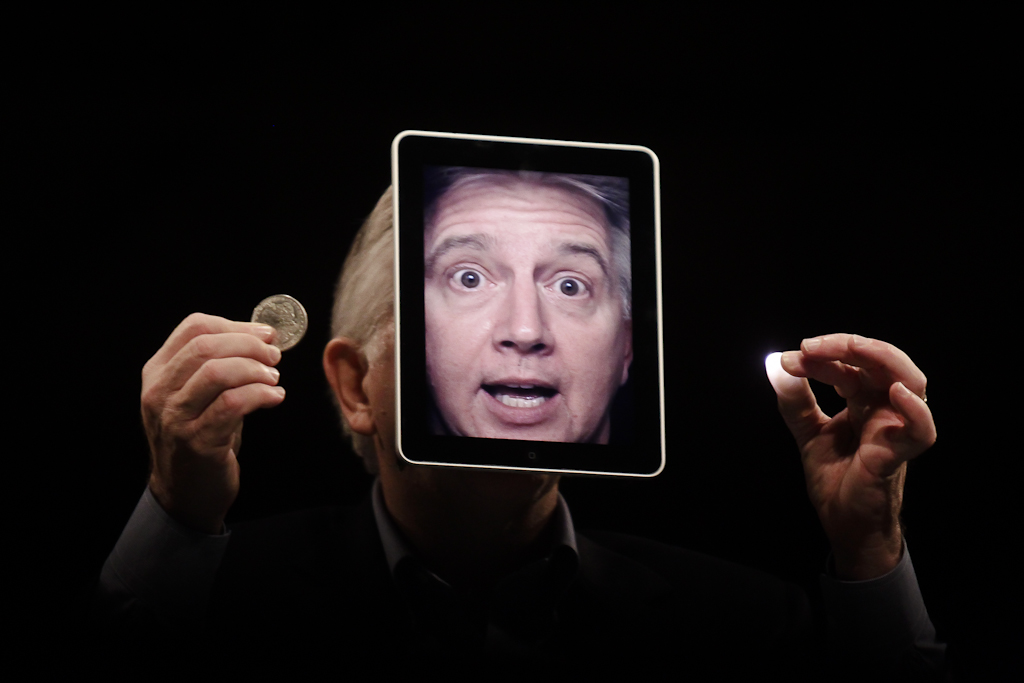
"Blind Love" couldn't possibly be mistaken for a feature film at just six minutes in length, but its theme – how technology has come to dominate our lives – and its kaleidoscope of sublime choreography takes the viewer through an emotional transformation that seems just as effective as it would be a feature. With a little help from an iPad and Tom Waits' classic "Grapefruit Moon," Paul Gertner weaves an unexpected spell of melancholy and longing, detailing one man's inner journey from love to the bittersweet celebration of loss.
I'm under no illusions that this routine was created especially for America's newly minted patron saint of technology. It wasn't. The choreography is far too complex to have been created in a matter of days and the technical preparation seems head-spinning when you start to deconstruct it. Therefore, it seems all the more remarkable and generous to me that Mr. Gertner, who makes his living performing at trade shows on behalf of companies like Apple, took his intimate, hard-won creation and handed it to the memory of Steve Jobs, and he did it free of charge!
Depending on who you are, the name Paul Gertner will either inspire wondrous amazement or utter indifference. Those in the former camp know him to be without a doubt one of the finest sleight-of-hand, close-up magicians in the world, and that's no hyperbole. For the purposes of this article, those in the latter camp sit uncomfortably, indeed, because it is likely they have never had the good fortune of witnessing his remarkable deceptions, whether in person or on television. (The late Johnny Carson, himself an amateur magician, sat in the former camp, having witnessed Paul's work up close and personal on the Tonight Show on three occasions.)
Penn and Teller and David Copperfield – acts who work on a larger scale – get more press because they play to big crowds. By its very nature, Paul Gertner's specialty, micromagic (or table magic), is an intimate and intricate affair traditionally performed sitting down at a table with a skeptical audience surrounding the magician on all sides, scrutinizing his illusions from mere inches away.
While researching Paul's career for this piece, I came across his most renowned creation: an ingenious variation on the well-worn cups and balls routine. In the past, magicians who had mastered this illusion gave themselves an advantage by using felt or rubber balls to make it easier to move them around. (Such balls don't make any noise when you load them under the cups.) But, as you can plainly see in this video, Paul doesn't give himself any advantage; he uses balls made of steel, and the result is thrilling. Take a look.
But, this piece doesn’t seek to burnish the man's reputation; he certainly doesn't need any help from me. I wanted to know how a man like Paul Gertner, a technical sleight-of-hand master, came to create a video as transcendently moving and fascinating as the one you saw above.
So, I called him and we talked about it.
Ken: Thanks for doing this. Talk about this type of performance art – the use of music and emotion in magic. I know David Copperfield does a little bit of this.
Paul: You're right. Copperfield has done a good bit with this angle, these ideas, in terms of using the music and a story. Magicians are always attempting to incorporate a story or emotion into magic […] and I say attempting because a lot of times what magicians tend to do is they base everything on the trick. And if it fools you, that's all there is to it. But there is history of [illusionists] doing that. I'm certainly not the first one to attempt it. But it's not done as often as it should be.
Ken: When you created "Blind Love," did you tell yourself, "I want to move my audience. I want to speak to them in a way that I've never spoken to them before"?
Paul: Yes. In fact, this was designed for a magician audience initially and my thoughts were to confront them with the emotional choice that many performers make. That choice is between people – their relationships and so on – and their art. The initial routine had a different ending than the one we see now. The initial routine was designed to present a performer sitting with a deck of cards and thinking of the woman who he [is in] a relationship with. He had to make a choice between her and the cards. In fact, at the end of the routine, he did make a choice. In the original version, she ended up on the floor. It was a bit of a brutal ending. In the magic world there are magicians out there, very well-known magicians, that have made that choice, and I wanted to confront [them] and [have them] see themselves in that situation and say, “Oh my god. This is about me and [what] choice did I make.” Some magicians have made the same decision to have both, like I did – a career and a relationship. Some chose just the career. Some [have] said the magic just has to be a pastime and that family is more important.
Ken: That comes across in a section of the routine where you are dealing below a picture of your wife. You appear to have a choice between your two loves: your wife and your magic.
Paul: I'm doing at that point what magicians refer to as a “second deal.” It's a gambling technique. You aren't dealing the top card. You are dealing the one under [it]. The second card. Hence the name second deal. I'm [attempting] to grab the woman's photograph and
it is my wife's high school photo, and each time I attempt to, there is a flash on the screen of her image. Finally…I grab the card and the moment it's in my hand, my face on the screen morphs into her image just for a few seconds…and as I set her down she fades away. My thinking [is], what's going on at home? What am I missing by staying on the road? Ken: It does come across.
Paul: Good.
Ken: The way I figured it, about 3 1/2 minutes of this routine is accomplished holding your breath. I read about the…secrecy surrounding the methodology of magicians. Is that something you want to talk about?
Paul: I'm trying to be careful not to reveal too much of the method. Because, hopefully, I'm not going to see too many people picking up and copying the ideas.
Ken: Did Tom Waits' “Grapefruit Moon” reach you in some way? How did you come to pick that one for this routine?
Paul: I had the idea for the act sitting on a plane going from Pittsburgh to L.A. I always wanted to do something with a Tom Waits tune. So, I started going through Tom Waits' music on my iPhone […]. When I hit “Grapefruit Moon,” as I listened to the song, this whole routine came into my head. Within three hours, the exact routine was in my head. That hasn't happened too often. It was kind of a bolt of lightning.
Ken: To be clear, you thought of it in three hours and it took you how long to execute it?
Paul: Yeah, five months to put together. Before I could do it the first time, I had to build it. The little tree [in the video] took a month and a half to build. You don't go into a magic shop and buy one of those. Ken: In this piece, there's plenty of acting on your part – most of it projected onto an iPad. I was struck that this appears to be the perfect metaphor for the way technology has changed the way we conduct our lives. The way we remember. The way we grieve. The way we fall in love. All of it projected into cyberspace. There is, sort of, a digital version of ourselves now that didn't exist 20 years ago. This feeds the idea of dedicating this piece to Steve Jobs, who brought these technologies together that changed our lives.
Paul: I think you’re right on target in terms of this whole idea of projecting our emotions into cyberspace. You see this on YouTube. It's very freeing on some level. I'm not an actor. I'm a magician and I've been taking acting lessons over the last ten years. Most magicians probably view me as more corporate and…business-like. So, when they see me do something like this, it's like – whoa! Where did that come from? For this piece, I was [acting] for a camera that was going to be on an iPad that I can't see. It frees you up to be totally different. It's sort of like an actor [getting into] a role and [letting] himself go. I can't see [the audience], and since I can't see them, I don't pull back in relationship to how the audience is reacting, and I think many times, actors do [exactly that]. In my case, [the performance] is already done. I've done it in my private little studio. Ken: Let's zero in on this. Are digital emotions just as valid as real ones?
Paul: That's where it will be interesting to find out. I don't know. That's the big question mark…whether these digital emotions that I'm doing on the screen are able to connect with the audience. I don't know whether it does [connect] as well over the video. When I've done this act live, it's freaky, because people forget whether it's me [looking] through the screen at them and at the cards or if I'm not looking through the screen at the cards. I've gotten quite a few responses from magicians who have watched this online who have said, "Damn, I was halfway through the routine before I realized that he can't see anything. That's not him looking at me. That's the video." I just had a good friend write me, and he told me, "It's not connecting with me because of that wall there. The video."
Ken: That guy is nuts.
Paul: (Laughs)
Ken: I totally bought into the idea that I was looking at an expression of your digital self. That those emotions were valid. There is a bittersweetness to that performance which really affected me.
Paul: If it does comes through, [it's because] it's an honest performance. I've been through that phone call with my wife many, many times. Fortunately, we're still married. She's put up with a lot – a crazy performer who’s obsessed with magic.
Ken: How many magicians out there – and I'm talking about micromagic performers – how many are doing this kind of emotional storytelling?
Paul: There's a small handful. There's a gentleman named René Lavand from Argentina. Juan Tamariz from Spain. It's an honor to be considered in those categories. These are my heroes. I think it's kind of harder with close-up magic because you're so close to your audience. It's much easier to fool people with a card trick. [Creating a storyline] is much more risky because…you're baring your soul a little bit. When I did this the first time, my feet were shaking […] because it was for a group of magicians in Buffalo, New York at a very exclusive close-up magic convention.
Ken: How long have you been in this business?
Paul: Since 1974.
Ken: Coming up on 40 years. How much of that time have you spent speaking to your audience emotionally, rather then just inspiring a sense of awe through your illusions?
Paul: Unfortunately, sad to say only within the last 10 years. I started working with an acting teacher. I started that in 2001. That opened me up toward being willing to do things a little different. Before that, I was more corporate. Very business-like. My magic was very good technically. My presentation was a bit more one-dimensional, though. I could fool you really bad. But, I wouldn't draw you in as much because I would not expose that much of myself. My magic was almost robotic at times. If I hadn't been exposed to acting class, I wouldn't have been able to come up with this routine.
Ken: You got past 50 and you decided to take more risks.
Paul: You look at things differently. I wish I would have taken acting class when I was 20. The weird thing you have to realize about magicians as performers is they do everything themselves. They write the script. They direct the show. They pick the music. Other performers have directors and composers. A magician is a solitary [profession]. Ken: Talk about how technology affected your life.
Paul: I recently did this act at a TEDx conference [Technology Entertainment and Design] and…I opened up the presentation by showing home movies that were filmed by my father on Super 8 in 1954, 1955, 1956 when I was a one-, two- and three-year-old, and he loved making movies. Do you remember the show Candid Camera?
Ken: Of course, Allen Funt.
Paul: He loved Candid Camera. My sense of reality was distorted at a very young age and in our house nothing was quite as it seemed. My father liked making these crazy, funny home movies with me, the kid, being the butt of most of the jokes. That was what created my interest in this world of magic and illusion. [In the movies] he was basically pulling magic tricks on me, but using editing. He did it with a Bell & Howell camera and a Cathcart editing machine. Today, he would be shocked to discover what I'm doing with an iPad. He wouldn't understand what an iPad was because he died at age 47 in 1969. So, that was the beginning of my experience with technology.
[Note to reader: if you would like to watch Paul's home movies, go here.]
Ken: People are going to say that this trick was built in the editing room with digital effects. I want you to speak to those people directly. I know that's not true because you are completely blind in this routine. They only way to know where you are in the trick is to listen to the music and take your cues from that.
Paul: What you see there is what I'm performing live. Now, obviously, I shot a number of takes in the course of doing the routine. I'm shooting from a couple different angles only to give the best representation of the routine. When I showed it to my brother for the very first time on video, he looked at it and said, "Now, this isn't something you're going to do for anybody live. Right?"
Ken: (Laughs)
Paul: I said, "What do you mean?" He said, "Who did the C.G.I. for you? Who did the green-screen stuff? How are you creating that illusion of your face?" I said, "No, you're watching a live performance." So [there is] no trick photography. If you watch me do it live, that's what you'd see.
Ken: You're considered one of the finest technical sleight-of-hand magicians around. A friend of mine told me that you can force a card behind your back. Is that right?
[Note to the reader: When a magician asks you to "pick a card" as part of a magic trick, he is usually executing a classic "force." The magician has usually picked the card ahead of time, and with various techniques, he can induce you to choose the exact one he wants you to pick.]
Paul: Yeah. (Laughing)
Ken: You can force a card from behind your back!
Paul: Yeah, I can fan out a deck of cards behind my back and ask you reach in and pick a card. I can control what you take and make you feel like you've had a free choice.
Ken: That seems impossibly hard, like learning to read lips or something. Deaf people can read lips but that doesn't make it any less remarkable. This seems amazing to me.
Paul: Without revealing too much of a magic secret, there are certain techniques magicians learn on the fly. You use your audience as guinea pigs and after you've done it for five years, it gets to the point where it becomes natural.
Ken: Let's change course. Why Apple? Did Apple products change your life?
Paul: I bought one of the very first Apple computers in 1981, I think it was. I've had nothing but Apple my entire life. About 30 of them. I love Apple products.
Ken: What about this latest round of technologies? The target [market] is the regular guy on the street [as opposed to the techno-hobbyist] who wants to experience that Jetsons moment.
Paul: I'm fascinated by this new round [of technologies]. In the TEDx talk, I use the Arthur C. Clarke quote, "Any sufficiently developed technology is indistinguishable from magic." I tell my audience, “If today I was able to demonstrate some of the technologies you’ll be using 40 years from now, you’d walk out of the room thinking you'd seen the most amazing magic trick you've ever seen.” The technology we'll be using 40 years from now will be inconceivable to us while we sit here today. When I saw the iPad for the first time, I didn't want to see it right away, ‘cause I didn't want to buy one.
Ken: (Laughs)
Paul: I couldn't afford to go home with another device. I didn't look at it for the first two or three months. And somebody showed it to me and I went out that night and bought one. Because I said to Cathy [Paul’s wife], it's like a [magic] trick. If I went into a magic shop and plunked that thing down on the counter and said, "This is a new trick," I'd pay thousands of dollars for that. I've paid thousands of dollars for [magic] tricks many times that didn't do half of what [the iPad] does. It was just shocking at the time that it was available to the general public.
Ken: What about Steve Jobs himself?
Paul: Yeah. I found him to be an interesting personality to keep an eye on. They say that he wasn't that technically brilliant. But he could envision what people would buy next. He had an interesting mind on him and on some level, it was magical thinking. I'm sorry I didn't get to meet him.
Ken Cancelosi lives in Dallas, Texas and is co-founder of Press Play.

 Makeup effects were always a key component of the movies. Greasepaint, wigs, putty, latex appliances and other items in the makeup master's toolkit helped make the improbable, and the impossible, seem vividly real. Boris Karloff could make us believe that he was a tormented, tragic creature built from pieces of dead men in Universal's Frankenstein films – with makeup by the great Jack Pierce. Pierce's work on The Wolfman made an ordinary man become a werewolf when the wolfbane bloomed and the moon was full and bright. A 25-year-old Orson Welles played the title character of Citizen Kane at a dazzling array of ages, thanks to inventive, at times highly theatrical effects by Maurice Seiderman.
 The 1960s through the 1980s were the high point of traditional, analog filmmaking techniques. Some of the most memorable films from this era showed transformation, decay and violence with unprecedented realism. Some of the most striking makeup effects of this period were the work of one man, Dick Smith, who finally received a special Oscar from the Academy in 2012 after decades of groundbreaking work. Nobody spilled blood with more panache.
 The late 1970s saw makeup effects moving away from realistic applications and moving toward the extremes of fantasy. Christopher Tucker's remarkable makeup for David Lynch's 1980 drama The Elephant Man may have pushed the Academy to start handing out a Best Makeup award the following year. After eight decades' worth of movie makeup effects, and 20 years of rapid technical innovations, to continue ignoring the makeup artist's craft would have seemed perverse. And speaking of perverse….
 The Oscar for American Werewolf signaled that the 1980s – the decade of high-concept blockbusters – would be the golden age of analog makeup effects. When you look back over genre movies from the period – small and big, sensitive and crass, clichéd and innovative – the special effects often hold up surprisingly well. In some cases they're the main reason that people still talk about the movies. Modern makeup effects are slicker and more consistent from scene to scene and shot to shot for reasons that we'll get to in a minute. But, given the mechanical limitations of the pre-digital era, their achievements are still impressive. Even when the storytelling falters, or when the film itself seems less an artistic statement than the end result of a studio deal memo, you can still see the behind-the-scenes craftspeople working at the peak of their powers, always striving to innovate and impress.
 Brad Pitt’s performance is an almost old-fashioned, movie star one. In another universe, one could imagine Jimmy Stewart or Cary Grant taking the part. He brings to the role an assured quality on overzealous, yet understated, lust for ultimate success that was forged in the fires of years and years of failure. He's charming and cheeky and funny, and very good looking (despite the hideous early naughties’ haircut and lumbering fashion sense). Pitt brings a subtle comedic take to what could have been a rather boring central role; his various dealings with other managers, his scouts and players, betray genius-level timing and mimicry.
 [EDITOR'S NOTE: Press Play presents "Should Win," a series of video essays advocating winners in seven Academy Awards categories: supporting actor and actress, best actor and actress, best director and best picture. These are consensus choices hashed out by a pool of Press Play contributors.]

 Luthor’s out of prison (thanks to the absent hero’s failure to testify at his trial) and up to his old tricks, scheming around Metropolis with his thug henchmen, his wiseass gal pal (Parker Posey) and two yippy but vicious little dogs. In Superman’s absence, Lois Lane (Bosworth, swapping stoic warmth for Margot Kidder’s abrasive ’70s kookiness) won a Pulitzer for an editorial about why the world doesn’t need him, and then settled down with Daily Planet colleague Richard White (James Marsden), nephew of publisher, Perry White (a brusque yet warm performance by Frank Langella).
 Where most comic book movies are paradoxically inclined to make their points verbally—bulldozing heaps of raw data in our faces, a la The Matrix movies, Batman Begins and Singer’s own X-Men films — Superman Returns is conceived as a visionary spectacle, a series of mythic tableaus that brazenly liken Superman to Mercury, Jesus, Atlas and Prometheus. It’s a sensory—at times sensuous—experience, modeled not just on great comic book art, but on the crème-de-la-crème of machine-age spectacles: 2001: A Space Odyssey and Close Encounters of the Third Kind. (Warning, that segue means possible spoilers ahead.)




 Press Play Video Blog