A Second Chance for MUD

A Second Chance for MUD

null

Jeff Nichols’ film Mud was just added to Netflix streaming in what I hope will be the film’s second chance at earning the attention and acclaim it deserves. For me, Mud was one of the finest films of 2013 but it was somehow overlooked during its theatrical release. It is difficult to know whether it was a marketing problem, a timing issue, or a matter of the film’s understated artistry that caused it to miss hitting critical mass in theaters. But this soft box office performance does not reflect the fine quality of storytelling in Mud: after my first viewing, I left the theater with the distinct feeling that I had just experienced an American classic.

What was so powerful about this film? And what elements had come to bear on the idea of a “classic” for me? To begin, there is something fundamental in the storytelling—something close to nature. One of the very first scenes of the film is captured from a moving boat so that the pace of the film truly aligns with the rhythm of the Mississippi River, where the tale takes place. Going forward, we see that Mud continues to move like the river, the story unfolding with the same smooth, slow-rolling tension.

This river scene introduces two boys, Ellis (Tye Sheridan) and Neckbone (Jacob Lofland), who are setting out on an adventure in the secret hours of the early morning. The distinctly American spirit of exploration is palpable, and as the boys navigate the foggy river, we recognize the archetype of a great adventure tale beginning. They boys are searching for the island where a recent storm has supposedly landed a boat high in the branches of a tree. The image recalls mythological floods and a sense of folklore, imbuing Mud with that quality of classic storytelling from the start.

What begins as an innocent adventure takes a serious turn when the kids realize that someone is living in the fabled tree-boat. This turns out to be a mysterious fugitive who calls himself Mud (Matthew McConaughey). As the boys begin a friendship with an outlaw on the banks of the Mississippi River, the influences of another classic American tale become clear: writer-director Jeff Nichols has certainly rooted Mud in the mood of The Adventures of Huckleberry Finn. He even had the two young actors study Mark Twain’s novel on set, and the influence is beautifully apparent in the film’s deep sense of adventure and wonder.

Another striking Huck Finn influence—and to me, one that lends Mud that quality of a classic—is the way the story highlights the genius of youthful intuition. The character of Ellis celebrates the intuitive wisdom of the American kid. He is adventurous, perceptive, and resourceful, having grown up steering boats and catching fish. In addition to these good old Southern attributes, Ellis values loyalty and love with such intensity that the adults in his life cannot meet his standards. That is, until he meets Mud, whose fierce devotion to his first love has landed him on the wrong side of the law. And so where Ellis might be “The Great American Kid,” Mud is “The Great American Rebel.” Both characters possess a particular kind of intelligence—the wisdom of the outliers and the outlaws, the children who see more clearly than the adults, the shrewd wit of those raised close to nature. Their characters reflect a value system that fits into the old Southern classics, the tradition of Huck Finn and Tom Sawyer coming of age and evading the law on the Mississippi River.

The film takes place in contemporary Arkansas, but it is easy to lose track of the era while watching Mud. Its raw and natural imagery evokes a timeless spirit, rather than identifying a particular moment. The cinematography engages with the rich textures of the terrain – close-ups of mud and sand, writhing snakes and creaking houseboats. This intimacy with the landscape enhances the old fabled quality of life on the river. Even the acting reflects this natural style. The cast of Mud puts forth refreshingly honest performances. Indeed, six months before his Academy success in Dallas Buyers Club, McConaughey proved himself as a seriously nuanced actor with a neatly restrained performance in this film. Surely his young co-stars encouraged this organic acting style; their intuitive performances—something of that childish genius—seemed to draw a more natural tone of acting from McConaughey and the rest of the adult cast.

And so the acting, too, feels close to nature, in a sense. It fits with the raw and uncontrived essence of Mud‘s story, closer to Southern folklore than a Hollywood performance. In many ways, Mud is a throwback to good old-fashioned storytelling. It takes us back to Mark Twain, back to childhood, back to the rhythms of nature. Now, looking forward, this modern classic gets a second life through Netflix streaming. If you missed it the first time around, Mud is well worth another look.

Kayleigh Butera is
a writer from Philadephia, PA. She is a recent graduate of Brown University,
where she studied American Studies and French language. She worked as the
programming coordinator of Brown’s Ivy Film Festival, the world’s largest
student-run film fest. Kayleigh is currently living in Brooklyn. She can be reached at
kayleigh.butera@gmail.com.
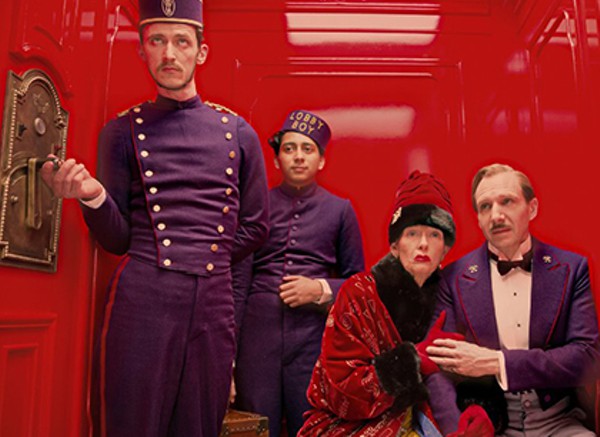
Wes Anderson’s THE GRAND BUDAPEST HOTEL: A Vivid Self-Portrait

Wes Anderson’s THE GRAND BUDAPEST HOTEL: A Vivid Self-Portrait

null

Last week, as I watched director
Wes Anderson take the stage at Lincoln Center to introduce the premiere of The Grand Budapest Hotel, I was struck
by the unusual deep-purple color of his suit. I almost wrote this off as an
inconsequential choice by the famously quirky director. But once the film began
rolling, I realized that Anderson’s colorful attire was actually his subtle
synchronization with the film’s leading character, Monsieur Gustave H. This
character dons the same shade of plum throughout the entire film, and soon I
couldn’t help but see that the similarities between the two went far beyond
their purple garb. The fascinating parallels between Anderson and his leading
man make this film his most soulful and self-reflective work to date.

Anderson’s exploration of this
delightful character gives us a rare glimpse into how the director views his
own world. Gustave (luminously played
by Ralph Fiennes) is the owner of the titular hotel, and his mission is not
unlike Anderson’s as he strives to preserve the particular charms of a world
that is slipping away. Both the director and his fictive concierge create
intricate but impossible worlds in The
Grand Budapest Hotel
. Set in the fictional Eastern European state of Zubrowka,
this pink wedding cake of a hotel is at its peak of grandeur. Gustave directs
the Grand Budapest so that it runs like clockwork, working to maintain its
splendor before it fades and falls with the oncoming war.

With idiosyncratic fervor, Gustave—like Anderson—tries to preserve his whimsical tastes despite the realities
around him. We watch Gustave speed through the halls, fastidious in his duties,
upholding comically high standards. One can imagine a similar eccentricity in
Anderson’s creative work, requiring exquisite attention to detail and
everything just so. Indeed, actors from
Anderson’s veteran cast have described the director’s meticulous production
methods as genius, beginning with his own detailed sketches, animations, and even
a suggested reading list for the cast.

It is hard not to see Anderson as a
sort of innkeeper himself, directing life on and off the set with the same
spirit and extravagant standards as Monsieur Gustave H. In a recent interview, cast
member Jeff Goldblum explained how Anderson’s visionary style pervades the
entire production experience. The director, Goldblum said, “wants to make the
shooting an art project of itself.” He described how the entire cast lived
together in the same hotel during shooting and sat down each night for group
dinners, elaborately arranged by Anderson. This custom aligns so perfectly with
the ethos of The Grand Budapest Hotel,
and seems to be a striking union of character and creator for Anderson.

There is a similarity between the two,
as both Gustave and Anderson hold tightly to their peculiar visions of the
world. For Gustave, this vision is the strange splendor of the Budapest in the
face of an oncoming war. And for Anderson, it is the intricate styling of his
own filmmaking, which stands alone in cinema today. Critics often accuse
Anderson of prioritizing his stylized design over substance, but this film is a
sweet exception to this charge. Visually, The
Grand Budapest Hotel
is as fantastical and charming as ever. But the story
also reaches new depths, with Anderson articulating themes that are richer and
more complex than his earlier works.

Some of that added complexity comes
from the darker and more realistic forces at work in The Grand Budapest Hotel. In past works such as Rushmore and Moonrise Kingdom, the opposing powers take the form of adult
authorities. These professors, parents, and scout leaders may clash with the
protagonists, but they are hardly villainous. This latest film, however, deals
with war, brutality, and a fictional “ZZ” unit that unsubtly recalls Nazi
Germany’s SS. The violence is harsher and the darkness comes closer than usual
for Anderson.

The effect of these forces’ encroachment
on the playful world of the Budapest is a richer story—still the fanciful
world of Wes Anderson, but one that occasionally snaps the characters back into
a meaningful reality. In the same vein, the character of Gustave is not simply
a caricature. He too comes to life with moments of unfeigned grace. We learn
that Gustave is more genuine and deeply relatable than the shiny purple tuxedo
would initially let on.  

One of these endearing traits is
his habit of reciting romantic poetry at length. This meaningful quirk turns
out to be representative of Gustave’s character and, more significantly, of
Anderson’s entire method. As it happens, Gustave consistently chooses the wrong
moment to pause for poetry. He begins forty-stanza poem before dinner, a
dramatic ode while escaping a maximum-security prison, never able to finish his
verses. It is a comical pattern throughout the film, and a fitting one: art
interrupted by a more urgent reality. Anderson portrays exactly this—a world
where there is less and less time for romance, beauty, and whimsy. In spite of
this reality, one man—be it Gustave or Anderson himself—works tirelessly to
uphold the old elegance.

We cannot know how much of himself
Anderson projected onto his leading man, but the resulting film is a triumph.
Anderson is true to his own narrative techniques, and the purple threads that
tie him to Gustave only enrich this: he delves deeper yet into style and
substance, putting a little more of himself into his film.

Kayleigh Butera is
a writer from Philadephia, PA. She is a recent graduate of Brown University,
where she studied American Studies and French language. She worked as the
programming coordinator of Brown’s Ivy Film Festival, the world’s largest
student-run film fest. Kayleigh is currently living in Brooklyn. She can be reached at
kayleigh.butera@gmail.com.