
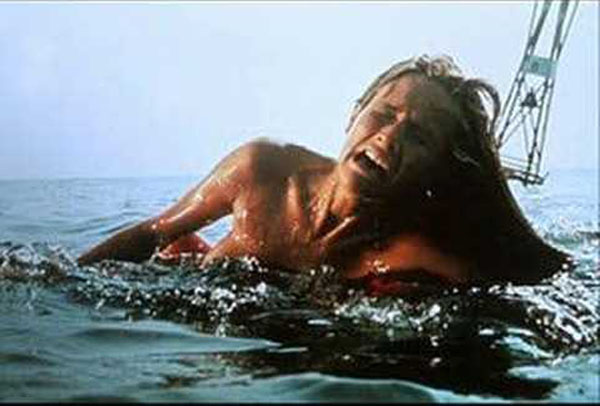

All I really need to know about fear I learned in elementary school. Before I ever saw a horror film, I had acquired an extensive knowledge of the genre’s main visual icons. More vital than any knowledge instilled in our classroom was the information we exchanged at recess, or on the bus. Besides highly confused descriptions of sexual reproduction, the bits of knowledge most eagerly exchanged were meticulously detailed descriptions of horror films. These movies took on legendary status in inverse proportion to the number of kids who had actually seen them. The kid whose irresponsible parents unwisely took him to see The Exorcist might have been psychologically scarred for life, but among third graders he could become, for a time, a kind of schoolyard prophet. When strict parents intervened, someone’s older brother or sister would always be eager to terrify their younger siblings with lurid retellings of the most horrific moments from The Texas Chainsaw Massacre or I Spit on Your Grave. The bearers of this precious knowledge provided me with a rich vocabulary of terror that has stood me well over time.
Horror is a genre founded on suspense, and much of this suspense begins outside the theater. From the commercial end, film studios have created a virtual subgenre of promotional material—from salacious posters to sensationalistic radio and television spots to tautly edited trailers—that is often more satisfying than the films it promotes. Such promotional tools, as much as they might serve the interests of capitalism, are in fact the most recent manifestation of a far older cultural tradition. In earlier centuries, before a circus, freak show, or menagerie came to town, heralds carrying broadsides and placards describing or illustrating the chief attractions would march through town, building anticipation which then spread by word of mouth. More than any other genre, the horror film is the true heir of this carnivalesque tradition, since the sense of anticipation and suspense is so clearly part of horror’s narrative structure. The tension we feel as we wait for a protagonist to find out what’s behind the door is all the more intense when the waiting begins with a trailer or poster image.
 By the time I actually came to see Jaws, I was well acquainted with all of the film’s main events, told with a series of images that rivaled the most lurid frames of a 1950s horror comic. “Oh, man, how about when the woman’s skinny dipping at night! She’s all naked, right, only you can’t really see much ’cause it’s so dark; but anyway, she’s swimming and she sticks one leg up in the air and then it sinks into the water. Then that music starts, you know, da-duh, da-duh, and they show what it looks like underwater and you’re looking up, you know like you’re the shark looking up at her swimming and then you can see a little bit more of her nakedness but then they show her face, and she, like, disappears for a second, like she’s pulled under. Then it happens again and she starts screamin’. Then, oh man, she starts jerkin’ around, this way and that way, and then she slides way over until she smacks into this buoy, and then you’re like, oh man she made it, but then, no, she gets pulled off again and dragged around and then she’s, like, totally dead.” To an eager audience of children, this is not a spoiler: it’s an appetizer.
When I finally got to see the film for myself, my enjoyment of these and other foretold moments was actually enhanced by the verbal previews. Although I was an avid and attentive viewer, I have to admit there were things I might have missed had I not been fully prepared to appreciate them. My classmates astutely noted, for instance, not just that the sailing coach’s leg sinks to the bottom, but that it is cut off just above the knee, that a cloud of blood seeps from the ragged flesh where it was cut off, and, most importantly, that “it still had its sneaker on, can you believe that?” Another classmate took time to notice that, shortly before the Kittner boy is devoured, accompanied by “a huge, like, air bubble of blood,” a boy throwing sticks into the water for his dog suddenly notices that the dog is missing. Once I became a supposedly more sophisticated filmgoer, I marveled at the virtuoso dolly zoom effect that accompanies Chief Brody’s horrified realization of the shark’s attack. But without the guidance of a perceptive schoolyard critic, I might have overlooked that poignant detail of a boy calling into the sea for his lost dog.
Over the years our visual vocabulary grew. Piece by piece, our anatomy lessons added “spinning heads,” “still-beating hearts,” “guts spilling out,” “guts being eaten,” “guts on the floor,” “guts hanging from a hook,” “green puke,” “face melting off,” “eyes popping out,” “drill going into his forehead,” “arms reaching out of the grave,” “head on a stick,” and the one that confused me as much as it horrified me, “masturbating with a crucifix.” Every slight variation on the general theme of dismemberment and penetration was told in meticulous detail. Linda Blair’s head didn’t just spin around in The Exorcist, it turned slowly to the right, like she was looking away from the priest, and then turned slowly around to the sound of bones cracking and then completed the turn and snapped into place. Her puke wasn’t just green, it was green like the color of Apple Jolly Ranchers. What is most remarkable about such descriptions is how little exaggeration was involved. Children are generally known as tellers of tall tales, but when recounting scenes from horror films, they were as anatomically precise as forensic pathologists, as closely attuned to performative nuances as anthropologists in the field, and as keenly attentive to subtle variations of color, light, and shadow as art collectors.
Those who experienced such schoolyard exchanges know that there was nothing especially cruel or violent about them. Scenes of graphic violence were recounted not with sadism but with a sense of wonder. By describing such images, we were bearing witness to how strange and awful the world could be: not awful in its contemporary sense, but in the more archaic sense of awe-inspiring. By telling one another about these things, we strengthened our sense of community and kinship. Iona and Peter Opie have gathered an extensive record of what they call “The Lore and Language of Schoolchildren,” noting the infinitely rich continuities and variations between the kinds of songs, rhymes, chants, and stories children have told across generations. From them we learn that, long before children were describing grotesque scenes from horror films, they were chanting lines like “Tell tale tit, / Your tongue shall be slit, / And all the dogs in the town / Shall have a little bit.” Invoking such violent imagery doesn’t beget violence: it’s when we lose the sense of community and camaraderie such imagery fosters that we become sad, angry, and, sadly, sometimes terribly violent. Behind most school shootings is a story of alienation and loneliness.
 My classmates weren’t simply discussing films when they described them at recess: they were engaging in a form of storytelling as old as oral culture itself. Like the folk tales recorded by the Brothers Grimm and others, these narratives were structured around horrifically vivid images. Folklorists have recorded infinite cultural and ethnic variations on the meme we know as “Little Red Riding Hood,” but they all have one element in common: a catechism between a child and a disguised monster that progresses from innocent “big eyes” to suspiciously “big ears” to terribly “big teeth” that threaten to “eat you up.” The protagonist might be a little boy in one version, a girl in another; the victim might be eaten and then cut out of the wolf by a huntsman, or she might outwit the wolf and escape; the moral of the story might be that we shouldn’t stray from the path or talk to strangers, or there might not be any moral at all. Every element of the story can be changed but not the progression from eyes to ears to teeth that can eat you: these words distill what is perhaps the most fundamental experience of horror any of us ever have.
Jed Mayer is an Associate Professor of English at the State University of New York, New Paltz.

 Stanley Kubrick’s The Shining is not generally considered a family picture, but it is certainly one of the most brutally honest films ever made about the nature of family relationships. I discovered this when seeing the film for the first time with my father when I was fourteen. My father took me to dozens of R-Rated films when I was growing up, which reflected, I think, his trust in my maturity rather than any negligence about what was morally appropriate for children (though there was some of that too). Many of my fondest memories of my father involve going to the movies, and going to R-Rated films was something we usually did together, without my Mom or my sister. For two guys who hated sports, this was our equivalent of playing catch. We’d seen plenty of horror films together, but I never anticipated that a horror film would hit quite so close to home as The Shining.
 We learn during Jack’s interview that the Torrances have just moved to Colorado from Vermont, but it is not until a pediatrician is called in to check on Danny after he experiences a blackout that we learn more of the details of their past life. During this interview the camera focuses on Wendy, as she awkwardly describes to the doctor how Jack once dislocated his son’s shoulder in a fit of drunken rage. The violence of the event is masked by Shelley Duvall’s nervous smile and chirpy voice, her forced cheeriness deflecting the viewer’s empathy. The alleged “happy ending” to the story, that Jack quit drinking as a result of this incident and hasn’t had a drink for five months, is further undercut when we shift from Wendy’s face to that of the doctor, who looks frankly horrified. The camera resumes its deep focus, isolating Wendy from the doctor by framing them on either side of a series of bookshelves with the books arranged in a nervous zigzag. While today we might expect a call to Child Protective Services, in the world of The Shining such confessions only serve to further isolate the family.
 Several years ago, I was delighted to discover how well The Shining works as a Christmas ghost story, when my wife and I were spending the holiday with her family. After Christmas dinner we got into a conversation about times when we’d been snowbound, and this led us gradually to a discussion of Kubrick’s film. We reminisced on favorite scenes while sipping hot toddies, until we all agreed that watching this would be much more entertaining than our traditional viewing of A Christmas Carol. Just as the cold outside makes the warmth inside more welcoming, so the vision of a family tearing itself apart onscreen makes one feel closer to the family on the couch. Jack Nicholson’s malignly comic performance provides just the right sense of dangerous hilarity, heightening the sense of camaraderie, and the whole family can cheer at the end as Danny ingeniously escapes his father’s pursuit and reunites with his mother. It’s easy to forget, but The Shining actually does have a happy ending.
 The film has become a family tradition for us, but underneath the sense of kinship and connection with my in-laws that the film seems to foster, are more disturbing family memories. Like Jack Torrance, my father was an alcoholic, and several scenes in the film capture the experience of being the child of an alcoholic better than any film I know. In particular, I find especially troubling the scene where Danny quietly enters the chamber of his sleeping father to retrieve his toy fire engine and finds his father sitting awake on his bed. In a kind of narcoleptic daze Jack calls Danny over for a little talk. As disturbing as is Jack’s affectless attempt at speaking on a child’s level, what most troubled me about this scene when I first saw it with my father was the benumbed wariness of Danny’s responses to his father’s affection. What is most unsettling about being the child of an alcoholic is the sense of uncertainty: I never knew which version of my father I was dealing with from night to night, and this is what I saw in Danny’s response.
 I have always been drawn to visions of the future, but little did I know what brutal images were held on the Beta videocassette of Stanley Kubrick’s A Clockwork Orange I rented at the tender age of ten. Although the film had been banned in Great Britain, it was shelved innocently in the science fiction section of Johnny’s TV, and no one would have thought of suggesting that this might be inappropriate viewing for a child. By the time I reached the infamous scene where Alex and his droogs violently assault and rape a woman while forcing her husband to watch, I knew that I had crossed some indefinable line and that I couldn’t turn back. Later, wondering what had led me to this most disturbing of film experiences, I realized that it had all started with a filmstrip.
  Such primitive media technologies have a distinctive charm that, like Czech animation or natural history dioramas, is indistinguishable from their premature obsolescence. There is something poignant about the notion of watching sequences of still images in an age of television and film. I remember settling into the experience of viewing these slow-moving narratives as into a kind of meditational trance, broken occasionally by the pitch bend and warbling of stretched cassette tape. How fitting, then, that this peculiar medium would be the means of introducing me to the strange world of early electronic music.
 Seeing the horrific rape scene in the film left a similarly indelible impression on me, and proved to be as effective an education in the immorality of violence against women as the education the film’s protagonist experiences as part of his aversion therapy. This scene remains the image that comes to mind whenever I hear the word rape, and it gave me an early, brutal understanding of the uniquely sadistic and degrading nature of this act. If prostitution can be glibly referred to as the oldest profession, then surely rape is the oldest crime. Ironic, then, that the film I had hoped would take me into an imagined future ended up exposing me to the primitive and the barbaric.
  As a teenager I would return to the film, drawn to the stark images of a retrogressive future that seemed closer than ever. I later learned that most of the film was shot, not on sets, but in actual London settings, including Thamesmead, one of many planned urban communities of the 1960s and 1970s that produced scenarios not unlike that presented in Kubrick’s film, when families experienced traumatic feelings of disorientation as they relocated to blocks of buildings that had little in common with the neighborhoods they’d grown up in. What was an unpleasant reality for many Londoners became for me a kind of stark fantasy image, one on which I gazed obsessively in its various permutations, as seen on album covers and music videos produced by a new wave of electronic artists, like Gary Numan, John Foxx, and The Human League, composing pop music for a dark future.
 Though I still deplored the violent acts of Alex and his mates, A Clockwork Orange resumed its earlier place among my obsessions. As with Alex, the film’s earlier aversion therapy didn’t take. Perhaps that’s because none of us experience only one form of social conditioning. While Alex is given nausea-inducing drugs meant to establish negative associations with the violent images on screen, his therapists clearly underestimate the staying power of his previous conditioning.

 The most innovative of the Carpenter-Howarth collaborations, however, is certainly Halloween III: Season of the Witch (1982), a soundtrack whose brilliance is in inverse proportion to that of the film it was created to accompany. The Halloween sequels ran out of steam earlier than most slasher franchises, beginning with Halloweeen II (1981), a film that, under the direction of newcomer Rick Rosenthal, indulges in the kind of exploitative violence of Carpenter’s imitators while largely eschewing its precursor’s blend of subtle suspense, humor and horror.
  The soundtrack of Halloween II is a true sequel to its predecessor, consisting largely of elaborate variations on Carpenter’s original, facilitated by Howarth’s vast analog synthesizer battery. Halloween III, on the other hand, offers fresh, new compositions that capture the bleakness and pessimism that lay just underneath the brightly painted surfaces of the early Reagan era. While the film itself presents a weak satire on commercialism through its story of an evil plot to control and kill children with a sinister line of mass-produced Halloween masks, the soundtrack presents a grim version of the shiny dance-pop and adult contemporary-friendly synthesizer music increasingly dominating American airwaves. “Chariots of Pumpkins,” as its title suggests, is a nightmarish take on Vangelis’ hugely successful theme to Chariots of Fire (1981), while more driving tracks, like “First Chase,” capture the darkness hovering at the edges of MTV hits like the Eurhythmics “Sweet Dreams” and Yazoo’s “Don’t Go.”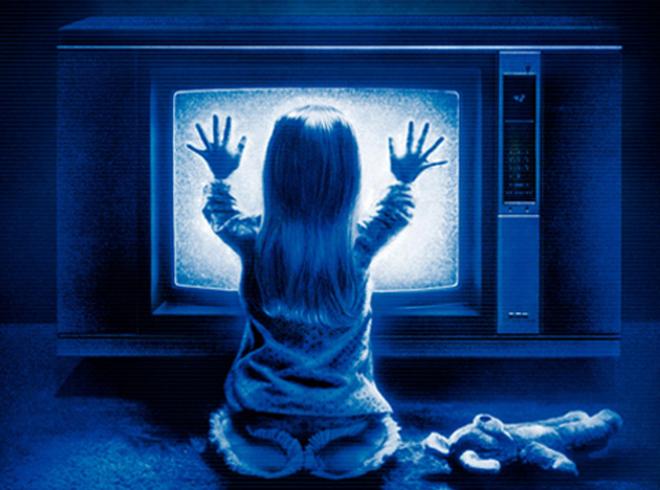
 Most responsible parents will tell you that using the television as a surrogate nanny is bad for kids, but my own experience as a child would argue against this. My parents were wise enough to know that they couldn't raise me alone, that there were some places in the child mind that parents shouldn't go, and the only reliable guides were creatures of the night.
.jpg) Watching the Universal films now, I am as aware of their flaws as of their flickering moments of brilliance. Carl Laemmle’s productions suffered from the curse of the early “talkies,” lamely interspersing arresting visual drama with perfunctory drawing room chat, light romance, and insipid comedy. But to paraphrase Norma Desmond: the monsters are big, it’s the pictures that got small. What struck me as a child watching these for the first time, and what still amazes me, is the concentrated power of character evoked by Karloff, Lugosi, and Chaney. The dead stare, wild arm movements, and disconcerting forward lurch of Karloff’s Creature have become iconic, and while they are easy to imitate, as I would come to learn by donning a “Frankenstein’s Monster” costume the following year, there is nothing quite as compelling as the real thing.
Watching the Universal films now, I am as aware of their flaws as of their flickering moments of brilliance. Carl Laemmle’s productions suffered from the curse of the early “talkies,” lamely interspersing arresting visual drama with perfunctory drawing room chat, light romance, and insipid comedy. But to paraphrase Norma Desmond: the monsters are big, it’s the pictures that got small. What struck me as a child watching these for the first time, and what still amazes me, is the concentrated power of character evoked by Karloff, Lugosi, and Chaney. The dead stare, wild arm movements, and disconcerting forward lurch of Karloff’s Creature have become iconic, and while they are easy to imitate, as I would come to learn by donning a “Frankenstein’s Monster” costume the following year, there is nothing quite as compelling as the real thing.  In the days before VCR, it was easy to forget the less compelling qualities of uneven horror classics. But one could experience their most arresting images repeatedly through grainy photographic reproductions in magazines like Famous Monsters of Filmland, Creepy, and Fangoria. These were the pulps of my youth, their garish covers splattered across drugstore and supermarket magazine racks across suburbia. The amount of time I spent gazing at still images of movie monsters dwarfs the time spent watching moving images on the television screen. Thanks to a series of Revell model sets, children of the sixties and seventies were even able to experience these creatures in three dimensions, and in painstakingly painted color. Monster magazines and model sets formed the youth culture of many of the great horror film innovators of the seventies, a point emphasized in Tobe Hooper’s Salem’s Lot (1979), whose youthful protagonist, Mark Petrie, adorns his room with posters and hand-painted models of the classic movie monsters.
  These figures have an undeniable charisma, a glamour that attracts while it repulses. It is an effect I had become familiar with from book illustrations to the Grimm’s Fairy Tales and other nursery chillers. I cherish having grown up with books as physical objects: an octavo or quarto tome can be haunted in ways a Kindle cannot. One particular image comes to mind, from Brunhoff’s Babar the King, which depicts, in a two-page spread, a horrific nightmare suffered by the elephant hero. I believe I gazed at this image more often than any other illustration from my childhood library, but each viewing involved a prolonged ceremony, as I worked up the courage to open the page, gripping the covers to shut the book quickly if the excitement became too much. This tense and awestruck mode of viewing is the essential posture of visual horror, one I would repeatedly resume in watching films as disparate as Dracula, Polanski’s Repulsion, Hooper’s The Texas Chainsaw Massacre, and Cronenberg’s Dead Ringers.
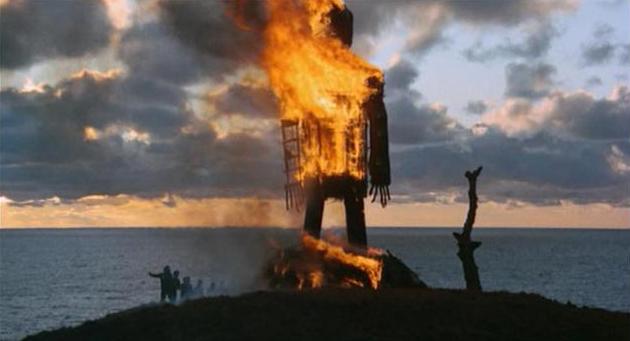



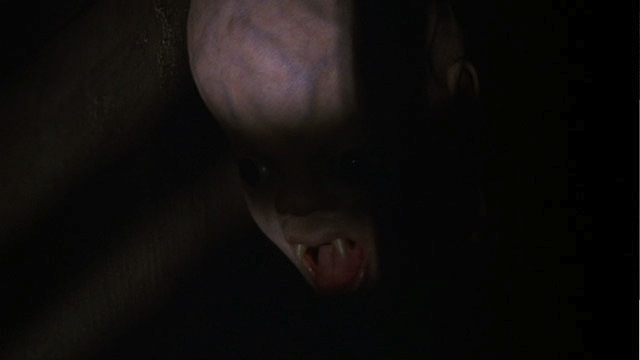
 It started with a poster. Amidst a field of black stands a Victorian basinet, its quaint domesticity rudely marred by a fleshy, twisted claw hanging ominously over the side. I stared at this disturbing image for weeks as it occupied the “coming attractions” window of the St. Croix Mall Theater, a cinder block “two-plex” in a Minnesota suburb. In the bygone America of a Ray Bradbury story, impressionable youngsters would be drawn to similar posters announcing the imminent arrival of a travelling fair or circus. In American suburbs of the 1970s, we had low-budget, grainy horror movies, which I believe were every bit as magical and transformative as the wonder-shows of old.


 For many filmgoers, seeing their first horror movie is a rite of passage: mine came at the tender age of six, on our first family visit to the drive-in to see The Satanic Rites of Dracula (1973). Though I imagine I must have been scared, what I remember most from the experience was getting out of the car when we returned home, and looking up at the moon, which now held a newly ominous sense of enchantment. Contrary to the prohibitive logic of our ratings classification system, horror films, like fairy tales and märchen in an earlier era, can and do provide young minds with a visual vocabulary for structuring imaginative experience.
 When Michael visits a blind old fortune-teller and her starry-eyed granddaughter for advice on how to cope with the increasing absence of his beloved older brother, Jody, for example, the old crone subjects him to a fear-test copped directly from Frank Herbert’s Dune. This is the first of several hints that the gothic horror mode in which the film begins will point towards other genres. The intermingling of horror and science fiction (not to mention 1970s interior decorating) is nicely encapsulated in the set of Michael’s bedroom, where we see him covered in an orange and brown afghan, slumbering beneath a wall-size poster of NASA’s famous “Earthrise” image. The camera cuts to another image of Michael’s bed, now in a graveyard, as the earth around him suddenly erupts and he is covered by a host of corpses who seem to draw him beneath the earth. These are the things alienated kids obsess over, and hence it makes sense that these would shape the dream life of the main character.
  But the interweaving of narrative conventions in the film is not merely playful: as the film slowly unveils its science fiction underpinnings, it begins to explore fears and anxieties that haunt the borders between genres and the ways those genres reflect our imaginative perception of the world. In one of the most sensitive readings of the film, John Kenneth Muir
  While loss and mourning are certainly keynotes of this often surprisingly poignant film, the science fiction story which lies at the heart of the mystery that is Morningside Funeral Parlor will direct our attention, and our fears, towards what is perhaps an even more traumatic part of growing up: getting a job. Imagined through the dreaming mind of our protagonist, this fate takes the form of an outlandish conspiracy theory: the Funeral Director, referred to only as the Tall Man (Angus Scrimm), turns out to be an emissary from another world, sent to retrieve reanimated corpses who will serve as slave labor on a distant planetary wasteland.
  What cannot help sounding ridiculous when summarized in a few words takes on a horrifying vividness in the film, largely through the working details of this zombie slave industry. Michael, Jody, and Reggie eventually meet in a glowing white room filled with three-foot canisters complete with ventilation holes revealing the dwarf workers trapped within. These transport cases uniformly line the walls in a grotesque image of efficiency. In the center of the room stands a two-pronged gateway into the destination world, which Michael briefly passes through, to hover over an eerie red desert on which a long line of forced laborers march towards a distant horizon. After being rescued from the portal, Michael describes his vision to his brother and friend, and works through the infernal logic of what’s been going on up at Morningside: “Slaves. They're usin' 'em for slaves. The dwarfs. And they got to crush 'em 'cause of the gravity. And the heat. And this is the door to their planet.” Where once the protagonists feared death at the hands of the ominous Tall Man, they are now faced with an even more horrifying life-in-death that resembles a grotesque dream version of that forced labor politely termed a “career,” looming just over the dwindling horizon of youth.
 In contrast to this envisioned slavery is the characters’ earlier life, which seems to consist largely of tradin’ tasty guitar licks on the front porch, tinkering with Jody’s muscle car, drinking Dos Equis, slinging ice cream, getting laid in the graveyard, spying on an older brother getting laid in the graveyard, and pursuing paranormal mysteries on a mini-bike. The film, like many low-budget horror films of the period, seems to take place in a land where it is always late summer, the streets are strangely deserted, and the parents strangely absent. The disturbing mystery that eventually engrosses our youthful heroes emerges through Michael’s binoculars as he witnesses the Tall Man lifting a casket with his bare hands and loading it into the back of his hearse. In one of the film’s delightfully dumb but idiomatically pitch-perfect conversations, Jody responds: “You’re crazy. I helped carry that sucker myself. It must have weighed over five hundred pounds. Well, I can’t figure this thing out. But I do know one thing: something weird is going on up there.” Later, when Reggie boastfully proposes a plan to “lay that sucker out flat and drive a stake right through his goddamn heart,” Michael replies in the film’s rich period vernacular, “You gotta be shittin’ me man: that mother’s strong.” And indeed he is.
 Press Play Video Blog