

Later
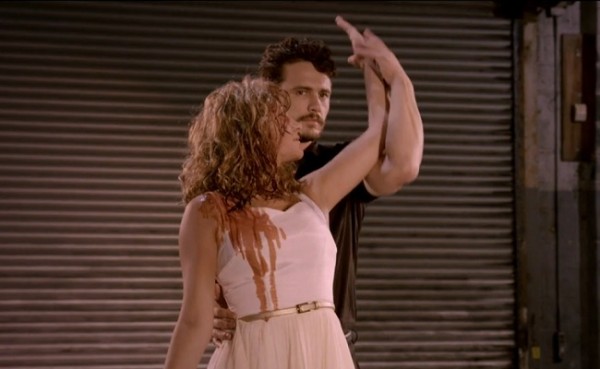
this year, Hollywood superstar James Franco will come out with a new film whose
animating concept is so confusing it takes an entire article to explain and
contextualize it.
Here’s
what happened: a few years ago, Franco listened to some songs by The Smiths to
help him write poems that he later compiled into a poetry collection entitled Directing Herbert White. He then turned
those Smiths-influenced poems back into Smiths- and poetry-influenced songs. He
then gave those songs to high school students in Palo Alto and asked them to
translate the songs into a third creative genre—cinematic screenplay—and based
on the resulting screenplays, he and his band Daddy (yes, he has a band) wrote an
album’s worth of new Smiths-, poetry-, and screenplay-inspired songs. The
student screenplays have now been produced, and, with the aid of songs by
Daddy, comprise a film called Let Me Get
What I Want.
You can watch the first music video to emerge from this project here.
The
upshot here is that Franco has engineered a compositional process that mirrors the
way culture moves in the Internet Age: from one genre to another, with each
successive genre translating (and also mistranslating) the same source material
in its own way. The best part is that not only is Franco letting us see the
results at each stage in the process, but his “final” product—a film and its accompanying
soundtrack—offers us both listenable music and watchable film, making it not
only a suitably complex concept-driven artwork but also a likely entertaining
one. If avant-garde literary artists and filmmakers are pissed at Franco, as
they usually and currently are, they have a right to be—but only because Franco
has a (to them) unimaginable budget, not because the ideas Franco is working
with are subpar. They’re not subpar; frankly, they’re pretty great. It’s not a
popular thing to say, but it’s not a difficult position to defend. If the late
novelist David Foster Wallace once criticized the American postmodernism of the
1980s and 1990s as “hellaciously un-fun,” and in doing so prophesied the
imminent demise of postmodernism (and its poster-child irony) as a generative
cultural paradigm, young artists like Franco have taken the hint and begun
producing avant-garde art that’s at once cerebral and a visceral delight.
In
lauding Franco as I do here, don’t misunderstand me: plenty of writers and
filmmakers are coming up with ideas just as good as Franco’s, they’re just not
coming up with as many of them all at once, and in so many different genres,
and all while living a life in the public eye that’s equal parts “hounded
celebrity” and “pariah for every disappointed artiste-cum-barista from Seattle
to D.C.” Those who hate Franco’s art, and the (to them) obscure motivations
that drive its production in such copious volume, are the sort of artists who have
always hated those who step outside anticipated roles. These artists often find
ways to double down on the status quo without seeming to be doing so—they
maintain their bohemian street cred even as they strangle in its crib any
audacious innovations in art. In the end, though, Franco’s critics are
profoundly misunderstanding what they’re critiquing. They believe themselves
superior to Franco as artists if they can (variously) write a better screenplay
than Franco, write a better poem than Franco, and so on—when in fact Franco’s
creative persona has nothing to do with quality per se, and everything to do with the new byword in the arts:
interdisciplinarity.
Franco
masterfully
coordinates multiple genres, discrete disciplines, and disparate
resources in a way the
rest of us can’t, not only because we’re poorer but because, generally,
we’re
not as smart or creative as Franco is within his own context—that
context being
a life of limitless resources, staggering visibility, and a restlessness
that
many celebrities deal with through moral sloth or gestural
charity work. While it’s true that much of Franco’s smarts and
creativity are
attributable to him being wealthy and famous enough to know and
collaborate with some very smart and talented people, even here we must
say
that the ability to aggregate talent is both rare generally and
vanishingly
rare among the Hollywood elite—even as it’s perhaps the most critical
skill an
artist can possess in our present age of collaboration and
intertextuality. Postmodern dialectics have given way to metamodern
dialogue, and Franco knows it.
In
other words, given his local and cultural contexts, Franco is, conceptually
speaking, hitting the ball out of the ballpark nine times out of ten. His
projects, both Let Me Get What I Want
and its immediate predecessors,
are conceptually astute even when (sometimes particularly when) they fail as
individual artworks. Is Directing Herbert
White a particularly good book of poetry? No. Is it any good at all? Not
really, at least if we judge it using conventional standards of craft, form,
and imagination. But the concept behind the book, that being to have a famous
person unabashedly write earnest poems about what a celebrity’s life is
like—which, judging from American culture, is all anyone wants to know about
celebrities anyway—is ingenious in its way. We didn’t get that kind of fan
service from Jewel, or Billy Corgan, or Leonard Nimoy, or any of the other
Hollywood darlings who’ve decided to try their hand at poetry. Franco writes
poems entirely responsive to who he is to us as well as who he is to himself,
and in making that difficult and perhaps unintentionally selfless decision he’s
exhibited a sensitivity to context which, surprisingly, even today’s most
multi-generic artists seem to lack. Indeed, American poetry—by way of
example—has repeatedly made national headlines over the past couple years for
its brazen commitment to giving exactly no one in America what they want, for doing
almost nothing to write verse that reflects the culture in which it’s being
written, and meanwhile—on top of that—for arguing loudly about how it’s
preposterous to expect it to do otherwise. Franco has made a different
decision, and in the context of his cross-generic career it’s clear that that
decision was motivated by the actor’s artistic vision rather than financial
gain. Franco doesn’t need the cash, after all.
It’s
time
for the Franco hate to stop. Viewed at the level of a career rather
than
on the level of individual artworks, Franco is Hollywood’s most
interesting,
daring, and multi-faceted artist. Hating on him is not only easy to do
but also
easy to justify as coming from a protective instinct—that is, the idea
that the
arts must be protected from the intrusion of dilettantes like Franco. In
fact,
the anti-Franco madness is as retrograde, conservative, and reactionary
as any
inclination we find in the arts today. It says that not only should we
all stay
within our generic and subcultural boxes, but that delivering
anticipated
results is always preferable to displaying uncommon (even if only
intermittently winning) daring. In fact, the reverse is true, a premise
for
which Franco is the poster-child. In light of the age we live in, and
the
explorations of genre and how artists live and interconnect that should
be
happening right now across all genres, the truth is that James Franco is
as intelligent and creative as any of his peers, and perhaps much more
so.
Seth Abramson is the author of five poetry collections, including two, Metamericana and DATA,
forthcoming in 2015 and 2016. Currently a doctoral candidate at
University of Wisconsin-Madison, he is also Series Co-Editor for Best American Experimental Writing, whose next edition will be published by Wesleyan University Press in 2015.

 Press Play Video Blog