TRUE BLOOD RECAP 3: WHATEVER I AM, YOU MADE ME

TRUE BLOOD RECAP 3: WHATEVER I AM, YOU MADE ME

This week’s True Blood suffered a bit from Game of Thrones syndrome—too many people, parts, and ideas for all of them to properly register—but boy howdy were they mostly fine, fun and full of portent of freaky things to come.

nullAlthough the Season Five hot topic is vampire politics, the stories that gave off the most emotional heat belonged to Tara (Rutina Wesley), Jason (Ryan Kwanten) and Pam (Kristin Bauer).

““Whatever I Am, You Made Me” opens with Tara doing the full Terrence Mallick (!) as her enhanced vamp sense connects her to nature, the stars and the galaxies beyond–before hunger guts her.

Enraged with Sookie and Lafayette for not letting her rest in peace, she turns to Merlotte’s and Sam (Sam Trammell) who feeds her a six-pack of True Blood before she passes out.

Vampire Tara is all about wonder and rage, confusion and hyper vigilance. Wesley is killing false accusations of limited thespian skills. Pre-vamp Tara was two notes: terse and bitchy. I’m loving how she does nothing eerily, how she’ll perch on a table and not watch Sookie so much as scan her.

Ryan Kwanten is also developing as an actor as Jason slowly learns why he’s Bon Temp’s automatic sex machine.

This isn't a pretty process. It starts when he meets his old high school teacher at the grocery store. In a disturbing child's voice, he says, “I remember everything you taught me.”

They have sex. But with the phrase “statutory rape” in my mind, I watched Jason realize his high school teacher’s prior predatory acts have left him scarred and left with a sad brand of compulsive sexuality, with “a hole inside I fill with sex.”

But then Jason meets up with Jessica (Deborah Ann Woll) who, in a lovely, soft scene, realizes that the last thing Jason needs is bodily intimacy. So Jessica flips off her sexy supernatural energies, and insists, strongly and intuitively that what’ll fix what’s ailing him is that he stay puts while she throws on a sweatshirt and grabs them both a beer. That is, even as an eternally teenage vampire, Jessica still has killer native nurturing skills to spare and we’re remanded that True Blood is mostly about one thing: female power.

In just this episode, we’ll see Sook use her fairy light burst to kick Pam’s ass when she fails to perform her maker’s duties with Tara.

We’ll imagine the portent of the powers of Salome (Valentina Cervi) which are literally Biblical. And see Tara’s unguided powers screw her up. The focus on female power both natural and supernatural is more repetitive than an old house beat and has been going on in endless iterations for four years now, enough to where you’d think Rolling Stone and other mass organs would have regular “Women of True Blood" issues.

Oh, how we dream. Anyway. Down in the chambers of the vampire Authority, Roman is dealing with the problem of what to do with Bill (Stephen Moyer) and (Alexander Skarsgård) and the news that Russell Edgington (Denis O'Hare) has somehow broken out of his cement grave.  

Russell Edgington, who as we all recall, is the 3,000 year old psycho-vamp who once ripped someone’s heart out on live TV, and has now somehow escaped from being buried in a few tons of cement by Bill and Eric.

In the first iteration of something we’ll hear several times, Roman explains that the only thing that will help vampires beat the insane Fundamentalism of a “Sanguinista” movement that believes in a future where all humans are farmed for food is ‘mainstreaming’, or simple co-existence with humans.

Russell Edgington, he bellows, is “the poster boy of the anti-mainstream movement . . . it’s Osama Bin laden.”

Bill promises that he is a firm anti-fundamentalist. Eric, who’s totally not into politics, kind of shrugs his agreement.

After this little chat, fans of Veronica Mars get to see Tina Majorino again playing a techie who in this case straps harnesses on Bill and Eric that are like GPS’s that blow you up. Eric: “How’s this work?” Tina Majorino: “There’s an app for that.”

What’s remarkable about this season so far is how peripheral Sookie’s been. Later, after she admits to Alcide that she did indeed kill his ex-wife—which as you’d expect, pisses him off a bit—you could have extracted Sook from the episode and lost nothing.

Especially when we get a whole lotta Pam circa 1905, San Francisco. As a whorehouse madam reaching the twilight of her years as a viable sex industry product. And yes, Bauer adds just enough vulnerability for us to buy the idea that this is Pam from over a century ago and not so much as to ruin the character’s flinty credibility.

The scene also shows Eric meeting Bill for the first time, and of course Bill’s being impossibly, annoyingly gallant.

When Bill’s gone, she explains the uselessness of an aging woman, and begs Eric to change her into a vamp.

In one of the episode’s best lines, Eric says that ‘making’ a vampire is an eternal responsibility. “Would you toss a new born baby in the gutter?” he asks, and we can’t help but think of Pam and Tara.

Pam ends the conversation by slashing her wrists—vertically, of course. “Let me walk the world with you, Mister Northman,” she says, “Or watch me die.”

America swoons as Eric’s fangs pop.

Meanwhile, back at vampire Authority HQ, Salome takes Bill for a seductive walk. She is the Salome, Daughter of Herodias, the Seven Veils, all that, and “from a seriously fucked up family,” she quips.

Of course, lost girl stories are catnip for our Bill. When she practically begs for a reason to trust him, he finds it under his zipper.

Then, after taking a shower, one hopes, she plays Eric.

The best way to Eric’s heart is through his maker, Godric. So she goes there before seducing him.

Bill and Eric meet later and realize they’ve been played but why . . . why?

We get another good teaser from the kitchen at Merlotte’s. It’s Lafayette, suddenly pouring bleach into the gumbo, looking into the mirror and he’s wearing Jesus’ demon-face. (Which freaks him out but cheers me up: Jesus will return!)

Then we’re back to Authority HQ, but a deluxe bedroom that looks like the swankest W Hotel room ever. It’s Roman’s private chambers, and Salome, who’s been a very busy girl today, is very naked because this is HBO.

Salome assures him that neither Bill nor Eric is Sanguinista.

And then Roman goes through the mainstreaming vs. Fundamentalism discourse as if this were broadcast TV before the Internet and major plot points had to be repeated endlessly.

The up side is Mr. Meloni sans shirt is a pumped and ripped side of quality beefcake.

He purrs to Salome, “You’re my secret weapon” which, when purred to someone out of the freakin’ Bible, is worth considering—or not. At this point, we don’t know just how far Ball is willing to go with his trashing of the Christian Bible’s power and so we can’t extrapolate how badass Salome might be. Still, if she’s worthy of Roman’s attention, one imagines her destructive powers must be at least above the average Biblical icon’s.

And then we see poor lost Tara, who started the episode with her mind in the stars, breaking into a tanning salon and sliding into a tanning bed. As her body fries and she screams, we cut to Pam who, as Tara’s maker, can sense this and sighs “stupid bitch” but it’s the sighed “stupid bitch” of an exasperated mom, which is, after all, what Pam’s become.

In every way that matters, in teaching her how to take care of herself, how to feed herself, when to go to ground, when to rise, everything in her new life, Pam is Tara’s new mom. Many a drinking game was played based on what would happen to Tara after she was shot in the head last season. Nobody got drunk enough to see “Pam’s a mom” coming.

Ian Grey has written, co-written or been a contributor to books on cinema, fine art, fashion, identity politics, music and tragedy. Magazines and newspapers that have his articles include Detroit Metro Times, gothic.net, Icon Magazine, International Musician and Recording World, Lacanian Ink, MusicFilmWeb, New York Post, The Perfect Sound, Salon, Smart Money Magazine, Teeth of the Divine, Venuszine, and Time Out New York.

TRUE BLOOD RECAP 2: AUTHORITY ALWAYS WINS

TRUE BLOOD RECAP 2: AUTHORITY ALWAYS WINS

You know the endlessly self-amused Nazi prick Christoph Waltz played in Inglourious Basterds? Well, someone over at True Blood casting found a prim-o Waltz-alike in the actor Christopher Heyerdahl.

nullHeyerdahl plays Dieter, a sociable sadist and Vampire Authority operative. His vampire theology monologue—shared while torturing Bill (Stephen Moyer), no less–finally gives Alan Ball, who's leaving the show this season, a chance to actually offend people.

Dieter asks Bill if he recalls what’s special about the Vampire Bible.

And we learn that what’s special about this Bible isn’t that it predates The Old and New Testament. Or that it’s the original Testament, telling how God created Adam and Eve as food for vampires and for God’s greatest creation—Lilith. 

No, what’s remarkable in this time of election year Fundamentalist fever is that God created Lilith in his image, as God is a vampire.

As Dieter editorializes, “Powerful stuff indeed!” (To view this scene, please click on the video above.)

If this episode is any indication, Season Five will indeed be powerful stuff. I’m just not even certain what genre it is anymore.

I mean, sure, there are vamps and shifters and werewolves. But Ball is also fusing the zero sum war between Fundamentalism and sanity inside large institutions, with allusions to splintering U.S. conservatism in an election year. And making no bones about it.

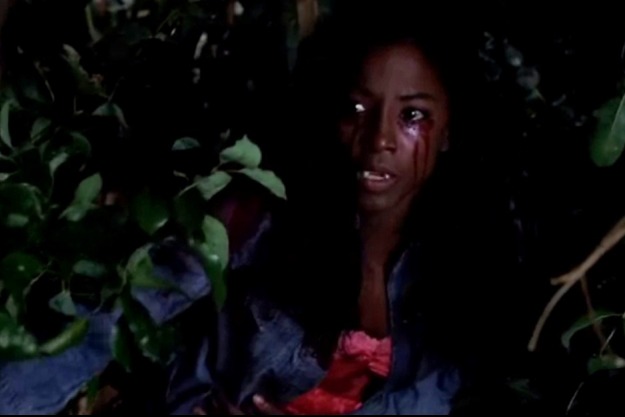
But there’s much more. There’s an ongoing, Andrew Sullivan-style "death of gay culture" subtext argument, an import of the main theme of Buffy’s Season Six necro-existential crankiness, courtesy the turning of Tara (Rutina Wesley) into a vampire—or as I’ll call her from now on, the Tarapire.

And at least half the show is finally showing us the Vampire Authority. Damned if their underground realm, all chrome, sleek curving plastics amid a mid-century futurism that never happened doesn’t evoke a Swingin’ 60s spy film, equal parts Phillipe Starck and Ken Adam (the master designer behind Thunderball, Dr. No, and The Ipcress File), 

At the center is Roman, the Authority himself, played by Christopher Meloni with the a brand of hyper-intense, top-dog, apocalyptic Type A times Pi machismo imported from an edgy production of Glengarry Glen Ross.

Roman, the ultimate sanguine super CEO, who loves to toss off non sequiturs like “Do you think that the whole concept of the common good is hopelessly naïve?”—which allows Eric the drollery of “I try to stay away from politics.”

But True Blood certainly doesn't.

But on to recapping. Much of this week is devoted to the Tarapire’s freak out, when she tears down down Sookie’s house.

Dying has been a really positive thing for the Tarapire—she’s very assertive (bam, there goes the fridge), has a killer deathly stare, and most of all, she doesn’t complain.

When she does snarl to Sook and Lafayette (Nelsan Ellis) that “I will neither forgive either of you,” there’s the delicious possibility that she’ll be promoted to full-blown bad guy. (To watch Tara in vampire form, please click on the video below.)

Things are going from bad to incredibly terrible for Bill and Eric (Alexander Skarsgård).

An Authority operative new to the show named Salome (Valentina Cervi) escorts them to the 60s design extravaganza I mentioned earlier, and jails them in a facility where they’re tortured with artificial sunlight and liquid silver and interrogated by sophisticated sociopaths like the aforementioned Dieter.

Over in our werewolf subplot, Alcide (Joe Manganiello) is refusing to join the pack in eating the corpse of ex-pack leader Marcus. Among the ritual diners is Marcus’s mom, Martha (Dale Dickey).

Clearly signed up for her gnarly, white thrash outlaw Sons of Anarchy appeal, and this impressively gross scene aside, Martha is a terrific addition to the cast, a gravel-voiced biker chick in her deep fifties with a worn regal vibe that fascinates.

Martha insists in several scenes that her daughter Emma, child of Marcus and Luna (Janina Gavankar), has more in common with her werewolf father than with her. This is a teaser for a scene that is astonishing, that demands you not drink fluids for you may gag or spit them up.

But right now, we’re talking Terry flashing back to Iraq and saying, “It’s coming for us.”

Will this show ever tire of crazed Iraq storylines? Can’t Terry get possessed by fairy lemurs or something, just once?

Then, a sweet cookie of a backstory is tossed to Pam (Kristin Bauer) fans. It’s a bawdy house in San Francisco, 1905. After a Campari, she hits the street. A creep tries to kill her, but in a flash Eric, in full Victorian eveningwear, kills the guy, licks the blood off his fingers and gives Pam his charm-face. There’s something oddly tentative about the show’s depiction of pre-vamp Pam, like Ball isn’t certain what he think of her quite yet. Still, that dress is a keeper. (Pam meets her maker, Eric, below.)

Sam (Sam Trammell), meanwhile, is recovering from his own wounds when Martha shows up, again insisting that Luna and Marcus’s toddler has supernatural canine blood in her veins. “She’s wolf—I can feel it!”

Are you sitting down? If not, do.

You’ll next see a scene where Jason goes to Hoyt’s mom’s, only to be rebuffed as by Hoyt (Jim Parrack) yet again as a girlfriend-fucker. And then we’re back at Luna’s house.

Suddenly, director Michael Lehmann cuts to a puppy in pajamas.

No CG, no make-up. Just a puppy in jammies. Only on True Blood.

There’s no way to follow that, but the show must go on. We end up deep in vampire Authority HQ, where Dieter is explicating that theology we started with, ending with what I assume will be the crux of this season’s drama:

That there are Vampire Bible fundamentalists who believe in a utopia where humans are farmed for food and human/vampire intimacy is blasphemy.

And there’s the Authority and Roman, who believe in “mainstreaming” and peaceful co-existence with humans.

In their secret chambers, the congress of the Authority lorded over by Meloni, dressed in the ultimate Hugo Boss-style pinstripe power suit.

Roman considers Bill and Eric, and says, “I’m in a real pickle here, boys.”

The pickle is—he needs to mete out justice to the killer of Authority member Nan Flanagan. Who Bill and Eric did kill.

Roman is the king of the mainstreaming cause, and he tells about it in detail, which is cool: I’ll listen to Meloni yell at me about a Google search for superior celery, he’s that violently entrancing.

Meloni wants to stake Eric and Bill. Bill has something to trade: the news that psycho-vamp Russell Edgington (Denis O'Hare) is alive.

Russell the anarchist psycho-vamp who would love nothing more than to destroy the Authority’s mainstreaming initiative for the sheer fun of it.  

As Meloni considers the import of this news, Lehmann cuts to Russell in a cart, his skin cracked into a thousand bloody fissures.

In true Edgington style, he licks his ruined lips. Gross! (Awesome.)

This week’s vestigial subplots:

Luna

She falls victim to Bon Temps’ most prevalent illness: unmotivated Sudden Character Reversal Syndrome. Last year, Sam became a murderous asshole for no apparent reason. Now Luna’s becoming a mean jerk, apropos of nothing.

Steve Nawlins

Steve Nawlins claims vampires for Christ. Will this dovetail with the Authority’s interests?

Jessica (Deborah Ann Woll)

Nawlins tries to buy Jason from her. Jessica says she does not sell her friends. Like, ever.

But mainly this week is owned by  Meloni’s Roman, the Tarapire, and the puppy. Good times.

Ian Grey has written, co-written or been a contributor to books on cinema, fine art, fashion, identity politics, music and tragedy. Magazines and newspapers that have his articles include Detroit Metro Times, gothic.net, Icon Magazine, International Musician and Recording World, Lacanian Ink, MusicFilmWeb, New York Post, The Perfect Sound, Salon, Smart Money Magazine, Teeth of the Divine, Venuszine, and Time Out/New York.

GREY MATTERS: Chaos Is Here To Stay

GREY MATTERS: Chaos Is Here To Stay

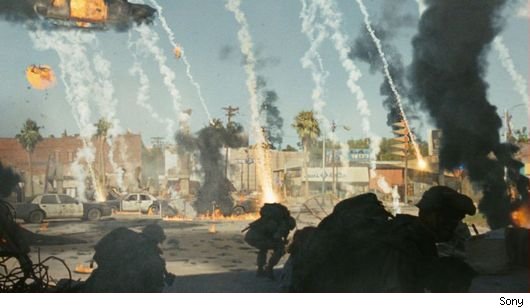
nullWhen a movie turns into the biggest film that isn’t a sequel or a remake in Earth’s history, you can bet that Hollywood is going to do everything short of ritual sacrifice to figure out what made that film such a billion dollar baby.  That movie, of course, is Gary Ross’ The Hunger Games, and the most easily utilized element of that film that can be transferred to other films hoping to cash in on the nonlinear zeitgeist is something not much loved around here—chaos cinema.

Chaos cinema: Yes, that pell-mell movie-making style of un-motivated shakycam and matching frenetic cutting style, both of which leave us confused as to where a character might be in a scene at any given time.

Chaos cinema: where the director starts a scene with a Dutch angle of a character running (a low, oblique shot like they’d use in a Batman cartoon), then cuts suddenly to her feet, and then a long shot in reverse from a helicopter, leaving the audience utterly baffled as to who’s where, or when, or how.

Ah, but making linear sense isn’t the goal. Visceral excitement is what’s on the menu, with a side dish of faux documentary-style verité.

And some folks here at Press Play really dislike it. Film writer Matthias Stork went so far as to craft a video essay titled “CHAOS CINEMA: The decline and fall of action filmmaking.”

Stork looks back fondly on how, until the early 21st century, classical style was the default.  Camera movement and editing were motivated, and things happened in the frame for a reason.

But over the last decade or so, all that started going to hell. Films were speeding up, being packed with event, and thanks to nonlinear editing systems like AVID, being cut into often crazed new shapes that made less and less sense. Sensory overload, stylistic excess, and exaggeration became the coin of a realm Stork named “chaos cinema”.

Looking back, it looks like Mr. Stork has a point. It really did seem that if a movie wasn’t one of those spiritually rotted films reflective of the Cheney years’ new bellicosity, it was one of those cutting edge techno-nihilism actioners, and both were total chaos.

Cases in point: stinkers like Black Hawk Down (2001), Domino (2005), The Kingdom (2007), Man on Fire (2004), Michael Bay's filmography, and Quantum of Solace (2008). One particularly offensive scene in The Dark Knight was brilliantly deconstructed by Jim Emerson here.

We see how Nolan seems to have either lost interest, or never had it, in where cars and trucks are coming from, what direction they seem to be going when he cuts, what happens after that happens, and so on. This may seem like nerdy minutiae unless you think of it this way—if this were real life, and a car hit you, and your body was thrown a few feet, and you closed your eyes, but when you opened them, you found you were on the other side of the road, well, that would freak you a bit. Same thing in movies.

So yes, these particular “chaos films” were dreadful grotesques. But what was I to make of–

Moulin Rouge! (2001), a rapturously gorgeous film that felt chopped together, at 120 BPM?  Or 2004’s hyper-jacked The Transporter? Or 2007’s [rec], which combined chopped-up, personal DV and horror? Or The Hurt Locker  (2008), the first chaos Oscar winner? Or Friday Night Lights (2006-2011) the first great show to import chaos values to serialized TV, and The River (2012) the first to do so to network horror?

To me, Rouge! Is a traditional musical, except with twice as many shots run at the speed of a trance remix. The Transporter is a Euro-trash version of a John Woo cartoon. And Friday Night Lights with graceful camera? Nope. Boring. We’d never be able to slink into those sizzling Texas mini-worlds on network time. And I’ve not yet mentioned Paul W.S. Anderson’s jaw-dropper of a surprise, Resident Evil: Afterlife, one of the greatest uses of multi-level geometry and spatiality in cinema I can recall seeing, where oneattack scene features twenty or so color-coded Milla Jovoviches attacking hundreds of color-coded bad guys, and it’s not even a high point.

Chaos, I think, has been evolving. And now there’s The Hunger Games, whose “high chaos” style will have an incalculably huge effect on action, drama, indie and hell, on all kinds of films, that just pulled in about $140 million its first weekend. In that film, Katniss' neo-Depression small town life of privation, hunting and solitude, her total love for her sister, and the ambient danger of a totalitarian government are all conveyed in quick, but soft-cut nonlinear hyper-montage that would take classical storytelling a quarter hour to express but here zips by in dreamy minutes. You've never seen a cinema future like this.

So: drop it. The argument is lost and over. Chaos is here to stay as a permanent part of televisual syntax. All that’s left is how we incorporate that reality into our critical discourses.

The exciting thing isn’t chaos cinema on its own—that can be as rote, knee-jerk and annoying to me as anything else.

It’s the incredibly exciting promise of what it will lead to that’s exciting, while classicism always just points back to more of itself. 

“Truths” are death and taxes. Everything else is changing and subjective. Everyone said ET was full of “universal” truths, when all I found was the truth that my heartstrings had been mauled and mangled by a sociopathic optimist. And recently I showed Psycho to a  friend—not a cineaste, a pro journalist, age 27—only to have her fall asleep. She felt terrible for just not getting it. Remembering my unseemly lack of ET resonance, I said not to worry. Universal, shmuniversal.

Meanwhile, this is a generation that’s been raised viewing entertainment on all manner of screens, some tiny, some tablet, in theaters, at home, everywhere. And a lot of the time, the image is literally shaky because it’s on your leg, in your hand, or wherever.

So televisual entertainment—movies, webcasts, networks, the whole shebang–wants to fit into our natural ecosystem by being a little wobbly itself—even Parks and Recreation and The Office are a bit shaky. So shakycam now signifies a base level of realism. The imperious side of chaos, then, is trapping artists in a small range of high velocities. This could be bad or…

I’m staying with my story—that Ross, who may not be a Great Filmmaker but is one helluva craftsman, trusted his instincts regarding how his market would best be served with the most valuable property on the planet. And he chose chaos. And, like that, chaos cinema became the mainstream.

THE HUNGER GAMES: The Conversation

THE HUNGER GAMES: The Conversation

null

Now that The Hunger Games, the new film adaptation of the first book in Suzanne Collins's hyper-popular young adult book series, has raked in $68 million dollars on its opening day alone, it seems especially prudent to take a somewhat harder look at the film, both as a stand-alone work and as an adaptation. Below, Ian Grey and Simon Abrams discuss the film, which is set in a futuristic America comprised of twelve districts barely held together by a fascistic central Capitol. The Capitol residents hold an annual event called the Hunger Games, a gladiatorial contest where 24 contestants, 12 girls and 12 boys chosen at random from 12 districts, fight as a means of humiliating the residents of outlying districts. Katniss Everdeen (Jennifer Lawrence), a plucky fourteen year-old who's developed survival instincts by illegally foraging for food in the forests surrounding District 12, volunteers to take her younger sister Primrose's (Willow Shields) place in this year's Hunger Games. With the help of fellow contestant Peeta Mellark (Josh Hutcherson) and their hyper-cynical mentor Haymitch Abernathy (Woody Harrelson), Katniss fights for her life while everyone in the Capitol and the outlying 12 districts watches.

Ian Grey: I think The Hunger Games does something conceptually radical—it’s the first CG-lite blockbuster pastoral. Otherwise, I liked-not-loved this first table-setter. The set design was a fun mélange of Starship Troopers and American Idol. Capitol's people were a properly daft mix of Lady Gaga fans and Ziggy Stardust's band and Gaultier ala The Fifth Element. Lenny Kravitz makes an unexpectedly winning Cinna and Woody Harrelson's liquored up Haymitch is even better. And, you know, there’s Jennifer Lawrence.

A big critical complaint is being slapped at the hyper-editing style used during the opening scenes of District 12 as Walker Evans-style Appalachia. I'm fairly certain the style was used because it leaves you with no choice but to pay close attention.

Another problem I'm willing to forgive Ross has to do with some blurry action scenes. I assume this has to do with the MPAA, outed recently as morally insane for giving a life-saving film like Bully an R, and who no doubt gave Ross endless notes on how to more tastefully slaughter teens.

But every time Ross' action got wonky or his pace meandered, his character love sold me on the movie. There was Katniss tucking in Prim's clothes. The strange wound erotica when Katniss and Peeta attend to each other in the cave. Or Cinna's sole vanity, his lovely thin golden eye shadow. And those extreme close-ups to Lawrence's lips to show her controlling her breath/herself before shooting an arrow.

And please, T-Bone Burnett and James Newton Howard's soundtrack? The way it eased from full-blown Dvořák-like romantic cues to eerie Glass-ian arpeggios to rust-bucket

Americana? Amazing work. And there's that 2001-level jump-cut that's officially Occupy's first cinema moment.

And Jennifer Lawrence. As they say, out of the park. There's a scene where she thinks Peeta has betrayed her and her rage is so violent you don't only fear for the boy's physical well-being, you feel the accumulated rage beneath Katniss' 16 years of deprivation. Like Ripley in Alien, she represents an entirely new way of thinking about women in films. For that alone, The Hunger Games is an instant classic.

That duly noted, there were things I thought simply wrong, miffed or unrealized. But that's enough for me for now.

Your turn, kind sir!

Simon Abrams: Et tu, Ian? I was sure that if anyone would get why I intensely disliked the movie version of The Hunger Games, it'd be you. The critical tongue-bathing that this movie is getting is fairly intimidating, even downright disheartening. It's sort of like when Iron Man came out and was hailed for having a semi-distinct personality rather than for its quality, or lack thereof. I can't discredit director Gary Ross as the sole reason for this new adaptation's consistent mediocrity. Collins herself co-adapted the film's screenplay along with Billy Ray (Shattered Glass, Breach), a writer/director I quite admire. But honestly, while I agree that Lawrence did deliver the goods, I find most other aspects of The Hunger Games to be sorely lacking. And like you, I dig Collins's book! I wish I could say the same for this new adaptation.

Firstly, as you anticipated, the use of violently shaky handheld cameras really bugged me. I'm specifically talking about the establishing scenes in District 12 before the Reaping, the moment when Katniss takes her sister's place. In the scenes where we see the mine workers of district 12, their hard-working wives and, uh, soil-tilling children (?!), Ross's shaky cam-work violently makes us feel like looking at working class people is punishment. Once in the Capitol, protagonists are treated like hamburgers in McDonalds commercials: they're fetishized to the point where they look beautiful. There's lots of negative space behind them, they're shot in only the most flattering close-ups and they're just generally purty-looking. So in spite of the stupid and garish-for-garish's-sake costumes of your average Capitol resident (Versailles by way of Clown College), Ross tacitly accepts that people just look better in the Capitol. This is problematic, to say the least, because spectacle is supposed to be an inherently stigmatized aspect of The Hunger Games.

Then again, Ross makes the scenes of violence during the actual games so joyless and anti-spectacular that I also kind of hate him for doing what he was supposed to, albeit in a more a creative way. Ross goes so overboard in denying his audience the relatively simple pleasures and horrors of watching kids we care about die that he zealously cuts the legs out from under his own film.

But again, Ross isn't the only one to blame, really. Collins and Ray don't follow through on a number of crucial plot points. One of the reasons why the act of being watched is so crucial to The Hunger Games is that Katniss knows she's participating in a spectator sport and must win the crowd over in order to attract sponsors that can give her food, medical supplies, weapons, etc. This is most apparent in the scene where Haymitch (Woody Harrelson) sends Katniss a care package of soup with a note that says, "You call that a kiss?" The soup is Katniss's reward for giving the games' viewers a spectacle. She kissed Peeta, the boy that's already won viewers over with his earnest displays of affection for Katniss, and has been rewarded for it.

In the book, Katniss doesn't know whether Peeta is faking it or not, though, so she is constantly wary of his advances. That aspect of their romance is not in the movie. In fact, after Katniss smooches Peeta some more, it's just understood that their romance is genuine, even if it falls apart in the book. That real-or-fake aspect to Katniss's romance with Peeta isn’t followed through on in the movie, making it a fairly dismal and dimwitted entertainment.

Ian Grey: First, Katniss's ambivalence towards Peeta has not been exnayed for the movie version, even if it's not as agonizingly nuanced as in the book.

But still, what we get are one highly qualified kiss, and another to help save Peeta's life. And afterwards Katniss rolls away in the dark.

This is not exactly love's battle's won. As Ross has chosen not to do a voice-over, the only way we can see Katniss’s ambivalence is through actions. But even now, she remains true to the books' essence of Everdeen.

The essence, Simon, is still there. Love was nothing she looked for or wanted. After Peeta declared his affection, Katniss very nearly clocked him. That Katniss is still here and we'll be seeing her in the next film. Yes, she's holding his hand. But that parting overly-glow-y smile? I don’t buy it. She knows there are cameras everywhere and that Prim and her mother’s fate depend on her ‘performance’. The smile is for them.

As for the matter of critical reception, I shielded myself, so I was, for once, a virgin regarding something.

I'm confused about the problem you have with Ross' class system, in which "Ross tacitly accepts that people just look better in the Capitol."

Dude, they're RICH! And without taste. That's the entire point of them–and of Cinna.

Look at this in real world fashion terms. The Capitol citizens are like coked out 80s Upper East Siders  bonkers onmanhandled Mugler, Sproise and Johnson. Despicable but fun to watch, in a zoo-ish kind of way. Their couture trashiness establishes that it's money, not style, art or beauty, that drives the Capitol. (Alas, Ross completely omits Collins’ concurrent fashion fascism critique.)

Anyway—who are the ugly Citizens’ opposite number?

Cinna. With his understated elegant blouse, his gold flecked eyes, his hopeless adoration for an impossible charge. He literally—in the book and in the film—fights spiritual and material ugliness with material and spiritual beauty.

That black fire-retardant chic totally worked for me. Ross and his fashion and CG team totally pulled it off. Respect.

When you say "Ross makes the scenes of violence during the actual games so joyless and anti-spectacular," I have to stop you here. I know you know that Collins' Dad was a Vietnam war vet, that the books were written out of a seething hatred of war and everything it touches.

Ross worked hard to escape that war movie paradox, that even antiwar movies are so exciting they become recruitment pictures. Not here. Ross' war is ugly and pitiful..

Simon Abrams: Your argument about Katniss and Peeta is mostly reliant on the assumption that there's a subtle but visible intelligence motivating Ross's direction. To put it bluntly: I don't think he's that clever. And because neither Collins nor Ray works to explicitly suggest that there's a disingenuous element to Peeta and Katniss's relationship post-Hunger Games, I don't buy the whole "smile for the camera" argument either.

Also, the movie's presentation of Katniss and Peeta's relationship is more inconsistent than you've suggested. For instance, during pre-Games training, Peeta abruptly decides to train alone with Haymitch. This surprises Katniss in the movie, but in the book, she just assumes Peeta wants to work on a new strategy privately. He is an opponent, after all. But in the movie, we don't see Katniss even consider that maybe Peeta's just doing what she was doing a few days earlier: trusting nobody and scheming to stay alive. So in the movie, Katniss looks doe-eyed and confused when Haymitch announces Peeta's private final session. What happened to the independent, calculating and openly wary young heroine we saw a few scenes ago?

 And as for the inarguably stupid-looking costumes that the Capitol residents wear, it's too easy to go over-the-top with these characters. The film's righteous characters are always unadorned and simply dressed, whether they're Cinna or Katniss. I mean, Cinna only gets along with Katniss because he supposedly can judge her character based on her actions. But even that nonsensical cop-out logic doesn't apply to the Capitol residents. Consider the blunt contrast Ross, Collins and Ray draw between the film's simple/good characters and the more flamboyant/evil Capitol residents. The Capitol is represented by Caesar Flickerman (Stanley Tucci), the Games' announcer and the Capitol's hammy version of Bob Costas. The Capitol's absurdly decadent nature is driven home with all the grace of a sledgehammer by Caesar's hokey, theatrical commentary alone. So why then do we also need his hair to be made-up in that stupid blue bee-hive hairdo? That kind of camp may be intentional (it's in both the book and movie). But that doesn't mean I'm groaning with the moviemakers when I'm looking at it projected on the big screen.

The same goes for Ross's deadly earnest "war is hell so it should look like hell" ethos. The desperate hyper-realism inherent in that kind of violently shaking camerawork doesn't convince me that what I'm seeing is any more intense or violent. It's a textbook example of shortcut storytelling: Ross wanted to get a point across quickly and efficiently so he did it in the most direct way possible. The emotional stakes in this film don't really seem to matter, either. Even Katniss's interactions with Rue (Amanda Stenberg), the young Games contestant that she bonds with because Rue reminds Katniss of her sister, felt canned and lifeless. This movie’s three main architects all obviously know what they need to emphasize but are ultimately stumped as to how to do so.

Ian Grey: With all due respect for what you’re arguing about, regarding whether or not Ross has the skills to pull off the nuance of Katniss’ romance or lack of it with Peeta—forget the books. As much as you can, forget them.

It’s impossible, but especially now, I can’t do a book/movie battle. I could talk about how much richer Woody Harrelson’s Haymitch is than Collin’s broad comic relief confection. I could also talk about Kravitz’s gravity as Cinna (man-crush alert!) and I could complain about how they downsized the other Tributes to mere canon-fodder (at last a literal description).

Point is, I need to think about the film.

May I suggest we start with not agreeing about Ross’ war work?

What’s up with your sour grapes about the “deadly earnest "war is hell so it should look like hell" ethos”?”

I mean, is that unhip? Should war look groovy? What’s undesirable about a movie that thinks war is filthy, chaotic work done out of desperation at the bidding of morally insane monsters?

And your claim that “The emotional stakes in this film don't really seem to matter, either” is a real head-scratcher. Katniss’ entire universe circles around Prim—and so in what universe would she not transfer her feelings to a dear, small,Prim-like creature like Rue? “Canned and lifeless”? It takes two to tango.

And what follows Rue’s awful death, a death of two girls, by the way, to double Katniss’ reflecting agony, is for me, one of the greatest film experiences of my life, so when you trash it, respect that.

For me, this scene IS The Hunger Games, distilled. (It’s also Occupy’s National Banner, in images and sound.)

It’s where the film soars and Ross—who’s often all-thumbs—finds the place where subtext becomes syntax and then the only working currency in the frame.

Against Howard’s eerie Glass-on-Eno funereal thrum, Katniss prepares Rue’s body with flowers. The music and the low camera looking at Lawrence’s ruined-heart face…everything keeps building, the festering wound sun and inhumanity and that insistent music and then a jump cut to Rue’s District and the enraged crowds are tearing down the monitors that show the Hunger Games and they’re trashing barriers and attacking Peacekeepers and… Ross and Collins are saying, screaming, that a human life has worth. That sometimes one death can be one death too many. It’s what history is based on.

Simon Abrams: I wish I agreed with you, Ian. This movie fails as both an adaptation and a stand-alone film in general. You can forget the books all you want. I'm referring back to them for the sake of pointing out that Collins was more thoughtful there about themes and plot points. Even if the books didn't exist, there would still be crucial ideas that were misconceived in the movie. But the books do exist and I think that's a very good thing. Because I wouldn't care about The Hunger Games if its source material didn't exist.

With that in mind, let me address your dislike of my dislike of the abhorrent use of shaky cam. A visual aesthetic is not a mandate to replicate reality. People came to see The Hunger Games to be entertained, yes? But there are ways to get across a semi-complicated view of violence, one that reflects intensity in a visually exciting way, other than making it visually incoherent. I am not at war, I am in a movie theater. So unless Gary Ross has suddenly turned into Gaspar Noe, I don't think it's a good or especially interesting thing that The Hunger Games looks ugly. Again, the use of shaky hand-held camerawork is just a cheap means of making violence look immediately violent. It doesn't allow spectators the pleasure of realizing for themselves why the violence they're looking at is so deplorable. 

Which is why I brought up Rue. Yes, I know her death is supposed to mean something. But I felt nothing when it happened. Had Ross, Collins and Ray done their job well, I would have gasped when Rue died. 

You point to the moment where Katniss puts flowers on Rue's body as a moment of intense sadness but I could just as easily point to it as another shortcut. You want to show me Katniss mourning Rue's death? Show me her running and thinking about Rue. Show me her talking about Rue to Peeta. Earn my tears with something other than cheap flowers and a dopey riot.

Again, the Hunger Games's moviemakers just didn't grasp the power of symbolic representation in their movie. Their film is all thumbs because it's all chintz.

Ian Grey has written, co-written or been a contributor to books on cinema, fine art, fashion, identity politics, music and tragedy. Magazines and newspapers that have his articles include Detroit Metro Times, gothic.net, Icon Magazine, International Musician and Recording World, Lacanian Ink, MusicFilmWeb, New York Post, The Perfect Sound, Salon, Smart Money Magazine, Teeth of the Divine, Venuszine, and Time Out/New York.

Simon Abrams is a New York-based freelance arts critic. His film reviews and features have been featured in The Village Voice, Time Out New York, Slant Magazine, The L Magazine, The New York Press and Time Out Chicago. He currently writes TV criticism for The Onion AV Club and is a contributing writer at the Comics Journal.His writings on film are collected at the blog, Extended Cut.

GREY MATTERS: A Defense of BATTLE: LOS ANGELES

GREY MATTERS: A Defense of BATTLE: LOS ANGELES

nullAfter the first time my interest felt forbidden, something to not share in smart company. But with my second viewing three months later, I realized my reaction wasn’t just a quirk of mood or contrarian impulse, or the film version of one of those inexplicable crushes that make your friends smile politely and count the days until sanity returns. 
No, I really, truly love the heck out of Battle: Los Angeles. And there are sound reasons powering my affection. For every knife the critics stabbed into the film–that it was a chaotic wreck of shakycam, Weed Whacker cutting, clichéd plotting, and even fascist subtext—I found an argument that not only answered these cavils but enriched my appreciation for South African director Jonathan Liebesman’s panoramic vision.

I don't expect to change minds or opinions—when was the last time that happened? But I know one thing and believe another.

I know that more than any film from 2011, Battle: Los Angeles barges through my defenses and just plain touches me in the same ways as Joss Whedon’s alternative family adventure, Firefly.

Meanwhile, I believe that all criticism is always filtered through, and colored by, the observer’s needs and desires. This is only an argument for aesthetic relativism insofar as it’s an argument from the gut that comes from living through the times when everyone agreed, no two ways about it, that Carpenter’s The Thing was an abject failure, that Mario Bava was a hack, and that Cronenberg was an artless freakshow dealer of literalized bio-erotic metaphors that just happened to happen at the peak of the AIDS epidemic.

And now we have Battle: Los Angeles, which is to Marines what Friday Night Lights was to football, and already I can see I have some ‘splainin’ to do, so here goes.

The POV character here is Staff Sergeant Michael Nantz (Aaron Eckhart). He’s about to quit active service as if in penance for a failed Iraq command where one bad decision led to the death of his entire, very young, squad.

While cable TV announces strange environmental irregularities, we meet a partying group of young Marines. They’re a racially mixed group, representative of LA’s Latino/black/white demographic. They all love the sense of belonging and service being a Marine provides.

Battle: Los Angeles (B: LA for short) offers a frighteningly pell-mell sort of invasion.

First, what look like canisters surrounded by smoke ring haloes fall on and obliterate a Navy destroyer. Liebesman sacrifices his own expensive/excellent beach-invasion effects so he can show a group of Marines watching and reacting to this on low res cable news broadcasts. Tokyo, not Manhattan, is the first city attacked. So much for American exceptionalism. The focus here is on the human reaction to the intrusion of wrongness into the everyday.

Nantz and a squad of freshmen Marines are given a mission: find whatever civilians you can before alien forces in LA are nuked in three hours.

What happens: Women and children are killed with no action-film taglines or Hollywood mercies in pitched battles with superior bio-mechanic alien forces.

By B: LA’s third reel, only an Air Force tech (Michelle Rodriguez), a veterinarian (Bridget Moynahan), a Latino named Joe (Michael Peña), and his small boy Hector (Bryce Cass) augment what’s left of the squad.

And as Joe dies of an alien-blast in Nantz’s arms, what “Marine” means—the simple notion of a branch of the US military united by Marine-specific, world-exclusive rituals–changes radically under the weight of Nantz’s guilt and the context of species extinction.

Nantz tells little Hector that his father loved him, that he has to be strong, that he needs him to be his Marine.

There’s no logical reason for this progression. But by now, we realize that “Marine” has already morphed from a traditional squad into a fluid Whedonesque alternative family group where a female Air Force tech with no field experience (Rodriguez’s character), a female veterinarian, a child, and a man (Joe)—the last three with no obvious military "worth" —now work as an effective combat unit according to their abilities and represent a stateless species patriotism. (I’m assuming the film’s lack of “USA! USA!”-style bellicosity helped with overseas box office.)

Eventually, our Marines manage to bring down a (not the) mother ship. Finally, they’re helicoptered to a functioning military base, are offered food and rest, and Nantz instead loads up on ammo. The others follow his lead. The war for the world continues.

It’s a realism-infused old school war story the critics largely hated because it was so old school. Never mind that nobody had seen this narrative style since Guadalcanal Diary, or that Drive’s hipster brand of ancient school noir-ness is celebrated (see: trend trumps quality). Or that the film plays with its own antecedents, as when a Marine jokes about one Marine’s brave actions, “That was some serious John Wayne shit!” which is followed by another’s meek question, “Who’s John Wayne?”

Otherwise, B: LA was universally and inaccurately despised for a shaky-cam style routinely compared to despicable, fun bloodbaths like  Gladiator, Black Hawk Down, and The Kingdom, where faux documentary shooting style comes off as the cinematic version of Tourette’s, meant to gin up verité on the creative cheap.

 B: LA has nothing to do with such low fare.  Liebesman’s mobile, subjective camera has the same intent as the Dardenne brothers following  Rosetta in the way his camera, once interested in a character, will not leave them, will stay with them like a guardian angel with OCD, or like Lukas Moodyson in Lilja 4-Ever, except with breaks where it pulls back to medium shot to observe the world around that character, to see what she’s up against. Or most specifically, Friday Night Lights

You can believe this last claim because B: LA begins with a hailstorm of FNL shout-outs.

Over Brian Tyler’s echoing guitar score theme, actionably similar (for three minutes) to W. G. Snuffy Walden’s FNL theme, we enjoy a FNL-like vibe of non-partisan Americana, even as the late-fortyish Nantz struggles to jog at his old pace on a setting-sun-lit beach. The camera mirrors his pains with a simultaneously rolling and halting gait.

Liebesmancuts to a young squad boasting and bullshitting, his camera excited, non-linear and lens-flared with youth, never just observing, always symmpathetic. (It’s around here that Liebesman stops with the FNL homage.)

When we meet a Marine (Jim Parrack) struggling with PTSD but trying to hide it from a shrink, Liebesman’s camera is discrete, occasionally showing clenched fists, or otherwise gently conveying tension. Even in the film’s most iconic, sci-fi-esque image, the slow, endlessly vast mother ship rising from the bowels of a ruined Earth, Liebesman keeps Nantz in the foreground, his focus on his men.

And so it goes. A director rewriting how you do this. Total character devotion. You’d think there’d be more love.

Meanwhile, here on Press Play, there a continuing discourse about “chaos cinema”, that frothy mixture of a shaky cam style B: LA doesn’t use, mixed with slapdash mise-en-scène and hyper-cutting meant to gin up excitement while disguising an ignorance of classic style.

This one is easy to disprove, courtesy of a sequence where Liebesman  does go full metal bedlam.  If what came before this sequence were nothing more than ‘chaos cinema’, this would be like adding more white to a paint mixture consisting of eggshell and ivory. Instead, it’s a gold standard nerve-wracker that shows Liebesman’s mastery in orchestrating multi-POV pandemonium and slowly restoring order.

After investigating the smoky ruins of Santa Monica during a lull in the action, our Marines are attacked and Liebesman’s camera takes the role of battle victim, always falling, getting up, and tumbling, with no sense of left or right as alien energy weapons alight in the fog in flash frames, and the audio becomes a Murch-ian soundscape of ring-modulated screams and clatter, and we glimpse the occasional mecha-alien in chiaroscuro, before a Marine finds a safe house by sheer accident, and the film, by degrees, calms down.

Is this cut too quickly? Is Moulin Rouge? Within certain parameters, you just cannot quantity too fast or slow.

I loved Rouge. But I also loved the glacial non-pace of Nicolas Winding Refn’s Valhalla Rising. I’m also aware both spoke very directly to shadow parts of my own secret history, a thing defined by extremes of alcoholism-powered chaos and the bad quiet of madness. So are my assessments incorrect due to my biographical special needs? Or am I actually more attuned to certain velocities because of my history, and therefore a better judge?

What seldom gets questioned outside of academia is the fascism of Comic-Con-y action-hero cinema, the way we all bend over backwards for Iron Man, Batman, Superman. Part of the appeal is that we give it up to these, uh, men.

So it’s ironic that B: LA, the rare action film steeped in meritocracy, should be accused of fascist subtext.

The only explanation I have is that some Americans look at young people happily in uniform and fall into one of two traps, both occluding what’s on-screen.

It’s always been a Republican-pimped sell that liberals are anti-military pussies. This is bullshit except for the extremist fringes, where, especially during the lawless Cheney years, the creeps claimed soldiers were culpable.

But what also exists is the left’s dubious comfort with our Platoons and Full Metal Jackets. More on point, I think the way B: LA celebrates being happily in The Squad (oorah!) collides with the left’s greatest fetish–endless individuality (hence the old joke that getting Democrats to organize is like herding cats. Or getting Burning Man participants to dance in lockstep. You get the point). The same dynamic was at play with the contrast between being an individual and being on the Team in FNL.

But like FNL, B: LA strips away partisanship and finds people thrown together and struggling for one goal. Not much of a fascist vision.

Why this would attract me—well, you and I don’t know each other well enough.

But I have, in my articles here at Press Play, outed myself as a person dealing since the late 80s with the life-long effects of brain trauma, so it’s not surprising that, on some Pavlovian level, a film that limns an assaultive world would resonate with me.

Brain trauma, which at one point left me able to navigate Lacan and advanced audio engineering but unable to talk at a table full of people, renders fantasies of interconnectedness incredibly seductive.

So yeah, I’m pre-inclined towards this sort of narrative, where isolated people come together to create a family unrelated to the accident of birth. But that doesn’t make me more easily impressed.

No, because I desire or even need the real deal, whether it be Firefly, or SyFy’s Alphas or Battlestar Galactica, I’ll reject the bogus item—the list is too long–with great antipathy. But that’s just one angle. I could go on about Liebesman’s unique compression of depth, ‘grain’ and perspective (the upcoming Wrath of the Titansis instantly identifiable as a Liebesman film), his love of actors’ faces, and so on.

But what perhaps more delights me on a meta-but-real level is that almost everything about  B: LA probably has something connected to it that’s connected to something else beyond the film that resonates with me. Something from when I was a kid. Or from an unrecalled painting, comic, film, toy or dream I liked. People throw around the word "awesome" too much. But this really is.

Ian Grey has written, co-written or been a contributor to books on cinema, fine art, fashion, identity politics, music and tragedy. Magazines and newspapers that have his articles include Detroit Metro Times, gothic.net, Icon Magazine, International Musician and Recording World, Lacanian Ink, MusicFilmWeb, New York Post, The Perfect Sound, Salon, Smart Money Magazine, Teeth of the Divine, Venuszine, and Time Out/New York.

GREY MATTERS: HOMELAND and the art of playing crazy

GREY MATTERS: HOMELAND and the art of playing crazy

null

As a certified crazy person, I’m here to tell you that either vampires burn in daylight or they don’t. I’ll accept no wiggle room on this. Anything less and you’ll quickly lose my suspension of disbelief. To get what I’m babbling about, this way, please. I’m talking about Homeland, which is, by the way, about almost nothing but crazy people.

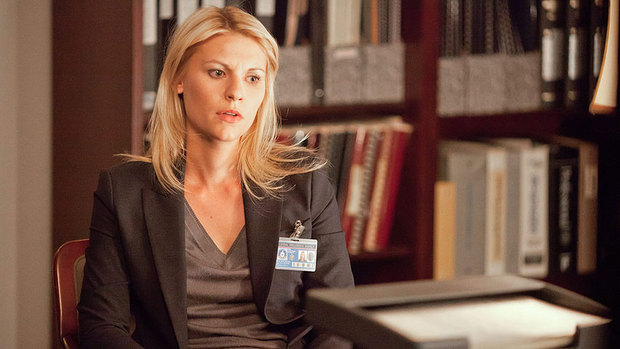
Homeland, in case you’ve been busy catching up on something more realistic – I suggest Syfy’s zero-dollar wonder, Alphas – is about Carrie Mathison (Claire Danes), a C.I.A. operations officer haunted by the notion that she failed to do something that may have stopped 9/11 from happening. She was also compromised in an Iraq operation because of an American soldier who’d turned against his country.

Then a Delta Force raid uncovers Marine Sergeant Nicholas Brody (Damian Lewis) in a compound belonging to super-terrorist Abu Nazir. Brody becomes a hero but Carrie pegs him as connected to her failed op and worse, a turned sleeper agent.

When the C.I.A. turns down Carrie’s requests for invasive surveillance because dammit, we don’t do that sort of thing in America, she does it herself with some spy pals. (Alphas, with its metaphor-fraught tales of working class, genetically “super-powered” people fighting Cheney’s still-booming and lawless torture system that Homeland needs to pretend doesn’t exist, is the more clear-eyed, adult view of post-civil liberties America.) In episodes Alfred Hitchcock would love, Carrie watches Brody eat, talk and have sex with his stunningly gorgeous wife (Morena Baccarin of Firefly fame).

The season-long hook, teased sometimes to exquisitely hair-pulling extremes, is a has-he-or-hasn’t-he game of whether or not Brody has been turned and is out for big-time trouble.

And then, for me, it all went to hell.

nullCarrie’s a character whose entire life, as the brilliant credits sequence reminds us every week, is literally defined by terrorism, fear and trying to control that fear by building a life, a personage as a person in strict control, serving her country, her profession and the one real man in her life, her mentor and father figure Saul Berenson (the mighty Mandy Patinkin).

So of course she decides to throw it all away, including, quite possibly, the security of the United States, so she can get drunk and fuck Brody.

The show recovered in fits, some so good and others so bad it was like tuning in to get whiplash, but this was the first trumpet sounding Homeland’s true nature, and televisual literature was not included in that symphony. Homeland never dived so far as The Killing. It stayed professional, keeping us interested (and glad there were no commercial breaks where we could pause to think about its manifold absurdities). Then there was last week’s finale that led to an explosive terrorist conflagration that wasn’t – because if it was, one of the players would be taken off the board, and so much for Homeland Season Two.

But what about the vampires? What about you being crazy?

Okay. What I mean is, if a show has vampires who can never walk in sunlight because they’ll burn up in flames except when the writers need them to, well, I’m not going to be watching that show, because the writers have contempt for me, or their material, or both.

On the most basic level, that’s the deal with Carrie and Brody. In order to accept Carrie and Brody, we must accept some whoppers about what we know about bipolar disorder – if only from Oprah, what millions of people know about returning Iraq vets and P.T.S.D. and what we all know about what it is to be human.

nullRight, bipolar disorder. I didn’t mention that, to add some tension spice to Carrie’s character, Homeland makes Carrie suffer really badly from bipolar disorder. Like, it’s so bad that she has to take her meds every day or else she’ll go into a manic tailspin and lose her mind. The poor thing, she can’t even go to a regular doctor for those meds because the C.I.A. would kick her out as a security risk. So, she visits her psychiatrist sister on the down-low for her weekly supply, which translates into even more suspense, and some shame and anxiety to boot; this bipolar thing is paying off big-time and all they had to do was say she has it. Poor Carrie. This is going to be one rough season.

Except, not so much, because on Homeland, vampires can walk in daylight, so to speak. After a few episodes, her bipolar kind of…goes away. Why? I would imagine because its rigors would get in the way of other plots leading to such flights of fancy as Carrie blowing off seeing her sister for meds so she can get blotto drunk for some hot Brody ooh la la. Unlike all of us, intemperance does nothing to aggravate her bipolar; hell, she doesn’t even get hangovers.

Yes, “us.” I outed myself a while ago on being bipolar. It’s no big thing – as long as you remotely behave like a grown-up about this controllable thing, i.e., not like Carrie.

nullDon't get me wrong: I don’t suggest Homeland hang itself on the horns of scientific accuracy (or a WebMD search). I just ask that it create a ‘verse where there are laws for Carrie’s condition, and then stick to those laws, like the way Vulcans can or can’t intermarry and the like. (On the other hand, absurdity met ugliness when the showrunners had Carrie, in deep depression, diagnosing herself – with her sister mutely complicit – for electroconvulsive therapy, a.k.a. shock treatment, a controversial, risky, cognition- and memory-impairing but highly photogenic treatment calling for Danes to be strapped and gagged, electrodes glued to her scalp. Then they cranked the juice as her body spasmed grotesquely. If you’re suffering from depression, there are a million other ways to get help – this is just an ignorant TV show by the guys who made the torture-happy 24.)

Danes has created a viable person built off the showrunners’ thumbnail description and her own vision of Carrie, which manifests in endlessly fascinating halting speech patterns, “talking” body language, odd glares and more. The creators of Homeland were insanely fortunate to get such an artist.

As for Brody – good grief. Here’s a man who for eight years was brutalized, beaten, locked in solitary, became a surrogate father to an adorable child who died horribly, was forced to brutalize other Americans and, for a freshet of memorable detail, was pissed on while he bled. And yet within a day or so he’s home, and aside from limited, soon-to-improve sexual dysfunctions and some behavioral dissonances, he’s on his way to a full recovery with timeouts for plot-advancing nightmares.

nullMeanwhile, in Brody’s frequent shirtless scenes we see his scars and their implied memories of unimaginable months of pain and horror, which now have no apparent effect. (Even his attempted terrorist act is based not on torture, but on love of a child.) This is Spielbergism; take a sad song and make it ludicrously better, one-upping it by saying the sad song doesn’t exist even as you’re looking at it.
As Brody breezed through photo ops, interrogations, his love affair, superior fathering, a remarkable act of remembrance in a church, the first steps towards a congressional run and the build-up to his terror attack, watching Homeland, for me, became the job of creating in my mind a less ridiculous backstory for Brody. Something Uwe Boll would not reject as failing to meet his stringent standards of realism. (I also had to ixnay the absurdity that any country would allow such damaged goods into the ‘burbs with no decompression process, where anyone could get to him, or the poor bastard could just blow his brains out in 24 minutes.)

Again, it’s entirely the actor’s art that pulls this nonsense off. It’s Lewis’ eye and neck muscle work, his oddly timed blinks, his general tightness of bearing suggesting things blowing up inside. Everything that nobody bothered to write.

But there were such great moments! Like when Brody and Carrie went to her family cabin in the woods, with its implications of a peaceful childhood she somehow missed, and his connection to a person who gets his deal. It was beautiful. And then she flat-out accuses him of being with Al Qaeda, and he’s back at her, yelling that he isn’t (which technically is true). It’s the spy scene we’ve always wanted to see: the breaking of both players’ pose.

Pure gold. But moments like this get lost in a spy show’s mechanics and, as Carrie’s mental illness makes that special guest appearance, devastating her just in time for dramatic effect, I’m just over these daywalking vampires. Next season, I’ll recalibrate my expectations of Homeland. I’ll enjoy the acting, the twists and turns. What do you want? It’s just TV.

Ian Grey has written, co-written or been a contributor to books on cinema, fine art, fashion, identity politics, music and tragedy. His column "Grey Matters" runs every week at Press Play. To read another piece about Drive, with analysis of common themes and images in all of Refn's films, click here.

GREY MATTERS: Martin Scorsese’s interesting year

GREY MATTERS: Martin Scorsese’s interesting year

null

Aside from being a lousy whitewash out to prove God-knows-what, Martin Scorsese’s George Harrison: Living in the Material World doesn’t even live up to some simple realities, things like the fact that when you’re Martin Scorsese, you most certainly do have a huge responsibility when taking on such an undertaking. Nobody will ever again have your resources, access or your name, and the sobriety of purpose and sheer cred that goes with it.

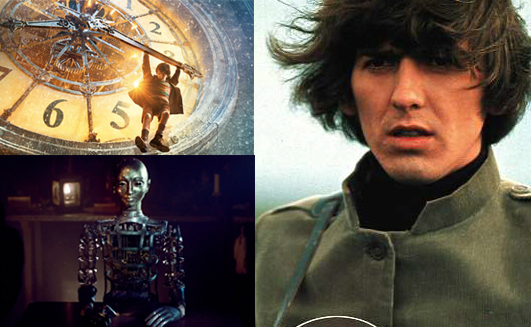
And now, to super-complicate matters really interestingly, we have Hugo, easily one of Scorsese’s top five films, a masterpiece, coming mere months on the heels of the Harrison debacle. The two films, in eternal orbit and connected by “George” as a name and notion – of the guitar player and his revolution in sound, and of the disgraced special effects trailblazer, Georges Méliès, who, in our world, delighted a small, asthmatic Italian-American boy in Little Italy almost 60 years ago with his lowest-fi wonders.

My sense is that Scorsese – a Catholic boomer from the age of Aquarius, director of Kundun and The Last Temptation of Christ – simply could not have made Hugo without the mysteries of Harrison’s persona and life-long mysticism nagging him on. It’s just a damned pity that a huge chunk of facts, music history and Harrison’s vast, real legacy had to be the sacrificial lamb for Scorsese’s beautiful triumph.

So am I arguing that artists have responsibilities? Nope, no way. Do journalists? Yes. Absolutely.

nullBut in Material World Scorsese straddles art and reportage and screws the pooch on both. And yet Hugo, a film that makes no bones about being a total spin on some history using the toolbox of fiction, absolutely gets the heart of so many truths: truths about cinema, anger and healing, growing up and magic. And yeah, ironically, of the creation of history.

The irony is that the methods and mindset that serve Hugo so well are poison to Material World. Before we move on, though, a quick view of both films.

Material World offers a superfan’s mind-blow of previously unearthed Beatles and Harrison footage to drag us through a brilliantly edited but still relentlessly middlebrow, Ken Burns-like take on The Beatles and Harrison.

You know the drill. Grew up in grim, post-war Liverpool. Played crap clubs with John, Paul and Ringo until gaining world domination. Became entranced with Indian culture, the sitar and transcendental meditation under the guidance of Maharishi Mahesh Yogi. Made the magisterial All Things Must Pass solo record with the insane Phil Spector, now imprisoned for murder. Formed The Travelling Wilburys with Dylan, Tom Petty, Jeff Lynne and Roy Orbison. Did too much coke at some point. Got cancer, beat it. Suffered a knife attack by an insane person. Got cancer again, died peacefully. Every so often something new and interesting pops up – Harrison was a race car driver? – only to be summarily deleted.

nullAs you’ve probably heard, the film’s talking heads – among them Ringo and McCartney – are sometimes identified and sometimes not. About fifteen years of Harrison’s life are simply omitted, one assumes, because, like that racing bit, they just don’t fit Marty’s thesis: quiet guy becomes mystic. (You could say this lacks dimension.) The tales we’ve heard of George as a compulsive, somewhat cruel womanizer are whimsically hinted at by his wife Olivia, and then dropped. The epic coke binges occupy a fascinating single string of video that suggests the great film this could have been – I’ll return to that topic.

In general, Scorsese behaves as if his love of music will cover for the fact he truly doesn’t understand the thing, how it works or why the damned it so bewitches and obsesses him.

On the other hand, Hugo finds Scorsese not only at home in multiple cinematic languages and dialects, but talking about talking those languages. And so 3D not only works as immersion technique, but as an element with its own sacred history in a film that assumes longing for the cinematic experience and love of illusions as basic currencies.

The incredible richness of Scorsese’s visual languages allows him to express Harrisonian spiritual values delivered with an Amélie-like breathlessness and a neo-Gaultier splendor. (If costume designer Sandy Powell doesn’t win an Oscar for her designs, heads will roll – to speak only of heads.) As much as The Tree of Life is intrinsically Christian, Hugo is deeply Eastern in tradition, a film of real and metaphorical deaths and rebirths, of spirit animating the material world.

The film’s about Hugo (Asa Butterfield), a smudge-face Dickensian literally marking time by minding a Paris train station’s clocks and trying to repair the broken, beautiful automaton gifted to him by his deceased dad (Jude Law).

Hugo’s enemy is Inspector Gustav (Sacha Baron Cohen), once a foster child, now a spiritually broken policeman crippled by war. (Scorsese/Cohen/writer John Logan only play Gustav for laughs until they understand the true depths of his brokenness).

nullHugo’s redemption comes in the form of Isabelle (Chloë Moretz), a young girl who’s never seen a film, and who’s the foster granddaughter of Papa Georges (Ben Kingsley), a cranky man with a toy shop in the station, and who is on the run from the slow reveal of being the Georges Méliès – more than just special effects’ godfather, a man who rejects bleak reality for the hygienics of extreme fantasy.

By the way, we already we know far more about Hugo’s fictional characters than we ever learn about anyone in Material World. Just saying.

Scorsese’s film, the stuff of John Logan’s script (itself based on Brian Selznick’s book), unfolds a series of beautiful, almost Hindu cycles of death – Hugo’s dad and uncle’s passing – of birth – Isabelle’s discovery of cinema, the “awakening” of the automaton – and rebirth – the automaton coming to “life,” Georges’ films rediscovered, his reputation, his essence, Inspector Gustav healed of the burns of a bad childhood.

Along with its spiritual transcendences and heroic humanism, Hugo addresses, delights in and celebrates film history through mostly-fictional characters, fantastic devices and interlocking, exquisitely alive tableaus.

The reason this works with Méliès and not Harrison would seem obvious: most of Méliès’ films were destroyed after World War I, most Americans have no idea who he was, most historians have no idea what the “real” man was like. And so there’s no such thing as “doing” Méliès inaccurately. Harrison’s life, on the other hand, as we see in Scorsese’s own film, is ridiculously open to scrutiny, which means the director has to work that much harder to float his revision.

In Hugo, fiction about fact frees Scorsese. In Material World, what we get is an attempt to mold fact to fit intent. After a while, it’s like a root canal; the only painless part is when it’s over.

nullI get the temptation to rewrite George as spiritually ahead-of-the-curve, as an enigma tucked inside a mystery. Problem is, in order to do this properly, you have to commit all kinds of misdemeanors against the artist, the arts and history. Scorsese ends up so busy whitewashing alone, he has to, for example, mostly play down the matter of George’s, well, guitar playing.

Off and on, people – mostly unidentified – declare George’s playing to be “soulful.” This means nothing. Paul and Ringo – both acquitting themselves with warmth and grace – speak of their fallen mate with respect, with Paul saying he was the best musician by far when they started, which is something as George was, like, 17 years old at The Beatles’ beginning. Whatever – I eat this stuff up with a spoon, Paul and Ringo’s humbled late-life understanding of their band’s magnificence.

But aside from the static, overlong middle section of the film involving George’s interest in the sitar and Ravi Shankar, there’s not much in the way of musical insight. Scorsese seems so bent on fuck-knows-what, he misses the ready-made metaphor for Harrison’s spiritual quest sitting right there on his AVID screens.

It’s Harrison’s mysterious morph from the edgy, all-elbows player on early hits like “Don’t Bother Me” to the soaring transcendent slide guitarist you hear on Badfinger’s “Day After Day” (not in the film) and pretty much everywhere after the White Album.

What happened? How did he change? This is exciting stuff – the sound of a man’s soul in transition!

nullScorsese, literally, could not care less. Instead of this tale of self and spiritual discovery through music, Scorsese fritters away precious time with Eric Clapton, who shares tales of his cockmanship, of his creation of Scorsese’s favorite GoodFellas track, “Layla.” Scorsese is so enraptured with Clapton, who comes off as the epitome of noxious, boomer rock royalty, chortling about stealing George’s wife and choosing to not join the Beatles due to his extreme awesomeness, that Scorsese doesn’t seem aware Clapton is most recalled as a soft rock favorite and that, more importantly, aside from the solo on “While My Guitar Gently Weeps” and some shared women (nice), Clapton has fuck-all to do with our story here.

The Clapton infatuation is, however, a side effect of what’s really wrong: Scorsese refusing to leave his boomer bubble for context or insights, and in so doing, missing Harrison’s vast contributions beyond his own first edition vinyl collection.

Based on what’s here, Harrison is a minor figure – no big deal, used to be in The Beatles, saw God, Ommmmmmm…. You’d never know that Harrison’s early Beatles compositions (think “If I Needed Someone”), with their signature bell-toned arpeggios, tightly harmonized, octave-sweeping melodies and oddly chorded middle-eights, provided the vocabulary for New Wave, power pop and indie pop, inspiring/defining everyone/everything from Aimee Mann, Elvis Costello and Glenn Tilbrook to David Bowie’s wholesale theft of the song in “Blue Jean” to Elliot Smith’s post-Brit Invasion confessional aesthetic.

You’d never know that, as much as John Lennon, Harrison brought the ways and modes of the avant-garde into pop, whether it was the teeth-rattling extreme dissonances in “I Want to Tell You,” the tape-loop floaty-ness of “Blue Jay Way” or the triumphant wall of feedback in “It’s All Too Much.”

nullIt’s an amazing legacy that Scorsese omits, and it doesn’t end there. There’s George creating “world music” decades before the likes of Peter Gabriel, Sting or Björk via the 1968 Beatles track “The Inner Light” and its pulsing dress of sitar, harmonium, flute, table and santoor. (That Scorsese used world-music-style music by Gabriel for the soundtrack for The Last Temptation of Christ makes this omission a real head-scratcher – or is Scorsese simply unable to connect the dots?)
Meanwhile, wouldn’t it be clean fun to chart Harrison’s perversely “WTF?” appearances on records by Belinda Carlisle (The Go-Go’s), Fleetwood Mac and Electric Light Orchestra?

Who was that George? In particular, the George who, again like the Georges Méliès of Hugo, lived to enjoy a late-life resurgence with 1987 Top Ten hits like “Got My Mind Set on You,” “When We Was Fab” and the album Cloud Nine? You’re not going to hear much about that George. In order to buy the mystic-dude-in-the-material-world shtick, you have to – simply have to – accept that an entire fifteen or so years of Harrison’s life didn’t much matter.

Actually, Harrison seems to leave Scorsese’s radar as soon as the counter-culture dissipated. Which means that Harrison only has meaning for the director if he’s attached to a larger context, like the perky midlife crisis that was The Traveling Wilburys.

What does compel more than anything in the film comes from the artist’s cocaine days (told you I’d get back to this.). Not because it limns him bottoming out way, but because Harrison with his throat trashed by blow doing godawful Philly-soul-inflected versions of his hits so utterly deconstructs the narrative Scorsese has so painstakingly constructed. Because it turns Scorsese into Jake LaMotta beating his own film, which, for a few moments, is incredibly liberating. Here and only here is the Scorsese we all love and admire, the actual artist willing to go way out on a ledge.

Who is this George Harrison sarcastically mixing a throat concoction recommended by Barbara Streisand? We’ve been hearing, in draughts here and there, about an anger living beneath George’s placidity, a cooled, arched-eyebrow lividity amping up even early solos.

And here, in his cocaine days, finally, that anger twitches near the surface and Harrison cackles. You get the sense that if a mantra showed up, this George Harrison would spit at it and laugh.

I wish Scorsese had started here, or referenced this more. Not because it’s “dark,” or what I want to see, but because it’s true, because it goes beyond the firewall of the Harrison legend and because, if you want the mystery of George Harrison, it’s hidden in plain sight.

I want to believe that Material World will be forgotten – an aberration in a great career. I know Hugo will be remembered as long as cinema exists in any form.

Ian Grey has written, co-written or been a contributor to books on cinema, fine art, fashion, identity politics, music and tragedy. His column "Grey Matters" runs every week at Press Play. To read another piece about Drive, with analysis of common themes and images in all of Refn's films, click here.

RECAP: What’s this on DEXTER? An incest tease?

RECAP: What’s this on DEXTER? An incest tease?

nullSeriously, Showtime: Dexter-Debra incest? That’s what you’re banking on as you approach the season-six finale? Isn’t that why God created slashfic? What’s next? Ghost-y tussles between Dexter and Harry? Deb and Laguerta? The mind reels.

This week’s Dexter is all bent out of shape, peaking at the 20-minute mark, then limping along as it betrays sundry atrocities, anti-revelations and proof that Captain Laguerta (Lauren Vélez) is the Latina Cruella de Vil of the Miami police department.

After a recap in which Debra (Jennifer Carpenter) says that Dex (Michael C. Hall) is her one safe place — oh, great — the Miami police find the body of Travis’ latest murdered girl, along with the corpse of Doomsday_Adam (Kyle Davis), the one-time Travis fanboy, who was actually stabbed by Dexter.

Travis, meanwhile, has hogtied Angel (David Zayas), stolen his ID and given it to Doomsday_Adam’s batty wife Beth (Jordana Spiro). He’s also gifted Beth with a backpack bomb of wormwood poison, with instructions to deliver the package to Deb. She’d once interviewed the object of Travis’ passions, his sister (who he then killed, as these brother-sister love affairs never pan out). And so Deb and the Miami P.D. must die in the name of God. It’s simple, really.

You can read the rest of Ian's piece here at Salon.

Ian Grey has written, co-written or been a contributor to books on cinema, fine art, fashion, identity politics, music and tragedy. His column "Grey Matters" runs every week at Press Play.

GREY MATTERS: Here are the top 10 beautiful ideas, people and events that defined 2011

GREY MATTERS: Here are the top 10 beautiful ideas, people and events that defined 2011

null

This is my theory and I’m sticking to it: if more things were more beautiful, everything else would be way better. Even in this age of fiscal cholera, beauty for the sake of it is it’s own sacred reward.

But as Americans, we’re saddled with the Protestant curse and the attendant pathologies of fetishizing plainness, respecting the mediocre and being in thrall to outright ugliness, whether that manifests in strip malls, lip-warping Restylane or mind-rotting Rush. We could all use a bit of Stendhal syndrome, that most wonderfully strange of
psychosomatic ailments that causes the individual to experience rapid heartbeat, dizziness and even hallucinations when exposed to beautiful things.

And so: a list, where I don’t worry on a genre or platform and instead celebrate ten people, events or ideas whose beauty shook me of the uglies in 2011.


1. Alexander McQueen, "Savage Beauty," The New York Metropolitan Museum of Art, May 4 – August 7

Experiencing "Savage Beauty" was a ravishment and reminder that form is just a means, and that for Alexander McQueen, fashion, film, hologram, robotics and sculpture were all just avenues to transcendence. McQueen was expert in them all, even if he did make his mint in high end couture.

McQueen had the soul of a Romantic and a Gothic, and the sense of humor of a postmodernist who could contain and cross-reference Scorsese, Corman and Kubrick, Scottish nationalism, man versus and fucking machines, angels in water, angels in light, The Birds, and nature triumphant always. McQueen’s runway shows were performance art mixed with Oscar-worthy short films where nature, death and mourning fused.

As you walked the Met’s reverberant, church-like spaces, you encountered Poe in the thousand hand-placed raven feathers of a dress; HAL 9000 reborn in twisting machines that ejaculate clashing colors on a spinning model; the Alien as phallic chrome spine-jewelry; a hologram box of Kate Moss floating in an eternity-loop in what looked like snowy high fashion seaweed. Georges Méliès would have wept.

McQueen was on the verge of creating a new species in style, a hybrid of anime and aquatica glimpsed in Lady Gaga’s Bad Romance video. But after a protracted depression, the designer of the early 21st century took his own life at age 40.

2. The repeal of Don’t Ask, Don’t Tell

On July 22, 2011, President Obama, Secretary of Defense Leon Panetta, and Admiral Mike Mullen, Chairman of the Joint Chiefs of Staff, officially started the process that would end Don’t Ask, Don’t Tell on September 20, 2011.

It is beautiful beyond words to know that, because of Obama’s kept promise, unknown thousands now live and serve without the virus of shame eating their guts away as a country begins the process of joining the civilized world.


3. Hugo, directed by Martin Scorsese

Good God, what a fourth act Hugo finds the 69-year-old Martin Scorsese in, taking the Stendhal-inducing gorgeousity of Kundun and triple-upping it.

There isn’t an inch that isn’t gorgeously fussed over to beautiful purpose. You could take any frame from the film and have the best artwork in your home. And yet it isn’t simple-minded pictorialism. Every image powers the one coming while advancing the narrative (exactly like a McQueen runway performance, although Scorsese’s an
Armani man.)

Sandy Powell’s wool-heavy designs are almost pornographically gorgeous in a mid-period Gaultier way. If gorgeous imagery mixed with deep-bone-felt humanism were food, you could feed a family of five for a month on a screening of Hugo.


4. Alex Kingston as River Song, Doctor Who

I remember Alex Kingston from ER: sassy, brassy, British – what wasn’t there to love? But, well, it was ER, you know? Limitations were the order of business.

But then came Russell T. Davies and Steven Moffat’s resurrection of Doctor Who, which gave life to Kingston as River Song, a gleefully amoral time traveller who, unfortunately, is travelling in the reverse time direction as the good Doctor she dearly loves.

The result: every time she sees him, he remembers her a little bit less until, ultimately, he will recall her not at all.

As an elegantly painful metaphor for Alzheimer’s in particular and entropy in general, it’s hard to beat. But this is Doctor Who, for fuck’s sake, so there’s also River Song as butt-kicking, quip-popping action hero in the finest of couture. Being in kissing distance of 50 just adds some could-give-a-fuck Helen Mirren to the mix.


5. Timothy Olyphant's shoulders, Justified

It's been a really long time since a star's physiology symbolized his meaning so elegantly, so beautifully. The gold standard of this sort of thing was John Wayne's gait, which in three steps told you all you needed to know about his essence.

On FX’s Justified, Timothy Olyphant's shoulders do a Wayne sort of thing. The beauty in those shoulders is not just their sculptural appeal. It's how Olyphant, playing a modern day sheriff in white trash Kentucky, elegantly cleaves space, shoulders-first. He's carrying on those wide shoulders the weight of an angry man who must corral that rage with a moral code he most certainly did not inherit from the terrible father who betrayed him. When he's with the women he loves, his head sort of bobs down between his shoulders like a boy in trouble – which he is, really.

Along with the sadness of this new, angry, decent lawman, Timothy Olyphant’s shoulders announce a new, softer iteration of the recent masculinity-in-crisis craze (Breaking Bad, Sons of Anarchy, Terriers). “I’m willing,” those shoulders say, “and I want to be very, very reasonable. But I will hurt you if you fuck with me. And it pains me how much I will enjoy hurting you.”


6. Janelle Monáe

McQueen lived long enough to base his last collection around Lady Gaga’s “Bad Romance”. It’s a terrible tease to imagine what he no doubt would have done with the wonder that is Janelle Monáe and any song off her album The ArchAndroid (Suites II and III). They are, after all, drinking of the same wells – Fritz Lang, Hitchcock, Goldfinger, Ziggy Stardust, Philip-K.-Dickian simulacrum erotica – to which Monáe adds her amazing Cubist Afro/deco space-waitress look and her musical splashes of space-age Afro-funk, spazzy semi-metal, big band
played by a few people. There’s nobody on Earth even faintly in her league; the rapture is in listening to her Technicolor dream-trip mind flipping out at warp speed.


7. Lady Gaga, “Judas” music video, 0:44

Look at her face. The secret is she’s just…nice looking, possible looking, and she’s on this great adventure – that’s why they love her. And in this second and a half we see her at the precipice of the true beginning of the unfolding of the legend she co-wrote, programmed, played, sang, engineered. Unprecedented control. And here’s the release of joy. She may never quite have that expression again. It is ecstatic and pure.
null
8. The ascendancy of e-reader culture

As the uber-cheap Kindles rolled out this November, the elegant beauty and ascension of e-reader culture became undeniable. At a low entry price during the worst economy, a book lover now gets anything instantly, and in so doing, everyone – the reader, the retailer and (God forbid!) the writer – profits.

I like – I need – to get books at slashed prices. I love supporting my friends’ books or small presses, and I love avoiding snide clerks, battered copies, sitting on dirty floors while I try to read sample chapters or discovering that only volume three of a six-volume series  is available.

It’s a windfall being able to choose between biographies on Isabella Blow (the visionary who discovered Alexander McQueen) or books on black metal, or finding fantasies like the Hunger Games books, which
really are quite good, dammit. Having access to informed criticism saves more money and time.

The bookstore as community hub, zine and subculture publication distrib is still vital and needed – Baltimore’s Normals is a best-case scenario – but for first run books, e-books are simply, quantitatively better.


9. Black metal invades (finally!)

Black metal was originally defined in the early ‘90s by low-fi misanthropic bursts of fast-picked, super distorted guitars, blast-beat drums and throat-slashed screams about sundry Satanic miseries. It was seriously niche.

But as it cross-pollinated with ambient, new folk and soundtrack music (see Nicolas Winding Refn’s Valhalla Rising), it morphed into something blatantly beautiful. Hopped up on highly processed guitars, echoed drums and washed out keyboards, I imagine the Cocteau Twins if they'd been born on 9/11, which is probably subliminally part of the picture.

Brooklyn's Wolves in the Throne Room suggest deep space, narcosis and sudden metal attacks. Agalloch, a Portland outfit, are more pastoral: they sound like the prettiest trees ever falling into the most lovely of icy rivers. The documentary Until the Light Takes You made black metal’s ascendancy official, but bands like Agalloch, Wolves, Havnatt, Alcest, Nadja and tons more proved the new breed’s sell is based entirely on a savage glacial beauty. You get it where you can.
null
10. V for Vendetta masks

Released in 2006 at the peak of the new bellicosity, V for Vendetta’s anti-fascist/Christianist allegory was nobody’s idea of a hit or artistic success, but it did have the blunt-tool power of real political class rage you never, ever get in an American-bankrolled film.

That the film’s sardonically anonymous Guy Fawkes masks should become the 99 Percenter’s fashion accessory of choice was a beautiful bit of intuitive mass pop-political alchemy. The mask wouldn’t define the 99% movement, but a crowd without a few Fawkers just doesn’t feel quite right, you know? Talk about revolting into style.

Ian Grey has written, co-written or been a contributor to books on cinema, fine art, fashion, identity politics, music and tragedy. His column "Grey Matters" runs every week at Press Play. To read another piece about Drive, with analysis of common themes and images in all of Refn's films, click here.

GREY MATTERS: With “Grimm” and “Once Upon A Time,” TV fantasy casts its spell with mixed results

GREY MATTERS: With “Grimm” and “Once Upon A Time,” TV fantasy casts its spell with mixed results

null

Fall's two biggest TV hits center on traumatized people waking up to a universally terrible reality, and all anyone can do is work endlessly to prevent things from perpetually worsening. But what I wonder about the ascendancy of Grimm and Once Upon a Time is if people are tuning in because they directly validate our sense of things falling apart, or if viewers feel so battered that they can’t even enjoy fantasy without a substratum of neo-Depression dread and jitters. Certainly, both shows’ hard-times elements are in your face so often that interpretation mostly becomes a critical redundancy.

For this way-dedicated Joss Whedon fan, Grimm feels like a karaoke version of a cover band's take on an Angel episode, with mise-en-scène ported from Jennifer’s Body. (Steal from the best.)  The show's co-creator is Angel main man David Greenwalt, which explains Grimm’s similarities but does nothing to shed light on why it's so, well, awful.

It takes place in Portland, where there's a lot of moss. Nick Burkhardt (David Giuntoli) is a pretty detective who starts seeing flashes of citizens with monster faces. His Aunt Marie (Kate Burton) drops by in a beat up '70s station wagon, mobile home in tow – a visit from the terrible economy. Unemployed thanks to a fight with cancer that has her bald and near death, Aunt Marie wants Nick to know something: his parents did not die in a car crash. They were murdered.

Also, he's a Grimm, as in “Grimm’s Fairy Tales,” which were actually reports by Nick’s ancestors on their ongoing battles against a seemingly endless profusion of creatures that walk among us. That’s why he can see monster people.
null
After the workman-like pilot, Grimm riffs a version of "Goldilocks and the Three Bears" that only makes sense to people living in the stuck-in-glue daymare of Depression 2.0. The hook: an attractive couple breaks into a swanky country home. Do they use super criminal skills to computer-transfer gold bonds to an anonymous account in the Cayman Islands? To steal a rare diamond? To hot-wire the family's classic 1963 Porsche 356B Cabriolet Convertible?

No. They’re just two members of Generation Debt who want to pretend to be rich for a couple hours. They drink rich people wine, eat rich people food and fuck on rich people sheets. That is, until the rich people return and only the girl can get away in time, leaving the boy as prey for the week’s beasties: bear people. Like, bears in a bear market. Well, I thought it was funny.

Anyway, Grimm is a rote procedural glued to a weekly creature feature. The only time it has a pulse is when it is most Angel-like, with Nick playing straight guy to the hilariously constantly annoyed "big bad wolf," played by the delightful Silas Weir Mitchell. But while David Boreanaz owned an enjoyably self-deprecating brand of comic timing and Angel (the character) always had a backstory of epic woe to texturize his prettiness, the Brandon Routh-ian Giuntoli just leaves the always-game Mitchell with a puppy’s eagerness for a foil. Could be limiting.

Perhaps Greenwalt’s master plan is to bring current social anxieties to the forefront to get our minds off the fact that the show proper hasn’t that much on its own mind. Or perhaps Grimm's real objective is to officially add “supernatural” to the doctor/cop/hospital list of approved genre presets.
null
Luckily, there’s Once Upon a Time to distract us from such mercenary things, doing that awesome TV thing: teaching us how to watch it while also creating the kind of giddy, free-associative buzz you get after a couple hits of mellow sensimilla.

Lots of shows have practically sold the souls of virgins wetted with the tears of newborns to get people to think, “This is the new Lost”. Well, this is the new Lost in the way it sucks viewers into its tale of spiritual entrapment, now updated for the new hopelessness and told in a way that’s just super sui generis. (It helps that the show is written by ex-Lost scribes Adam Horowitz and Edward Kitsis.)

Once Upon a Time’s hook is that fairy tales are real, and that at some point in the world of these tales, the Evil Queen (Lana Parrilla) let loose a curse that threw everyone to the worst of all places in all the universes: America in 2011. Now, fairy tale characters live as normal Americans in Storybrooke, Maine, which allows us to enjoy, for example, the magnificent and delightful Robert Carlyle in two roles: Rumpelstiltskin and Mr. Gold, Storybrooke’s local one-percenter.

Our P.O.V. character is Emma Swan (Jennifer Morrison), broadly played (like many of the people in Once Upon a Time) as a sort of bounty hunter with a large chip on her shoulder. Her life's efforts have gained her a Volkswagen Bug, a red faux-leather Forever 21-style jacket, and that’s about it.  (Unlike Grimm, where Nick casually sports a good $5,000 of McQueen-level leather couture. The fashion folks here understand how class represents in style.)
null
Anyway, Emma meets 10-year-old Henry (Jared S. Gilmore), who – long story short – she becomes so compelled to take care of that she brings him to his hometown of Storybrooke to see what the deal is with his mom, Regina (the Evil Queen in fairy world), who's a real piece of work and basically runs the town. Swan instantly feels a deep affinity with Mary, Henry's elementary school teacher (Ginnifer Goodwin, rockin’ an adorable and practical short Mia Farrow/Vidal Sassoon cut), who in fairy world is Emma’s mother, which is kind of kinky in my opinion.

Little Henry, clearly a nascent Obama Democrat, thinks that by remembering how things got so terrible, the residents of Storybrooke will get back to where they once belonged. But will they? Are the events unfolding in the past/fairy world fixed, or can they be changed to change this world? Will knowing what you once were influence who you are now?

The human incarnation of the Evil Queen, Regina, loves her child Henry, but she knows something is existentially wrong about everything in Storybrooke, and we’re already getting indications that, a la Lost's Others, she may not be the repository of pure, unmotivated evil that “Grimm’s Fairy Tales” would probably like us to believe. (Holy inter-textuality, Batman!)

A lot of people gave the show’s pilot shit for being too earnest – as if irony and self-snarkiness were automatic virtues – but by its second episode, Once Upon a Time was already showing a stealthy sense of humor about itself, with Snow White giving Prince Charming (Josh Dallas) shit about his name, and the Prince pulling out a warrant for White, showing her wanted for treason, murder and the like. The original multi-camera laziness has been perked up by zippy single camera moves. Morrison has grown comfortable enough with a very stylized character; she casually tosses extra-value curveballs into already funny lines like, "Kid, telling someone their soulmate is in a coma is probably not helpful."
null
And I’m loving a narrative strategy that doesn’t work by linear storytelling but by skillfully randomized accumulation of themes, images and recalled interactions. The writers not only have cocky confidence in their skills, they have confidence in their audience. Most of all, the show works in shades of entrapment, which is why, I believe, five or so million Americans keep tuning into it during a terrible Sunday night time slot.

Just like the surviving passengers of Lost’s Flight 815 can’t really leave the island even when they leave it, the rudely Americanized fairy tale folk of Once Upon a Time feel somehow displaced, with glimmers of basic, existential wrongness indicating something vast and malign is writing the script. At a time when so many critics seem willing to wait years for Boardwalk Empire to match in quality what it has in stylish depictions of cruelty, gore-violence and horrible men (the things that automatically signify "quality" and "seriousness" sight unseen these days), it’s no surprise that viewers are happy to vote with their remotes and tune in to a show like Once Upon a Time, a show that entertains and connects with wit, spirit and soul about things that matter to them.

Me, I’m more than happy to put my Best Show sticker on Once Upon a Time, a wee smidgen above Homeland – a great show, but still a super-honed iteration of things we’ve seen before, while the loopy, lysergic Once Upon a Time has the right stuff to transcend the nihilism craze, to become awesome in a way we’ve never seen.

Ian Grey has written, co-written or been a contributor to books on cinema, fine art, fashion, identity politics, music and tragedy. Magazines and newspapers that have his articles include Detroit Metro Times, gothic.net, Icon Magazine, International Musician and Recording World, Lacanian Ink, MusicFilmWeb, New York Post, The Perfect Sound, Salon, Smart Money Magazine, Teeth of the Divine, Venuszine, and Time Out/New York