
 [EDITOR'S NOTE: The following piece about Showtime's drama Homeland contains spoilers for season one. Read at your own risk.]
Pop culture serves to entertain and reinforce cultural norms. Television shows have always done this; studying them and their attitudes towards authority reveals a lot about America.
One of the most well-received shows of the season is Showtime’s Homeland. The series features a fine cast including Claire Danes and Mandy Patinkin, and was originally an Israeli TV show. While that may not sound exactly like the BBC, Homeland still has the allure of the foreign-produced, which suggests a less provincial background.
The New Yorker critic Emily Nussbaum praised Homeland as “an antidote to NBC’s 24,” accused of glorifying torture abroad. Homeland is presented as a show with more liberal values, one which portrays a more nuanced C.I.A that's less likely to promote bigotry against Muslims and enhanced interrogation techniques.
 This has not been my viewing experience. While Homeland is undeniably compelling, it is not a balanced show that seems very interested in presenting American intelligence services honestly. Rather, it is very validating. The all-star, critic-proof cast somehow sublimates the very undemocratic policies the show suggests need to exist in order for the Claire Danes character to succeed in her mission.
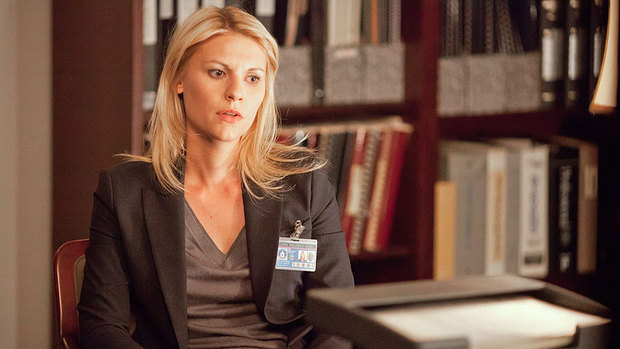
Danes' Carrie Mathison is a complicated character with an undisclosed mood disorder that may actually help her do her job; after all, what kind of sane person could reconcile leading the double life of the spy? Yet her actions are quite horrifying; she installs bugs on the home of a terror suspect, which she has been ordered to take down before she can gather any meaningful intelligence. Isn’t that convenient? Our civil liberties are what come between sniffing out Al Qaeda operatives, who just won’t allow well-meaning if somewhat psychotic spies to do their jobs properly.
The fact Carrie does not lose her job is telling; ultimately, Homeland’s C.I.A. bends the rules a lot. Carrie’s boss Estes is supposedly the “smartest guy in Near East, by a mile,” yet is short-sighted enough to allow a Marine P.O.W., Nick Brody (Damian Lewis), to visit a former jailer who is kept locked up in an interrogation room. Naturally, Brody attacks his former torturer and possibly slips him a razor blade.
There are many other slip-ups by Carrie’s boss, and Carrie herself; she even has a brief affair with said Marine, who she suspects is a sleeper agent. She also manages to inadvertently let it slip she’s been spying on him. All of this suggests that the C.I.A. is a rather sloppy organisation, but such criticism is not blatant in Homeland. Carrie is the rogue genius who might become occaissionally unhinged, but her unorthodox methods are what is needed, and can lead to results.
 But do they really? Not according to interrogation research, which has shown time and again that torture leads to bad intelligence and creates even more terrorists. Yet Homeland embraces torture as a viable tool to get information. The captured Al Qaeda operative is tortured in a C.I.A. cell which is freezing cold (he is undressed), and plays bursts of heavy metal music and blasts strobe lights to unnerve him sufficiently to name names. Just before he is about the provide them with specific information, he manages to commit suicide. The subtext is not missed by the viewer. Geneva conventions be damned, torture works, and an exceptional America must be allowed to practice it.
It is also telling that when innocent Muslim bystanders are shot and killed in a mosque by American law enforcement, the issue is not dealt with; it is understood this will not create an international or even domestic incident. They are Muslims, and therefore expendable; this seems to be the show’s message.
Viewers of the far superior British program The Sandbaggers would likely notice that Homeland is a far less sensitive program. The show’s eponymous “sandbaggers” are a group of British agents who would fit in well in John Le Carre’s The Spy Who Came In From the Cold. They are low-paid civil servants who engage in highly dangerous, and certainly morally ambiguous missions to keep the KGB in check. What was brilliant about this show (and, to some extent, Le Carre in general) was how it questioned the sanity of the Cold War and those who ordered these excursions in the first place. The agency bosses are portrayed as careerists, all too willing to send the sandbaggers on highly dangerous and morally ambiguous missions while they wine, dine, and dream of knighthood.
Expect no such honestly from Homeland, which can admit no such complexity. Nussbaum mentions the program’s “deep characterization.” Certainly, the writers take their time detailing some of Carrie’s family background and inability to sustain romantic relationships. This is to appease critics, who cannot simply criticize the characters as one-dimensional Jack Bauers or James Bonds. It hints at it to woo critics just enough, but it would never go so far as to suggest that there is something rotten about the State Department, whose endorsement of internationally illegal prisons abroad has served to encourage the growth of terror cells and damaged our authenticity when we criticize other nations like China, Syria, and Russia for not respecting civil liberties. The show recently won several Golden Globes, lending even more credibility to the show’s dangerous message that the war on terror can, and should, indulge our “dark side.”
Pamela AuCoin is a freelance journalist living in New York City. She has written investigative articles on the Manhattan real estate market for New York Living magazine, and currently teaches world history and occasionally German in the New York City Department of Education.
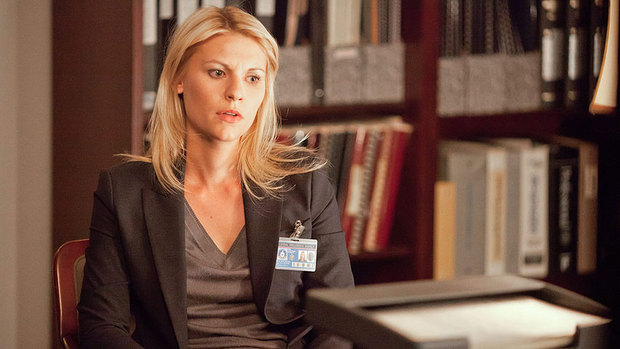
 Right, bipolar disorder. I didn’t mention that, to add some tension spice to Carrie’s character, Homeland makes Carrie suffer really badly from bipolar disorder. Like, it’s so bad that she has to take her meds every day or else she’ll go into a manic tailspin and lose her mind. The poor thing, she can’t even go to a regular doctor for those meds because the C.I.A. would kick her out as a security risk. So, she visits her psychiatrist sister on the down-low for her weekly supply, which translates into even more suspense, and some shame and anxiety to boot; this bipolar thing is paying off big-time and all they had to do was say she has it. Poor Carrie. This is going to be one rough season.
 Don't get me wrong: I don’t suggest Homeland hang itself on the horns of scientific accuracy (or a WebMD search). I just ask that it create a ‘verse where there are laws for Carrie’s condition, and then stick to those laws, like the way Vulcans can or can’t intermarry and the like. (On the other hand, absurdity met ugliness when the showrunners had Carrie, in deep depression, diagnosing herself – with her sister mutely complicit – for electroconvulsive therapy, a.k.a. shock treatment, a controversial, risky, cognition- and memory-impairing but highly photogenic treatment calling for Danes to be strapped and gagged, electrodes glued to her scalp. Then they cranked the juice as her body spasmed grotesquely. If you’re suffering from depression, there are a million other ways to get help – this is just an ignorant TV show by the guys who made the torture-happy 24.)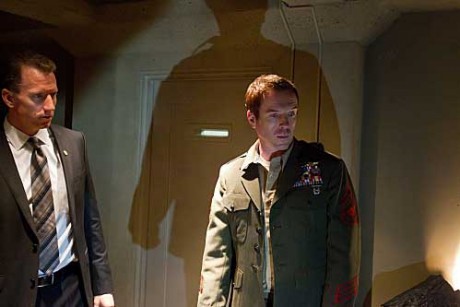



 Press Play Video Blog